Disclosure: airfryerkitchensupply.com is reader-supported. When you buy through links on our site, we may earn an affiliate commission at no extra cost to you.
Where to buy
The under-$200 tier is the most contested ground in stand mixers, and the most mis-sold: wattage numbers are inflated, bowl sizes are quoted generously, and half the listings are colour variants of the same machine. Every pick below was confirmed as a distinct, orderable model in this budget tier. Prices in this bracket move constantly, so use the links to check the current price on Amazon for the exact colour and bundle you want.
- Hamilton Beach 4-Quart Electric Stand Mixer (7 Speed) — check price on Amazon
- Aucma 6.5-Qt Tilt-Head Stand Mixer (660W) — check price on Amazon
- Dash Everyday Stand Mixer (3-Qt) — check price on Amazon
- VIVOHOME 6-Quart Tilt-Head Stand Mixer — check price on Amazon
- Kitchen in the Box 3.2-Qt Stand Mixer — check price on Amazon
- bella 3.5-Qt Hand & Stand Mixer (2-in-1) — check price on Amazon
Shopping for the best stand mixers under 200 dollars means accepting a trade before you start: at this budget you are choosing which compromise you can live with, not avoiding compromise altogether. The machines here give up something — cast-metal weight, bowl capacity, low-speed finesse, or accessory ecosystems — in exchange for a price that leaves money in the baking budget. The good news is that for the work most home kitchens actually do — weekly bread, birthday cakes, cookie dough, whipped cream, mashed potatoes — the compromises on this list are the right ones, and several of these machines will serve for years without making you wish you had spent more.
What the under-$200 tier cannot honestly do is pretend to be a professional bakery. Stiff, low-hydration doughs in full-size batches will strain the lighter machines; double batches of buttercream will not fit the smaller bowls; and a mixer at this price that claims commercial power is telling you a story. We have been specific in every review about where each machine’s ceiling sits, because a budget mixer bought with clear eyes is a tool you will love, while the same mixer bought on inflated promises becomes the appliance you apologise for.
One more piece of honesty about this tier: the number in the search is a budget frame, not a price list. Street prices for these models move with sales, colours, and seasons, and a machine can drift above or below the line depending on the week. Treat ‘under 200’ as the neighbourhood, verify the current figure through the Amazon links, and judge each machine on whether its design suits your baking — that judgement stays true even when a sale price does not.
A final framing note before the picks: prices in this bracket are unusually volatile, because budget mixers are the most promoted appliances in the kitchen category. The same machine can sit comfortably inside the budget one month and drift above it the next without changing at all. We therefore wrote every review to survive price movement — the rankings rest on action, bowl fit, and completeness of kit, so if your finalist’s current figure has wandered slightly, the reasoning still holds and the decision can too.
In this guide
Quick Picks
Six genuinely different budget machines — a planetary workhorse, two compact city-kitchen picks, a big-bowl value play, a tiny first mixer, and a 2-in-1 for cooks who also need a hand mixer.
- Best Overall Under $200: Hamilton Beach 4-Quart Electric Stand Mixer (7 Speed) — true planetary action and a full attachment set at 300 watts — the budget benchmark the others are measured against. — Check on Amazon
- Best Big Bowl on a Budget: Aucma 6.5-Qt Tilt-Head Stand Mixer (660W) — a 6.5-quart bowl and 660-watt motor for batch bakers who outgrew small mixers but not the budget. — Check on Amazon
- Best Compact for Small Kitchens: Dash Everyday Stand Mixer (3-Qt) — a 3-quart, 6-speed tilt-head sized for apartments, dorms, and one-to-two-person baking. — Check on Amazon
- Best Value for Growing Bakers: VIVOHOME 6-Quart Tilt-Head Stand Mixer — 6 quarts of tilt-head capacity aimed at bakers whose recipes are getting bigger faster than their budget. — Check on Amazon
- Best Portable / Lightest Pick: Kitchen in the Box 3.2-Qt Stand Mixer — a lightweight 3.2-quart, 6-speed machine with whisk, hook, and beater for daily small-batch use. — Check on Amazon
- Best 2-in-1 Versatility: bella 3.5-Qt Hand & Stand Mixer (2-in-1) — a detachable hand mixer on a stand with a 3.5-quart bowl — two tools for one budget line. — Check on Amazon
How These Picks Were Chosen
Each model below was cross-checked against Amazon listing data via this site’s provider account: brand-and-model search, title match against the machine we intended to recommend, and only then a purchase link built from the listed ASIN. Colour variants of one model count as one pick — we list the configuration the listed and say so. No ASIN was guessed or borrowed from a review site.
Selection favoured honest engineering over spec-sheet theatre. Planetary mixing action — where the beater orbits the bowl while spinning — mattered more than headline wattage, because coverage is what stops you scraping the bowl every minute. Bowl size was judged against real recipes: a standard sandwich loaf, a double cookie batch, a family cake. We also weighted weight itself: at this tier many buyers store the mixer in a cupboard, so a machine you can lift one-handed-ish has a genuine advantage over a marginally stronger one that lives on the counter because moving it is a chore.
Finally, we required the basics to be complete in the box: beater, whisk, and dough hook, with a splash guard where the design needs one. Budget machines that nickel-and-dime the attachments push their real cost toward the tier above, and we note in each review what is actually included so the comparison stays fair.
We also ran a simple reality filter over the long list before these six survived: any model whose listing could not state its bowl size, speeds, and included attachments plainly was set aside, however enthusiastic its marketing. At this price, a maker who cannot describe the machine clearly rarely supports it clearly either, and budget buyers feel poor support first and worst.
The 6 Best Stand Mixers Under $200

Hamilton Beach 4-Quart Electric Stand Mixer (7 Speed) — Best Overall Under $200
This is the default recommendation for a first stand mixer, and it earns that status the unglamorous way: planetary mixing action that actually reaches around the bowl, seven usable speeds, and all three core attachments — whisk, flat beater, dough hook — plus a splash guard in the box. The 4-quart bowl is the honest size for family baking: a standard loaf, a full cake, a double batch of cookies, without the sloshing a smaller bowl guarantees.
Strengths
- Planetary mixing gives full bowl coverage, so less stopping to scrape than most budget rivals
- Complete attachment set included — whisk, beater, dough hook, and splash guard
- 300-watt motor and 7 speeds cover the realistic home range from folding to whipping
Trade-offs
- Plastic-forward body feels lighter than premium machines and can shift under the stiffest doughs
- 4-quart bowl means large double batches of bread dough are a stretch, not a routine
- Design is functional rather than decorative — it will not anchor a styled kitchen
| Motor | 300 watts (Amazon listing) |
| Bowl capacity | 4 quart |
| Speeds | 7 |
Why does this machine keep winning the budget slot? Because its compromises are in the right places. Hamilton Beach spent the money on the mixing geometry — the beater orbits the bowl, so ingredients at the edge get pulled into the work instead of smearing against the glass — and saved it on housing materials and styling. For the cook, geometry is the part you experience in every recipe; housing is the part you experience in photographs. A budget buyer should always make that trade in this direction.
Its ceiling is equally clear. Feed it a stiff, low-hydration dough at full bowl capacity and you will hear the motor work and see the head flex; the fix is batch discipline — halve the stiffest doughs, let the machine rest between heavy jobs — rather than a bigger purchase. Within family-scale baking, though, it simply does the work, week after week, which is the entire point of the under-$200 tier. If you buy one machine from this list without a specific constraint pushing you elsewhere, buy this one.
Best for: first-time stand mixer buyers and general family baking / Not suited for: frequent bakers of stiff, full-size artisan doughs
Check on Amazon — check the current price on Amazon before you buy, because configurations and included accessories vary by listing.

Aucma 6.5-Qt Tilt-Head Stand Mixer (660W) — Best Big Bowl on a Budget
The Aucma exists for one clear reason: bowl envy. If your baking life is double batches — two loaves, forty-eight cookies, the big cake for the school fair — a 4-quart bowl is a daily frustration, and this machine’s 6.5-quart bowl removes it at a budget price. The tilt-head design keeps it approachable, the stated 660-watt motor gives it headroom on ordinary doughs, and the included dough hook, wire whip, and beater cover the standard repertoire.
Strengths
- 6.5-quart bowl is the largest here — double batches without splitting
- Strong stated motor output for the tier, with headroom on everyday doughs and batters
- Tilt-head access makes scraping, adding, and bowl removal easy for newer bakers
Trade-offs
- Small quantities get lost in the big bowl — a single egg white will not whip properly
- Lighter construction than its size suggests; place it on a stable, grippy surface for stiff mixes
- Accessory ecosystem beyond the included tools is thin compared with the big brands
| Motor | 660 watts (Amazon listing) |
| Bowl capacity | 6.5 quart |
Judge the Aucma as a batch tool and it makes complete sense; judge it as an all-rounder and the big bowl becomes its flaw. Large bowls need enough mixture to engage the beater, so the cook who mostly makes half-recipes and small test bakes will fight it. The cook who doubles everything will feel the opposite: one batch instead of two, one wash-up instead of two, and buttercream or dough in quantities that make the mixer earn its counter space. Know which cook you are before the bowl size seduces you.
A word on the wattage figure: headline watts across this whole category are measured inconsistently, and we treat the Aucma’s number as a claim of intent rather than a guarantee. What matters practically is that owners put it to work on pizza dough, enriched doughs, and large cookie batches — the realistic budget workload — and its value case rests on capacity per dollar, which is where it genuinely leads this list. Pair it with batch discipline on the stiffest doughs and it is the volume buyer’s pick.
Best for: batch bakers who routinely double recipes / Not suited for: small households making half-batches and single whites
Check on Amazon — check the current price on Amazon before you buy, because configurations and included accessories vary by listing.

Dash Everyday Stand Mixer (3-Qt) — Best Compact for Small Kitchens
Small kitchens do not need small ambitions; they need honest sizing. The Dash Everyday is built for the baker with a galley counter and a cupboard, not a baking station: a 3-quart stainless bowl, six speeds, and a footprint that stores away without a furniture rearrangement. It handles the everyday repertoire — pancakes, a single cake layer batch, whipped cream, a small loaf — in quantities matched to one or two people, which is precisely the food its buyers actually make.
Strengths
- Genuinely compact and light — stores in a cupboard and comes out without a struggle
- 3-quart bowl is correctly sized for small households, so small batches mix properly
- Simple 6-speed control keeps it approachable for first-time bakers
Trade-offs
- Capacity ceiling is real: family-size and double batches are out of scope
- Not the tool for stiff bread doughs beyond small, soft recipes
- Feels like a starter machine because it is one — keen bakers may outgrow it within a couple of years
| Bowl capacity | 3 quart |
| Speeds | 6 |
There is a quiet virtue in a mixer whose bowl matches its motor and its audience. Oversized budget machines whip single egg whites badly and cream small amounts of butter worse; the Dash’s modest bowl means the beaters engage small quantities properly, which is the difference between a machine that gets used three times a week and one that disappoints twice and gets donated. For students, first flats, camper kitchens, and grandparents baking for two, that fit matters more than any spec race.
Be clear-eyed about the ceiling, though. This is not the mixer for a sourdough habit or a December cookie marathon, and pushing stiff dough through it repeatedly is how budget motors die young. Treat it as the right-sized tool for everyday small baking and it will repay you in the only currency that matters at this price: frequent, uncomplicated use. When your baking outgrows it, it graduates gracefully to a second home, a holiday let, or a teenager’s first kitchen.
Best for: apartments, small households, and first kitchens / Not suited for: family batch baking or regular bread dough
Check on Amazon — check the current price on Amazon before you buy, because configurations and included accessories vary by listing.

VIVOHOME 6-Quart Tilt-Head Stand Mixer — Best Value for Growing Bakers
The VIVOHOME pitches itself at the in-between baker: past the starter stage, regularly feeding a family or a bake sale, not ready to spend premium money. Its 6-quart bowl sits near the top of this list for capacity, the tilt-head keeps operation simple, and the whole proposition is capacity-first value — the machine for the cook whose most common sentence is ‘I need to double that.’
Strengths
- 6-quart bowl handles family batches and doubling without drama
- Straightforward tilt-head operation with the standard attachment set for everyday baking
- Value positioning leaves budget room for ingredients, pans, and a second bowl habit later
Trade-offs
- Refinement lags the Hamilton Beach — expect more scraping and less polished speed control
- Brand support and accessory availability are thinner than the legacy names
- Like all big budget bowls, small batches under-engage the beater
| Bowl capacity | 6 quart |
| Design | Tilt-head |
Compare this machine directly with the Aucma if capacity is your driver: both chase the big-bowl budget buyer, and the choice comes down to the configuration and current pricing on the day you buy — which is why we link both and tell you to check the current price on Amazon rather than declaring a permanent winner. The VIVOHOME’s case is straightforward value: a lot of bowl, a simple control scheme, and enough motor for the soft-to-medium workloads that make up most home baking.
Its limits are the budget tier’s usual ones, slightly more visible: fit and finish are workmanlike, the low end of the speed range is less delicate than a keen baker would like for folding, and long-term accessory hunting takes more effort than with KitchenAid or Hamilton Beach. None of that disqualifies it for its intended buyer. If your baking is growing and your budget is not, this is a rational, honest step up — bought with clear expectations, it will not disappoint.
Best for: growing family bakers who need capacity on a budget / Not suited for: bakers who value finesse, finish, and deep accessory support
Check on Amazon — check the current price on Amazon before you buy, because configurations and included accessories vary by listing.
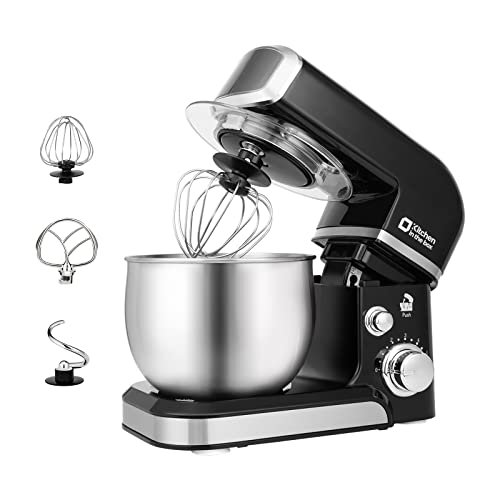
Kitchen in the Box 3.2-Qt Stand Mixer — Best Portable / Lightest Pick
Some buyers’ first question is not power but lifting: can I get it out of the cupboard without thinking twice? The Kitchen in the Box mixer is the lightest direction on this list, a 3.2-quart, 6-speed machine explicitly positioned as portable and lightweight, with the egg whisk, dough hook, and flat beater included for daily use. For older bakers, small flats, and anyone whose mixer must travel between cupboard and counter, that ease of handling is not a minor feature — it is the feature that decides whether the machine gets used at all.
Strengths
- Lightweight build makes cupboard storage genuinely practical
- Full basic attachment set included despite the small size
- Six speeds cover daily tasks: eggs, batters, cream, soft doughs
Trade-offs
- Small bowl and light frame cap it at small, softer workloads
- Stiff doughs and large batches are outside its design brief
- Less planted on the counter — keep a hand nearby during heavier mixes
| Bowl capacity | 3.2 quart |
| Speeds | 6 |
Put this machine beside the Dash and the choice is about emphasis: the Dash is the compact all-rounder for small kitchens, while the Kitchen in the Box leans harder into portability and daily light duty. Its design brief — daily use, small quantities, easy handling — matches a real and underserved buyer: the person who bakes a small cake on Sunday, whips cream on Friday, and wants the machine back in the cupboard by the time the washing-up is done.
The discipline it demands is honesty about load. Soft doughs in small quantities, yes; a full-size stiff loaf, no. Work within that brief and the light frame stops being a compromise and becomes the point. It is also a sensible gift purchase — for a first flat, a student kitchen, or a parent downsizing — because it asks nothing of the recipient except a cupboard shelf, and gives back a complete little baking station.
Best for: anyone who must lift and store the mixer after every use / Not suited for: bread bakers and batch bakers
Check on Amazon — check the current price on Amazon before you buy, because configurations and included accessories vary by listing.

bella 3.5-Qt Hand & Stand Mixer (2-in-1) — Best 2-in-1 Versatility
The bella splits the difference that budget buyers argue about most: hand mixer or stand mixer? Its motor unit works on the stand with the 3.5-quart bowl for hands-free creaming and whipping, then detaches for the jobs a stand mixer does badly — mashed potatoes in the pot, a quick batter in a different bowl, whipped cream in the jug you will serve from. For a first kitchen equipping itself from zero, that two-tools-in-one logic is hard to beat at this tier.
Strengths
- Detachable hand-mixer mode covers in-pot and any-bowl jobs no stand mixer reaches
- Stand mode gives hands-free mixing for creams, batters, and frostings
- One purchase equips a new kitchen with both mixing formats
Trade-offs
- Neither mode matches a dedicated machine: the stand is lighter-duty, the hand unit heavier than a basic hand mixer
- 3.5-quart bowl caps batch size at small-family level
- Dough work is limited to soft, small recipes — this is not a bread machine in disguise
| Bowl capacity | 3.5 quart |
| Design | 2-in-1 hand and stand |
The honest way to judge a 2-in-1 is by the second tool’s usefulness, and here it is real: a large share of everyday mixing is not bowl-shaped. Soup-pot mashing, a dressing whisked in its serving jug, egg whites in the copper bowl you already own — a pure stand mixer watches all of that from the counter. The bella handles both worlds adequately, and adequate in both worlds beats excellent in one and absent in the other for a cook building a kitchen on a budget.
Where it will not follow you is into serious baking volume. Frosting for a crowd, double cookie batches, and regular dough all want a dedicated, heavier stand mixer, and the bella’s stand mode will feel its limits there first. Buy it as the versatile foundation of a small kitchen, enjoy the hand-mixer freedom daily, and let a future dedicated machine — perhaps from the top of this list — arrive when your baking actually demands it. That is a sensible two-step path, not a compromise to apologise for.
Best for: first kitchens wanting hand and stand mixing in one purchase / Not suited for: high-volume or dough-focused bakers
Check on Amazon — check the current price on Amazon before you buy, because configurations and included accessories vary by listing.
Comparison Table
| Pick | Badge | Key spec | Best for |
|---|---|---|---|
| Hamilton Beach 4-Quart Electric Stand Mixer (7 Speed) | Best Overall Under $200 | 4-qt planetary, 300W, 7 speeds | first-time stand mixer buyers and general family baking |
| Aucma 6.5-Qt Tilt-Head Stand Mixer (660W) | Best Big Bowl on a Budget | 6.5-qt tilt-head, 660W claimed | batch bakers who routinely double recipes |
| Dash Everyday Stand Mixer (3-Qt) | Best Compact for Small Kitchens | 3-qt compact tilt-head, 6 speeds | apartments, small households, and first kitchens |
| VIVOHOME 6-Quart Tilt-Head Stand Mixer | Best Value for Growing Bakers | 6-qt tilt-head value pick | growing family bakers who need capacity on a budget |
| Kitchen in the Box 3.2-Qt Stand Mixer | Best Portable / Lightest Pick | 3.2-qt lightweight, 6 speeds | anyone who must lift and store the mixer after every use |
| bella 3.5-Qt Hand & Stand Mixer (2-in-1) | Best 2-in-1 Versatility | 3.5-qt 2-in-1 convertible | first kitchens wanting hand and stand mixing in one purchase |
The table hides the real decision, which is bowl size versus batch size: pick the smallest bowl that fits your largest regular recipe, because small bowls mix small quantities better and big bowls only earn their keep when you fill them. Then check weight if the machine must be stored, and planetary action if you hate scraping.
How to Choose a Stand Mixer Under $200
Spend on mixing action, not wattage theatre
Wattage is the most abused number in this category: brands quote peak draw, locked-rotor figures, or plain optimism, and none of it tells you how the machine mixes. What you can judge is the action. Planetary designs orbit the beater around the bowl, pulling ingredients from the edges into the work; simpler designs spin in place and leave a smear of unmixed butter at the wall that you must scrape down repeatedly. Over a year of baking, that difference is worth more than any wattage claim on the box.
Speed count deserves the same scepticism. Seven well-spaced speeds beat twelve bunched ones, and the low end matters most: a gentle first speed folds flour without a dust cloud, while a lurching start decorates the counter. When a listing tells you speeds and action plainly — as the Hamilton Beach listing does — that honesty is itself a buying signal.
Match bowl size to your real recipes
Write down the three things you bake most and size the bowl to the largest. A 3 to 3.5-quart bowl is correct for one-to-two-person baking and mixes small quantities properly; 4 quarts is the family all-rounder; 6 quarts and up only make sense if doubling is your habit. Oversizing is the silent budget-mixer mistake: the beater cannot engage a small amount in a cavernous bowl, egg whites refuse to whip, and you conclude the machine is bad when the match was.
Material matters less than fit at this price. Stainless bowls are light and durable; glass bowls let you watch the bottom of the mix but add weight and breakability. Either is fine — what matters is that the bowl locks firmly to the base, because a budget machine with a wobbling bowl walks, rattles, and eventually teaches you to hold it with one hand, at which point it has stopped being a stand mixer.
Weight, storage, and the cupboard test
Premium mixers live on counters; budget mixers often live in cupboards, and that changes what ‘good’ means. If your machine must be lifted out for every bake, its weight is a performance spec: a lighter machine you use weekly beats a heavier, stronger one you avoid moving. Measure the cupboard shelf and the counter footprint before ordering, and be honest about whether a tilt-head can open beneath your wall cabinets.
Carry handles, compact footprints, and detachable designs (the bella’s hand-mixer mode, the Kitchen in the Box’s light build) are not gimmicks at this tier — they are the difference between a mixer that fits your kitchen’s real life and one that fits its photographs. Choose for the kitchen you have.
Where the budget ceiling really is
Under $200 buys honest family baking: cakes, cookies, frostings, whipped cream, soft-to-medium doughs in sensible batches. It does not buy commercial duty cycles, cast-metal heirloom weight, or indifference to stiff dough. That is not a failure of these machines; it is the physics of the price. The bakers who are happy with budget mixers for a decade are the ones who match the workload to the tool — halving the stiffest doughs, resting the motor between heavy jobs, and letting the machine do the hundred ordinary tasks it is good at.
If your baking is outgrowing this tier — weekly artisan loaves, wedding-scale buttercream, a side business — the correct move is saving toward the tier above, not buying the most inflated claim inside this one. Check the current price on Amazon for your shortlist on the day you buy; this bracket is sale-driven, and the best-value pick rotates with the discounts.
Reading a budget listing like an engineer
Budget listings reward a specific reading skill. Separate the machine’s facts (bowl size in quarts, speeds, included attachments, mixing action) from its adjectives (powerful, professional, heavy-duty), because at this tier the adjectives are unregulated and the facts are where the value hides. Check whether the bowl size quoted is the bowl’s brim capacity or its working capacity — the working figure is always smaller, and recipes care about the working one. Confirm the dough hook is actually in the box if bread matters to you; ‘hook available’ and ‘hook included’ are different sentences with different endings for your wallet.
Finally, read the questions-and-answers section of any listing you shortlist. Owners answer the things brochures omit — whether the head locks, whether the bowl wanders, whether the low speed is gentle — and at this price those lived details are worth more than another hundred claimed watts.
Making a Budget Mixer Last: The Care Habits That Matter
Budget mixers rarely die from age; they die from three habits. The first is dough overload — stiff, low-hydration dough at full capacity, run until the motor smells hot. Halve those batches and the same machine lasts for years. The second is the lurch start: engaging a high speed in a full bowl of flour, which shocks the gears and paints the kitchen. Start low, let the mixture come together, then climb. The third is storage neglect — attachments lost in a drawer, the bowl used as a general mixing bowl and dented, the machine put away damp. None of these require money to fix, only attention.
A simple rhythm helps: wash and dry attachments the day you use them, store the whisk inside the bowl so the set stays together, and give the machine a rest between heavy jobs on marathon baking days. Once a season, check the beater-to-bowl clearance if your model allows adjustment, because a beater that has drifted high leaves the tell-tale unmixed stripe at the bowl’s bottom. These are five-minute habits that separate the budget mixer still working in year eight from the one replaced in year two.
The Second-Bowl Effect at Budget Prices
Ask experienced budget-mixer owners what transformed their baking and few will name the machine itself; they name the second bowl. At this tier a spare bowl costs a fraction of the mixer, yet it converts the whole workflow from serial to parallel: dough proofing in one bowl while the beater creams in the other, meringue holding while batter mixes, a chilled spare waiting for whipped cream. The effect is largest exactly where the budget is smallest, because a sub-$200 mixer cannot buy its way out of a bottleneck with power — but a second bowl routes around the bottleneck entirely.
Before ordering any machine on this list, check two things: that a spare bowl exists for that exact model, and what it costs. On some budget lines the spare is easy and cheap; on others it is effectively unavailable, which quietly caps the machine’s usefulness for batch bakers. Fold that answer into the comparison the way you would a missing dough hook — it is part of the real price of the real workflow, and it is the detail most budget reviews never mention.
What Breaks First, and What It Costs You
Budget mixers rarely die dramatically; they fade. The whisk wires loosen, the beater’s coating chips where it meets the bowl, a speed setting goes intermittent, the bowl lock wears until the bowl can turn under load. Knowing the fade order changes ownership: attachments are consumables to be replaced without resentment, the bowl lock is a reason to stop forcing stiff doughs, and intermittent speeds are the signal to plan a successor rather than to nurse the machine through a December of baking. Owners who expect this arc get five to ten good years from this tier; owners who expect cast-iron immortality at this price write the angry reviews.
A Note on Gifting a Budget Stand Mixer
Budget stand mixers are gifted constantly — weddings, first flats, graduations — and the gift context changes the right choice. A recipient who has never owned one values completeness and forgiveness over ceiling: the full attachment set in the box, a bowl sized to ordinary recipes, and controls that cannot be set disastrously. That points gift-buyers toward the middle of this list rather than its extremes of size or specialisation. Include the receipt’s flexibility where you can, because the one variable no guide can know is the recipient’s counter — its height, its cupboards, its owner’s lifting comfort. A well-chosen budget mixer is a decade-long presence in someone’s kitchen; choosing it with their kitchen in mind, rather than your own baking ambitions, is the difference between a gift that anchors a counter and one that anchors a cupboard’s back corner.
How to Get the Best Results from a Budget Stand Mixer
Budget machines reward technique more than premium ones do. These steps close most of the gap between a budget mixer and a premium one, using the recipes home bakers make most.
Step 1: Bring ingredients to the right temperature
Room-temperature butter creams properly; cold butter defeats a budget motor and leaves lumps no amount of beating fixes. Eggs whip higher at room temperature too. Thirty minutes of staging before you switch on is worth more than a hundred extra watts.
Step 2: Start slow, always
Engage the lowest speed whenever flour, cocoa, or icing sugar is in the bowl, and let it incorporate before climbing. This keeps the batch in the bowl, protects the gears from shock loads, and prevents the flour-cloud that makes new bakers think stand mixers are messy by nature.
Step 3: Scrape once, deliberately
Plan a single mid-mix scrape with the machine off: bowl walls, bottom centre, and the beater itself. One deliberate scrape beats five anxious ones, and planetary machines like the Hamilton Beach need it least — but every budget mixer needs it once on butter-heavy recipes.
Step 4: Respect the dough ceiling
For bread, stay with soft-to-medium doughs at sensible batch sizes, and let the hook work at low speed. If the head flexes, the body rocks, or the motor note strains, split the batch. The machine is giving you information; the bakers who listen keep their mixers.
Step 5: Whip in a clean, dry bowl
Egg whites and cream whip best in a bowl free of grease film. A quick wipe with a drop of vinegar on a paper towel before whipping whites is an old baker’s trick that costs nothing and rescues marginal whips on any machine.
None of these steps require the expensive machine — they require the baker’s attention, which is why skilled cooks produce excellent results from this entire list. Master the habits on a budget mixer and they transfer upward forever; skip them on a premium mixer and the results stay ordinary at any price.
Common Buying Mistakes
Chasing the biggest wattage number
Peak-watt claims are marketing, not mixing. Buyers who choose by the largest number often end up with a worse action, a noisier machine, and the same real-world performance as the honest 300-watt planetary pick.
Oversizing the bowl ‘just in case’
The just-in-case bowl ruins everyday small batches: whites will not whip, small butter amounts smear and hide. Size for your regular recipes and borrow or batch for the rare giant one.
Assuming under $200 means disposable
Treating a budget mixer as disposable leads to the dough overloads and lurch starts that kill it. These machines last for years under matched workloads — the price buys a workload ceiling, not an expiry date.
Ignoring what is in the box
A cheap machine missing its dough hook or whisk is not cheap once the attachments are bought separately. Compare complete kits, not headline prices.
Storing it somewhere you will not fetch it from
A mixer in a high cupboard or a garage is a mixer you stop using. If storage is awkward, choose the lighter or convertible designs deliberately — convenience is a performance feature.
Believing the box’s serving claims
Listings that promise a small mixer will knead dough for a crowd are describing a theoretical maximum, not a Tuesday. Trust the bowl-size-to-recipe matching in this guide over any serves-twelve banner on a 3-quart machine.
Final Recommendation
For most buyers the Hamilton Beach 4-Quart is the under-$200 answer: planetary action, complete attachments, honest sizing. Batch bakers should take the Aucma’s big bowl or the VIVOHOME’s value capacity; small kitchens the Dash or the Kitchen in the Box; new kitchens wanting both formats, the bella 2-in-1.
Check the current price on Amazon for your finalist before deciding — in this tier the best value genuinely changes with the week’s pricing, and the machine that is second on paper is often first at the till.
The shortlist in one line: Hamilton Beach 4-Quart Electric Stand Mixer (7 Speed), Aucma 6.5-Qt Tilt-Head Stand Mixer (660W), Dash Everyday Stand Mixer (3-Qt), VIVOHOME 6-Quart Tilt-Head Stand Mixer, Kitchen in the Box 3.2-Qt Stand Mixer, bella 3.5-Qt Hand & Stand Mixer (2-in-1).
Keep exploring the cluster: Best Stand Mixers For Wedding Cake Making Best Stick Mixers Best Affordable Stand Mixers Best Hand Mixers Best Starter Mixers
Frequently Asked Questions
Can a stand mixer under $200 handle bread dough?
Yes, within limits: soft-to-medium doughs in single-loaf batches are fine on the stronger picks here. Stiff, low-hydration doughs at full capacity strain budget motors — halve those batches and the machine will last.
What bowl size is best for a family of four?
Four quarts is the sweet spot: it covers standard loaves, cakes, and double cookie batches while still mixing smaller quantities properly. Go to six quarts only if doubling is your routine.
Is planetary mixing action worth prioritising?
Yes — it is the single biggest quality-of-life feature at this price, because it pulls ingredients from the bowl walls into the mix and cuts scraping dramatically compared with in-place spinning designs.
How long should a budget stand mixer last?
With matched workloads and basic care, years of regular use. The killers are dough overload, lurch starts with dry ingredients, and neglect — all avoidable habits rather than price-tier destiny.
Stand mixer or hand mixer on a tight budget?
If you bake cakes, frostings, and doughs, the stand mixer’s hands-free power wins. If your mixing is mostly in-pot and small jobs, consider the 2-in-1 bella on this list, which covers both formats in one purchase.
Why do prices for the same mixer vary so much?
Colour, bundle, and sale cycles. The machine is identical; the listing configuration is not. Always compare the complete kit — bowl, beaters, guard — at the current price, not the headline figure alone.
Are budget stand mixers loud?
Generally louder than premium machines, because lighter housings and simpler gearing transmit more sound. It is a kitchen-appliance loud, not a problem loud — but if you bake early in a sleeping household, the lighter plastic machines are the most noticeable.
Can I leave a budget mixer on the counter permanently?
Yes, and most owners do — just confirm the tilt-head can open beneath your cabinets, or slide the machine forward for use. Counter storage also solves the lifting problem that makes cupboard-stored mixers go unused.


