Disclosure: airfryerkitchensupply.com is reader-supported. When you buy through links on our site, we may earn an affiliate commission at no extra cost to you.
Where to buy
Every pick below for the best meat grinders under 200 dollars is a verified, live Amazon listing matched to the exact model described. The six machines here were placed in the under-$200 tier using catalog data at the time of verification — but prices in this category move, and the only price that matters is the one on the listing today, so check it before ordering. Attachment products are labeled as attachments, plainly, wherever they appear.
- Weston #12 Electric Meat Grinder & Sausage Stuffer (33-1301-W) — the #12 workhorse — a 750-watt, 1 HP motor driving a #12 head rated at 4 pounds per minute, with stainless plates included.
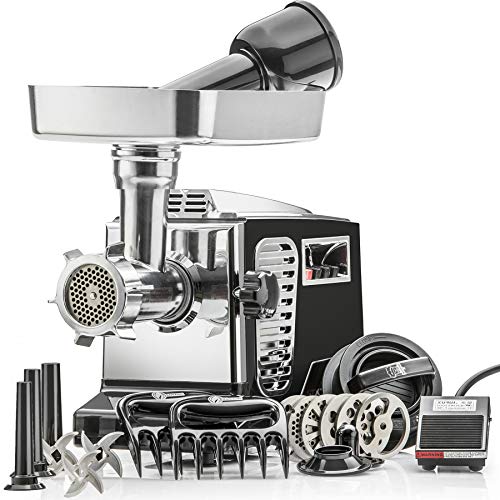
- STX International Turboforce 3000 Series 6-in-1 Electric Meat Grinder — the kit champion — five grinding dies, three stainless blades, sausage and kubbe attachments, and a juicer, in one 3-speed package.
- Sunmile SM-G50 ETL Electric Meat Grinder — the sensible middle — metal gears, a reverse function, a circuit breaker, and stainless blade and plates in an ETL-listed machine.
- STX International Turboforce Cadet 2000 Series Electric Meat Grinder — the Cadet — STX’s 5-in-1 system with four grinding plates, sausage stuffer, and kubbe maker at a friendlier tier than its big sibling.
- LEM #8 Countertop Meat Grinder, 575 Watt — the compact specialist’s pick — a 575-watt #8 countertop grinder from LEM, the game-processing specialist, in an aluminum body.
- Cuisinart Electric Meat Grinder (MG-100) — the household-name pick — Cuisinart’s stainless steel standalone grinder for everyday home batches.
Shopping for the best meat grinders under 200 dollars means shopping in the tier where home grinding becomes genuinely good. Below this budget you find hand-crank novelties and underpowered motors that smear fat and stall on sinew; at this tier you find real electric machines — #8 and #12 grinder heads, metal gears, reverse functions, sausage stuffing kits — that turn a pork shoulder or a deer trim pile into clean, cold, properly textured ground meat. The six verified picks below all sit in this tier by catalog price at verification, and they split into clear camps: the #12 workhorses, the accessory-rich all-rounders, and the compact #8 machines for smaller batches.
Why grind at home at all? Control and freshness. You choose the cut, the fat ratio, and the grind size; the meat is ground cold, once, minutes before cooking, instead of sitting as pre-ground product of mixed provenance. Burgers taste like the chuck you put in. Sausage becomes a hobby with an entry fee under two hundred dollars. For hunters, a grinder in this tier handles a season’s trim and burger blending without the rental queue at the processor. The machines below were chosen for metal where it matters — gears, plates, knives — because grinding is torque work and plastic drivetrains are where cheap grinders go to die.
Two honesty notes that shape this guide. First, the tier placement uses catalog prices captured at verification, and this category’s prices move — a machine can drift across the $200 line in either direction, so the listing, not this page, is the authority at purchase time. Second, a famous brand is absent from the picks for a factual reason: KitchenAid sells no standalone meat grinder, only stand-mixer attachments (the metal KSMMGA and its siblings), which are excellent if you own the mixer but are not standalone grinders — they are discussed honestly in the buying guide below rather than smuggled into the rankings.
In this guide
Quick Picks
Six verified standalone grinders in the under-$200 tier: two #12 workhorses, two all-rounders, and two compact #8 machines.
- Best Overall: Weston #12 Electric Meat Grinder & Sausage Stuffer (33-1301-W) — the most grinder this budget buys — #12 throughput from a brand built on game processing.
- Best Accessory Kit: STX International Turboforce 3000 Series 6-in-1 Electric Meat Grinder — buy it for the box contents — no rival in the tier includes this much grinding hardware.
- Best Mid-Tier All-Rounder: Sunmile SM-G50 ETL Electric Meat Grinder — the grown-up mid-tier pick — metal drivetrain and electrical safety features the flashier rivals skip.
- Best Value 5-in-1: STX International Turboforce Cadet 2000 Series Electric Meat Grinder — most of the Turboforce idea for less money — four plates and the stuffing kit intact.
- Best Compact Brand-Name: LEM #8 Countertop Meat Grinder, 575 Watt — the smallest footprint here, from the most specialized brand — for small batches done properly.
- Best Mainstream Brand: Cuisinart Electric Meat Grinder (MG-100) — for buyers who want a familiar kitchen brand’s standalone grinder at the tier’s friendly end.
How These Picks Were Chosen
Tier placement was done with catalog prices at verification time — used internally only, never printed as product prices in the reviews, because the figure on the listing today is the only honest one. Brand accuracy was policed in both directions: every pick is the standalone machine its name claims, and one frequently invented product — a standalone meat grinder sold under the Chef’s Choice brand — does not exist and appears nowhere in this guide.
Picks had to be standalone electric grinders with metal cutting plates and knives, a reverse function or the torque not to need one, and a sausage stuffing capability, because under-$200 buyers overwhelmingly grind for burgers and sausage. We spread the list across the tier deliberately: the strongest #12 machines at the top of the budget, the accessory-rich mid-tier, and compact #8 machines at the friendliest prices, so the guide maps the whole tier rather than six versions of the same machine.
Safety and workload honesty also shaped the list. Grinder size numbers (#8, #12) describe the head and plate diameter — and therefore throughput — and the reviews use them properly instead of treating them as model-name decoration. Where a machine’s marketing wattage (a peak figure) differs from its working character, the reviews say so and judge the machine by its head size, gearing, and reputation instead.
The verification process also produced a small museum of exclusions worth reporting. Hand-crank grinders were left out because this tier’s buyers are shopping for electric throughput, and the cranks have their own honest place elsewhere. Mixer attachments were excluded from the rankings for the reason stated in the guide — they are not standalone machines — and a number of aggressively marketed no-name electrics were excluded because their listings could not substantiate metal drivetrains or replaceable plates, the two features this guide treats as non-negotiable. What remains is six machines whose identities, formats, and tier placement could be verified end to end. In a category thick with invented wattage and borrowed brand names, that verification is not bureaucratic caution; it is the product this guide actually sells.
The 6 Best Meat Grinders Under 200 Dollars

Weston #12 Electric Meat Grinder & Sausage Stuffer (33-1301-W) — Best Overall
The Weston #12 is what the under-$200 tier is for. A #12 head is the threshold where home grinders stop being slow: the larger plate diameter and throat move meat at the listing’s rated four pounds per minute, which turns a ten-pound batch of burger blend from a half-hour vigil into a few minutes of feeding the tray. The 750-watt, 1 HP motor behind it is a working rating from a company whose business is game and harvest processing, and the machine behaves like it — steady under load, unbothered by the fat-and-sinew mix of real trim.
The details are the brand’s usual competence. Stainless steel grinding plates come in the box, the die-cast aluminum body keeps the machine liftable without feeling tinny, and sausage stuffing is a designed function rather than an afterthought, with Weston’s wider catalog of plates, knives, and stuffing accessories available as your ambitions grow. For hunters, this is the pick that processes a deer season at home; for burger households, it is the pick that makes grinding a non-event.
It spends nearly the whole budget to do it, and shoppers should know the tier’s edge is real — check the current price on Amazon, because this model lives close to the line. It is also a substantial appliance to store. But measured as capability per dollar at the moment of verification, nothing else in this roundup touches it: this is the most standalone grinder the under-$200 tier contains.
Strengths
- #12 head grinds at a genuine 4 lbs per minute — batch work goes fast
- Weston is a game-processing brand; the machine is built for seasons, not demos
- Stainless plates included, and the accessory ecosystem is deep and available
Trade-offs
- Top of the tier pricing — it uses nearly the whole $200 budget
- Die-cast aluminum body is lighter than all-steel rivals, though durable
- Size and weight make it a store-it-properly appliance, not a drawer tool
| Grinder size | #12 head |
| Motor | 750 watts, 1 HP |
| Rate from listing | Grinds 4 lbs per minute |
| Plates | Stainless steel grinding plates included |
| Body | Die-cast aluminum |
Best for: hunters, batch grinders, and burger households that grind weekly / Not suited for: tiny kitchens or once-a-year grinders
Check the current price on Amazon

STX International Turboforce 3000 Series 6-in-1 Electric Meat Grinder — Best Accessory Kit
The Turboforce 3000’s argument arrives in the box: five grinding dies spanning coarse chili grind to fine, three stainless steel cutting blades, a sausage stuffer, a kubbe maker, and a juicer attachment — a kit that would cost a meaningful fraction of the machine’s price to assemble separately. For the cook who grinds meat and immediately wants to stuff sausage, form kubbe, and experiment with textures, this is the tier’s most complete starting point, and its three-speed control supports that range, from deliberate stuffing pace to full grinding speed.
A word about the headline wattage, because this guide does not repeat marketing arithmetic as fact: 3000 watts is a maximum peak figure, not the machine’s sustained working power, and no home grinder in this tier sustains anything near it. Judged by what it actually does — steady grinding of ordinary batches, clean cuts with its sharp multi-blade setup, and competent stuffing — the STX performs as a strong mid-tier machine, which is the honest basis on which it earns this badge.
The kit’s abundance is also its cost: more dies, blades, and attachments mean more washing, more drying, and more small parts to keep together. Owners who grind one texture of burger forever will use a third of the box. Owners who cook widely will use all of it and consider this the best-value purchase in the roundup. Know which cook you are, and the decision makes itself.
Strengths
- Five grinding dies and three blades — the deepest kit in the tier, full stop
- Kubbe maker and sausage stuffer included for cooks who will actually use them
- Three speeds give control across grinding, stuffing, and softer jobs
Trade-offs
- The 3000W figure is a locked-rotor peak, not working power — judge it by results
- More parts means more washing and more storage to organize
- Accessory breadth trades against the Weston-style single-purpose focus
| System | 6-in-1 electric meat grinder |
| Power note | 3000W max (peak) rating |
| Speeds | 3-speed control |
| Included | 5 grinding dies, 3 stainless steel blades, sausage stuffer, kubbe maker, juicer |
Best for: sausage makers, kubbe cooks, and experimenters who want every die size / Not suited for: single-texture burger grinders who want minimal parts
Check the current price on Amazon

Sunmile SM-G50 ETL Electric Meat Grinder — Best Mid-Tier All-Rounder
The SM-G50 is the machine this guide would hand to a buyer who asked for the sensible one. Its virtues are structural: metal gears instead of plastic in the drivetrain — the single most predictive feature of grinder longevity — a reverse function that walks a jam back out instead of forcing a teardown mid-batch, and a circuit breaker that protects the motor when a tough piece of sinew asks too much. It is ETL listed, a detail shoppers skip and electricians do not. The stainless cutting blade and plates are the correct materials in the correct places.
In the work itself, the Sunmile is a calm, capable mid-tier grinder. Ordinary batches of beef, pork, and poultry move through at a comfortable pace, the cut quality is clean rather than smeared when the meat is properly chilled — the technique every grinder demands — and the included sausage stuffer covers the second job most buyers grow into. It has been sold for years in substantially this form, which in this category is its own kind of review.
It will not out-grind the Weston #12 on throughput or out-include the STX on accessories, and its styling is honest appliance rather than countertop jewelry. Its peak-power headline deserves the same discount applied to every rival here. But for the buyer who wants the drivetrain and safety engineering right and the drama absent, the SM-G50 is the tier’s most defensible purchase.
Strengths
- Metal gears — the drivetrain choice that decides a grinder’s lifespan
- Reverse function clears jams without disassembly
- Circuit breaker and ETL listing: electrical safety taken seriously
Trade-offs
- Accessory kit is the essentials, not the STX’s abundance
- Design and finish are utilitarian
- Peak horsepower figures, as with all rivals, flatter the working reality
| Power note | 1000W / max 1.3 HP rating |
| Drivetrain | Metal gears |
| Features | Reverse function, circuit breaker |
| Cutting parts | Stainless steel blade and plates |
| Certification | ETL listed |
Best for: regular home grinders who value durability and safety engineering / Not suited for: maximum-throughput hunters or accessory collectors
Check the current price on Amazon

STX International Turboforce Cadet 2000 Series Electric Meat Grinder — Best Value 5-in-1
The Cadet 2000 is STX’s value expression of the same idea as its bigger sibling: a multi-function home grinder sold as a system. Four grinding plates span the textures home cooking actually uses — coarse for chili and sausage, medium for burgers, fine for emulsified products — and the sausage stuffer and kubbe maker are in the box, so the second and third hobbies this machine enables cost nothing extra to start. For a first-time grinder buyer who is not sure how deep the hobby goes, that completeness at a friendly tier is a well-judged package.
Performance is home-scale and honest about it. The Cadet handles the standard repertoire — a few pounds of burger blend, a sausage session, chicken for pet food or patties — with the clean cutting that sharp stainless plates deliver, provided the meat goes in cold and partially firmed, as every grinder prefers. It is sized and built for the household cadence: weekend batches, not a whole season in an afternoon.
Buyers with hunting-season ambitions should step up to the Weston #12, and kit maximalists to the Turboforce 3000. The Cadet’s place is the wide middle: households that grind regularly but moderately, want the stuffing option open, and would rather keep part of the budget for the meat itself. In that role it is one of the easiest recommendations in this tier.
Strengths
- Four grinding plates cover the texture range most cooks actually use
- Sausage and kubbe capability included at a value tier
- Same STX system logic as the 3000, simplified where it is safe to simplify
Trade-offs
- One plate and a few extras fewer than the Turboforce 3000 kit
- Home-use design brief — batch sizes should stay moderate
- Peak-power marketing applies here too; judge by head and results
| System | 5-in-1 electric meat grinder |
| Included | 4 grinding plates, sausage stuffer, kubbe maker |
| Cutting parts | Stainless steel |
Best for: first-time grinder owners and moderate, regular home use / Not suited for: season-scale game processing
Check the current price on Amazon

LEM #8 Countertop Meat Grinder, 575 Watt — Best Compact Brand-Name
LEM builds equipment for people who process game and harvests for a living-adjacent hobby, and this little #8 countertop grinder is the bottom rung of that serious ladder. The #8 head defines it: smaller plate, smaller throat, a deliberate pace — matched to small batches ground well rather than large batches ground eventually. The 575-watt motor and aluminum body keep the whole machine compact and light enough to live in a cupboard and come out for a few pounds at a time, which is how most households actually grind.
The specialist-brand advantage is the ecosystem. LEM’s catalog of plates, knives, stuffing tubes, and accessories is deep, standardized, and actually available years later — the difference between an appliance and a system. A buyer who starts here and catches the sausage-making or game-processing bug has a growth path within the same brand’s sizes and parts, instead of a dead-end gadget.
The limits are the format’s: throughput. A #8 grinding a season’s deer trim is an afternoon of patience, and the Weston #12 exists for that buyer. The motor also asks to be fed at its pace — steady pieces, cold meat, no forcing. For apartment kitchens, small households, and burger-for-two grinding, though, this is the most credentialed small machine in the tier, and its price leaves room in the budget for the casings and spices.
Strengths
- LEM is a processing specialist — plates, parts, and support are a catalog, not a hope
- #8 format and compact body suit small kitchens and small batches
- Aluminum construction keeps it light enough to fetch and store easily
Trade-offs
- #8 throughput is the slowest here — patience for big batches
- 575 watts is a modest motor; feed it steadily rather than forcing it
- Its bigger LEM siblings tempt upgraders out of the tier
| Grinder size | #8 head |
| Motor | 575 watts |
| Format | Compact countertop |
| Body | Aluminum |
| Brand focus | Game and harvest processing specialist |
Best for: small households, apartment kitchens, and brand-ecosystem buyers / Not suited for: large-batch or whole-season processing
Check the current price on Amazon

Cuisinart Electric Meat Grinder (MG-100) — Best Mainstream Brand
The Cuisinart MG-100 is the pick for the buyer who wants a name they already trust in the kitchen to stand behind their first grinder. It is a standalone countertop electric meat grinder in a stainless steel finish — a real machine in its own right, not an attachment — sized for the ordinary household workload: a few pounds of burger blend, ground pork for meatballs, chicken for patties, the weekly mince that a family actually consumes.
That positioning is its virtue. Where the specialist brands speak in head sizes and plate catalogs, Cuisinart speaks in simplicity: a machine that does the standard job, from a company with ordinary retail support and warranty channels, at the friendly end of this tier’s pricing. For a household entering home grinding without ambitions toward sausage festivals or hunting seasons, the absence of complexity is the feature.
The honest limits follow from the same positioning. Its listing is specification-light compared with the specialist machines, its accessory depth is the standard kit rather than a system, and high-volume users will feel its ceiling. Buyers who suspect grinding will become a hobby should start with the LEM, STX, or Weston and grow. Buyers who want a dependable, familiar-brand grinder for family batches will find the MG-100 exactly what it claims to be.
Strengths
- A mainstream brand with mainstream support, parts, and warranty channels
- Stainless steel presentation suits a permanent counter spot
- Sized and priced for ordinary household batches
Trade-offs
- Specification-light listing — a simpler machine than the specialist picks
- Throughput and kit depth trail the Weston and STX machines
- Occasional grinders may be better served by the LEM’s ecosystem
| Finish | Stainless steel |
| Format | Standalone countertop electric grinder |
| Brand | Cuisinart |
Best for: mainstream households grinding ordinary family batches / Not suited for: hobbyists who will want plates, parts, and throughput
Check the current price on Amazon
Comparison Table
| Pick | Badge | Key spec | Best for |
|---|---|---|---|
| Weston #12 Electric Meat Grinder & Sausage Stuffer (33-1301-W) | Best Overall | #12 head, 750W / 1 HP, 4 lbs per minute | hunters, batch grinders, and burger households that grind weekly |
| STX International Turboforce 3000 Series 6-in-1 Electric Meat Grinder | Best Accessory Kit | 6-in-1 system, 5 grinding dies, 3 speeds | sausage makers, kubbe cooks, and experimenters who want every die size |
| Sunmile SM-G50 ETL Electric Meat Grinder | Best Mid-Tier All-Rounder | Metal gears, reverse, circuit breaker, ETL listed | regular home grinders who value durability and safety engineering |
| STX International Turboforce Cadet 2000 Series Electric Meat Grinder | Best Value 5-in-1 | 5-in-1 system, 4 grinding plates | first-time grinder owners and moderate, regular home use |
| LEM #8 Countertop Meat Grinder, 575 Watt | Best Compact Brand-Name | #8 head, 575W, compact countertop format | small households, apartment kitchens, and brand-ecosystem buyers |
| Cuisinart Electric Meat Grinder (MG-100) | Best Mainstream Brand | Stainless steel finish, mainstream home format | mainstream households grinding ordinary family batches |
How to Choose a Meat Grinder Under $200
Start with the size number, because it is the spec that predicts your experience. Grinder sizes — #8, #12, and up — describe the diameter of the head and grinding plate. A #12 like the Weston moves meat roughly twice as fast as a #8 like the LEM, and asks for larger, steadier feeding. Match the head to your batch: a few pounds at a time makes a #8 a pleasure and a #12 an indulgence; ten-plus pounds regularly makes the #12 the only sane choice in this tier. Motor wattage headlines deserve a discount everywhere in this category — peak figures describe a stalled motor’s instant draw, not grinding power — so judge by head size, gear material, and brand seriousness instead.
Then audit the drivetrain and the cutting parts. Metal gears survive; plastic gears are a countdown. Plates and knives should be stainless or carbon steel, replaceable, and available — a grinder whose plate you cannot replace is a disposable appliance on a delay. Reverse is worth having: it clears the sinew jam that every grinder eventually meets, without a teardown. A circuit breaker is the quiet mark of a maker who expects the machine to be worked. The Sunmile in this roundup is the tier’s exemplar of those engineering choices.
Be honest about the second job. Most under-$200 grinders are bought for burgers and kept for sausage — so confirm the stuffing tubes are included (they are, across this roundup) and think about plate sizes: a coarse plate for chili and sausage texture, a medium for burgers, a fine for emulsified products. And a boundary note on brands: if you own a KitchenAid stand mixer, its metal food grinder attachment (KSMMGA) is a legitimate, well-made way to grind — but it is an attachment that borrows the mixer’s motor, not a standalone grinder, and it is priced and judged as such. Likewise, no standalone grinder is sold under the Chef’s Choice brand; any listing or guide claiming one is mistaken, and this guide does not include it. Finally, remember tier prices drift — verify the current price on Amazon sits under $200 before ordering, because that line, not this page, is the budget.
Grinding Technique: Cold Meat, Clean Cuts, Better Burgers
Every grinder in this roundup will produce either clean, distinct grounds or a smeared paste, and the difference is temperature, not machinery. Fat begins to soften and smear at temperatures a warm kitchen reaches easily, and smeared fat coats the meat particles instead of distributing through them — the ground result cooks up dense, greasy, and gray where it should be loose, juicy, and browned. The professional habit is simple: everything cold. Chill the meat in cubes until it is firm at the edges, chill the grinder’s head, plate, knife, and tray in the freezer beforehand, and grind into a cold bowl.
Cut size and feeding come next. Cubes around an inch feed evenly through #8 and #12 throats; long strips of sinew-heavy trim should be trimmed rather than forced, because sinew wraps the knife and is the true cause of most jams (and the reason reverse exists). Feed steadily at the machine’s pace — the pusher is a guide, not a ram — and alternate fatty and lean pieces so the mix self-distributes. For burgers, a single pass through a medium plate keeps texture; for sausage, the grind is only the start, and keeping the mixture cold through mixing and stuffing is what sets the final snap and bind.
Cleanup is part of the technique, not an afterthought. Disassemble and wash the head, plate, and knife immediately — dried meat in a plate’s holes is tomorrow’s sanitation problem — dry the carbon and stainless parts thoroughly, and give plates and knives the lightest film of food-grade oil if they will sit. A grinder treated this way cuts cleanly for years; a grinder put away wet and dirty is dull and suspect by its third use. The machines in this tier reward the ritual amply.
#8 vs. #12: What Grinder Size Numbers Actually Mean
The numbers in grinder names are not model decoration — they are an industry size standard for the diameter of the grinding head and plate, inherited from commercial butchery equipment. A #8 grinder’s plate is roughly two and a half inches across; a #12’s is roughly two and three-quarter inches, with a correspondingly larger throat and knife. That sounds like a small difference until you watch both work: throughput scales with the area meat passes through and the size of pieces the throat accepts, so the #12 Weston in this roundup grinds at its rated four pounds a minute while the #8 LEM works at a deliberate, smaller-batch pace. Neither is better in the abstract — they are different tools wearing similar clothes, and the reviews above judge each against its own format’s promise.
Size also decides the supporting cast. Plates, knives, and stuffing tubes are size-specific — a #8 plate will never fit a #12 head — which is why the brand ecosystem discussion in this guide matters: buying into LEM’s or Weston’s size standard buys into a deep catalog of replacement and specialty parts, while a no-name grinder’s plate may be unobtainable the first time it dulls or chips. When a grinder in this tier is described as having stainless plates included, that is the consumable heart of the machine arriving in its best material, with a replacement path behind it.
For the under-$200 shopper, the practical translation is this: if your grinding is a few pounds of burger blend or a modest sausage session, a #8 returns your money in a lighter, cheaper, easier-stored machine. If your grinding is seasonal, social, or serious — a deer, a pig share, a freezer campaign — the #12’s throughput is not a luxury but the difference between a task and an ordeal. The tier contains both because kitchens contain both, and the most expensive mistake in this category is buying the wrong size with great confidence.
Sausage, Kubbe, and Juicers: The Attachments Economy
A meat grinder’s second life is its attachments, and the under-$200 tier is where that economy gets interesting. Sausage stuffing is the attachment that changes households: once a grinder owner can turn seasoned ground pork into linked sausage, the machine stops being an appliance and becomes a project engine, and every pick in this roundup includes stuffing capability for that reason. The technique crossover is real — the same cold-meat discipline that makes good burgers makes good sausage — and the marginal cost of the hobby, once the grinder is owned, is casings and spices.
Kubbe (kibbeh) attachments, included with both STX models here, serve a specific and beloved dish: a hollow shell of seasoned meat-and-grain mixture, stuffed and fried or baked. Their presence in a kit signals a manufacturer designing for the world’s kitchens rather than one country’s, and for households that make kubbe, the attachment alone can justify a model choice. Juicer attachments, like the Turboforce 3000’s, are the honest opposite — a bonus of modest capability that no one should choose a grinder for, pleasant if used and irrelevant if not. This guide weighs attachments in that order: stuffing is core, kubbe is a genuine differentiator for the cooks who need it, and everything else is garnish.
The buying principle that emerges is to pay for the attachments you will use in the configuration the manufacturer designed, rather than assembling a kit afterward. Included plates and tubes are matched to the machine’s head and priced into a bundle that separate purchases rarely beat — the STX kits in this roundup are the extreme example, arriving with more grinding hardware than many owners will exhaust in years. Buy the grinder for its head, motor, and gears; let the attachments you will actually use break the tie.
How to Grind Meat at Home, Step by Step
Home grinding is a short process with a few non-negotiable disciplines — cold, clean, steady. These steps work with every machine in this roundup.
- Chill everything. Cube the meat, trim heavy sinew, and put the cubes in the freezer until firm at the edges but not frozen solid. Put the grinder head, plate, knife, and tray in the freezer alongside.
- Assemble the grinder with the plate you need — medium for burgers, coarse for chili and sausage texture, fine for emulsified products — and confirm the knife’s cutting edge faces the plate.
- Grind into a cold bowl, feeding cubes steadily with the pusher and alternating fatty and lean pieces. Never push with your fingers; the pusher is the only thing that follows meat into the throat.
- If the machine strains or the output smears, stop. Smearing means warmth — return the meat to the freezer for fifteen minutes. A jam means sinew — use reverse if fitted, or disassemble and clear the knife.
- For a finer or more uniform result, pass the meat through a second time — re-chilled if it has warmed. For burgers, one pass usually preserves the best texture.
- Cook or refrigerate promptly, and wash everything immediately: hot soapy water for the head, plate, knife, and tray, a bottle brush for plate holes, and thorough drying before storage.
One discipline deserves its own paragraph: grind only what you will use within a day or two, or freeze the ground meat flat in sealed bags the same day. Fresh-ground meat is at its best fresh — that immediacy is the entire reason to own the machine — and treating it like a fresh product rather than a shelf-stable one is the food-safety habit that makes home grinding a pure pleasure.
A final technique note concerns the grinder’s rest and rhythm. Home grinders in this tier are intermittent-duty machines wearing ambitious clothes: they are built to work hard in sessions, not to run without pause for an hour. Grind in natural batches — a tray of cubes at a time, a pause while you portion or season — and the motor will stay in its comfortable zone all afternoon. If the housing grows hot or the sound changes, let the machine rest while the meat re-chills; the pause serves both. Owners who build these rests into the workflow stop noticing them within one session, and their grinders repay the courtesy with years of uncomplaining torque. The machine asks for rhythm, not mercy — give it rhythm.
Common Buying Mistakes
Grinding warm meat. The most common and most damaging mistake. Warm fat smears, coats the meat, and produces dense, greasy results no machine can prevent. Cold meat, cold parts, cold bowl — every time.
Believing the wattage headline. Peak wattage figures in this category describe a stalled instant, not working power. Head size, gear material, and plate quality predict performance; the biggest number on the box predicts marketing.
Forcing the feed. Ramming meat with the pusher strains the motor, warms the grind, and still does not clear sinew. Feed at the machine’s pace, trim the sinew, and let reverse do its job.
Buying an attachment expecting a standalone. Mixer attachments like KitchenAid’s grinder are good tools that borrow a motor you must already own. If you do not own the mixer — or want a dedicated machine — buy a standalone from this roundup, and be wary of brands attached to grinders they do not actually sell.
Putting the grinder away dirty. Meat residue in plate holes and around the knife dulls parts and breeds trouble. Ten minutes of hot water and thorough drying after every session is the maintenance contract these machines ask for.
Final Recommendation
For most buyers in this tier, the Weston #12 is the best meat grinder under $200: the most throughput, the most serious brand, and a machine that will not be outgrown. Kit lovers should take the STX Turboforce 3000, value shoppers its Cadet sibling, durability-first buyers the metal-geared Sunmile SM-G50, small households the compact LEM #8, and brand-loyal mainstream kitchens the Cuisinart MG-100. Every one is a verified standalone machine, honestly described — no attachments in disguise, no invented models.
Because this tier is defined by a price line and prices move, check the current price on Amazon for your pick before ordering and confirm it still sits under $200 on the day you buy. Then chill the meat, chill the parts, and grind — the first batch of burgers from your own chuck will explain the purchase better than this page can.
One last piece of advice before you order: budget for the unglamorous companions — a spare plate and knife in your size, stuffing tubes if your pick omits a size, and freezer bags worthy of the meat. The grinder is the headline purchase, but those small, correct accessories are what a grinding household actually runs on, season after season.
Keep exploring the cluster: Best 200 Meat Grinders, Best 1hp Meat Grinders, Best Electric Meat Grinders, Best Affordable Meat Grinders, Best Electric Meat Grinders For Home Use, Best Choice Meat Grinders.
Frequently Asked Questions
Is a #8 or #12 grinder better for home use?
It depends on batch size. A #12 head, like the Weston’s, grinds roughly twice as fast and suits ten-pound batches, hunting trim, and weekly family grinding. A #8, like the LEM’s, is lighter, cheaper, and entirely sufficient for a few pounds at a time. Buy the head that matches your typical batch, not your biggest imaginable one.
Does KitchenAid make a standalone meat grinder?
No. KitchenAid sells meat grinding as stand-mixer attachments — the metal KSMMGA, the KSMFGA, and the older FGA — which are well-made but require a KitchenAid stand mixer to power them. They are attachments, not standalone grinders, which is why this standalone roundup discusses them in the guide rather than ranking them.
Why do grinders advertise huge wattage numbers?
The large figures are peak or locked-rotor maximums — the draw at a stalled instant — not sustained working power. Real grinding ability comes from head size, gearing, and motor design. This guide reports the manufacturers’ figures with that context and judges the machines by their format and construction.
Can a grinder under $200 handle deer and game?
Yes, with the right pick and technique. The Weston #12 in this roundup comes from a game-processing brand and handles season trim at home scale; the LEM #8 suits smaller volumes. Keep the meat cold, trim heavy sinew, and work at the machine’s pace — game grinds beautifully when it is cold and cleanly trimmed.
What plates do I actually need?
Three cover nearly everything: a coarse plate for chili grind and sausage texture, a medium plate for burgers and everyday mince, and a fine plate for emulsified sausage and smooth pâtés. Sets in this roundup include plates across that range — the STX models include the most — and specialist brands sell additional sizes individually.
How long should a grinder in this tier last?
Years of regular use, if two things hold: metal drivetrain parts where it matters, and washing and drying after every session. The mid-tier picks here with metal gears and replaceable plates are built on exactly that contract; a grinder with available replacement plates and knives is a grinder you will not have to replace whole.