Disclosure: airfryerkitchensupply.com is reader-supported. When you buy through links on our site, we may earn an affiliate commission at no extra cost to you.
Where to Buy
Marine cooking appliances live a harder life than kitchen ones, and the market is thinner: true marine galley cooktops are specialist products, while many boat owners fit compact RV and camper cooktops that meet the same safety logic. Every model below was verified against Amazon’s catalogue data for this site, with brand and model matched exactly, and the reviews state plainly which are true marine units and which are RV-pattern units widely used in small galleys.
- Dickinson Marine Two Burner Propane Drop-In Cooktop — check price on Amazon
- CAMPLUX Elite RV Stove 3 Burners (21-Inch) — check price on Amazon
- RecPro RV Suburban 2 Burner Propane Cooktop — check price on Amazon
- CAMPLUX Classic RV Cooktop 2 Burners (12 Inch) — check price on Amazon
- Furrion RV Chef Collection Gas Cooktop (FGH4ZSA-SS) — check price on Amazon
- ANHANE 12 Inch Gas Cooktop (2 Burner) — check price on Amazon
No fixed prices are printed — marine and RV appliance pricing moves, and configurations differ. Use the links to check the current price on Amazon, and confirm dimensions against your galley cutout and locker layout before ordering; returns to a boat are never convenient. Keep the order paperwork with the boat’s documents; surveyors like a paper trail for gas appliances. Keep the order paperwork with the boat’s documents; surveyors like a complete paper trail for gas appliances aboard, and insurers reviewing a claim will ask for exactly that file.
The best quality boat gas cooktops solve a problem no kitchen cooktop faces: cooking on a moving platform, in a small sealed space, with a propane bottle stored somewhere below. Quality in a galley therefore means a specific list of things — flame-failure protection that cuts gas the second a flame dies, pan clamps or fiddle rails that keep pots aboard in a seaway, compact drop-in or slide-in formats that fit galley cutouts, corrosion-resistant materials, and ignition that works without mains power. A beautiful domestic cooktop with none of those is not a boat cooktop at any price.
The honest state of the market, verified for this guide: true marine galley cooktops — the Dickinson Marine in this list is the genuine article — are few on general marketplaces, and famous marine names such as Force 10 could not be verified through this site’s catalogue channel at the time of writing, so they are discussed as prose rather than sold as picks. Around that specialist core sits a ring of compact propane cooktops built for RVs and campers — CAMPLUX, RecPro’s Suburban-pattern unit, Furrion — whose flame-failure devices, glass lids and small footprints have made them the practical choice in thousands of small galleys. This guide ranks the verified best of both groups, labelled for what they are.
A note on scope: this guide covers cooktops — the burners themselves. Gimballed ranges with ovens, stern-rail grills and portable camping stoves are neighbouring categories with their own guides and their own logic; what follows is deliberately confined to fixed galley burners, because that is the purchase this search describes and the one where safety discipline concentrates.
In this guide
Quick Picks
One true marine cooktop, four RV-pattern units proven in small galleys, and one compact budget option — each labelled honestly. Shortlist first, reviews below. Every unit was verified as an exact catalogue match before listing, and flame-failure protection was treated as the price of admission for a quality badge afloat.
Dickinson Marine Two Burner Propane Drop-In Cooktop — Best True Marine Cooktop. The genuine marine article: a two-burner propane drop-in cooktop from a dedicated marine manufacturer, built for galleys with marine materials and safety expectations. Check the current price on Amazon.
CAMPLUX Elite RV Stove 3 Burners (21-Inch) — Best Boat-and-RV All-Rounder. A 21-inch slide-in three-burner propane cooktop with tempered glass cover and flame-failure protection — its own listing names boats among its intended homes. Check the current price on Amazon.
RecPro RV Suburban 2 Burner Propane Cooktop — Best Compact Drop-In. A drop-in two-burner in the long-running Suburban pattern: tempered glass lid, battery-powered ignition that needs no shore power, and two 5,800 BTU burners. Check the current price on Amazon.
CAMPLUX Classic RV Cooktop 2 Burners (12 Inch) — Best Small Slide-In. A 12-inch slide-in two-burner propane cooktop with a tempered glass cover — the narrow-format option for galleys that measure width in single inches. Check the current price on Amazon.
Furrion RV Chef Collection Gas Cooktop (FGH4ZSA-SS) — Best Three-Burner RV Pattern. Furrion’s Chef Collection three-burner: pulse ignition, a cast-iron grate and stainless finish — the most kitchen-like of the RV-pattern units used in larger galleys. Check the current price on Amazon.
ANHANE 12 Inch Gas Cooktop (2 Burner) — Best Budget Compact. A 12-inch stainless two-burner that runs on LPG or natural gas, built in or portable — the budget compact for small galleys, campers and outdoor kitchens. Check the current price on Amazon.
How These Picks Were Chosen
Verification for this guide ran through the same channel as all our cooktop coverage: every linked model was matched against Amazon’s catalogue data — brand, model and format confirmed — before earning a link. We then applied the marine filter that defines this category: propane fuel, compact built-in formats, and safety hardware appropriate to a boat, with flame-failure protection weighted heavily. True marine-manufacturer equipment was identified as such, and RV-pattern equipment was neither hidden nor exaggerated — it is labelled RV-pattern in every review.
The search also produced an honest negative worth reporting: several famous marine galley names, Force 10 among them, returned no verifiable machine listing through the API for this site at the time of writing, so they appear in this guide’s advice but not in its picks. Likewise, portable butane camping stoves and boat grills surfaced repeatedly; they are not galley cooktops and were excluded, however good they are on a stern rail.
We also made a deliberate editorial choice about scope: dual-fuel and portable units were admitted only where they serve a recognisable galley pattern, and each such pick carries its limits in its review rather than in a footnote. A boat cooktop guide that blurs the line between a plumbed galley appliance and a camping stove would fail its readers in the one category where the distinction is a safety matter.
- Every linked ASIN verified against Amazon catalogue data for this site
- Marine and RV-pattern units labelled distinctly in every review — no category blurring
- Flame-failure protection and propane-system safety weighted as primary quality markers
- Famous marine brands that could not be listing-verified are discussed as prose, never linked on reputation
The Best Quality Boat Gas Cooktops

Dickinson Marine Two Burner Propane Drop-In Cooktop — Best True Marine Cooktop
Dickinson Marine builds equipment specifically for boats, and this two-burner drop-in is the only pick in this guide designed from the keel up for a galley: propane-fuelled, compact, built in marine-grade materials that tolerate salt air, and sized for the standard small-galley cutout. It suits sailboats and powerboats whose owners want equipment from a maker who understands the environment. It is a cooktop only — no oven — its two burners ask for menu planning at anchor with a crowd, and true marine gear carries marine pricing.
Strengths
- Purpose-built marine design from a specialist marine manufacturer
- Materials and construction intended for salt-air service
- Drop-in format matches small-galley layouts and refits
Trade-offs
- Two burners only — no third burner or oven
- Marine pricing reflects a specialist, low-volume product
- Pot restraint and gimballing accessories are separate considerations
| Type | Marine galley cooktop, drop-in |
| Burners | 2 burners |
| Fuel | Propane (LPG) |
| Maker | Dickinson Marine — marine specialist |
| Installation | Drop-in, galley cutout |
The case for the Dickinson is provenance. Marine galleys punish domestic appliances — vibration, humidity, salt, cramped ventilation — and a maker whose entire business is boat equipment designs for those punishments in fastener choice, burner construction and finish. Owners refitting older boats frequently find a Dickinson-shaped hole in the counter, because the brand has been a galley standard for decades; parts and knowledge travel with that installed base.
Judge it as a cooktop rather than a range and it does its job completely: two reliable propane burners in a footprint a small galley can spare, in a unit that will not embarrass itself after five seasons afloat. If your boat cooks seriously offshore, pair it with proper pan clamps and a gimbal strategy as your layout allows — and read the safety section of this guide before its first passage, because galley safety is a system, not an appliance.
Best for: boat owners wanting a genuine marine-manufacturer cooktop for a small galley / Not suited for: boats needing three burners or an oven in one unit
Check on Amazon — check today’s price on Amazon, as appliance promotions rotate through these listings.

CAMPLUX Elite RV Stove 3 Burners (21-Inch) — Best Boat-and-RV All-Rounder
The CAMPLUX Elite is the pragmatic centre of this guide: three burners totalling 21,000 BTU, flame-failure protection on the burners, a tempered glass cover that becomes counter space when closed, and a slide-in format shared with RV ranges. It suits small-to-midsize boats whose galleys can take a 21-inch unit and whose owners cook real meals at anchor. It is an RV-pattern appliance rather than a marine-certified one — installation must follow marine propane practice regardless of the box it came in — and the glass cover, while practical, is one more thing to protect in a seaway.
Strengths
- Three burners with flame-failure protection in a compact slide-in body
- Tempered glass cover doubles as galley counter space
- Listing explicitly covers boats among its intended installations
Trade-offs
- RV-pattern appliance — not a marine-certified galley unit
- Glass cover needs care in rough conditions
- 21-inch footprint is too large for the smallest galleys
| Type | Slide-in propane cooktop (RV/boat pattern) |
| Burners | 3 burners, 21,000 BTU total |
| Safety | Flame-failure protection |
| Cover | Tempered glass cover |
| Size | 21 inch |
What makes the Elite work afloat is the combination of capacity and shut-down safety. Three burners change galley life — pasta, sauce and vegetables stop queuing — and flame-failure devices mean a flame killed by a gust through the companionway or a sloshing boil-over does not leave gas flowing into a boat’s bilge, which is precisely the scenario marine propane discipline exists to prevent. The glass cover earning its keep as prep surface matters in galleys where counter space is measured in inches.
Fit it with marine practice: a proper propane locker vented overboard, a solenoid shut-off, secured mounting, and pan restraints when cooking underway. Do that and the Elite is the best-value route in this guide to a genuinely capable galley. Skip the installation discipline and no cooktop — marine-branded or not — makes the system safe.
Best for: midsize galleys wanting three burners, flame-failure protection and a space-saving cover / Not suited for: tiny galleys or owners wanting a marine-certified appliance specifically
Check on Amazon — check today’s price on Amazon, as appliance promotions rotate through these listings.
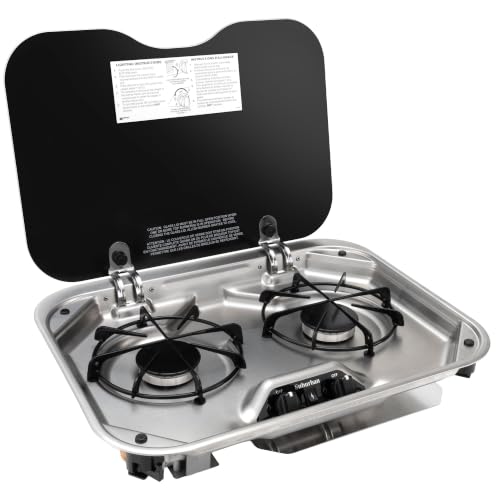
RecPro RV Suburban 2 Burner Propane Cooktop — Best Compact Drop-In
RecPro’s Suburban-pattern cooktop is the small-galley and camper classic: a shallow drop-in body, a glass lid that protects the burners and adds a surface, and battery ignition — a detail that matters afloat, because the cooktop lights at anchor with the inverter off. The two 5,800 BTU burners are sized for real cooking in small pans rather than spec-sheet drama. It suits compact galleys, camper conversions and boats that cook simply. Output will not rush a huge pot to the boil, and like all RV-pattern units it relies on your installation for marine-grade safety.
Strengths
- Battery-powered ignition works independent of shore power or inverter
- Glass lid protects burners and adds workspace in tiny galleys
- Suburban pattern means a long track record in compact installations
Trade-offs
- Modest burner output — large pots are slow
- RV-pattern unit; marine safety comes from installation practice
- Two burners limit ambitious menus
| Type | Drop-in propane cooktop (RV pattern) |
| Burners | 2 burners, 5,800 BTU each |
| Ignition | Battery-powered |
| Cover | Tempered glass lid |
| Installation | Drop-in |
Compact galleys reward appliances that disappear, and this unit disappears twice: the lid closes to make counter, and the drop-in body leaves the locker below usable. Battery ignition sounds like a footnote until the first anchored morning when the boat’s batteries are being saved for the anchor light and the kettle still lights first press. The burners’ modest output matches the pans a two-burner galley can actually hold — this is honest sizing, not deficiency.
For boats, treat the purchase as the start of a system: secure the unit against movement, add pan clamps for underway use, and plumb propane to marine standards with a leak-tested, solenoid-controlled supply. Within that system the RecPro is the compact pick we would fit to a small cruiser without hesitation — simple, proven and correctly sized.
Best for: small galleys and campers wanting a proven drop-in with battery ignition / Not suited for: cooks needing high output or three burners
Check on Amazon — check today’s price on Amazon, as appliance promotions rotate through these listings.
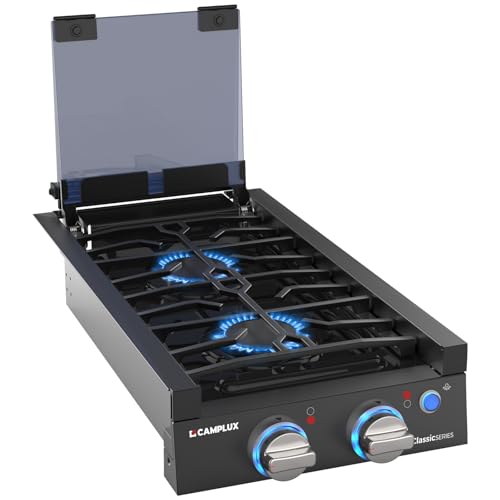
CAMPLUX Classic RV Cooktop 2 Burners (12 Inch) — Best Small Slide-In
Where the Elite is the mid-size answer, the Classic is the narrow one: a 12-inch slide-in body that fits galley runs and camper kitchens where a 21-inch unit cannot go, with a glass cover for the closed-counter trick and propane burners sized for one-pot and two-pan cooking. It suits small sailboats, camper vans and tiny galleys refitting on a budget. It shares the RV-pattern caveat of its siblings, and two burners in 12 inches means pans must be chosen with the same care as the cooktop.
Strengths
- 12-inch slide-in format fits the narrowest galley runs
- Glass cover converts the cooktop into counter space
- Simple propane system, easy to install and service
Trade-offs
- Pan size is limited by the compact burner spacing
- RV-pattern appliance — marine safety depends on installation
- No high-output burner for large pots
| Type | Slide-in propane cooktop (RV pattern) |
| Burners | 2 burners |
| Size | 12 inch |
| Cover | Tempered glass cover |
| Fuel | Propane |
Small-boat cooking is a choreography of small pans, and the Classic is choreographed correctly: two burners close enough to use, a cover that closes the unit into the counter line, and nothing extraneous to break. For a couple cruising on a 30-footer, this is the size of appliance that actually gets used daily rather than worked around — coffee, eggs, a one-pot dinner, all without hauling a portable stove into the cockpit.
Its limits are the format’s limits, stated plainly: a feast for six is not its brief, and neither is a giant stockpot. Boats that host crowds should step up to the Elite or cook in stages. As the narrow refit option with a cover and a sensible price class, the Classic earns its slot.
Best for: narrow galleys and camper kitchens needing a covered two-burner slide-in / Not suited for: crowd cooking or large-pot work
Check on Amazon — check today’s price on Amazon, as appliance promotions rotate through these listings.
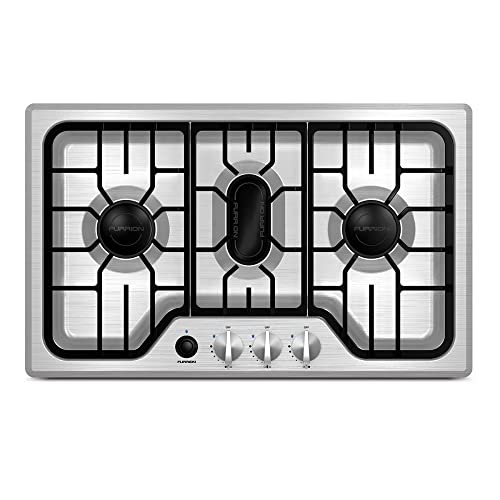
Furrion RV Chef Collection Gas Cooktop (FGH4ZSA-SS) — Best Three-Burner RV Pattern
Furrion builds for the RV industry, and its Chef Collection cooktop is the most appliance-like unit in this guide: three burners under a cast-iron grate, pulse ignition, stainless steel finish. Larger powerboats and catamarans with proper galley runs fit it naturally, and its grate gives pans a stable, familiar platform. It is the biggest and heaviest pattern here — small monohull galleys need not apply — and as an RV appliance it carries no marine certification; galley installation standards remain the owner’s job.
Strengths
- Cast-iron grate gives a stable, familiar cooking platform
- Three burners with pulse ignition in a stainless appliance format
- Furrion’s RV industry presence supports parts and documentation
Trade-offs
- Largest footprint here — needs a real galley run
- RV appliance without marine-specific certification
- Cast iron needs drying discipline in a salt-air environment
| Type | RV-pattern gas cooktop, larger galleys |
| Burners | 3 burners (7,500 BTU class main burner per maker) |
| Grate | Cast iron |
| Ignition | Pulse ignition |
| Finish | Stainless steel |
The Furrion’s appeal is normality: cooking on it feels like cooking on a small domestic cooktop, which on a liveaboard or a long cruise is a genuine quality of life. The cast-iron grate keeps pans planted better than wire racks, the burners cover the daily range from coffee to a proper sear, and the stainless body wipes down like a kitchen’s. Catamarans and trawlers with straight galley runs are its natural home.
Two marine notes keep the recommendation honest. Cast iron afloat wants a wipe of care after salt-air exposure, or it will freckle with rust at the edges. And underway cooking still needs pan restraints — a stable grate is not a clamp. Fit it in a boat that mostly cooks at anchor and in marinas, and the Furrion is the most civilised cooking in this guide.
Best for: larger boats, catamarans and liveaboards wanting a kitchen-like three-burner / Not suited for: small galleys or offshore cooking in heavy weather
Check on Amazon — check today’s price on Amazon, as appliance promotions rotate through these listings.

ANHANE 12 Inch Gas Cooktop (2 Burner) — Best Budget Compact
The ANHANE is the flexible footnote of this guide: a small stainless two-burner that can drop into a cutout or sit as a portable unit, fuelled by LPG (the boat case) or natural gas ashore. For a small boat that cooks at anchor and in marinas, it offers real burners at the lowest commitment in this list. It is a general-purpose compact rather than a marine or RV appliance — no galley pedigree, no glass cover — and its safety case rests entirely on careful installation and use at rest, not underway.
Strengths
- Dual-fuel flexibility (LPG/NG) suits boats that also cook ashore
- 12-inch footprint fits almost any galley or cockpit-adjacent setup
- Lowest-cost verified two-burner in this guide’s class
Trade-offs
- Not a marine appliance — use at anchor or in marina, with full propane discipline
- No cover, clamps or marine fittings included
- Basic construction matches its price
| Type | Compact 2-burner gas cooktop, built-in or portable |
| Burners | 2 burners |
| Fuel | LPG/NG dual fuel |
| Body | Stainless steel |
| Size | 12 inch |
There is a real use case here and it is common: the daysailer or small cruiser whose cooking is coffee, noodles and a harbour-side breakfast, where a full marine range is absurd and a camping stove feels improvised. The ANHANE gives that boat fixed, plumbed burners with a proper grate, in stainless that wipes clean, for the price of a tank of fuel. Installed rigidly, supplied through a proper marine propane system and used at rest, it is a sensible economy.
The boundaries must be as clear as the bargain. This is not the cooktop for a rolling anchorage fry-up, and it brings no flame-failure pedigree of its own — your system’s solenoid, ventilation and leak discipline carry the safety case. Buy it inside those boundaries and it is the budget pick; buy it expecting Dickinson behaviour and you have misread the guide.
Best for: small boats cooking at anchor or in marinas on the tightest budget / Not suited for: underway cooking or owners wanting marine-grade safety hardware built in
Check on Amazon — check today’s price on Amazon, as appliance promotions rotate through these listings.
Comparison Table
| Pick | Badge | Key Spec | Best For |
|---|---|---|---|
| Dickinson Marine Two Burner Propane Drop-In Cooktop | Best True Marine Cooktop | True marine 2-burner propane drop-in | boat owners wanting a genuine marine-manufacturer cooktop for a small galley |
| CAMPLUX Elite RV Stove 3 Burners (21-Inch) | Best Boat-and-RV All-Rounder | 3 burners, 21,000 BTU, flame-failure protection | midsize galleys wanting three burners, flame-failure protection and a space-saving cover |
| RecPro RV Suburban 2 Burner Propane Cooktop | Best Compact Drop-In | 2 × 5,800 BTU, battery ignition, glass lid | small galleys and campers wanting a proven drop-in with battery ignition |
| CAMPLUX Classic RV Cooktop 2 Burners (12 Inch) | Best Small Slide-In | 12-inch slide-in, 2 burners, glass cover | narrow galleys and camper kitchens needing a covered two-burner slide-in |
| Furrion RV Chef Collection Gas Cooktop (FGH4ZSA-SS) | Best Three-Burner RV Pattern | 3 burners, cast-iron grate, pulse ignition | larger boats, catamarans and liveaboards wanting a kitchen-like three-burner |
| ANHANE 12 Inch Gas Cooktop (2 Burner) | Best Budget Compact | 12-inch dual-fuel 2-burner, built-in or portable | small boats cooking at anchor or in marinas on the tightest budget |
The table’s most important column is the one that is not there: installation. Every unit below becomes a boat cooktop only inside a proper marine propane system — vented locker, solenoid, leak-tested lines, pan restraints. The Dickinson brings marine pedigree; the CAMPLUX and RecPro units bring compact safety hardware; the Furrion brings kitchen normality; the ANHANE brings price. Choose by galley size and how you actually cook afloat. Certifications and intended environments are named in each review for the same reason — a surveyor or insurer reading your refit file will look for exactly those words.
How to Choose a Gas Cooktop for a Boat
Measure the galley before the catalogue: cutout width and depth, the locker space below, and the swing of any gimbal if your boat cooks underway. Most small galleys were built around a two-burner footprint, and forcing a three-burner into the run costs the counter space you prep on. Decide honestly whether you cook underway — if yes, gimballing and pan clamps move from accessories to requirements, and the cooktop choice narrows to units that accept them.
Then audit the safety hardware in this order: flame-failure protection on every burner; ignition that works on battery or piezo without shore power; materials that tolerate salt air; and a format — drop-in or slide-in — that can be secured rigidly against movement. A glass lid is a genuine galley feature, not a luxury: closed, it is the only flat surface some small galleys have.
- Fuel: propane (LPG) is the boat standard; confirm the cooktop’s regulator and jet configuration matches your system
- Restraint: plan pan clamps or fiddle rails for any cooking beyond a flat calm
- Ventilation: galleys need combustion air and a path for moisture — never seal a galley tight with a burner lit
- Gas system: solenoid shut-off at the tank, controlled from the galley, is the marine norm
- Certification: marine or RV appliance standards both beat unbranded general-purpose units for a boat
Boat Propane Safety: The System Around the Cooktop
More galley incidents trace to the gas system than to any cooktop, so this guide states the marine consensus plainly. Propane is heavier than air and pools in bilges; therefore the bottle lives in a locker sealed from the interior and vented overboard at its bottom, lines run with minimal joints, a solenoid at the tank is switched from the galley, and the system is leak-tested on a schedule — with a pressure gauge test or a bubble tester — and sniffed, literally, whenever something smells wrong. A propane detector with a bilge sensor is inexpensive insurance that quality installations include.
Operating discipline completes the system: open the solenoid, light the burner, cook attended, shut the burner, shut the solenoid. Never leave a galley burner burning unattended, and treat any flame-out as a gas event, not an inconvenience — ventilate before relighting. Cooktops with flame-failure devices automate part of this discipline, which is why this guide weights them so heavily, but no device replaces the routine.
The Marine Names You Will Not Find Linked Here
Buyers researching galley refits will meet famous marine names — Force 10, Eno, and the gimballed ranges fitted to generations of cruising boats. Those are serious appliances, typically sold through marine chandlers rather than general marketplaces, and at the time of writing they could not be verified through this site’s catalogue channel. This guide’s rule is absolute: no verification, no purchase link — so they are named here for your own research rather than sold to you on reputation.
If your refit budget and your boat’s voyaging justify that class, buy through a chandler, confirm the gimbal and clamp hardware for your exact model, and have the installation surveyed as part of the boat’s gas system. The verified picks in this guide serve the much larger fleet of boats that cook competently at anchor and in harbour — which is, honestly, most boats, most of the time.
Cooking Underway vs Cooking at Anchor
Two different sports share the word ‘galley’. Cooking at anchor is kitchen cooking in miniature: any unit in this guide, sensibly installed, does it well, and the choice turns on burners, covers and counter choreography. Cooking underway in a seaway is an engineering problem: the cooktop should ideally gimbal so pots stay level as the boat rolls, pans must be clamped, deep pots beat wide ones, and the menu narrows to one-pot food that forgives being cooked one-handed while the other hand holds on.
Most cruising boats solve this pragmatically — pressure cookers and one-pot meals underway on a secured two-burner, full cooking at anchor — and the cooktop that serves that pattern best is rarely the biggest. Match the appliance to the sport you actually play: passage-makers should weight gimbal compatibility and restraint hardware above a third burner; harbour and anchorage cooks should weight burners and workspace, which is how this guide’s badges were assigned.
Galley Ventilation and Condensation
Gas cooking afloat adds three things to a small sealed cabin: heat, carbon dioxide and a surprising quantity of water vapour — burning propane releases moisture as surely as a kettle does. In winter cruising that moisture condenses on cold hull surfaces and feeds mildew; in any season, combustion in a closed cabin competes for the crew’s oxygen. Quality galley practice therefore pairs the cooktop with ventilation: a hatch or port cracked above the galley, a dorade or solar vent moving air, and the discipline never to use the burners as cabin heating.
If your boat cooks daily at anchor in cool climates, a small extractor or even a well-aimed fan over the galley transforms comfort below. It is the same lesson as the domestic guide’s hood section, scaled to a hull: the cooktop is half the system, and the air path is the other half.
Pressure Cookers and the Two-Burner Galley
The cruising world’s open secret is that a pressure cooker is the third burner a small galley cannot fit. It cooks rice, stews, beans and bread-adjacent miracles with a fraction of the fuel and time, stays sealed in a seaway, and its lid cannot launch across the cabin. Paired with a two-burner cooktop — one burner for the cooker, one for everything else — it covers menus that look impossible on the appliance count alone.
Fuel economy compounds the argument on long cruises: propane is a logistics item in remote anchorages, and pressure cooking’s shorter burner times stretch a bottle measurably. Several of this guide’s picks earn their place partly by pairing well with that pattern — compact, reliable burners that light first time on battery ignition and simmer steadily under a cooker for an unattended-feeling half hour, with flame-failure protection standing guard.
Fuel Logistics: Propane, Butane and Alcohol Compared
Propane is the default galley fuel for good reasons — it is energy-dense, widely available in cruising grounds, and works in cold weather — but it is not the only tradition. Butane cartridges power the portable stoves many small boats carry as backup; they are convenient and their fuel is sold everywhere, yet butane sulks in cold weather and cartridge stoves belong on deck or in a cockpit locker, not plumbed into a galley. Alcohol stoves, the non-pressurised kind, remain the choice of a minority of safety-first sailors: the fuel cannot accumulate explosively, at the cost of slower, cooler cooking and a flame that is nearly invisible in daylight.
For the fixed galley cooktop this search is about, propane’s infrastructure is the mature one: regulators, solenoids, detectors and appliances like this guide’s picks form a complete, understood system. The quality decision is rarely which fuel — it is whether the propane system is installed and maintained to the standard the fuel deserves. Boats that respect that standard cook superbly on gas for decades; the fuel is not the risk, the shortcuts are.
Shore-Side Thinking: Cooking in Marinas and on the Hard
Boats cook in more places than anchorages. In marinas, shore power and still air make galley cooking feel domestic — which is exactly when crews relax the disciplines that matter, leaving burners simmering while they socialise on the dock. The rules do not change with the postcode: attended cooking, solenoid off when done, and no burner as a cabin heater, however damp the evening.
On the hard, in a boatyard, add one more consideration: a hauled boat does not float level, ladders replace companionway steps, and yard rules often restrict open flame and fuel handling. Many owners simply do not cook aboard on the hard — and a refit planned around that reality, with the galley work done while the boat is out and the cooking resumed at launch, is the professional pattern this guide quietly recommends.
How to Fit a Compact Gas Cooktop in a Small Galley
This sequence covers the owner’s side of a galley refit; the gas connection itself belongs to a qualified marine gas technician in most jurisdictions and insurers’ eyes.
- Measure the existing cutout and the locker below it, and photograph the current gas run before removing anything
- Dry-fit the new cooktop in the cutout and confirm the lid or cover opens fully against bulkheads and shelves
- Plan the securing method — the unit must be rigid against the boat’s movement, with fixings accessible for future service
- Route the gas supply to minimise joints inside the cabin, keeping the run inspectable along its whole length
- Confirm the propane locker’s vent is clear and the solenoid wiring reaches the galley switch position
- Have the technician connect, set the regulator for the appliance, and leak-test the complete system, recording the test
- Fit pan clamps or fiddle rails, then commission the cooktop: light every burner, test flame-failure shut-off by blowing a flame out, and verify ignition from battery alone
Commissioning is not complete until the flame-failure test passes and every crew member has run the solenoid-and-light routine once. A galley is a system of hardware and habits; fit both. Record the refit in the boat’s log — date, installer, test results, hose and regulator dates — because the next owner, surveyor or insurer will ask, and because future-you, planning the next hose replacement, will be grateful the dates exist.
Common Buying Mistakes
Fitting a domestic cooktop in a galley. Kitchen cooktops lack flame-failure discipline, corrosion resistance and any means of restraining pans. A boat needs marine or RV-pattern hardware, installed to marine standards.
Skipping flame-failure protection. A flame blown out in a galley keeps flowing gas into a hull. Thermocouple protection is the single most important safety feature in this category.
Storing propane below decks. Bottles belong in a sealed, overboard-vented locker — never in the cabin, the engine space or an unvented locker, whatever the cooktop’s size.
Cooking underway without restraints. An unclamped pot in a seaway is a scald looking for a moment. Clamps, fiddles and deep pots are part of the cooktop decision, not accessories.
Ignoring the gas system’s age during a refit. A new cooktop on perished hoses and a tired regulator is not an upgrade. Refit the system — hoses, regulator, solenoid, detector — with the appliance.
Final Recommendation
For a genuine marine appliance, the Dickinson Marine two-burner is this guide’s answer — specialist-built, correctly sized, and made for salt air. For most small and midsize galleys, the CAMPLUX Elite’s three burners, flame-failure protection and glass cover make it the practical quality buy, with the RecPro Suburban-pattern unit the compact drop-in classic and the CAMPLUX Classic its narrow sibling. Larger boats that cook like homes should look at the Furrion, and the smallest budgets at the ANHANE — inside its stated limits.
Whatever you fit, fit the system with it: vented locker, solenoid, leak test, restraints, detector. Quality in a boat galley is not a brand — it is an appliance and an installation that respect what propane does in a hull. Choose on that basis and the cooking, at anchor under a quiet sky, will take care of itself.
A final word for refitters: photograph and label everything you remove, keep the old appliance until the new one has cooked for a week, and have the finished installation looked over by your surveyor or insurer if your policy mentions gas systems — many do. A documented, tested, standards-following galley refit adds to a boat’s value; an undocumented one, however shiny, subtracts from it at sale time.
The shortlist in one line: Dickinson Marine Two Burner Propane Drop-In Cooktop, CAMPLUX Elite RV Stove 3 Burners (21-Inch), RecPro RV Suburban 2 Burner Propane Cooktop, CAMPLUX Classic RV Cooktop 2 Burners (12 Inch), Furrion RV Chef Collection Gas Cooktop (FGH4ZSA-SS), ANHANE 12 Inch Gas Cooktop (2 Burner). Check the current price on Amazon for the one that matches your kitchen, then commit to learning it properly for a month before judging it.
Keep researching inside this cluster: Best Boat Cooktops Best Boat Gas Cooktops Best Quality Gas Cooktops Best 2 Burner Cooktops Electric Best Cooktops For Liquid Propane Best Quality 36 Gas Cooktops
Frequently Asked Questions
Can I use an RV cooktop on a boat?
Widely done and reasonable, with a condition: the appliance is only half the system. Installed rigidly, supplied through a marine-standard propane system (vented locker, solenoid, leak-tested lines) and used with pan restraints, an RV-pattern cooktop with flame-failure protection serves many small galleys well. It does not carry marine certification, and your insurer’s requirements are worth checking.
Why is flame-failure protection so important on a boat?
Because propane is heavier than air. A flame extinguished by a gust or boil-over on a cooker without protection keeps releasing gas, which sinks and pools in the bilge instead of dispersing as it would in a house. A thermocouple device shuts the gas at that burner within seconds.
What is a gimballed cooktop and do I need one?
A gimbal lets the cooktop swing so pots stay level as the boat heels or rolls — essential for cooking underway on a sailing boat, unnecessary for boats that cook at anchor or in marinas. If you passage-make and cook en route, prioritise gimbal-compatible units and pan clamps; if not, a fixed compact cooktop is simpler and cheaper.
How many burners does a boat galley need?
Two burners cover the overwhelming majority of boat cooking, especially with a pressure cooker in the locker. Three burners help larger crews and liveaboards but demand galley width that many boats cannot spare. Buy for your crew size and your counter, not for entertaining fantasies.
Why aren’t Force 10 and other famous marine ranges in the picks?
Because this guide only links products verified through the site’s catalogue channel, and those ranges — sold mainly through marine chandlers — returned no verifiable listing at the time of writing. They are discussed in the guide section so you can research them through proper marine channels.
Should a boat cooktop have battery or mains ignition?
Battery or piezo ignition is strongly preferable afloat: it works at anchor with shore power disconnected and the inverter off, which is exactly when most galley cooking happens. Mains-dependent ignition is a small but daily friction on a cruising boat.
How often should a boat’s propane system be leak-tested?
At every bottle change, at the start of every season, and whenever any joint has been disturbed — plus a sniff test by habit every time you open the solenoid. A simple pressure-gauge decay test or bubble tester takes minutes and is the cheapest safety routine on the boat.


