Disclosure: airfryerkitchensupply.com is reader-supported. When you buy through links on our site, we may earn an affiliate commission at no extra cost to you.
Where to Buy
The compact models in this guide to the best boat gas cooktops were each matched to a live Amazon listing through our product database check before receiving a link, and the links here and throughout the article let you check price on Amazon and confirm dimensions, fuel conversion and safety features before ordering. One honest note up front: true marine gimballed stoves are sold mainly through marine chandlers rather than Amazon, and the one covered in prose below is there so you can compare the two routes before spending anything.
Shop the verified picks on Amazon: FORIMO Gas Cooktop 22 Inch 4 Burners · Gases Cooktop 20 Inch 2 Burners · ChronosGear 20in Gas Countertop Cooktop 4 Burners · 22×20 Built-In Gas Cooktop 4 Burners with Thermocouple Protection · Empava 30-Inch Gas Cooktop 5 SABAF Burners. Availability and configurations change, so check price on Amazon before you order.
Shopping for the best boat gas cooktops starts with a truth the listings rarely state plainly: there are two different products hiding under this search. The first is the true marine stove — gimballed so it swings level as the boat rolls, fitted with pot clamps, built for propane and priced like boat equipment. The second, which is what most Amazon results actually are, is the compact built-in gas cooktop: small two- and four-burner NG/LPG units that sailors, liveaboards and camper-van converters install in galleys because they are affordable, available and — with the right safety features — entirely workable on the water.
This guide covers both honestly. The verified picks are compact gas cooktops with the features that matter afloat: LPG conversion for bottled gas, thermocouple flame-failure protection, sizes that fit real galley cutouts, and surfaces that survive a damp, salty cabin. The true marine gimballed stove is covered in prose, with a clear explanation of when it is worth its considerable premium. Below the reviews: how to choose for a galley, gas safety afloat, installation planning, and the mistakes that matter more at sea than they ever do in a house.
In this guide
Quick Picks
Five verified compact gas cooktops suited to galley installation, plus the true marine gimballed option covered in prose for completeness. Badges match the full reviews below; check the safety discussion carefully before choosing any galley appliance on price alone.
- FORIMO Gas Cooktop 22 Inch 4 Burners — Best Overall: A 22-inch, four-burner built-in in stainless steel with an NG/LPG conversion kit — the most complete compact package for a mid-size galley. Check price on Amazon.
- Gases Cooktop 20 Inch 2 Burners — Best Compact Two-Burner: A 20-inch two-burner in black tempered glass — the right-sized answer for small galleys where two burners and easy cleaning beat four burners and crowding. Check price on Amazon.
- ChronosGear 20in Gas Countertop Cooktop 4 Burners — Best No-Cutout Option: A 20-inch countertop (not built-in) four-burner that sits on the counter — dual fuel NG/LPG convertible, and removable when the boat needs the space back. Check price on Amazon.
- 22×20 Built-In Gas Cooktop 4 Burners with Thermocouple Protection — Best Safety-Led Budget Pick: An unbranded 22×20 built-in whose verified listing leads with the two things a boat needs most: an NG/LPG conversion kit and thermocouple protection. Check price on Amazon.
- Empava 30-Inch Gas Cooktop 5 SABAF Burners — Best for Larger Galleys: A 30-inch, five-burner cooktop with Italian SABAF burners and NG/LPG dual fuel — for trawlers, catamarans and liveaboards with a real galley. Check price on Amazon.
- True Marine Gimballed Stove (Dickinson / Force 10 class) — Best for Cooking Underway: The gimballed marine stove swings to stay level as the boat rolls and clamps its pots in place — the only correct answer for cooking in open water, sold through chandlers. (Sold through specialty retailers — see the full review below.)
How These Picks Were Chosen
We applied marine criteria to a land-market catalogue, and most models failed. A cooktop earned consideration for this guide only if it converted to LPG (boats cook on bottled propane or butane, not mains gas), offered thermocouple flame-failure protection or an equivalent safeguard in its verified listing, and came in a footprint a real galley can absorb — which in practice means the 20- to 24-inch class, plus one larger unit for trawler and liveaboard galleys. Tempered glass and stainless surfaces scored for corrosion tolerance and wipe-down practicality in a damp cabin.
Every linked model was cross-checked against Amazon’s product data for this site before writing, checked on 2026-11-21; sizes, burner counts and conversion details printed here come from those verified listings. Per this site’s standing rules, we print no fixed prices — check price on Amazon — and no fixed star ratings or review counts.
The gimballed marine stove is deliberately unlinked: we could not confirm a matching Amazon listing for a true marine gimbal stove through our product database check, and rather than invent a link we describe the category, its makers and its use case so you can shop it at a chandler with your eyes open. That honesty cuts both ways — if your boat cooks underway in open water, the prose pick may be the right purchase and the linked bargains the wrong ones, and this guide will say so plainly.
The Best Boat Gas Cooktops
Each review judges the unit as galley equipment first: fuel, safety features, footprint and life in a moving, damp, salt-air kitchen. The final pick is the unlinked marine option, included so the comparison is complete and honest.
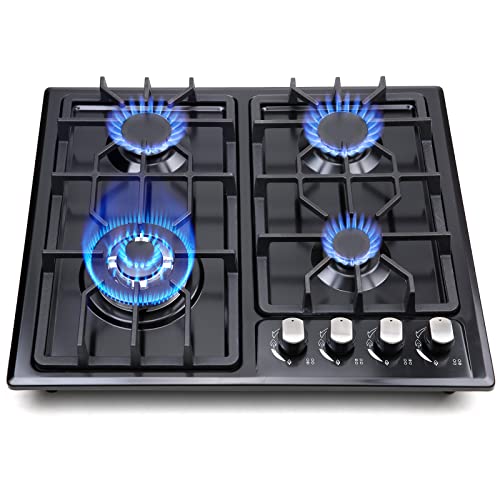
FORIMO Gas Cooktop 22 Inch 4 Burners — Best Overall
The FORIMO 22-inch is the pick that best balances the galley equation: four burners in a footprint small enough for a real boat counter, a stainless steel surface that tolerates the marine environment, and the NG/LPG conversion kit that bottled-gas cooking requires, all confirmed in its verified listing.
Strengths
- Four burners in a compact 22-inch built-in footprint
- NG/LPG conversion kit included for bottled propane systems
- Stainless steel surface suits damp, salty cabins
Trade-offs
- Four burners in 22 inches means pans crowd — plan on two active pots
- Built-in format requires cutting the galley counter
- Not gimballed: underway cooking needs calm conditions or added pot restraints
| Size | 22 inch built-in |
| Burners | 4 burners |
| Fuel | NG/LPG conversion kit (per listing) |
| Surface | Stainless steel |
Four burners on a boat sounds like a luxury until the first evening at anchor with pasta, sauce, vegetables and a kettle all wanting heat in a galley the size of a wardrobe — then it sounds like dinner. The FORIMO’s layout serves harbour and anchorage cooking completely, while its size keeps it installable in the counter runs of typical cruising boats rather than only in trawlers.
Set expectations for seaway use honestly. Like every fixed built-in in this guide, it is not gimballed, so cooking underway is a fair-weather activity unless you add pot clamps or rails and cook defensively with lidded, low-filled pans. For the majority of cruising boats — which cook the overwhelming majority of their meals at anchor, in marinas and in sheltered water — that is an acceptable and very common compromise, and it buys you four real burners at a fraction of marine-stove money.
Stainless steel deserves its sentence in a marine context: galley surfaces live with salt air, spray through open hatches and the occasional green-water adventure down the companionway. Stainless wipes clean, does not rust cosmetically the way coated finishes can once chipped, and matches the rest of a modern galley’s hardware. It will show water spots and demand an occasional polish to look its best — a fair trade in an environment that punishes delicate finishes without mercy.
Best for: Cruising boats and liveaboards wanting full four-burner cooking at anchor / Not suited for: Offshore passages where cooking underway in a seaway is routine
Check on Amazon — check the current price on Amazon before ordering.

Gases Cooktop 20 Inch 2 Burners — Best Compact Two-Burner
Small boats have small galleys, and in a small galley two burners you can actually use beat four burners you cannot. This 20-inch two-burner unit, finished in black tempered glass over stainless per its verified listing, is the compact pick: simple, wipeable, and sized for the counters of trailer-sailers, small cruisers and camper conversions.
Strengths
- 20-inch footprint fits the smallest galley counters
- Two-burner layout matches real small-boat cooking
- Tempered glass surface wipes clean in seconds
Trade-offs
- Two burners cap ambitious meals — one pot and one pan is the rhythm
- Glass surface and a moving boat require careful pan handling
- Brand support is thinner than the marine names
| Size | 20 inch |
| Burners | 2 burners |
| Surface | Black tempered glass / stainless (per listing) |
| Design notes | Anti-melting and anti-scalding design (per listing) |
Two-burner cooking is a discipline with its own pleasures: one-pot meals with a side, pan-plus-kettle breakfasts, and a galley that stays uncluttered because the appliance never promised more than the space allows. For weekending and coastal cruising, that covers the overwhelming majority of meals actually cooked aboard, and the counter space saved goes to food preparation — which small galleys need more than a third burner.
The glass top wants a mention. In a house it is a style choice; in a boat it is a practical one, because a flat glass surface in a damp cabin wipes completely clean with no grate crevices for salt and spills to colonise. The countervailing duty is care: pans go down gently, and heavy cast iron is lifted rather than slid. Crews who cook carefully — which, in a seaway, is the only kind of crew there is — will find it a fair exchange.
There is also a storage argument unique to small boats: a slim two-burner leaves counter perimeter for the things a galley accumulates — the dish rack, the chopping board, the all-important mug that must not slide. Owners of small cruisers consistently report that galley happiness correlates with clear counter, not burner count. If your boat is under thirty feet, weight this pick more heavily than its modest specification suggests; it is sized for your actual life aboard.
Best for: Small cruisers, trailer-sailers and camper conversions with tight galleys / Not suited for: Liveaboards cooking multi-pot meals daily
Check on Amazon — check the current price on Amazon before ordering.

ChronosGear 20in Gas Countertop Cooktop 4 Burners — Best No-Cutout Option
Cutting a hole in the joinery of a boat is a decision owners rightly hesitate over. The ChronosGear answers with a countertop format: a 20-inch, four-burner unit, dual fuel NG/LPG convertible per its verified listing, that sits on the galley counter rather than in it — installable in an afternoon and removable for winter storage, resale or a change of mind.
Strengths
- Countertop format — no cutting into the galley
- Four burners in a 20-inch unit for harbour cooking
- Dual fuel NG/LPG convertible for bottled gas
Trade-offs
- A loose countertop unit on a boat must be secured before any passage
- Four burners at this size are tightly spaced
- Takes counter height and space a built-in would not
| Size | 20 inch countertop |
| Burners | 4 burners |
| Fuel | Dual fuel NG/LPG convertible (per listing) |
| Format | Countertop stovetop |
The countertop format suits two specific boating lives. The first is the seasonal or shared boat, where permanent modification is unwelcome and the cooktop can live ashore or in a locker out of season. The second is the project boat, where the galley is not finished and may never be — a countertop unit cooks tonight and forgives tomorrow’s redesign. In both cases, removability is not a compromise but the entire point.
The non-negotiable duty is securing it. A countertop appliance on a moving boat is a projectile with a gas hose attached; it needs a fixed position, fiddles or rails, or removal and stowage before the boat moves — full stop. Owners who build that habit (or a simple retaining frame) get the most flexible four-burner option in this guide. Owners who will not should buy a built-in and accept the saw work.
A practical arrangement that works well on project boats: build the retaining frame as part of the temporary galley — a low timber or stainless fiddle box that the cooktop drops into and lifts out of. The frame makes the installation look intentional, keeps the unit located in a chop, and leaves the counter unmarked when the permanent galley eventually arrives. Several long refits have kept exactly such an arrangement for years because it simply worked, which is the highest compliment boat gear can earn.
Best for: Project boats, seasonal boats and owners avoiding permanent modification / Not suited for: Anyone who will not secure or stow it before getting underway
Check on Amazon — check the current price on Amazon before ordering.

22×20 Built-In Gas Cooktop 4 Burners with Thermocouple Protection — Best Safety-Led Budget Pick
This unbranded stainless built-in earns its place on one specification pairing: its verified listing explicitly includes both the NG/LPG conversion kit and thermocouple protection — the flame-failure device that cuts the gas if a burner blows out. On a boat, where a flapping curtain or a gust through the companionway can kill a flame, that device is not a feature; it is the feature.
Strengths
- Thermocouple flame-failure protection named in the listing
- NG/LPG conversion kit included
- Four burners in a 22×20 stainless built-in at a budget position
Trade-offs
- Unbranded: long-term parts and support are a gamble
- Specification beyond the headline features is thin
- Same fixed, non-gimballed character as the other built-ins
| Size | 22 x 20 inch built-in |
| Burners | 4 burners |
| Safety | Thermocouple protection (per listing) |
| Fuel | NG/LPG conversion kit (per listing) |
Why does thermocouple protection matter more afloat than ashore? Because a boat is a small, sealed, sleeping space with a bilge where leaked propane — heavier than air — collects and waits. A burner extinguished by a gust that keeps flowing gas is a house problem and a boat emergency. The thermocouple closes the valve when the flame dies, converting that emergency back into an inconvenience. Any gas appliance installed aboard should have it, and buyers should treat its absence as a disqualifier rather than a discount opportunity.
The unbranded gamble is the honest counterweight: fit and finish will be ordinary, the manual may be brief, and in five years the maker’s name may be unfindable. What you are buying is a stainless box, four burners and the right two safety-and-fuel features at the lowest sensible cost. For a budget refit that refuses to compromise on the safety line, that is a defensible purchase — made with eyes open.
If you buy in this tier, do two things on day one. Photograph the rating plate and keep the manual with the boat’s papers, because both are your parts-and-specification lifeline when the seller’s listing has vanished. And have your installer verify the thermocouple’s operation on every burner during commissioning — the feature justifies the purchase, so confirm it works rather than assuming the badge on the box tells the truth. Verified, it is the smartest money in this guide; unverified, it is a hope, and boats run badly on hopes.
Best for: Budget refits that put flame-failure protection first / Not suited for: Buyers wanting brand-backed parts support for a decade
Check on Amazon — check the current price on Amazon before ordering.

Empava 30-Inch Gas Cooktop 5 SABAF Burners — Best for Larger Galleys
Some boats have galleys the size of apartment kitchens: trawlers, cruising catamarans and full-time liveaboards. For them, the compact picks above are the compromise, and this Empava is the answer — 30 inches, five Italian SABAF burners, stainless construction and NG/LPG dual fuel per its verified listing.
Strengths
- Five SABAF burners give full-size cooking aboard
- NG/LPG dual fuel suits bottled gas systems
- SABAF components have a wide service ecosystem
Trade-offs
- 30 inches demands a genuinely large galley counter
- Higher total gas demand — the supply and locker must be sized for it
- Still a fixed cooktop: no gimbal for rough-water cooking
| Size | 30 inch |
| Burners | 5 Italian SABAF burners (per listing) |
| Fuel | NG/LPG dual fuel (per listing) |
| Surface | Stainless steel |
Liveaboard cooking is not camping cooking stretched out; it is household cooking in a floating house, with guests, holidays and winters aboard. A five-burner cooktop with quality Italian burner hardware supports that life properly, and the SABAF name matters for the same reason it does ashore — burners, caps and parts are serviceable worldwide, a real consideration for boats that cruise away from their home chandler.
The planning duties scale with the appliance. Five burners burning together draw serious gas: bottle capacity, regulator sizing and locker ventilation all need to be specified for the load, and the installation deserves a marine gas professional rather than a household one. Do that work and this is the most capable galley cooktop in the guide; skip it and the biggest cooktop becomes the biggest liability.
Catamaran owners should note one specific virtue of this class of cooktop: a wide, stable platform with room for two cooks’ worth of pans suits the social, open galleys that cats are famous for, where cooking is a group event rather than a solitary watch duty. On a monohull the same width would be unthinkable; on a cat or a trawler it is simply the galley working as designed. Match the appliance to the hull, as with everything else aboard.
Best for: Trawlers, catamarans and full-time liveaboards with large galleys / Not suited for: Any boat whose counter or gas locker is compact
Check on Amazon — check the current price on Amazon before ordering.
True Marine Gimballed Stove (Dickinson / Force 10 class) — Best for Cooking Underway
Every linked pick above shares one limitation: it is fixed flat, like a kitchen. A gimballed marine stove — the class built by makers such as Dickinson and Force 10 — mounts on pivots so the stove stays level while the boat rolls around it, with fiddle rails and pot clamps holding the cookware in place. It is the only appliance genuinely designed to cook dinner in a seaway.
Strengths
- Gimbal keeps burners level and pots aboard in rough water
- Purpose-built for propane systems and marine safety standards
- Pot clamps and rails are integral, not improvised
Trade-offs
- Costs several times the compact built-ins in this guide
- Usually two or three burners — less harbour capacity per dollar
- Sold through marine chandlers; not confirmed on Amazon in our check
Decide by your sailing, not your aspirations. If your passages are long, your weather is honest and hot food underway is part of how your crew functions, the gimbal is not an upgrade — it is the correct tool, and the compact cooktops in this guide are the compromise. If your boat cooks at anchor and in marinas, as most do, the gimbal’s premium buys capability you will use twice a year, and a good fixed cooktop plus a thermos-and-sandwiches passage routine is the rational allocation.
Shopping the category: buy through a marine chandler, confirm the stove is built and certified for marine propane use, and budget for the full system — gimbal mounts, regulator, solenoid shutoff and a proper gas locker — rather than the stove alone. This is the one pick in the guide where the installation ecosystem matters as much as the appliance.
One more consideration that separates real passage boats from marina queens: motion changes what a good burner is. On a gimbal, flame behaviour stays consistent because the stove stays level; pots sit in clamps sized to them, which means carrying cookware that fits the clamps — deep, straight-sided pots rather than wide shallow pans. Crews refitting for ocean work often replace half their galley cookware alongside the stove, and budgeting for that pairing in advance prevents the classic discovery, three days offshore, that the favourite pan does not fit the new stove’s restraints.
Best for: Offshore and passage-making sailors who cook underway / Not suited for: Harbour and anchorage cooks — the premium buys unused capability
This pick is covered without a link: we could not confirm a matching Amazon listing through our product database check on 2026-11-21, so rather than guess at a link we describe it here and recommend buying through an authorized specialty retailer.
Comparison Table
All five linked picks burn LPG via conversion or dual-fuel design, which is the entry requirement for any galley. The columns that matter afloat are footprint, burner count and — above all — flame-failure protection, because a boat is the one kitchen where a blown-out burner can fill the bilge with gas while the crew sleeps.
| Pick | Badge | Key Spec | Best For |
|---|---|---|---|
| FORIMO Gas Cooktop 22 Inch 4 Burners | Best Overall | 22in built-in, 4 burners, NG/LPG kit | Cruising boats and liveaboards wanting full four-burner cooking at anchor |
| Gases Cooktop 20 Inch 2 Burners | Best Compact Two-Burner | 20in, 2 burners, tempered glass | Small cruisers, trailer-sailers and camper conversions with tight galleys |
| ChronosGear 20in Gas Countertop Cooktop 4 Burners | Best No-Cutout Option | 20in countertop, 4 burners, NG/LPG | Project boats, seasonal boats and owners avoiding permanent modification |
| 22×20 Built-In Gas Cooktop 4 Burners with Thermocouple Protection | Best Safety-Led Budget Pick | 22x20in, 4 burners, thermocouple protection | Budget refits that put flame-failure protection first |
| Empava 30-Inch Gas Cooktop 5 SABAF Burners | Best for Larger Galleys | 30in, 5 SABAF burners, NG/LPG | Trawlers, catamarans and full-time liveaboards with large galleys |
| True Marine Gimballed Stove (Dickinson / Force 10 class) | Best for Cooking Underway | Gimballed marine stove, pot clamps | Offshore and passage-making sailors who cook underway |
How to Choose the Best Boat Gas Cooktops
Begin with how your boat actually cooks. Count the meals made underway in a seaway versus at anchor over your last season. If underway cooking is real and regular, your shortlist is the gimballed marine stove class and this decision is already made. If — like most cruising boats — you cook at anchor, in marinas and in calm water, a fixed compact cooktop serves you fully, and the rest of this guide applies.
Fuel is the second gate. Boats cook on bottled gas: propane in most regions, butane in some. Any cooktop you install must be jetted or converted for your gas — every linked pick here includes conversion or dual-fuel capability in its verified listing — and the conversion must be done and leak-tested properly. A natural-gas-only appliance has no business aboard.
Safety features are the third gate, and they are not negotiable. Flame-failure protection (thermocouple) on every burner, a gas locker that vents overboard, a solenoid shutoff you can reach without entering the galley, and a gas alarm in the cabin are the system your cooktop lives inside. The appliance is one component; buy it as part of that system, not as a standalone bargain.
Galley Dimensions: Fitting a Cooktop Into a Boat
Measure the counter you have, then measure the locker and bilge access beneath it — a built-in cooktop needs depth below the counter for its body and gas connection, and boats hide tanks, wiring and steering gear in exactly that space. The 20- to 22-inch class in this guide exists because it fits the counter runs of production cruising boats; the 30-inch Empava fits trawlers and catamarans whose galleys were drawn around full-size appliances.
Allow working room, not just fitting room. A cooktop shoehorned edge-to-edge leaves nowhere to set a hot lid, land a pan or rest a spoon — in a galley that moves. If the choice is between a four-burner that fills the counter and a two-burner that leaves a landing zone, most small-boat cooks end up happier with the two-burner, a truth the sales charts never tell.
Finally, plan the pot geography. Fiddle rails or a clamp system to keep pans aboard, a safe place for the kettle when it is not on a burner, and companionway clearance so the cook is not trapped between a hot stove and a crew member squeezing past — these are the unglamorous details that decide whether a galley works at sea or merely photographs well at the boat show.
Ventilation belongs in the same conversation. A galley cooktop fills a small cabin with steam, cooking vapour and combustion moisture faster than any house kitchen, and boats grow mould in exactly the places that moisture settles. A hatch or portlight that opens above or beside the cooktop, and the habit of cracking it whenever the burners run, protects both the crew’s lungs and the boat’s interior. When comparing two otherwise-equal installations, choose the one that puts the cooktop under moving air.
Propane vs Butane Aboard: Fuel Choice and Cold Weather
Two bottled gases dominate boat cooking, and they are not interchangeable moods of the same fuel. Propane vaporises at very low temperatures, which makes it the reliable choice for cold climates and winter sailing; it is stored at higher pressure and is the default marine fuel in North America and northern Europe. Butane is common in warmer regions and in small cartridge appliances, but it stops vaporising effectively near freezing — a butane stove on a frosty morning can produce a sad, shrinking flame or none at all, exactly when hot drinks matter most.
The practical consequences: choose the gas your cruising ground actually supplies, because bottle systems and regulators differ by region and refills dictate loyalty more than preference does. Jetting matters too — an appliance converted for one gas must be re-jetted for the other, which is installer work, not a dockside experiment. And whichever gas you carry, the locker discipline is identical: sealed from the cabin, vented overboard, bottles secured upright, and a spare bottle treated with the same respect as the connected one.
Liveaboards in cold climates should plan one step further: propane demand rises exactly when vaporisation falls, and small bottles can frost and fade during long cooking sessions in deep winter. Larger bottles, a properly sized regulator and keeping the in-use bottle as warm as the locker design allows are the working answers — all of them system decisions to make with your installer before the first frost, not discoveries to make during it.
Gas Safety Aboard: The Rules That Outrank Everything Else
Propane is heavier than air. Ashore, a leak dissipates; aboard, it sinks into the bilge and waits for a spark. That single fact generates the whole marine gas discipline: bottles live in a locker sealed from the interior and vented overboard; lines run as continuous lengths where possible; every burner has flame-failure protection; a solenoid at the bottle, controlled from the galley, shuts the system down when cooking ends; and the system is leak-tested after any work, every time.
Cooking discipline aboard is equally specific. Never leave a burner unattended in a seaway. Turn the gas off at the solenoid when the meal is done, not when you remember later. Keep the cabin’s gas alarm powered and in date — it is the crew member who never sleeps. And brief every guest who will use the galley: boats forgive many things, but improvised gas procedure is not one of them.
Certification matters when you buy. Appliances and components intended for marine gas systems are built and tested to marine standards; household parts substituted into a boat’s gas system are a false economy that surveyors and insurers notice. When in doubt, a marine gas professional is the cheapest consultant you will ever hire.
Fixed Cooktop vs Gimballed Stove: The Decision, Worked Through
The fixed-versus-gimbal question resolves into three sub-questions. Where do you cook? Harbour, anchorage and marina cooking — the large majority of meals on most boats — needs no gimbal. What do you cook underway? If the honest answer is “we heat soup and make tea in calm patches”, a fixed cooktop with deep, lidded pans and low fills handles it, carefully. If the answer is “full dinners on passage, in weather”, only the gimbal is honest equipment for the job. What does the rest of the system cost? A gimbal stove implies its mounting space, its swing clearance — the stove must be free to move through the boat’s full roll angle without striking joinery — and usually a galley designed around it. Retrofitting swing clearance into a finished galley is the hidden cost that sinks many gimbal upgrades.
There is a respectable hybrid: a fixed cooktop for harbour life plus a passage routine built on a flask, a pressure cooker used in calm spells, and meals that need no flame. Most cruising couples we hear from run exactly this system and eat well. The gimbal is magnificent machinery for the boats that need it; the fixed cooktop is the rational tool for the boats that do not; and the seamanship lies in knowing which boat yours is.
Budget the decision whole. A gimbal stove at several times the price, plus its installation ecosystem, can equal the cost of the fixed cooktop, its professional installation, a full gas-system refit and a year of marina fees combined. For a boat whose passages are coastal hops, that arithmetic is decisive. For a boat pointing at an ocean, the same arithmetic reverses: the gimbal becomes the cheap option, because the alternative — not cooking properly for three weeks at sea — is a cost no spreadsheet captures. Price is a fact; value is a voyage plan.
How to Plan a Galley Cooktop Installation (Overview)
Gas work aboard belongs to qualified marine professionals in most jurisdictions and under most insurance policies. This overview is for planning and briefing your installer — not a substitute for one.
Step 1 — Survey the space and the system. Confirm counter cutout, below-counter clearance, gas locker condition and venting, and the route the gas line will run. Decide at this stage whether the boat’s bottle, regulator and solenoid suit the new appliance’s demand.
Step 2 — Choose and convert. Confirm the cooktop is set up for your bottled gas — LPG conversion completed with the correct jets — before it goes near the boat. Conversions done on the dock are conversions done badly.
Step 3 — Fit the appliance securely. Built-ins are clamped and sealed per the manufacturer; a countertop unit gets a fixed position with rails or a retaining frame. Nothing that carries a gas flame aboard may be free to move when the boat does.
Step 4 — Connect and leak-test. The installer connects the line, then leak-tests every joint with the approved method and checks the solenoid shutoff and flame-failure devices burner by burner. This step is documented for the boat’s file and the insurer.
Step 5 — Commission with a real meal. Cook something ordinary at anchor: all burners lit in turn, a kettle, a pan moved across the surface. You are checking flame quality, ignition, pot stability and your own workflow in the space — while the installer is still a phone call away.
Step 6 — Set the standing routine. Gas on at the solenoid to cook, off when done; alarm checked monthly; locker vent confirmed clear at every bottle change. Write the routine on a card in the galley for guests and charterers.
Common Buying Mistakes
Installing a natural-gas-only cooktop. Boats run on bottled LPG. An appliance that cannot be converted — or whose conversion was skipped — is a hazard wearing a bargain’s clothing.
Skipping flame-failure protection. A gust through the companionway can extinguish a burner in a second. Without a thermocouple, the gas keeps flowing into a sealed cabin. This feature is the price of admission, not an option.
Leaving a countertop unit unsecured. A loose gas appliance on a moving boat is the worst object in the galley. Rail it, frame it or stow it before every departure.
Buying burners instead of workspace. Four burners filling the whole counter leave nowhere to put anything down. Galleys need landing space as much as flame.
Ignoring the gas locker and alarm. The finest cooktop installed on a rotten gas system is a liability. Budget for the locker, solenoid, alarm and professional installation as part of the same purchase.
Pretending a fixed cooktop is a seaway stove. Cook underway within the appliance’s real limits: calm conditions, lidded pans, low fills, constant attendance — or buy the gimbal.
Forgetting the survey and the insurer. An unrecorded gas installation can complicate a survey, a claim or a resale. Keep the installer’s documentation with the boat’s papers, photograph the installation, and tell your insurer what was fitted. Ten minutes of paperwork protects the largest asset most owners have.
Final Recommendation
For most cruising boats, the FORIMO 22-inch four-burner is the right boat gas cooktop: compact, stainless, LPG-ready and complete. Small galleys should take the 20-inch two-burner; owners avoiding joinery work should take the ChronosGear countertop and secure it properly; budget refits should prioritise the thermocouple-equipped built-in; and liveaboards with real galleys should step up to the Empava 30-inch. Passage-makers who cook in open water should skip the bargains entirely and buy the gimballed marine stove from a chandler — it is the only pick here designed for their ocean.
Related guides: Best 2 Burner Gas Cooktops, Best Portable Gas Cooktops, Best Rv Cooktops, Best Gas Cooktops and Best Cooktops.
Related guides
Frequently Asked Questions
Can I install a regular gas cooktop on a boat?
A compact household gas cooktop can be installed aboard if it converts to LPG, has flame-failure protection, is fixed securely, and is connected by a qualified installer to a proper marine gas system — locker, solenoid, alarm and leak test included. What you cannot do is treat it as a gimballed seaway stove; it cooks safely at anchor and in calm conditions.
What gas do boats use for cooking?
Most boats cook on bottled liquefied petroleum gas — propane in many regions, butane in others, carried in a locker that vents overboard. Cooktops must be jetted or converted for the specific gas, which is why every linked pick in this guide includes LPG conversion or dual-fuel capability in its listing, and why the conversion belongs to a qualified installer rather than a dockside afternoon.
What is thermocouple protection and why does it matter on a boat?
A thermocouple is a flame-failure device: if the flame goes out, it cools and closes the gas valve automatically within seconds. Ashore it is a convenience; aboard, where leaked propane sinks into the bilge of a sealed, sleeping space and waits for a spark, it is essential safety equipment — and one of the first things a marine surveyor looks for in a galley.
Do I need a gimballed stove?
Only if you cook underway in open water regularly. A gimbal keeps the stove level as the boat rolls and works with pot clamps to keep dinner aboard in weather that would slide pans off any fixed surface. For harbour, anchorage and marina cooking — most boats, most meals, most of the time — a fixed cooktop is sufficient and far cheaper.
How many burners does a boat galley need?
Two burners cover the great majority of meals cooked aboard small and mid-size boats, and leave precious counter space for preparation — the resource small galleys are truly short of. Four burners suit liveaboards and crews who cook full meals daily, provided the counter and the gas supply are sized for them. Buy for your typical dinner, not your most ambitious one; the ambitious dinner happens twice a year, and the typical one happens every night of the season.
Can a countertop gas cooktop be used on a boat?
Yes, with a discipline: it must sit in a fixed position with rails or a retaining frame while in use, its gas connection must be part of the proper marine system, and it must be secured or stowed before the boat gets underway. An unsecured gas appliance on a moving boat is unacceptable.


