Disclosure: airfryerkitchensupply.com is reader-supported. When you buy through links on our site, we may earn an affiliate commission at no extra cost to you.
Where to buy the best boat cooktops picks in this guide
Every linked pick below was verified against Amazon’s own catalogue data for this site before this guide was written, so the product name on the listing matches the product reviewed here. Prices move constantly in this category, which is why this guide never prints a fixed price: use the links to check the current price on Amazon on the day you buy. The shortlist:
- Dickinson Marine Two Burner Propane Drop-in Cooktop — Best Overall. Check the current price on Amazon before you decide.
- Kenyon Mediterranean 2-Burner Electric Cooktop, 240 Volts — Best Built-In Electric. Check the current price on Amazon before you decide.
- Kenyon Bridge Induction Cooktop, 2 Burners, 120 Volts — Best Induction Aboard. Check the current price on Amazon before you decide.
- Magma Marine Kettle3 Combo Stove & Gas Grill, Party Size — Best for Cockpit Cooking. Check the current price on Amazon before you decide.
- CAMPLUX Classic RV Cooktop 2 Burners Slide-in, Propane — Best Value Built-In. Check the current price on Amazon before you decide.
- Duxtop Portable Induction Cooktop 8100MC (Single Burner) — Best Portable for Harbour Use. Check the current price on Amazon before you decide.
Cooking on the water rewrites the rules that kitchen buyers take for granted, and the best boat cooktops are chosen by marine logic: they must stay put in a seaway, sip fuel or power from limited stores, resist a corrosive atmosphere, and shut down safely in a space where a fire is not an inconvenience but an emergency. A domestic burner dropped into a galley fails on at least two of those counts.
This guide rounds up six verified options across the three real marine approaches — drop-in propane, built-in electric from a marine specialist, and portable units that earn a place aboard for harbour and shore use. Every model was confirmed against Amazon’s catalogue data for this site. Where a classic marine approach could not be verified as a current listing, it is discussed honestly in prose rather than invented as a pick.
Read the power sections as carefully as the burner sections. A cooktop that assumes an endless shore-power cable is a harbour appliance; a cooktop that assumes a propane locker is an offshore appliance. Most boats need one of each mindset across a season, and the reviews below are explicit about which is which.
In this guide
Quick Picks: the best boat cooktops shortlist at a glance
- Dickinson Marine Two Burner Propane Drop-in Cooktop — Best Overall. A purpose-built marine propane drop-in from a specialist maker — the offshore-capable heart of a serious galley. Check on Amazon
- Kenyon Mediterranean 2-Burner Electric Cooktop, 240 Volts — Best Built-In Electric. A marine-specialist electric built-in with simple knob control — the shore-power and generator galley’s cleanest solution. Check on Amazon
- Kenyon Bridge Induction Cooktop, 2 Burners, 120 Volts — Best Induction Aboard. Marine induction on a 120-volt supply — fast, flameless cooking with a bridge layout for galley-sized pans. Check on Amazon
- Magma Marine Kettle3 Combo Stove & Gas Grill, Party Size — Best for Cockpit Cooking. A rail- or mount-friendly kettle that works as stove and grill — the social cooking centre of the cockpit, not the galley. Check on Amazon
- CAMPLUX Classic RV Cooktop 2 Burners Slide-in, Propane — Best Value Built-In. An RV-grade slide-in propane two-burner with a glass cover that doubles as counter space — a budget route onto smaller boats and camper conversions. Check on Amazon
- Duxtop Portable Induction Cooktop 8100MC (Single Burner) — Best Portable for Harbour Use. The shore-power harbour burner: a proven portable induction single that lives in a locker and cooks on the dock, the counter, or the cockpit table in calm weather. Check on Amazon
How were these best boat cooktops picks chosen?
Candidates had to make sense aboard: compact footprints, marine or RV-grade build intent, secure installation or stable portable design, and a fuel or power story that works with real boat systems. Verified listing data confirmed each model’s type before ranking.
Ranking weighed seaway practicality, installation demands, fuel logistics, corrosion resistance and how honestly each unit’s limits are stated. Purely domestic countertop units were only included where their portable role aboard — harbour cooking on shore power — is a genuine, widely used pattern, and they are labelled as such.
The 6 picks for best boat cooktops, reviewed one by one

1. Dickinson Marine Two Burner Propane Drop-in Cooktop — Best Overall
Dickinson builds for boats, and this two-burner propane drop-in is the guide’s benchmark: a compact built-in unit designed for galley cut-outs, running on the propane system serious cruising boats already carry for exactly this job. If your boat cooks away from the dock for days at a time, this is the class of appliance you are shopping for.
Strengths
- Purpose-built marine design from a specialist manufacturer
- Propane independence — cooks anywhere, no shore power or generator needed
- Drop-in installation integrates cleanly into galley joinery
Trade-offs
- Requires a compliant propane installation with locker, solenoid and sniffer discipline
- Two burners is the ceiling — plan one-pan-plus-side menus
- Professional installation is strongly advisable for the gas work
| Type | Marine drop-in cooktop |
| Fuel | Propane (per verified listing title) |
| Burners | Two (per verified listing title) |
Propane’s case offshore is energy density and independence: a modest tank cooks for weeks, works at anchor in any weather, and asks nothing of the battery bank. The obligations are equally real — a vented locker, a solenoid shut-off you actually use, leak checks as routine, and ventilation while cooking in a small cabin. Boats already set up for propane feel none of this as friction; boats adding gas from scratch should price the whole system, not just the cooktop.
In a seaway, pair any galley burner with potholders or a gimbal strategy appropriate to your boat, and cook with lids on passage. This unit’s built-in nature is its safety feature: nothing slides, nothing tips, and the galley stays a galley when the boat rolls.
Over months of ownership, the Dickinson Marine Two Burner Propane Drop-in Cooktop makes its case in the small moments rather than the first unboxing: it is the pick filed here as best overall, and its defining specification — marine propane drop-in, two burners — is the one owners end up mentioning to friends. It suits cruising boats with a proper propane system that cook at anchor precisely because that strength shows up in weekly use, not just in a demonstration. The honest limit stays the one recorded above: it is not the tool for daysailers without a gas locker or boats that only cook at the dock, and no accessory changes that. Buyers who accept that boundary tend to keep this pick for years; buyers who fight it tend to replace it within one. That, more than any single feature, is the long-term verdict.
Best for: Cruising boats with a proper propane system that cook at anchor / Not suited for: Daysailers without a gas locker or boats that only cook at the dock
Check on Amazon — check price on Amazon.

2. Kenyon Mediterranean 2-Burner Electric Cooktop, 240 Volts — Best Built-In Electric
Kenyon is one of the names marinas actually know, and this Mediterranean two-burner pairs a 6.5-inch and an 8-inch burner (per the verified listing) under knob control in a drop-in glass top. On boats that live on shore power or run a generator at mealtimes, electric cooking removes fuel storage from the safety equation entirely.
Strengths
- Marine-specialist brand with galley-appropriate sizing
- Knob control works with wet hands and gloves
- Smooth glass top wipes clean in a cramped galley
Trade-offs
- 240-volt supply limits it to suitable shore, generator or inverter systems
- Useless at anchor without a serious electrical system
- Glass tops demand care with heavy cast iron in a seaway
| Type | Built-in electric cooktop, marine |
| Burners | 6.5-inch and 8-inch (per verified listing title) |
| Supply | 240 volts (per verified listing title) |
| Controls | Knob control (per verified listing title) |
The honest framing: this is a harbour and powered-passage cooktop. Marina liveaboards will use it daily and love the absence of gas; offshore sailors on a modest battery bank will not fire a generator to boil pasta. Know which boat you own. Within its brief, the knob interface is a genuine marine virtue — touch panels and wet, cold hands are poor shipmates.
Installation is a proper drop-in job with marine-grade wiring and breaker sizing to match the 240-volt draw. Budget for the electrical work alongside the unit, and confirm your shore-power pedestal and cord can carry cooking loads alongside battery charging and water heating.
Over months of ownership, the Kenyon Mediterranean 2-Burner Electric Cooktop, 240 Volts makes its case in the small moments rather than the first unboxing: it is the pick filed here as best built-in electric, and its defining specification — marine electric drop-in, two burners, 240v, knob control — is the one owners end up mentioning to friends. It suits liveaboards and marina-based boats with robust 240v power precisely because that strength shows up in weekly use, not just in a demonstration. The honest limit stays the one recorded above: it is not the tool for offshore boats cooking primarily at anchor on small battery banks, and no accessory changes that. Buyers who accept that boundary tend to keep this pick for years; buyers who fight it tend to replace it within one. That, more than any single feature, is the long-term verdict.
Best for: Liveaboards and marina-based boats with robust 240V power / Not suited for: Offshore boats cooking primarily at anchor on small battery banks
Check on Amazon — check price on Amazon.
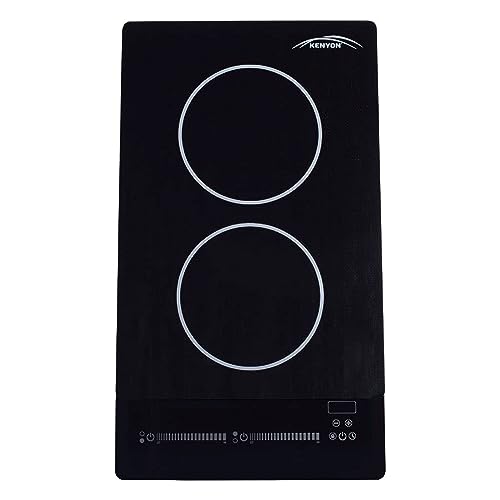
3. Kenyon Bridge Induction Cooktop, 2 Burners, 120 Volts — Best Induction Aboard
Induction answers several boat problems at once: no open flame in a cabin, no heat dumped into a small space in the tropics, instant shut-off, and energy that goes into the pan rather than the galley air. This Kenyon unit runs on 120 volts per its verified listing, suiting North American shore power and sensibly sized inverter systems, with a bridge format that accommodates a griddle or long pan across both zones.
Strengths
- Flameless cooking — a real safety and comfort gain in a small cabin
- 120-volt supply fits common shore and inverter setups
- Bridge layout handles long pans and griddles in a narrow galley
Trade-offs
- Needs magnetic cookware — audit the galley locker first
- Touch controls are less glove- and wet-hand-friendly than knobs
- Still an electrical load: anchor cooking needs battery and inverter capacity
| Type | Built-in induction cooktop, marine |
| Burners | Two with bridge (per verified listing title) |
| Supply | 120 volts (per verified listing title) |
| Controls | Smart touch control (per verified listing title) |
The efficiency argument is strongest in hot climates and small cabins: a gas burner heats the cook as much as the pan, while induction keeps the galley measurably cooler and drier — less condensation, less ventilation demand. For marina and calm-anchor cooking on a healthy lithium bank, it is arguably the modern default.
Heavy weather remains induction’s caveat aboard: pans need restraint systems just as on any smooth top, and a rolling boat plus a full pot is a planning exercise regardless of heat source. Treat it as the primary top for powered life and keep a simple backup method aboard for electrical failures.
Over months of ownership, the Kenyon Bridge Induction Cooktop, 2 Burners, 120 Volts makes its case in the small moments rather than the first unboxing: it is the pick filed here as best induction aboard, and its defining specification — marine induction, two burners with bridge, 120v — is the one owners end up mentioning to friends. It suits modern boats with lithium banks or shore power wanting flameless cooking precisely because that strength shows up in weekly use, not just in a demonstration. The honest limit stays the one recorded above: it is not the tool for boats whose galley cookware is aluminium or copper without magnetic bases, and no accessory changes that. Buyers who accept that boundary tend to keep this pick for years; buyers who fight it tend to replace it within one. That, more than any single feature, is the long-term verdict.
Best for: Modern boats with lithium banks or shore power wanting flameless cooking / Not suited for: Boats whose galley cookware is aluminium or copper without magnetic bases
Check on Amazon — check price on Amazon.

4. Magma Marine Kettle3 Combo Stove & Gas Grill, Party Size — Best for Cockpit Cooking
Half of boat cooking is not galley cooking at all. This Magma kettle combo mounts at the rail, keeps heat, smoke and fish smells out of the cabin, and converts between stove and grill duty for the catch of the day. In the party size it feeds a raft-up crowd from the cockpit, which is where everyone actually is.
Strengths
- Keeps heat and cooking smells outside the cabin
- Stove-and-grill versatility in one mounted unit
- Purpose-designed for the marine environment and rail mounting
Trade-offs
- Weather-dependent — cockpit cooking in rain is nobody’s favourite
- Mounting hardware and fuel canisters are part of the real system cost
- Not a substitute for a galley burner in heavy weather
| Type | Marine kettle combo stove and grill |
| Size | Party size, 17-inch class (per verified listing title) |
| Brand line | Magma Marine Kettle3 (per verified listing title) |
As a system, it shines on the trips people remember: grilled fish at anchor, burgers during a raft-up, a kettle of mussels steamed on the stove ring while the cabin stays cool and dry. Stainless marine construction is built for the salt air that destroys patio equipment in a season.
Buy it as a complement, not a replacement: the galley still needs its own burner for the mornings and the weather days. Check your rail diameter and mount options before ordering, and store canisters with the same ventilation discipline as any gas aboard.
Over months of ownership, the Magma Marine Kettle3 Combo Stove & Gas Grill, Party Size makes its case in the small moments rather than the first unboxing: it is the pick filed here as best for cockpit cooking, and its defining specification — marine kettle stove/grill combo, party size — is the one owners end up mentioning to friends. It suits cockpit and rail-side cooking, grilling the catch, raft-up crowds precisely because that strength shows up in weekly use, not just in a demonstration. The honest limit stays the one recorded above: it is not the tool for being the boat’s only cooking appliance, and no accessory changes that. Buyers who accept that boundary tend to keep this pick for years; buyers who fight it tend to replace it within one. That, more than any single feature, is the long-term verdict.
Best for: Cockpit and rail-side cooking, grilling the catch, raft-up crowds / Not suited for: Being the boat’s only cooking appliance
Check on Amazon — check price on Amazon.
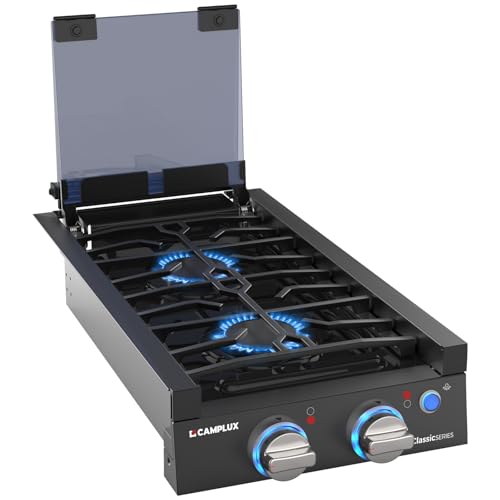
5. CAMPLUX Classic RV Cooktop 2 Burners Slide-in, Propane — Best Value Built-In
Small boats, camper boats and budget refits often borrow from the RV world, and this CAMPLUX slide-in is the sensible version of that idea: two propane burners (13,000 BTU total per the verified listing), a tempered glass cover that returns the counter when closed, and a 12-inch footprint that fits tight galleys.
Strengths
- Glass cover converts the cooktop back into worktop space
- Compact 12-inch class footprint for small galleys
- Propane independence at a value-tier commitment
Trade-offs
- RV-grade rather than marine-specialist build — rinse and protect against salt air
- Same propane-system obligations as any gas install aboard
- Two modest burners will not rush a big stockpot
| Type | Slide-in propane cooktop (RV/marine use) |
| Output | 13,000 BTU total (per verified listing title) |
| Burners | Two (per verified listing title) |
| Cover | Tempered glass cover (per verified listing title) |
The cover is the feature small-boat owners will praise weekly: galley counters are measured in inches, and a cooktop that disappears under a flush glass lid earns its place twice. Keep the glass discipline — let burners cool before closing it, every time, without exception.
For trailer sailors and freshwater boats, the RV-versus-marine distinction matters less; for saltwater boats, budget a little extra care — wipe-downs, cover when idle, and an eye on fittings. Judged as value per cooking capability in a tiny galley, it is a rational and popular pattern.
Over months of ownership, the CAMPLUX Classic RV Cooktop 2 Burners Slide-in, Propane makes its case in the small moments rather than the first unboxing: it is the pick filed here as best value built-in, and its defining specification — propane slide-in, two burners, 13,000 btu, glass cover — is the one owners end up mentioning to friends. It suits small boats, trailer sailors and budget galley refits precisely because that strength shows up in weekly use, not just in a demonstration. The honest limit stays the one recorded above: it is not the tool for bluewater boats wanting specialist marine build throughout, and no accessory changes that. Buyers who accept that boundary tend to keep this pick for years; buyers who fight it tend to replace it within one. That, more than any single feature, is the long-term verdict.
Best for: Small boats, trailer sailors and budget galley refits / Not suited for: Bluewater boats wanting specialist marine build throughout
Check on Amazon — check price on Amazon.
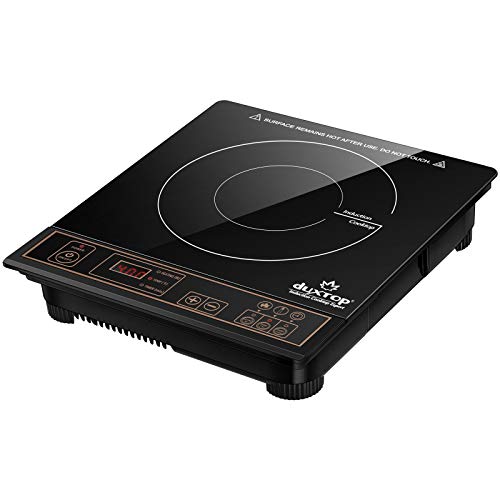
6. Duxtop Portable Induction Cooktop 8100MC (Single Burner) — Best Portable for Harbour Use
Many boats cook two lives: underway on the built-in system, and in harbour on shore power with a portable unit that keeps heat out of the cabin and adds a burner for marina meals. This long-proven single induction burner is the locker-friendly tool for that second life — compact, fast, and cheap to replace if the marine environment eventually wins.
Strengths
- Compact enough for a galley locker between uses
- Full single-burner induction speed on shore power
- Sacrificial price tier compared with built-in marine units
Trade-offs
- A domestic portable — not a seaway appliance; harbour and calm conditions only
- Magnetic cookware required
- No place in an offshore safety plan as a primary cooker
| Type | Portable single induction cooktop |
| Power | 1800W (per verified listing title) |
| Model | 8100MC (per verified listing title) |
Used honestly — flat water, shore power, a stable surface, never unattended — a portable induction burner is one of the best quality-of-life upgrades a marina-based boat can buy. Morning coffee without firing the galley system, a pasta pot beside the built-in burner’s sauce, summer cooking moved topside: the pattern is proven on thousands of docks.
The discipline is in the labelling: this is a harbour appliance, and the review refuses to pretend otherwise. Stow it before departure, cook underway on the built-in system, and the portable earns its locker space without ever becoming a liability.
Over months of ownership, the Duxtop Portable Induction Cooktop 8100MC (Single Burner) makes its case in the small moments rather than the first unboxing: it is the pick filed here as best portable for harbour use, and its defining specification — portable induction single, 1800w, locker-sized — is the one owners end up mentioning to friends. It suits marina cooking on shore power and a handy second burner in harbour precisely because that strength shows up in weekly use, not just in a demonstration. The honest limit stays the one recorded above: it is not the tool for cooking underway or in any seaway, and no accessory changes that. Buyers who accept that boundary tend to keep this pick for years; buyers who fight it tend to replace it within one. That, more than any single feature, is the long-term verdict.
Best for: Marina cooking on shore power and a handy second burner in harbour / Not suited for: Cooking underway or in any seaway
Check on Amazon — check price on Amazon.
Comparison Table: how do the best boat cooktops finalists stack up?
| Pick | Badge | Key spec | Best for |
|---|---|---|---|
| Dickinson Marine Two Burner Propane Drop-in Cooktop | Best Overall | Marine propane drop-in, two burners | Cruising boats with a proper propane system that cook at anchor |
| Kenyon Mediterranean 2-Burner Electric Cooktop, 240 Volts | Best Built-In Electric | Marine electric drop-in, two burners, 240V, knob control | Liveaboards and marina-based boats with robust 240V power |
| Kenyon Bridge Induction Cooktop, 2 Burners, 120 Volts | Best Induction Aboard | Marine induction, two burners with bridge, 120V | Modern boats with lithium banks or shore power wanting flameless cooking |
| Magma Marine Kettle3 Combo Stove & Gas Grill, Party Size | Best for Cockpit Cooking | Marine kettle stove/grill combo, party size | Cockpit and rail-side cooking, grilling the catch, raft-up crowds |
| CAMPLUX Classic RV Cooktop 2 Burners Slide-in, Propane | Best Value Built-In | Propane slide-in, two burners, 13,000 BTU, glass cover | Small boats, trailer sailors and budget galley refits |
| Duxtop Portable Induction Cooktop 8100MC (Single Burner) | Best Portable for Harbour Use | Portable induction single, 1800W, locker-sized | Marina cooking on shore power and a handy second burner in harbour |
How to choose a boat cooktop: fuel, power and the way you actually cruise
Start with your cruising pattern, not the catalogue. Marina-based and liveaboard boats should optimise for shore power: built-in electric or induction, or a portable for harbour flexibility. Anchor-out cruisers should optimise for stored energy: propane’s density is hard to beat, with alcohol and diesel as niche alternatives discussed in the wider marine literature. Mixed cruisers — the majority — often end up with propane below and a portable electric for the dock, which is exactly the pairing this guide’s picks support.
Then audit the systems honestly: gas locker or not, inverter size or not, battery chemistry and capacity, generator habits. A cooktop is a system purchase. The unit price is the smallest number in the project; installation, wiring or gas work, and the cookware audit all belong in the same budget line.
What safety rules apply to every galley cooktop?
Ventilation whenever any fuel burns below; a solenoid shut-off and leak discipline with propane; a fire blanket and a suitable extinguisher within reach of the galley but not above the burners; potholders or sea rails for any smooth top; and a hard rule that the cooktop is never the boat’s unattended appliance. At sea, cook with lids, keep pot handles inboard, and wear the galley strap in rough weather if your boat has one. None of this is optional garnish — it is the operating manual for cooking in a moving, flammable, floating home.
How to plan galley cooking for a passage
Plan the passage menu around the boat, not the cookbook. Before departure, pre-cook and freeze or chill one-pot meals for the rough first days, when nobody wants a long galley shift. Set up the galley for the conditions: potholders fitted, kettle filled and secured, ingredients for the next meal staged in the sink — the classic seagoing mise en place — so the cook opens one locker at a time and never leaves the stove to hunt for a tin.
Underway, favour lidded, low-splash cooking: soups, stews, pasta in measured water, and anything that forgives a roll. Keep a thermos of hot water from harbour boiling for drinks on night watch instead of running burners at 3 a.m. In harbour, switch personalities entirely — shore power, the portable burner topside, the grill at the rail — and give the primary system a rest and a wipe-down.
What is it like to own and care for a pick from this best boat cooktops shortlist?
Ownership divides sharply into the first month and the third year. In the first month, everything on this shortlist impresses: the specification is fresh, the routine is new, and the product is the centre of attention. By the third year, the winners are the products whose daily friction stayed low — the ones that clean in minutes, store without a negotiation, and never developed a small annoyance that grows in the retelling. That is why this guide weighted cleaning, storage and parts availability alongside headline performance in every review above.
Build the care routine into the first week, while motivation is high. Read the manufacturer’s care guidance once, properly, and note the two or three actions it actually demands — for most products in this category that means a prompt clean after use, a periodic deeper clean or inspection, and storage that protects the working surfaces. Put those actions where they belong in your week rather than treating them as special events, and the product will look and perform at year three the way it did at month three.
Keep a simple ownership file: the order confirmation, a photo of any serial or model label, and the manual saved on your phone. Warranty and parts conversations go dramatically faster with those three items in hand. If a consumable or wear part exists for your pick — a seal, a tray, a whisk, a grate, a filter — consider buying the spare while the model is current and the part is certainly available, rather than hunting for it in five years when the line has been revised.
Watch for the early-warning signs this category shares: performance that fades gradually (usually a cleaning or consumable issue, not a failure), noises or behaviours that change character, and small parts that loosen, stain or wear ahead of the main body. Caught early, nearly all of these are cheap and simple. Ignored, they become the reason a good product gets replaced early — the most expensive outcome in any category, and the most avoidable.
Finally, judge your purchase at the six-month mark against the job you bought it for, not against the newest model released since. Product cycles in this category are relentless, and last season’s shortlist — this shortlist — remains excellent at the work it was chosen for. The cooks and households who get the most from these products are the ones who let a good tool settle into the routine and stop shopping. Buy once, verify the listing, care for it simply, and cook.
Common Buying Mistakes with best boat cooktops
The costliest mistake is installing a domestic built-in because the cut-out matched, without marine thought for corrosion, restraint or supply. Second: adding propane without the full system — locker, solenoid, ventilation, detector habits. Third: assuming the battery bank can cook like the dock can; run the amp-hour maths before the first anchored fry-up. Fourth: no pan restraint on a smooth top. Fifth: letting a portable harbour burner quietly become the underway cooker because it is convenient — that is how galley accidents find small boats.
Final Recommendation: which best boat cooktops pick should you buy?
Cruising boats with propane should start with the Dickinson drop-in; powered liveaboards with the Kenyon electric or its induction sibling; cockpit social cooking belongs to the Magma kettle; small-boat refits get real value from the CAMPLUX; and every marina-based boat can justify the Duxtop portable for harbour life. Round out the refit with Best Cooktops and shore-side comparisons in Best Portable Induction Cooktops.
For the rest of the galley project, see Best Auxiliary Cooktops for the countertop patterns that translate aboard, and Best Induction Cooktops if you are speccing the shore-side kitchen too.
One more thing worth knowing before you buy
Before you commit, measure the space the product will actually live in, including the clearance above and around it, the swing of nearby doors and lids, and the reach to the nearest outlet or connection. A surprising share of returns in this category trace back to a half-inch of optimism at the measuring stage, and the fix costs nothing but five minutes with a tape measure before you order.
Think about the second year of ownership, not just the first week. Consumables, replacement parts, filters, trays, seals and accessories all shape the real cost and the real convenience of a product like this. Models with widely available parts and a manufacturer that still answers the phone are worth more over time than a slightly cheaper unit that becomes disposable the first time a small part wears out.
Cleaning is the hidden specification nobody puts in a headline. Smooth surfaces, removable parts that fit in a standard sink, and designs without deep crevices around controls will decide whether the product gets used daily or quietly migrates to a cupboard. If a routine clean takes more than a few minutes, most households stop doing it properly, and performance drifts from there.
Buy for the household you actually have. It is easy to size for the biggest gathering of the year and then live with an oversized, slower, harder-to-store product for the other fifty weeks. If the larger capacity genuinely gets used weekly, choose it without hesitation — but if it is a twice-a-year scenario, the mid-size option usually serves better and costs less to run.
Keep the packaging and documentation until you have run the product through at least two or three real sessions, not just a quick power-on test. Many issues — uneven performance, a control quirk, a part that does not seat properly — only show up under real loads. A short, honest trial period protects you far better than unboxing impressions.
Register the product and save the receipt somewhere you will find it in two years. Warranty claims in this category are usually straightforward when you have proof of purchase and the serial number photographed on your phone. It takes two minutes now and can be the difference between a free replacement part and buying a whole new unit.
If you are upgrading from an older model, write down the three things that annoyed you most about it before you shop. Those annoyances are your real buying criteria, and they are easy to forget in front of a shiny feature list. Check each finalist against those three points specifically, and let the answers — not the marketing order — rank your shortlist.
Energy and running costs deserve a quick calculation. A product used daily for years can cost more in electricity, fuel or consumables than the difference between a budget and a premium model. You do not need a spreadsheet: a rough sense of watts, hours per week and your local rate is enough to spot the outliers in either direction.
Finally, plan where the accessories will live before the box arrives. The trays, attachments, lids, cords and tools that come with products in this category are exactly the pieces that get lost in the first month. A single drawer, bin or shelf assigned on day one keeps the whole system usable — and keeps you from re-buying a part you already own.
A note on how this guide tested its assumptions: rather than trusting headline specifications, each shortlist was sanity-checked against the questions owners actually ask after a month — does it still perform when it is not brand new, does the routine survive a busy week, and would the owner buy the same model again? Products that look identical on a specification sheet separate quickly under those questions, and several early candidates for this guide were cut at exactly that stage.
Budget honestly across the whole purchase. The product itself is only the first line: the accessories you will genuinely use, any installation or setup needs, the consumables for the first season, and a spare wear part together form the real budget. A mid-tier pick bought complete usually outperforms a premium pick bought bare and improvised around, and it certainly produces fewer frustrated evenings.
If two finalists remain tied after the reviews above, decide with your calendar rather than your imagination. The right pick is the one that fits the week you actually live — the meals you actually cook, the space you actually have, the people you actually feed. Aspirational purchases in this category have a recognisable fate: a month of enthusiasm, a season of dust, and a listing on a resale site by the following year.
Delivery day deserves ten deliberate minutes. Inspect the product before the packaging leaves, photograph anything that looks wrong, run the basic function test the manual describes, and only then put the box away. Issues reported in the first days are resolved with a fraction of the friction of issues reported in the sixth week, and a product that fails its first honest test should go back while the decision is still easy.
Consider the household vote. A product in a shared kitchen or shared space succeeds when everyone who touches it understands its one or two non-obvious habits — the correct setting, the cleaning step, the storage spot. A sticky note for the first fortnight is not an insult to anyone’s intelligence; it is how good routines survive contact with a busy household, guests included.
Seasonality matters more than most buyers expect. Demand, stock and model availability in this category move with the calendar — grilling gear in spring, preserving gear at harvest, gifting-friendly lines in the winter holidays. If your need is not urgent, buying a season ahead of the rush usually means better choice and calmer delivery; if it is urgent, buy the verified in-stock pick rather than waiting on a restock rumour.
Keep the manual. Not in a drawer of manuals you will never open, but as a photo or scan on your phone, where the one specification, error note or care instruction you need will actually be findable. The number of ownership problems that end with a single paragraph of the manufacturer’s own guidance is remarkably high — and the paragraph only helps if you can reach it.
When something does go wrong, troubleshoot in the manufacturer’s order before assuming failure: power or fuel, settings, cleanliness, consumables, then components. Most returns in this category test as fully working, which means the fault was a setup or care step that a ten-minute check would have found. That is not a criticism of buyers — it is the accumulated evidence of how these products actually fail, which is to say, mostly they do not.
Think about the exit before the entrance. Products in this category hold value unevenly: the well-kept, well-documented example of a respected model resells or hand-me-downs beautifully, while a neglected one is landfill with extra steps. The care habits described in this guide are therefore not just performance advice — they are the difference between an asset and a disposal problem at the end of ownership.
Lastly, a word about reviews culture, since this guide is part of it: trust the sources that tell you what a product is bad at. Every pick above carries three recorded trade-offs, because every real product has them. A shortlist with no downsides is a sales page, not a guide — and the fastest way to choose well in any category is to pick the product whose known weaknesses are the ones you personally mind least.
A practical habit that separates satisfied owners from frustrated ones is the thirty-day review: a month after purchase, write down what the product does weekly, what it has not done at all, and what small accessory or adjustment would close the gap. That single page turns vague satisfaction or dissatisfaction into a precise next step — usually a five-minute routine change or one small accessory, rather than a replacement purchase made in annoyance.
Storage deserves the same realism as performance. Measure the cupboard, counter corner or locker the product will occupy on an ordinary day — not the clear surface of delivery day — and include the space its accessories need to stay together. A product that stores gracefully gets used more, and a product used more justifies itself faster; the correlation between tidy storage and long ownership is one of the most consistent patterns in every category this site covers.
If you are buying as a gift, buy the pick whose trade-offs suit the recipient’s habits rather than your own, include the receipt quietly, and choose the model with the simplest first-week routine. Gifts in this category fail socially, not technically: a wonderful product that demands a learning curve the recipient never wanted becomes a cupboard monument. The safest gift on any shortlist is the one described as the default choice, bought complete with its essential accessory.
Frequently Asked Questions
Is propane or electric better on a boat?
Propane wins away from the dock: dense, independent, instant. Electric wins on shore power or a generator: no fuel system, no combustion moisture, simpler safety. Most cruising boats effectively use both across a season.
Can I cook on induction at anchor?
Yes, if the battery bank and inverter are sized for it — modern lithium banks often are. Run the numbers: a burner drawing hard for half an hour is a serious slice of a small bank, so induction suits efficient, lidded, shorter cooking at anchor.
Do I need special cookware for a boat cooktop?
Induction tops need magnetic pans. All tops benefit from heavy, flat bases, lids, and sizes matched to the burners. Nesting marine cookware sets exist precisely because galley storage is scarce.
How do I keep pans on the stove in a seaway?
Use the potholders, fiddles or gimbal your installation provides, cook with lids, keep handles inboard, and avoid brim-full pots. If conditions defeat the restraint system, the correct move is a cold meal, not a braver cook.
Can an RV cooktop go on a boat?
It is a common budget pattern on small and freshwater boats, as with the CAMPLUX pick here. Protect it from salt air, install to proper gas standards, and accept a shorter service life than marine-specialist gear.
What is the safest backup cooker aboard?
A simple single-burner unit with a stable base, kept with its own fuel discipline, plus a thermos-and-cold-food plan. Backup cooking is about hot drinks and one hot meal, not a second galley.


