Disclosure: airfryerkitchensupply.com is reader-supported. When you buy through links on our site, we may earn an affiliate commission at no extra cost to you.
Where to buy
The six ovens below were verified on 2026-11-22 and chosen for one quality above all: real convection, a fan moving hot air so food cooks faster and more evenly than in a static oven. The list runs honestly from premium home machines to commercial countertop workhorses, and each review says which world its oven belongs to.
- Cuisinart Convection Toaster Oven, 15-Function, 1800W (TOB-260N1) (Best Overall for Home Kitchens): Check the current price on Amazon
- Breville BOV800XL Smart Oven (Best Smart Home Convection): Check the current price on Amazon
- Waring WCO500X Countertop Convection Oven, Half-Size (Best Commercial Half-Size): Check the current price on Amazon
- Cadco XAF-133 Heavy-Duty Countertop Convection Oven, 208-240V (Best Heavy-Duty Commercial): Check the current price on Amazon
- VEVOR Commercial Convection Oven 47L Half-Size (Best Value Commercial): Check the current price on Amazon
- KoolMore KM-CTCO-15 23-Inch Commercial Countertop Convection Oven (Best Compact Commercial): Check the current price on Amazon
The best counter top convection ovens solve a problem the big oven cannot: they heat a small space quickly, move the air inside it with a fan so hot spots fade, and cook a tray of food in a fraction of the time and energy a full-size range demands. For weeknight cooking that difference is not a luxury. A countertop convection oven preheats while you are still chopping, roasts vegetables with genuinely crisp edges, and reheats leftovers without turning them to leather.
This guide takes convection seriously as the deciding feature, which shapes the shortlist in a way casual roundups miss. Alongside the two best home machines in the class, the Cuisinart with its 15 functions and the Breville Smart Oven with its convection setting that cuts cooking time, we include the commercial countertop ovens that bakeries and cafes actually use: Waring, Cadco, VEVOR and KoolMore models built around half-size sheet pans, multi-rack capacity and duty cycles no domestic oven is asked to survive. If you bake in volume, sell what you bake, or simply want the most even tray of biscuits of your life, those machines deserve your attention.
Every pick was verified as a current listing, and every specification quoted in the spec boxes comes from the verified listing title. Where the home and commercial worlds divide, on pan standards, voltage and controls, the reviews say so plainly, because buying across that divide without knowing it is the classic mistake in this category.
In this guide
Quick Picks
- Cuisinart Convection Toaster Oven, 15-Function, 1800W (TOB-260N1) — Best Overall for Home Kitchens: A 15-function, 1800W home convection oven with Exact Heat technology, fitting a 13-inch pizza and a full-size chicken. — Check price on Amazon
- Breville BOV800XL Smart Oven — Best Smart Home Convection: Breville’s long-running Smart Oven in brushed stainless, whose convection setting is stated to reduce cooking time by up to 30 percent. — Check price on Amazon
- Waring WCO500X Countertop Convection Oven, Half-Size — Best Commercial Half-Size: A 1.5 cubic foot commercial convection oven fitting four half-size sheet pans, with convection bake, roast and broil, NSF listed, 120V. — Check price on Amazon
- Cadco XAF-133 Heavy-Duty Countertop Convection Oven, 208-240V — Best Heavy-Duty Commercial: A heavy-duty commercial convection oven with manual controls and humidity, in stainless steel, NSF listed, running on 208-240 volts. Commercial voltage: read the caution. — Check price on Amazon
- VEVOR Commercial Convection Oven 47L Half-Size — Best Value Commercial: A 47 litre, 1600W four-tier commercial countertop oven for restaurant and bakery use, with trays, racks and gloves included, 120V. — Check price on Amazon
- KoolMore KM-CTCO-15 23-Inch Commercial Countertop Convection Oven — Best Compact Commercial: A 23-inch stainless commercial convection oven for half-size pans with four racks and 1600W, ETL listed for safety and sanitation. — Check price on Amazon
How These Picks Were Chosen
We chose for convection performance first: a real fan, sensible airflow design and evidence the oven is built around moving air rather than merely mentioning it. Home picks were then judged on function range, temperature control and the size of food they honestly fit, using only claims their verified titles support, such as the Cuisinart’s 13-inch pizza capacity and the Breville’s stated reduction in cooking time from its convection setting.
Commercial picks were judged on the standards of their world: pan capacity in the half-size and quarter-size sheet pan language professionals use, rack count, wattage, and certifications stated in the titles, NSF and ETL where listed. We deliberately mixed one 208-240 volt commercial oven into a list of 120 volt machines and flagged it clearly, because workshops and bakeries wired for it will be glad it is here, and home buyers must not order it by accident.
The 6 Best Counter Top Convection Ovens

Cuisinart Convection Toaster Oven, 15-Function, 1800W (TOB-260N1) — Best Overall for Home Kitchens
For most home kitchens this is the countertop convection oven to beat. Fifteen functions wrap around a proper convection system, 1800 watts give it real pace, and the verified title promises the two capacity facts that matter daily: it fits a 13-inch pizza and a full-size chicken. Cuisinart’s Exact Heat technology is its name for the sensor-driven temperature management that keeps a small cavity honest, and the nonstick interior acknowledges the truth that a countertop oven gets cleaned exactly as often as it is easy to clean.
Strengths
- 15 functions with 1800W of power cover everything from toast to a full roast chicken
- Fits a 13-inch pizza and a full-size chicken, per the verified title, so capacity rarely limits a home cook
- Exact Heat technology and a nonstick interior target even cooking and easy cleaning
Trade-offs
- Premium home pricing tier compared with basic toaster ovens
- A full-size chicken capacity means a substantial countertop footprint
- Fifteen functions mean a learning curve before the controls feel automatic
| Functions (from listing title) | 15-function |
| Power (from listing title) | 1800W |
| Capacity (from listing title) | Fits 13″ pizza and full-size chicken |
| Technology (from listing title) | Exact Heat technology |
| Interior (from listing title) | Nonstick |
What separates this class of oven from cheap toaster ovens is temperature trust. A small cavity with a fan can still lie about its heat, overshooting on preheat and sagging when a cold tray goes in. The Cuisinart’s sensor management is built to close that gap, and in practice it means convection recipes written for full-size ovens translate with only the customary time reduction, rather than a session of guesswork and foil shields.
As a daily driver it also covers the unglamorous jobs: toast in the morning, a tray of roasted vegetables at night, leftovers reheated with their edges intact. Buyers replacing a big oven’s weekday role, rather than adding a gadget, are the natural audience, and for them this is the safest single recommendation in the guide.
Best for: Home cooks who want one countertop oven to handle weekday cooking end to end / Not suited for: Commercial users who need sheet-pan standards, or minimalists who only ever make toast

Breville BOV800XL Smart Oven — Best Smart Home Convection
The BOV800XL Smart Oven is one of the designs that defined this category, and its verified title states the convection benefit in the plainest terms in this guide: the convection setting reduces cooking time by up to 30 percent. Bake, toast and broil headline a function set aimed at cooks rather than button collectors, and the brushed stainless build has the solid, appliance-grade feel that explains the model’s longevity on counters.
Strengths
- Convection benefit stated plainly in the title: cooking time reduced by up to 30 percent
- A cook-focused function set covering bake, toast, broil and more
- Brushed stainless build from the brand that helped define the premium countertop oven
Trade-offs
- An established design, so buyers wanting the newest air-fry-everything feature lists should compare the wider market
- Premium tier positioning among home countertop ovens
- Capacity suits households rather than batch or commercial baking
| Convection (from listing title) | Convection setting reduces cooking time by up to 30% |
| Functions (from listing title) | Bake, toast, broil and more |
| Finish (from listing title) | Brushed stainless steel |
The Smart Oven’s philosophy is that a countertop oven should think like an oven. Its element management, distributing heat intelligently for each function, is the idea Breville built the line on, and convection sits inside that system rather than bolted onto it. For bakers of cookies, scones and small cakes, that integration shows up as even colour across the tray, the single most requested outcome in this entire category.
Choose it if your cooking is recipe-driven and your counter is a permanent home for the oven. It rewards cooks who use an oven as an oven, several times a week, and who value predictable results over novelty features they will press twice and forget.
Best for: Recipe-driven home bakers and cooks who value even, predictable results / Not suited for: Feature collectors, or anyone needing commercial pan capacity

Waring WCO500X Countertop Convection Oven, Half-Size — Best Commercial Half-Size
Cross into the professional world and the language changes: capacity is counted in sheet pans, and the WCO500X holds four half-size pans in its 1.5 cubic feet. Waring builds for cafes, bakeries and food service, and the title’s details read like a spec sheet for work: convection bake, roast, bake and broil functions, NSF listing, and a clear 120V supply that suits standard North American commercial outlets. This is the oven for a counter that earns money.
Strengths
- Four half-size sheet pan capacity speaks the professional baker’s native language
- Convection bake, roast and broil functions cover a working menu
- NSF listing stated in the title, the sanitation mark commercial buyers look for
Trade-offs
- Commercial size, weight and price are all beyond domestic expectations
- 120V supply and commercial draw need a suitable circuit, not a random kitchen socket
- No home-style presets or toast theatre; it is a tool, not an appliance experience
| Capacity (from listing title) | 1.5 cubic feet, fits 4 half-size sheet pans |
| Functions (from listing title) | Convection bake, roast, bake and broil |
| Voltage (from listing title) | 120V |
| Certification (from listing title) | NSF |
Half-size sheet pans are the currency of small commercial baking: cookies, pastries, roasted vegetables and reheated portions all move on them, and an oven that takes four at once quadruples a small operation’s throughput without a range installation. If you sell at markets, run a cafe counter or cater from a small kitchen, that standardisation, pans, racks and workflow all matching, is worth more than any domestic feature list.
Home buyers should be honest with themselves here. Unless you bake in genuine volume, the Waring’s virtues are wasted and its commercial manners, sparse controls, serious heat, no apology design, will feel austere. Bought for the right counter, though, it is the kind of machine that runs for years and becomes invisible infrastructure.
Best for: Cafes, bakeries, market bakers and caterers working in half-size sheet pans / Not suited for: Casual home use, or kitchens without a suitable circuit and counter run

Cadco XAF-133 Heavy-Duty Countertop Convection Oven, 208-240V — Best Heavy-Duty Commercial
The XAF-133 is the heavyweight of this guide in every sense: heavy-duty construction, manual controls, a humidity feature for proofing-friendly baking, stainless steel throughout, NSF listing, and a stated weight of 125 pounds. It also carries the guide’s most important electrical flag: this oven runs on 208-240 volts, the commercial supply found in many professional kitchens, and it must never be ordered for a standard 120 volt home outlet. For the bakery or institution wired for it, that voltage is normal service; for everyone else it is a hard stop, stated here in the review rather than buried in a footnote.
Strengths
- Heavy-duty commercial build with humidity control for serious baking
- Manual controls suit professional environments that value durability over electronics
- NSF listed and stainless throughout, per the verified title
Trade-offs
- 208-240V supply: requires commercial wiring and is not compatible with home 120V outlets
- At 125 lbs it is a two-person lift and a permanent counter commitment
- Commercial pricing and austerity put it beyond domestic needs entirely
| Voltage (from listing title) | 208-240V — commercial supply, NOT a 120V home oven |
| Controls (from listing title) | Manual controls |
| Feature (from listing title) | Humidity |
| Build (from listing title) | Stainless steel, 125 lbs |
| Certification (from listing title) | NSF |
Humidity is the feature that separates bakery ovens from reheating boxes. A burst of moisture early in the bake keeps crusts supple long enough for full oven spring, then lets them set glossy and crisp; it is how professional bread and pastry get their finish. Combined with manual controls that a gloved hand can work and that no software update can ever break, the XAF-133 is aimed at people who bake the same excellent products every day and need the machine to disappear into the routine.
Its inclusion in a general guide is deliberate. Serious home bakers graduate toward commercial equipment every year, and the Cadco is the honest summit of this list, provided the electrical service exists. If it does not, an electrician’s quote belongs in the purchase budget from day one.
Best for: Professional bakeries and institutions with 208-240V service baking bread and pastry daily / Not suited for: Any standard home kitchen, full stop, unless an electrician installs the correct supply
VEVOR Commercial Convection Oven 47L Half-Size — Best Value Commercial
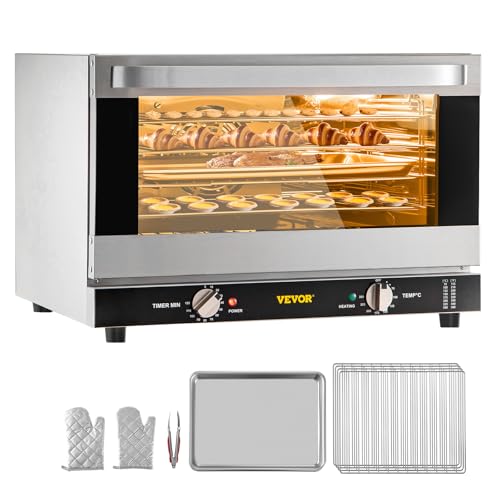
VEVOR’s 47 litre entry is the accessible door into commercial convection: a half-size, four-tier countertop oven at 1600 watts on a standard 120V supply, aimed at restaurants and bakeries, and bundled with the trays, wire racks and clip gloves a working setup needs on day one. The front glass door lets you watch a bake without opening the cavity and dumping the heat, a small detail that working bakers appreciate more than any preset.
Strengths
- 47L four-tier half-size capacity at an accessible commercial tier
- Runs on 120V, per the title, easing installation in North American premises
- Trays, wire racks and clip gloves included in the box
Trade-offs
- Value-tier commercial build; heavy professional users should compare duty expectations with the Waring and Cadco
- Four tiers of a 47L cavity means each tier is shallow; tall items belong on one rack with tiers removed
- Restaurant-bakery positioning means home-style convenience features are absent
| Capacity (from listing title) | 47L / 43Qt, half-size, 4-tier |
| Power (from listing title) | 1600W |
| Voltage (from listing title) | 120V |
| Included (from listing title) | Front glass door, trays, wire racks, clip gloves |
The four-tier layout is this oven’s argument: cookies, pastries, meringues and reheated portions in parallel layers, turning a single countertop footprint into a small production line. For a market stall baker or a cafe adding a bake-off programme, that multiplication matters more than raw cavity size, and the 120V supply means the machine can often be installed without an electrician’s visit, on a circuit that can honestly carry 1600 watts.
Judge it as what it is, an entry commercial oven, and it is compelling. Judge it against the Cadco’s decade-duty construction and the comparison is unfair in both directions. Small operations buying their first commercial convection oven will find the VEVOR’s combination of capacity, standards and simplicity hard to argue with.
Best for: Small restaurants, cafes and market bakers buying a first commercial convection oven / Not suited for: High-volume production bakeries, or home users wanting domestic presets and polish

KoolMore KM-CTCO-15 23-Inch Commercial Countertop Convection Oven — Best Compact Commercial
The KoolMore closes the commercial trio with a 23-inch footprint, half-size pan compatibility, four racks and 1600 watts in stainless steel, carrying an ETL listing for safety and sanitation that commercial buyers and inspectors both recognise. Its proposition is density: professional pan standards and multi-rack throughput in the smallest counter run of the three, for premises where every inch of counter is already spoken for.
Strengths
- Half-size pan standard with four racks in a compact 23-inch body
- 1600W of power matches the VEVOR while the footprint shrinks
- ETL listed for safety and sanitation, as stated in the title
Trade-offs
- Compact commercial cavity still demands commercial expectations on controls and care
- Four racks in a tight cavity favour flat items; tall bakes need rack management
- A commercial machine’s noise and heat output exceed domestic norms
| Size (from listing title) | 23 in commercial countertop |
| Capacity (from listing title) | Half-size pans, 4 racks |
| Power (from listing title) | 1600W |
| Certification (from listing title) | ETL listed for safety and sanitation |
Counter space is the scarcest resource in small food businesses, and the KoolMore is designed by people who know it. A food truck adding baked items, a coffee shop bake-off corner, a deli reheating and finishing through lunch: these are the counters where 23 inches that behaves like a professional oven changes the menu. The four-rack layout keeps portions moving, and stainless construction wipes down at close without ceremony.
As with its commercial siblings, home buyers should admire it from a distance unless their baking is genuinely production-shaped. For its intended buyer, the checklist is short and satisfied: pan standard, rack count, power, certification, footprint. That is what a well-aimed commercial product looks like.
Best for: Food trucks, coffee shops and delis needing professional convection in minimal counter space / Not suited for: Home kitchens wanting domestic features, or high-volume bakeries needing larger cavities
Comparison Table
| Pick | Badge | Key spec | Best for |
|---|---|---|---|
| Cuisinart Convection Toaster Oven, 15-Function, 1800W (TOB-260N1) | Best Overall for Home Kitchens | 15 functions, 1800W, fits 13″ pizza | Home cooks who want one countertop oven to handle weekday cooking end to end |
| Breville BOV800XL Smart Oven | Best Smart Home Convection | Smart Oven, convection cuts time up to 30% | Recipe-driven home bakers and cooks who value even, predictable results |
| Waring WCO500X Countertop Convection Oven, Half-Size | Best Commercial Half-Size | 1.5 cu ft, 4 half-size pans, 120V, NSF | Cafes, bakeries, market bakers and caterers working in half-size sheet pans |
| Cadco XAF-133 Heavy-Duty Countertop Convection Oven, 208-240V | Best Heavy-Duty Commercial | 208-240V commercial, humidity, manual controls | Professional bakeries and institutions with 208-240V service baking bread and pastry daily |
| VEVOR Commercial Convection Oven 47L Half-Size | Best Value Commercial | 47L, 4-tier, 1600W, 120V | Small restaurants, cafes and market bakers buying a first commercial convection oven |
| KoolMore KM-CTCO-15 23-Inch Commercial Countertop Convection Oven | Best Compact Commercial | 23 in, half-size pans, 4 racks, 1600W, ETL | Food trucks, coffee shops and delis needing professional convection in minimal counter space |
How to Choose the Best Counter Top Convection Oven
Decide which world you are buying in before comparing a single model. Home ovens speak in pizzas and chickens; commercial ovens speak in sheet pans and rack counts. Neither language is wrong, but they describe different workflows. If your trays are domestic baking sheets and your goal is better weeknight cooking, the home picks will serve you beautifully. If you bake in batches, sell food, or already own half-size sheet pans, the commercial picks speak your language and will out-work any domestic machine.
Next, take convection itself seriously. A fan should do two things: shorten cooking times, as the Breville’s stated up-to-30-percent figure illustrates, and even out the tray so the back row stops burning while the front row pales. When you read any oven’s claims, look for that specificity. Then check the unglamorous fit questions: the largest dish you actually cook, the counter depth with the door open, and the circuit. An 1800 watt home oven or a 1600 watt commercial unit deserves a socket and breaker that can carry it alongside your other appliances.
Finally, match controls to the cook. Households juggling homework and dinner benefit from functions and presets. Professionals reach for manual dials that work with floury hands and never need a software decision. Both instincts are correct, in their own kitchens.
Convection Cooking Technique: Getting the Even, Fast Results You Paid For
Convection rewards small adjustments. Reduce recipe temperatures modestly or shorten times, and check food a few minutes early until the oven’s personality is familiar; the fan’s efficiency is real, and yesterday’s timings will overcook today’s tray. Leave space between items and between pans: convection is moving air, and a cavity packed wall to wall blocks the very circulation you bought. In multi-rack commercial ovens, rotate pans between tiers halfway through for the most even batch.
Use the right vessels. Low-sided pans let air reach food surfaces, which is where crisping happens; deep dishes shield their contents and belong to braising logic, not convection logic. Preheat fully before the tray goes in, because a small cavity loses proportionally more heat at the door opening than a big one, and it recovers fastest when it started from a stable temperature.
Home vs Commercial Countertop Ovens: Ownership, Cleaning and Care
Ownership differs as much as cooking. Home ovens offer nonstick interiors and domestic cleaning expectations; commercial ovens offer stainless cavities built to be scrubbed daily and inspected. Both reward a simple ritual: crumbs out while the oven is warm, a wipe of the door seal, and a check that the fan guard stays clean, because a grease-filmed fan moves less air and flavours tomorrow’s bake with yesterday’s roast.
Ventilation and placement rules are shared. Give any countertop convection oven the clearances its manual specifies, keep it off circuits already loaded with kettles and microwaves at peak hour, and never run a commercial-voltage model like the Cadco on anything but its rated supply. Treat those basics with respect and either class of oven will repay you with years of even, fast cooking.
Sheet Pan Literacy: The Commercial Sizes Explained for Home Bakers
Commercial ovens speak in fractions of a sheet pan, and the dialect is worth learning before you buy. A full sheet pan is the bakery standard, roughly 18 by 26 inches; a half sheet is half that, and a quarter sheet half again. Home baking sheets sold as cookie sheets are usually close cousins of the half sheet, which is why the commercial ovens in this guide, rated in half-size pans, can feel surprisingly familiar to an experienced home baker’s hands.
The practical consequence: if your existing trays measure near the half sheet standard, a commercial countertop oven may integrate with your kitchen more smoothly than its industrial looks suggest. Measure your favourite pan before dismissing the commercial picks, and measure the oven’s rack spacing against your tallest regular bake. Pan literacy turns a confusing category into a simple matching exercise.
Convection for Baking Science: Why Moving Air Changes Crumb and Crust
Still air insulates. In a static oven, a cool boundary layer clings to food surfaces, slowing heat transfer and letting moisture linger where crusts are trying to form. A convection fan strips that layer away continuously, which is why the same temperature cooks faster and browns more assertively with the fan on. Understanding that mechanism explains the technique rules elsewhere in this guide: space between items preserves the airflow, low pans expose surfaces to it, and crowded cavities quietly revert to static-oven behaviour.
It also explains convection’s one famous side effect: delicate batters can lean or skin over under a strong fan, which is why experienced bakers drop the fan for the first minutes of a sponge or use the gentlest setting for soufflés and choux. The fan is a tool with a dial of intensities, and the cooks who get famous results from these ovens are the ones who learned to turn it down as deliberately as they turn it up.
Duty Cycles and Longevity: What Commercial Buyers Know That Home Buyers Should Borrow
Commercial ovens are rated by the work they can repeat: tray after tray, service after service, without sagging temperature or sulking electronics. Home ovens are rarely asked that question, which is why a keen home baker who produces for markets, churches or a big family’s freezer can outgrow a domestic machine while a commercial unit is still bored. If your baking has a production shape, judge ovens by recovery: how fast the cavity returns to temperature after a cold tray goes in and the door has been open.
Longevity follows the same logic. Manual controls, stainless cavities and standard pan hardware age gracefully because every part is either simple or replaceable. That is the deeper reason the commercial picks appear in a general guide: for the small group of home users whose cooking is genuinely production-shaped, they are not overkill. They are the first ovens that will not need replacing when the hobby becomes a livelihood.
Temperature Mapping: Learning Your Oven’s True Personality in One Afternoon
Every convection oven has a personality: a back-left corner that runs hot, a tier that browns faster, a displayed temperature that flatters the truth by a few degrees. Professionals map a new oven once and cook with the map forever. You can do the same in an afternoon with a tray of pale biscuits or slices of white bread spread across every rack position: bake, photograph the browning pattern, and you hold a permanent chart of where delicate items belong and where the aggressive browning lives.
An inexpensive oven thermometer completes the map by telling you the gap between the dial and reality at your most-used temperatures. None of this is pedantry; it is the difference between blaming recipes and knowing your equipment. The ovens in this guide, home and commercial alike, reward the mapped cook with a consistency that looks, from the outside, like talent.
From Countertop to Career: When a Home Baker Should Go Commercial
The transition announces itself in symptoms: the home oven cannot recover temperature between batches, a market day requires military scheduling around a domestic duty cycle, and the baking that used to be pleasure becomes logistics. At that point the commercial picks in this guide stop being industrial curiosities and become the honest next step, with pan standards, rack counts and recovery rates that treat your production as the normal case rather than an abuse of the equipment.
The step need not be dramatic. A single half-size commercial countertop oven alongside the home machine transforms a production day: the commercial unit runs the batches, the home unit handles the delicate and the experimental. Many small bakeries began exactly there, on one counter, with one machine that finally kept up. If your baking life is bending toward volume, let this guide’s commercial trio be the shortlist you grow into rather than the one you discover after the home oven fails mid-season.
Reading Reviews of Countertop Convection Ovens Without Being Misled
This category’s reviews, elsewhere, suffer from three recurring distortions worth naming so you can discount them. The first is capacity inflation: ovens described by their exterior dimensions or by a pizza diameter they fit only with the door open. This guide’s insistence on title-stated claims is the antidote, and you can apply the same test anywhere: find the claim in the specifications, in inches and pans, or treat it as atmosphere. The second distortion is function counting, where a timer variation becomes a separate function; judge repertoires by the distinct cooking methods named, not by the integer on the box.
The third distortion is the silent voltage. Commercial equipment listings sometimes bury the supply requirement deep in a specification table, and more than one home buyer has taken delivery of a 208-240 volt oven for a 120 volt kitchen. The Cadco in this guide is flagged repeatedly precisely because the mistake is so common and so avoidable. Read the electrical line of any oven, home or commercial, before the feature list, and you will never join that particular club of disappointed buyers.
Countertop Convection in Rental and Temporary Kitchens
There is a setting where countertop convection quietly outperforms every alternative: the kitchen you do not own. Rentals with a tired or absent oven, temporary accommodation during a renovation, a site cabin, a holiday property you return to yearly: in all of them, a countertop convection oven restores real cooking without installation, landlord negotiation or a gas fitter. The home picks in this guide need only a suitable socket and their clearances, and they leave with you when the tenancy ends.
That portability also makes them the thinking cook’s insurance policy. When a main oven fails in December, and they specialise in failing in December, the countertop machine that already lives in the kitchen absorbs Christmas rather than merely assisting it. Owners who bought for weeknight convenience discover, in that week, that they had quietly bought resilience too. Few appliances repay their footprint in as many different lives as this category does.
A Note on Second-Hand and Refurbished Commercial Ovens
Commercial countertop ovens circulate on the second-hand market whenever cafes close or upgrade, and for a confident buyer they can be remarkable value: stainless cavities and manual controls age slowly, and a Waring or Cadco class machine with years of service behind it often has years ahead of it too. Inspect before you commit: heat the oven and watch it hold temperature, check the fan for noise and wobble, examine the door seal and hinges, and confirm the rating plate’s voltage matches your supply, because second-hand listings are where the 208-240 volt mistake most often hides.
Factor the consumables into the price. Racks, pans and a fresh door seal are cheap; a failed fan motor or element on an unfamiliar model may not be. Bought with those checks done, a used commercial oven is not a compromise purchase. It is the professional market’s normal circulation of durable goods, and a home production baker who joins it gets commercial duty at a domestic price.
How to Use a Counter Top Convection Oven for the First Time
Your first three cooks teach you the oven. Structure them deliberately and the learning curve collapses.
- Place the oven with its specified clearances, plug it into a suitable circuit, and run it empty at a moderate temperature for a short burn-in if the manual advises one, to clear manufacturing residues.
- First cook: a tray of vegetables at a familiar temperature, checking five minutes before your usual time. Note the colour difference between the front and back of the tray.
- Second cook: a batch of cookies or scones, the ultimate evenness test. If one side colours faster, plan a halfway rotation into your routine for that food.
- Third cook: reheat leftovers, the daily job. Compare the result with your old method; convection should return edges and crispness that a microwave destroys.
- Record your adjustments, temperature trimmed, time shortened, rotation added, on a card kept with the oven. Three cooks of notes become a personal conversion table for every recipe you own.
- Clean while warm: crumbs out, interior wiped, fan guard checked. Make it a same-day habit and the oven never becomes a project.
Within a week the oven stops being new equipment and becomes the way cooking works in your kitchen, which is the quiet definition of a successful appliance purchase.
Common Buying Mistakes
- Buying a commercial-voltage oven for a home kitchen. The Cadco in this guide runs on 208-240V. Check every oven’s supply requirement before ordering, not at installation.
- Judging capacity by litres alone. What matters is whether your pans and dishes fit. Home buyers should think in pizzas and chickens; commercial buyers in sheet pan sizes.
- Packing the cavity tight. Convection is moving air. Crowded pans block circulation and recreate the uneven results you bought the fan to escape.
- Using full-size oven timings unchanged. Convection cooks faster. Check early, trim time or temperature, and write down what worked.
- Ignoring the circuit. An 1800W oven sharing a loaded kitchen circuit will find the breaker at the worst moment. Plan the socket as part of the purchase.
- Skipping the halfway rotation on multi-rack bakes. Even good convection has tiers that run hotter. One rotation is cheap insurance for a uniform batch.
Final Recommendation
For most homes, the Cuisinart TOB-260N1 is the complete answer: fifteen functions, real capacity and convection that handles everything from toast to a full chicken. The Breville Smart Oven is the connoisseur’s alternative, recipe-focused and even-tempered. Cross to the commercial world and the choice sharpens by workflow: the Waring for half-size pan production with NSF credentials, the VEVOR for four-tier value on a standard supply, the KoolMore for professional density in 23 inches, and the Cadco, on its proper commercial voltage, as the heavy-duty summit for bakers who need humidity and permanence.
Whichever world you choose, choose it knowingly. The divide between home and commercial countertop convection is the most useful thing this guide can teach, and the oven on the right side of it will feel right every single day.
The shortlist in one line: Cuisinart Convection Toaster Oven, 15-Function, 1800W (TOB-260N1); Breville BOV800XL Smart Oven; Waring WCO500X Countertop Convection Oven, Half-Size; Cadco XAF-133 Heavy-Duty Countertop Convection Oven, 208-240V; VEVOR Commercial Convection Oven 47L Half-Size; KoolMore KM-CTCO-15 23-Inch Commercial Countertop Convection Oven.
Keep exploring related guides on this site: Best Countertop Ovens With Convection Best Countertop Convection Ovens That Hold A 12 Pizza Best Counter Top Convection Ovens Best Toaster Ovens Best Commercial Convection Ovens
Frequently Asked Questions
What is the advantage of a countertop convection oven over a regular toaster oven?
The fan. Moving hot air cooks food faster, the Breville in this guide states up to 30 percent faster on its convection setting, and far more evenly, so trays brown uniformly instead of in patches. For roasting, baking and reheating, that combination is a genuine upgrade rather than a marketing adjective.
Can a countertop convection oven replace my full-size oven?
For many households, on weekdays, yes. Models like the Cuisinart here fit a 13-inch pizza or a full-size chicken, which covers most everyday cooking. The full-size oven still wins for very large items, multiple big dishes at once and holiday-scale cooking, so most owners end up using the countertop oven daily and the range occasionally.
What does half-size sheet pan capacity mean?
It is the commercial standard: pans roughly half the size of a full bakery sheet pan. Ovens rated in half-size pans, like the Waring, VEVOR and KoolMore here, are built for cafes, bakeries and food service workflows where those pans, and the racks that hold them, are the unit of production.
Why does one oven in this guide need 208-240 volts?
Because it is a heavy-duty commercial machine, and commercial kitchens commonly have 208-240 volt service for exactly this class of equipment. The Cadco XAF-133 cannot run on a standard 120 volt home outlet. If you do not have that supply, choose one of the 120V models instead.
How much faster is convection, really?
A useful working expectation is that food cooks noticeably sooner, which is why this guide advises checking several minutes early and trimming either time or temperature until you know your oven. The one figure stated in a verified title here is Breville’s: its convection setting reduces cooking time by up to 30 percent.
Do countertop convection ovens need special pans?
Home models use your ordinary oven-safe dishes that fit the cavity. Commercial models are built around sheet pan standards, which is a benefit if you adopt the pans and a mismatch if you do not. In both worlds, low-sided pans let the moving air reach food surfaces and produce the crispest results.
Do I need special cookware for a countertop convection oven?
No special cookware category exists; you need oven-safe dishes that fit the cavity with air space around them. Metal pans suit the high, dry heat best, glass and ceramic work for bakes and gratins, and silicone suits baking. Measure your largest regular dish against the cavity before buying, as this guide advises.
How loud is a countertop convection oven’s fan?
Audible but modest in home models, comparable to a microwave’s fan, and more noticeable in commercial units built for duty over quietness. It runs only while cooking. If the oven will live in a studio space where someone sleeps, favour the home picks here and check the machine’s behaviour in person where possible.