Disclosure: airfryerkitchensupply.com is reader-supported. When you buy through links on our site, we may earn an affiliate commission at no extra cost to you.
Where to buy
Every grinder in this guide to the best household meat grinders is sold through Amazon, where listings confirm the current bundle — plates, tubes, and accessories vary by seller configuration, so check what is in the box before comparing. Start with the LEM #8 Countertop for the benchmark, the LEM MightyBite #8 for small batches, or the KitchenAid KSMMGA attachment if a stand mixer already anchors your counter. Value hunters should compare the Sunmile SM-G50 and the STX Turboforce 3000 bundle.
The best household meat grinders do one job that store-bought ground meat cannot: they let you choose the cut, the fat ratio, and the freshness of what goes into your burgers, meatballs, and sausage — and once a household tastes a chuck-and-brisket burger ground ten minutes before cooking, the supermarket tube loses its appeal. This guide compares the best household meat grinders across the real decision space: specialist standalone machines, a mainstream compact, a maximalist bundle, a budget benchmark, and the attachment that turns a stand mixer into the grinder.
Two honest calibrations before the picks. First, grinder size numbers — #8, #12, #22 — describe the plate diameter class, and #8 is the household standard: big enough for family batches, small enough to store. Second, wattage marketing in this category is optimistic; several listings quote peak or maximum figures rather than sustained power. The reviews below flag that where it applies and judge machines by the things that actually determine your grind: head size, knife and plate quality, gear construction, and whether the maker sells parts. Every pick was verified against Amazon’s catalog data before inclusion; check the current price on Amazon from each pick’s link.
In this guide
Quick Picks
- LEM #8 Countertop Meat Grinder, 575 Watt — Best Overall. The household benchmark: a #8 grinder from the company that supplies hunters and homesteaders, sized and priced for home kitchens without giving up the real-grinder build. Check the current price on Amazon.
- Cuisinart MG-100 Electric Meat Grinder — Best Compact Brand-Name. Cuisinart’s stainless countertop grinder: the mainstream-appliance answer for households that grind occasionally and value compact storage and a familiar brand. Check the current price on Amazon.
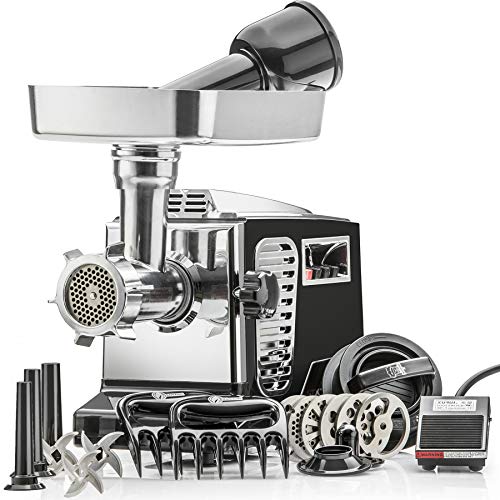
- STX International Turboforce 3000 Series — Best Accessory Bundle. The maximalist bundle: five grinding dies, three blades, sausage and kubbe attachments, even a juicer — the most complete starter kit in home grinding, with a 3000W max (peak) motor rating. Check the current price on Amazon.
- Sunmile SM-G50 ETL Electric Meat Grinder — Best Budget. The budget benchmark: metal gears, a reverse function, a circuit breaker, and stainless blade and plates — the fundamentals done right at the price tier where they are usually skipped. Check the current price on Amazon.
- KitchenAid KSMMGA Metal Food Grinder Attachment — Best for Stand Mixer Owners. If a KitchenAid stand mixer already lives on your counter, this all-metal attachment turns it into the grinder — no second motor, no second appliance to store. Check the current price on Amazon.
- LEM MightyBite #8 Meat Grinder, 500 Watt — Best Small-Batch LEM. LEM’s compact MightyBite: a #8 head and 500 watts in the smallest footprint the brand makes — the specialist grinder for small batches and small kitchens. Check the current price on Amazon.
How These Picks Were Chosen
We required every pick to be a genuine household machine — sized for kitchens, not for processing a deer herd — and then judged them on the mechanics of grinding itself: how cleanly the knife and plate cut rather than smear, whether the drive is built to survive a jam, how the machine behaves across a ten-pound batch as meat warms, and how deep the maker’s parts ecosystem runs, because a grinder’s second decade depends entirely on replaceable knives and plates.
That filter is why the specialist brand LEM anchors this list twice: in home grinding, the ecosystem is the product. The mainstream, bundle, and budget picks earned their places by serving real household patterns the specialists price above — occasional use, first-machine experimentation, and tight budgets — without failing the safety and construction basics. The attachment earned its place by arithmetic: for a KitchenAid household it is the only pick that adds no appliance to the kitchen.
The 6 Best Household Meat Grinders, Reviewed

LEM #8 Countertop Meat Grinder, 575 Watt — Best Overall
LEM is the name serious home processors learn first, because the company sells to people who grind hundreds of pounds a season and cannot afford a toy. The #8 Countertop is where that lineage meets the household brief: a real #8 grinding head — the plate size that defines home-grinder capacity — driven by a 575-watt motor in an aluminum housing, sized to live in a kitchen cabinet rather than a barn. It grinds burger, sausage meat, and pet food at a pace that keeps a home batch moving without ever feeling like the bottleneck.
It suits the widest range of households in this guide: the family that buys chuck on sale and grinds its own burger, the home sausage maker working in five-to-ten-pound batches, the raw-pet-food household grinding weekly. If you want one grinder, from the brand that will sell you plates, knives, and parts for the next decade, this is the default recommendation and it is not close.
Strengths
- Real #8 head and a motor matched to it, from the category’s benchmark brand
- Deep parts and accessory ecosystem: plates, knives, stuffing tubes all orderable
- Aluminum housing keeps it light enough to move and store like a kitchen appliance
Trade-offs
- Aluminum rather than stainless housing — a step below LEM’s own BigBite line in build
- Household pace: it is not the tool for a whole deer in an afternoon
- Accessories beyond the basics are separate purchases, as with all LEM gear
| Grinder size | #8 (per Amazon title) |
| Power | 575 watt (per Amazon title) |
| Housing | Aluminum (per Amazon title) |
What ownership teaches is that grinder quality is mostly about the unglamorous parts: the knife and plate staying sharp and flat, the auger feeding evenly instead of smearing, and the motor holding its pace as the meat warms. The LEM #8 does these things the way a decade of iteration teaches a company to do them. Meat comes through as distinct strands rather than paste — the difference between burger with texture and burger with the consistency of pâté — and that difference is the entire reason to grind at home.
Support seals it. When you dull a knife in year three, LEM sells the knife. When you want a finer plate for sausage or a coarser one for chili grind, the plates exist and fit. A grinder is a twenty-year appliance bought from a company’s ecosystem as much as from its spec sheet, and LEM’s ecosystem is the deepest in home grinding.
Best for: Most households: regular burger, sausage, and pet-food grinding in home-size batches / Not suited for: Hunters processing whole animals — that is the BigBite class in our hunting guide
Check the current price on Amazon for the LEM #8 Countertop grinder.

Cuisinart MG-100 Electric Meat Grinder — Best Compact Brand-Name
Not every household grinds weekly, and Cuisinart’s MG-100 is built for the honest majority: people who grind a few pounds for a special burger night, a batch of meatballs, or holiday sausage a few times a year, and who want the appliance to be compact, presentable, and supported by a brand their kitchen already trusts. Its stainless finish matches a modern counter, and its footprint respects the cabinet it will live in between sessions.
It suits smaller households, occasional grinders, and buyers who weigh warranty handling and mainstream retail support heavily. Within its intended duty — a few pounds at a time, rested between batches — it does the household jobs without drama.
Strengths
- Compact, counter-friendly design from a mainstream appliance brand
- Stainless finish suits modern kitchens and wipes down easily
- Simple operation for occasional, small-batch grinding
Trade-offs
- Built for occasional duty; sustained big batches are beyond its brief
- Smaller head and throughput than the LEM #8 class
- Accessory and plate ecosystem is shallower than the specialist brands’
| Model | MG-100 (per Amazon title) |
| Finish | Stainless steel (per Amazon title) |
The way to judge the MG-100 is against its actual job description. For the household that grinds five pounds on a Saturday and puts the machine away, it is quick to set up, adequate in pace, and easy to clean — and those virtues, repeated a dozen times a year, are the ownership experience. Ask it to behave like a LEM through twenty pounds of warming pork shoulder and you will meet its limits in heat and pace, which is not a defect but a category boundary.
Buy it with clear eyes and it satisfies for years: chill the meat well, work in modest batches, let it rest when the housing warms. Households that discover they grind more than expected can graduate to the LEM class with the Cuisinart as the machine that taught them the habit.
Best for: Occasional grinders and small households wanting a compact, familiar-brand machine / Not suited for: Weekly high-volume grinding or sausage production in large batches
Check the current price on Amazon for the Cuisinart MG-100.

STX International Turboforce 3000 Series — Best Accessory Bundle
The STX Turboforce 3000 competes on a different axis from the LEM: completeness. Where the specialist brands sell you a grinder and then an ecosystem, the STX puts the ecosystem in the box — five grinding dies for textures from fine sausage to coarse chili grind, three stainless blades so a dull one never stops a session, sausage stuffing and kubbe attachments, and a juicer conversion for households that like their appliances plural. For a first grinder, that bundle removes every ‘I also need to buy’ moment between the box and the first batch.
It suits beginners who want to experiment across grinds and projects without a second purchase, and households that value versatility — sausage this month, kubbe next, juice in between. A note on the headline number, because honesty matters in this guide: 3000W is a maximum/peak rating, the convention of this market tier; judge the machine by its sustained grinding behavior, which owners find adequate for household batches, not by the biggest number on the box.
Strengths
- The most complete accessory kit in home grinding, included in the box
- Multiple dies and spare blades enable real experimentation from day one
- Three speeds give control across meats and the juicer function
Trade-offs
- Peak-watt marketing requires the calibration given above
- Jack-of-all-trades design; the specialist brands beat it on single-purpose refinement
- Long-term parts support runs through the seller rather than a deep dealer network
| Motor | 3000W max (peak rating, per Amazon title) |
| Speeds | 3-speed (per Amazon title) |
| Included | 5 grinding dies, 3 stainless blades, sausage stuffer, kubbe maker, juicer attachment (per Amazon title) |
In use, the STX’s virtues are the beginner’s virtues. The range of dies teaches you what grind sizes actually do — most new grinders own one plate and never learn what they are missing — and having a spare blade teaches the category’s first lesson painlessly: when grinding slows and smears, the knife is dull, and here the replacement is already in the drawer. The three speeds earn their keep on the juicer and on delicate work more than on burger, but control is never unwelcome.
Buy it as a starter platform and a variety machine. If grinding becomes a serious household production, you will eventually want a specialist grinder for the main work — and the STX will still be the box you reach for when a recipe calls for the odd die or the kubbe attachment.
Best for: Beginners and experimenters who want every grind and attachment in one purchase / Not suited for: Purists who want a single-purpose machine from a specialist maker
Check the current price on Amazon for the STX Turboforce 3000.

Sunmile SM-G50 ETL Electric Meat Grinder — Best Budget
Budget grinders fail in predictable places: plastic gears that strip, no reverse to clear a jam, motors that cook themselves against a tough batch. The Sunmile SM-G50 is the budget pick because it refuses those specific failures — metal gears, a reverse function, a circuit breaker to protect the motor, and stainless steel for the blade and plates that touch the meat, all under an ETL listing that says the electrical safety was actually examined. That is the correct list of things to spend a small budget on.
It suits first-time buyers testing whether home grinding is for them, smaller households grinding modest batches, and anyone whose alternative was a no-name machine with none of the above. Its power figures, like the STX’s, are maximum ratings in the tier’s convention — judge it by household-batch behavior, where it performs its brief.
Strengths
- Metal gears and a circuit breaker protect the machine’s working life
- Reverse function clears jams without disassembly
- Stainless blade and plates, ETL listing — the fundamentals are right
Trade-offs
- Budget fit and finish; it feels like the tier it is
- Sustained pace is modest — work in batches and keep meat cold
- Support and spare parts run through the seller
| Drive | Metal gears (per Amazon title) |
| Safety | Circuit breaker, ETL listed (per Amazon title) |
| Cutting parts | Stainless steel blade and plates (per Amazon title) |
The SM-G50’s ownership lesson is that cheap and correct beats cheap and flashy. The reverse button alone saves the session every grinder owner eventually faces — a wad of sinew at the plate, cleared in two seconds instead of a teardown — and the breaker means the mistake costs a reset, not a motor. Keep the meat cold and cubed small, feed steadily rather than forcing, and the machine returns tidy grinds for burgers and sausage at household scale.
For a household deciding whether grinding belongs in its life, this is the lowest-risk way to find out: the fundamentals are sound, the safety is real, and if the habit sticks and volume grows, you will know exactly which LEM to graduate to and why.
Best for: First-time and budget buyers who want the safety and durability fundamentals right / Not suited for: High-volume households or anyone expecting specialist-brand pace
Check the current price on Amazon for the Sunmile SM-G50.
KitchenAid KSMMGA Metal Food Grinder Attachment — Best for Stand Mixer Owners
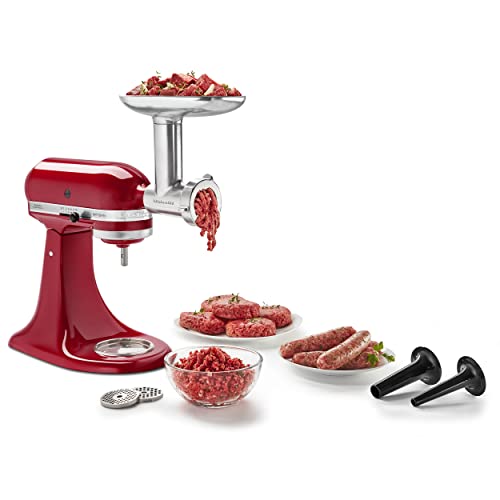
The best grinder for a KitchenAid household may not be a grinder at all. The KSMMGA is the metal version of KitchenAid’s grinder attachment — the material matters, because the cheaper plastic variant is the one with the cracking stories — and it mounts to the mixer’s hub, borrowing a motor you already own, already store, and already know. It arrives with tray, pusher, plates, and sausage stuffer tubes: a complete grinding station that stores in a fraction of a standalone machine’s space.
It suits the millions of kitchens where a stand mixer is the resident heavy appliance and grinding is a regular-but-not-industrial job: weekly burger batches, sausage projects, grinding for meatballs and dumplings. The mixer’s motor, working through the hub, handles household batches with the calm of a machine built for bread dough.
Strengths
- No second appliance: uses the mixer you already own and store
- All-metal construction — the durable version of this attachment
- Complete kit included: tray, pusher, plates, and stuffing tubes
Trade-offs
- Requires a KitchenAid stand mixer — it is an attachment, not a grinder
- Throughput is mixer-paced; marathon sessions are the standalone machines’ territory
- The mixer is occupied while grinding — no simultaneous mixing
| Compatibility | All KitchenAid stand mixers (per Amazon title) |
| Construction | Metal food grinder attachment (per Amazon title) |
| Included | Food tray, pusher, grinding plates, sausage stuffer tubes and plate (per Amazon title) |
The ownership experience is defined by storage and setup. The attachment lives in a drawer or a small box, mounts in under a minute, and after the session the mixer returns to its counter post while the attachment washes and disappears. For apartment and small-kitchen households, that arithmetic beats a standalone grinder that must justify a cabinet forever. Grind quality in metal, with the plates kept sharp, is genuinely good — distinct strands, even texture, no smearing when the meat is properly cold.
The limits are the honest ones: pace is the mixer’s pace, and a household that discovers a passion for twenty-pound sausage days will outgrow it into a dedicated machine. But for the great middle of home grinding, if a KitchenAid already anchors your counter, this attachment is the smartest money in the guide.
Best for: KitchenAid owners who grind regularly but not industrially, and small kitchens / Not suited for: Households without a stand mixer, or high-volume processors
Check the current price on Amazon for the KitchenAid KSMMGA.

LEM MightyBite #8 Meat Grinder, 500 Watt — Best Small-Batch LEM
The MightyBite is LEM’s answer to a specific household: one or two people, small batches, limited storage, but no willingness to buy a toy. It keeps the essentials of the brand — a real #8 head, LEM’s plates and knives, the accessory ecosystem — and trims the motor to 500 watts and the body to the line’s most compact form. For a couple grinding two pounds of burger on a weeknight, it is not a compromise at all; it is the correctly sized tool.
It suits small households, apartment kitchens, pet-food grinding in small weekly batches, and as a second grinder in serious households — the one that lives in the kitchen while the big machine lives in the garage, handling the small jobs without the big setup.
Strengths
- Full LEM #8 ecosystem in the brand’s most compact body
- Correctly sized for small batches: quick setup, quick cleanup
- Same plates, knives, and support as the bigger LEMs
Trade-offs
- 500 watts sets a real pace ceiling on large or warm batches
- Not the tool for production sausage days or game processing
- Per-pound-of-capacity, you pay for the brand like all LEM gear
| Grinder size | #8 (per Amazon title) |
| Power | 500 watt (per Amazon title) |
| Housing | Aluminum (per Amazon title) |
Small grinders live or die on whether they get used, and the MightyBite’s virtue is friction removal: it is light to fetch, fast to assemble, and sized so a two-pound batch feels like a two-minute job rather than a project. That is how grinding becomes a habit instead of an event, which is the actual goal for a household machine. The #8 head means the habit never outgrows the plates — grind size options are the full LEM range.
Pair it with the discipline all small grinders want — cold meat, modest batches, a rest if the housing warms — and it will serve a small household for years. If the household grows into volume, it graduates to second-grinder duty instead of the donation box, which is more than most small appliances manage.
Best for: Small households and small batches wanting specialist quality in a compact body / Not suited for: Large batches, production sausage making, or game processing
Check the current price on Amazon for the LEM MightyBite #8.
Comparison Table
| Pick | Badge | Key spec | Best for |
|---|---|---|---|
| LEM #8 Countertop Meat Grinder, 575 Watt | Best Overall | #8 size, 575W, aluminum housing | Most households: regular burger, sausage, and pet-food grinding in home-size batches |
| Cuisinart MG-100 Electric Meat Grinder | Best Compact Brand-Name | Countertop, stainless steel finish | Occasional grinders and small households wanting a compact, familiar-brand machine |
| STX International Turboforce 3000 Series | Best Accessory Bundle | 6-in-1 bundle, 5 dies, 3 speeds | Beginners and experimenters who want every grind and attachment in one purchase |
| Sunmile SM-G50 ETL Electric Meat Grinder | Best Budget | Metal gears, reverse, ETL listed | First-time and budget buyers who want the safety and durability fundamentals right |
| KitchenAid KSMMGA Metal Food Grinder Attachment | Best for Stand Mixer Owners | Attachment for all KitchenAid stand mixers | KitchenAid owners who grind regularly but not industrially, and small kitchens |
| LEM MightyBite #8 Meat Grinder, 500 Watt | Best Small-Batch LEM | #8 size, 500W, compact | Small households and small batches wanting specialist quality in a compact body |
How to Choose the Best Household Meat Grinders
Decide by volume first, honestly assessed: how many pounds, how often. A few pounds monthly points to the compact or budget picks; weekly family batches point to the #8 standalones; the attachment answers a different question — whether you need a separate machine at all. Then decide by ecosystem: if grinding will become a household production (sausage varieties, pet food, bulk buying), buy into the brand whose plates and parts you can order for a decade. Everything else — wattage headlines, speed counts, accessory lists — is secondary to those two decisions.
Grinder sizes and what #8 actually means
The number is the size class of the grinding head, which sets the plate diameter and, with it, the machine’s appetite. #8 is the household class: plates around two and three-eighths inches, a throat that takes inch-and-a-half cubes comfortably, and a pace that empties a five-pound bowl of cubed meat in minutes rather than seconds. #12 is the prosumer step — faster, hungrier, bigger to store — and #22 and up belong to the hunting and homestead world covered in our companion guide. For a household, #8 is not the small compromise; it is the size the duty actually calls for, and oversizing mainly buys storage pain.
Power ratings, translated honestly
This category’s wattage figures need a translator. Standalone specialists like LEM quote conservative motor ratings — a 500 or 575-watt LEM rating describes sustained working power. Value brands often quote maximum or peak watts, the number the motor can touch momentarily, which is why a ‘3000W’ bundle machine and a 575-watt LEM can grind a household batch at comparable real-world pace. The lesson is not that one side lies; it is that cross-brand wattage comparison is meaningless, and the honest comparisons are head size, gear material, and observed batch behavior — the criteria this guide’s reviews actually use.
Knives, plates, and why they decide grind quality
Ground meat quality is made at the knife-and-plate interface. A sharp knife sweeping a flat plate shears meat into distinct strands; a dull knife or a warped plate smears it into paste, warming it and wrecking texture no seasoning can restore. This is why the specialist ecosystem matters — replacement knives and plates are consumables on a multi-year cycle — and why the STX’s spare blades and the Sunmile’s stainless cutting parts earned genuine credit in their reviews. Whatever you buy, learn the symptom: when grinding slows and the output turns pasty, stop and check the knife before blaming the motor.
Attachments, stuffing, and the second job
Most household grinders moonlight as sausage stuffers, and the honest review is that they are adequate stuffers and excellent grinders. Driving casing-filling through a grinding head works for household batches — the picks here include tubes for it — but a household that falls for sausage making will eventually want a dedicated vertical stuffer, which is faster and gentler on the mixture. Treat the grinder’s stuffing as the gateway it is. The same realism applies to juicer and kubbe attachments: delightful range for a household machine, and no substitute for the dedicated tools if those become weekly productions.
What to grind first: a starter curriculum that teaches the machine
New owners learn their grinder fastest with a deliberate sequence. Start with a simple burger blend — chuck alone, medium plate — to learn the machine’s pace, sound, and the cold-chain routine with the most forgiving material there is. Follow with a fattier pork shoulder batch for sausage patties, which teaches how fat behaves and why temperature discipline matters more as fat content rises. Then grind a coarse chili blend, which teaches what the coarse plate is for and how texture changes a dish. Three sessions, three lessons, and you will know your machine’s honest capacity, its cleaning rhythm, and whether your household’s volume matches the size you bought.
That curriculum also calibrates the household, not just the cook. Many families discover their real pattern is four pounds a fortnight — squarely compact-machine territory — while others discover a standing Saturday production that justifies the specialist standalone. Either discovery is valuable, and both are cheaper made with a first machine bought honestly for experimentation than with a flagship bought on a guess.
The economics of grinding your own, stated plainly
Home grinding is rarely a money-saving scheme in its first year — the machine must be amortized, and premium whole cuts cost what they cost. The honest economics run the other way: grinding converts inexpensive whole cuts into premium ground product. A chuck roast on sale, ground at home, becomes burger that a store would sell as a premium blend; pork shoulder becomes sausage at a fraction of prepared prices; and bulk buying in season — the hunter’s household most of all — turns a single purchase into months of ground meat at the lowest per-pound cost available. The machine pays for itself in the second year of a real habit, and pays in quality from the first batch.
The non-monetary returns arrive immediately and are, for most households, the actual point: control of fat ratio, salt, and freshness; the ability to grind to order for a recipe rather than adapting the recipe to the store’s tube; and food-safety confidence from meat that was a whole cut in your own refrigerator an hour ago. Buyers who go in expecting those returns are never disappointed. Buyers who go in expecting a bargain appliance that prints money usually are — the grinder is a quality tool with good economics, not the reverse.
Cleaning, storage, and the friction factor
A grinder’s real cost is the friction of using it: fetching, assembling, washing a head’s worth of parts, and storing it all. Compact machines and the KitchenAid attachment win households precisely here. Whatever you buy, the care rules are universal: wash and dry the cutting parts immediately (they are the rust candidates), store plates and knives lightly oiled if your climate is humid, and never put the head parts away assembled and damp. A grinder that is annoying to clean is a grinder that gets used twice a year, and the best household grinder is definitionally the one that gets used.
How to Grind Meat at Home: The Cold Chain Method
Great home-ground meat is a temperature discipline before it is a machine skill. This is the method that makes any grinder in this guide produce clean, distinct grinds.
- Chill everything: cube the meat into roughly one-inch pieces, spread on a tray, and chill until firm at the edges — about 30 minutes in the freezer. Put the grinder head parts (or attachment) in the freezer too; a cold head is the single biggest quality upgrade available to you.
- Trim with intent: remove silver skin and the hardest sinew, which wrap the knife and cause smearing, but keep the fat your recipe wants — for burgers, that is the point of grinding your own blend.
- Grind in the order of the recipe: for blends, alternate cuts as you feed so the hopper mixes them naturally. Feed steadily with the pusher; never force, and never use fingers near the throat.
- Choose the plate by the dish: a coarse plate for chili and rustic sausage, a medium plate for burgers and meatballs, and a second pass through a finer plate only for recipes that call for it — each extra pass warms and works the meat.
- Rest the machine and the meat on big batches: if output starts to smear, the meat has warmed — stop, return it to the freezer for fifteen minutes, check the knife, and resume. Smearing is a temperature report, not a power failure.
- Season after grinding, mix gently and briefly to keep the texture loose, and cook or freeze promptly. Ground meat you made yourself deserves the same food-safety respect as any fresh product: cold, clean, and not left standing.
Master that loop and the machine differences in this guide become what they should be — matters of pace, capacity, and convenience — because the quality ceiling is set by temperature and sharpness, and both are in your hands.
A word on fat, because it is where home grinding quietly beats the store by the most. Supermarket ground beef is blended to a label claim across enormous batches; yours is blended to your hand. For burgers, a fifth to a quarter of the blend as fat is the juicy zone most households settle into; for sausage, the classic ratios run higher, and the grinder lets you hit them by trimming and adding deliberately rather than accepting the cut as it came. Keep a simple notebook for your first dozen batches — cut, ratio, plate, result — and within a season you will have house blends that no store sells, tuned to your own grill. That notebook, more than the machine, is the household grinder’s real product.
Common Buying Mistakes
Grinding warm meat
The universal beginner error. Warm meat smears, clogs, and turns pasty regardless of the machine’s price. Cold meat, cold head, and a pause when things warm up fix nearly every ‘bad grinder’ complaint ever filed.
Comparing wattage across brands
Peak watts and sustained watts are different languages. Compare head size, gears, and parts support — the specs that survive translation.
Forcing the feed
Jamming meat down the throat with force overheats the head and strains the drive. Steady feeding at the machine’s pace grinds faster in total than heroic pushing and stopping to clear jams.
Neglecting the knife
A dull knife mimics an underpowered motor. Learn the smear symptom, keep a spare knife if your machine’s ecosystem offers one, and replace or sharpen before blaming the grinder.
Buying capacity you will never use
A #22 production machine in a two-person apartment is storage regret with a motor. Honest volume assessment is the first buying skill in this category — and its mirror image matters too: a novelty mini-grinder bought for a household that cooks for six will be resented within a month. Both errors come from shopping for an imagined household instead of the real one at your table.
Grinding straight from the package without a plan for the output
Ten pounds of fresh grind with no containers, no freezer space cleared, and no recipe queue is a stress event disguised as productivity. Ground meat’s freshness clock starts at the grinder; stage your storage and your meals before the session, the way a butcher stages a cutting day, and the abundance stays a pleasure.
Washing parts and storing them wet
Cutting parts stored damp are where rust starts, and rust on a plate’s face prints itself onto every grind that follows until the plate is replaced. Wash, dry thoroughly, and reassemble loosely or store with a breath of space — thirty seconds of drying that protect the machine’s working surfaces for years.
Final Recommendation
For most households the LEM #8 Countertop is the answer: the right head size, a matched motor, and the deepest support ecosystem in home grinding. Small households should take the MightyBite’s same-ecosystem compactness; KitchenAid owners should seriously consider never buying a standalone at all; beginners who want to experiment should take the STX’s bundle; and budget buyers should take the Sunmile’s correct fundamentals. The Cuisinart serves the occasional grinder who values compactness and a familiar name.
Whichever you choose, run the cold chain method from the first batch. The machine provides the pace; the temperature provides the quality — and quality is why you are grinding at home in the first place.
Finally, a note for households still deciding whether the habit itself is for them: borrow the experience before you buy the machine, if you can — grind a batch with a friend who owns one, or start with the Sunmile or the attachment, whose cost of finding out is the lowest in this guide. Home grinding is one of those kitchen practices that people either drop in a month or keep for thirty years, and it announces which within the first three batches. Buy for the household you turn out to be, and this guide’s ladder — budget and attachment at the entry, LEM at the destination — is built to be climbed without waste, one honest step at a time, with no dead ends at all.
Keep researching the cluster: Best Hunting Meat Grinders Best Electric Meat Grinders Best 1hp Meat Grinders Best Affordable Meat Grinders Best Instant Meat Thermometers
Frequently Asked Questions
What size grinder does a household actually need?
A #8 head is the household standard and the right answer for most families: it handles batches from a pound to ten-plus pounds at a sane pace and stores like a kitchen appliance. Step up to #12 only if you regularly grind large batches or process game — that is the hunting guide’s territory. Smaller manual and novelty grinders are false economies for regular use.
Why does my ground meat come out mushy?
Almost always temperature or sharpness. Warm meat smears instead of cutting, and a dull knife does the same at any temperature. Chill the meat until firm at the edges, chill the head parts, and if the output still pastes, replace or sharpen the knife and check that the plate sits flat. The motor is rarely the culprit.
Can I grind bones for pet food?
Small, soft bones in modest quantities are within some household grinders’ ability, but it is hard on knives and plates and beyond the design brief of the compact and attachment picks here. Households grinding raw pet food with bone regularly should buy into the specialist lines, keep spare cutting parts, and follow the manufacturer’s guidance for their model.
Is a stand mixer attachment as good as a standalone grinder?
For household volumes, the metal KitchenAid attachment grinds genuinely well — the mixer motor is strong and the cutting parts are proper. A standalone wins on pace, capacity, and marathon sessions, and it leaves the mixer free. The attachment wins on storage and value if you already own the mixer. It is a real choice, not a compromise tier.
How long do grinder knives and plates last?
With home use, a knife typically serves for years before its edge dulls enough to smear; plates last longer unless scored by bone or grit. The practical rule is symptom-based: when grinding slows and texture pastes despite cold meat, service the knife first. This is why buying from a brand that sells replacements — LEM above all — matters more than any spec.
Can these grinders stuff sausage well?
Adequately for household batches — all the picks here include or support stuffing tubes, and they will fill casings at a workable pace. Dedicated vertical stuffers are faster and treat the mixture more gently, so households that catch the sausage bug usually add one later. The grinder remains the right first tool: it grinds, and it introduces stuffing.
How do I clean a meat grinder properly?
Disassemble the head as soon as the session ends — dried meat is the enemy — and wash the parts in hot soapy water, using a bottle brush for the throat and plate holes. A useful old butcher’s trick is to run a piece of bread through the grinder at the end of the session to push out residual meat before washing. Dry every part completely before storage, especially the knife and plates, and store them so air circulates. Never leave parts soaking overnight, and never put the machine away assembled and damp.
What is the difference between household and hunting grinders?
Scale and duty cycle. Hunting grinders — #12, #22, and larger, with motors built for an afternoon of continuous work — process whole animals in season. Household grinders are sized for weekly kitchen batches and kitchen storage. Our companion guide covers the hunting class; buying that class for household duty mostly buys storage pain.