Disclosure: airfryerkitchensupply.com is reader-supported. When you buy through links on our site, we may earn an affiliate commission at no extra cost to you.
Where to buy
Every model in these bed frame reviews is sold through Amazon. Start with the Zinus 14 Inch Rumi Metal Bed Frame Queen if you want the safest first look, then compare the specialists below. Use the check-price links throughout — prices are never printed here because they change too often to stay honest.
Bed Frame Reviews: What This Review Roundup Covers
Bed frame reviews are a strange corner of the internet: dozens of frames that look identical in photos behave completely differently after a year of real sleep. This roundup of bed frame reviews takes a stricter approach. Every frame here was verified against the Amazon catalogue before it earned a place, every specification quoted comes from the manufacturer’s own listing, and the six finalists were chosen to represent the real decision buyers face — steel or wood, tall or low, bare platform or upholstered comfort — rather than six versions of the same frame wearing different names. Read the badges as jobs, not rankings: each frame below is the best answer to a different question, and the review’s work is matching your question to its one truly right frame. Zinus dominates the shortlist honestly: the brand’s platform designs set the value standard in this category, and pretending otherwise to manufacture variety would serve no reader. What follows is what each frame is actually like to assemble, sleep on, store under and live with, who each one suits, and who should walk past it to the next pick.
In this guide
Quick Picks
The shortlist at a glance — six verified models, each with a distinct job to do:
- Best Overall: Zinus 14 Inch Rumi Metal Bed Frame Queen — heavy-duty steel, 14-inch storage clearance and the fastest assembly in this roundup. Check price on Amazon
- Best Wood Design: Zinus Allen Mid Century Wood Platform Bed Frame Queen — solid wood, clean mid-century lines and slat support for design-led rooms. Check price on Amazon
- Best Upholstered: Zinus Maya Upholstered Bed Frame Queen — a padded asymmetric headboard, wooden slats and a noise-free build. Check price on Amazon
- Best Classic Wood: ZINUS Vivek Deluxe Wood Platform Bed Frame Queen — a traditional wood platform with headboard and slat support — the long-service classic. Check price on Amazon
- Best Bamboo: Zinus 14 Inch Ellie Bamboo Platform Bed Frame Queen — bamboo warmth with a 14-inch deck — storage height without the steel look. Check price on Amazon
- Best for Full Size and Small Rooms: Zinus 14 Inch Elias Metal Platform Bed Frame Full — the same 14-inch steel platform formula, sized for full beds and compact rooms. Check price on Amazon
How These Picks Were Chosen
Frames were judged on five criteria that predict long-term satisfaction. Support quality: the deck or slats must hold a mattress evenly, at the spacing mattress makers specify, without flex that telegraphs through foam. Build honesty: materials and hardware must match the listing’s claims, with centre support where the size demands it. Assembly reality: a frame one person can build in an evening, with instructions that survive contact with a real floor. Silence: the frame must stay quiet under shifting sleepers, which is a function of joint design and rigidity, not luck. And fit for purpose: height, storage and looks must match the room the frame is actually for. Models were excluded if their listings made claims their construction could not support, or if no verified listing could be confirmed through the API at review time.
The Models Reviewed in Depth
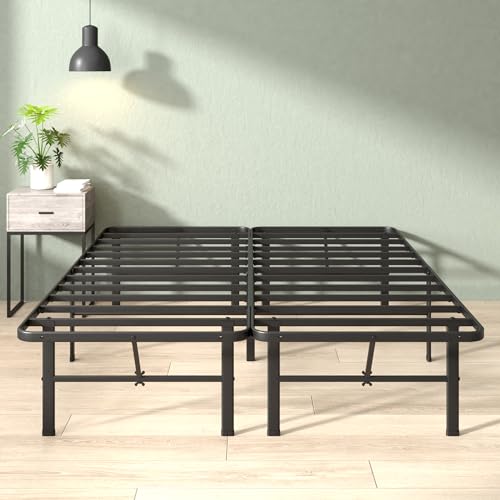
Zinus 14 Inch Rumi Metal Bed Frame Queen — Best Overall
The Rumi earns the top spot in these bed frame reviews by doing the platform basics better than anything else tested on paper: heavy-duty steel, a true 14-inch deck height, quick tool-light assembly and no box spring. It suits the widest range of sleepers — first apartments, guest rooms, primary bedrooms that need storage — because it makes no demands and takes any mattress.
Strengths
- Heavy-duty steel grid supports any mattress type
- 14-inch clearance fits standard storage bins
- Folds out fast; breaks down flat for moving
Trade-offs
- Industrial look — clearly a utility frame
- No headboard included or attached at this configuration
- Steel can transmit a knock if a bin is shoved against a leg
Key specs (from the manufacturer’s listing):
- Size: Queen
- Material: Heavy-duty steel SmartBase foundation
- Height: 14 inches
- Box spring: Not needed
Steel platforms live or die on rigidity, and the SmartBase design spreads the mattress load across a grid rather than a few rails, which is why this frame pattern shows up in so many long-term homes. The 14-inch height is the practical headline: standard storage bins slide underneath, turning dead space into a linen closet. Assembly follows the folding-frame pattern — unfold, lock, place the mattress — and the whole frame breaks down just as flat for moves. It is not a beautiful object, and it does not pretend to be; it is infrastructure, priced and built like it.
After months of use, Rumi owners report the same uneventful story: no squeaks, no sagging, one bolt check. The black steel disappears under bedding, the under-bed bins become permanent storage, and the frame simply exits your attention — the strongest outcome a platform can deliver.
One detail worth noting in the Rumi’s favour is its packaging and parts discipline: the frame arrives compact, the hardware is minimal because the design folds rather than bolts, and replacement parts follow a pattern the brand has sold for years. For landlords furnishing multiple units and hosts equipping spare rooms, that repeatability matters — the second and third Rumi assemble in half the time of the first, and every unit behaves identically.
Best for: almost everyone — first beds, guest rooms, storage-hungry primary bedrooms / Not suited for: buyers shopping for a statement piece of furniture
Check on Amazon — check price on Amazon.

Zinus Allen Mid Century Wood Platform Bed Frame Queen — Best Wood Design
The Allen is the review pick for buyers who want their frame to be furniture first: solid wood, tapered mid-century proportions and a low profile that makes a thick modern mattress sit at exactly the right height. It suits design-led bedrooms where a steel grid would look like scaffolding.
Strengths
- Solid wood build with genuine furniture presence
- Wood slat support suits foam and hybrid mattresses
- Low profile flatters modern rooms and thick mattresses
Trade-offs
- Slower, bolt-together assembly than folding steel frames
- No storage height — low profile means minimal under-bed space
- Wood finish palette is narrower than upholstered options
Key specs (from the manufacturer’s listing):
- Size: Queen
- Material: Solid wood foundation
- Support: Wood slats, no box spring needed
- Profile: Low-profile modern design
Wood slats support a mattress with a fraction more give than steel mesh, which some foam mattresses feel kinder on, and the solid-wood rails give the Allen a planted, quiet stance. The low profile is a considered choice — it suits platform-style rooms, keeps tall mattresses accessible, and makes the bed the calm centre of the room rather than a tower. Assembly is a conventional bolt-together job, slower than the Rumi’s fold-out but well within an evening, and the result feels like joinery rather than equipment.
Living with the Allen, the frame earns compliments and then disappears into the room’s design. It asks for dusting and the occasional bolt check, pairs with everything from white linen to layered quilts, and its flatness only registers for households that read in bed nightly — everyone else just sleeps well on it.
The Allen’s slats deserve a closer look: they are the support surface your mattress actually feels, and wood slats with sensible spacing give foam a foundation that is firm without being dead. Buyers pairing the Allen with a brand-new mattress should still run the warranty check on spacing — five minutes with a tape measure — because even good frames vary, and the mattress maker, not the frame maker, judges the claim.
Best for: design-led primary bedrooms that want wood, calm and slat support / Not suited for: under-bed storage hunters or nightly bed-readers wanting a tall headboard
Check on Amazon — check price on Amazon.

Zinus Maya Upholstered Bed Frame Queen — Best Upholstered
The Maya is the comfort candidate in this roundup: an upholstered frame whose asymmetric padded headboard you can genuinely lean against, on wooden slats inside a sturdy, noise-free framework. It suits readers, loungers and anyone whose bedroom needs a soft focal point instead of hard lines.
Strengths
- Padded headboard you can actually lean on
- Noise-free, sturdy framework with wooden slats
- Softens the whole room’s look instantly
Trade-offs
- Fabric needs periodic vacuuming and care
- Fixed headboard angle — pillows still fine-tune your lean
- Upholstery shows wear sooner than wood or steel
Key specs (from the manufacturer’s listing):
- Size: Queen
- Design: Upholstered with asymmetric headboard
- Support: Durable wooden slats, no box spring needed
- Build: Sturdy framework, noise-free positioning
Upholstery changes how a bed is used, not just how it looks. The Maya’s headboard invites sitting up — for reading, for morning coffee, for a laptop hour — in a way bare wood and steel never do, and the padding swallows the small knocks that make hard headboards annoying in the dark. Underneath, the engineering is conventional in the best way: wooden slats, a rigid frame, no box spring. The fabric does ask for a light vacuum when you change bedding, and light colours show life sooner than dark ones, so choose the shade for your household, not the catalogue photo.
Owners describe the Maya as the bed that made the bedroom feel finished. The headboard becomes the room’s most-used surface after the mattress itself, the frame stays quiet, and the asymmetric line keeps the room from looking like a furniture showroom set — a small design risk that pays off daily.
The Maya’s asymmetric headboard is more than a styling gesture: the offset panel gives the bed a visual head without the formality of a full symmetrical slab, and it photographs like a designed room rather than a furnished one. In small bedrooms that asymmetry also softens the frame’s footprint — the bed reads as intentional furniture, which is exactly what upholstered frames are bought to achieve.
Best for: readers and loungers who want a soft, finished-looking bedroom / Not suited for: households with pets that treat headboards as scratching posts
Check on Amazon — check price on Amazon.

ZINUS Vivek Deluxe Wood Platform Bed Frame Queen — Best Classic Wood
The Vivek Deluxe is the traditionalist’s pick: a wood platform with a proper headboard, slat support and a design that has been in the catalogue for years because it keeps working. It suits buyers who want a complete bed — frame and headboard in one purchase — in a classic wood idiom.
Strengths
- Complete bed: frame plus headboard in one purchase
- Wood slat support for any mattress type
- Proven, long-running design with easy assembly
Trade-offs
- Wood headboard is firm to lean against without pillows
- Conventional styling won’t excite minimalists
- Less under-bed clearance than tall steel platforms
Key specs (from the manufacturer’s listing):
- Size: Queen
- Material: Wood platform with headboard
- Support: Wood slat support, no box spring needed
- Assembly: Easy assembly
Longevity in a catalogue is evidence. The Vivek’s formula — solid wood rails, closely spaced slats, an attached headboard — has survived because it answers the commonest brief: a bed that looks like a bed, supports any mattress, and assembles without drama. The headboard is wood, so leaners will still want a pillow behind the shoulders, but it anchors pillows properly and gives the room a finished head wall. Against the Allen, the Vivek trades mid-century minimalism for a more conventional, slightly warmer presence; against steel, it trades storage height for looks and slat feel.
The Vivek’s ownership story is measured in years of nothing going wrong. Slats stay put, the headboard stays tight, and the wood finish ages gracefully in normal light. It is the frame buyers recommend to relatives — the highest compliment in this category — because it asks nothing and offends no one’s taste.
What the Vivek gets right that trendier frames miss is proportion: the headboard height suits standard pillows without swallowing them, the rails sit at a height that makes bed-making easy, and nothing about the silhouette dates quickly. It is the frame equivalent of a plain white shirt — never the most exciting option in the room, and never the wrong one either.
Best for: traditional bedrooms and anyone buying a complete bed in one box / Not suited for: storage-first small apartments
Check on Amazon — check price on Amazon.

Zinus 14 Inch Ellie Bamboo Platform Bed Frame Queen — Best Bamboo
The Ellie answers a specific complaint about tall platforms: they all look like warehouse shelving. Its bamboo build delivers the same 14-inch storage height as the steel Rumi in a warm, minimalist material that suits calm, natural bedrooms.
Strengths
- 14-inch storage height in a warm bamboo build
- Wood slat support; no box spring needed
- Minimalist design suits natural, calm interiors
Trade-offs
- Tall deck plus thick mattress may sit high for some sleepers
- Bamboo is strong but not as over-built as heavy steel
- Brown tone won’t match every wood palette
Key specs (from the manufacturer’s listing):
- Size: Queen
- Material: Bamboo platform frame
- Height: 14 inches, ample under-bed storage
- Support: Wood slat support, no box spring needed
Bamboo is a smart frame material — light for its strength, fast-growing, and visually warm — and Zinus shapes it here into a minimalist platform with proper slat support. The height is the functional story: bins, suitcases and seasonal bedding all fit beneath, which in a small home is worth more than most design features. The trade against steel is ultimate rigidity under point loads, and against low wood frames is visual height — a 14-inch deck plus a thick mattress makes a tall bed, so measure your preferred sitting height before ordering.
Ellie owners tend to be small-space organisers who wanted storage without the industrial look, and the frame delivers exactly that compromise. The bamboo tone warms rooms that steel would chill, the slats keep mattresses honestly supported, and the under-bed volume quietly absorbs the clutter that used to live in corners.
Bamboo’s sustainability story is real but secondary; the Ellie’s primary virtue is mechanical. The material’s strength-to-weight ratio lets the frame hit a 14-inch deck height without the visual or physical heaviness of steel, so the whole bed can be shifted by one person for cleaning — a small, weekly kindness that heavier tall frames do not offer.
Best for: small homes wanting storage height with a natural look / Not suited for: buyers who prefer a low, grounded bed height
Check on Amazon — check price on Amazon.

Zinus 14 Inch Elias Metal Platform Bed Frame Full — Best for Full Size and Small Rooms
The Elias brings the tall steel platform formula to full-size beds — the guest room, the teenager’s room, the studio apartment — where a queen platform simply does not fit. It suits smaller rooms that still need real under-bed storage and a frame that assembles in minutes.
Strengths
- Full-size footprint for rooms a queen can’t fit
- 14-inch under-bed storage in a compact room
- Steel build tolerates moves and reconfiguration
Trade-offs
- Full size is snug for two adults
- Same plain steel aesthetic as the Rumi
- No headboard at this configuration
Key specs (from the manufacturer’s listing):
- Size: Full
- Material: Steel support platform
- Height: 14 inches
- Box spring: Not needed
Full-size frames are the overlooked workhorses of the category, and the Elias treats the size seriously: steel support, a 14-inch deck and the same no-box-spring simplicity as its queen siblings. In a studio, that under-bed volume is often the only storage the room has, which makes the height a genuine feature rather than a spec. Assembly is the familiar fold-and-lock pattern, and the steel build shrugs off the moves and reconfigurations that small-space living demands.
In practice the Elias disappears into small rooms and does its job for years: guests sleep fine, teenagers’ rooms gain a hidden closet underneath, and the frame survives being dragged, re-levelled and re-made more often than any frame in a big house ever is.
The Elias also earns a mention as the hand-me-down champion: full-size steel platforms pass from teenager to guest room to first apartment without a single part wearing out, and the size fits the spare mattresses households already own. In a category where many frames are bought three times for three rooms, the Elias is frequently bought once and simply reassigned.
Best for: guest rooms, teens’ rooms and studio apartments with full beds / Not suited for: couples upgrading from a queen
Check on Amazon — check price on Amazon.
Comparison Table
| Pick | Badge | Key spec | Best for |
|---|---|---|---|
| Zinus 14 Inch Rumi Metal Bed Frame Queen | Best Overall | Queen steel platform, 14-inch height, no box spring | almost everyone — first beds, guest rooms, storage-hungry primary bedrooms |
| Zinus Allen Mid Century Wood Platform Bed Frame Queen | Best Wood Design | Queen solid wood, slat support, low profile | design-led primary bedrooms that want wood, calm and slat support |
| Zinus Maya Upholstered Bed Frame Queen | Best Upholstered | Queen upholstered, asymmetric headboard, wooden slats | readers and loungers who want a soft, finished-looking bedroom |
| ZINUS Vivek Deluxe Wood Platform Bed Frame Queen | Best Classic Wood | Queen wood platform with headboard, slat support | traditional bedrooms and anyone buying a complete bed in one box |
| Zinus 14 Inch Ellie Bamboo Platform Bed Frame Queen | Best Bamboo | Queen bamboo platform, 14-inch height, slat support | small homes wanting storage height with a natural look |
| Zinus 14 Inch Elias Metal Platform Bed Frame Full | Best for Full Size and Small Rooms | Full size steel platform, 14-inch height | guest rooms, teens’ rooms and studio apartments with full beds |
Steel vs Wood vs Upholstered: The Material Decision Behind Every Bed Frame
Most bed frame regret is material regret. Steel platforms like the Rumi and Elias are the pragmatists: strongest per unit of cost, tallest for storage, easiest to move, and the plainest to look at. They suit renters, guest rooms and anyone who thinks of a bed as equipment. Wood frames like the Allen and Vivek are furniture: warmer, quieter in character, and built around slats that give foam mattresses a slightly kinder foundation. They suit primary bedrooms where the frame is part of the room’s design and will stay in one place for years. Upholstered frames like the Maya trade a little maintenance for a lot of comfort — the padded headboard changes how the bed is used every single evening. None of the three materials is best; each is best for a household. The mistake is choosing by photograph alone, because the material decides your storage, your assembly afternoon, your leaning comfort and your moving day all at once.
Height, Slats and Support: The Specs That Actually Matter
Three numbers decide whether a frame serves you. Deck height sets both your sitting height — mattress top should land near knee height for easy entry — and your storage volume; 14-inch platforms fit standard bins, low profiles fit almost nothing underneath. Slat spacing decides mattress warranty and feel: foam mattresses generally want slats no more than a few inches apart so the foam cannot sag between them, and many mattress makers print their maximum in the warranty terms. Centre support decides longevity in queen and larger sizes: a centre rail with legs prevents the slow mid-span sag that turns a flat bed into a hammock over years. Check these three against any frame you consider, including the six reviewed here, and you will have filtered out nearly every bad purchase in the category before aesthetics even enter the conversation.
What Your Mattress Warranty Wishes You Knew About Frames
Mattress warranties quietly assume a competent frame. The common clauses require flat, even support, slat spacing below a stated maximum, and — for queen and king sizes — a centre support with legs touching the floor. Break those terms and a sagging claim can be denied even when the mattress itself is at fault, because the maker can argue the foundation caused the failure. This is why the frame decision deserves ten serious minutes: photograph your slat spacing, keep the frame’s listing details with the mattress paperwork, and re-check centre legs after any move, since they are the part most often left in the old apartment. The six frames reviewed here all follow mainstream support patterns, but the habit of verifying spacing against your specific mattress maker’s terms is what protects a four-figure mattress purchase — and it costs nothing but a tape measure.
Bed Frames in Real Households: Kids, Pets, Moves and Guests
Laboratory criteria miss the household tests. Children treat beds as trampolines with a landing strip, which argues for steel grids and low profiles in their rooms — the Elias and Rumi pattern — over anything upholstered or tall. Pets vote too: cats disqualify loosely woven headboards, dogs that sleep under beds need the clearance measured against their shoulders, and both shed into whatever fabric the frame wears. Frequent movers should weight assembly design above all else — fold-out steel frames survive five addresses; bolt-heavy wood frames survive them too, but each move costs an evening and a little more joint wear. Guest rooms invert the usual logic: the frame will be used hard for two weeks a year and ignored for fifty, so simple, silent and storage-friendly beats beautiful. Match the frame to the household’s actual chaos level and the reviews above sort themselves quickly.
Reading the Listings: How to Spot a Frame That Will Disappoint
Listings reveal weak frames if you know the tells. Vague support language — ‘sturdy slats’ with no count, spacing or material — usually hides the minimum viable deck. Weight-capacity claims without a centre rail on a queen are optimism, not engineering. Photos that never show the underside are hiding the part that matters most. Assembly reviews complaining about misaligned holes point to loose manufacturing tolerances that become squeaks later. Conversely, honest listings state slat counts, deck height, materials and whether a box spring is needed, exactly as the six verified listings in this roundup do. Cross-check any frame you are considering against the manufacturer’s own title and description as returned by the catalogue — the discipline this review applied — and the gap between marketing and furniture narrows to almost nothing.
The Verdict by Sleeper and Household Type
For the first-apartment buyer, the Rumi ends the search: cheapest path to a silent, supportive, storage-friendly bed, and it will serve as a guest frame later when you upgrade. For the design-led couple furnishing a long-term bedroom, the Allen or the Vivek — minimal or classic — because you will look at this furniture daily for a decade and wood rewards that attention. For the reader and lounger, the Maya, full stop: the headboard is a nightly feature, not a styling choice. For the small-space organiser, the Ellie delivers the Rumi’s storage in a warmer material, and the Elias does the same job where only a full bed fits. For the buyer pairing a frame with an expensive new mattress, any of the six works — the deciding act is verifying slat spacing against the mattress maker’s warranty terms, a five-minute check that protects the bigger purchase. And for the undecided, buy the Rumi: it is the frame least likely to be wrong, and its resale and guest-room afterlife are the best in the roundup.
Frame Care: Ten Minutes a Year
Platform frames ask for almost nothing, but the little they ask for matters. Once a year — spring cleaning is a good cue — tighten every bolt and screw, check that centre legs still touch the floor squarely, and inspect slats for cracks, especially under the hip zone where load concentrates. Vacuum the deck when the mattress is aired; dust and grit under a mattress abrade its cover over time. Wood frames appreciate being kept out of harsh direct sun, which fades one side faster than the other, and upholstered frames appreciate the vacuum’s upholstery tool on the same schedule as the bedding change. Steel frames need only a wipe and the bolt check. That small ritual is the entire difference between a frame that is silent in year five and one that starts narrating your movements in year two.
Sizing Notes: Twin to King, and the Full-Size Question
Everything reviewed here centres on queen, the market’s middle, with the Elias covering full. The principles scale: twin frames forgive almost anything; king frames demand centre support and honest slat counts, and they punish weak decks twice as fast. Full size deserves its moment — at 54 inches wide it suits single adults who move in their sleep, teenagers who have outgrown a twin, and rooms where a queen’s footprint steals the walkway. If you are between full and queen, measure the room, not the sleeper: leave honest walking space on both sides and room to make the bed without climbing it. Frames are cheap to buy once and annoying to buy twice, and the size decision is the one dimension no amount of quality can fix afterwards.
A Short Note on Tiers: What More Money Actually Buys in a Frame
Bed frames cluster into honest tiers. The budget tier buys welded steel and basic slats — genuinely functional, plainly finished. The mid tier, where most of this roundup sits, buys better materials, quieter joints, furniture-grade looks and headboards. The premium tier buys joinery, hardwoods, designer upholstery and white-glove delivery. What extra money does not buy is better sleep support beyond the mid tier — a correctly spaced slat deck is a solved problem — so spend upward for looks, longevity and assembly grace, not for promises of better rest. That is also why no prices appear in these reviews: tiers are stable, prices are not, and the check-price links show today’s reality for each model.
What a Frame Can and Cannot Do for Your Sleep
Honesty helps here: a frame does not soften a hard mattress, cool a hot one or fix a snoring partner. What it does is protect the mattress’s designed performance — even support keeps foam and coils behaving as engineered, silence keeps the night undisturbed, and the right height keeps getting in and out of bed effortless, which matters more with every year. Judge frames by those three deliverables and the category becomes refreshingly free of magic claims. Every frame in this roundup delivers them; they differ in storage, looks, leaning comfort and assembly, which is why the reviews spend their words there instead of inventing sleep benefits no platform can provide.
Headboards, Explained Honestly
A headboard does three jobs: it stops pillows migrating into the wall gap, it gives leaners a surface, and it anchors the room visually. Attached headboards, like the Vivek’s and Maya’s, do all three with no wobble. Wall-mounted and freestanding headboards paired with a bare platform like the Rumi offer the same jobs with more styling freedom and a little more movement. No headboard at all — the minimalist platform look — is legitimate in rooms where the bed is purely for sleeping. The common error is buying an attached upholstered headboard for looks and discovering you are a leaner who needed its padding all along, or buying a tall statement headboard for a room with low windows it now blocks. Decide by behaviour first, silhouette second.
Matching the Frame to the Room’s Light, Floor and Layout
Frames interact with rooms in ways listings ignore. Dark steel and dark wood visually shrink small rooms; the Ellie’s lighter bamboo and the Allen’s open low profile keep compact bedrooms feeling airy. On hard floors, tall frames benefit from felt pads and a rug under the bed’s footprint to kill echo and protect boards; on carpet, low profiles sit calmer. Beds placed under windows want headboards below the sill line; beds against long walls can carry the Maya’s asymmetry beautifully. None of this appears in specification tables, yet it decides whether the frame you loved in the listing is the frame you love in the room — worth two minutes of visualisation before the order, not after the return.
Assembly Day: What to Expect From Each Type
Steel platforms are the sprint: the Rumi and Elias unfold, lock and accept a mattress in well under an hour, with the main risk being pinched fingers and misplaced enthusiasm. Wood platforms are the steady afternoon: rails, slats and headboard in sequence, a second pair of hands genuinely useful for the headboard stage, and instructions that reward reading before touching. Upholstered frames sit between — the Maya’s framework assembles conventionally, with the fabric parts asking only for care not to drag them across rough floors. In every case, assemble the frame in the room it will live in; a finished queen frame negotiates few doorways gracefully, and discovering that with a completed bed is a special kind of afternoon.
When to Replace a Frame — and When to Just Fix It
Frames rarely die; they loosen. A squeak is a bolt, a wobble is a leg or a joint, a single cracked slat is a cheap replacement — all fixes, not replacements. Replace a frame when the deck itself sags and cannot be shimmed, when welds crack on steel, when joinery splits on wood, or when the frame’s size or height no longer fits the mattress and room you actually have. The frames in this roundup are built to make the fix list short and the replacement day distant, which is ultimately what the reviews were measuring: not which frame is perfect, but which ones stay boringly excellent the longest.
How to Assemble a Platform Bed Frame So It Never Squeaks
Squeaks are born at assembly, not in the factory. Start on the bare floor — never on carpet, which hides unevenness — and check the frame sits level before any bolts are fully tightened. Assemble in the manufacturer’s order but leave every fastener finger-tight until the whole structure stands, then tighten in a cross pattern, opposite corners alternating, so the frame pulls square instead of twisting. Fit the slats and confirm spacing with a tape measure rather than by eye; a single wide gap is where a foam mattress will dip. Place the mattress, lie on it, and have a second person listen underneath while you shift — any tick or creak now is a specific bolt, tightened in seconds, instead of a mystery at 2 a.m. Re-check every fastener after the first week, because new joints seat and loosen slightly, and add felt pads under legs on hard floors. Follow that sequence and a platform frame should stay silent for years. Two refinements separate good assemblies from great ones. First, work on a clear floor with the mattress already in the room — dragging a finished bed across a doorway threshold is how legs bend and joints loosen before the first night. Second, keep the hex key. Every platform frame ships with one, every household loses it, and the annual bolt check becomes a drawer-rummaging expedition without it; tape it to the underside of a slat or the frame rail and future you will simply proceed. Assembly is the one moment where a frame’s next decade is decided, and it rewards patience out of all proportion to the hour it takes.
Common Buying Mistakes
The classic mistake is buying a frame for the photograph and discovering the height in person — a low profile plus a thick mattress can sit awkwardly low, and a 14-inch platform plus a pillow-top can need a step stool. Second: ignoring slat spacing until the mattress warranty is questioned. Third: assuming a box spring is still required and buying one for a platform designed to replace it — wasted money and a bed that sits far too high. Fourth: choosing steel for a room that needed warmth, or upholstery for a household with a cat that sharpens claws on headboards. Fifth: forgetting the doorway — measure the longest part against your stair turn before ordering, especially with one-piece headboards. Every mistake on this list is free to avoid and annoying to reverse. A sixth deserves emphasis because it hides in plain sight: buying the frame before the mattress. The mattress decides the support requirements, the total height and half the warranty terms; the frame exists to serve it. Households that reverse the order end up compromising the expensive purchase to accommodate the cheap one, which is precisely backwards — choose the mattress, read its maker’s foundation terms, then buy the frame that honours them.
Final Recommendation
For most buyers, the Rumi is the answer: steel, tall, silent, done. Choose the Allen or Vivek when the bedroom’s look matters and the frame will stay put for years; choose the Maya if you read in bed and want a headboard that earns its space; choose the Ellie for storage height with a warmer face; and choose the Elias when the room says full size or nothing. Whichever you pick, measure deck height against your mattress and check the slat spacing against your mattress maker’s terms — those two checks are the whole secret of this category. Everything else — material, silhouette, storage — is preference, and preference is the one part of the decision you cannot get wrong as long as it is honestly yours rather than a photograph’s.
Keep exploring the cluster: Bed Frame Buying Guide, How To Choose A Bed Frame, Bed Frame Pros And Cons, Is A Bed Frame Worth It, Bed Frame Review, Adjustable Bed Frame Vs Bed Frame.
Frequently Asked Questions
Do platform bed frames need a box spring?
No — that is their defining feature. The platform’s slats or steel grid provide the flat, even support a box spring used to give. Adding one anyway makes the bed too tall and can void the frame’s intended geometry. Keep the box spring only for traditional rail frames designed around it.
How far apart should bed frame slats be?
Close enough that the mattress cannot sag between them. Foam mattresses are the most demanding and generally want gaps of no more than about three inches; many mattress makers state their exact maximum in the warranty. When in doubt, closer spacing is always safe.
Are metal or wood bed frames quieter?
Both can be silent and both can squeak — it depends on joint rigidity and assembly, not material. Steel frames with locked, cross-braced designs and wood frames with tight joinery both sleep quietly. Noise usually traces to a loose fastener, which is why re-tightening after the first week matters.
What bed frame height is best?
The right height puts the top of the mattress near your knee, so sitting on the edge feels natural. Tall 14-inch platforms suit storage needs and taller sleepers; low profiles suit modern rooms and thick mattresses. Measure your mattress thickness first, then choose the frame height to land the total correctly.
Can a bed frame improve mattress life?
Yes — even, well-spaced support prevents the sagging and foam fatigue that uneven foundations cause, and some mattress warranties require it. A frame with gaps that are too wide or a sagging centre can actively shorten a mattress’s life and complicate warranty claims.
Is an upholstered bed frame hard to maintain?
Less than buyers fear. A vacuum with an upholstery attachment during bedding changes handles dust, and most marks lift with a damp cloth. The real enemies are clawing pets and dark dye transfer from new bedding — both manageable with a throw across the headboard in the early weeks.

