Disclosure: airfryerkitchensupply.com is reader-supported. When you buy through links on our site, we may earn an affiliate commission at no extra cost to you.
Where to buy
Every pick in this guide to the best kitchen and bathroom faucets was cross-checked against live Amazon listings before it earned a link. Prices move with promotions and finish choice, so each pick below says check price on Amazon rather than printing a number that could be stale tomorrow. Start with the shortlist:
- Delta Arvo Centerset Bathroom Faucet, Brushed Nickel — Best for Small Bathrooms. Check the current price on Amazon.
- KOHLER Elate Centerset Bathroom Faucet 33591-4-CP, Polished Chrome — Best Modern Centerset. Check the current price on Amazon.
- KOHLER Devonshire Centerset Bathroom Faucet K-393-N4-BN, Brushed Nickel — Best Traditional Centerset. Check the current price on Amazon.
- Delta Windemere Centerset Bathroom Faucet, Oil Rubbed Bronze — Best Bronze Centerset. Check the current price on Amazon.
- Moen Chateau 7906 Two-Handle Kitchen Faucet, Chrome — Best Compact Kitchen Fit. Check the current price on Amazon.
- Moen Brantford Widespread Bathroom Faucet TV6620ORB, Oil Rubbed Bronze — Best Widespread for Larger Vanities. Check the current price on Amazon.
The best kitchen and bathroom faucets for most real projects are not the prettiest ones; they are the ones that fit. This guide takes the compatibility angle on buying for both rooms: hole patterns, spreads, spout scale for small bathrooms, and the flow-rate differences between a lavatory and a kitchen sink. Every linked pick was verified against its listing, and every pick declares its pattern plainly, because a faucet that does not fit your deck is not a bargain at any tier.
Small bathrooms drive most of the hard cases. A compact vanity may carry a 4-inch centerset pattern, a narrow deck that crowds widespread handles, or a shallow bowl that a tall spout splashes out of. Meanwhile the kitchen side of the same project usually needs the opposite: reach, height, and flow. The picks below are chosen to cover the standard patterns honestly, four-inch centerset and eight-inch widespread in the bath, mainstream deck patterns in the kitchen, with scale notes for tight rooms.
Its sibling guide on kitchen and bath faucets covers the coordination and finish-family angle of the same purchase. Read this one when fit is the risk; read that one when looks are. Between the two, they cover the whole decision without repeating each other.
In this guide
Quick Picks
Six verified faucets organized by the pattern they fit, so you can shop your measurements rather than a mood board.
Best for Small Bathrooms — Delta Arvo Centerset Bathroom Faucet, Brushed Nickel. A compact centerset bath faucet in brushed nickel, the default answer for small vanities on a 4-inch pattern.
Best Modern Centerset — KOHLER Elate Centerset Bathroom Faucet 33591-4-CP, Polished Chrome. A modern centerset bath faucet at 1.2 GPM in polished chrome, for small baths with contemporary taste.
Best Traditional Centerset — KOHLER Devonshire Centerset Bathroom Faucet K-393-N4-BN, Brushed Nickel. The traditional centerset counterpart: verified 4-inch pattern, pop-up drain included, 1.2 GPM.
Best Bronze Centerset — Delta Windemere Centerset Bathroom Faucet, Oil Rubbed Bronze. Bronze on the small-bath pattern: 4-inch centerset with a metal push-pop drain included.
Best Compact Kitchen Fit — Moen Chateau 7906 Two-Handle Kitchen Faucet, Chrome. The kitchen side for modest homes: a long-running two-handle chrome platform that fits standard decks and tight budgets of space.
Best Widespread for Larger Vanities — Moen Brantford Widespread Bathroom Faucet TV6620ORB, Oil Rubbed Bronze. The widespread option for bigger vanities: two-handle bronze with the valve included per the verified listing.
How These Picks Were Chosen
Verification came first, as always: each model was searched by brand and model connection, and only listings confirming room, pattern, and finish were linked. The bathroom models were verified in fresh searches for this batch. Selection then sorted candidates by pattern coverage: we required strong options for 4-inch centerset vanities, the most common small-bath pattern, and for 8-inch widespread vanities, plus kitchen models whose footprints suit the modest kitchens that usually accompany small bathrooms.
Scale was the second filter. Bath picks favor compact footprints and sensible spout heights for shallow bowls; the kitchen picks favor mainstream patterns over exotic ones. Flow ratings are stated only where the verified listing states them, which for lavatory models is the water-wise 1.2 GPM standard.
The 6 Best Kitchen and Bathroom Faucets

Delta Arvo Centerset Bathroom Faucet, Brushed Nickel — Best for Small Bathrooms
The Arvo centerset is the small-bathroom default done right: a three-hole centerset footprint that drops onto the standard 4-inch vanity pattern, two handles at a comfortable scale, and brushed nickel that tolerates the splashes a small sink generates. In a tight bath, the centerset’s single footprint also wipes down faster than three separate widespread pieces with grout-line gaps between them. It suits powder rooms, guest baths, and any vanity where deck space is measured in inches.
Strengths
- Standard centerset pattern fits most small vanities
- Compact single footprint is quick to clean
- Brushed nickel hides splash marks in tight sinks
Trade-offs
- Centerset cannot convert a widespread vanity
- Two-handle operation only
- Modest presence; not a statement piece
| Configuration | Centerset bathroom faucet, 3-hole |
| Handles | Two-handle (per Amazon title) |
| Finish | Brushed nickel |
Small-bathroom fit is a chain of small mercies: the faucet mounts on the pattern you have, its handles clear the backsplash, its spout lands mid-bowl instead of against the front edge where it splashes out. The Arvo centerset was chosen because it asks for nothing unusual at any link in that chain. If your vanity measures standard and your room measures small, this is the lowest-risk bathroom purchase in the guide, and the budget it leaves behind can go to the kitchen side of the project.
Best for: small bathrooms and powder rooms on 4-inch patterns / Not suited for: widespread vanities and statement-bath designs
Check on Amazon — check price on Amazon for the current finish options and included parts.

KOHLER Elate Centerset Bathroom Faucet 33591-4-CP, Polished Chrome — Best Modern Centerset
Small bathrooms are not obliged to look traditional. The Elate brings current, squared-off styling to the humble centerset pattern, with a verified flow rating of 1.2 GPM and polished chrome that matches the towel bars and shower trim most small baths already have. It suits apartment bathrooms, modern powder rooms, and anyone whose vanity pattern is old but whose taste is not.
Strengths
- Modern styling on the standard centerset pattern
- Verified 1.2 GPM water-wise flow
- Chrome matches existing small-bath hardware
Trade-offs
- Chrome shows water spots; expect regular wiping
- Modern lines will fight a traditional vanity cabinet
- Centerset pattern only
| Configuration | Centerset bathroom faucet |
| Flow rate | 1.2 GPM (per Amazon title) |
| Finish | Polished chrome |
The Elate’s lesson is that pattern and style are independent variables. Buyers often assume a 4-inch vanity condemns them to dated faucets; the current centerset market includes genuinely modern designs like this one. The ownership cost is chrome’s honesty about water spots, which in a small, frequently used bath means a weekly wipe. For renters-turned-owners and apartment renovators, it is the pick that modernizes the room without touching the vanity top.
Best for: modern small bathrooms on centerset patterns / Not suited for: traditional vanities and spot-averse owners
Check on Amazon — check price on Amazon for the current finish options and included parts.

KOHLER Devonshire Centerset Bathroom Faucet K-393-N4-BN, Brushed Nickel — Best Traditional Centerset
Where the Elate modernizes the centerset, the Devonshire dignifies it. The verified listing spells out the small-bath essentials: a 4-inch centerset three-hole installation, two handles, a pop-up drain included, and 1.2 GPM flow. Its traditional detailing suits the pedestal sinks and older vanities that dominate small period bathrooms, where a modern faucet looks like a mistake and a correct traditional one looks like restoration.
Strengths
- Verified 4-inch pattern with drain included
- Traditional detailing suits period small baths
- Water-wise 1.2 GPM flow
Trade-offs
- Traditional styling is wrong for modern rooms
- Two-handle only
- Brushed nickel wants gentle cleaners to stay even
| Configuration | Centerset bathroom faucet, 3-hole, 4-inch |
| Flow rate | 1.2 GPM (per Amazon title) |
| Drain | Pop-up drain included (per Amazon title) |
Included drains matter more in small baths than anywhere, because there is nowhere for a mismatched drain flange to hide; it sits inches from the faucet in full view. The Devonshire’s included pop-up removes that risk. It also anchors Kohler’s traditional ecosystem, so matching the room’s other trim later is straightforward. For a small traditional bathroom, this is the complete, fit-first package.
Best for: traditional small bathrooms and pedestal sinks / Not suited for: modern small bathrooms
Check on Amazon — check price on Amazon for the current finish options and included parts.
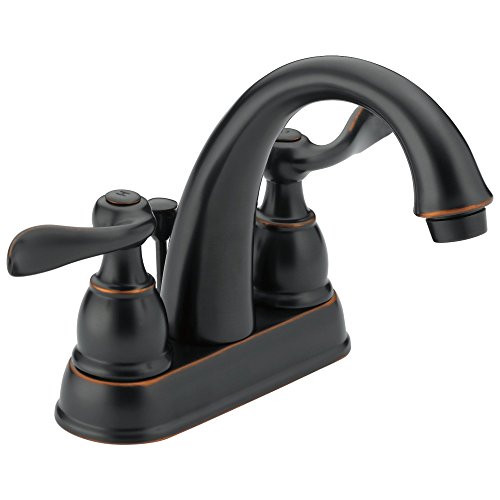
Delta Windemere Centerset Bathroom Faucet, Oil Rubbed Bronze — Best Bronze Centerset
Bronze small-bath options are thinner on the ground than nickel ones, which makes this Windemere centerset valuable: the verified listing confirms a 4-inch centerset three-hole layout and a metal push-pop drain assembly in oil rubbed bronze. It suits small traditional baths in bronze-family homes, where the kitchen and bath coordination plan would otherwise stall at the little vanity with the standard pattern.
Strengths
- Bronze finish available on the common 4-inch pattern
- Metal push-pop drain included
- Centerset footprint suits compact vanities
Trade-offs
- Dark finish shows scale deposits in hard water
- Bronze tone matching across brands is unreliable
- Centerset only; no widespread version implied
| Configuration | Centerset bathroom faucet, 4-inch, 3-hole |
| Drain | Metal push-pop assembly (per Amazon title) |
| Finish | Oil rubbed bronze |
This pick exists to solve a specific project failure: the bronze plan that reaches the small bathroom and finds only nickel centersets. With the Windemere, the little room joins the plan properly, drain included. Care notes mirror every bronze fixture: soft cloth, no abrasives, and a vinegar wipe for scale. Accept those, and a small bronze bath becomes one of the most characterful rooms in the house relative to its size.
Best for: small bronze-family bathrooms / Not suited for: widespread vanities and chrome-plan homes
Check on Amazon — check price on Amazon for the current finish options and included parts.

Moen Chateau 7906 Two-Handle Kitchen Faucet, Chrome — Best Compact Kitchen Fit
Projects with small bathrooms usually have modest kitchens too, and the Chateau is the kitchen faucet for that house. Moen’s long-running two-handle platform in chrome asks for a standard deck pattern, presents a compact profile that does not crowd a small sink, and belongs to a line with the kind of production history that makes future parts a non-event. It suits apartments, smaller homes, and rental-grade renovations done properly.
Strengths
- Long-running platform with deep parts support
- Compact, uncomplicated two-handle layout
- Chrome coordinates with standard fixtures in both rooms
Trade-offs
- Basic styling; no high-arc drama
- Confirm sprayer configuration on the current listing
- Chrome shows spots more than brushed finishes
| Configuration | Two-handle kitchen faucet |
| Finish | Chrome |
The Chateau’s virtue is the absence of surprises. It installs on the pattern most modest sinks already have, its handles clear tight backsplashes better than tall designer models, and its maker has supported the platform for years. In a fit-first guide, that predictability is the headline. Buyers with generous kitchens should look at the arc guide instead; buyers whose kitchen is as compact as their bathroom have found their faucet.
Best for: modest kitchens in smaller homes and apartments / Not suited for: large kitchens wanting high-arc presence
Check on Amazon — check price on Amazon for the current finish options and included parts.

Moen Brantford Widespread Bathroom Faucet TV6620ORB, Oil Rubbed Bronze — Best Widespread for Larger Vanities
Not every bathroom in a fit-first project is small, and the Brantford covers the other standard case: an 8-inch widespread vanity in a traditional bronze home. The verified listing’s most useful detail is that the valve is included, which removes the classic widespread gotcha of ordering a trim kit and discovering the rough-in is a separate purchase. It suits primary baths with generous vanities where the handles deserve room to spread.
Strengths
- Valve included per verified listing; no separate rough-in surprise
- Widespread layout suits larger vanities
- Bronze finish serves traditional plans
Trade-offs
- Needs a true widespread vanity pattern
- Dark finish shows hard-water scale
- Two-handle widespread is the most parts-intensive bath format
| Configuration | Widespread bathroom faucet, 3-hole |
| Valve | Included (per Amazon title) |
| Finish | Oil rubbed bronze |
Widespread faucets reward measuring and punish assuming, and the Brantford is the guide’s example of buying one with eyes open: confirm the 8-inch-class spread, confirm deck thickness against the mounting hardware, and enjoy the furnished, spread-out look that makes large vanities feel intentional. With the valve in the box, the remaining risk is purely dimensional, and the how-to section below walks the exact checks.
Best for: larger traditional vanities on widespread patterns / Not suited for: small vanities and centerset patterns
Check on Amazon — check price on Amazon for the current finish options and included parts.
Comparison Table
| Pick | Badge | Key spec | Best for |
|---|---|---|---|
| Delta Arvo Centerset Bathroom Faucet, Brushed Nickel | Best for Small Bathrooms | Centerset 3-hole bath, two-handle, brushed nickel | small bathrooms and powder rooms on 4-inch patterns |
| KOHLER Elate Centerset Bathroom Faucet 33591-4-CP, Polished Chrome | Best Modern Centerset | Centerset bath, 1.2 GPM, polished chrome, modern lines | modern small bathrooms on centerset patterns |
| KOHLER Devonshire Centerset Bathroom Faucet K-393-N4-BN, Brushed Nickel | Best Traditional Centerset | 4-inch centerset, 2-handle, 1.2 GPM, pop-up drain included | traditional small bathrooms and pedestal sinks |
| Delta Windemere Centerset Bathroom Faucet, Oil Rubbed Bronze | Best Bronze Centerset | 4-inch centerset bath, metal push-pop drain, oil rubbed bronze | small bronze-family bathrooms |
| Moen Chateau 7906 Two-Handle Kitchen Faucet, Chrome | Best Compact Kitchen Fit | Two-handle kitchen, chrome, long-running Chateau platform | modest kitchens in smaller homes and apartments |
| Moen Brantford Widespread Bathroom Faucet TV6620ORB, Oil Rubbed Bronze | Best Widespread for Larger Vanities | Widespread bath, two-handle, valve included, oil rubbed bronze | larger traditional vanities on widespread patterns |
Pattern is the first column in disguise throughout this table: every row’s key spec names its mounting, and a row that does not match your measured vanity or deck is not a worse faucet, it is simply not your faucet. Strike those rows first, then compare what remains.
Kitchen and Bathroom Hole Patterns, Translated
Bathroom patterns come in two standards. A 4-inch centerset pattern puts three holes close together, usually on one base plate; it dominates small vanities and pedestal sinks. An 8-inch widespread pattern spreads three independent holes across the vanity top; it dominates larger furniture-style vanities. The two are not interchangeable, and no adapter makes one into the other. Kitchen patterns add their own family: single-hole, three-hole with a deck plate, and 8-inch two-handle patterns with an optional fourth hole for a sprayer or dispenser.
The translation rule for a two-room project is simple: inventory every top before falling for any faucet. Write down, per sink, the hole count and the center-to-center spread of the outer holes. That two-line inventory, matched against the pattern each pick in this guide declares, eliminates nearly every return in this category. Sellers’ titles often bury the pattern mid-sentence; the verified listings behind these picks state it, which is one reason they are the picks.
Sizing Faucets for Small Bathrooms
Small-bath sizing is about three collisions. First, spout versus bowl: a spout that lands too close to the bowl’s front edge splashes out during handwashing, while a very short reach dribbles down the back. Aim for a stream landing near the drain. Second, handles versus backsplash: widespread and centerset handles both need rear clearance to rotate or lift, and compact vanities against tiled walls are where levers go to collide. Third, height versus storage: tall bath faucets under a low medicine cabinet door are a daily negotiation. Compact centerset models like the Arvo and Elate in this guide exist precisely because they respect all three collisions by default.
Flow is the invisible sizing factor. Lavatory faucets at 1.2 GPM, the rating on the verified Kohler picks here, deliver a comfortable handwashing stream while keeping multi-bath homes water-wise. Kitchen faucets are rated higher because filling a pot at lavatory flow is a punishment. Do not try to standardize flow across rooms; standardize fit, finish, and care instead.
Vessel Sinks, Pedestals, and Other Pattern Rebels
Standard patterns cover most bathrooms, but three common fixtures rebel against them, and a fit-first guide should name them. Vessel sinks, the bowls that sit on top of the counter, move the faucet decision entirely: the faucet mounts on the counter behind the vessel or on the wall, and it needs a spout height that clears the vessel’s rim, which standard lavatory faucets are not built to do. If your small bathroom plan includes a vessel, stop shopping standard bath faucets and shop tall or wall-mount models as a separate category, with the rim height measured before anything else.
Pedestal sinks are the opposite rebellion: no deck at all in many designs, or a small drilled deck in others. For a pedestal with faucet holes, compact centerset models like the Arvo and Devonshire in this guide are the natural fit, chosen for footprint as much as pattern. For a pedestal without holes, the faucet belongs on the wall, and the project’s plumbing scope changes completely, which is a decision to make before tile, not after.
Wall-hung and console vanities split the difference and reward the measurement ritual in this guide’s how-to section more than any product choice. The lesson across all three rebels is the same one this article is built on: the fixture dictates the faucet category, and no amount of finish coordination rescues a faucet bought for a deck that does not exist.
Small Bathroom Storage and the Faucet’s Footprint
In a small bathroom, the faucet competes for the scarcest resource in the room: flat surface. A widespread faucet spreads three objects across the vanity top, and each object annexes the space around it, because nobody stores a toothbrush against a faucet base. A centerset consolidates everything into one footprint and returns the rest of the deck to the household. That reclaimed strip, a few inches wide, is where the soap dish, the razor, and the water glass actually live, and in a small room it is the difference between a vanity that functions and one that merely photographs.
Cleaning follows the same geometry. Three separate bases mean three grout-line rings to detail; one centerset base means one. In a family small bath, that difference compounds weekly. This is the unglamorous reason this guide’s small-bath picks are all centersets, and why we recommend the format even to buyers whose hearts are set on the widespread look: in a small room, the widespread’s elegance is paid for daily, in space and in cleaning, by the people who live there.
The kitchen side has its own version of the same law. A faucet with a deck plate occupies counter length; a single-hole faucet returns it. Small kitchens attached to small bathrooms, the exact homes this guide serves, should count inches at both sinks before falling for any silhouette.
Rentals, Resale, and the Fit-First Faucet
Landlords and sellers should read this guide differently from owner-occupiers, because for them compatibility is not a preference but the business model. A rental faucet must fit the existing deck without modification, survive tenants who will not baby it, and be serviceable by any plumber from van stock. That brief points straight at the mainstream pattern picks in this guide: centersets for the standard vanities, the long-running Chateau platform in the kitchen, finishes in chrome or brushed nickel that read as clean and current to every prospective tenant who walks through.
Resale has a subtler calculus. Buyers touring a home register bathrooms and kitchens emotionally, and a mismatched, dripping, or obviously wrong-pattern faucet signals deferred maintenance louder than its cost justifies. Replacing a tired faucet with a correct-pattern, finish-coherent model is one of the cheapest signals of care a seller can send, provided the replacement respects the deck that exists. The moment a resale faucet requires countertop surgery, the economics invert.
Both cases reward the same discipline this article teaches homeowners: inventory the decks, buy the pattern, favor platforms with deep parts support. The audience changes; the tape measure does not.
Reading Dimensions Like a Pro: Reach, Height, and Clearance in the Bath
Bathroom faucet listings speak in three dimensions that decide fit, and each has a failure it prevents. Spout reach, measured from the faucet’s centerline to where the stream leaves the spout, decides where water lands in the bowl. On a small vanity bowl, a reach that is too long parks the stream against the bowl’s front slope, where it climbs and splashes; too short, and the stream hugs the back, dribbling down the bowl’s rear wall and wetting the faucet’s own base. The happy zone lands the stream near the drain, and the way to shop for it is to measure your bowl from its mounting centerline to its drain and match the faucet’s reach to that figure, not to the bowl’s overall width.
Spout height in the bathroom is about vessels and hands, not pots. A standard lavatory spout sits low, clearing hands and a toothbrush glass; anything taller belongs to vessel installations, which are a different category with different rules, as this guide’s rebel-fixtures section explains. Clearance, the third dimension, is the space behind and above: handles that rotate need a rear arc free of tile and mirror frames, and a faucet centered under a medicine cabinet needs its handles’ full travel measured against the cabinet door’s swing.
Kitchen dimensions rhyme but do not repeat. Reach and height scale up, the bowl deepens, and the stream’s landing zone widens. The professional habit that transfers between rooms is identical: measure the fixture you own, in the three dimensions that matter, and let those numbers, not the product photography, arbitrate every candidate. Photography is taken in a studio sink that is not yours.
Accessibility and the Small Bathroom: Fit Is a Kindness
Small bathrooms concentrate every usability challenge a home contains. The vanity is narrow, the door swings close, the user may be a child on a step, an elder with a walker parked at the threshold, or a guest in an unfamiliar room at night. In that setting, faucet fit stops being a specification exercise and becomes a form of hospitality. Lever handles that a palm can push, a spout whose stream lands where hands naturally wait, and controls whose hot and cold are legible by position and touch are the difference between a room that works for everybody and a room that works for its designer.
The centerset format, which dominates this guide’s small-bath picks for dimensional reasons, happens to serve accessibility too: its controls sit close together and close to the user, at the front of a compact footprint, rather than spread across a wide vanity that a shorter reach must patrol. Two handles give the clearest possible temperature language, separate, named, and settable in advance, which matters for users who cannot react quickly to a surprise in temperature. Households designing for aging in place should read this section together with the family-friendly guide, where the same principles are applied at the kitchen sink with touch and touchless options.
None of this requires special products. It requires the standard products in this guide, chosen with the room’s real users in mind and installed at heights and clearances checked against those users rather than against a catalog’s assumptions. Fit-first shopping, which is this article’s entire thesis, turns out to be accessibility shopping as well, and that is not a coincidence: both are the discipline of measuring the actual situation before admiring the object.
Troubleshooting Fit Problems After Installation
Even measured projects occasionally produce a faucet that misbehaves in place, and fit problems have a diagnostic order worth learning. Splashing first: if water leaves the bowl, confirm where the stream lands. A stream landing on the bowl’s slope rather than near the drain will splash regardless of pressure; the remedies are an aerator change to a laminar or lower-flow pattern, which tames the stream’s energy, or, in stubborn cases, accepting that the spout reach and the bowl were mismatched and exchanging the faucet within its return window. This is the strongest argument for buying from listings with clear return terms and for testing with real handwashing during the first days, not the first months.
Handle interference second: a lever that kisses the backsplash at full travel can sometimes be re-indexed on its stem to shift its arc forward, a five-minute adjustment described in most platforms’ documentation. A handle that collides with a mirror or cabinet is a measurement that was skipped, and its honest fix is a different handle style or a different faucet, in that order. Third, the slow weep at the base: water at a faucet’s base is usually splash that has crept under an unsealed escutcheon rather than a plumbing leak, and the test is to dry everything, run the water without splashing, and watch. Seal or reseat the base gasket once the diagnosis is sure.
The meta-lesson is that fit problems announce themselves early and cheap, during the return window, to owners who test deliberately. Run the new faucet through its real life in week one: the child’s handwash, the elder’s grip, the biggest glass, the fullest bowl. What passes that week will pass the decade, and what fails can still be exchanged for the pick that should have won.
The Measurement Manifesto: Five Numbers That Decide Everything
Every argument in this article reduces to five numbers, and a buyer who collects them before shopping has effectively already chosen correctly; the rest is taste. Number one is the spread, center to center of the outer holes, which sorts the world into centerset and widespread and tolerates no approximation. Number two is the hole count, complete with the accessories squatting in spare holes, because a faucet’s configuration must have somewhere to live. Number three is deck thickness at the mounting point, the silent variable that decides whether standard hardware can clamp the faucet at all.
Number four is rear clearance, centerline to backsplash, against which handle travel is checked; it is the number most often skipped and most often regretted, because a faucet can fit its holes perfectly and still be unusable against a tiled wall. Number five is the bowl’s own geometry, the distance from the mounting centerline to the drain, which the spout’s reach must approximate if the stream is to land where water belongs. Five numbers, one tape measure, perhaps fifteen minutes across both rooms: that is the entire technical content of faucet compatibility, and it is remarkable how completely the industry’s return statistics would collapse if every buyer performed it.
The reason this guide repeats the ritual in its how-to, its mistakes, and now its manifesto is that repetition is what the problem responds to. Nobody returns a faucet because they measured twice. The picks assembled here were chosen to reward the measuring buyer, with their patterns and included parts stated in verified listings rather than implied, so that the five numbers can be matched line by line without interpretation. Measure, match, and the glamorous part of the project, choosing finishes and silhouettes, becomes what it should have been all along: the reward for the arithmetic, not a substitute for it.
The Guest Test: How Visitors Grade Your Faucets
Every faucet in a home is eventually operated by someone who did not choose it, and visitors grade fixtures by a ruthless rubric: can I work this without instructions, does the water land where I expect, and does anything feel loose, drippy, or improvised. The small bathroom, where guests are most often alone with a faucet, is where that grade is assigned to the whole house’s competence. A centerset that fits its vanity, lands its stream in the bowl, and turns with clean, even resistance passes so completely that it is never thought about again, which is the highest grade a faucet can earn. A beautiful widespread shoehorned onto the wrong pattern, handles crowding the backsplash, stream climbing the bowl’s front slope, fails in ways a guest cannot articulate but absolutely remembers.
The kitchen faucet faces the same test at higher volume, with helpers at holidays putting their hands on controls whose logic must be guessable while their owner is busy elsewhere. This is the unspoken argument for the mainstream platforms that fill this guide: their handle logic, spray behavior, and proportions are the ones the culture has already learned, so a guest’s hands arrive pre-trained. Exotic faucets tax visitors; standard ones host them. Fit, in the end, is not only a relationship between a faucet and a deck. It is a relationship between a faucet and every person who will ever stand at that sink, most of whom were never consulted.
Sellers understand this instinctively, which is why estate agents beg for working, coherent bathrooms before they beg for almost anything else. But the guest test matters just as much to households that never sell, because a home is a place where other people are perpetually being welcomed, helped, and handed a towel. Buy the faucet your guests will never have to think about, in the pattern your vanity actually has, and you have understood everything this article exists to teach.
When to Call a Plumber vs When to DIY a Faucet Swap
The fit-first philosophy of this guide extends to the install itself, because the cheapest faucet swap is the one matched to the installer’s actual abilities. A like-for-like pattern replacement, centerset for centerset on a vanity with working shutoffs and flexible supplies, is among the most forgiving jobs in home maintenance: an hour, a basin wrench, and the measurement discipline this article teaches. The same is true of a kitchen deck-mount swap on a standard pattern. These are DIY jobs in the honest sense, and the picks in this guide were chosen partly because their mainstream mounting keeps them that way.
The boundary cases announce themselves clearly, and respecting them is a financial skill. Shutoffs that will not close move the job’s first step to the main valve and possibly to a plumber’s torch. Rigid copper supplies that must be cut and re-fitted, decks that need new holes in stone, widespread bath installs where the valve itself is being replaced under a finished vanity, and any situation involving a pedestal sink’s concealed connections all belong to professionals, not because homeowners are incapable, but because the cost of a mistake in those settings is measured in water damage rather than in pride. Get the quote before the old faucet comes out; a plumber’s estimate is free information, and it converts the DIY question from a gamble into a comparison.
Whichever route a given sink takes, the buyer’s contribution remains the same: the five measurements, the correct pattern on the truck when it arrives, and the documentation filed afterward. Plumbers, like faucets, perform best when the fit was decided before they were asked to perform.
One Last Measurement: The Tape You Keep
End the project the way it began, with the tape measure, and then do something quietly radical: write the five numbers for every sink in the house on a card and keep it with the faucet documentation. Future you, shopping for a replacement aerator at a hardware store, standing in a showroom years from now, or answering a plumber’s question over the phone, will spend that card like cash. Compatibility knowledge compounds exactly like money does, in small deposits made before they are needed. The faucets in this guide were bought with measurements; the card ensures every faucet after them is bought the same way, and that is how a household graduates from lucky purchases to a system.
How to Measure a Vanity and Sink Deck Correctly
Step one: clear the deck and photograph each sink from directly above; patterns are obvious in photos and deniable in memory. Step two: measure center to center between the two outer faucet holes. About four inches means centerset; about eight means widespread or an 8-inch kitchen pattern. Step three: count every hole, including sprayer, dispenser, and any capped extras hiding under escutcheons. Step four: measure deck thickness if the top is stone or a thick vessel mount, and note it against the model’s mounting range.
Step five: measure from the faucet centerline to the backsplash and to the bowl’s front edge, then picture the new spout’s stream landing near the drain. Step six: under the sink, confirm shutoffs turn and note supply line type. Step seven: write the inventory down per room and shop against it line by line. This fifteen-minute ritual, done once, is the entire difference between a fit-first project and a returns-first project.
Common Buying Mistakes
Ordering by room name instead of pattern. ‘Bathroom faucet’ is not a fit specification. The pattern is the specification.
Assuming a widespread trim kit includes its valve. Some do, some do not. The Brantford in this guide includes it per its verified listing; others must be checked line by line.
Putting a tall faucet under a low cabinet door. Measure the swing of anything stored above the sink before choosing height.
Ignoring stream landing in small bowls. A spout that lands at the bowl’s edge splashes constantly. Visualize the stream before buying.
Forcing kitchen flow expectations onto bath faucets. 1.2 GPM at a vanity is correct and code-friendly, not weak.
Final Recommendation
Fit decides everything here. Small standard vanities should take the Delta Arvo centerset, modern rooms the KOHLER Elate, traditional rooms the Devonshire or the bronze Windemere centerset, and larger widespread vanities the Moen Brantford with its included valve. The Moen Chateau covers the modest kitchen that usually accompanies these baths. For the finish-coordination view of the same project, read best kitchen and bath faucets; for compact kitchen patterns specifically, see best kitchen bar sink faucets and best kitchen counter faucets.
Delta Arvo Centerset Bathroom Faucet, Brushed Nickel covers the best for small bathrooms slot. KOHLER Elate Centerset Bathroom Faucet 33591-4-CP, Polished Chrome covers the best modern centerset slot. KOHLER Devonshire Centerset Bathroom Faucet K-393-N4-BN, Brushed Nickel covers the best traditional centerset slot.
Best Kitchen And Bath Faucets Best Kitchen Bar Sink Faucets Best Kitchen Counter Faucets Best Kitchen 2 Handle Faucets Best Kitchen Family Friendly Faucets
Frequently Asked Questions
How do I know if my vanity is centerset or widespread?
Measure center to center between the outer faucet holes. Roughly four inches with holes grouped on one base area is a centerset pattern; roughly eight inches with three clearly separated holes is widespread. When in doubt, photograph the deck from above and compare against the pattern named in the listing.
Can I install a widespread faucet on a centerset vanity?
No. The hole spacing is physically different and the vanity top would need replacement or professional re-drilling, which is rarely sensible for stone or ceramic tops. Buy the pattern you have; both patterns have strong modern and traditional options in this guide.
Why is my bathroom faucet’s flow lower than my kitchen faucet’s?
By design. Lavatory faucets are commonly rated at 1.2 GPM for water efficiency at handwashing tasks, while kitchen faucets are rated higher so pots fill at a practical speed. A 1.2 GPM bath faucet is correct, not defective.
What faucet suits a very small bathroom best?
A compact centerset model. Its single footprint fits the standard 4-inch pattern, wipes down quickly, and keeps handles and spout at a scale that respects shallow bowls and tight backsplashes. The Arvo and Elate in this guide are the modern and classic-shaped answers.
Does a widespread faucet always need a separate valve purchase?
No, but it is a common trap. Some widespread models are trim only. Check the listing for valve inclusion; the Moen Brantford in this guide includes the valve per its verified listing, which is one reason it earned its slot.
Can the same faucet model serve kitchen and bathroom?
Almost never. Kitchen and lavatory faucets differ in scale, spout height, flow rating, and mounting. Buy room-specific models and coordinate them by finish family instead, as the sibling guide in this cluster explains.


