Disclosure: airfryerkitchensupply.com is reader-supported. When you buy through links on our site, we may earn an affiliate commission at no extra cost to you.
Where to buy
Every pick in this guide to the best kitchen and bath faucets was cross-checked against live Amazon listings before it earned a link. Prices move with promotions and finish choice, so each pick below says check price on Amazon rather than printing a number that could be stale tomorrow. Start with the shortlist:
- Moen Essie 87014SRS Pulldown Kitchen Faucet, Spot Resist Stainless — Best Kitchen Anchor. Check the current price on Amazon.
- Delta Windemere Widespread Bathroom Faucet B3596LF-OB, Oil Rubbed Bronze — Best Traditional Bath. Check the current price on Amazon.
- Moen Belfield 7255SRS Two-Handle High Arc Kitchen Faucet, Spot Resist Stainless — Best Traditional Kitchen. Check the current price on Amazon.
- KOHLER Devonshire Centerset Bathroom Faucet K-393-N4-BN, Brushed Nickel — Best Classic Bath. Check the current price on Amazon.
- Delta Essa 9113-AR-DST Kitchen Faucet, Arctic Stainless — Best Modern Kitchen. Check the current price on Amazon.
- Delta Arvo Widespread Bathroom Faucet 35840LF-SP, SpotShield Stainless — Best Modern Bath. Check the current price on Amazon.
Shopping for the best kitchen and bath faucets at the same time usually means one of two projects: a whole-home refresh where every fixture should feel like family, or a renovation touching both rooms where one finish decision has to work in two very different spaces. This guide takes the coordinated route. It pairs verified kitchen faucets with verified bathroom faucets by finish family and brand ecosystem, so the stainless in your kitchen and the stainless over your vanity read as one decision instead of two accidents.
The practical reason to coordinate is maintenance, not just looks. Brands build finish families across both rooms, and staying inside one or two ecosystems means one cleaning routine, one set of care rules, and a coherent answer when a guest walks from your kitchen to your powder room. The picks below alternate kitchen and bath deliberately: three proven kitchen platforms and three bathroom counterparts chosen to sit comfortably beside them.
A scope note: this article is about buying across both rooms together. Its sibling guide on kitchen and bathroom faucets takes the other angle, drilling into hole compatibility and small-bathroom fit. If your project is a full coordination exercise, stay here. If your project is one tricky vanity with odd holes, that guide will serve you better.
In this guide
Quick Picks
Three kitchen anchors and three bathroom counterparts, all verified, organized so each bath pick coordinates with the kitchen platforms around it.
Best Kitchen Anchor — Moen Essie 87014SRS Pulldown Kitchen Faucet, Spot Resist Stainless. The kitchen anchor for a stainless coordination plan: 15.75 inches tall, flexible 1 to 4 hole mounting, and a soap dispenser in the box.
Best Traditional Bath — Delta Windemere Widespread Bathroom Faucet B3596LF-OB, Oil Rubbed Bronze. An 8-inch widespread bath faucet in oil rubbed bronze with a metal push-pop drain included, the traditional bath counterpart.
Best Traditional Kitchen — Moen Belfield 7255SRS Two-Handle High Arc Kitchen Faucet, Spot Resist Stainless. The traditional kitchen counterpart: two-handle high arc with side spray and ADA compliant levers in spot-resistant stainless.
Best Classic Bath — KOHLER Devonshire Centerset Bathroom Faucet K-393-N4-BN, Brushed Nickel. A classic 4-inch centerset bath faucet at a water-wise 1.2 GPM with pop-up drain, in brushed nickel.
Best Modern Kitchen — Delta Essa 9113-AR-DST Kitchen Faucet, Arctic Stainless. The modern kitchen anchor: a clean single-hole pull-down at 15.25 inches in Arctic stainless.
Best Modern Bath — Delta Arvo Widespread Bathroom Faucet 35840LF-SP, SpotShield Stainless. A modern 8-inch widespread bath faucet with push-pop drain and a spot-shielding stainless finish.
How These Picks Were Chosen
Every model here was verified individually: brand and model were searched connection, and the returned title had to confirm the room, configuration, and finish. Bathroom models came from fresh verification searches run for this batch, because our standing cache is kitchen-heavy; kitchen models came from the pre-verified cache. Pairing logic then grouped models by finish family: spot-resistant stainless kitchen platforms with brushed nickel and stainless bath counterparts, traditional bronze with bronze, and modern single-handle kitchen designs with clean-lined widespread bath models.
We also weighted ecosystem depth. A coordinated purchase locks you into finish families for a decade, so platforms from makers with broad cross-room catalogs rank ahead of one-room wonders. Where a finish is described as spot-resistant or shielded in the verified listing, we say so; where it is a plain finish, we do not dress it up.
The 6 Best Kitchen and Bath Faucets
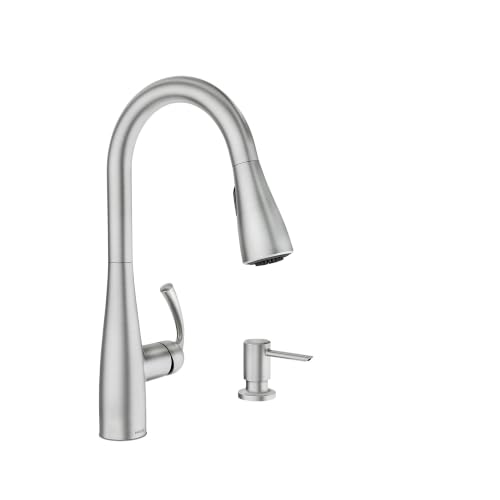
Moen Essie 87014SRS Pulldown Kitchen Faucet, Spot Resist Stainless — Best Kitchen Anchor
Start a coordinated plan with the hardest-working faucet in the house. The Essie’s verified specs make it the flexible anchor: 15.75 inches of height, a deck plate covering one to four hole patterns, Power Clean spray with Reflex docking per the verified features, and a soap dispenser included. In Spot Resist stainless it sets the finish reference every bathroom choice in this guide is measured against. It suits open-plan homes where the kitchen is visible from everywhere and the bath fixtures should quietly agree with it.
Strengths
- Flexible 1 to 4 hole mounting with included deck plate
- Soap dispenser included in the verified configuration
- Spot Resist finish hides daily fingerprints
Trade-offs
- Pull-down format is kitchen-only; bath coordination is by finish, not format
- Traditional-leaning kitchens may prefer the Belfield below
- Dispenser claims a deck hole some sinks lack
| Configuration | Single-handle pull-down, deck plate included |
| Height | 15.75 in (per Amazon listing) |
| Mounting | 1, 2, 3, or 4-hole (per API features) |
Coordination works when the anchor finish is forgiving, and Spot Resist stainless is exactly that: it tolerates the kitchen’s grease-and-splash environment and gives bathroom brushed nickel and stainless finishes a close, calm relative. The Essie’s included dispenser also removes one mismatched accessory from the counter, a small coherence win that visitors register without noticing. As a kitchen faucet alone it is a mainstream, well-supported platform; as the reference point for a whole-home plan it is the strongest start in this guide.
Best for: stainless-led whole-home coordination plans / Not suited for: buyers who want identical faucet formats in both rooms
Check on Amazon — check price on Amazon for the current finish options and included parts.

Delta Windemere Widespread Bathroom Faucet B3596LF-OB, Oil Rubbed Bronze — Best Traditional Bath
For bronze-family kitchens, this Windemere is the bathroom counterpart that keeps the story straight. The verified listing confirms the full package: an 8-inch widespread three-hole layout for vanities, oil rubbed bronze finish, and a metal push-pop drain assembly included, which matters because a plastic drain beside a bronze faucet is the kind of detail that cheapens a coordinated room. It suits traditional primary baths and powder rooms echoing a bronze kitchen.
Strengths
- Metal push-pop drain included, not plastic
- 8-inch widespread suits standard vanity tops
- Bronze finish coordinates with traditional bronze kitchens
Trade-offs
- Dark finish shows hard-water scale as pale deposits
- Widespread needs a true 8-inch vanity pattern
- Bronze tones vary across brands; stay in family where possible
| Configuration | Widespread bathroom faucet, 3-hole, 8-inch |
| Drain | Metal push-pop assembly included (per Amazon title) |
| Finish | Oil rubbed bronze |
The Windemere name also appears in this cluster’s kitchen guides as a two-handle kitchen faucet, which is precisely the coordination advantage: one design family, both rooms, consistent detailing. In the bathroom the widespread layout spreads handles wide on the vanity, giving the room a furnished feel a centerset cannot match. Budget a moment for finish care; bronze rewards a soft-cloth routine and punishes abrasive cleaners. Chosen as part of a bronze plan, it is the bath pick with the fewest regrets.
Best for: traditional baths coordinating with bronze kitchens / Not suited for: 4-inch centerset vanities and low-maintenance-first buyers
Check on Amazon — check price on Amazon for the current finish options and included parts.

Moen Belfield 7255SRS Two-Handle High Arc Kitchen Faucet, Spot Resist Stainless — Best Traditional Kitchen
Where the Essie anchors a modern stainless plan, the Belfield anchors a traditional one. Its two-handle high-arc layout and side sprayer bring the kitchen side of a classic home up to date, while the Spot Resist stainless finish coordinates with brushed nickel and stainless bathroom fixtures without demanding an exact match. The verified listing’s ADA compliant levers also make it the coordination pick for multigenerational homes, where the bath plan should follow the same easy-operation logic.
Strengths
- Traditional two-handle presence with modern finish
- ADA compliant levers per verified features
- Finish family coordinates broadly with nickel bath fixtures
Trade-offs
- Side sprayer needs a fourth hole
- Two-handle format differs from bath lever layouts
- Traditional styling is a commitment across both rooms
| Configuration | Two-handle, high arc, side spray |
| Handles | Lever, ADA compliant (per API features) |
| Finish | Spot Resist stainless |
Coordinating a traditional home is less about matching silhouettes, kitchen faucets are tall and bath faucets are not, and more about matching temperature of finish and quality of detailing. The Belfield’s restrained traditional lines let a bathroom model like the Devonshire below speak the same language in a smaller accent. If your home mixes generations of users, let this faucet set the accessibility standard and choose bath levers to match that standard, a point the family-friendly guide in this cluster develops further.
Best for: traditional coordinated plans and multigenerational homes / Not suited for: modern minimalist coordination plans
Check on Amazon — check price on Amazon for the current finish options and included parts.

KOHLER Devonshire Centerset Bathroom Faucet K-393-N4-BN, Brushed Nickel — Best Classic Bath
The Devonshire is the classic-bathroom answer in this coordinated set. Verified details: a 4-inch centerset three-hole layout, two handles, a pop-up drain, a rated flow of 1.2 GPM, and brushed nickel. That flow rating matters in a coordination plan because bathroom faucets sip where kitchen faucets pour; 1.2 GPM is the modern water-wise standard for lavatory faucets and it keeps a multi-bath home’s water bill honest. It suits traditional and transitional baths paired with nickel-family kitchens.
Strengths
- Verified 1.2 GPM flow suits multi-bath water budgets
- Centerset layout fits the most common vanity pattern
- Brushed nickel coordinates with stainless kitchens
Trade-offs
- Centerset footprint will not fit widespread vanities
- Classic styling commits the room to a traditional direction
- Two-handle operation only; no single-lever option in this model
| Configuration | Centerset bathroom faucet, 3-hole, 4-inch |
| Flow rate | 1.2 GPM (per Amazon title) |
| Drain | Pop-up drain included (per Amazon title) |
Kohler’s Devonshire detailing, flared bases and traditional lever silhouettes, is designed to sit beside the brand’s broader traditional bath suite, which gives a coordination plan room to grow into towel bars and shower trim later. In this guide it plays the classic counterweight to the Belfield: same traditional temperature, smaller scale, thriftier flow. For a guest bath or a child’s bathroom on a coordinated plan, it is the pick that spends money on coherence rather than on features nobody uses at a vanity.
Best for: classic baths on a nickel-family coordination plan / Not suited for: widespread vanities and ultra-modern baths
Check on Amazon — check price on Amazon for the current finish options and included parts.

Delta Essa 9113-AR-DST Kitchen Faucet, Arctic Stainless — Best Modern Kitchen
The Essa is the modern alternative anchor: a single-hole pull-down with a verified height of 15.25 inches and the clean, soft-modern profile that dominates current kitchen design. In a coordination plan it pairs naturally with widespread bath faucets in stainless and brushed nickel, where the bath models carry the room’s visual width and the kitchen carries the height. It suits contemporary homes and anyone whose bath plan leans modern but not stark.
Strengths
- Clean modern profile anchors contemporary plans
- Verified 15.25 in height clears tall cookware
- Single-hole mounting simplifies the kitchen deck
Trade-offs
- Single-hole format may need a deck plate on multi-hole sinks
- Modern lines clash with strongly traditional bath suites
- Coordination is by finish family, not by matching silhouette
| Configuration | Single-handle pull-down, single hole |
| Height | 15.25 in (per Amazon listing) |
| Finish | Arctic stainless |
Modern coordination is the easiest kind to get right and the easiest to overdo. The Essa plus a stainless widespread bath faucet reads as calm and intentional; adding chrome, matte black, and brushed gold across other fixtures dissolves the effect. Let the Essa set two rules for the whole plan: stainless-family finishes only, and simple silhouettes everywhere. Follow those rules and even budget bath accessories fall into line behind the two anchor faucets.
Best for: contemporary coordination plans / Not suited for: traditional homes wanting ornate detailing
Check on Amazon — check price on Amazon for the current finish options and included parts.
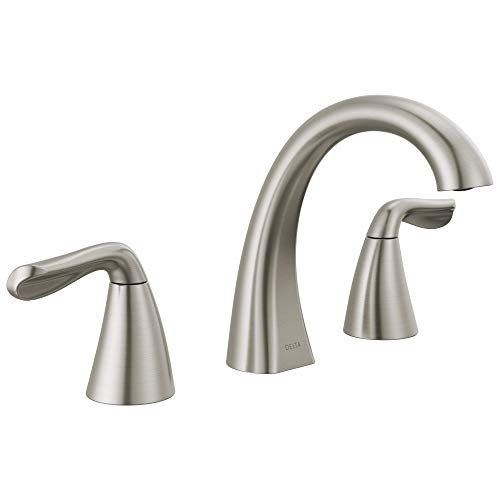
Delta Arvo Widespread Bathroom Faucet 35840LF-SP, SpotShield Stainless — Best Modern Bath
The Arvo closes the modern pairing. Its verified listing confirms an 8-inch widespread three-hole layout, a push-pop drain assembly, and Delta’s SpotShield stainless finish, which resists the spots and fingerprints that make bathroom faucets look tired between cleanings. Beside the Essa in a kitchen, the Arvo gives the bathroom the same finish attitude at vanity scale. It suits primary baths in contemporary homes and busy family bathrooms where the finish has to forgive a crowd.
Strengths
- SpotShield finish resists spots and fingerprints
- Widespread layout gives vanities a furnished feel
- Push-pop drain included in the verified listing
Trade-offs
- Requires an 8-inch widespread vanity pattern
- Modern styling pairs poorly with ornate traditional suites
- Two handles plus drain is more parts than a centerset
| Configuration | Widespread bathroom faucet, 3-hole, 8-inch |
| Drain | Push-pop assembly (per Amazon title) |
| Finish | SpotShield stainless |
Bathroom faucets live a harder cosmetic life than kitchen faucets: toothpaste, soap film, and daily splashes at close range. A spot-shielding finish is therefore worth more in this room than any decorative upgrade, and it is why the Arvo earns the modern bath slot over prettier but needier rivals. As the closing piece of a modern coordination plan, it also demonstrates the guide’s core rule: match the finish family and the maintenance profile, and the rooms will feel designed together even though no two faucets share a silhouette.
Best for: modern primary and family baths / Not suited for: centerset vanities and traditional suites
Check on Amazon — check price on Amazon for the current finish options and included parts.
Comparison Table
| Pick | Badge | Key spec | Best for |
|---|---|---|---|
| Moen Essie 87014SRS Pulldown Kitchen Faucet, Spot Resist Stainless | Best Kitchen Anchor | Pull-down, 15.75 in height, 1-4 hole with deck plate, soap dispenser included | stainless-led whole-home coordination plans |
| Delta Windemere Widespread Bathroom Faucet B3596LF-OB, Oil Rubbed Bronze | Best Traditional Bath | 8-inch widespread bath, metal push-pop drain included, oil rubbed bronze | traditional baths coordinating with bronze kitchens |
| Moen Belfield 7255SRS Two-Handle High Arc Kitchen Faucet, Spot Resist Stainless | Best Traditional Kitchen | Two-handle high arc, side spray, ADA compliant levers | traditional coordinated plans and multigenerational homes |
| KOHLER Devonshire Centerset Bathroom Faucet K-393-N4-BN, Brushed Nickel | Best Classic Bath | 4-inch centerset bath, 2-handle, 1.2 GPM, pop-up drain | classic baths on a nickel-family coordination plan |
| Delta Essa 9113-AR-DST Kitchen Faucet, Arctic Stainless | Best Modern Kitchen | Single-hole pull-down, 15.25 in height, modern profile | contemporary coordination plans |
| Delta Arvo Widespread Bathroom Faucet 35840LF-SP, SpotShield Stainless | Best Modern Bath | 8-inch widespread bath, push-pop drain, SpotShield stainless | modern primary and family baths |
The table alternates rooms deliberately, kitchen then bath, in the order a coordination plan is actually bought. Match each bath row’s finish family to the kitchen anchor you choose, and check the bath row’s pattern against your vanity before falling for its looks.
How to Coordinate Kitchen and Bath Faucets Without Overmatching
Coordinate on three axes, in this order: finish family, maintenance profile, and design temperature. Finish family means stainless and brushed nickel together, bronze together, chrome together; it does not mean the identical finish name in both rooms, which is usually impossible and always fragile. Maintenance profile means spot-resistant in the kitchen should be answered by spot-shielding or brushed finishes in the bath, so neither room becomes the one that always looks dirty. Design temperature means traditional, transitional, or modern; keep both rooms within one step of each other on that scale.
Resist buying literal matching sets across rooms. Kitchen and bath faucets have different jobs, heights, and flow ratings, and a forced match usually means a compromised kitchen faucet or an oversized bath faucet. The homes that feel designed are the ones where finishes agree and silhouettes suit each room. Spend the coordination budget on the two anchor faucets first, one per room, then let accessories follow cheaply.
Budgeting a Two-Room Faucet Plan
Allocate by workload. The kitchen faucet works hardest, gets touched most, and should take the largest share of a two-room budget; a sensible split puts roughly sixty percent in the kitchen and forty across the bathroom or bathrooms. Within the bath share, the primary bath outranks the powder room, because a powder room faucet is jewelry while a primary bath faucet is equipment. Do not forget the unglamorous line items: drains, supply lines, and the occasional valve replacement ride along with faucet swaps, and a plan that budgets only for the shiny parts stalls mid-project.
Sequencing saves money too. Buy the kitchen anchor first and live with its finish for a week before committing the bath order; screens lie about undertones, and a finish you love at the sink is the finish to echo at the vanity. If the plan spans several bathrooms, standardize on one bath model in the right pattern for each vanity rather than curating each room separately. Standardization cuts cost, simplifies spare parts, and strengthens the coordinated effect that started the project.
Finish Families Across Rooms: A Practical Field Guide
Finish coordination fails in predictable ways, and the failures are worth cataloging because they are all avoidable. The first is undertone drift: one brand’s brushed nickel leans warm, another’s leans cool gray, and two faucets that share a finish name can sit in adjacent rooms quietly disagreeing. The cure is hierarchy: the kitchen anchor’s undertone wins, and bath faucets are chosen to be compatible with it rather than identical to a name. The second failure is sheen mismatch, a polished faucet in one room and a matte one in the other, which reads as a mistake even when the color family matches. Keep sheen consistent across the plan.
The third failure is the orphan finish: a single matte black accessory in a stainless plan, bought because it was on sale, that draws the eye forever. Coordination plans survive on discipline at the accessory level more than at the faucet level, because accessories are bought often and faucets are bought once. Write the plan’s finish family on the project list and let it veto impulse purchases.
The fourth failure is ignoring the fixed metal already in the rooms: appliance stainless, door hardware, lighting, and the tub and shower trim you are not replacing. The faucets must join that existing parliament, not pretend to be a new government. The audit in this guide’s how-to section exists to force that inventory before money moves, and it is the highest-value fifteen minutes in any two-room project.
The Primary Bath vs the Powder Room: Spending Where It Shows
A two-room plan usually conceals a three-room reality, because most homes have a powder room lurking beside the primary bath, and the budget logic differs sharply between them. The primary bath faucet is equipment: it is used by tired people in bad light, twice a day at minimum, and its valves, finish durability, and included drain quality repay investment. The powder room faucet is jewelry: it is used briefly, by guests, in a room whose entire purpose is impression. Counterintuitively, the powder room is where a slightly more decorative model earns its keep, while the primary bath should take the durable, easy-care pick even within the same finish family.
Guest and children’s bathrooms follow the primary bath’s logic with the volume turned up: durability and easy cleaning outrank everything, and spot-shielding or brushed finishes are worth more than any silhouette. This is why this guide’s bath picks emphasize finish behavior as much as looks. A coordination plan that assigns the same model everywhere ignores these different jobs; a plan that assigns the same finish family with different models per job is the one that still looks intentional in five years.
Sequence the purchases accordingly: kitchen anchor first, primary bath second, powder room last and only with what the budget proves it can spare. Projects that reverse that order tend to own a gorgeous powder room and a compromised kitchen, which is the wrong monument to a renovation.
Water, Pressure, and the Two Rooms’ Different Jobs
It surprises many buyers that the two rooms’ faucets are regulated and rated differently, and understanding why prevents a class of false complaints. A lavatory faucet at 1.2 GPM, like the verified Kohler picks in this guide, is delivering exactly what handwashing and toothbrushing need, at a flow that keeps a house full of bathrooms from wasting water at scale. A kitchen faucet flows faster because its signature task, filling a pot, is measured in gallons. Judging the bath faucet by the kitchen’s standard produces a return; judging the kitchen faucet by the bath’s standard produces a very slow soup.
Pressure interacts with the plan too. Homes with modest water pressure will feel it first at the kitchen’s spray modes and at long bath pipe runs, not at a lavatory stream. If your home’s pressure is low, favor kitchen models whose spray systems are known quantities, the magnetic-docking, well-documented platforms in this guide, and keep bath expectations at the calm end. Homes with aggressive pressure have the opposite note: aerators and flow ratings are your friends in both rooms, and the rated figures printed in this guide’s spec boxes are the numbers to plan around.
None of this requires a plumber’s license to use. It requires only that the two-room plan treat each room’s faucet as the tool it is, rated for its own job, coordinated with its sibling by finish and care rather than by identical specifications.
Planning the Renovation Sequence Across Both Rooms
Two-room faucet projects fail logistically more often than aesthetically, and the sequence is the logistics. The correct order begins with measurement, the audit from this guide’s how-to, because every later decision depends on patterns and fixed finishes. Purchasing follows, kitchen anchor first and bath models after the anchor’s finish is confirmed in the home’s own light, because return shipping on a widespread bath faucet is a penalty nobody should pay for a foreseeable reason.
Installation order surprises people: do the bathroom first. The kitchen is the home’s engine, and a kitchen without a faucet for a weekend is a household emergency, while a bathroom faucet swap is an hour’s inconvenience with another bathroom as backup in most homes. The bath install also serves as the rehearsal, where the household learns its own shutoffs, its water’s sediment habits, and its plumber’s number, before the high-stakes kitchen swap. If the kitchen install then hits a corroded valve or a surprise deck pattern, it does so in a house that still has a working bathroom and a family that has seen the movie once.
Close the project clerically. Photograph every installed faucet with its model documentation, record install dates, and file the spare aerators and any included parts in one labeled place. A coordinated two-room installation creates a small fleet of fixtures, and fleets are maintained from records. The households that do this final step are the ones whose ten-year faucet story is a non-story, which is the highest compliment plumbing can earn.
Guests, Resale, and the Quiet Power of Coherent Fixtures
Nobody tours a home and praises its faucet coordination in so many words, and yet the effect registers. A kitchen and bathrooms that share a finish family read as a house that has been thought about, and that reading colors everything from a guest’s comfort to a buyer’s offer. Real-estate professionals have a phrase for the opposite: the house that feels like a parts bin, where every room announces a different decade and a different budget panic. Faucets are small, but they are at eye level, at hand level, and in the two rooms buyers inspect hardest.
The economics are asymmetric in the seller’s favor. A coherent mid-range faucet plan costs a fraction of the incoherent premium plan it can out-impress, because coherence is a property of selection, not of spending. This is the strategic heart of the present guide: three disciplined finish decisions, made once, outperform six indulgent ones made separately, in daily pleasure as much as in resale. The picks here were chosen to make the disciplined version easy to execute, with anchor platforms in the kitchen and pattern-correct counterparts in the bath.
Even households with no intention of selling should steal the insight. You are the guest you host most often. A home whose wet rooms agree with each other is calmer to live in, in a way that is difficult to itemize and impossible to un-feel once noticed, and the faucet plan is one of the cheapest places in a renovation to buy that calm.
Care Routines That Keep Two Rooms’ Finishes in Sync
Coordination is purchased in a day and maintained for a decade, and the maintenance has a subtlety specific to two-room plans: finishes age at the speed of their room. The kitchen faucet lives in grease vapor and daily abrasion; the bath faucet lives in soap film and humidity. Left to identical cleaning schedules, they drift apart in appearance, and the coordinated effect quietly expires even though nothing is technically wrong with either fixture. The countermeasure is to clean by need rather than by calendar: the kitchen faucet on the kitchen’s weekly rhythm, the bath faucets on theirs, with the finishes’ shared rules, soft cloths, mild cleaners, no abrasives on any coated finish, applied in both rooms.
Hard water writes both rooms’ calendars. Scale appears first where water stands and evaporates: aerators, spout outlets, and the bases of bath faucets where splashes pool. A monthly pass with a vinegar-dampened cloth, never a soak on dark or coated finishes, keeps both rooms’ metal reading as the same age. Aerators in both rooms want a rinse on the same schedule, and doing them together, one small circuit of the house with a towel and a cup, is the kind of maintenance ritual that actually survives contact with real life.
Keep one care kit for the whole plan: the soft cloths, the approved cleaner, the spare aerators, stored once, labeled once. Two-room ownership fails in the gap between rooms, in the product that was fine for the kitchen and wrong for the bath’s finish, used by a helpful hand. A single kit closes that gap, and the finishes stay siblings for the life of the plan.
One Weekend, Two Rooms: A Realistic Project Plan
Ambition is the enemy of finishing, so here is the two-room faucet project scoped to what a household can actually complete without living in a construction site. The preparation weekend comes first and involves no tools beyond a tape measure, a phone camera, and a notebook: the fixture audit from this guide, patterns recorded per sink, finishes inventoried, shutoffs located and tested. Orders are placed only after that audit, kitchen anchor first, with the bath models following once the anchor’s finish is confirmed at home. Delivery week is for staging: unbox, inventory parts against the documentation, photograph everything, and assemble the small kit of consumables, new supply lines where needed, plumber’s tape, a basin wrench if the cabinets are deep, towels, and a bucket that will absolutely be needed.
The work itself fits the sequence this guide recommends: bathroom first, as the rehearsal with lower stakes, kitchen second, with the household fed and the sink’s contents relocated before the first wrench turns. Each swap follows the same liturgy: water off, lines drained, old faucet out, deck cleaned to bare material, dry-fit, mount, connect, restore, inspect with a dry hand at every joint, then run every function, including the sprayer and the drain, before the tools leave the room. Photograph the finished installs with their model cards; the project’s archive is part of the project.
What this plan refuses is simultaneity. Two rooms without faucets at once converts a satisfying project into a household crisis, and the marginal time saved is negative once the first surprise arrives, because surprises in plumbing are not possibilities but appointments. Staged calmly, the entire two-room upgrade is two half-days of work separated by a week of ordinary life, and the result, coherent finishes, correct patterns, documented models, is indistinguishable from a professional’s project except in the invoice. That is the realistic ambition this guide is written for, and every pick in it was chosen to be installable inside that plan.
What Designers Actually Do: Lessons From Coordinated Homes
Professional designers, asked how they coordinate fixtures across a home, rarely begin with faucets. They begin with a metal story for the whole house, decided once, often from the door hardware and lighting that were chosen first, and they let every subsequent fixture audition against that story. The kitchen and bath faucets enter late in that process, which is precisely why amateur projects, which buy the faucets first and improvise the story later, struggle to feel coherent. The practical translation for a two-room project is humbling and useful: before ordering anything in this guide, walk the house and name the metals that are already staying. The faucets’ job is to join that cast, not to replace it.
The second designer habit is restraint about heroes. A coordinated home typically allows one fixture per room to be expressive, and in wet rooms that honor usually goes to lighting or tile rather than to the faucet, which is expected to be handsome, correct, and quiet. This is why the anchor strategy in this guide works: the kitchen faucet is allowed presence because it is the hardest-working object in the house, while the bath faucets are chosen for finish agreement and pattern correctness, virtues that photograph as calm. Buyers who demand that every faucet be a statement end up with rooms full of soloists and no ensemble.
The third habit is documentation. Designers keep a finish schedule, one page listing every fixture, its finish, and its model, and the homes they deliver stay coherent for a decade because replacements and additions are checked against that page. The two-room buyer can steal the habit at zero cost: the audit and the project archive recommended throughout this guide are a finish schedule by another name. Coherence, it turns out, is not a talent. It is a filing system, and this guide has been quietly building yours since the first section.
Seasonal and Second Homes: Faucets That Wait Well
Vacation homes, lake houses, and properties that sit empty for weeks impose a special faucet brief that two-room planning should not ignore: fixtures must wait well. Cartridges that sit dry and still for months should not weld themselves shut; finishes should tolerate the dust and the occasional hard-water event without an audience; and the whole system should forgive being winterized, drained, and revived by whoever opens the house in spring. Mainstream platforms, the kind that fill this guide, are the correct answer almost by definition, because their seals, cartridges, and parts are the ones designed for the widest range of real-world neglect and the easiest revival.
For a second home, simplify the coordination plan rather than shrinking it: one finish family, the most forgiving one your water allows, standard patterns everywhere, and the documentation archive kept at the property itself, in the drawer every caretaker opens. The faucets in a house that waits should be the most boring, serviceable, pattern-correct models the budget allows, in both rooms, because nobody drives three hours to admire a faucet, but everybody drives three hours when one fails.
How to Audit Your Current Fixtures Before a Coordinated Buy
Step one: photograph every faucet in the house, kitchen and all baths, in daylight, with a note of its finish as best you can name it. Step two: record each vanity’s hole pattern by measuring the spread between outer holes; 4-inch centerset and 8-inch widespread are the two standard answers, and every bath pick in this guide declares which it fits. Step three: check the kitchen deck the same way, counting sprayer and dispenser holes. Step four: note water behavior. Visible scale on current fixtures argues for brushed or spot-shielding finishes in the new plan; clean fixtures on chrome argue your water will let you choose freely.
Step five: decide the finish family from the audit, not from a catalog, because the audit includes the fixed elements you are not replacing: tub trim, shower valves, and door hardware that will sit beside the new faucets. Step six: order the kitchen anchor, confirm its finish in your light against the bath candidates’ finish family, then place the bath order. This sequence turns a two-room gamble into two one-room certainties.
Common Buying Mistakes
Matching finish names instead of finish families. Names differ across brands; families coordinate. Compare undertones in your own light.
Buying the bath faucet in the wrong pattern. Centerset and widespread are not interchangeable. Measure every vanity before ordering.
Splitting the budget evenly. The kitchen faucet works ten times harder. Fund it like it matters.
Forgetting the drain. A coordinated bath faucet over a mismatched plastic drain undoes the effect. Favor models with metal drains included.
Coordinating finishes but not maintenance. A polished kitchen faucet beside a brushed bath faucet guarantees one room always looks dirtier.
Final Recommendation
Build the plan on an anchor: the Moen Essie for a stainless modern-traditional home, the Delta Essa for a contemporary one, and the Moen Belfield if the home leans traditional. Answer the anchor with the Delta Arvo or KOHLER Devonshire in the bath depending on pattern and temperature, and use the Delta Windemere where bronze rules. For the compatibility-first view of the same project, read best kitchen and bathroom faucets, and for the kitchen-only deep dives see best kitchen 2 handle faucets and best kitchen arc faucets.
Moen Essie 87014SRS Pulldown Kitchen Faucet, Spot Resist Stainless covers the best kitchen anchor slot. Delta Windemere Widespread Bathroom Faucet B3596LF-OB, Oil Rubbed Bronze covers the best traditional bath slot. Moen Belfield 7255SRS Two-Handle High Arc Kitchen Faucet, Spot Resist Stainless covers the best traditional kitchen slot.
Best Kitchen And Bathroom Faucets Best Kitchen 2 Handle Faucets Best Kitchen Arc Faucets Best Kitchen Counter Faucets Best Kitchen Family Friendly Faucets
Frequently Asked Questions
Should kitchen and bath faucets match exactly?
They should share a finish family and a design temperature, not an identical model or finish name. Stainless-family kitchens coordinate with brushed nickel baths; bronze coordinates with bronze. Exact matching across rooms is fragile and usually forces a compromise faucet somewhere.
What finishes coordinate most easily across rooms?
Stainless and brushed nickel are the most forgiving family, because many brands offer both rooms in compatible tones and the finishes hide wear. Chrome coordinates easily too but shows spots. Bronze and brushed gold coordinate beautifully within one brand family and less reliably across brands.
Do bathroom faucets use less water than kitchen faucets?
Yes, by design and by code. Lavatory faucets are commonly rated at 1.2 GPM, like the Devonshire in this guide, while kitchen faucets are typically rated higher to fill pots at a useful speed. That difference is normal and is not a defect in either room.
Which faucet should I buy first in a two-room plan?
The kitchen anchor. It is the most-used fixture, its finish is the hardest to live with if you choose wrong, and its tone should set the family the bath faucets join. Live with it briefly before committing the bath order.
Can one brand cover both rooms well?
The large makers all maintain cross-room finish families, and staying within one or two ecosystems simplifies care and future trim coordination. Mixing two strong ecosystems, one per room, within the same finish family works nearly as well.
Are included drains important in bath faucets?
Yes. The drain flange sits in the sink beside the faucet and is seen every day. Models that include a metal push-pop or pop-up drain in the matching finish protect the coordinated look; a mismatched drain is the most common way these projects quietly fail.


