Disclosure: airfryerkitchensupply.com is reader-supported. When you buy through links on our site, we may earn an affiliate commission at no extra cost to you.
Where to buy
Every pick in this guide to the best kitchen counter faucets was cross-checked against live Amazon listings before it earned a link. Prices move with promotions and finish choice, so each pick below says check price on Amazon rather than printing a number that could be stale tomorrow. Start with the shortlist:
- Chicago Faucets 786-E3ABCP Deck Mounted Kitchen Faucet, 8-Inch Centers, Chrome — Best Commercial Deck Mount. Check the current price on Amazon.
- Chicago Faucets 895-317ABCP Deck Mounted Gooseneck Faucet, Chrome — Best Gooseneck Deck Mount. Check the current price on Amazon.
- Moen Essie 87014SRS Pulldown Kitchen Faucet, Spot Resist Stainless — Best Flexible Mounting. Check the current price on Amazon.
- Delta Foundations B1310LF Kitchen Faucet, Chrome — Best Simple 3-Hole. Check the current price on Amazon.
- Delta Foundations B4410LF Kitchen Faucet with Side Sprayer, Chrome — Best 4-Hole with Sprayer. Check the current price on Amazon.
- Moen M-Dura 8287 Commercial Kitchen Faucet, Chrome — Best Heavy-Duty Counter Pick. Check the current price on Amazon.
The best kitchen counter faucets are the ones that respect the countertop they sit on. Counter, or deck-mount, installation is the standard way kitchen faucets mount, through the sink deck or directly through the countertop behind it, and this guide treats mounting as the main event: deck thickness, hole patterns, rear clearance, and what happens under the counter where the hardware actually lives. Every pick was verified against its listing, and the mounting facts stated here come from those listings, not from generic advice.
Why devote a guide to mounting? Because it is where faucet projects actually fail. The faucet that delights in the showroom binds against a thick stone deck, or its handles strike the backsplash, or its mounting nuts land exactly where the sink clip sits. The picks below span the realistic counter scenarios: commercial-grade deck mounts with published center measurements, flexible one-to-four-hole platforms with deck plates, and simple three and four hole foundations models that drop into standard decks without negotiation.
If your counter is being fabricated now, this guide is also a drilling brief: it will tell you which patterns to ask for and how much rear space to leave. If your counter already exists, it is a fit audit. Either way, measure first; the how-to section is the checklist.
In this guide
Quick Picks
Six verified deck-mount faucets chosen for mounting clarity, from a commercial 8-inch centers deck mount to flexible deck-plate platforms.
Best Commercial Deck Mount — Chicago Faucets 786-E3ABCP Deck Mounted Kitchen Faucet, 8-Inch Centers, Chrome. A commercial deck mount with its 8-inch centers stated in the verified listing, built for counters that work hard.
Best Gooseneck Deck Mount — Chicago Faucets 895-317ABCP Deck Mounted Gooseneck Faucet, Chrome. The gooseneck version of the commercial deck mount, for counters needing clearance with institutional durability.
Best Flexible Mounting — Moen Essie 87014SRS Pulldown Kitchen Faucet, Spot Resist Stainless. The mounting diplomat: one to four hole coverage with a deck plate, plus a dispenser for the fourth hole.
Best Simple 3-Hole — Delta Foundations B1310LF Kitchen Faucet, Chrome. The uncomplicated three-hole deck mount: single handle, no sprayer, standard everything.
Best 4-Hole with Sprayer — Delta Foundations B4410LF Kitchen Faucet with Side Sprayer, Chrome. The four-hole counterpart: the same Foundations simplicity with a side sprayer using the fourth hole.
Best Heavy-Duty Counter Pick — Moen M-Dura 8287 Commercial Kitchen Faucet, Chrome. A certified commercial counter faucet at a verified 2.2 GPM, with vandal-resistant hardware details.
How These Picks Were Chosen
Verification followed the standing rule: brand and model searched connection, listing title confirming configuration and mounting. For this lens we additionally favored models whose verified listings state their mounting facts, centers, hole counts, deck plate inclusion, in plain terms, because a counter guide that cannot state a faucet’s pattern is not doing its job.
Ranking weighed mounting flexibility first, then the under-counter reality of the install: standard shank lengths, mainstream connections, and platforms a plumber will recognize. The Chicago Faucets pair leads on published commercial deck specifications; the Moen and Delta platforms follow on hole-pattern forgiveness. Commercial flow figures are stated only where verified, and one commercial model whose listing described a replacement part rather than a faucet was excluded, as in the sibling guides.
The 6 Best Kitchen Counter Faucets

Chicago Faucets 786-E3ABCP Deck Mounted Kitchen Faucet, 8-Inch Centers, Chrome — Best Commercial Deck Mount
Chicago Faucets builds for institutions, and the 786-E3ABCP brings that brief to a residential counter: a deck-mounted kitchen faucet on 8-inch centers, in chrome, from a maker whose products are specified in commercial kitchens and schools. The verified listing states the mounting plainly, concealed deck mount, 8-inch centers, which is exactly the information a counter guide exists to surface. It suits hard-working kitchens, utility and laundry counters, and buyers who want commercial bones under a domestic counter.
Strengths
- Mounting stated plainly: deck mount, 8-inch centers
- Commercial-grade platform built for serviceability
- Chrome finish suits utility and traditional counters
Trade-offs
- Commercial styling is plain by design
- 8-inch centers pattern is mandatory, no flexibility
- Confirm spout and handle configuration on the listing
| Mounting | Deck mount, 8-inch centers (per Amazon title) |
| Grade | Commercial (per cache notes) |
| Finish | Chrome |
Commercial deck mounts earn their keep under the counter: standardized connections, parts that exist by the bin, and a design assumption that a plumber, not a homeowner with a basin wrench and regrets, will service it in year ten. On thick or hard-worked counters that assumption is worth money. If your kitchen brief includes words like canning, rental, or multi-generational wear, this is the counter faucet that matches the brief.
Best for: hard-working and utility counters wanting commercial bones / Not suited for: design-led kitchens and non-8-inch decks
Check on Amazon — check price on Amazon for the current finish options and included parts.

Chicago Faucets 895-317ABCP Deck Mounted Gooseneck Faucet, Chrome — Best Gooseneck Deck Mount
The 895-317ABCP pairs Chicago’s commercial deck-mount platform with a gooseneck spout, the shape that gives a working counter real clearance for buckets, tall pitchers, and watering cans. The verified listing confirms the deck-mounted gooseneck configuration in chrome. It suits utility counters, farmhouse work sinks, laundry and potting stations, and any counter where the faucet is a tool first and a furnishing second.
Strengths
- Gooseneck clearance on a commercial deck platform
- Deck mount stated in the verified listing
- Built for service in hard-use settings
Trade-offs
- Utilitarian looks will not anchor a styled kitchen
- Deck pattern must match the model’s requirements
- Commercial supply conventions may need a plumber’s eye at install
| Mounting | Deck mount (per Amazon title) |
| Spout | Gooseneck (per Amazon title) |
| Finish | Chrome |
Gooseneck plus commercial deck mount is the specification behind a century of institutional sinks, and it persists because it works: clearance where you need it, hardware that survives being needed. In a home, this faucet makes the most sense at a secondary working counter, the laundry, the garage-adjacent utility sink, the big farmhouse prep counter, where its honesty is an aesthetic match. At a styled main kitchen counter, choose one of the finished platforms below instead.
Best for: utility and working counters needing gooseneck clearance / Not suited for: styled main kitchens
Check on Amazon — check price on Amazon for the current finish options and included parts.
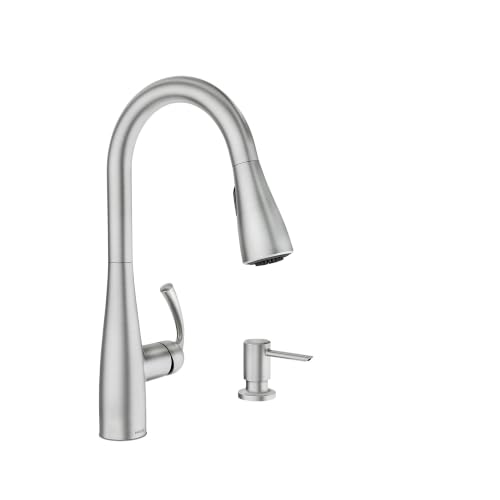
Moen Essie 87014SRS Pulldown Kitchen Faucet, Spot Resist Stainless — Best Flexible Mounting
Most counters do not need a commercial faucet; they need a forgiving one. The Essie’s verified mounting covers one, two, three, or four holes with its included deck plate, which makes it the counter guide’s flexibility champion: whatever your sink or stone is drilled for, this faucet has a clean answer, including a soap dispenser for the spare hole. Its verified height is 15.75 inches. It suits replacements on unknown decks, new counters drilled to a standard pattern, and anyone who refuses to let hole count choose their faucet.
Strengths
- Verified 1 to 4 hole mounting with deck plate
- Soap dispenser included for the spare hole
- 15.75 in height suits standard counters
Trade-offs
- Deck plate look is a compromise for single-hole purists
- Dispenser needs its hole and under-counter room
- Pull-down format only; no two-handle option
| Mounting | 1, 2, 3, or 4-hole, deck plate included (per API features) |
| Height | 15.75 in (per Amazon listing) |
Deck plates have an image problem they do not deserve. On a stainless sink deck they read as part of the appliance; on stone they cover the sins of previous faucets, including the outline of the old escutcheon that no cleaner fully erases. The Essie turns that practicality into the pick: buy the faucet you want, and let the plate negotiate with the counter you have. For the majority of replacement projects, that negotiation is the whole job.
Best for: replacement projects on existing counters and sinks / Not suited for: single-hole minimalists drilling new stone
Check on Amazon — check price on Amazon for the current finish options and included parts.

Delta Foundations B1310LF Kitchen Faucet, Chrome — Best Simple 3-Hole
The B1310LF is the counter guide’s simplicity pick: a three-hole, single-handle deck mount in chrome with no side sprayer, from Delta’s Foundations platform. Three-hole decks are the most common kitchen drilling in existing homes, and this faucet meets that deck on its own terms, no plate gymnastics, no stranded holes, no sprayer hose competing for under-sink space. It suits straightforward replacements, rentals, and secondary counters.
Strengths
- Native fit for the common 3-hole deck
- No sprayer means a simpler under-counter install
- Mainstream platform, easy future service
Trade-offs
- No sprayer limits rinsing in a single-bowl sink
- Basic styling and chrome finish only in this model
- Single-handle only
| Mounting | 3-hole deck mount (per Amazon title) |
| Configuration | Single handle, no sprayer |
| Finish | Chrome |
Every omitted feature is an omitted failure mode, and at a rental or a utility counter that arithmetic wins. The Foundations platform is also the kind of hardware any plumber in any town can service from van stock, which is a mounting-adjacent virtue: the best counter faucet is partly the one whose install and service never become a story. Choose it when the deck is three-hole and the brief is dependable.
Best for: three-hole decks needing a dependable simple faucet / Not suited for: single-bowl sinks wanting a sprayer
Check on Amazon — check price on Amazon for the current finish options and included parts.
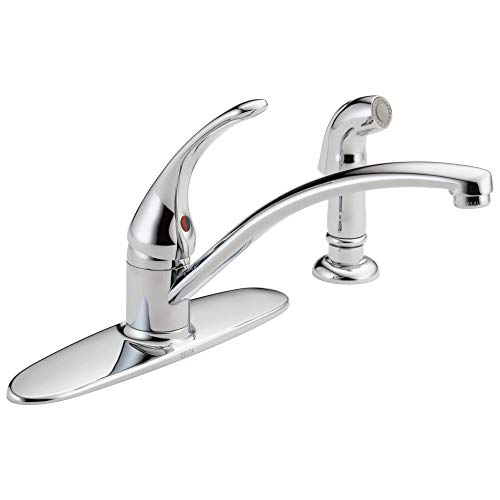
Delta Foundations B4410LF Kitchen Faucet with Side Sprayer, Chrome — Best 4-Hole with Sprayer
Where the B1310LF serves three-hole decks, the B4410LF serves the other standard: a four-hole deck mount with a single handle and a side sprayer occupying the fourth hole, in chrome, on the same Foundations platform. Four-hole sinks are everywhere in homes of a certain age, and this is the like-for-like modern replacement that uses every hole as intended. It suits traditional kitchens and anyone whose deck already carries a sprayer they actually use.
Strengths
- Native four-hole fit with sprayer included
- Single-handle convenience on a traditional deck
- Platform serviceability matches its 3-hole sibling
Trade-offs
- Sprayer hose needs under-sink clearance
- Chrome shows spots without regular wiping
- Contemporary-basic styling
| Mounting | 4-hole deck mount (per Amazon title) |
| Configuration | Single handle, side sprayer |
| Finish | Chrome |
Counter projects go wrong when a faucet’s hole count and the deck’s hole count negotiate badly, producing plates over holes that should hold accessories or sprayers rattling in drawers. The B4410LF avoids the negotiation entirely on a four-hole deck. Pair it with the three-hole sibling in multi-sink properties and a landlord or facilities-minded owner gets one platform, two native fits, and a single parts vocabulary. That is counter-faucet thinking at its most practical.
Best for: four-hole decks wanting a sprayer, natively / Not suited for: three-hole decks and sprayer-free briefs
Check on Amazon — check price on Amazon for the current finish options and included parts.

Moen M-Dura 8287 Commercial Kitchen Faucet, Chrome — Best Heavy-Duty Counter Pick
The M-Dura 8287 is the heavy-duty end of the counter category: a commercial two-handle faucet with a verified flow of 2.2 GPM, certification to the relevant ASME and CSA standards in its verified features, half-inch IPS connections, and vandal-resistant fasteners. That specification reads institutional because it is; on a home counter it translates to a faucet built for decades of unkind use. It suits working kitchens, multi-user homes, and utility counters where residential hardware has died young before.
Strengths
- Verified 2.2 GPM commercial flow
- Certified construction per verified features
- Vandal-resistant, service-first hardware
Trade-offs
- Commercial looks and two-handle operation only
- 2.2 GPM flow is thirsty by residential standards
- Confirm deck pattern and connections suit a home install
| Flow rate | 2.2 GPM (per Amazon listing) |
| Connections | 1/2-inch IPS (per API features) |
| Certification | CSA B-125 / ASME A112.18.1M (per API features) |
A necessary caution from our verification work on this family: a sibling model number in the M-Dura line surfaced in searches as a replacement part rather than a complete faucet, which is why this guide links only the 8287, whose listing describes the full faucet. Read commercial listings with that skepticism everywhere. For buyers whose counters genuinely work, a cannery weekend, a rental’s turnover cleans, a farmhouse sink that never rests, the 8287’s overbuilding is the point, and its verified paperwork is the proof.
Best for: heavy-use home and utility counters / Not suited for: styled kitchens and water-conservation-first homes
Check on Amazon — check price on Amazon for the current finish options and included parts.
Comparison Table
| Pick | Badge | Key spec | Best for |
|---|---|---|---|
| Chicago Faucets 786-E3ABCP Deck Mounted Kitchen Faucet, 8-Inch Centers, Chrome | Best Commercial Deck Mount | Deck mount, 8-inch centers, commercial grade, chrome | hard-working and utility counters wanting commercial bones |
| Chicago Faucets 895-317ABCP Deck Mounted Gooseneck Faucet, Chrome | Best Gooseneck Deck Mount | Deck mount gooseneck, commercial grade, chrome | utility and working counters needing gooseneck clearance |
| Moen Essie 87014SRS Pulldown Kitchen Faucet, Spot Resist Stainless | Best Flexible Mounting | 1-4 hole with deck plate, 15.75 in height, dispenser included | replacement projects on existing counters and sinks |
| Delta Foundations B1310LF Kitchen Faucet, Chrome | Best Simple 3-Hole | 3-hole deck mount, single handle, no sprayer, chrome | three-hole decks needing a dependable simple faucet |
| Delta Foundations B4410LF Kitchen Faucet with Side Sprayer, Chrome | Best 4-Hole with Sprayer | 4-hole deck mount, single handle, side sprayer, chrome | four-hole decks wanting a sprayer, natively |
| Moen M-Dura 8287 Commercial Kitchen Faucet, Chrome | Best Heavy-Duty Counter Pick | Commercial two-handle, 2.2 GPM, certified, vandal-resistant details | heavy-use home and utility counters |
Mounting is the headline of every row in this table, which is the point of the category: match the key spec’s pattern and centers to your deck’s measurements, and only then let badges and finishes argue. A row that does not fit your counter is information, not a temptation.
Deck Mounting, Explained: Decks, Thickness, and Rear Clearance
Deck mount means the faucet’s shanks pass through holes in the sink deck or the countertop and are secured from below with mounting nuts. Three variables decide whether a given faucet and a given counter agree. The first is hole pattern: count and spread, covered throughout this cluster. The second is deck thickness: stone counters and thick sink decks need shanks long enough to engage the nuts with thread to spare, and very thick decks occasionally need extension kits, which is a question to settle from the model’s documentation before the stone is drilled. The third is rear clearance: the distance from the faucet centerline to the backsplash must accommodate handle swing and, on lever models, the handle’s rearward travel at full hot or cold.
Under the counter, leave the mounting zone honest. Sink clips, dishwasher brackets, and disposal flanges all compete for the same few inches the faucet hardware needs. When fabricating a new counter, the forgiving pattern is a standard three or four hole drilling with generous rear space; when inheriting an old counter, the forgiving faucets are the deck-plate platforms in this guide that cover pattern sins gracefully.
Countertop Materials and Faucet Fit
Stainless sink decks are the easiest hosts: thin, standard patterns, and happy under a deck plate. Laminate counters drill easily and forgive repositioning, but their faucet holes need sealing against water ingress at the deck, since a swollen core under a faucet is a slow, silent failure. Stone and quartz are the commitment materials: holes are drilled once, patterns are forever, and the faucet decision should be finalized, model in hand or documentation open, before fabrication. Solid surface sits between, drillable by professionals and less forgiving of amateur correction.
Two material rules travel across all of them. Never let a faucet’s footprint bridge a seam or sit half on a sink deck and half on stone; the mounting will never pull down evenly. And always dry-fit on the actual deck before connecting supplies, because the counter, not the catalog, has the final vote on every dimension in this guide.
Wall-Mount vs Deck-Mount: When the Counter Is the Wrong Place
This guide champions deck mounting, but intellectual honesty requires the comparison, because some counters should not host a faucet at all. Wall-mount faucets connect to supplies inside the wall and arc over the sink from behind it, freeing the entire deck. They are the right answer for vessel and apron sinks with no deck, for counters too narrow to give a faucet its footprint plus handle clearance, and for commercial-style ranges where a pot filler or a wall faucet over a wok station is the actual brief. Their cost is paid in plumbing: the supplies move into the wall, which means opening the wall, and a future leak announces itself inside the structure rather than under a cabinet.
Deck mounting wins on everything else. Installation is a countertop exercise, service happens from the cabinet, leaks drip where they can be seen, and the faucet can be replaced in an afternoon without touching tile or plaster. That is why the overwhelming majority of kitchen faucets, including every pick in this guide, mount on the deck, and why a homeowner should need a positive reason, a deckless sink, a genuinely narrow counter, a deliberate commercial design, to choose the wall instead.
Hybrid situations exist and are worth naming: a deck faucet for the main sink plus a wall-mounted pot filler at the range is a common and sensible luxury pairing, and a wall faucet over a laundry tub behind a deckless utility sink is standard practice. Judge each sink on its own deck, not on a house-wide ideology, and the mounting decision makes itself.
Reading a Faucet Listing Like an Installer
Installers read listings differently from shoppers, and a counter buyer should borrow their eyes. The shopper reads the silhouette and the finish; the installer reads the pattern, the shank, and the connections, in that order, and this guide’s spec boxes are built to that order. Pattern first, because it is binary. Shank and deck range second, because a faucet that cannot clamp your deck cannot be installed at any price. Connections third: standard supply connections and included lines mean an afternoon; proprietary or commercial conventions, like the half-inch IPS connections noted on the M-Dura pick, mean a plumber’s visit or an adapter run, which is fine when it is planned and miserable when it is discovered.
The installer’s fourth read is the parts diagram’s existence. Platforms with published parts and mainstream cartridges, the Moen, Delta, and Chicago platforms throughout this guide, can be serviced forever. Listings that cannot produce a parts vocabulary are asking you to treat the faucet as disposable, and should be priced in your head accordingly.
Finally, the installer reads the reviews nobody else opens, not for stars, which this guide never prints, but for the recurring nouns: leak, loose, hose, cartridge. A pattern of the same noun across a listing’s history is the closest thing to a service forecast a buyer can get. Combine that read with the verified facts this guide supplies, and a counter faucet stops being a style purchase and becomes what it should be: a small, well-understood machine bought for a specific deck.
Counter Faucets in Rental and Multi-Unit Properties
Property owners are the counter category’s most rational buyers, and their playbook deserves a section because it clarifies what durability actually means. Standardize: one platform across units, in the two native fits this guide’s Foundations pair demonstrates, three-hole and four-hole, so every turnover, every service call, and every parts order speaks one language. The savings are not in the faucets; they are in the truck stock, the plumber’s familiarity, and the absence of per-unit surprises behind every sink cabinet.
Choose finishes for the turnover clean, not the showroom. Chrome and brushed stainless read as clean to every incoming tenant and survive the aggressive products that turnover cleaning actually uses. Dark and living finishes, however beautiful in an owner’s kitchen, accumulate other people’s water habits as visible history and should stay out of rentals. Choose mechanisms for the same reason: single-handle or simple two-handle platforms with mainstream cartridges, no electronics, no proprietary spray systems, nothing a tenant can break in a way that becomes your weekend.
Document the standard. A one-page sheet per property, faucet model, pattern, cartridge reference, install date, turns a decade of faucet events into a filing task. The owners who do this discover that faucets nearly vanish as a cost category; the owners who buy whatever is on sale each time pay the chaos tax forever. This guide’s verified, pattern-labeled picks are written to make the disciplined version easy.
Gaskets, Sealants, and the Slow Leak You Never See
The most damaging counter faucet failure is not a burst or a drip but a seep: water that migrates under the faucet’s base, through the mounting holes, and into the counter or cabinet below, at a rate too slow to announce itself for months. Laminate and wood counters swell; stone counters stain at the hole; cabinets grow the smell that owners chase through three wrong theories before lifting the faucet. The defenses are unglamorous and entirely known. The base gasket that ships with the faucet must be present and seated; where the manufacturer specifies sealant, a thin, complete bead at the base’s perimeter is the whole job; and the deck holes themselves, in porous materials, deserve sealing at fabrication time.
Diagnosis favors the patient. Water under a sink cabinet has many possible parents, supply connections, sprayer hoses, the sink’s own rim seal, the disposal, and the faucet base is only one suspect. The disciplined test isolates them: dry everything, then run each function alone, faucet only, sprayer only, and watch with a flashlight and a dry paper towel at each joint. The towel finds seeps that eyes miss, turning a mystery into a location in one session. Owners who perform this test in the first week of a new install, and again at the first anniversary, essentially never meet the swollen-counter version of the story.
Prevention closes the loop. Wipe the deck behind the faucet when you wipe the counters, because standing water at the base is the seep’s raw material. Teach the household that the counter behind the faucet is a dry zone, not a sponge dock. These are thirty-second habits guarding a four-figure countertop, which is the best exchange rate in all of home maintenance.
Counter Faucets for Aging in Place and Future-Proofing
A counter faucet installed today will likely serve a household whose abilities change across its life, and the deck decisions made now either welcome that future or fight it. Lever handles, operable by palm and wrist, are the future-proof default, and this guide’s mainstream platforms offer them across price tiers. Single-handle designs concentrate control in one reachable place, which suits seated users and short reaches; two-handle designs spread control across an 8-inch deck, which suits users who benefit from unambiguous, separate hot and cold. Neither is universally kinder; the household’s own hands are the specification, and the family-friendly guide in this cluster develops the comparison in full.
The deck itself can be future-proofed. A standard three or four hole pattern preserves the widest future choice of faucets, including the assisted and touch models that a later decade may want, while an exotic pattern mortgages that future to one manufacturer’s continued goodwill. Counters being fabricated for a forever home should be drilled to the standard the industry cannot abandon, and the extra hole, if any, should be planned as the dispenser or the future accessory rather than capped as an afterthought.
Under the counter, leave the next installer a gift: shutoffs that turn, supply lines with slack, and a clear working envelope around the mounting hardware. The person who benefits may be a plumber in fifteen years or your future self at seventy, working by flashlight. Future-proofing a faucet is mostly this: standard patterns, honest hardware, and room to work. The counter will remember the kindness.
The Faucet as Countertop Insurance: Protecting the Surface You Paid For
Countertops are among the most expensive surfaces in a home, and the faucet is the only object that brings water to them daily, under pressure, for decades. Thinking of the faucet as the countertop’s insurance policy clarifies several choices that otherwise look like fussiness. A faucet whose base seals properly, whose sprayer returns to a holder rather than dripping onto the deck, and whose connections are inspected in the first week is a policy that pays out silently every year in damage that does not happen. The premium is measured in minutes: the dry-fit ritual, the first-week leak check, the annual glance under the sink that this guide keeps recommending because it keeps being the difference.
Material pairing is the policy’s fine print. On laminate and wood, the faucet’s footprint is a water border crossing that must be sealed and kept dry; on stone, the risk migrates to staining at the holes and to the slow loosening that thermal cycles work on any clamped assembly; on stainless decks, the risk is the galvanic and cosmetic marriage between faucet and sink finishes, which is why brushed stainless faucets on stainless decks read as one appliance and age as one. None of these pairings is dangerous. All of them reward the owner who knows which one they own.
The final clause is behavioral: the counter behind the faucet should be the driest strip in the kitchen. Sponges live in the sink or in a holder that drains into it, not on the deck; the sprayer is docked, not laid; splashes are wiped in the same motion that made them. Households that adopt the dry-deck habit find their counters aging at the speed of the cabinets rather than the speed of the sink. It is the cheapest insurance in this entire guide, and unlike the other kind, it pays out in a kitchen that simply never has the problem.
Counter Faucets and Resale: The Inspector’s-Eye View
Home inspectors, the unsung critics of the faucet world, read a kitchen’s plumbing the way editors read a manuscript, looking for the small errors that predict larger ones. Their faucet checklist is worth stealing because it is purely functional: does the faucet sit square and sealed on its deck, do the handles travel without striking anything, do the shutoffs below actually shut off, is there staining or swelling in the cabinet that suggests a history of leaks, and does the sprayer behave. A counter faucet installation that passes that checklist in a resale inspection does more than avoid a repair request; it testifies that the home’s invisible systems have been maintained by someone who sweats details, and buyers pay for that testimony across the whole house.
The corollary is that faucet neglect testifies too, and disproportionately. A loose faucet rocking on a stained deck, in an otherwise presentable kitchen, costs a seller credibility out of all proportion to the repair bill, because it suggests that what cannot be seen has been treated the same way. Sellers preparing a home are therefore rational to spend a modest sum on a correct-pattern, mainstream replacement, professionally set and sealed, exactly the profile of the Foundations and Essie-class picks in this guide, before spending a larger sum almost anywhere else in the room.
Buyers can run the same checklist in reverse during viewings, and should. Rock the faucet gently, look under the sink with a phone light, run the sprayer, watch the base. Ten seconds of inspector’s-eye attention will tell you more about a kitchen’s true condition than the renovated surfaces are trying to. The counter faucet, humblest of fixtures, turns out to be the house’s most honest witness, which is one more reason to install yours as if it will someday be cross-examined. It will.
A Short Tour of Countertop History at the Sink
The countertop a faucet sits on has changed more in fifty years than the faucet has, and the mounting conventions in this guide are the sediment of that history. The oldest kitchens in this cluster’s audience sit on laminate over particleboard, a forgiving, drillable, water-fearing surface that made the deck plate and the base gasket into load-bearing ideas. The stainless sink deck rose beside it, thin and standardized, and quietly taught the industry the hole patterns, three, four, eight-inch, that every pick in this guide still speaks. Stone arrived as a luxury and stayed as a default, moving the drilling decision from the installer’s drill to the fabricator’s CNC program, which is why the modern counter buyer must finalize the faucet before the slab is cut, a sequence this guide repeats because violating it is the category’s most expensive sentence.
Quartz and solid surface refined the stone era rather than replacing it: engineered materials with predictable thickness, which made deck-thickness specifications, the quiet numbers in faucet documentation, into reliable planning tools instead of surprises. The newest arrivals, sintered and porcelain slabs, are thinner and harder, and they reward the same discipline more severely, since a pattern error in a porcelain slab is not a patch but a replacement. Across every era, the faucet’s side of the bargain has barely moved: standard shanks, standard patterns, a gasket, and two nuts, which is a large part of why a thirty-year-old faucet can still be serviced on a new counter and a new faucet can still serve a fifty-year-old deck.
The practical moral for today’s buyer is that the counter and the faucet should be specified as one system, in one conversation, with the five measurements from this cluster’s guides on the table. Homes where that conversation happened read as coherent at the sink for decades. Homes where it did not are the ones telling stories at dinner parties about the weekend the countertop met the wrong hole saw. Choose which story your kitchen tells.
Keep the Box, Keep the Card, Keep the Calm
A closing clerical ritual separates owners who enjoy their counter faucets from owners who merely have them. Keep the model card, a photograph of the installed faucet, and a note of the deck pattern and install date in one place, physical or digital, labeled with the room. When the first question arrives, a cartridge in year six, a gasket in year nine, a matching dispenser in year two, the answer takes ninety seconds instead of an afternoon of archaeology under the sink with a flashlight and a guess. Every guide in this cluster ends with some version of this advice because every category’s long-term satisfaction is quietly decided by it. The faucet was the purchase; the paperwork is the ownership.
How to Dry-Fit a Counter Faucet Before Final Installation
Step one: with the counter clean and dry, set the faucet, with its gasket or deck plate, into the holes without any sealant and finger-tighten the mounting nuts. Step two: sight down the counter and confirm the spout centers over the bowl and the handles sit level and symmetric; crooked at dry-fit means crooked forever. Step three: swing every handle through its full travel and confirm nothing touches the backsplash at any point. Step four: from below, confirm the mounting nuts clear sink clips, brackets, and the disposal, and that supply lines reach their shutoffs without tension or sharp bends.
Step five: if a sprayer is fitted, route its hose in a clean loop with its weight, where applicable, hanging free, and pull the sprayer out to full extension to confirm nothing snags. Step six: only when every check passes, remove, apply any sealant the manufacturer specifies, and set the faucet for real. The dry-fit takes fifteen minutes and converts the three classic counter failures, collision, crookedness, and unreachable hardware, into non-events.
Common Buying Mistakes
Drilling stone before choosing the faucet. Patterns are forever in stone. Finalize the model, then drill.
Ignoring deck thickness. Thick decks can outrun standard shanks. Verify before the counter is fabricated.
Forgetting backsplash clearance. Handles that strike tile at full swing annoy daily and chip grout eventually.
Letting hardware collide under the counter. Sink clips and disposal flanges share the faucet’s mounting zone. Dry-fit from below, not just above.
Trusting commercial listings blindly. Some model numbers in commercial lines are parts, not faucets. Read the full listing, as this guide did.
Final Recommendation
For most counters, the Moen Essie’s one-to-four-hole flexibility makes it the safest buy in this guide. Commercial and utility counters should take the Chicago Faucets deck mounts or the Moen M-Dura, and standard three and four hole decks are served natively by the Delta Foundations pair. Whatever you choose, dry-fit before you seal. Pattern questions for small decks are covered in best kitchen bar sink faucets, and two-handle deck layouts are compared in best kitchen 2 handle faucets.
Chicago Faucets 786-E3ABCP Deck Mounted Kitchen Faucet, 8-Inch Centers, Chrome covers the best commercial deck mount slot. Chicago Faucets 895-317ABCP Deck Mounted Gooseneck Faucet, Chrome covers the best gooseneck deck mount slot. Moen Essie 87014SRS Pulldown Kitchen Faucet, Spot Resist Stainless covers the best flexible mounting slot.
Best Kitchen Bar Sink Faucets Best Kitchen 2 Handle Faucets Best Kitchen Arc Faucets Best Kitchen And Bathroom Faucets Best Kitchen Family Friendly Faucets
Frequently Asked Questions
What does deck mount or counter mount mean for a faucet?
The faucet mounts through holes in the sink deck or countertop and is secured from below with nuts on its shanks. It is the standard kitchen mounting method, as opposed to wall mounting, where the faucet connects to supplies inside the wall and needs a different deck entirely.
How thick a counter can a deck-mount faucet handle?
It depends on the model’s shank length, which is stated in its documentation. Standard models suit typical sink decks and common stone thicknesses; unusually thick counters may need extension hardware. Verify against the specific model before fabricating a thick stone top.
Can I mount a kitchen faucet directly on the countertop behind the sink?
Yes, if the counter has the rear space and is drilled for the pattern. Leave enough distance to the backsplash for handle swing, and confirm the spout reach still lands over the bowl, since counter mounting moves the faucet back relative to a sink-deck mount.
What if my counter has the wrong number of holes?
Deck-plate models, like the Moen Essie in this guide, cover one to four hole patterns gracefully. A spare hole can host a soap dispenser or an air gap. A missing hole in stone is a fabrication job, which is why the model should be chosen before drilling.
Are commercial deck-mount faucets suitable for homes?
Yes, with eyes open. They bring certified construction, serviceable parts, and plain styling, and some use commercial connection conventions a plumber handles easily. Check flow rate too: commercial models may run at 2.2 GPM, which is thirstier than residential norms.
Should I seal under the faucet base?
Follow the model’s instructions. Many use a gasket that needs no sealant; where sealant is specified, a thin bead at the base edge keeps deck water out of the mounting holes, which matters most on laminate and wood counters.


