Disclosure: airfryerkitchensupply.com is reader-supported. When you buy through links on our site, we may earn an affiliate commission at no extra cost to you.
Where to buy
Every pick in this guide to the best kitchen bar sink faucets was cross-checked against live Amazon listings before it earned a link. Prices move with promotions and finish choice, so each pick below says check price on Amazon rather than printing a number that could be stale tomorrow. Start with the shortlist:
- GROHE Concetto Pull Down Bar Faucet 31479001, Starlight Chrome — Best Overall. Check the current price on Amazon.
- GROHE Concetto Pull Down Bar Faucet 31479DC1, SuperSteel — Best Stainless Finish. Check the current price on Amazon.
- Delta Essa Bar Faucet 9913-BL-DST, Matte Black — Best Modern Bar. Check the current price on Amazon.
- Delta Modern Bar Faucet 14882LF-SP, SpotShield Stainless — Best Simple Bar Faucet. Check the current price on Amazon.
- KRAUS Oletto Bar Faucet KPF-2822SFS, Spot Free Stainless — Best Bar Height Alternative. Check the current price on Amazon.
- Delta Foundations Two-Handle Bar/Prep Faucet B2410LF — Best Two-Handle Bar. Check the current price on Amazon.
The best kitchen bar sink faucets are not small kitchen faucets; they are faucets scaled for a different job. A bar or prep sink is a secondary station, for rinsing glasses, washing produce near the cutting board, filling a coffee maker, or giving a second cook a water source that is not the main sink. Faucets built for that station are shorter, narrower in reach, and gentler in flow, and forcing a full-size kitchen faucet onto a 15-inch bar sink is how counters get splashed and decks get crowded. This guide ranks verified bar faucets by fit and function for the secondary station.
The verified market here is genuinely good. GROHE and Delta both sell purpose-built bar versions of their kitchen lines, Kraus shrinks its Oletto platform for bar height, and the category’s defining verified figure, the GROHE Concetto Bar’s 1.75 GPM with a compact single-hole deck mount, shows what a designed-for-purpose bar faucet looks like. Every pick below was confirmed against its listing as a bar or prep model, not merely a small faucet.
Scale honesty matters in this category. A bar faucet will disappoint anyone who secretly wants it to run a main sink: the reach is shorter and the flow is tuned for glasses and prep bowls, not stockpots. Buy it for the station it serves and it is one of the most satisfying fixtures in a kitchen. Buy it as a cheap main faucet and it will annoy you daily, a distinction the buying guide makes concrete.
In this guide
Quick Picks
Six verified bar and prep faucets, from a chrome GROHE with full specs to a two-handle Delta for traditional wet bars.
Best Overall — GROHE Concetto Pull Down Bar Faucet 31479001, Starlight Chrome. The complete bar package on paper: 1.75 GPM, single-hole mount, 360-degree swivel, dual spray, and GROHE’s ceramic valve.
Best Stainless Finish — GROHE Concetto Pull Down Bar Faucet 31479DC1, SuperSteel. The same verified Concetto Bar platform in GROHE’s SuperSteel finish, for stainless-led kitchens.
Best Modern Bar — Delta Essa Bar Faucet 9913-BL-DST, Matte Black. Delta’s Essa shrunk for the bar: a single-hole prep faucet with pull-down sprayer in matte black.
Best Simple Bar Faucet — Delta Modern Bar Faucet 14882LF-SP, SpotShield Stainless. A clean single-hole bar faucet without the pull-down premium, in a spot-shielding stainless finish.
Best Bar Height Alternative — KRAUS Oletto Bar Faucet KPF-2822SFS, Spot Free Stainless. The Oletto platform at bar height in spot-free stainless, for a coordinated Kraus kitchen.
Best Two-Handle Bar — Delta Foundations Two-Handle Bar/Prep Faucet B2410LF. The traditional bar option: a two-handle bar and prep faucet from Delta’s Foundations platform.
How These Picks Were Chosen
Candidates were verified by brand and model connection, and the returned listing had to identify the model as a bar or prep faucet. Full-size kitchen faucets marketed with the word ‘bar’ in a keyword string were excluded. One unbranded bar listing that surfaced in our broader cache work was deliberately left out of the linked picks because it lacked a brand support channel; in a small category with strong branded options, that risk buys nothing.
Ranking weighed station fit first: single-hole mounting dominates bar sinks, so single-hole models lead. Flow and spray utility came second, since a pull-down head transforms a prep sink’s usefulness. Finish range and platform depth close the order, with the two GROHE finishes of the same bar platform treated as distinct picks because finish is a real buying decision at a visible wet bar.
The 6 Best Kitchen Bar Sink Faucets
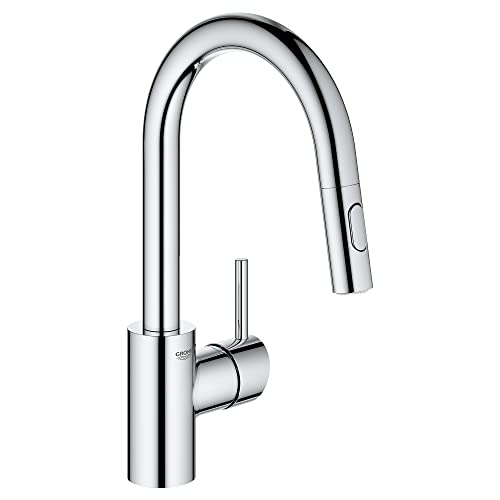
GROHE Concetto Pull Down Bar Faucet 31479001, Starlight Chrome — Best Overall
The Concetto Bar in chrome is the category’s reference product because every relevant spec is verified: a pull-down sprayer with dual spray modes, a 360-degree swivel spout, a 1.75 GPM flow that fills a pitcher briskly without blasting a small bowl, a single-hole deck mount that matches bar sink drilling, and GROHE’s SilkMove ceramic valve. It suits modern prep stations, coffee bars, and kitchen islands where the second sink does daily work.
Strengths
- Fully verified bar specifications, including 1.75 GPM flow
- Pull-down dual spray at bar scale
- Single-hole mount matches most bar sinks
Trade-offs
- Chrome shows spots at a splash-prone station
- Bar reach will not serve a main sink
- Premium tier for a secondary fixture
| Configuration | Bar/prep pull-down, single hole |
| Flow rate | 1.75 GPM (per Amazon title) |
| Valve | SilkMove ceramic (per Amazon title) |
What the numbers mean at the station: 1.75 GPM is the sweet spot for prep work, fast enough for a kettle, controlled enough for rinsing berries in a colander without redecorating the counter. The pull-down head extends the small spout’s effective reach across the whole bowl and into a bucket beside the sink. If your bar sink earns its counter space daily, this is the faucet that justifies it, and the one the rest of this guide is measured against.
Best for: modern prep stations and island sinks in daily use / Not suited for: main-sink duty or traditional wet bars
Check on Amazon — check price on Amazon for the current finish options and included parts.

GROHE Concetto Pull Down Bar Faucet 31479DC1, SuperSteel — Best Stainless Finish
This is the Concetto Bar platform in SuperSteel, GROHE’s stainless-look finish, for kitchens where the main faucet and appliances are stainless and chrome would strike the wrong note at the island. The verified listing confirms the same bar-prep brief: single-hole deck mount, pull-down sprayer, and the SilkMove ceramic cartridge family. It suits island prep sinks in stainless kitchens and home bars built around stainless under-counter refrigeration.
Strengths
- Stainless-look finish coordinates with appliances
- Same verified bar platform as the best overall
- Pull-down sprayer at prep scale
Trade-offs
- Finish premium over the chrome version
- Bar scale limits it to secondary duty
- Stainless-look finishes vary by brand; match in person for critical pairings
| Configuration | Bar/prep pull-down, single hole |
| Finish | SuperSteel (stainless finish, per Amazon title) |
Treat this pick as a finish decision on a proven platform, which is the healthiest way to shop faucets. The working parts mirror the chrome model; the difference is how the station reads against your kitchen. SuperSteel’s brushed character also hides the water spots a prep sink generates better than mirror chrome, a small daily mercy at the station most likely to be left un-wiped. Stainless kitchens should start here and only move on if the budget objects.
Best for: stainless kitchens with island or bar prep sinks / Not suited for: chrome-finished kitchens and tight budgets
Check on Amazon — check price on Amazon for the current finish options and included parts.
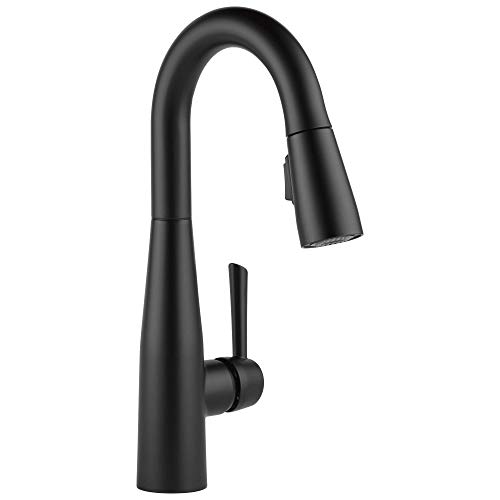
Delta Essa Bar Faucet 9913-BL-DST, Matte Black — Best Modern Bar
Delta’s Essa is one of the most popular modern kitchen faucets in this cluster’s other guides, and this is its purpose-built bar sibling: single-hole, single-handle, with a pull-down sprayer, in matte black. The coordination logic is the draw; an Essa at the main sink and this Essa at the bar sink read as one design decision. It suits contemporary kitchens, matte black accent plans, and island stations in open-plan spaces.
Strengths
- Design-matched bar version of a proven kitchen platform
- Pull-down sprayer at bar scale
- Matte black suits modern accent plans
Trade-offs
- Matte black shows pale scale in hard water
- Single-hole only
- Bar reach is for prep bowls, not stockpots
| Configuration | Bar/prep pull-down, single hole |
| Finish | Matte black |
Matched-platform buying is underrated at the second sink. The handles feel the same, the sprayer behaves the same, and guests read the room as designed. The matte black caution is real but manageable: hard-water scale shows as pale dusting on dark finishes, answered by a weekly soft-cloth wipe. If your main faucet is an Essa or a matte black contemporary model, this is the bar faucet that completes the sentence.
Best for: modern kitchens coordinating a main and bar faucet / Not suited for: hard-water homes avoiding dark finishes
Check on Amazon — check price on Amazon for the current finish options and included parts.

Delta Modern Bar Faucet 14882LF-SP, SpotShield Stainless — Best Simple Bar Faucet
Not every prep sink needs a pull-down head. The Delta Modern Bar is the straightforward version: a single-hole, single-handle bar faucet in SpotShield stainless, sized for the station and finished to resist the spots that constant small splashes create. It suits coffee stations, butler’s pantries, and bar sinks used mostly for filling and glass rinsing, where a fixed spout at the right scale beats a feature list.
Strengths
- SpotShield finish suits a splash-prone station
- Simple single-handle operation
- Bar scale without unnecessary features
Trade-offs
- No pull-down sprayer for bowl washdown
- Fixed spout reach is short by design
- Modern styling only
| Configuration | Bar/prep faucet, single hole, single handle |
| Finish | SpotShield stainless |
The honest case for a fixed bar spout is reliability through simplicity: no hose, no docking, nothing to droop, and a price tier that reflects it. At a coffee station, where the faucet fills a reservoir and rinses a portafilter, that is the correct specification. Buyers whose prep sink washes produce and bowls daily should step up to a pull-down pick above; buyers whose station pours and fills should save the difference and take this one.
Best for: coffee stations and fill-and-rinse bar sinks / Not suited for: prep sinks doing daily produce and bowl washing
Check on Amazon — check price on Amazon for the current finish options and included parts.
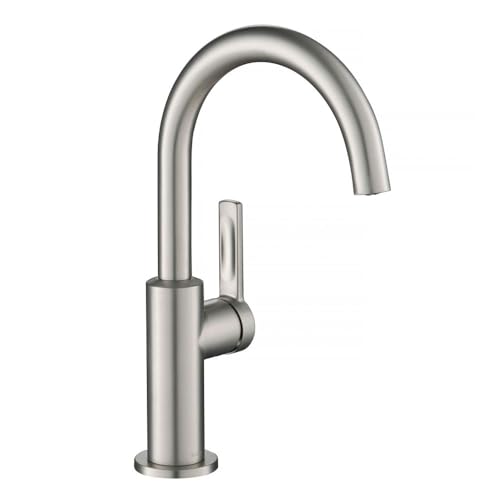
KRAUS Oletto Bar Faucet KPF-2822SFS, Spot Free Stainless — Best Bar Height Alternative
Kraus applies the same platform logic as Delta: the Oletto, which leads our arc guide at full kitchen size, also comes in a bar-height version in spot free stainless. For kitchens running an Oletto at the main sink, this is the matched second-station faucet, with the same finish attitude and a scale cut for bar and prep bowls. It suits island stations and wet bars in stainless Kraus kitchens.
Strengths
- Bar-height version of a proven platform
- Spot free finish forgives a busy station
- Coordinates with full-size Oletto installations
Trade-offs
- Confirm spray configuration on the current listing
- Bar scale only
- Stainless family only in this verified model
| Configuration | Bar faucet, single handle |
| Finish | Spot Free stainless steel (per Amazon title) |
Platform coordination is this pick’s whole argument, and it is a good one: one finish family, one handle feel, two correctly scaled faucets. Buyers without an Oletto at the main sink should compare it directly against the GROHE pair at the top of this guide, which carry fuller verified spec sheets. Buyers with one should stop shopping; the matched answer is rarely wrong at a second sink.
Best for: Oletto kitchens adding a second station / Not suited for: buyers wanting the fullest verified spec sheet
Check on Amazon — check price on Amazon for the current finish options and included parts.

Delta Foundations Two-Handle Bar/Prep Faucet B2410LF — Best Two-Handle Bar
Traditional wet bars and older prep sinks often carry two-handle drilling, and this Foundations model is the verified answer for them: a two-handle bar and prep faucet from Delta’s workhorse platform. Independent hot and cold handles suit a bar station surprisingly well, since tempering water for glass washing or a warm rinse is a set-and-stay task. It suits traditional home bars, laundry-adjacent prep sinks, and replacements on existing two-handle decks.
Strengths
- Fits two-handle bar deck patterns
- Independent temperature control suits bar tasks
- Mainstream platform with broad support
Trade-offs
- Two-handle footprint will not fit single-hole bar sinks
- Basic styling; a utility-first design
- Confirm finish and included parts on the current listing
| Configuration | Two-handle bar/prep faucet |
Replacement logic dominates this pick. If your bar deck is drilled for two handles, the alternatives are this faucet or deck surgery, and deck surgery loses. The Foundations platform’s virtue is availability: it is the kind of faucet that can be serviced forever with mainstream parts. For a traditional bar that pours more than it preps, that is the whole requirement, met without drama.
Best for: traditional bars and two-handle replacement decks / Not suited for: single-hole modern bar sinks
Check on Amazon — check price on Amazon for the current finish options and included parts.
Comparison Table
| Pick | Badge | Key spec | Best for |
|---|---|---|---|
| GROHE Concetto Pull Down Bar Faucet 31479001, Starlight Chrome | Best Overall | Bar pull-down, 1.75 GPM, single hole, 360 swivel, dual spray | modern prep stations and island sinks in daily use |
| GROHE Concetto Pull Down Bar Faucet 31479DC1, SuperSteel | Best Stainless Finish | Bar pull-down, single hole, SuperSteel stainless finish | stainless kitchens with island or bar prep sinks |
| Delta Essa Bar Faucet 9913-BL-DST, Matte Black | Best Modern Bar | Bar version of Essa, pull-down, single hole, matte black | modern kitchens coordinating a main and bar faucet |
| Delta Modern Bar Faucet 14882LF-SP, SpotShield Stainless | Best Simple Bar Faucet | Single-hole bar faucet, single handle, SpotShield stainless | coffee stations and fill-and-rinse bar sinks |
| KRAUS Oletto Bar Faucet KPF-2822SFS, Spot Free Stainless | Best Bar Height Alternative | Bar-height Oletto, single handle, spot free stainless | Oletto kitchens adding a second station |
| Delta Foundations Two-Handle Bar/Prep Faucet B2410LF | Best Two-Handle Bar | Two-handle bar/prep, Foundations platform | traditional bars and two-handle replacement decks |
Every row here is bar scale, so the table’s real work is matching the station: pull-down rows for prep work, fixed rows for filling and rinsing, and the two-handle row for traditional decks. The finish column then coordinates the survivor with your main faucet.
How to Choose a Bar Sink Faucet
Start with the sink, not the faucet. Measure the bowl: most bar sinks run 13 to 17 inches wide, and the faucet’s reach should land the stream near the bowl’s center, which usually means a shorter reach than a kitchen faucet offers. A kitchen faucet’s long reach on a bar sink parks the stream against the far wall and splashes everything. Next, count holes. Bar sinks are most often single-hole, occasionally two-handle patterns on older or traditional installations, and the picks in this guide are labeled by which they serve.
Then decide the sprayer question by task. A prep sink that washes produce, rinses blender jars, and cleans up after a second cook earns a pull-down head. A coffee or drinks station that fills and rinses glasses does not, and the simpler fixed faucet will outlast and undercut it. Flow follows the same logic: bar faucets around 1.75 GPM, like the verified GROHE here, fill pitchers briskly while staying polite in a shallow bowl. Finally, coordinate the finish with the main faucet, ideally the same platform family, because the two stations are usually visible in the same sightline.
Bar Sink vs Prep Sink vs Main Sink: Sizing the Station
The terms blur in listings, so size by bowl and by job. A bar sink is the smallest station, glasses and ice and cocktail prep, happiest with a compact faucet and moderate flow. A prep sink is a cook’s second workstation, wider, deeper, and the natural home of a pull-down bar faucet that can rinse produce and wash a cutting board. A main sink is neither, and no bar faucet in this guide should be asked to run one: the reach, height, and flow are all tuned down on purpose.
The common failure is buying a bar faucet as a budget main faucet. It fits the deck, it costs less, and it then spends a decade landing its stream in the wrong part of a big bowl at a flow that makes filling a pot a meditation exercise. The reverse failure, a full kitchen faucet on a bar sink, splashes and crowds. Match the faucet class to the station class and both fixtures feel designed, which they were.
Designing the Wet Bar and Coffee Station Around the Faucet
A bar sink earns its plumbing when the station around it is designed as a system. For a drinks station, the faucet’s neighbors are the ice supply, the glass storage, and the surface where drinks are built; the faucet should be reachable without crossing the work surface, and its spout should land over the bowl’s center so a shaker can be rinsed without a wrist angle. For a coffee station, the faucet lives beside the machine it fills, and the winning detail is a spout and, ideally, a pull-down head that can fill the machine’s reservoir in place, sparing the daily carry across the kitchen that ends, eventually, in a spill on the good floor.
Glassware dictates the spray decision more than any other factor. Delicate stemware wants a gentle, aerated stream and no sprayer blasting at close range; pint glasses and cocktail shakers want the sprayer’s speed. A dual-mode pull-down like the GROHE picks in this guide covers both households in one fixture, which is why they lead the roundup. Fixed-spout picks serve stations whose glassware is uniformly sturdy or uniformly delicate, where one behavior is genuinely enough.
Under the counter, give the station the same respect as the main sink: a filter if the main sink has one, so drinks taste like the rest of the house’s water, and a leak pan or at least a clear cabinet floor where a drip would be seen. Second stations fail socially before they fail mechanically, when they are slightly too far, slightly too awkward, or slightly unpleasant to use, and the faucet’s fit and behavior are most of that impression.
Bar Faucets Beyond the Kitchen: Laundry, Potting, and Outdoor Stations
The bar faucet’s virtues, compact scale, honest flow, simple mounting, travel well beyond the kitchen. Laundry rooms are the most common second career: a bar faucet over a utility sink fills buckets at a civilized rate, rinses delicately where a slop-sink faucet would blast, and fits the narrow decks that laundry tubs often present. The two-handle Foundations pick in this guide is the natural laundry candidate, since laundry decks frequently carry two-handle drilling and the platform shrugs off detergent chemistry and indifference alike.
Potting and garden stations reward the pull-down models, whose heads reach a watering can on the floor beside the sink and rinse soil from roots and tools at an angle a fixed spout cannot offer. Outdoor kitchens, where the station is truly a bar, reward the finishes that forgive weather-adjacent neglect, brushed and spot-shielding families over mirror chrome, and reward simple mechanisms that a seasonal shutdown cannot confuse.
The transferable rule is the one this guide opened with: match the faucet class to the station’s bowl and job. A bar faucet succeeds in any room where the sink is small, the tasks are quick, and the water’s job is rinsing and filling rather than production. It fails, in any room, when promoted to a main sink’s duties. Buy it for the station it is, wherever that station lives.
The Second Sink Decision: Is a Bar Sink Worth It at All?
Because this guide exists to sell you the right bar faucet, it owes you the prior question answered honestly: many bar sinks are mistakes. A second sink earns its cost when two cooks genuinely work simultaneously, when entertaining happens weekly at a distance from the kitchen’s mess, or when a coffee ritual is daily and distant from the main sink. It does not earn its cost as a resale checkbox in a kitchen where one person cooks and the island is four steps from the main sink; in those kitchens the bar sink becomes a mail tray with plumbing, and its faucet, however good, becomes the nicest fixture nobody uses.
The test is behavioral, not architectural. For two weeks, notice every time you wait for the main sink, carry water across the room, or wish for a rinse station at the island. If the count is near zero, spend the bar budget on the main faucet instead, and let our arc and two-handle guides compete for it. If the count is daily, the bar sink is a workstation, and it deserves the best faucet in this guide rather than the cheapest, because under-specifying a used-daily station is the most expensive kind of saving.
For households between the extremes, the middle picks here, the simple Delta Modern Bar for a coffee corner, the two-handle Foundations for an existing deck, let the station prove itself at modest cost. A station that gets used will argue for its own upgrade in a year or two, with evidence. A station that does not will have cost you the least possible tuition.
Plumbing a Second Station: The Costs Nobody Quotes
The faucet is the visible tip of a second sink’s budget, and honest planning prices the submerged part. A new bar or prep station needs hot and cold supplies extended to a new location, a drain tied into the home’s system with correct venting, and shutoffs of its own. In a renovation where walls and cabinets are already open, that plumbing is a modest line item. As a standalone project in a finished kitchen, it can exceed the cost of every faucet in this guide combined, which is why the second-sink decision in this article’s other extra section is behavioral before it is financial: the station must promise daily use to justify infrastructure, not just hardware.
Existing wet bars and prep sinks invert the economics completely. The plumbing is already there, the deck is already drilled, and the entire project collapses into the faucet decision this guide covers, plus the small print: shutoffs that may not have turned in a decade, supply lines at the end of their safe life, and a trap that will not survive being disturbed without a fight. Budget the faucet, a plumber’s hour, and a contingency for those three antiques, and a revival project stays the bargain it looks like.
One more line item deserves naming because it is perpetually forgotten: filtration and specialty feeds. A coffee station that wants filtered water, a drinks station that wants an instant-chilled or sparkling feed, each adds its own under-sink equipment competing for the cabinet the faucet’s hoses also need. Measure the cabinet as carefully as the deck. The stations that delight are the ones whose under-sink was planned as deliberately as their countertops, and that planning is free at the stage when it matters most.
Bar Faucet Finishes and Glassware: The Aesthetics of the Small Station
A bar station is the most looked-at small stage in a home, because it is where drinks are made in front of an audience. The faucet’s finish therefore works under social lighting, evening light, glass everywhere, and it should be chosen the way one chooses barware: for how it behaves among reflections. Brushed and satin finishes, the SuperSteel and spot-free stainless picks in this guide, glow without glare and hide the water spots that a working bar generates constantly. Mirror chrome sparkles and then, inevitably, shows every splash of the evening’s work, which some hosts read as honest patina and others as a mess they must keep chasing with a cloth.
Glassware is the second aesthetic system at the station, and it argues for the pull-down head on grounds nobody lists: a head that comes to the glass rinses stemware at close range, gently, without the glass traveling to meet a fixed stream at an angle that risks the rim against the spout. Fine glassware and fixed tall spouts are natural enemies; the scaled-down pull-downs in this guide exist partly to end that feud. Hosts with serious glass collections should weight the GROHE and Delta pull-down picks accordingly.
The station’s small scale forgives one indulgence the main kitchen cannot afford: a genuinely decorative finish or silhouette, because the surface area is small and the maintenance is bounded. A matte black bar faucet, like the Essa Bar pick, in a kitchen whose main faucet is stainless would be a coordination error at main-sink scale and can be a deliberate accent at bar scale, provided the accent is repeated somewhere, a rail, a light fixture, a cabinet pull, so it reads as a decision. Small stations are where a home’s design gets to take its one stylish risk.
Stocking the Station: What Belongs Around a Bar Faucet
A bar faucet becomes a station when the objects around it are chosen with the same care, and the list is shorter than retailers suggest. Within arm’s reach of the faucet there should be exactly four categories of things: the vessels being filled or rinsed, the tools of the station’s trade, a towel that lives at the station rather than visiting it, and a small, dignified place for the inevitable drips, a mat or tray that makes the wet zone intentional. Everything else, the backup bottles, the specialty gadgets, the glassware overflow, belongs in storage one step away, because a station crowded at the faucet is a station whose faucet cannot be used gracefully, and grace under audience conditions is the entire point of a home bar.
The coffee version of the same discipline puts the machine the faucet serves within hose or pitcher distance, the beans and filters in one closed home, and the knock box or drip tray where the faucet’s sprayer can reach it, because a coffee station that cannot be rinsed is a coffee station that gets cleaned monthly and resented weekly. The prep version puts the board beside the bowl, the knife magnet out of the splash zone, and the colander in the cabinet directly below, where the faucet’s pull-down head and the cook’s workflow meet without a journey.
Notice that none of these lists is long, expensive, or photogenic in the way catalog spreads are. Stations succeed on proximity and restraint. The faucet, chosen from this guide to fit the bowl and the job, is the fixed point; the discipline is arranging the movable world so the fixed point can do its work. Hosts and cooks who get that arrangement right find that guests gravitate to the bar station and that prep flows through the second sink as if the kitchen had been designed by someone who cooks, which, at that point, it has been.
A Brief Defense of the Small Faucet
There is a quiet prejudice in kitchen design that bigger fixtures are more serious ones, and the bar faucet suffers from it: dismissed as the main faucet’s little sibling, specified last, budgeted with leftovers. The prejudice survives because it is rarely examined. A faucet’s seriousness is not its size but the precision with which it fits its task, and by that measure a well-chosen bar faucet, its stream landing exactly mid-bowl, its flow tuned to the glassware it serves, its scale leaving the small counter around it usable, is a more serious object than a flagship kitchen faucet looming over a bowl it overshoots. Fit is the luxury. Everything else is dimension.
The small faucet also carries an argument about attention. The main sink receives the household’s money and anxiety in proportion to its workload, which is just, but the second station is where the household’s pleasures disproportionately live: the coffee ritual that starts the day, the drink built for a friend, the quiet prep work done beside a window while the main kitchen is occupied by someone else’s project. Fixtures that serve pleasure deserve specification as careful as fixtures that serve labor, and a bar station fitted with a faucet that splashes, crowds, or dribbles taxes the exact moments it exists to elevate.
So the defense rests: buy the small faucet with the same rigor as the large one. Measure its bowl, count its holes, match its finish family, demand its verified specifications, as this guide has done on your behalf for six of them. The station will repay the rigor every single day, in the currency small stations trade in, which is not throughput but delight. No fixture in the house offers a better exchange rate.
The Bar Faucet in a Rental and in a Forever Home
The same bar faucet decision looks different through the two lenses that govern most housing choices. In a rental, a bar or prep sink is an amenity a landlord maintains and a tenant enjoys, and the specification that serves both is the indestructible middle: a mainstream platform, a finish that reads clean under any housekeeping regime, and a mechanism with no electronics and no proprietary parts, which is why the two-handle Foundations pick exists in this guide and why it may be the correct first choice for any bar sink that will be used by people who did not buy it. Tenants will not baby a pull-down head’s docking, and a faucet whose worst failure mode is a five-dollar cartridge is a faucet whose landlord sleeps well.
In a forever home, the calculus inverts completely. The station will be used by its owners for decades, its pleasures are daily and personal, and the correct specification is the one that maximizes the owners’ own rituals: the pull-down that fills the beloved machine’s reservoir in place, the finish that matches the kitchen they built around it, the platform whose parts they have already filed in the home archive. The GROHE and Delta picks at the top of this guide are forever-home answers, priced accordingly and justified accordingly.
Most households live between the lenses, in homes they own but may sell, and for them the guidance is to buy for the current chapter with the next one in peripheral vision: a quality mainstream bar faucet, in a finish family the main kitchen already speaks, installed on the deck’s existing pattern without modification. That specification delights its owners now, reassures a future buyer later, and never requires an apology in either direction. It is, not coincidentally, a fair summary of every pick in this guide.
A Word on Bar Sink Bowls Themselves
Because faucet and bowl are one system, a final note on the bowl deserves its place. Depth is the bar sink’s version of the arc faucet’s height question: a shallow bowl under a lively stream splashes, while a deeper bowl swallows the same stream calmly and holds a bucket or a case of bottles without theater. If you are choosing the sink and the faucet together, buy the depth first and let the faucet’s flow, the verified figures in this guide, confirm the pairing. If the bowl already exists and runs shallow, favor the gentler end of this guide’s picks and let the aerator do the diplomacy. Either way, judge the couple, not the individual, because at a small station there is nowhere for a mismatch to hide, and a matched pair will quietly outperform a brilliant faucet married to the wrong bowl every single day of its working life together in your kitchen.
How to Plan a Second Sink Station That Actually Gets Used
Step one: assign the station a job in writing, drinks, coffee, or cooking prep, because the job chooses the faucet, the accessories, and whether the station earns its plumbing. Step two: place the station where the job happens; a prep sink belongs beside the main cutting and cooking zone, a drinks station near the seating it serves. Step three: confirm the deck pattern on the sink you are buying or keeping, and match the faucet’s mounting to it before ordering either.
Step four: plan the under-sink honestly. A second station still needs shutoffs, a trap, and often a small water filter or an instant-hot unit; crowded cabinets are where second stations go to leak unnoticed. Step five: match the faucet finish and platform family to the main sink so the room reads as one design. Step six: after installation, run the station through its real job, fill the kettle, rinse the produce, wash the glasses, and confirm the stream lands mid-bowl and the sprayer, if fitted, reaches the corners. A station that passes its own job test gets used for years; one that fails becomes a very expensive plant stand.
Common Buying Mistakes
Buying a bar faucet for the main sink. Shorter reach and gentler flow are features at a bar and failures at a main sink.
Putting a full-size kitchen faucet on a bar sink. The stream overshoots the small bowl and the deck looks crowded.
Ignoring the hole pattern. Single-hole and two-handle bar decks are different worlds. Count before ordering.
Skipping the pull-down on a true prep sink. Produce and board washing without a sprayer gets old within a week.
Mismatching the main faucet’s finish family. The two stations share sightlines; coordinate them like one design.
Final Recommendation
The GROHE Concetto Bar in chrome is the default buy for a working prep station, and its SuperSteel twin covers stainless kitchens. Delta’s Essa Bar completes matte black modern plans, the Delta Modern Bar is the simple coffee-station answer, and the Foundations two-handle rescues traditional decks. If the station grows into a primary workspace, step up to the full-size options in best kitchen arc faucets; deck questions for any of these installs are covered in best kitchen counter faucets.
GROHE Concetto Pull Down Bar Faucet 31479001, Starlight Chrome covers the best overall slot. GROHE Concetto Pull Down Bar Faucet 31479DC1, SuperSteel covers the best stainless finish slot. Delta Essa Bar Faucet 9913-BL-DST, Matte Black covers the best modern bar slot.
Best Kitchen Arc Faucets Best Kitchen Counter Faucets Best Kitchen 2 Handle Faucets Best Kitchen And Bathroom Faucets Best Kitchen Family Friendly Faucets
Frequently Asked Questions
What is the difference between a bar faucet and a kitchen faucet?
Scale and tuning. Bar faucets are shorter, with shorter reach and moderate flow, designed for small secondary sinks used for drinks and prep. Kitchen faucets are taller, reach further, and flow faster for filling pots and washing large items. Each feels wrong when swapped into the other’s sink.
Can I use a bar faucet as my main kitchen faucet?
It will mount, but it will underperform daily: the stream lands short in a big bowl and filling a stockpot at bar flow is slow. Bar faucets are a deliberate specification for a second station, not a budget shortcut for the main sink.
Do bar faucets come with pull-down sprayers?
Yes, the leading models in this guide, including both GROHE Concetto Bar finishes and the Delta Essa Bar, are pull-down designs scaled for prep work. Simpler fixed-spout models suit fill-and-rinse stations like coffee bars.
What hole pattern do bar sinks use?
Most modern bar sinks are single-hole. Traditional and older prep installations may use a two-handle pattern, which the Delta Foundations pick in this guide serves. Count your deck’s holes before ordering, as the patterns do not adapt to each other.
What flow rate should a bar faucet have?
Around 1.75 GPM, the verified rating of the GROHE Concetto Bar, is the sweet spot: fast enough to fill a pitcher or kettle, controlled enough not to blast a shallow bar bowl. Much lower feels sluggish; kitchen-level flow splashes.
Should my bar faucet match my main faucet?
In finish family, yes, and ideally in platform. Delta and Kraus both sell bar versions of their kitchen platforms, and matched pairs read as one design decision across the room’s sightlines.


