Disclosure: airfryerkitchensupply.com is reader-supported. When you buy through links on our site, we may earn an affiliate commission at no extra cost to you.
Where to buy
If you are shopping for the best food stand mixers, start with the shortlist below. Every linked model in this guide was checked against Amazon’s own catalogue data for this site before it earned a link, and the listing is where you confirm the exact bowl size, colour and included attachments for the configuration you want. Prices move often in this category, so use the listing rather than any roundup to see what a model costs today.
- KitchenAid Artisan 5-Qt Tilt-Head Stand Mixer KSM150PS — check the current price on Amazon and confirm the exact configuration on the listing before you order.
- KitchenAid 7-Quart Bowl-Lift Stand Mixer KSM70 — check the current price on Amazon and confirm the exact configuration on the listing before you order.
- Cuisinart Precision Master 5.5-Quart Stand Mixer SM-50 — check the current price on Amazon and confirm the exact configuration on the listing before you order.
- Bosch Universal Plus Stand Mixer (500 Watt, 6.5 Quarts) — check the current price on Amazon and confirm the exact configuration on the listing before you order.
- Ankarsrum Assistent Original Stand Mixer AKM6230 — check the current price on Amazon and confirm the exact configuration on the listing before you order.
- Hamilton Beach 4-Qt Electric Stand Mixer (7 Speeds) — check the current price on Amazon and confirm the exact configuration on the listing before you order.
A stand mixer is the closest thing the home kitchen has to a universal food machine, so the search for the best food stand mixers pulls in every kind of cook at once: the cake baker, the bread devotee, the batch cook, the once-a-year holiday baker. That breadth is exactly why general guides disappoint — they average away the differences that decide satisfaction. This guide takes the opposite approach: six machines, each genuinely best at something, ranked by how they perform across the whole food-mixing repertoire rather than by a single party trick.
Read the list as a map, not a ladder. The Best Overall pick is the machine to buy when you know nothing else about the buyer. The others exist because real kitchens differ — in batch size, in dough habits, in storage, in budget — and each badge marks the machine that wins when that difference leads. Specifications quoted are the ones confirmed in listing data for this guide; prices are deliberately absent, because they move, and every pick links to its listing so you can check the current price on Amazon for the exact configuration.
One principle before the details: a stand mixer is a ten-year purchase made in an afternoon. The features that matter across ten years are unglamorous — frame rigidity, bowl size matched to your recipes, parts and attachments you can still buy in year seven, controls that never annoy you. The reviews below weight those things heavily, because a mixer is not really bought on day one; it is bought on the five hundredth use.
This guide is the generalist of the series. Its sibling guides take single jobs — cakes, dough, small budgets, specific designs — and judge machines by that job alone, and where your own cooking has a clear centre of gravity, those guides will serve you more precisely. This one serves the majority in the middle: households whose mixing is a bit of everything, and who need the machine that is never the wrong tool even when it is not the perfect one.
In this guide
Quick Picks
Short on time? These are the best food stand mixers worth a serious look, each chosen for a different kind of baker, budget and counter. The badge beside each name is the same badge used in its full review further down, so you can jump straight to the model that matches how you actually bake.
- Best Overall — KitchenAid Artisan 5-Qt Tilt-Head Stand Mixer KSM150PS: The reference point of the category: 5-quart tilt-head, ten speeds, pouring shield included, and the deepest colour and attachment ecosystem in stand mixing.
- Best for Heavy Use — KitchenAid 7-Quart Bowl-Lift Stand Mixer KSM70: Seven quarts on a rigid bowl-lift frame with 11 speeds and a five-piece accessory kit — the heavy-duty end of the home stand-mixer market.
- Best Value — Cuisinart Precision Master 5.5-Quart Stand Mixer SM-50: Twelve speeds, a 5.5-quart stainless bowl and the full three-tool kit plus splash guard — the complete stand-mixer specification at a mid-range tier.
- Best for Dough and Capacity — Bosch Universal Plus Stand Mixer (500 Watt, 6.5 Quarts): Bottom-drive design with wire whips and dough hook in a 6.5-quart open bowl — the capacity and dough champion that also handles everyday mixing.
- Best Premium Alternative — Ankarsrum Assistent Original Stand Mixer AKM6230: The Swedish rotating-bowl Assistent — a premium, design-distinct machine whose gentle kneading and big capacity attract bakers leaving the mainstream behind.
- Best Budget — Hamilton Beach 4-Qt Electric Stand Mixer (7 Speeds): Planetary mixing, 300 watts, seven speeds and the full whisk-beater-hook set with splash guard — the budget tier done properly, with a carry handle for storage.
How These Picks Were Chosen
Every linked model in this guide was verified against Amazon’s catalogue data through this site’s own product-checking system, and the specifications printed — capacities, speeds, motors, included tools — are taken from that confirmed data. Models that could not be confirmed do not carry links. As throughout this series, no prices are printed: each pick’s link leads to its live listing, where checking the current price on Amazon also confirms the exact colour, bundle and bowl configuration on offer.
Selection balanced the full food-mixing repertoire: batter and cake work, creaming and whipping, frosting, moderate and heavy dough, and the everyday small jobs — mashing, mixing, shredding with the right tools — that decide whether a machine earns permanent counter space. Machines were then spread deliberately across designs (tilt-head, bowl-lift, bottom-drive, rotating bowl), capacities from 4 to 7 quarts, and tiers from budget to premium, so the shortlist maps to real kitchens rather than to a single idealised one.
A note on what was left out, because it shapes the list you are reading: several famous names do not appear because their current models could not be confirmed in the catalogue data at verification time, and this series does not link what it cannot check. Absence here is a verification outcome, not a quality verdict, and the six confirmed machines were more than sufficient to cover every frame, size and tier a home buyer needs to choose between.
The 6 Best Food stand mixers

Best Overall: KitchenAid Artisan 5-Qt Tilt-Head Stand Mixer KSM150PS
Some products become the category in the public mind, and the Artisan is the stand mixer’s example — not by marketing, but by accumulation: decades of home kitchens, a design that has been refined rather than replaced, and an ecosystem of attachments, bowls and parts that no rival matches. As a food mixer in the general sense — batters, doughs of moderate size, whipped everything, frostings, mashes and mixes — it is the most complete answer here, with a 5-quart bowl that fits standard recipes and ten speeds that cover the range from a gentle stir to a fast whip.
Strengths
- Balanced at every common job — batters, creams, moderate doughs, meringues
- Tilt-head access and familiar controls make it the easiest flagship to live with
- Attachment hub and parts availability are the best in the business
Trade-offs
- Mid-premium tier — value hunters get similar cake results for less
- Not the dough or capacity champion; specialists beat it at the extremes
- Hinge pin needs an occasional check to keep the head tight over years
| Bowl capacity | 5 quart |
| Design | Tilt-head |
| Speeds | 10 speed settings |
| Included | Pouring shield for mess-free mixing |
Its everyday virtues are ergonomic as much as mechanical. The tilt head opens with one motion for scraping and adding; the controls are a single lever your hand learns in a day; the bowl locks and releases without a fight. The pouring shield in the box sounds minor until the first flour addition. And because the machine is the category’s default, everything around it — replacement beaters, a second bowl, a flex-edge upgrade, advice — is easier to find than for any rival, which is a real ownership advantage across a decade of use.
The honest limits are at the specialisms. Dough in quantity belongs to the bowl-lift and bottom-drive machines below; doubled celebration batches crowd the bowl; and bakers who care nothing for ecosystem or finish can match its cake results for less money with the Cuisinart. But as the single answer to ‘which stand mixer should a normal household buy’, the Artisan remains what it has been for years: the machine you recommend without needing to know anything else about the kitchen it is going to.
Best for: most households wanting one excellent stand mixer for all food mixing / Not suited for: batch dough bakers or buyers who need maximum capacity
Check the current price on Amazon for the KitchenAid Artisan 5-Qt Tilt-Head Stand Mixer KSM150PS in the colour and configuration you want.

Best for Heavy Use: KitchenAid 7-Quart Bowl-Lift Stand Mixer KSM70
Heavy use breaks stand mixers in slow motion: heads loosen, frames flex, motors that coped with single batches sulk at doubles. The KSM70 is KitchenAid’s answer built in the other direction — a bowl-lift frame that clamps a 7-quart bowl rigidly, eleven speeds that still include a gentle half speed for folding, and an accessory set that assumes serious work, led by a double flex-edge beater that scrapes the bowl as it mixes. If your current mixer sounds strained on your normal bake, this is the class of machine that ends the straining.
Strengths
- Frame rigidity and capacity for the heaviest home workloads
- Half-speed setting adds delicacy unusual in a machine this size
- Rich accessory kit, including a bowl-scraping flex-edge beater
Trade-offs
- Tall, heavy and priced like the flagship it is
- Small batches sit low in the big bowl
- Needs measured cabinet clearance and a permanent counter spot
| Bowl capacity | 7 quart |
| Design | Bowl-lift |
| Speeds | 11 speeds, including 1/2 speed for folding |
| Included | Double flex-edge beater and 4 other accessories |
What heavy use really means at home is repetition at scale: the weekly double loaf, the celebration cake in one mix, buttercream by the batch, holiday baking that runs the machine for hours across a weekend. The KSM70 treats that schedule as its design brief. The bowl-lift mechanism also ages gracefully — there is no hinge to loosen in the tilt-head sense — and the machine’s weight, a burden on day one, becomes stability every day after.
Its demands are space and honesty. It is tall enough to require a clearance check, heavy enough to require a permanent home, and capacious enough that a single small sponge is genuinely worse in it than in a 4.5-quart bowl. Buy it because your workload is real, and it is one of the most satisfying tools in this entire series of guides. Buy it as insurance against imaginary workloads, and the Cuisinart below will quietly make you happier.
Best for: high-volume home bakers, big families and anyone upgrading from a straining tilt-head / Not suited for: small kitchens or modest, occasional baking
Check the current price on Amazon for the KitchenAid 7-Quart Bowl-Lift Stand Mixer KSM70 in the colour and configuration you want.

Best Value: Cuisinart Precision Master 5.5-Quart Stand Mixer SM-50
The SM-50’s argument is arithmetic: a 5.5-quart stainless bowl, twelve speeds, whisk, paddle, dough hook and splash guard, at a tier clearly below the flagships — with the cuts taken where most households will never feel them. The frame is lighter than a bowl-lift KitchenAid, the attachment catalogue is shorter, and that is close to the whole of the sacrifice. For the central work of a food stand mixer — batters, cakes, creams, frostings, moderate doughs, everyday mixing — it performs the repertoire completely.
Strengths
- Specification-for-money is the best in this guide
- Granular 12-speed control suits both folding and whipping
- Complete kit in the box — nothing essential to buy next
Trade-offs
- Lighter frame than the premium bowl-lifts
- Accessory world is a fraction of KitchenAid’s
- Dial control divides opinion versus a simple lever
| Bowl capacity | 5.5 quart stainless steel bowl |
| Speeds | 12 speeds |
| Included | Chef’s whisk, mixing paddle, dough hook, splash guard with pour spout |
The twelve-speed dial is its signature in use. More steps between stir and whip means a speed that matches the task instead of bracketing it: a true creep for folding, a confident mid-range for creaming, a top end that whips without hesitation. The splash guard’s pour spout, included rather than upsold, keeps flour additions tidy in small kitchens. Owners upgrading from hand mixers find nothing missing; owners cross-shopping flagships find the difference is mostly weight, ecosystem and price.
It is the rational pick of this guide, and rational picks deserve clear boundaries. Weekly stiff-dough bakers should buy rigidity further up the list; bakers dreaming of pasta rollers and grain mills should buy into the bigger ecosystem. Everyone else — the large middle of home bakers who want one good machine at a fair tier — should start here and spend the savings on ingredients, which improve food more than badges do.
Best for: value-led households wanting a full-size, full-kit stand mixer / Not suited for: attachment collectors or the heaviest dough workloads
Check the current price on Amazon for the Cuisinart Precision Master 5.5-Quart Stand Mixer SM-50 in the colour and configuration you want.
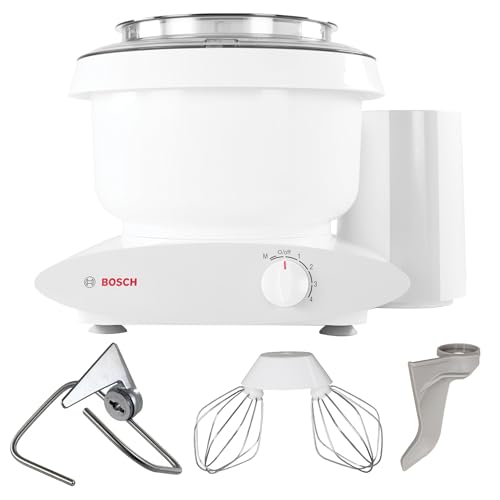
Best for Dough and Capacity: Bosch Universal Plus Stand Mixer (500 Watt, 6.5 Quarts)
The Universal Plus approaches the stand mixer from the dough outward. Its motor drives from beneath the bowl, leaving a 6.5-quart workspace completely open at the top — no head to tilt, no shield slot to aim flour through. Wire whips handle foams and batters, the dough hook and its extender handle the machine’s home ground, and the whole system is built around throughput: big batches, stiff mixtures, weekly repetition. For a household whose mixing life is led by bread, pizza and batch baking, it is not an alternative design; it is the correct one.
Strengths
- Open bowl: add ingredients freely, watch mixtures, scrape easily
- Outstanding dough stamina and batch capacity
- Long-lived platform with a devoted batch-baking following
Trade-offs
- Unconventional workflow takes adjustment for tilt-head natives
- Cake and cream work is good rather than class-leading
- Aesthetics are functional, not decorative
| Bowl capacity | 6.5 quarts |
| Motor | 500 watt |
| Included | Wire whips, dough hook and NutriMill dough hook extender (bundle) |
As a general food mixer it remains more capable than its specialist reputation suggests. The open bowl is a daily convenience for any mixture you add to in stages — which is most of cooking — and the whips produce proper whipped cream and egg foams. What it does not do is mimic the planetary mainstream’s feel: speeds, attachments and cues differ, and bakers raised on tilt-heads should expect a short apprenticeship rather than instant fluency.
Judge it by centre of gravity. If dough and volume lead your kitchen, the Bosch will likely out-serve and out-last the conventional picks here, and its following among serious home bakers is earned. If your mixing is cakes and creams with dough as a guest, the Artisan and Cuisinart fit your life more naturally. The machine is superb; the question is only whether its superbness points in your direction.
Best for: bread and batch bakers who also need a general food mixer / Not suited for: small-batch bakers or design-led kitchens
Check the current price on Amazon for the Bosch Universal Plus Stand Mixer (500 Watt, 6.5 Quarts) in the colour and configuration you want.
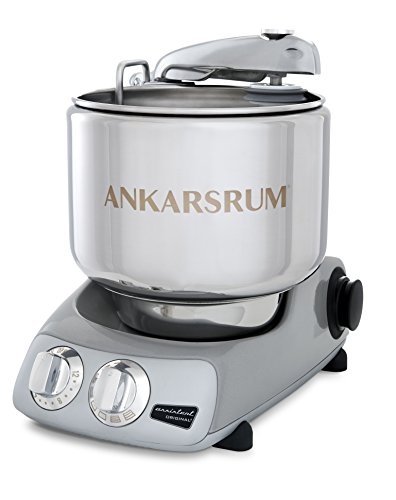
Best Premium Alternative: Ankarsrum Assistent Original Stand Mixer AKM6230
Every category has the product its enthusiasts describe as ‘not really comparable’, and in stand mixers it is the Ankarsrum. The Swedish Assistent rotates its bowl against a roller and scraper, kneading and mixing by pressure and folding rather than by dragging tools through the mixture. The design is decades old, visually unlike anything else on a counter, and supported by a service reputation that makes its premium tier legible: this is bought the way good furniture is bought, once and for a long time.
Strengths
- Kneading quality and gentleness no hook machine matches
- Very large effective batch capacity
- Distinctive design and a reputation for decades-long service
Trade-offs
- Premium pricing, firmly
- Learning curve: techniques and cues differ from planetary mixers
- As a pure cake-and-cream machine it is outshone by cheaper rivals
| Model | AKM6230, Jubilee Silver |
| Design | Rotating bowl, roller and scraper system |
| Style | Assistent Original |
Its dough work is covered in this series’ dough guide, where it takes the top badge; here the relevant point is breadth. With its beater bowl and tools it creams, whips and mixes respectably across the food-mixer repertoire, and its capacity handles family-scale quantities of almost anything. What it asks in return is relearning: mixture cues, attachment logic and even how you add ingredients differ from the planetary mainstream, and the first month involves a manual in a way a KitchenAid never does.
So the Assistent is a considered purchase, not an impulse one. Bakers whose centre of gravity is dough, who value longevity and design coherence, and who enjoy mastering a distinct tool will find it the most rewarding machine in this guide. Bakers who want the familiar, the versatile-per-money or the instantly intuitive should take the Artisan or Cuisinart and never look back. Both decisions are correct; they belong to different people.
Best for: committed bakers, especially dough-led ones, buying a long-term centrepiece / Not suited for: casual bakers or anyone seeking best value per function
Check the current price on Amazon for the Ankarsrum Assistent Original Stand Mixer AKM6230 in the colour and configuration you want.

Best Budget: Hamilton Beach 4-Qt Electric Stand Mixer (7 Speeds)
Budget stand mixers fail in a predictable place: they keep the silhouette and cut the mixing action, leaving a beater that stirs the middle of the bowl and ignores the edges. This Hamilton Beach refuses that cut. It keeps planetary mixing — the beater orbiting the bowl for full coverage — pairs it with a sensible 300-watt motor and seven speeds, and includes whisk, flat beater, dough hook and splash guard. For the standard work of a home food mixer, that is the whole recipe, at the tier this guide’s other picks cannot reach.
Strengths
- Real planetary action — the feature that decides mixing quality — at a budget tier
- Complete included kit, splash guard and all
- Light with a carry handle: genuinely easy to store and retrieve
Trade-offs
- Coarser speed ladder than premium machines
- Motor is sized for standard work, not stiff or oversized loads
- Lighter construction will age faster under heavy weekly use
| Bowl capacity | 4 quart |
| Speeds | 7 speeds |
| Motor | 300 watts |
| Included | Whisk, flat beater, dough hook, splash guard; planetary mixing; easy-carry handle |
Its lightness, elsewhere a compromise, is here a lifestyle feature: the easy-carry handle and modest weight suit the many kitchens where a mixer is stored in a cupboard and fetched per use. The 4-quart bowl matches standard recipes, and cakes, creams, frostings and light doughs all come out as they should. The speed ladder is coarser than a flagship’s — folding takes a watched, gentle hand — and stiff doughs should be kept small and occasional.
Set expectations at its tier and it exceeds them. It will not out-last an all-metal machine under relentless use, and it is not the tool for batch bread. But as the affordable route into genuine stand mixing — the purchase that turns hand-mixer households into stand-mixer households — it is the most defensible budget pick in this series, and many bakers will use it happily for years before wanting more.
Best for: budget-led buyers who want true stand-mixer function for standard home mixing / Not suited for: heavy dough bakers or twenty-year-machine shoppers
Check the current price on Amazon for the Hamilton Beach 4-Qt Electric Stand Mixer (7 Speeds) in the colour and configuration you want.
Why Stand Mixers Became the Kitchen’s Centre of Gravity
The stand mixer’s dominance is not an accident of marketing; it is the shape of home cooking itself. Mixing is the most repeated mechanical act in a kitchen that bakes, and the stand mixer is the only appliance that performs it hands-free, at scale, with tools that swap for the task. That is why the category supports such different designs — the tilt-head mainstream, the bowl-lift heavies, the bottom-drive batch machines, the Swedish roller — each an optimisation for a different centre of gravity in a different kitchen.
It is also why this guide refuses a single winner-takes-all ranking beyond its overall pick. The machines above are not six attempts at the same product; they are six answers to six kitchens. Reading them that way — matching frame, bowl and temperament to your own cooking — is the entire skill of buying a stand mixer well, and it is a skill that pays out weekly for a decade.
There is a final, practical consequence of that centre-of-gravity position: the stand mixer is the appliance most worth buying correctly the first time. It is too bulky to store a mistake, too durable to justify replacing a near-miss, and too central to work around. The twenty extra minutes spent measuring cabinets, counting your standard recipes and reading the verdicts in this guide are, hour for hour, the highest-value time in the whole purchase — more than any sale, bundle or colour decision that follows them.
Comparison Table
| Pick | Badge | Key spec | Best for |
|---|---|---|---|
| KitchenAid Artisan 5-Qt Tilt-Head Stand Mixer KSM150PS | Best Overall | 5-qt tilt-head, 10 speeds | most households wanting one excellent stand mixer for all food mixing |
| KitchenAid 7-Quart Bowl-Lift Stand Mixer KSM70 | Best for Heavy Use | 7-qt bowl-lift, 11 speeds | high-volume home bakers, big families and anyone upgrading from a straining tilt-head |
| Cuisinart Precision Master 5.5-Quart Stand Mixer SM-50 | Best Value | 5.5-qt, 12 speeds, full kit | value-led households wanting a full-size, full-kit stand mixer |
| Bosch Universal Plus Stand Mixer (500 Watt, 6.5 Quarts) | Best for Dough and Capacity | 6.5-qt bottom-drive, 500W | bread and batch bakers who also need a general food mixer |
| Ankarsrum Assistent Original Stand Mixer AKM6230 | Best Premium Alternative | Rotating-bowl premium system | committed bakers, especially dough-led ones, buying a long-term centrepiece |
| Hamilton Beach 4-Qt Electric Stand Mixer (7 Speeds) | Best Budget | 4-qt, 7 speeds, 300W, planetary | budget-led buyers who want true stand-mixer function for standard home mixing |
Specifications above are limited to figures confirmed in the manufacturer listing data checked for this guide. Where a maker sells the same model in several sizes or bundles, the listing for the exact version is the final word, which is one more reason to check price on Amazon on the precise configuration rather than relying on a headline number.
How to Choose the Best Food Stand Mixers
Begin with the frame, because it decides access and rigidity for the machine’s whole life. Tilt-head mixers open by lifting the motor head: fastest access for scraping and adding, the natural choice for cake-led and general baking. Bowl-lift mixers raise the bowl into a fixed head: more rigid, usually more capacious, the choice for heavy and doubled work. Bottom-drive and rotating-bowl designs leave the bowl open or turn it: specialists for dough and batch work whose convenience general bakers also grow to love. There is no best frame — there is the frame that matches your dominant tasks.
Size second, by your standard recipes. Four quarts serves standard home baking for small households; 5 to 5.5 quarts is the mainstream sweet spot for family recipes; 6.5 to 7 quarts is doubled-batch and celebration territory. Remember the two-sided rule of bowl sizing: batter should fill no more than about two-thirds for even mixing, and small quantities mix poorly in oversized bowls. The right bowl is the one your monthly baking fills properly, not the one your largest-ever project filled once.
Power, speeds and the numbers that mislead
Wattage is the most advertised and least comparable number in this category, because makers measure it differently and because gearing matters as much as the motor. Treat watts as a rough class indicator only. Speed count is similarly slippery: what matters is the quality of the bottom of the range — a true slow stir that does not throw flour — and the honesty of the top for whipping. Ten good speeds beat twenty theatrical ones. The specification that repays attention is the maker’s stated dough or flour capacity, which is a real engineering limit stated by people who warranty the machine.
Budget tiers across the category
Without printing prices, the tiers divide cleanly. Budget buys planetary action and a complete kit in lighter construction — enough for standard work, honestly bounded. Mid-range buys the durable mainstream: metal where it counts, full ecosystems beginning, sizes for families. Premium buys rigidity, capacity, design and longevity — worth it for heavy users and counter-display kitchens. In every tier, the correctly sized machine in the lower tier beats the wrongly sized machine in the higher one; spend on fit before finish.
The Attachment Ecosystem, Weighed Honestly
Stand mixers are platforms, and the hub at the front of most heads can drive pasta rollers, food grinders, slicers, grain mills and more. This matters in proportion to how you cook. A household that makes pasta monthly will genuinely use a roller for years; a household buying the ecosystem ‘just in case’ usually funds a drawer of good intentions. KitchenAid’s catalogue is the deepest, which is a real advantage for committed platform buyers; other makers cover the common tools. The disciplined approach: buy the mixer for the bowl work you do weekly, count the hub as a bonus, and let any specific attachment you already know you want break ties between finalists.
The attachments that matter most are the unglamorous ones in the bowl: a flex-edge beater that scrapes as it mixes, a second bowl for two-job recipes, a pouring shield that fits properly. These get used weekly. Judge a machine’s included kit by that standard before pricing its exotic options.
Tilt-Head, Bowl-Lift, Bottom-Drive and Rotating Bowl: The Four Frames Compared
Because the frame decision shapes a decade of baking, it deserves a slower comparison than a buying checklist allows. Tilt-head machines — the Artisan and its class — are the ergonomics champions: one motion opens the bowl completely, attachments swap at standing height, and the machine’s whole manner is familiar within a day. Their ceiling is mechanical: a hinge is a hinge, and under years of heavy dough work it is the component that loosens first, which is why tilt-heads dominate cake-led kitchens and merely serve in dough-led ones.
Bowl-lift machines trade that easy access for a rigid column and a bowl that rises to meet a fixed head. The trade favours anyone whose regular work is heavy — doubled batters, stiff doughs, long sessions — and anyone who dislikes moving parts at the top of the machine. The access penalty is real but small: you lower the bowl rather than tilt the head, and after a month it is simply how your mixer opens. Bottom-drive machines remove the head from above the bowl entirely, which batch bakers experience as freedom — unobstructed adding, watching and scraping — at the cost of learning a new system’s cues. Rotating-bowl machines, the Ankarsrum pattern, rethink the action itself, and reward the bakers who commit to them with the gentlest kneading in the category.
A useful way to decide: name your three heaviest regular jobs. If they are cakes, frostings and creams, tilt-head. If they are doughs and doubles, bowl-lift or bottom-drive. If dough is not a job but the job, rotating bowl. The frame that serves your heaviest work will serve everything lighter without complaint, while the reverse is not true — and that asymmetry is the whole argument.
How to Set Up and Care for a Stand Mixer So It Lasts a Decade
Stand mixers rarely die dramatically; they drift — a loosening head, a worn beater, a bowl that no longer locks sweetly. Twenty minutes of setup and a few habits prevent nearly all of it.
- Place the machine where it will live, then measure: cabinet clearance with the head tilted or the bowl raised, cord reach to a socket without stretching across the hob, and room to see into the bowl from above. A mixer that fits its home gets used; one that fights its home gets stored.
- Before first use, wash bowl and tools, then run the machine empty through its speeds. Listen to it healthy — a smooth rise in pitch, no grinding — so you have a baseline for every future bake.
- Adjust beater-to-bowl clearance if your model allows it: the beater should sweep close without striking. Correct clearance is the difference between mixtures that need one scrape and mixtures that need four.
- Adopt the load disciplines from day one: flour added in stages, dough only at the maker’s dough speed and within the stated flour capacity, nothing jammed or forced. Machines remember abuse cumulatively.
- Wash tools promptly, dry the bowl before storing it on the machine, and wipe the body while spills are fresh. Every few months, check a tilt-head’s hinge pin and any bowl-lock for play — small corrections early prevent the wobbles people mistake for old age.
- Store attachments together, ideally in the bowl or a single drawer, and keep the manual’s capacity figures where you can see them. The best-kept mixer secret is simply that cared-for mainstream machines routinely outlive the kitchens they were bought for.
If the machine ever sounds different — a new knock, a strain note at a familiar load — stop and look before the next bake. Nine times out of ten it is a loose pin, an overfilled bowl or a tool not fully seated, all free to fix. The tenth time, you have caught a real problem while it is still small.
Common Buying Mistakes
Buying by wattage headline. Watts are measured inconsistently across brands and say little about gearing or real mixing quality. Frame, bowl fit, speed quality and stated capacities are the honest specifications.
Ignoring the cabinet measurement. A bowl-lift that cannot raise its bowl under your cabinets, or a tilt-head that cannot open, is a daily frustration purchased at full price. Measure the working height, not the shelf height.
Oversizing for imaginary baking. Big bowls mix small batches badly. Your monthly recipes, not your annual project, should choose the size — the annual project can be batched twice.
Counting attachments you will never use. A long accessory list flatters a listing. The tools used weekly are beater, whisk, hook, shield and perhaps a flex-edge upgrade. Let those decide; treat the rest as noise.
Kneading dough at whatever speed feels fast. Dough has a specified speed on every machine, and it is a low one. High-speed kneading overheats dough and strains drives — the most common self-inflicted mixer damage in home kitchens.
Never checking the hinge or lock. Tilt-head pins creep and bowl locks wear. A ten-second check every few months keeps a machine feeling new; ignoring it turns maintenance into repair.
Judging the machine by its first bake. Every design in this guide has a short apprenticeship — a speed that is faster than expected, a bowl release that needs the knack, a dough cue that reads differently. Bakers who judge on bake one return good machines; bakers who judge on bake five keep them for a decade. Give any new mixer a month of ordinary use before forming the verdict, and spend that month on recipes you already know, so the only new variable is the machine.
Buying the bundle instead of the machine. Seasonal bundles add bowls, tools and extras that can make a lesser machine look like the better buy. Price the base machines against each other first, then value the bundle’s extras at what you would actually pay for them separately — which, for tools you did not want, is nothing. The machine is the decade-long decision; the bundle is a weekend’s arithmetic.
Final Recommendation
The shortlist resolves by kitchen, not by rank. Most households: the KitchenAid Artisan, the category’s reference machine. Heavy users: the KSM70 bowl-lift. Value-led families: the Cuisinart SM-50, which gives up the least for its tier. Dough and batch leaders: the Bosch Universal Plus. Committed specialists: the Ankarsrum, bought with open eyes and a long horizon. Budget-led starters: the Hamilton Beach, which keeps the one feature that matters most.
Choose by your dominant tasks, size by your standard recipes, and check the current price on Amazon on the exact configuration — then put the machine where you can see it, because the best stand mixer is the one that gets used every week for a decade.
- Best Overall: KitchenAid Artisan 5-Qt Tilt-Head Stand Mixer KSM150PS — most households wanting one excellent stand mixer for all food mixing.
- Best for Heavy Use: KitchenAid 7-Quart Bowl-Lift Stand Mixer KSM70 — high-volume home bakers, big families and anyone upgrading from a straining tilt-head.
- Best Value: Cuisinart Precision Master 5.5-Quart Stand Mixer SM-50 — value-led households wanting a full-size, full-kit stand mixer.
- Best for Dough and Capacity: Bosch Universal Plus Stand Mixer (500 Watt, 6.5 Quarts) — bread and batch bakers who also need a general food mixer.
- Best Premium Alternative: Ankarsrum Assistent Original Stand Mixer AKM6230 — committed bakers, especially dough-led ones, buying a long-term centrepiece.
- Best Budget: Hamilton Beach 4-Qt Electric Stand Mixer (7 Speeds) — budget-led buyers who want true stand-mixer function for standard home mixing.
Related guides in this series: Best Food Mixers For Cake Making; Best Food Mixers For Cakes; Best Food Mixers For Dough; Best Food Mixers Under $100; Best Freestanding Kitchen Mixers; Best German Made Stand Mixers.
Related guides
Frequently Asked Questions
What is the best stand mixer for most people?
A 5-quart class tilt-head with ten speeds and a full tool kit — the profile of this guide’s Best Overall pick — suits the widest range of households. It handles standard cakes, batters, creams and moderate doughs, opens easily for scraping, and fits typical counters and cabinets.
Are stand mixers better than hand mixers?
For frequent, large or stiff work, yes: hands-free power, capacity and stability. For small, occasional or foam-focused jobs, a good hand mixer is cheaper, stores in a drawer and works in any bowl. Many serious bakers own both and reach for each where it wins.
How long do stand mixers last?
Mainstream metal-built machines used within their capacities routinely serve for many years, often decades, with prompt washing and occasional hinge or lock checks. Lighter budget machines trade some lifespan for price. Overloading — especially dough beyond the stated flour capacity — is the fastest way to shorten any mixer’s life.
What size stand mixer should I buy?
Match the bowl to your standard recipes: around 4 quarts for small households, 5 to 5.5 quarts for family baking, 6.5 to 7 quarts for doubled and batch work. Batter should fill no more than two-thirds of the bowl, and small batches mix poorly in oversized bowls, so bigger is not automatically better.
Can a stand mixer replace a food processor?
Partly. With hub attachments a stand mixer can slice, grind and roll, and in the bowl it mixes, kneads and whips — but it does not chop, purée or process like a food processor’s blade and bowl. Kitchens that process heavily need both; mixing-led kitchens often find the stand mixer covers their real work.
Is a bowl-lift or tilt-head mixer better?
Tilt-head for access and everyday baking; bowl-lift for rigidity and capacity under heavy loads. Neither is better in the abstract — the correct frame is the one matched to your heaviest regular job, with cabinet clearance checked either way.


