Disclosure: airfryerkitchensupply.com is reader-supported. When you buy through links on our site, we may earn an affiliate commission at no extra cost to you.
Where to Buy
If you are shopping for the best espresso and single serve coffee machines, start with the verified shortlist below. This hybrid category exists because most households contain both kinds of drinker: someone who wants a real espresso and someone who wants a mug of coffee from a pod, fast. Every machine below was verified in Amazon’s catalog before earning a link, and the list separates the two honest hybrid designs — machines with a true espresso side plus a pod or drip side, and pod platforms that brew both espresso-style drinks and full cups — from the compromises that do both jobs badly.
- Cuisinart Coffee Center Barista Bar 4-in-1 (SS-4N1NAS) (Best Overall Hybrid) — Check the current price on Amazon
- Ninja Espresso & Coffee Maker (CFN601) (Best for Pod Households) — Check the current price on Amazon
- Ninja DualBrew Prestige (CFN801) (Best Two-System Pod Platform) — Check the current price on Amazon
- De’Longhi All-in-One (COM530M) (Best Pump-and-Pot Combo) — Check the current price on Amazon
- De’Longhi Combi (BCO430) (Best Value Combo) — Check the current price on Amazon
- Ninja DualBrew Pro Specialty (CFP301) (Best Coffee-First with Espresso Styles) — Check the current price on Amazon
The best espresso and single serve coffee machines solve a domestic negotiation. One person wants the ritual and intensity of espresso; another wants a twelve-ounce mug before their eyes focus; a third wants a pod because the counter is already a war zone at 7 a.m. A hybrid machine settles that negotiation in one footprint — but only if both sides are real. The market is full of machines whose ‘espresso’ is a short, strong pod coffee and whose ‘coffee’ is an afterthought, and this guide exists to separate those from hybrids with genuine capability on both sides of the counter.
Two architectures dominate. Combination machines pair a pump espresso side with a drip or single-serve side — De’Longhi’s All-in-One and Combi lines and Cuisinart’s Barista Bar are the established examples, the last adding pod compatibility to espresso and drip in a single chassis. Pod-native platforms like Ninja’s DualBrew and Espresso & Coffee systems take the other route: one brewer that handles espresso-style capsules and ground coffee across cup sizes. All six picks were verified, and each review states plainly which drink each machine makes best, because every hybrid has a stronger side.
One more framing before the picks: a hybrid should be judged as a peace treaty, not as two specialist machines at a discount. Every pick below concedes something to a dedicated machine — and the guide names each concession in its review — because the household buying a hybrid is purchasing harmony and counter space, currencies that do not appear on spec sheets. Readers shopping for one drink only should follow the internal links to the specialist guides, where their drink gets a machine that concedes nothing.
And a small promise about how this guide handles the category’s inflated language: where a machine’s espresso is a capsule system, we call it capsule espresso; where it is a pump and portafilter, we call it pump espresso; and where it is neither, we say espresso-style in the open and rank the machine as the coffee maker it actually is. Readers who finish this guide will be able to apply the same three labels to any listing they meet elsewhere — which may be the most durable thing a buying guide can leave behind.
In this guide
Quick Picks
The Cuisinart Barista Bar is the most complete hybrid, the Ninja CFN601 is the pod household’s espresso upgrade, and the De’Longhi combos serve households that still brew full pots.
- Best Overall Hybrid: Cuisinart Coffee Center Barista Bar 4-in-1 (SS-4N1NAS) — espresso, drip carafe, single-serve pods and hot water in one chassis — the negotiation, settled completely. — Check price on Amazon
- Best for Pod Households: Ninja Espresso & Coffee Maker (CFN601) — Nespresso-compatible espresso in three brew styles plus single-serve ground coffee — the pod machine that grew up. — Check price on Amazon
- Best Two-System Pod Platform: Ninja DualBrew Prestige (CFN801) — the DualBrew formula with an espresso system added — grounds and capsules, espresso styles and full cups, one brewer. — Check price on Amazon
- Best Pump-and-Pot Combo: De’Longhi All-in-One (COM530M) — a true pump espresso side with a frothing wand beside a full drip coffee side — two complete machines, one body. — Check price on Amazon
- Best Value Combo: De’Longhi Combi (BCO430) — the combination formula at its most affordable — pump espresso, a 10-cup drip side and a frothing wand. — Check price on Amazon
- Best Coffee-First with Espresso Styles: Ninja DualBrew Pro Specialty (CFP301) — the specialty coffee platform — pods and grounds, a fold-away frother and thirteen sizes — for households whose espresso is an occasional style, not a ritual. — Check price on Amazon
How These Picks Were Chosen
To qualify, a machine had to do both jobs credibly: an espresso function with real pressure or a respected capsule espresso system, and a single-serve function that brews an honest cup — not a diluted espresso with extra water. We verified each model through its Amazon listing and weighted the balance between the two sides, because a hybrid that delights one drinker and disappoints the other fails its only purpose.
We also judged footprint and workflow honestly: some combos are two machines sharing a power cord, which is fine if the counter allows it, while the pod platforms genuinely integrate. Cost per cup was considered qualitatively — pod convenience is a subscription you choose daily — and the reviews flag which households each running-cost profile suits.
A final selection note on honesty in labeling: this category’s listings are the most marketing-stretched in the espresso cluster, and two machines we examined were cut because their ‘espresso’ was an unpressurized drip concentration with no pump and no capsule system behind the claim. The DualBrew Pro survives that same scrutiny only because this guide labels its espresso-style output as exactly that, in its badge’s spirit and its review’s first paragraph — readers deserve the distinction in the open, not in a footnote.
The 6 Best Espresso and Single Serve Coffee Machines

Cuisinart Coffee Center Barista Bar 4-in-1 (SS-4N1NAS) — Best Overall Hybrid
The Barista Bar is the hybrid brief executed fully: a pump espresso side for shots and milk drinks, a drip side with a carafe for the household pot, a single-serve brewer compatible with pods, and three brewing sizes across the system. Four drinkers with four habits share one machine and one footprint, which is precisely the problem this category exists to solve.
It suits genuinely mixed households — the more varied the drinks, the more its breadth earns. Espresso specialists will find its shot quality a step behind a dedicated machine like those in our pump guide, and the chassis is wide; measure the counter before the wedding, not after.
Strengths
- Four functions in one machine: espresso, drip, single-serve pods, hot water
- Three brewing sizes cover espresso through full travel mugs
- One footprint replaces what would otherwise be two or three appliances
Trade-offs
- Espresso side is competent rather than specialist-grade
- Wide chassis demands real counter space
- More systems mean more cleaning routines to keep on schedule
| Specification | Detail |
|---|---|
| Functions | 4-in-1 coffee maker, per Amazon listing title |
| Pods | Single-serve pods compatible, per Amazon listing title |
| Sizes | Three brewing sizes, per Amazon listing title |
The Barista Bar’s virtue is that none of its four jobs is a stunt. The espresso side uses a real pump and produces drinks that satisfy the household espresso drinker on weekdays; the drip side brews a proper carafe rather than a scaled-up pod; the single-serve side takes the pod drinker’s favorite format without a second machine. Households report the quiet miracle of a counter that stops accumulating coffee appliances.
Specialists should calibrate expectations: the espresso is good, not Gaggia good, and the machine’s breadth means its interface serves four workflows adequately rather than one beautifully. As the single answer to a mixed household’s coffee question, though, nothing in this guide is more complete — it is the pick we would buy for a family and stop thinking about.
The Barista Bar’s hot-water function sounds like filler until a household lives with it: tea, instant noodles, warming a baby’s bottle station, preheating the espresso cup — the fourth function quietly serves all day, which is how 4-in-1 machines justify their counters in a way a spec sheet cannot show. Its three brewing sizes also map well onto real households: the espresso drinker’s shot, the pod drinker’s standard cup, and the travel mug that leaves at 7:40. Breadth, in this machine, is not a list — it is a schedule of the household’s actual day.
Best for: mixed households with espresso, drip and pod drinkers under one roof / Not suited for: espresso specialists who want one job done to the highest standard
Check the current price on Amazon
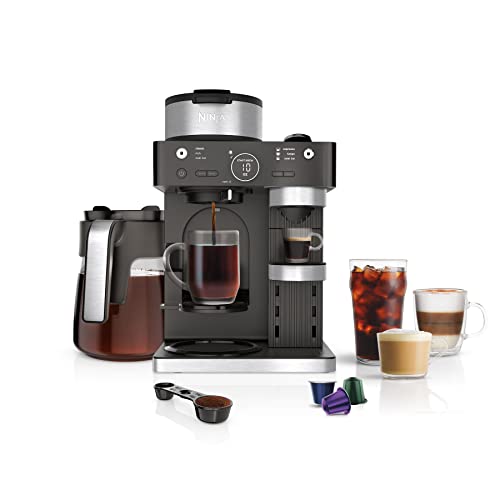
Ninja Espresso & Coffee Maker (CFN601) — Best for Pod Households
The CFN601 starts from the pod household’s reality and upgrades it: it accepts Nespresso capsules and brews them in three espresso styles — a standard shot, a richer ristretto-style extraction and an over-ice style — while also brewing single-serve coffee from grounds across cup sizes. One brewer covers the capsule drinker and the mug drinker without a portafilter anywhere in sight.
It suits households committed to capsule convenience who want better espresso-style drinks than a basic pod machine gives. Hands-on espresso lovers will miss grind and dose control entirely, and the capsule side locks you into the Nespresso-format ecosystem and its running costs.
Strengths
- Three espresso brew styles from standard Nespresso capsules
- Brews single-serve ground coffee as well as capsules in one system
- No portafilter technique required — consistent drinks for every user
Trade-offs
- Capsule espresso is consistent, not fresh-ground nuanced
- Locked to the Nespresso capsule format for the espresso side
- Milk drinks need a separate frother — none is built in
| Specification | Detail |
|---|---|
| Capsules | Nespresso capsule compatible, per Amazon listing title |
| Brew styles | 3 espresso brew styles, per Amazon listing title |
| Coffee | Single-serve coffee, per Amazon listing title |
The three brew styles are more than menu padding. Capsule espresso usually arrives at one fixed extraction; Ninja’s styles vary the water and pressure profile enough that the ristretto setting genuinely tastes more concentrated and the over-ice setting avoids the washed-out flavor iced capsule drinks usually suffer. For pod drinkers, that is a real quality step that costs no additional effort.
The grounds side keeps the household’s other drinker honest — a proper single cup from fresh grounds rather than a giant diluted capsule. Add a standalone frother and the system covers milk drinks too. As a hybrid philosophy — meet the pod household where it lives and raise its ceiling — the CFN601 is the most thoughtful machine in this guide.
One operational note: the CFN601’s capsule side benefits from the same habit as any Nespresso machine — run a water-only cycle first if the machine has sat, both to warm the cup and to clear the path, and its first drink of the day tastes like its third. Households also find the grounds side quietly becomes the decaf route: a scoop of decaf grounds at night, capsules in the morning, one machine keeping both treaties. That kind of unplanned versatility is what hybrids are actually for.
Best for: pod households wanting better espresso-style drinks plus fresh-ground single cups / Not suited for: hands-on espresso hobbyists or households avoiding capsule costs
Check the current price on Amazon

Ninja DualBrew Prestige (CFN801) — Best Two-System Pod Platform
The DualBrew Prestige takes Ninja’s established grounds-and-pods coffee platform and bolts on a genuine espresso side: Nespresso-compatible capsules brewed in three espresso styles, alongside the DualBrew system’s single-serve coffee from grounds or pods in a wide range of sizes. It is the pod platform for households that refuse to choose a format.
It suits format-agnostic households — some pods in the drawer, some grounds in the freezer, both used weekly. It shares the CFN601’s capsule ceiling on the espresso side and adds platform complexity; a household that only ever brews one format is buying flexibility it will not use.
Strengths
- 2-in-1 system brews espresso capsules and single-serve coffee from grounds or pods
- Three espresso brew styles lift capsule drinks above the basic standard
- Wide size range covers espresso through large travel mugs
Trade-offs
- Espresso quality is capsule-bound — no fresh-ground espresso path
- Breadth of formats means a busier interface than single-format machines
- Milk drinks require a separate frother
| Specification | Detail |
|---|---|
| System | 2-in-1 system, per Amazon listing title |
| Espresso | 3 espresso brew styles, Nespresso compatible, per Amazon listing title |
| Coffee | Single-serve coffee, per Amazon listing title |
Where the Prestige earns its place over the CFN601 is the coffee side’s maturity: the DualBrew platform’s size range and grounds handling are the more developed half of this hybrid, so households whose center of gravity is the morning mug — with espresso as the second drink — are better served here. The espresso side matches its sibling’s three-style capsule performance.
Think of the two Ninjas as the same idea weighted differently: CFN601 espresso-forward, CFN801 coffee-forward. Both are honest about the capsule ceiling, both avoid a portafilter entirely, and both suit households that value a single, consistent interface for every drinker over the peaks a specialist machine reaches.
The Prestige’s size range deserves a practical footnote: its largest settings brew into travel mugs directly, which removes the carafe from weekday service entirely for commuter households. Combined with the capsule side for the second drinker’s espresso, the machine covers the two journeys most households actually make — one mug for the road, one shot at home — with less washing-up than any pot-based system in this guide asks for.
Best for: format-flexible households centered on single-serve coffee with espresso as a real second drink / Not suited for: households wanting fresh-ground espresso or a built-in milk system
Check the current price on Amazon

De’Longhi All-in-One (COM530M) — Best Pump-and-Pot Combo
De’Longhi’s combination design is the oldest honest answer to the hybrid question: build a real pump espresso machine and a real drip coffee maker into one chassis and let them share a counter. The COM530M’s espresso side carries a proper pump and a manual frothing wand for cappuccinos, while the coffee side brews full pots with programmable timing — the household pot, ready when the alarm goes off.
It suits households that brew pots on weekends and espresso on weekdays, and want both done properly. It is a large appliance — genuinely two machines wide — and neither side matches a dedicated specialist, so single-habit households should buy the specialist instead.
Strengths
- True pump espresso side with a manual frother for real cappuccinos
- Full drip side with a 47-ounce capacity for household pots
- Programmable coffee side suits scheduled weekday mornings
Trade-offs
- Footprint is effectively two machines
- Espresso side is mid-tier — pressurized convenience over specialist control
- Two water systems and two cleaning routines to maintain
| Specification | Detail |
|---|---|
| Capacity | 47 ounces, per Amazon listing title |
| Type | Combination coffee and espresso machine, per Amazon listing title |
The combo’s enduring appeal is that the drip side is not a compromise. Households that entertain, or where one drinker takes coffee by the pot, are poorly served by single-serve platforms; the COM530M brews the pot properly and still pulls a respectable espresso with steamed milk after dinner. That breadth across the whole day is something no pod platform in this guide attempts.
Ownership asks for counter commitment and routine: two tanks, two descaling schedules, one large footprint. Households that clear that bar get a machine that ends the two-appliance era without asking anyone to change their drink — which, in the end, is the entire point of the hybrid category.
The COM530M’s programmable drip side creates the combo’s signature morning: coffee drinkers are served by the timer before anyone is awake, and the espresso drinker uses the other side an hour later without disturbing the pot. That staggered peace treaty is the real product being sold. Keep the two sides’ water tanks labeled in your routine — they descale on different rhythms — and the machine runs for years as the household’s unnoticed infrastructure.
Best for: households brewing full pots and weekday espresso in equal measure / Not suited for: small counters or single-format households
Check the current price on Amazon

De’Longhi Combi (BCO430) — Best Value Combo
The BCO430 is the combination machine at the value end: a pump espresso side with a frothing wand for cappuccinos and lattes, and a 10-cup drip side for the household pot. It has anchored De’Longhi’s combo range for years because it covers the two drinks most households actually make, at a price that undercuts buying the two machines separately by a wide margin.
It suits budget households with mixed drinkers and the counter to hold it. The espresso side is firmly entry-level — forgiving baskets, modest steam — and enthusiasts will outgrow it; treat it as the family appliance it is designed to be.
Strengths
- Pump espresso and 10-cup drip in one value-priced machine
- Frothing wand covers cappuccinos and lattes without extra appliances
- Long-running model with easy parts and filter availability
Trade-offs
- Entry-level espresso quality and steam stamina
- Large footprint for the capability on the espresso side
- Dated, utilitarian design compared with newer hybrids
| Specification | Detail |
|---|---|
| Drip capacity | 10-cup drip coffee, per Amazon listing title |
| Espresso | Combination pump espresso with frothing wand, per Amazon listing title |
Judged as a family appliance rather than a barista tool, the BCO430 is easy to defend: it makes the morning pot, the afternoon espresso and the weekend cappuccino, and it has done so in countless kitchens for years with parts still on shelves. The espresso is pressurized-basket honest — pleasant with medium and dark roasts, not a vehicle for light-roast nuance.
The buyers who regret it are those who expected a specialist in disguise. Buy it as the household’s shared coffee station, maintain both sides’ descaling, and it returns exactly the convenience its design promises at the lowest cost in this guide.
Longevity is the BCO430’s quiet argument. Because the design has been sold for years in volume, its filters, carafes and wear parts are stocked everywhere and its repair knowledge is universal among appliance shops. A value hybrid that can be kept alive cheaply beats a cleverer one that cannot, and on a five-year cost basis — purchase plus parts plus the drinks themselves — the Combi’s arithmetic is hard for any pick in this guide to beat.
Best for: budget mixed households wanting one shared coffee station / Not suited for: espresso enthusiasts or minimal counters
Check the current price on Amazon

Ninja DualBrew Pro Specialty (CFP301) — Best Coffee-First with Espresso Styles
The DualBrew Pro is included with a clear label: it is a specialty coffee machine whose brew styles include espresso-style drinks from grounds and pods, with a fold-away frother for lattes and cappuccinos. It does not pull true pump espresso, and this guide will not pretend otherwise — but for households whose real drink is brewed coffee in thirteen sizes, with an occasional espresso-style drink, it may serve better than a true hybrid whose espresso side gathers dust.
It suits coffee-first households that want maximum format freedom — K-Cup pods, grounds, carafe or cup — plus a frother for weekend milk drinks. Anyone whose primary drink is espresso should choose the CFN601 or a pump machine instead.
Strengths
- Brews pods and grounds across 13 cup-to-pot sizes with four brew styles
- Fold-away frother adds milk drinks without another appliance
- Specialty brew styles produce genuinely good filter coffee
Trade-offs
- Espresso-style drinks are not true pump espresso — no crema-forming pressure extraction
- Coffee-first design means espresso drinkers are guests, not residents
- Carafe and pod systems both need their cleaning routines kept
| Specification | Detail |
|---|---|
| Brew styles | 4 brew styles, per Amazon listing title |
| Sizes | 13 cup to pot sizes, per Amazon listing title |
| Compatibility | Pods & grounds, K-Cups compatible, per Amazon listing title |
Honesty is this pick’s function in the guide. Search data shows many ‘espresso and single serve’ shoppers actually want a do-everything coffee maker, and the DualBrew Pro is the best-executed version of that desire: excellent specialty coffee, total format freedom, a frother for the occasional latte-style drink. Its espresso-style setting makes a small, strong coffee that satisfies in milk — it simply is not espresso, and buyers who know the difference will taste it.
Choose it with eyes open and it is a superb household machine. Choose it expecting café espresso and it will disappoint through no fault of its engineering. The guide’s other five picks exist for the espresso-serious; this one exists for everyone else, labeled plainly.
The DualBrew Pro’s frother deserves fair description: it is a fold-away whisk-style frother that heats and foams milk for latte-style drinks competently, then rinses clean in seconds and folds out of sight. For the household that makes two milk drinks a week, that is the correct amount of milk technology — anything more would be an appliance bought for a hobby the household does not have. Judged by fit rather than by category pride, it is the right machine for its stated buyer.
Best for: coffee-first households wanting every format plus occasional espresso-style drinks / Not suited for: anyone whose main drink is true espresso
Check the current price on Amazon
Comparison Table
| Pick | Badge | Key Spec | Best For |
|---|---|---|---|
| Cuisinart Coffee Center Barista Bar 4-in-1 (SS-4N1NAS) | Best Overall Hybrid | 4-in-1: espresso + drip + pods + hot water | mixed households with espresso, drip and pod drinkers under one roof |
| Ninja Espresso & Coffee Maker (CFN601) | Best for Pod Households | Nespresso capsules in 3 styles + grounds brewing | pod households wanting better espresso-style drinks plus fresh-ground single cups |
| Ninja DualBrew Prestige (CFN801) | Best Two-System Pod Platform | DualBrew coffee platform + 3-style capsule espresso | format-flexible households centered on single-serve coffee with espresso as a real second drink |
| De’Longhi All-in-One (COM530M) | Best Pump-and-Pot Combo | Pump espresso + full drip pot in one chassis | households brewing full pots and weekday espresso in equal measure |
| De’Longhi Combi (BCO430) | Best Value Combo | Pump espresso + 10-cup drip, value tier | budget mixed households wanting one shared coffee station |
| Ninja DualBrew Pro Specialty (CFP301) | Best Coffee-First with Espresso Styles | 13 sizes, pods + grounds, fold-away frother | coffee-first households wanting every format plus occasional espresso-style drinks |
How to Choose the Best Espresso and Single Serve Coffee Machines for a Mixed Household
Start by naming each drinker’s actual drink, not their aspirational one. If the espresso drinker pulls shots daily, the hybrid needs a real espresso side — pump or quality capsule — which means the Cuisinart, the De’Longhi combos or the Ninja CFN machines. If ‘espresso’ in your house means an occasional small strong coffee in milk, a coffee-first platform like the DualBrew Pro serves better and spends the money on the drinks you actually make.
Then weigh format politics. Pods cost more per cup and create waste, but they end grind mess and morning negotiation; grounds are cheaper and fresher but need a grinder and a minute of effort. Hybrids that accept both — the Ninjas and the Cuisinart — postpone that argument indefinitely, which in shared households is worth money by itself.
Finally, measure the counter and count the cleaning routines. A combination machine is two appliances sharing a body: two tanks, two descale cycles, one large footprint. A pod platform is one system with one routine. The best hybrid is the one whose footprint fits and whose maintenance your household will genuinely keep — an unmaintained hybrid fails on both sides at once.
True Espresso vs Espresso-Style: Knowing What Your Hybrid Actually Brews
True espresso is water forced through a puck of fine coffee by a pump at high pressure, producing a concentrated shot with emulsified oils — the reddish-brown crema. Pump machines do this by design. Capsule systems like Nespresso do it in miniature, with the coffee pre-ground and sealed; the result is genuine espresso of a consistent, if less nuanced, character. Both count as espresso in this guide, and both appear among the picks.
Espresso-style is different: a drip or pod brewer making a small, strong coffee by concentration rather than pressure. It can taste good, especially in milk, but it lacks crema and the intense, syrupy body of the real thing. Machines in this style are not frauds — the DualBrew Pro is excellent at its actual job — but the label matters, because a buyer expecting espresso will judge the drink a failure no matter how well it is made.
The practical test when shopping: find the words ‘pump’ or a recognized capsule espresso system in the specification. If neither appears, you are looking at espresso-style, and you should buy it — if at all — as a coffee maker with a strong small-cup setting, which is how this guide presents it.
How to Run a Hybrid Machine Well: A Household Routine
- Assign each side its supplies. Keep the espresso side’s coffee, the pods and the grounds in fixed places. Hybrids fail socially when using one side means excavating the other’s supplies.
- Stagger the descaling. Put each side’s descale on alternate months in the calendar. Doing both the same weekend is how routines get abandoned.
- Rinse after espresso, always. A blank shot through the group and a wipe of the wand or frother after the last drink keeps the espresso side tasting like coffee instead of old coffee.
- Rotate pod stock. Capsules stale slowly but surely; buy quantities your household uses within a couple of months and store them away from the machine’s heat.
- Give each drinker one saved setting. Where the machine allows profiles or saved sizes, set them once. A hybrid earns its keep when every household member’s drink is two button presses, not a negotiation.
The deeper principle is that a hybrid is a shared appliance, and shared appliances survive on defaults. Set the default grind, the default pod, the default cup sizes to the household’s most common drinks, and let the exceptions be manual. Machines configured that way get used by everyone; machines configured for one expert get used by one expert.
Running Costs of a Hybrid Household: Pods, Grounds and the Honest Arithmetic
A hybrid household buys coffee three ways, and the costs behave differently. Ground coffee for the drip and grounds-brewing sides is the cheapest route per cup by a wide margin, and its price is set by the beans you choose. Pods and capsules cost several times more per drink — that premium is the convenience fee, paid daily, and it is neither hidden nor unreasonable provided the household chose it knowingly. The espresso side’s cost depends on its format: ground coffee in a portafilter is bean-priced; capsules are subscription-priced.
The practical management is inventory, not abstinence. Keep one pod type stocked for the pod drinker rather than a museum of flavors that stale; buy beans in quantities the household finishes within a few weeks of opening; and let the drip side carry high-volume, low-ceremony drinking — guests, work-from-home top-ups — where its per-cup cost is unbeatable. Hybrids reward households that route each drink to its cheapest adequate format, which is, in the end, the economic version of this guide’s whole argument.
Hardware costs complete the picture: filters for the drip side, descaler for both, a replacement carafe eventually. None rivals the consumables. A household that runs the arithmetic once, honestly, and then stops thinking about it has made the hybrid purchase correctly — the machines in this guide were chosen so that arithmetic lands in your favor.
One Hybrid or Two Machines? Deciding by Counter, Habit and Failure Modes
The case for the hybrid is consolidation: one footprint, one purchase, one appliance to learn, and a counter that stops looking like a café’s lost-property office. Its hidden benefit is social — a shared machine becomes shared infrastructure, maintained by everyone because everyone uses it. The case against is equally real: a hybrid’s failure takes both drinks down together, its espresso side will not satisfy a developing hobbyist, and its breadth can mean every drinker lives with a small compromise.
Two separate machines invert every term: each drinker gets a specialist, a failure only silences one drink, and the espresso hobbyist can climb without replacing the household’s coffee maker. The costs are counter space, a second purchase and a second maintenance routine. Households with the counter and a serious espresso drinker should seriously consider this route — a Bambino-class machine beside a good drip brewer is a legitimate rival to every pick in this guide, and pretending otherwise would be category loyalty rather than advice.
The deciding question is which drinker’s standards are higher. If both drinkers are ‘good coffee, low fuss’ people, the hybrid wins and this guide’s picks are ranked for them. If one drinker is on the espresso journey, buy that person their machine and let the household’s other drink be served by the simplest adequate brewer — a conclusion this guide reaches comfortably, because its job is your mornings, not the category’s sales.
Placement and Plumbing: Living With a Big Hybrid
Hybrids are the largest machines in this cluster, and their placement deserves the same deliberation as their purchase. Measure the full operating envelope, not the footprint: lids and carafe docks open upward, tanks slide out sideways or lift, capsule bins pull forward, and a machine that fits its shelf but cannot open on it will be resented within a week. Leave the steam and frothing side — where fitted — elbow room for a pitcher, and keep the pod and capsule storage in the same reach zone as the brewer that uses them.
Water logistics decide the daily experience. Two-tank combos want a filling routine — a dedicated jug that lives beside the machine beats a tank carried to the sink and back, dripping, twice a day. Place the hybrid near the sink if the kitchen allows it; the rinse shots, wand wipes and tray empties of espresso life all point that way, and a hybrid exiled to a far counter slowly stops being used for its messier, better drinks.
Finally, give the machine a power point of its own where possible and a surge protector regardless. A hybrid is two appliances’ worth of heating elements; shared, overloaded strips are false economy. Set up thoughtfully once, and the machine disappears into the household’s infrastructure — which is the hybrid’s entire ambition.
Common Buying Mistakes
- Assuming ‘espresso’ on the box means pump espresso. Check for a pump or a capsule espresso system. Espresso-style is a different drink.
- Buying breadth nobody uses. Four functions serve a four-habit household. A two-habit household should buy the two-function machine and pocket the difference.
- Ignoring footprint. Combination machines are wide. Measure with the lid and carafe clearance included, not just the base.
- Forgetting the frother question. Several hybrids here need a separate frother for milk drinks. Decide before purchase whether that is acceptable.
- Letting one side’s maintenance slide. A scaled drip side and a gunked espresso side tend to be discovered on the same bad morning. Stagger the routines and keep both.
Final Recommendation
For the genuinely mixed household, the Cuisinart Barista Bar is the most complete answer — espresso, drip, pods and hot water in one chassis. Pod households should choose between the espresso-forward Ninja CFN601 and the coffee-forward CFN801 by which drink rules the morning. Households that still brew pots belong with the De’Longhi combos — the COM530M for capability, the BCO430 for value — and coffee-first households should take the DualBrew Pro with the clear understanding that its espresso is espresso-style.
The right hybrid is the one that matches your household’s real drinks. Buy that one, set everyone’s defaults, and let the morning negotiation end.
A closing observation from the households this category serves best: the hybrid that succeeds is rarely the one with the longest feature list — it is the one whose two drinks are both made weekly, whose defaults are set for the people who actually use it, and whose cleaning routines survived contact with February. Judge the six picks here by that standard rather than by specification depth. The Cuisinart wins on completeness, the Ninjas on pod-household fit, the De’Longhi combos on the honest pot, and the DualBrew Pro on knowing exactly what it is. Any of them, matched to the right household and maintained on the staggered rhythm this guide describes, ends the two-machine era without starting a regret — which is the whole assignment the category was invented to complete.
The shortlist, if you are deciding today: Cuisinart Coffee Center Barista Bar 4-in-1 (SS-4N1NAS), Ninja Espresso & Coffee Maker (CFN601), Ninja DualBrew Prestige (CFN801) — check price on Amazon for each before you buy, as espresso pricing moves with promotions.
Best Espresso Capsule Machines Best Coffee And Espresso Combo Machines Best Espresso And Latte Machines Best Electric Pump Espresso Machines Best Entry Level Espresso Machines
Frequently Asked Questions
Can one machine really make both espresso and single-serve coffee well?
Yes, within honest limits. Combination machines pair a real pump espresso side with a real drip or single-serve side, and pod platforms brew capsule espresso alongside ground coffee. Each side is typically a step below a dedicated specialist machine, which is the correct trade for households that genuinely drink both.
What is the difference between the Ninja CFN601 and CFN801?
Emphasis. The CFN601 is espresso-forward: Nespresso-compatible capsules in three brew styles plus single-serve grounds coffee. The CFN801 DualBrew Prestige weights the coffee side more heavily, with the DualBrew platform’s broader size and format handling, while keeping the same three-style capsule espresso.
Do hybrid machines make good espresso?
Pump-based hybrids like the Cuisinart and De’Longhi combos make good espresso — a step below dedicated machines in refinement, well above pod-only convenience drinks. Capsule hybrids make consistent, genuine capsule espresso. Espresso-style settings on coffee makers make strong small coffees that are not espresso, and this guide labels them as such.
Are combination machines hard to maintain?
They carry two of everything: two water paths, two descaling schedules, two sets of parts. None of it is difficult, but it must be calendared. Staggering the two sides’ descaling across alternate months is the routine owners find sustainable.
Should I buy a hybrid or two separate machines?
Buy the hybrid if counter space is the constraint and both drinks are made weekly — one footprint and one purchase serve both drinkers. Buy separate machines if one drink dominates (a specialist will serve it better) or if the counter can hold two appliances without friction.
Can these machines make lattes and cappuccinos?
The pump combos with frothing wands can, properly. The Cuisinart’s espresso side supports milk drinks, and the DualBrew Pro’s fold-away frother handles occasional ones. The Ninja CFN models have no built-in milk system — pair them with a standalone frother if milk drinks are part of the household’s routine.
Do hybrid machines need two descaling routines?
Yes — each water path scales independently, and most combination machines have separate descale procedures for the espresso and coffee sides. Pod platforms have a single path and a single routine. Calendar both sides of a combo on alternating months so the chore never doubles up, and use each maker’s specified method for that side rather than improvising one solution for both.
Can a hybrid machine replace a café habit entirely?
For most households, mostly — and the honest remainder is social, not technical. The drinks a hybrid makes at home cover the daily habit completely: the morning mug, the afternoon shot, the weekend cappuccino. What it does not replace is the café as a place — the meeting spot, the work break, the drink someone else makes on a hard day. Households that frame the purchase as covering the habit rather than abolishing the café find the machine pays for itself in saved weekday drinks while the occasional café visit becomes a pleasure instead of a tax.


