Disclosure: airfryerkitchensupply.com is reader-supported. When you buy through links on our site, we may earn an affiliate commission at no extra cost to you.
Where to buy
For the best 12 volt vacuum cleaner in each format, the two most useful starting points are the ThisWorx corded handheld kit for all-round cleaning and the RoadPro RPSC-807 if you need wet pickup from a canister. Every linked model in this guide was confirmed against a live Amazon listing for the exact product named, and each spec box states the true power source — socket plug-in or battery — in plain words. Check price on Amazon for the current configuration before you buy.
The phrase best 12 volt vacuum cleaner covers a wider territory than “car vacuum”. A 12 volt vacuum cleaner is any cleaner built around a 12 volt power system: handhelds and canisters that plug into a vehicle socket, machines that live in RVs, boats, workshops and garages on DC power, and — labelled honestly wherever they appear in this guide — cordless handhelds whose battery packs are rated at 12 volts. Judging them as cleaners, rather than as car accessories, changes the questions. Suction and airflow, filtration, chamber capacity, nozzle design and cleaning path matter the way they do for any vacuum; the 12 volt supply simply sets the performance ceiling and decides where the machine can work.
That ceiling deserves one clear paragraph. A vehicle socket is fused around 10 to 15 amps, so a plug-in cleaner can draw roughly 120 to 180 watts at most. A mains vacuum cleaner uses several times that. The 12 volt machines in this guide therefore win on placement and readiness — they live where the mess is, run without charging, and handle the daily debris of vehicles, cabins and small workspaces — and they lose, unavoidably, on deep extraction of fine dust from thick carpet. A guide that pretends otherwise would be selling you a disappointment. This one instead shows you which 12 volt cleaners clean best within the physics, and which jobs to hand to a mains machine.
Six models make the cut: a complete corded handheld kit that is the best all-rounder, a wet/dry canister for liquid and larger debris, a high-listed-suction detailing model, a budget wet/dry handheld, a light-equipped handheld for dark workspaces, and a cordless dustbuster included with explicit labelling for buyers whose priority is grab-and-go convenience. Each is reviewed as a cleaner first: what it picks up well, what it struggles with, and how its format shapes the work. If you came here from a car-vacuum search, nothing is lost — five of the six are vehicle natives — but the judgements below are made on cleaning merit, and a machine that cleans a camper or a workshop bench well will not be marked down for it.
In this guide
Quick Picks
Six cleaners judged on cleaning performance within 12 volt limits: pickup, reach, filtration care, chamber practicality and format. Badges name the job each machine does best, and the same badges head each full review below, so the quick list and the detailed verdicts cannot drift apart.
- ThisWorx Handheld Car Vacuum — Best Overall Cleaner: A corded 12 volt handheld with a 16 ft cord, three attachments and a storage bag — the most complete cleaning kit in this category, and the easiest to live with daily. — Check the current price on Amazon
- RoadPro RPSC-807 12-Volt Wet/Dry Canister Vacuum — Best Wet/Dry Cleaner: A plug-in 12 volt canister that picks up liquid as well as dry debris, with a hose for reach and a chamber sized for real sessions rather than single footwells. — Check the current price on Amazon
- Shop-Vac 12V Car Vacuum Cleaner — Best Listed Suction: A detailing-focused 12 volt handheld listing 7000 Pa suction, with a 16 ft cord and multiple nozzles for methodical, deep-as-12-volts-allows cleaning sessions. — Check the current price on Amazon
- ACNTENY Car Vacuum Cleaner 12V Corded 120W Wet Dry — Best Budget Cleaner: A 120W corded handheld with wet and dry pickup at a budget tier — the cheapest route here to a cleaner that can handle both grit and spills. — Check the current price on Amazon
- 12V Car Vacuum Cleaner Wet Dry with Flashlight — Best for Dark Workspaces: A corded wet/dry handheld whose built-in flashlight lights the exact area the nozzle is cleaning — footwells, lockers, under-bench spaces and other unlit corners. — Check the current price on Amazon
- BLACK+DECKER dustbuster Handheld Vacuum HHVI320JR02 — Best Cordless Cleaner: A cordless dustbuster on a 12V battery platform with a rotating, extendable nozzle — the convenience pick, labelled plainly: battery powered, not socket powered. — Check the current price on Amazon
How These Picks Were Chosen
The method for this guide was to judge each machine as a cleaner first and a 12 volt device second. Every linked pick was confirmed against a live Amazon listing for the exact model, and the power source stated in each spec box is the one that listing supports: plug-in corded, or battery. Models whose listings blurred that line without clarification, models that were mains cleaners bundled with a car charger, and models with no verifiable current listing were excluded.
Cleaning criteria were pickup type (dry versus wet/dry), format and chamber practicality, cord and hose reach, nozzle and attachment provision, and the maintenance each machine demands of its filter. Suction numbers appear only as clearly labelled listing claims, because brands measure them in incompatible units and conditions; no pick was ranked by a number we could not verify on equal terms.
The category’s honest shape also shaped the list: there are not dozens of distinct, verifiable 12 volt cleaners on the market, and several familiar names sell the same underlying machines under different badges. Six genuinely distinguishable picks, each with a defensible role, serve readers better than a padded list of clones.
One more screening rule deserves stating, because it removed several plausible candidates: recall and safety history. Any model with a known safety recall affecting its battery, motor or charging system was excluded regardless of cleaning performance, and the same standard was applied to listings whose electrical claims were implausible on their face — a claimed wattage no 12 volt socket could supply, for instance, disqualifies a listing from a guide that asks to be trusted about power.
The 6 Best 12 Volt Vacuum Cleaner
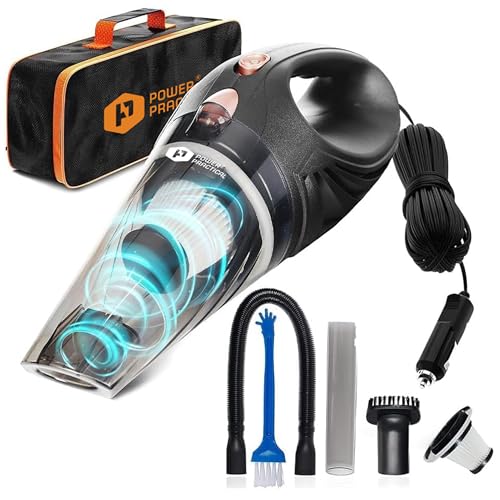
ThisWorx Handheld Car Vacuum — Best Overall Cleaner
Cleaning performance is mostly nozzle discipline, and the ThisWorx is the best-equipped teacher of it in this roundup. Its three attachments map onto the three surfaces a small cleaner meets: a crevice tool that concentrates suction into seams, seat rails and the edges where debris accumulates; a brush that agitates dust out of vents, switchgear and textured plastics while the suction carries it away; and a wider nozzle for flat work on mats, seats and floors. Owners who swap attachments deliberately get visibly better results from the same motor than owners who push one nozzle at everything.
The 16 ft cord is a cleaning feature, not just a convenience. Every re-plugging interruption breaks rhythm and leaves the far corners for “next time”; a cord that spans a whole vehicle, a camper interior or a small workshop bench area from one socket means the cleaning path is continuous. Combined with the storage bag — which keeps the machine and all three attachments in one place, ready — this is the pick most likely to be used the way small cleaners must be used: little and often.
Strengths
- Attachment set covers seams, brushes and flat work properly
- 16 ft cord allows one continuous cleaning path without re-plugging
- Bag-kept kit stays complete and ready, which drives regular use
Trade-offs
- Dry pickup only; liquids need one of the wet/dry picks
- Handheld chamber is small for large or very dirty spaces
- Suction still bounded by the 12 volt ceiling on deep carpet
| Power source | Vehicle 12 volt outlet (plug-in, corded) |
| Cord | 16 ft |
| Included | 3 attachments, storage bag |
As a cleaner, its honest limits are capacity and depth. A season of neglect in a family vehicle will overwhelm its chamber and ask more extraction than its motor can give; a weekly five-minute session plays entirely to its strengths. That rhythm — frequent, light, complete — is how 12 volt cleaners earn their keep, and this kit is designed around it better than any rival here.
If you buy one 12 volt vacuum cleaner for general duty around vehicles and small spaces, this is the one. Add the RoadPro below when liquids enter your life, and you have the category covered between two machines.
Best for: General cleaning of vehicles, campers and small workspaces with a complete attachment kit / Not suited for: Wet messes or one-shot rescue of a long-neglected interior
Check on Amazon — check price on Amazon before you buy, because vehicle and appliance listings change configurations often.

RoadPro RPSC-807 12-Volt Wet/Dry Canister Vacuum — Best Wet/Dry Cleaner
Wet capability changes what “clean” means. A dry cleaner redistributes a spill; the RoadPro removes it. Coffee, melted snow, cooler meltwater, damp sand — the liquids that stain upholstery and sour small spaces — go into the canister and out of the vehicle. For any cleaner that will work around boats, dogs, children, job sites or winter, that single ability outweighs small differences in dry suction between models.
The canister format is the second cleaning advantage. Chamber capacity several times a handheld’s means suction stays consistent through a whole session instead of fading as a tiny cup packs full, and the hose lets the nozzle work at angles a one-piece machine cannot reach: under seats without moving the motor unit, into lockers, along the base of cabinets in a camper. Cleaning quality is often just reach plus consistency, and this format has both.
Strengths
- Genuine wet and dry pickup removes spills instead of smearing them
- Canister chamber sustains suction across a full session
- Hose reach suits campers, boats and under-seat work
Trade-offs
- Bulkiest pick here; needs a storage home
- No attachment wardrobe to match the ThisWorx for fine detailing
- Corded radius is set by socket placement
| Power source | Vehicle 12 volt outlet (plug-in, corded) |
| Pickup type | Wet and dry |
| Format | Portable canister with hose |
Care defines its lifespan: empty dry debris before it compacts, rinse and air-dry after wet sessions, and never store it sealed with a damp filter. Observed, those habits keep a canister pleasant for years. Ignored, they produce the musty machine owners blame on the brand.
Choose the RoadPro when your cleaning includes liquid, volume or both. It is the workhorse of this roundup, and the pick we would hand to anyone maintaining a boat, an RV or a hard-working family vehicle.
Best for: Wet and dry cleaning of boats, RVs, work vehicles and family cars / Not suited for: Minimalists who want the smallest possible handheld in a glovebox
Check on Amazon — check price on Amazon before you buy, because vehicle and appliance listings change configurations often.

Shop-Vac 12V Car Vacuum Cleaner — Best Listed Suction
Shop-Vac’s 12 volt model is built for the owner who cleans thoroughly rather than quickly. The listed 7000 Pa suction figure leads this roundup on paper — with the standing caveat that such figures are maker claims measured under conditions that differ between brands, so they rank machines within a maker’s intentions better than across a market. What is not in doubt is the intent: this is the detailing end of the category, aimed at pulling grit out of carpet texture and seams rather than skimming crumbs off surfaces.
The multiple-nozzle kit supports that intent. Deep cleaning is a sequence: crevice tool along every seam and rail, brush across pedals, vents and textured trim, wide nozzle over mats with slow overlapping passes. The kit covers the sequence without improvisation, and the 16 ft cord means the sequence runs uninterrupted around the vehicle.
Strengths
- Strongest listed suction in the roundup, aimed at embedded grit
- Nozzle selection supports a proper detailing sequence
- Cord reach matches the best here
Trade-offs
- Suction figure is a listing claim, not a cross-brand measurement
- Overkill for owners whose cleaning is a weekly two-minute tidy
- Long detailing sessions need battery awareness in the host vehicle
| Power source | Vehicle 12 volt outlet (cigarette lighter plug) |
| Listed suction | 7000 Pa (per listing) |
| Cord | 16 ft |
| Included | Multiple nozzles |
Technique multiplies this machine. Slow passes with dwell time beat fast passes at any suction level; an emptied chamber and a clean filter matter more than the last few pascals. Owners who clean this way will find the Shop-Vac the most satisfying dry cleaner here. Owners who clean in a hurry should buy the ThisWorx and its tidier kit instead.
One boundary to verify before relying on it: this guide assigns the Shop-Vac dry detailing duty. If your cleaning includes regular liquid pickup, the wet/dry picks are the honest recommendations.
Best for: Methodical owners doing deep dry cleans and seasonal details / Not suited for: Spill-heavy duty or buyers who clean in two-minute bursts
Check on Amazon — check price on Amazon before you buy, because vehicle and appliance listings change configurations often.

ACNTENY Car Vacuum Cleaner 12V Corded 120W Wet Dry — Best Budget Cleaner
Budget cleaners usually cut the wet capability first, because dry-only machines are cheaper to build and seal. The ACNTENY keeps it: a corded handheld rated at 120W — near the sensible maximum a 12 volt socket circuit offers — that picks up liquids and dry debris alike. For a second vehicle, a work truck, a boat tote or a first purchase while you learn your habits, that combination is the value sweet spot of this roundup.
The compromises are the expected ones: a handheld chamber that fills quickly, build quality that feels its price, a listed suction figure in yet another unit that resists comparison, and a young brand whose support network is thinner than the established names. None of these prevent it cleaning a car, a camper or a cockpit perfectly adequately; they predict it will age faster under heavy use.
Strengths
- Wet and dry pickup at the lowest tier in this guide
- 120W rating uses the socket’s realistic headroom
- Corded design: no battery costs later
Trade-offs
- Small chamber and budget build limit heavy-duty life
- Filter care matters more; a clogged filter strangles it quickly
- Brand support and spares are limited
| Power source | Vehicle 12 volt outlet (plug-in, corded) |
| Power | 120W |
| Pickup type | Wet and dry |
| Listed suction | 3600mbar (per listing) |
The smart ownership pattern at this tier is frequency: short sessions, filter cleaned often, chamber rinsed and dried after wet work. A budget cleaner maintained that way out-cleans a premium cleaner neglected, because suction in small machines is mostly a story of airflow, and airflow is mostly a story of clean filters and empty chambers.
Buy it as a capable starter or a sacrificial second machine. If it becomes the most-used tool you own, upgrade to the canister with the knowledge of exactly why.
Best for: Budget buyers and second-machine duty where wet pickup still matters / Not suited for: Daily heavy use in a commercial or large-family setting
Check on Amazon — check price on Amazon before you buy, because vehicle and appliance listings change configurations often.

12V Car Vacuum Cleaner Wet Dry with Flashlight — Best for Dark Workspaces
Cleaning quality depends on seeing the dirt. The spaces small cleaners serve — footwells under dashboards, boat lockers, the floor under a workbench, the back of a camper’s storage bay — are the spaces room lighting forgets. This handheld’s built-in flashlight is aimed where the nozzle aims, so the grit line, the spill edge and the missed patch are visible while you work instead of discovered afterwards by hand.
The underlying cleaner is the sensible budget pattern: corded 12 volt plug-in power, wet and dry pickup, and a compact moulded body in a bright finish that is easy to locate in a crowded trunk or locker. It will not out-detail the Shop-Vac or out-carry the canister, but in genuinely dark workspaces it can out-clean both, simply because its operator can see.
Strengths
- Tool-mounted light reveals dirt in footwells and lockers as you clean
- Wet and dry pickup covers the spills dark spaces hide
- Compact, bright, easy to store and find
Trade-offs
- Unbranded model with uncertain spares and support
- Small handheld chamber
- The light adds little in bright, open spaces
| Power source | Vehicle 12 volt outlet (plug-in, corded) |
| Pickup type | Wet and dry |
| Extra | Built-in flashlight |
| Body | ABS and PP construction (per listing) |
Garage and workshop owners should note this pick as much as vehicle owners: under-bench floors, inside cabinets and behind stored gear are its natural territory wherever a 12 volt supply — vehicle socket or a suitable converter — is available. Boat owners will recognise the locker case immediately.
As with all budget wet/dry handhelds, rinse and dry after liquid work and store it dry. The light will keep working long after a neglected filter would have ended the machine’s useful life.
Best for: Cleaning dark footwells, lockers, cabinets and under-bench spaces / Not suited for: Buyers who prioritise brand support over situational features
Check on Amazon — check price on Amazon before you buy, because vehicle and appliance listings change configurations often.

BLACK+DECKER dustbuster Handheld Vacuum HHVI320JR02 — Best Cordless Cleaner
Every roundup of 12 volt cleaners owes its readers this clarification, so here it is in the pick itself: the dustbuster HHVI320JR02 is a cordless cleaner whose battery platform carries a 12V rating. It does not plug into a vehicle, and it should never be bought by someone who needs socket power. It earns its place because a large share of people searching this keyword want a small cleaner that works anywhere — stairs, a caravan awning, a car parked away from any socket — and this is a good one.
Its cleaning signature is the rotating, extendable nozzle, which reaches under seats, up windscreen pillars and into the corners fixed nozzles miss, paired with the dustbuster line’s long-refined dust cup and filter arrangement. For dry debris in short sessions it is arguably the pleasantest cleaner here to use. Its limits are runtime per charge and the slow fade of any battery pack across years.
Strengths
- Works anywhere, independent of sockets and cords
- Rotating, extendable nozzle reaches awkward angles
- Refined dust cup and filter system from an established line
Trade-offs
- Battery powered — not a plug-in 12 volt cleaner
- Minutes of runtime per charge; readiness depends on charging habits
- Dry duty; not a wet/dry machine
| Power source | Cordless — 12V battery pack (does NOT run from a vehicle socket) |
| Nozzle | Rotating and extendable |
The ownership rule is simple: it lives on or near its charger, indoors, and travels to jobs charged. Kept that way it is a delight. Left in a vehicle for months it becomes a paperweight with a famous name, and the disappointment belongs to the storage decision, not the cleaner.
If your definition of a 12 volt vacuum cleaner is strictly socket-powered — for a boat, an RV or a work vehicle — stop at the five picks above this one. If it is “a small cleaner in the 12 volt class”, this is the cordless benchmark.
Best for: Homes and vehicles where grab-and-go cordless convenience beats socket readiness / Not suited for: Boats, RVs and work vehicles needing a cleaner that is always ready
Check on Amazon — check price on Amazon before you buy, because vehicle and appliance listings change configurations often.
Comparison Table
| Pick | Badge | Key spec | Best for |
|---|---|---|---|
| ThisWorx Handheld Car Vacuum | Best Overall Cleaner | 12V corded; 16 ft cord; 3 attachments and storage bag | General cleaning of vehicles, campers and small workspaces with a complete attachment kit |
| RoadPro RPSC-807 12-Volt Wet/Dry Canister Vacuum | Best Wet/Dry Cleaner | 12V plug-in canister; wet and dry pickup; hose reach | Wet and dry cleaning of boats, RVs, work vehicles and family cars |
| Shop-Vac 12V Car Vacuum Cleaner | Best Listed Suction | 12V plug-in; 7000 Pa listed suction; 16 ft cord; multiple nozzles | Methodical owners doing deep dry cleans and seasonal details |
| ACNTENY Car Vacuum Cleaner 12V Corded 120W Wet Dry | Best Budget Cleaner | 12V corded; 120W; wet and dry pickup | Budget buyers and second-machine duty where wet pickup still matters |
| 12V Car Vacuum Cleaner Wet Dry with Flashlight | Best for Dark Workspaces | 12V corded; wet and dry pickup; built-in flashlight | Cleaning dark footwells, lockers, cabinets and under-bench spaces |
| BLACK+DECKER dustbuster Handheld Vacuum HHVI320JR02 | Best Cordless Cleaner | Cordless; 12V battery platform; rotating and extendable nozzle | Homes and vehicles where grab-and-go cordless convenience beats socket readiness |
How to Choose a 12 Volt Vacuum Cleaner
Decide the power source before anything else, because it defines the cleaner’s life. Plug-in models are always ready, run indefinitely and suit vehicles, boats, RVs and workshops with DC power. Cordless models trade that readiness for freedom and suit homes and mixed duty. The worst purchase in this category is the accidental one — a battery machine bought by someone who needed socket power — so read the power-source line of any listing as carefully as the headline.
Then decide on wet capability. Dry cleaning covers crumbs, grit, hair and dust, which is most of life. Liquid pickup covers the minority of messes that cause most of the damage: spills that stain, meltwater that sours, damp debris that mildews. If the cleaner will serve a boat, a family vehicle, a work truck or a pet, wet/dry is the prudent default; the premium over dry-only is small and the capability cannot be retrofitted.
Format: handheld, canister, or stick thinking
Handhelds win on storage and speed of deployment; canisters win on chamber capacity, sustained suction and hose reach. There is no 12 volt stick or upright class worth discussing — the power ceiling forbids it — so the real choice is between those two formats and, for cordless, the dustbuster pattern. Match format to session length: two-minute tidies want a handheld in reach; twenty-minute sessions want a canister that does not fade or fill.
Filtration and maintenance
Small cleaners exhaust close to the operator, so filtration is a comfort feature as well as a performance one. What matters practically is whether the filter can be cleaned in seconds — brushed, tapped or rinsed — because a filter that is annoying to service will not be serviced, and an unserviced filter quietly converts any of these machines into a noisy dust redistributor. Check filter access before purchase; commit to a quick clean every few sessions after it.
Noise and session length
Small cleaners are loud for their size, because small fans spin fast; none of the picks here is quiet, and buyers sensitive to noise should plan short sessions rather than hunt for a silent model that does not exist in this class. Session length cuts the other way for plug-in models: they can run as long as the battery plan allows, so a thorough clean is a matter of patience, not charge. Cordless buyers should match the cleaner’s runtime to their largest realistic job with margin to spare, because a cleaner that dies at ninety percent of a vehicle teaches its owner to stop starting.
Where it will live
A cleaner’s address determines its usage. In the vehicle, in the camper locker, on the workshop wall by the door: used. In a distant cupboard: admired. Choose the pick whose size and kit fit the place it will actually live — bag kits and canisters need their footprint respected — and the cleaning will happen at the frequency that makes 12 volt machines worthwhile.
Suction, Watts and Airflow: Reading 12 Volt Cleaner Specs Honestly
Three numbers circulate in this category and none of them mean what buyers hope. Watts describe electrical input, capped by the socket fuse at roughly 120 to 180 for plug-in models; a 120W machine is using most of what the circuit offers, which is information about draw, not directly about cleaning. Pascals and millibars describe sealed suction pressure, measured at a blocked inlet — a condition that never occurs while cleaning — and brands measure them under differing setups, so cross-brand comparison is unreliable. Airflow, the volume of air moved, is what actually carries debris into the chamber, and it is the figure listings quote least.
The practical translation: within the 12 volt ceiling, format and maintenance dominate outcomes. A clean-filter handheld with the right nozzle will out-clean a neglected higher-rated machine every time, because debris transport depends on moving air through an unclogged path. Spend your attention on attachments, chamber design and filter access — the parts of the specification that survive contact with real dirt — and treat headline suction figures as the maker’s statement of intent, which is how this guide reports them.
There is a field test any owner can run that cuts through all of this: the same patch of gritty carpet, the same number of slow passes, the chamber emptied and the filter cleaned before each attempt. Differences that survive that test are real — usually they trace to nozzle seal and airflow path rather than headline numbers — and differences that vanish were marketing. We describe picks in this guide the way that test would rank them: by what they reliably pick up, in the format they come in, with their filters in the state a real owner keeps them.
Battery models add a fourth number: voltage as platform naming. A 12V cordless platform describes the battery system, not a promise of socket compatibility or of superiority over lower-voltage rivals. Judge cordless cleaners on runtime, dust cup design and nozzle thinking, exactly as you would judge the dustbuster pick above.
Beyond the Car: 12 Volt Cleaners in RVs, Workshops and Garages
The “vacuum cleaner” framing earns its keep outside the car. In an RV, a 12 volt cleaner is part of the house system: it runs from the same DC supply as the lights and water pump, works at a pitch with no hookup, and keeps a small living space at a standard that a broom cannot, because RV floors are a sandwich of carpet, vinyl and matting that traps grit at every seam. Canister format usually wins here for chamber size; the cleaner lives in a locker and comes out after every dusty site arrival.
Workshops and garages present the opposite pattern: mains power is everywhere, yet a 12 volt cleaner still earns a place for vehicle-adjacent work — cleaning a car on the driveway far from a socket the mains hose reaches awkwardly, or keeping a bench and tool chest free of swarf and dust with a machine that lives on the wall. The honest caveat is duty: sawdust volume and metal swarf belong to a workshop wet/dry machine, and the 12 volt cleaner’s role is the light, frequent pass that keeps the space civilised between real cleans. Wet/dry capability matters here too, for the spills that workshops specialise in — with the standing exception that fuels and solvents are never vacuum work, on any machine, at any voltage.
Garages without a resident vehicle raise the power question in its purest form: a plug-in 12 volt cleaner needs either a vehicle or a correctly rated converter. That is a solvable problem — converters built for exactly this are a small category of their own — but it should be solved deliberately, with the converter’s continuous amp rating comfortably above the cleaner’s draw, rather than discovered through a hot, undersized adapter. Cordless picks sidestep the question entirely, which is part of their genuine appeal in this setting.
Across all three settings the pattern repeats: the 12 volt cleaner wins where mess is frequent, local and modest, and where its power source is native to the place. Judge any candidate pick against the room it will actually clean, and the category stops looking like a compromise and starts looking like a specialisation.
How to Clean with a 12 Volt Vacuum Cleaner: A Complete Session
Whether the space is a vehicle, a camper or a workshop corner, the sequence that makes a small cleaner perform is the same:
- Clear the space first: mats and loose items out, surfaces emptied, so the cleaner spends its session cleaning rather than navigating.
- Set your power plan: socket located, cord path planned, engine running if the session will be long.
- Work top-down with the brush: shelves, dashboards, vents and trim first, so dislodged dust lands where you have not yet cleaned.
- Follow with the crevice tool along every seam, edge and rail — the lines where debris concentrates.
- Finish with wide, slow, overlapping passes on flat surfaces; give grit time to lift rather than chasing it at speed.
- For wet messes, pick up liquid first, then dry-clean the area once it is merely damp.
- Close the session properly: chamber emptied, filter brushed or rinsed, machine stored dry with its kit together.
Frequency is the multiplier. A 12 volt cleaner used for five minutes weekly maintains a standard that a mains machine used twice a year cannot, because debris removed early never compacts, stains or smells. Build the session into an existing routine — fuel stops, Sunday checks, returning gear after a trip — and the modest machine will quietly outperform its specification.
Cords, Sockets and Converters: The Practical Power Guide
A plug-in cleaner is only as good as the socket feeding it. Vehicle sockets vary in location, in whether they are live with the ignition off, and in the fuse protecting them; a cleaner rated near the circuit’s ceiling on a socket that also feeds other accessories can pop fuses that a dedicated socket would not. Before a first long session, find your fuse rating, note which sockets share it, and plug the cleaner in alone. A plug that runs warm or a socket that crackles is a maintenance message about contacts, not a challenge to finish quickly.
Cord length interacts with socket position, not with vehicle size in the abstract. Sixteen feet from a dashboard socket covers most vehicles entirely; the same cord from a cargo-area socket covers the back half beautifully and the front barely. Campers and boats repeat the pattern at larger scale. The practical fix hierarchy is: choose the socket nearest the work, choose a cleaner whose cord or hose spans from it, and only then consider extension solutions — and avoid cheap socket splitters entirely, since they add resistance and heat at exactly the currents these cleaners draw.
Converters deserve their own paragraph because they convert a vehicle cleaner into a household one. A suitable converter takes mains AC in and provides a vehicle-style socket out, with a continuous current rating comfortably above the cleaner’s draw — the cleaner’s wattage divided by 12 gives its approximate amps, and headroom above that figure is what keeps the converter cool and the cleaner at full performance. Undersized converters are the most common cause of “my 12 volt cleaner is weak at home” complaints; the cleaner is fine, and it is being starved.
Common Buying Mistakes
- Confusing battery-platform voltage with socket power, and discovering the difference at the first flat battery.
- Ranking cleaners by suction figures measured in incompatible units by different brands.
- Buying dry-only for a spill-prone life because the price gap looked attractive at checkout.
- Choosing a handheld for long sessions, then fighting its chamber and fading suction throughout.
- Neglecting the filter — the single most common cause of a “weak” 12 volt cleaner is a clogged one.
- Expecting mains-machine deep extraction from a socket fused like a cigarette lighter.
- Storing a wet/dry cleaner wet, and seasoning it with mildew between uses.
Final Recommendation
Bought as a cleaner rather than an accessory, the ThisWorx kit is the best all-round 12 volt vacuum cleaner here: complete attachments, whole-space cord reach, a bag that keeps the kit together between sessions, and honest dry-cleaning performance that rewards regular use. The RoadPro is the wet/dry workhorse, the Shop-Vac the dry detailing specialist, the ACNTENY the budget route to wet capability, the flashlight handheld the dark-space problem solver, and the dustbuster the cordless convenience pick — with its battery nature stated as plainly in this summary as in its review.
If your cleaning is specifically vehicular, compare this guide with Best 12 Volt Vacuum; for boats, the marine-specific judgements are in Best 12 Volt Vacuum Boat; heavier workshop duty belongs to Best 12 Volt Shop Vac. And if the cleaner you want needs to run in a garage with no vehicle nearby, Best 110 To 12 Volt Converter covers powering 12 volt gear from the mains safely. The cold side of the same 12 volt system is covered in Best 12 Volt Vehicle Cooler.
The shortlist, one more time:
- ThisWorx Handheld Car Vacuum — Best Overall Cleaner: General cleaning of vehicles, campers and small workspaces with a complete attachment kit
- RoadPro RPSC-807 12-Volt Wet/Dry Canister Vacuum — Best Wet/Dry Cleaner: Wet and dry cleaning of boats, RVs, work vehicles and family cars
- Shop-Vac 12V Car Vacuum Cleaner — Best Listed Suction: Methodical owners doing deep dry cleans and seasonal details
- ACNTENY Car Vacuum Cleaner 12V Corded 120W Wet Dry — Best Budget Cleaner: Budget buyers and second-machine duty where wet pickup still matters
- 12V Car Vacuum Cleaner Wet Dry with Flashlight — Best for Dark Workspaces: Cleaning dark footwells, lockers, cabinets and under-bench spaces
- BLACK+DECKER dustbuster Handheld Vacuum HHVI320JR02 — Best Cordless Cleaner: Homes and vehicles where grab-and-go cordless convenience beats socket readiness
Frequently Asked Questions
Is a 12 volt vacuum cleaner powerful enough for real cleaning?
For the debris of vehicles, campers, boats and small workspaces — grit, crumbs, hair, sand, spills — yes, provided the filter is clean and the right nozzle is used. For deep extraction of fine dust from thick domestic carpet, no 12 volt machine matches a mains cleaner, because the socket fuse caps its power. The categories are complements: mains for depth, 12 volt for frequency and placement.
Can I use a 12 volt vacuum cleaner in the house?
A plug-in model can run indoors through a properly rated AC to DC converter with a vehicle-socket output, sized with headroom above the cleaner’s draw. A cordless model needs no converter at all. What you should not do is improvise power from undersized adapters; these machines draw currents far beyond small plug-in supplies.
How often should I clean the filter?
Brush or tap it clean every few sessions, and rinse it (if the maker allows) whenever suction feels reduced or after wet work, drying it fully before refitting. In small machines the filter is the performance bottleneck: a clogged filter can halve effective cleaning while the motor sounds unchanged.
Wet/dry or dry-only: which should a first-time buyer choose?
Wet/dry, unless the cleaner will serve one strictly dry, drink-free environment. Spills are rare but consequential, and the price difference is small. Every pick in this guide that lacks wet capability is labelled with its dry role explicitly so the choice is deliberate rather than discovered.
How long do 12 volt vacuum cleaners last?
A plug-in model has few wear parts — a motor, a switch, a cord and a filter — and can serve for many years if the filter is maintained and the cord is not abused; cord strain at the plug is the most common failure. Cordless models add a battery with a finite life measured in years and charge cycles, after which performance fades even if the cleaner itself is sound. For tools that live in vehicles and boats, storage conditions matter as much as build: heat, damp and salt shorten every lifespan in this guide, and dry storage lengthens all of them.
Why are there no 12 volt upright or stick cleaners?
Power. An upright format assumes mains-level wattage to drive a brush roll and sustain airflow across a wide head; a 12 volt socket cannot supply it, and a 12V battery large enough to try would defeat the format’s convenience. The category has sensibly settled on handhelds and small canisters, which is where its genuine strengths lie.


