Disclosure: airfryerkitchensupply.com is reader-supported. When you buy through links on our site, we may earn an affiliate commission at no extra cost to you.
Where to buy
Start with the Alpicool C15 if you want a true compressor refrigerator in a compact vehicle size, or the Wagan EL6214 if a simple thermoelectric cooler-warmer at a budget tier is honestly all your trips need. Every linked model was confirmed against a live Amazon listing for the exact product named. Vehicle cooler pricing shifts with seasons and configurations, so check price on Amazon before ordering.
The best 12 volt vehicle cooler decision is really two decisions wearing one name. The first kind is a compressor refrigerator: a real fridge-freezer that happens to run on 12 volts, able to hold freezing temperatures in a hot vehicle regardless of the weather. The second kind is a thermoelectric cooler: a simpler, cheaper box that chills a set amount below the surrounding air temperature and often doubles as a food warmer. Both plug into the same socket, and listings blur them together, but they serve different trips. A compressor unit protects insulin, frozen food and a week of groceries; a thermoelectric unit keeps sandwiches and drinks pleasantly cool on a day trip and asks far less money for the privilege.
Power is the second dividing line, and it matters more in a vehicle than in a kitchen. A compressor cooler cycles on and off and sips power between runs, and the better ones include battery protection that cuts the cooler off before it can drain your starter battery. A thermoelectric cooler draws its current continuously, all trip long. Neither is automatically wrong — a running engine feeds both happily — but parked-vehicle use separates them sharply, and this guide treats battery protection as a headline feature rather than a footnote for exactly that reason.
The six picks below span the honest range: three compressor models at compact, mid and premium positions, one large-capacity compressor box for families and long trips, and two thermoelectric models for buyers whose trips are measured in hours. Each spec box uses only figures the listing itself states, and each review says plainly which technology you are buying, because that single fact predicts your ownership experience better than any other. One more framing note before the picks: capacity figures in this category are measured differently by different makers — some count every litre the lid closes over, others count usable space around the cooling hardware — so treat quarts as a size class rather than a laboratory figure, and let the trip descriptions in each review, not the second decimal of capacity, guide the choice.
In this guide
Quick Picks
Six coolers split honestly by technology: compressor refrigerators first, thermoelectric cooler-warmers where they belong — on shorter, simpler trips. Read the badge and the first spec line together: together they tell you the technology, the job and the trip length each box is honestly for, which is more decision value than any temperature headline.
- Alpicool C15 Portable Car Freezer 16 Quart — Best Overall: A compact compressor fridge-freezer with a listed range of -4°F to 68°F, running on 12/24V DC or household AC — the default recommendation for most vehicles. — Check the current price on Amazon
- BougeRV 12V Refrigerator 23 Quart — Best for Cars and Road Trips: A 23 quart compressor cooler sized for the rear seat or trunk of a family car, running on 12/24V DC or household AC. — Check the current price on Amazon
- ICECO GO20 Dual Zone 12V Refrigerator — Best Premium Dual Zone: A dual-zone compressor cooler with a SECOP compressor, listed 0°F to 50°F range, and DC plus AC power — fridge and freezer in one vehicle box. — Check the current price on Amazon
- EUHOMY 59QT 12 Volt Refrigerator — Best Large Capacity: A 59 quart compressor fridge-freezer with a listed -4°F to 68°F range, ECO and MAX modes and 3-level battery protection, for big loads and long trips. — Check the current price on Amazon
- Wagan EL6214 Personal Thermoelectric Cooler/Warmer 14L — Best Budget Thermoelectric: A 14 litre thermoelectric cooler and warmer on 12/24V DC — simple, light and inexpensive chilling for day trips, with a warming mode for food on the way home. — Check the current price on Amazon
- Koolatron 12V Iceless Cooler & Warmer 18 qt — Best Thermoelectric for Camping and Boats: An 18 quart hard-sided thermoelectric cooler-warmer, iceless by design, shaped for car, truck, camper and boat day duty. — Check the current price on Amazon
How These Picks Were Chosen
Every linked pick was confirmed against a live Amazon listing for the exact model named, and each spec box is limited to what that listing states: capacities, temperature ranges, power inputs and named features such as battery protection levels or compressor brand. Where a listing did not state a figure, this guide does not invent one — most notably, thermoelectric picks carry no invented “cools to” temperature, because their performance is defined relative to ambient air and any absolute figure would mislead.
Technology screening came first. Compressor and thermoelectric models were separated before ranking, because comparing them as one class produces nonsense verdicts: the cheapest compressor outperforms the best thermoelectric on temperature, and the best thermoelectric undercuts every compressor on price and weight. Each technology is therefore judged against its own job, and the badges tell you which job.
Vehicle suitability shaped the rest: battery protection availability, DC and AC input flexibility, ventilation needs, loaded weight and whether the size class matches the vehicles buyers actually use. Models with no verifiable current listing, and novelty coolers too small to hold a realistic load, were excluded.
A final note on scope: this guide covers coolers that plug into a vehicle as their primary home. Passive ice chests, however good, are a different product with different arithmetic, and mains-only mini fridges cannot follow a trip. Where a pick also serves at home — and the compressor models’ AC inputs make them genuinely useful there — that is treated as a bonus, never as the reason for the pick.
The 6 Best 12 Volt Vehicle Cooler

Alpicool C15 Portable Car Freezer 16 Quart — Best Overall
The C15 is the pick that defines this category for most buyers: a genuine compressor refrigerator in a footprint a single person can carry, sized for a car’s rear seat or footwell-adjacent floor space and a couple of days of food and drink. The listed temperature range, running from below freezing to cool-storage, means it can be a freezer for ice cream and frozen meals on one trip and a fridge for produce and drinks on the next, which is a flexibility no thermoelectric box can imitate.
Dual power input is the quiet advantage. Run it from the vehicle on the road, then carry it inside and plug it into household AC at a motel, a cabin or home — pre-chilling before a trip and unloading without a warm gap after one. Owners who pre-chill both the cooler and its contents start every trip with the compressor loafing instead of labouring, and the difference shows up in battery draw over a parked afternoon.
Strengths
- True compressor cooling: holds set temperature regardless of vehicle heat
- Freezer-capable range covers ice, frozen food and fridge duty in one box
- Compact 16 quart size fits cars and carries easily
Trade-offs
- 16 quarts is tight for families or week-long trips
- Compressor cost is well above thermoelectric tier
- Needs ventilation space around its vents in a packed vehicle
| Type | Compressor fridge-freezer |
| Capacity | 16 quart (15 litre) |
| Listed temperature range | -4°F to 68°F |
| Power | 12/24V DC and 100-240V AC |
In a vehicle, placement decides performance: keep the vents unblocked, keep it out of direct sun where possible, and secure it against sliding — a full cooler is heavy enough to be a hazard in a sudden stop and to damage itself against trim. Run this way, the C15 is the cooler equivalent of the house fridge: set it, forget it, and find food exactly as cold as promised at the destination.
Buy it unless your trips are long, your group is large, or your budget says thermoelectric. It is the centre of the category, and the centre is popular for good reasons.
Best for: Solo travellers, couples and commuters wanting real refrigeration in a compact box / Not suited for: Large families, week-long group trips, or buyers on a thermoelectric budget
Check on Amazon — check price on Amazon before you buy, because vehicle and appliance listings change configurations often.
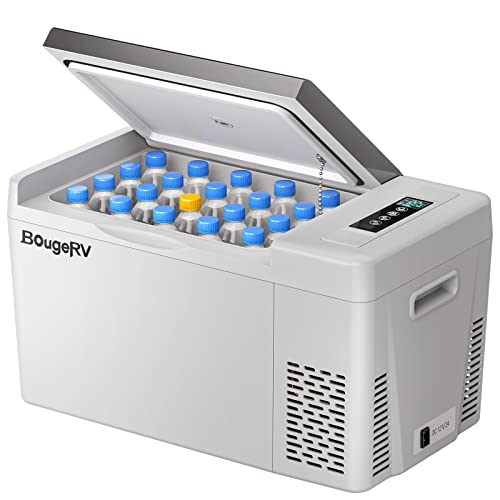
BougeRV 12V Refrigerator 23 Quart — Best for Cars and Road Trips
The step from 16 to 23 quarts is the step from personal to shared. The BougeRV 23 quart holds a family day’s drinks and food with room for the leftovers and the supermarket stop on the way home, while staying in the size class that a sedan trunk or a rear seat can absorb without rearranging the trip around the cooler. For road-trip duty — its natural home — that balance is the whole argument.
BougeRV builds for the RV and overland market, and the design shows it: the box expects vehicle power as its native supply, with household AC as the second input for pre-chilling and indoor use. As with the Alpicool, treat it as a small refrigerator rather than a chilled picnic box: load it cold, keep the lid discipline reasonable, and it will hold temperatures through a hot parked lunch stop that would defeat any thermoelectric rival.
Strengths
- Family-day capacity without leaving the car-friendly size class
- Compressor reliability in hot vehicles and parked stops
- AC input makes pre-chilling and home overflow use easy
Trade-offs
- Still a single zone: one temperature for everything inside
- Heavier than the compact picks when fully loaded
- Costs compressor money; overkill for solo day trips
| Type | Compressor fridge-freezer |
| Capacity | 23 quart |
| Power | 12/24V DC and 110V AC |
Road-trippers should think in terms of zones of the trip: drinks accessed constantly ride best in a small thermoelectric or a simple insulated bag, while the compressor box stays shut and cold for meals and perishables. Used as the cold vault rather than the drink dispenser, a 23 quart compressor covers a surprising amount of family travel.
Choose it over the C15 when the cooler serves more than two people; choose the C15 when it mostly serves one or two and space is at a premium. The technologies are the same; the arithmetic of appetites decides.
Best for: Families and road-trippers needing shared capacity in a car-sized box / Not suited for: Solo travellers short on space, or anyone needing separate fridge and freezer zones
Check on Amazon — check price on Amazon before you buy, because vehicle and appliance listings change configurations often.

ICECO GO20 Dual Zone 12V Refrigerator — Best Premium Dual Zone
Dual zone is the premium idea in this category: two compartments at two temperatures, so ice cream and frozen meat ride at freezer settings while drinks and produce sit at fridge settings beside them, in one box on one socket. The GO20 builds that idea around a SECOP compressor — a name with a long history in mobile refrigeration — and a listed range from 0°F to 50°F that covers both jobs honestly.
This is the cooler for trips where food is cargo rather than convenience: multi-day camping with real cooking, long drives between resupplies, fishing and hunting trips where the catch or the provisions must stay properly cold or properly frozen. In those settings the price gap over a single-zone box is not a luxury tax; it is the cost of not needing a second cooler, a bag of ice, or a compromise temperature that serves neither load well.
Strengths
- Independent dual zones end the fridge-versus-freezer compromise
- SECOP compressor pedigree in mobile refrigeration
- Wide listed range covers deep freeze to cool storage
Trade-offs
- Premium price tier; hard to justify for day trips
- Dual-zone boxes are bulkier for their usable fridge space
- More settings to manage; rewards an owner who reads the manual
| Type | Compressor fridge-freezer, dual zone |
| Compressor | SECOP (per listing) |
| Listed temperature range | 0°F to 50°F |
| Power | DC 12/24V and AC 100-240V |
Power discipline matters most at this tier, because a dual-zone box working hard in a hot vehicle is a real electrical load. Confirm the battery protection setting matches your setup — starter battery in a car, house bank in an RV — and the cooler will guard the vehicle while it guards the food. Paired with a healthy battery or any auxiliary power, it runs for days; asked to freeze hard off a lone starter battery in a parked car, it will eventually and correctly choose the battery over the ice cream.
Buy the GO20 when the trip is long, the food matters, or both zones will genuinely work. Otherwise the single-zone picks above deliver most of the benefit for notably less money.
Best for: Multi-day campers, overlanders and anyone carrying frozen and fresh food together / Not suited for: Day-trippers and budget buyers who would never use the second zone
Check on Amazon — check price on Amazon before you buy, because vehicle and appliance listings change configurations often.

EUHOMY 59QT 12 Volt Refrigerator — Best Large Capacity
At 59 quarts the question stops being “will it fit the food” and becomes “will it fit the vehicle”. This EUHOMY is the family-and-group end of the compressor category: a listed range from -4°F to 68°F, so the whole box can freeze or refrigerate, and capacity for a long weekend’s full catering, a big shop on a road trip, or a team’s worth of drinks and food in an SUV, truck or RV.
The listed ECO and MAX modes are the practical heart of a big box. MAX pulls temperature down fast after loading or a hot start; ECO settles into efficient holding once the load is cold, which is where a parked vehicle’s battery budget is won or lost. The 3-level battery protection, also listed, lets you match the cutoff to your electrical setup — protective on a starter battery, more permissive on a deep-cycle house bank — and on a cooler this size that setting deserves the two minutes it takes to configure.
Strengths
- Capacity for families, groups and long trips in one box
- Full freezer-to-fridge range across the whole interior
- ECO/MAX modes and adjustable battery protection suit vehicle life
Trade-offs
- Large and heavy when loaded; a two-person lift and real cargo space
- Single temperature for a big interior; no separate freezer zone
- Highest power appetite here when pulling down in MAX mode
| Type | Compressor fridge-freezer |
| Capacity | 59 quart |
| Listed temperature range | -4°F to 68°F |
| Modes | ECO and MAX (per listing) |
| Battery protection | 3-level (per listing) |
Big coolers reward loading discipline: pre-chill the box, load cold food, group by day or meal so the lid opens briefly and rarely, and keep the vents clear even when the cargo area is packed tight around it. A 59 quart box opened constantly in a hot vehicle is a battery test; the same box managed sensibly is a refrigerator that happens to travel.
Choose it when the headcount or the trip length makes 20-something quarts a fantasy. Everyone else will be happier carrying — and powering — the smaller picks.
Best for: Families, groups, event crews and long trips in SUVs, trucks and RVs / Not suited for: Small cars, solo travellers, or anyone who must carry the cooler far by hand
Check on Amazon — check price on Amazon before you buy, because vehicle and appliance listings change configurations often.
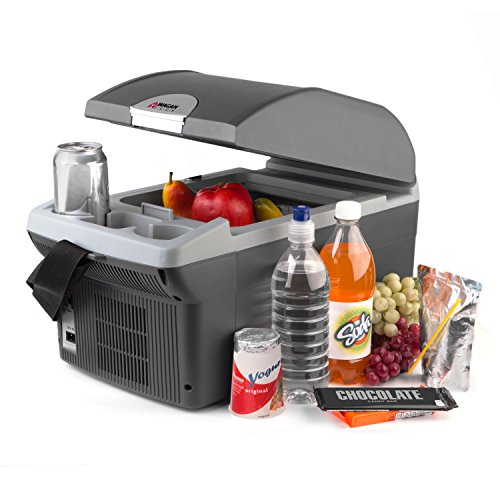
Wagan EL6214 Personal Thermoelectric Cooler/Warmer 14L — Best Budget Thermoelectric
Thermoelectric cooling is honest technology with a specific limit: it chills relative to the surrounding air, typically by a fixed margin, rather than to an absolute temperature. On a mild day that margin lands drinks at a genuinely pleasant chill. In a vehicle interior baking well past 100°F, the same margin lands them merely cool. The Wagan EL6214 is the budget benchmark of this class — 14 litres for one or two people’s day, light enough to carry with one hand, and switchable to a warming mode that keeps takeaway or a casserole warm on the drive home, a trick no compressor box in this guide offers.
Judged as what it is, it is a good tool: commuters keeping lunch and drinks cool, drivers doing day trips, anyone whose cold chain is measured in hours and whose food is not safety-critical. Judged as a refrigerator — for medication, raw meat on a long hot drive, frozen anything — it is the wrong tool, and no thermoelectric pick should be bought for those jobs.
Strengths
- Lowest cost and lightest weight route to powered cooling
- Warming mode is genuinely useful for food transport
- Simple, quiet solid-state cooling with no compressor to protect
Trade-offs
- Cooling is relative to ambient: hot vehicles defeat it
- Continuous current draw while running; mind parked use
- Cannot freeze or guarantee food-safe temperatures in heat
| Type | Thermoelectric cooler and warmer |
| Capacity | 14 litre |
| Power | 12/24V DC |
Two habits make thermoelectric ownership happy: pre-chill the contents in a home fridge so the box only maintains rather than pulls down, and run it while driving rather than parked, because its continuous draw is unkind to a starter battery over hours. Break either habit and the technology gets blamed for physics.
If your trips are day-length and your loads are lunches and drinks, this is the sensible spend. The moment a trip involves frozen food, medication or multi-day heat, step up to the compressor picks and do not look back.
Best for: Commuters and day-trippers cooling lunches and drinks on a budget / Not suited for: Frozen food, medication, raw meat in heat, or multi-day trips
Check on Amazon — check price on Amazon before you buy, because vehicle and appliance listings change configurations often.
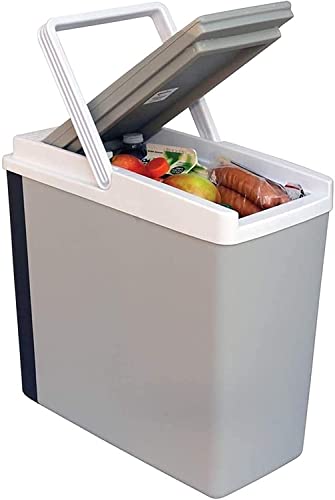
Koolatron 12V Iceless Cooler & Warmer 18 qt — Best Thermoelectric for Camping and Boats
The Koolatron’s proposition is the iceless day out: no ice to buy, no meltwater soaking the sandwiches, no cooler space surrendered to frozen water. At 18 quarts hard-sided, it is the picnic and day-boat size — drinks and food for a small group, in a box that stacks and stows like luggage and wipes clean like one. Its listing places it across car, truck, camper and boat use, which matches the thermoelectric reality: anywhere the trip is a day and the power is a vehicle.
The same thermoelectric limits apply as with the Wagan, in a slightly larger box: cooling relative to ambient, continuous draw, no freezing. The Koolatron earns its separate place on capacity and form — group day trips rather than personal ones, and a warmer mode shared with its smaller rival for the trip home. Owners who understand the class rate these boxes well; owners who expected a freezer write the angry reviews, which is a expectations problem this guide exists to prevent.
Strengths
- Iceless convenience: no meltwater, no ice runs, full capacity for food
- 18 quart group-day size in a tidy hard-sided box
- Cooler and warmer modes cover both directions of a day trip
Trade-offs
- Ambient-relative cooling struggles in serious heat
- Continuous draw makes parked, engine-off use a battery risk
- Not a refrigerator: no food-safety guarantee in hot weather
| Type | Thermoelectric cooler and warmer (iceless) |
| Capacity | 18 quart |
| Power | 12V DC |
Boat and campsite users should note the power pattern: run it from the vehicle or a house battery while travelling, and treat engine-off hours as borrowed time. For a day on the water with sandwiches and cold drinks loaded from a fridge that morning, it does the job cleanly and without a bilge full of meltwater.
Between this and the Wagan, choose on capacity and shape: personal and commuting, Wagan; group days and camping, Koolatron. Between either of them and any compressor pick, choose on trip length and heat, honestly assessed.
Best for: Day trips, picnics, camping days and small boats wanting iceless cooling / Not suited for: Multi-day trips, freezing duty, or food safety in high heat
Check on Amazon — check price on Amazon before you buy, because vehicle and appliance listings change configurations often.
Comparison Table
| Pick | Badge | Key spec | Best for |
|---|---|---|---|
| Alpicool C15 Portable Car Freezer 16 Quart | Best Overall | Compressor; 16 qt; -4°F to 68°F listed range; 12/24V DC and 100-240V AC | Solo travellers, couples and commuters wanting real refrigeration in a compact box |
| BougeRV 12V Refrigerator 23 Quart | Best for Cars and Road Trips | Compressor; 23 qt; 12/24V DC and 110V AC | Families and road-trippers needing shared capacity in a car-sized box |
| ICECO GO20 Dual Zone 12V Refrigerator | Best Premium Dual Zone | Compressor (SECOP); dual zone; 0°F to 50°F listed range; DC 12/24V and AC 100-240V | Multi-day campers, overlanders and anyone carrying frozen and fresh food together |
| EUHOMY 59QT 12 Volt Refrigerator | Best Large Capacity | Compressor; 59 qt; -4°F to 68°F listed range; ECO/MAX modes; 3-level battery protection | Families, groups, event crews and long trips in SUVs, trucks and RVs |
| Wagan EL6214 Personal Thermoelectric Cooler/Warmer 14L | Best Budget Thermoelectric | Thermoelectric cooler/warmer; 14 litre; 12/24V DC | Commuters and day-trippers cooling lunches and drinks on a budget |
| Koolatron 12V Iceless Cooler & Warmer 18 qt | Best Thermoelectric for Camping and Boats | Thermoelectric cooler/warmer; 18 qt; hard-sided; 12V | Day trips, picnics, camping days and small boats wanting iceless cooling |
How to Choose the Best 12 Volt Vehicle Cooler
Choose the technology first, using the harshest trip you realistically take — not the average one. If any trip involves frozen food, medication that must stay cold, raw meat in summer, or multiple parked days, you need a compressor model and the rest of the decision is sizing. If your hardest trip is a hot day with sandwiches and drinks loaded cold that morning, thermoelectric is a legitimate, money-saving answer, and the premium compressor money is better spent elsewhere.
Size second, by load rather than by vehicle. A useful rule: drinks for the day plus food for the day, in the box, with the lid closing without force. Solo and couple duty lives happily at 15 to 23 quarts; families and groups start at the mid-40s and up; dual-zone shoppers should count only the zone they will use most when comparing capacities, because a split box’s fridge side is smaller than its headline number suggests.
Battery protection is not optional reading
Any cooler that may run while the vehicle is parked needs battery protection, and you need to set it correctly. The typical scheme offers levels: a high cutoff that protects a starter battery aggressively, and lower settings for deep-cycle house batteries in RVs and boats. Set it for the battery actually feeding the cooler. Compressor models in this guide list protection among their features; thermoelectric models generally lack it, which is one more reason they belong on driving hours rather than parked ones.
Power budget for parked use
A compressor cooler cycles: it draws its rated current while the compressor runs and little between cycles, so its average draw over a day is a fraction of the headline figure — commonly the equivalent of a few amp-hours per day in mild weather, more in heat. A thermoelectric cooler draws continuously. Multiply continuous amps by parked hours and compare honestly with your battery’s usable capacity; that arithmetic, done once, prevents every dead-battery story in this category.
Lid discipline and internal organisation
Every lid opening trades cold air for warm, and in a vehicle cooler the trade is paid by your battery. Organise for the openings you know are coming: a top layer for the day’s drinks and snacks, dividers or a shallow basket if the model offers them, and a household rule that the cooler is not a browsing shelf. Families travelling with children will get more real-world benefit from this organisation than from any specification in this guide, because the best-insulated box in the world cannot insulate against a lid held open in the sun.
Placement and ventilation
Compressor coolers breathe through vents and reject heat into the vehicle; a cooler buried under luggage in a sealed trunk works harder, draws more and cools less. Leave the vents their space, shade the box where you can, and strap it down: a loaded 59 quart cooler is heavy cargo, and in a sudden stop it will travel unless it is secured.
Compressor vs Thermoelectric: The Two Technologies, Plainly
A compressor cooler is a refrigerator whose compressor is built to run on DC power and to tolerate vehicle life — vibration, tilt within reason, and voltage that wanders with the alternator. It cools to a set temperature and holds it: set 36°F and the interior is 36°F in a mild spring morning and in a 110°F desert rest stop alike, at the cost of more money, more weight and a machine with moving parts that deserves ventilation and a reasonably level, secure home.
A thermoelectric cooler uses a solid-state Peltier module: apply current and one side gets cold while the other gets hot, with a fan moving the heat away. Reverse the current and it warms instead — hence the cooler/warmer double act. It has almost nothing to wear out, it is light and cheap, and its cooling is a fixed step down from whatever the surrounding air is doing. That step is plenty on a temperate day and inadequate in a heatwave, and no specification sheet can repeal it.
The ownership summary is short. Compressor: buy once, trust with anything, feed it a battery plan. Thermoelectric: buy cheap, trust it with lunch, run it while driving. The market’s confusion between them is entirely a labelling problem, and it is why every pick in this guide carries its technology in the first line of its spec box.
There is also a middle behaviour worth naming, because it confuses new owners of either type: both technologies work hardest, and draw most, in the first hour after loading, and both are at their most efficient holding a full, cold, rarely opened box. A cooler that seems power-hungry on day one of a trip and thrifty by day three is not inconsistent; it is showing you the difference between creating cold and keeping it. Plan your battery for day one, load for day three, and the ownership experience of any pick here will match its review.
Running a 12 Volt Cooler Away from the Vehicle: Power Stations and House Batteries
A 12 volt cooler’s second life begins when it leaves the vehicle. The same DC input that plugs into a car socket plugs into a portable power station, an RV house bank, a boat’s cabin socket or a solar-charged battery box at a campsite, and the cooler neither knows nor cares which. That portability is a large part of the category’s value: the box that serves the drive also serves the pitch, the dock and the power cut at home, where a compressor cooler on a modest power station will protect a fridge-load of food far longer than ice would.
Sizing the supply is arithmetic, not guesswork. A compressor cooler’s average draw — not its peak — multiplied by the hours you need gives the watt-hours required; in mild weather a compact compressor box may average in the low tens of watts, and several times that while pulling down a warm load in heat. Give the calculation margin, pre-chill everything from the mains before departure, and the pairing will feel generous. Skip the pre-chill and the same pairing will feel broken, because pull-down is the most expensive work a cooler ever does.
House batteries in RVs and boats are the natural home for the larger picks. A 59 quart compressor box that would bully a car’s starter battery is a modest, well-behaved load on a proper house bank with solar or alternator charging, and its battery protection can be set permissively to match. The discipline transfers from the vehicle case unchanged: know which battery feeds the cooler, set its protection for that battery, and keep its vents breathing.
One caution travels with all off-vehicle use: connectors and cables matter at DC currents. Use the cable the cooler came with or a properly rated equivalent, keep connections clean and tight, and never extend a cooler’s DC lead with thin accessory wire — voltage drop on a long thin cable is the silent cause of coolers that cycle oddly, error out, or cool weakly far from the vehicle.
How to Load and Run a 12 Volt Cooler on a Trip
Good results are mostly procedure. Work through it in order:
- Pre-chill the cooler on household AC (compressor models) or in a cool room, and pre-chill or freeze the contents; a cooler maintains cold far better than it creates it.
- Set the battery protection level for the battery that will feed the cooler while parked, before you load.
- Load in reverse order of use: last-needed items at the bottom, today’s drinks and lunch on top, so the lid opens briefly and rarely digs deep.
- Fill gaps with cold mass — frozen bottles double as ice and drinking water later — rather than leaving insulating air pockets in a compressor box.
- Place the cooler shaded and ventilated in the vehicle, vents clear, and strap it against movement.
- On the road, run from the vehicle socket; parked, follow your battery plan and check the protection setting is doing its job.
- At the destination, move the cooler to shade or AC power where available, and unload perishables into a fridge for long stays.
Thermoelectric owners should compress the same procedure: everything goes in cold, the box runs while the engine runs, and parked time is kept short or powered from a separate source. Treated with that discipline, a thermoelectric cooler is a pleasant tool; treated like a refrigerator, it becomes a cautionary tale at the first hot rest stop.
A last procedural point applies to every pick: after the trip, empty the cooler fully, wipe it dry, and store it with the lid ajar. A sealed cooler stored damp grows the smell that owners later blame on the food; a dry, aired cooler is ready to pre-chill the moment the next trip is mentioned. Like the vacuums elsewhere in this programme, these are maintenance appliances, and two minutes of care at the end of a trip is the cheapest performance upgrade available.
Common Buying Mistakes
- Buying a thermoelectric cooler for frozen food, medication or multi-day heat — the technology cannot do those jobs.
- Ignoring battery protection, then blaming the cooler for a flat starter battery it was never configured to protect.
- Sizing by headline quarts on a dual-zone box, forgetting each zone is only part of the total.
- Burying a compressor cooler’s vents under luggage and wondering why it draws so much power.
- Loading warm drinks into any cooler and expecting vehicle power to chill them quickly — pre-chill at home.
- Leaving a loaded cooler unsecured in the cargo area, where it becomes a hazard in a sudden stop.
- Running a thermoelectric cooler parked for hours: its draw never cycles off.
Final Recommendation
Most buyers should buy the Alpicool C15: real refrigeration, freezer range, dual power inputs for home pre-chilling, and a size that fits real cars without consuming the trip’s luggage allowance. Families on the road step up to the BougeRV 23 quart, serious multi-day travellers to the ICECO GO20’s dual zones, and groups to the EUHOMY 59 quart. The Wagan and Koolatron thermoelectrics are good buys precisely when their limits do not matter — day trips, lunches, drinks — and poor buys the moment they do.
Whichever pick you choose, do the two-minute jobs that make it perform: set the battery protection for the battery that will actually feed it, and pre-chill the load at home before the first trip. Those two habits separate the owners who praise these coolers from the owners who return them. Related 12 volt decisions live nearby: smaller personal sizes are compared in Best 12 Volt Small Cooler, the RV-dedicated view is Best 12 Volt Rv Refrigerator, plug-in thermoelectric models get their own hearing in Best 12 Volt Thermoelectric Cooler, and the freezer end of the market is Best 12 Volt Ac Dc Freezers. For the rest of the vehicle kit, Best 12 Volt Vacuum covers cleaning on the same socket.
The shortlist, one more time:
- Alpicool C15 Portable Car Freezer 16 Quart — Best Overall: Solo travellers, couples and commuters wanting real refrigeration in a compact box
- BougeRV 12V Refrigerator 23 Quart — Best for Cars and Road Trips: Families and road-trippers needing shared capacity in a car-sized box
- ICECO GO20 Dual Zone 12V Refrigerator — Best Premium Dual Zone: Multi-day campers, overlanders and anyone carrying frozen and fresh food together
- EUHOMY 59QT 12 Volt Refrigerator — Best Large Capacity: Families, groups, event crews and long trips in SUVs, trucks and RVs
- Wagan EL6214 Personal Thermoelectric Cooler/Warmer 14L — Best Budget Thermoelectric: Commuters and day-trippers cooling lunches and drinks on a budget
- Koolatron 12V Iceless Cooler & Warmer 18 qt — Best Thermoelectric for Camping and Boats: Day trips, picnics, camping days and small boats wanting iceless cooling
Frequently Asked Questions
Will a 12 volt cooler drain my car battery?
A compressor cooler with battery protection correctly set will shut itself off before the battery is endangered; set the protection level for a starter battery when that is what feeds it. A thermoelectric cooler has no such protection in most cases and draws continuously, so parked engine-off use should be short. When in doubt, run coolers while driving and treat parked hours as a budget you have calculated, not a surprise you discover.
Can a 12 volt cooler really freeze food?
Compressor models can: several picks here list ranges reaching -4°F or 0°F, which is true freezer territory. Thermoelectric models cannot freeze; they cool below ambient by a fixed margin. If freezing matters to any trip you take, the compressor section of this guide is the whole of your shortlist.
What size cooler do I need for a family road trip?
For drinks and food for a day, most families land between 23 and 45 quarts; for multi-day catering, 50 quarts and up, or a dual-zone box if frozen and fresh loads must coexist. Count people and days honestly, remember the cooler also competes with luggage for the same cargo space, and favour the smaller box you will actually carry over the larger one that gets left behind.
Is a dual-zone cooler worth the extra cost?
Only if both zones will work: frozen goods and fridge goods on the same trips, regularly. Occasional ice cream is cheaper served by a single-zone box set colder with the fresh food packed carefully. Regular mixed loads — fishing trips, multi-day camping with real cooking — repay the dual-zone premium quickly in food quality and in not needing a second cooler.
Can I run a 12 volt cooler at home?
Yes — the compressor picks here list household AC inputs alongside DC, which makes them useful as overflow fridge space, for events, and for pre-chilling before a trip. Thermoelectric models run at home through a suitable converter where one is offered. Pre-chilling at home is in fact the single best habit in this category: the vehicle battery then only maintains cold instead of creating it.
How long will a compressor cooler run on a car battery while parked?
It depends on the weather, the temperature setting, how full and how cold the load started, and the battery’s size and health — which is why honest answers come as ranges, not promises. In mild conditions with a pre-chilled load, a compact compressor cooler can run through a parked day and night while its battery protection keeps the vehicle startable. In extreme heat, freezing hard, the same setup may reach its protection cutoff much sooner. The protection system is the point: it converts a potential no-start into, at worst, a warmer cooler.


