Disclosure: airfryerkitchensupply.com is reader-supported. When you buy through links on our site, we may earn an affiliate commission at no extra cost to you.
Where to buy
Every pick in this guide to the best 12 volt ac dc freezers is sold on Amazon, and that is where we recommend buying, because a portable compressor fridge-freezer is a considered purchase whose details live in the listing: confirm the temperature range reaches true freezer territory, check that both a 12/24V DC lead and an AC adapter are included or available, and measure your intended space against the external dimensions. All six picks were verified against Amazon’s catalog through the Creators API on 2026-11-20, and each is a genuine compressor fridge-freezer running on 12V DC and household AC, not a thermoelectric cooler wearing a freezer’s name.
- Alpicool C15 Portable Car Freezer 16 Quart — Best Compact: Check the current price on Amazon
- Alpicool CF45 Portable Fridge Freezer 42 Quart — Best Value Family Size: Check the current price on Amazon
- BougeRV 12V Refrigerator 23 Quart Portable Freezer — Best Mid-Size Singles Pick: Check the current price on Amazon
- BougeRV 12V Refrigerator 53 Quart Electric Car Cooler — Best Large Single Zone: Check the current price on Amazon
- Setpower 12V Refrigerator 48QT Dual Zone Car Fridge — Best Dual Zone Value: Check the current price on Amazon
- ICECO GO20 Dual Zone 12V Refrigerator 21 Quart SECOP — Best Premium Compact Dual Zone: Check the current price on Amazon
The best 12 volt ac dc freezers belong to one of the most useful product classes in mobile living: the portable compressor fridge-freezer. Unlike the cheap thermoelectric coolers that chill a fixed amount below ambient and never truly freeze, these units carry a real refrigeration compressor, reach temperatures well below freezing, commonly minus 4 degrees Fahrenheit, and run from a vehicle’s 12 or 24 volt system on the road and from a household AC adapter at home, at a campsite hookup or in a hotel room. One appliance therefore does the whole journey: pre-chilled at home on AC, frozen in the vehicle on DC, and still frozen at the destination either way.
The buyers are as varied as the vehicles: overlanders and vanlifers living out of them full-time, truck drivers keeping real food on multi-day routes, anglers and hunters protecting a catch, families road-tripping with ice cream that stays ice cream, and households buying outage insurance for medicines and frozen food. What they share is the need for genuine freezer performance without ice, without daily resupply, and without a generator. Capacity, single versus dual zone control, power consumption and battery protection are the decisions that matter, and this guide is organised around them.
One honest framing before the picks: a portable freezer is a load on a vehicle battery, and the discipline of powering it, a dual-battery setup, a portable power station, or at minimum the battery-protection settings every pick here includes, is part of owning one successfully. The buying guide covers that arithmetic in plain terms, because the best freezer in this list will still flatten a starter battery if it is asked to, and every one of these units gives you the tools to prevent exactly that.
Key Takeaways
- Demand a stated sub-zero temperature floor: compressor models print one, thermoelectric coolers cannot, and that single check eliminates the category’s biggest disappointment.
- Pre-chill at home on AC and load cold contents; never make a vehicle battery do the initial pull-down of warm food.
- Battery protection settings are the appliance’s most important feature after the compressor: set the level for the battery actually in use.
- Dual zone divides the headline capacity between compartments, so size by the zone you will use most, not by the total.
In this guide
Quick Picks
Alpicool C15 Portable Car Freezer 16 Quart — Best Compact. Sixteen quarts of genuine minus-4 freezing in the smallest package in this guide, with full AC/DC power: the personal freezer for one or two travellers. Check the current price on Amazon
Alpicool CF45 Portable Fridge Freezer 42 Quart — Best Value Family Size. The family-size version of the value formula: 42 quarts, the same full freezer range and dual power, for couples and families on multi-day trips. Check the current price on Amazon
BougeRV 12V Refrigerator 23 Quart Portable Freezer — Best Mid-Size Singles Pick. The coldest floor in this guide at minus 8, a stated 15-minute cool to freezing point, and a 23-quart size that splits the difference between personal and family boxes. Check the current price on Amazon
BougeRV 12V Refrigerator 53 Quart Electric Car Cooler — Best Large Single Zone. Fifty-three quarts with the two features power-conscious owners ask for by name: MAX/ECO compressor modes and three-level battery protection, at a stated quiet 45dB. Check the current price on Amazon
Setpower 12V Refrigerator 48QT Dual Zone Car Fridge — Best Dual Zone Value. True dual-zone independence at 48 quarts, fridge on one side and freezer on the other, with a three-year warranty stated in the listing itself. Check the current price on Amazon
ICECO GO20 Dual Zone 12V Refrigerator 21 Quart SECOP — Best Premium Compact Dual Zone. The premium compact: a SECOP compressor, dual zones in just 21 quarts, and ICECO’s metal-built reputation, with one range caveat stated honestly in the review. Check the current price on Amazon
How These Picks Were Chosen
Candidates were verified through the Creators API on 2026-11-20 across three brand searches, after an initial general search returned mostly replacement power cords, which tells its own story about this category’s accessory tail. Listings had to confirm a compressor fridge-freezer with a sub-freezing temperature range and dual AC/DC power; thermoelectric coolers were excluded outright, whatever their titles claimed, and ASINs were recorded from the API responses.
The shortlist balances the market deliberately: Alpicool’s value-leading singles in two sizes, BougeRV’s compact and large MAX/ECO models, a Setpower dual-zone with a notably long stated warranty, and an ICECO dual-zone built around a SECOP compressor for the premium end. Capacities below are the listings’ quart figures, temperature ranges are quoted from the listings, and one listing’s range, the ICECO GO20 variant returned by the API, reads 0 to 50 degrees Fahrenheit, which we flag in its review rather than gloss over. No prices or fixed ratings are printed; judge value on the day via the check-price links.
A word about the brands assembled here, because this category’s market structure matters to buyers. Alpicool anchors the value end with proven single-zone models; BougeRV builds around power management, with ECO modes and battery protection as brand signatures; Setpower competes on dual-zone value with warranty length as its calling card; ICECO occupies the premium tier built on SECOP compressors and tougher construction. The shortlist mirrors that structure deliberately, so that whichever tier your budget and ambitions point to, the pick waiting there is that tier’s honest representative.
The 6 Best 12 Volt AC/DC Freezers

Alpicool C15 Portable Car Freezer 16 Quart — Best Compact
The C15 suits the solo and duo end of the market: a truck cab, a small car’s boot, a campervan where every litre is argued over. Sixteen quarts holds a week’s frozen provisions for one or a weekend’s for two, and the unit’s compact footprint fits footwells and between seats where larger boxes cannot go. Its listing confirms the full freezer range and both power inputs. Buyers feeding a family or splitting fridge and freezer duties should step up to the larger and dual-zone picks below.
Strengths
- True -4F freezer range in a 16-quart footprint
- Runs on 12/24V DC and 100-240V AC as listed
- Compact size fits cabs, footwells and small boots
Trade-offs
- Capacity is personal-scale, not family-scale
- Single zone means one temperature for everything
- Small box fills fast with bulky frozen packaging
| Capacity | 16 Quart (15 Liter) |
| Range | -4F to 68F (per listing) |
| Power | 12/24V DC and 100-240V AC |
| Type | Compressor fridge freezer |
Compact freezers earn their place by being present. A large dual-zone box left in the garage because it does not fit the vehicle delivers no refrigeration at all, while the C15’s scale means it actually travels, in the cab, behind the seat, in the small camper. Alpicool built its name on this value end of the compressor market, and the C15’s specification, full freezer range, both power standards, fast cooling claims, is the complete article at the smallest size this guide covers.
Run it as a freezer at around 0F for provisions or as a fridge in the high 30s for drinks and fresh food, but decide before loading, because a single-zone box asked to do both does neither well. That discipline, plus pre-chilling on AC at home, is the whole technique of small portable refrigeration.
Best for: Solo travellers, truck cabs and small cars needing a true freezer in a small footprint / Not suited for: family-scale loads or simultaneous fridge-and-freezer duty
Check the current price on Amazon

Alpicool CF45 Portable Fridge Freezer 42 Quart — Best Value Family Size
The CF45 suits the mainstream of this market: a family SUV on a week-long road trip, a couple’s camper, a fishing camp that needs frozen bait and food in one box. Forty-two quarts is the size class where a single zone stops feeling like a compromise for most trips, because a full week’s provisions fit with room for the catch or the market stop. It remains a single temperature zone, so the fridge-versus-freezer decision still applies, but at this capacity many owners run it as a freezer and pair it with the vehicle’s or campsite’s ordinary cooler for fresh items.
Strengths
- 42 quarts serves family-scale trips in one box
- Full -4F to 68F range on both power inputs
- Value-brand positioning in a proven model line
Trade-offs
- Single zone forces the fridge-or-freezer choice
- Larger footprint needs a planned home in the vehicle
- No app control or dual-zone refinement at this level
| Capacity | 42 Quart (40 Liter) |
| Range | -4F to 68F (per listing) |
| Power | 12/24V DC and 100-240V AC |
| Type | Compressor fridge freezer, single zone |
Model longevity is a real virtue in this category, and the CF45 has been a fixture of the value end long enough for its ownership pattern to be well understood: it cools fast, holds freezer temperatures in hot vehicles when loaded sensibly, and asks for the standard disciplines of pre-chilling and ventilation space around its vents. For the buyer who wants the capability without paying for app ecosystems and dual-zone engineering, that settled, known quantity is precisely the appeal.
Load it like a freezer should be loaded: pre-chilled or frozen contents, minimal empty air space, lid opened briefly and rarely. At 42 quarts those habits are the difference between a compressor that sips power and one that works all day in a hot boot.
Best for: Families and longer trips wanting full freezer range at the value end / Not suited for: simultaneous fridge and freezer temperatures
Check the current price on Amazon
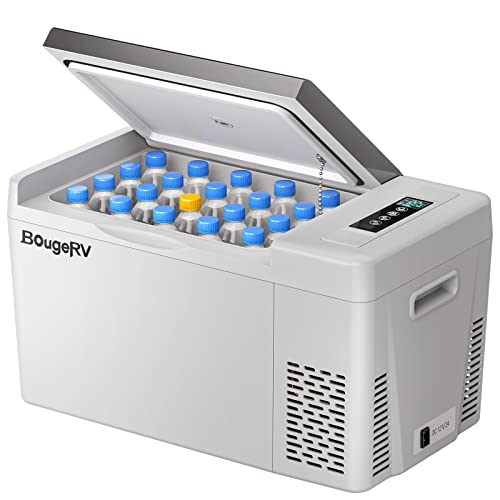
BougeRV 12V Refrigerator 23 Quart Portable Freezer — Best Mid-Size Singles Pick
The BougeRV 23-quart suits the middle traveller: couples on long weekends, commuters and drivers who keep real food in the vehicle daily, and campers whose trips outgrow the 16-quart class. Its listing claims the deepest freezer floor here, minus 8 degrees, and a fast initial pull-down, both valuable in hot climates where a box loaded in a sun-baked car park starts from a hard place. Grey finish and road-trip positioning aside, the substance is a properly specified single-zone compressor box in the most versatile size in the guide.
Strengths
- -8F floor is the coldest stated range in this guide
- Fast cool-down claim suits hot-climate loading
- 23 quarts is the versatile middle size for couples
Trade-offs
- Single zone, like all the sub-40-quart picks
- Freezer floor beyond -4F matters to few real loads
- 110V AC adapter standard is US-specific as listed
| Capacity | 23 Quart |
| Range | -8F to 50F (per listing) |
| Power | 12/24V DC, 110V AC |
| Claim | Fast 15-minute cool to 32F (per listing) |
A deeper freezer floor is easy to dismiss as specmanship, and for ice cream and provisions minus 4 is indeed enough. Its real value is margin: a box that can reach minus 8 holds 0F through door openings, hot days and full loads with its compressor cycling normally, where a box whose floor is 0F works at its limit to hold the same load. BougeRV’s stated fast pull-down serves the same philosophy, shortening the vulnerable period after loading warm contents. Bought for hot-climate use, this is the thinking owner’s mid-size pick.
As with its rivals, give the compressor ventilation room in the vehicle and pre-chill on AC before a trip. A box this capable still obeys physics, and the owners who respect that get the performance the listing promises.
Best for: Couples and commuters wanting the coldest stated range in a mid-size box / Not suited for: family-scale or dual-zone duty
Check the current price on Amazon

BougeRV 12V Refrigerator 53 Quart Electric Car Cooler — Best Large Single Zone
This BougeRV suits the long-trip and base-camp buyer: a week or more of provisions, a hunting camp, a worksite crew’s food, in one large single-zone box. Its MAX mode pulls temperature down fast when power is plentiful, its ECO mode sips when it is not, and the three-level battery protection lets you decide how much of your vehicle’s battery the freezer may use, the single most important setting for anyone running from a starter battery. The stated 45dB noise figure matters for vanlifers sleeping beside it. Families wanting fridge and freezer simultaneously should compare the dual-zone picks before choosing size over zones.
Strengths
- MAX/ECO modes match compressor effort to power supply
- 3-level battery protection guards the vehicle battery
- 53 quarts is genuine long-trip capacity, quietly run
Trade-offs
- Single zone at a size where dual zone tempts
- Large box needs a permanent vehicle home and lifting help
- Feature set still sits below the premium dual-zone tier
| Capacity | 53 Quart |
| Range | -4 to 50F (per listing) |
| Modes | MAX / ECO (per listing) |
| Protection | 3-level battery protection (per listing) |
| Noise | 45dB (per listing) |
Battery protection deserves the spotlight this pick gives it. A portable freezer’s defining ownership risk is not mechanical failure; it is the morning the vehicle will not start because the freezer drank the starter battery overnight. Three protection levels let you set the cut-off conservatively on a starter battery, or aggressively on a deep-cycle auxiliary, and that one setting, understood and used, is worth more than any capacity figure in this guide. BougeRV putting it in the title tells you the brand knows its customers’ real failure mode.
Pair this box with ECO mode and the high protection setting for starter-battery use, or MAX and low protection on a proper auxiliary battery or power station, and it adapts to both electrical worlds most owners pass through as their setups evolve.
Best for: Long trips and base camps wanting maximum single-zone capacity and power control / Not suited for: compact vehicles without a permanent home for a large box
Check the current price on Amazon

Setpower 12V Refrigerator 48QT Dual Zone Car Fridge — Best Dual Zone Value
The Setpower suits the traveller who has outgrown the single-zone compromise: fresh food kept at fridge temperature on one side, genuinely frozen goods on the other, each under independent control. Forty-eight quarts split across two zones serves a couple indefinitely or a family on long weekends, and the stated three-year warranty is a meaningful differentiator in a category where warranty terms are often an afterthought. It suits SUV, truck and RV owners with the footprint for it, and repays owners who plan loads by zone rather than by hope.
Strengths
- Independent dual-zone control: fridge and freezer simultaneously
- Three-year warranty stated in the listing
- 48QT total capacity in a single road-ready box
Trade-offs
- Each zone is smaller than a single-zone box of the same footprint
- Dual-zone discipline, lids, loading, settings, is on the owner
- Value brand lacks the premium compressor pedigree of the ICECO
| Capacity | 48QT total |
| Zones | Dual zone, independent control (per listing) |
| Range | -4F to 68F (per listing) |
| Warranty | 3 year (per listing) |
Dual zone is the point where a portable freezer stops being a better cooler and becomes a mobile kitchen’s cold store, and Setpower’s proposition is that transformation at a value position with warranty backing. The independent control matters more than the divider: two zones that share one setting are a box with a wall, while two genuinely independent zones let you run a deep freezer beside a gentle fridge, or two fridges, or switch one side off entirely on short trips to save power.
Learn the zone sizes before your first big shop, because 48 quarts divided is not 48 quarts of freezer, and frozen packaging is bulkier than fresh. Owners who plan the split once, then shop to it, find dual zone liberating; owners who improvise at the supermarket find it merely smaller.
Best for: Travellers wanting fridge and freezer at once without premium pricing / Not suited for: buyers wanting one large single-temperature space
Check the current price on Amazon

ICECO GO20 Dual Zone 12V Refrigerator 21 Quart SECOP — Best Premium Compact Dual Zone
The GO20 suits the buyer who prioritises build and compressor pedigree over raw litres: overlanders with a compact rig, drivers who want fridge-and-freezer separation in a box that fits behind a seat, and anyone who has learned that the compressor is the appliance. SECOP, the Danish compressor maker formerly known as Danfoss, is the name premium portable refrigeration is built around, and ICECO’s metal-construction approach suits rough vehicle life. The honest caveat: the API-returned listing for this variant states a 0 to 50 degree range, fridge territory at its floor rather than deep-freezer, so buyers needing verified minus-4 freezing should confirm the current listing’s range or choose the Setpower or BougeRV picks, whose listings state sub-zero floors.
Strengths
- SECOP compressor, the premium standard in this class
- Dual-zone separation in a compact 21-quart box
- Metal-built construction for vehicle life
Trade-offs
- API listing variant states 0 to 50F, so verify the freezer range before relying on it
- Premium pricing per quart is the highest in this guide
- 21 quarts splits into two genuinely small zones
| Capacity | 21 Quart |
| Zones | Dual zone (per listing) |
| Compressor | SECOP (per listing) |
| Power | DC 12/24V, AC 100-240V |
| Range | 0F to 50F on the API-returned listing variant; confirm before purchase |
Compressor provenance is the premium argument in portable refrigeration, and it is a legitimate one. The compressor is the only moving part that matters, it runs for thousands of hours in hot, vibrating vehicles, and SECOP’s units carry decades of mobile-refrigeration service behind them. ICECO builds its brand on that foundation plus tougher case construction, and owners who keep vehicles and gear for a decade rationally pay for both. The GO20 concentrates that proposition into the smallest dual-zone footprint in this guide.
The range caveat in this review is exactly the kind of detail to verify at purchase: ICECO sells GO-series variants, and the listing returned to us states 0 to 50F. If your need is a fridge and a cold freezer section for short trips, that serves; if your need is verified deep freezing, confirm the specific variant’s floor on the listing page or take the Setpower’s stated minus-4 dual-zone range instead.
Best for: Buyers wanting premium compressor pedigree and dual zones in a compact box / Not suited for: buyers needing a verified sub-zero floor on this listing variant without confirming first

Comparison Table
| Pick | Badge | Key spec | Best for |
|---|---|---|---|
| Alpicool C15 Portable Car Freezer 16 Quart | Best Compact | 16 quart, -4 to 68F, 12/24V DC + 100-240V AC | Solo travellers, truck cabs and small cars needing a true freezer in a small footprint |
| Alpicool CF45 Portable Fridge Freezer 42 Quart | Best Value Family Size | 42 quart, -4 to 68F, 12/24V DC + AC | Families and longer trips wanting full freezer range at the value end |
| BougeRV 12V Refrigerator 23 Quart Portable Freezer | Best Mid-Size Singles Pick | 23 quart, -8 to 50F, 12/24V DC + 110V AC | Couples and commuters wanting the coldest stated range in a mid-size box |
| BougeRV 12V Refrigerator 53 Quart Electric Car Cooler | Best Large Single Zone | 53 quart, -4 to 50F, MAX/ECO, 3-level battery protection | Long trips and base camps wanting maximum single-zone capacity and power control |
| Setpower 12V Refrigerator 48QT Dual Zone Car Fridge | Best Dual Zone Value | 48QT dual zone, independent control, -4 to 68F | Travellers wanting fridge and freezer at once without premium pricing |
| ICECO GO20 Dual Zone 12V Refrigerator 21 Quart SECOP | Best Premium Compact Dual Zone | 21 quart dual zone, SECOP compressor | Buyers wanting premium compressor pedigree and dual zones in a compact box |
How to Choose a 12 Volt AC/DC Freezer
Start with the ice test: does the listing state a temperature floor at or below 0 degrees Fahrenheit? True freezers in this class state minus 4 or lower; thermoelectric coolers state a differential below ambient and can never freeze in a hot vehicle, and any listing that will not print a floor temperature is telling you something. Every pick in this guide is a compressor unit with a stated range, and where one listing variant’s range reads as fridge-only, we say so in its review rather than letting the brand name carry it.
Size by traveller and trip, not by ambition. Sixteen to twenty-three quarts serves one or two people; forty-two to fifty-three serves families and long trips; dual-zone boxes divide their stated capacity between zones, so a 48-quart dual-zone is not 48 quarts of freezer. Then decide zones by menu: if your trips genuinely need fresh and frozen simultaneously, salads and ice cream in the same box, dual zone is worth its cost and footprint; if you travel on frozen provisions reheated daily, a larger single zone run as a freezer is simpler and roomier.
Finally, plan the power before the purchase. On a starter battery, use the battery-protection settings religiously and expect the freezer to be a daytime, driving-hours appliance unless the vehicle runs daily. On an auxiliary battery or portable power station, any pick here runs indefinitely with solar or driving recharge. The freezer is half the system; the power supply is the other half, and the owners who plan both are the ones posting the success stories.
Power Consumption and Battery Protection, in Plain Terms
A compressor freezer does not draw its rated power continuously; it cycles, working hard after loading or in heat, then sipping to maintain temperature. Real consumption depends on ambient temperature, set temperature, load and lid discipline, which is why honest guidance is behavioural rather than numerical: pre-chill on AC, load cold contents, keep the lid shut, park in shade, and any pick here becomes economical. ECO modes, where fitted, trade pull-down speed for lower draw, and MAX modes do the reverse; use each where it belongs.
Battery protection is the setting that cuts the freezer off before it can strand you, and its levels trade food safety against starting safety. High protection cuts off early and suits starter batteries; low protection extracts the most from a deep-cycle auxiliary that exists to be used. Know which battery your freezer is plugged into, set the level for that battery, and re-check it whenever the setup changes, because a freezer moved from the auxiliary to the starter socket without a settings change is the classic stranding story.
How to Set Up a Portable Freezer for Its First Trip
A first trip done properly teaches you the appliance under forgiving conditions, at home and on a short run, rather than at a remote campsite. The steps below cover bench setup, pre-chilling, loading and the vehicle installation habits that protect both the food and the battery.
Compressor vs Thermoelectric: The Distinction That Defines the Category
Two unrelated technologies hide behind the words ‘car cooler’, and confusing them is the most expensive mistake in this market. A thermoelectric cooler uses a Peltier element to move heat, achieving a temperature typically twenty to thirty degrees below the surrounding air. In a 95-degree vehicle that means contents at 65 to 75 degrees: cool drinks, unsafe food storage over time, and freezing that is physically impossible. These devices are inexpensive and light, and their listings borrow freezer language freely, which is why the stated temperature floor is the buyer’s one reliable test.
A compressor fridge-freezer is a true refrigerator in miniature, with the same vapour-compression cycle as a household appliance. It holds its set temperature regardless of ambient heat within its operating envelope, reaches genuine freezer temperatures, and cycles its compressor to sip power once there. Every pick in this guide is this technology, verified by a stated sub-zero range in its listing, and the price difference over thermoelectric boxes is the price of physics rather than of branding.
The ownership consequences flow from the distinction. A compressor unit can be trusted with insulin, frozen meat on a week-long trip, and a hunter’s harvest; a thermoelectric box can be trusted with sandwiches for an afternoon. Buyers who understand which appliance they own are happy with both, and buyers who were sold one expecting the other are the source of this category’s angriest reviews, a fate this guide exists to prevent.
Sizing a Power Supply: Batteries, Power Stations and Solar
The freezer is only half a system, and this section sizes the other half in round, usable terms. A compressor freezer in typical mixed weather consumes on the order of a few hundred watt-hours per day, more in extreme heat or freezer duty, less in cool weather or fridge duty. A 100 amp-hour deep-cycle auxiliary battery therefore carries one comfortably for a day or two between charges, a 500 watt-hour portable power station for roughly a day, and either, paired with a hundred watts or more of solar in decent sun, indefinitely for most travellers.
Charging sources matter as much as storage. Driving recharges through a DC-to-DC charger far more effectively than a cigarette socket trickle; shore power resets everything overnight; solar extends stationary stays in proportion to panel size and weather honesty. The travellers who run these freezers for months plan all three layers: enough storage for a dull day, a driving charge for moving days, and solar for the stationary stretches. None of it requires excess, but all of it requires the arithmetic to be done once, on paper, before the trip.
The starter-battery-only setup remains legitimate for a defined pattern: the freezer runs while driving and during short stops, protection set high, and it comes into the house or onto AC at night. Day-trippers, commuters and market traders live happily in that pattern for years. It fails only when it is stretched, silently, into stationary multi-day duty it was never sized for, which is a planning failure rather than an equipment failure, and the most preventable one in this guide.
How to Pre-Chill, Load and Power a 12V Freezer, Step by Step
Everything here happens before your first real trip. A freezer that has already run overnight at home and completed one short drive is a known appliance; one unboxed at the trailhead is an experiment conducted on your food.
- Unbox at home, let the unit stand upright for a few hours if it travelled on its side, and inspect the vents, lid seal and both power leads, DC and AC.
- Plug into AC power, set your intended temperature, freezer around 0F or fridge in the high 30s, and run the empty unit until it reaches temperature and cycles normally.
- Set the battery-protection level for the battery it will use in the vehicle: high for a starter battery, lower for a dedicated auxiliary or power station.
- Pre-chill or freeze the contents in your home freezer and fridge, and pre-chill the box itself on AC overnight before departure; never ask the vehicle battery to do the initial pull-down of warm food.
- Load tightly with minimal air gaps, frozen goods together, and place the unit in the vehicle with ventilation space around its vents, secured against sliding and tipping.
- Connect the DC lead to a sound socket or hardwired point, start the vehicle, and confirm the freezer is running on vehicle power before setting off.
- During the trip, open the lid briefly and rarely, keep the unit shaded where possible, and switch to AC or your power station at camp if the vehicle will sit for days.
- On return, empty, dry and store the unit with the lid ajar, and note what the trip taught you about capacity and settings while it is fresh.
If the freezer cannot hold temperature in a hot vehicle despite correct loading, check ventilation and lid seal before suspecting the compressor, because starved airflow and a trapped strap in the seal account for most real-world failures. A unit that still struggles belongs in a warranty conversation, which is one reason the stated warranty terms in this guide’s picks matter.
Living With a Portable Freezer: Loading, Cleaning and Winter Storage
Daily technique separates owners who love these appliances from owners who tolerate them. Load in order of use, tomorrow’s food accessible, the deep reserve below, because every lid opening dumps the cold the compressor worked to make. Keep a small inventory in your head or on the lid, so openings are surgical rather than exploratory. Group frozen goods tightly, since a full freezer holds temperature through stops and power gaps far better than a half-empty one, and fill voids with frozen water bottles that double as tomorrow’s cold water.
Cleaning is monthly and simple: empty, wipe with a mild solution, dry thoroughly, and inspect the lid seal, the component whose quiet failure mimics compressor failure. A seal that passes a banknote test loosely all round, or shows trapped grit and mould, needs cleaning or replacement before it needs a technician. Check the vents for the dust and pet hair that vehicle life deposits, because a compressor starved of airflow works harder for every degree it makes.
For winter or long storage, clean and dry the unit, store it with the lid ajar so seals and interior stay fresh, and keep it upright in a dry place. Run it for an hour every few months if convenient, more as a confidence check than a mechanical need. A freezer stored this way starts its next season as a known appliance, which, as this guide has argued from its first page, is the whole secret of the category.
Medicines, Provisions and the Serious Uses
It is easy to file portable freezers under leisure, but a substantial share of their work is serious, and the serious uses set the reliability bar for the whole category. Insulin and several other medicines must stay refrigerated, not frozen and not warm, through journeys and outages; a compressor unit with a stable set temperature and a power supply plan is a medical device in all but name for the travellers who depend on one, and its fridge-mode consistency matters more than any freezer floor. Owners in this position should favour the picks with the most stable reputations, run a thermometer inside the box, and treat the power plan as part of the prescription.
Food security is the second serious use, from the rural household whose nearest supermarket is an hour away to the family keeping a baby’s milk or a restricted diet safe on a long drive. Here the freezer’s virtue is certainty: food held at a known temperature for a known duration, immune to ice melt, petrol-station geography and the cooler that turned out to be a thermoelectric disappointment. The dual-zone picks earn their premium in this service, separating the frozen reserve from the daily fridge with no compromise on either side.
The third serious use is the outage reserve at home, where these units increasingly serve as the small, efficient freezer that keeps essentials through grid failures on a modest generator or power station, long after a full-size freezer has become a liability. A household that has thought this through owns the freezer, the power station and the habit of keeping both ready, and sleeps through storm warnings that empty supermarket shelves. Leisure may have invented this product class, but resilience is what it has grown into.
Common Buying Mistakes
Buying a thermoelectric cooler and expecting a freezer. Coolers chill below ambient; they cannot freeze in a hot vehicle. If the listing does not state a sub-zero floor temperature, it is not a freezer, whatever the title implies.
Loading warm food on vehicle power. The initial pull-down is the hardest work a portable freezer does. Pre-chill at home on AC and load cold contents, or the first day of the trip is spent catching up at your battery’s expense.
Ignoring the battery-protection setting. The default may not suit your battery. Set it for the battery actually in use, starter or auxiliary, and reset it whenever the freezer changes sockets or vehicles.
Blocking the compressor vents with luggage. Portable freezers breathe through their sides. A box buried under gear in a hot boot overheats, underperforms and ages fast. Ventilation space is part of the installation.
Choosing capacity by the headline number alone. Dual-zone totals divide between zones, and bulky frozen packaging eats space. Match the zone or box size to your actual menu and trip length, not to the largest number in the search results.
Final Recommendation
Most buyers should start with the Alpicool CF45 for family single-zone value or the Setpower 48QT where fridge-and-freezer independence matters, its stated warranty adding reassurance. Solo travellers take the C15, hot-climate users the BougeRV 23-quart, long-trip single-zone users the BougeRV 53-quart with its battery-protection focus, and premium compact buyers the ICECO GO20, having verified its listing’s temperature range against their freezing needs. Plan the power supply with the same care as the box and any of these will change how you travel. Related guides: Best 12 Volt 921 Led Light For Rv, Best 12 Volt 600 Cca Deep Cycle Batteries, Best 12 Volt 8ah Battery, Best 12 Volt 6 Volt Charger.
Start your shortlist here: Alpicool C15 Portable Car Freezer 16 Quart (Check the current price on Amazon), Alpicool CF45 Portable Fridge Freezer 42 Quart (Check the current price on Amazon), and BougeRV 12V Refrigerator 53 Quart Electric Car Cooler (Check the current price on Amazon).
Frequently Asked Questions
Can a 12V freezer really keep ice cream frozen in a hot car?
Yes, a compressor model with a stated floor of minus 4F or below holds ice cream properly, provided it was pre-chilled, is loaded with already-frozen goods, and has ventilation around its vents. A thermoelectric cooler cannot, which is why the stated temperature range is the first thing to check in any listing.
How long will a portable freezer run on my car battery?
It depends on the battery, the weather and the settings, and the honest answer is: not indefinitely. On a starter battery with protection set high, expect safe operation measured in hours of parked time; on an auxiliary battery or power station sized for the job, continuous multi-day running is routine. The battery-protection setting exists to make the safe outcome automatic.
What is the difference between single-zone and dual-zone models?
A single-zone box holds one temperature throughout, so it is a fridge or a freezer on any given trip. A dual-zone box has two independently controlled compartments, so it can be both at once, at the cost of dividing its total capacity between the zones and a higher price for the same footprint.
Do I need the AC adapter if my trips are all in the vehicle?
You will use it more than you expect: pre-chilling at home before departure is the single best habit in portable refrigeration, and it needs AC. Most picks here include or support an AC adapter for 100 to 240V or 110V as listed; confirm inclusion on the listing before ordering.
Can I run a 12V freezer from a portable power station or solar?
Yes, and it is the setup most full-time travellers converge on. The freezer’s DC lead plugs into the power station, solar or driving recharges the station, and the vehicle’s starter battery is never involved. Size the station for at least a day of the freezer’s consumption to bridge cloudy or stationary days.
Why does my freezer’s temperature rise when I load it at a campsite?
Warm contents and warm air from an open lid are a thermal load the compressor must remove, and in hot ambient conditions that takes time. Load pre-chilled goods, minimise lid-open time, and use MAX mode where fitted while the vehicle or AC power can support it.


