Disclosure: airfryerkitchensupply.com is reader-supported. When you buy through links on our site, we may earn an affiliate commission at no extra cost to you.
Where to buy
Every converter in this guide was verified against Amazon’s own catalog data before inclusion, and each is sold through Amazon. Use the links below to check the current price on Amazon. The specification that decides everything in this category is the amp rating — 5A, 10A, 15A or 50A — so confirm the rating printed in the listing matches the pick described here, and that it exceeds the draw of the 12V device you plan to run.
- ALITOVE AC to DC Converter 110V to 12V 10A 120W – Check the current price on Amazon
- Weishuo AC to DC Converter 110V to 12V 15A 180W – Check the current price on Amazon
- AstroAI AC to DC Converter 10A 120W – Check the current price on Amazon
- Wagan EL9903 AC to DC Power Adapter 5A 60W – Check the current price on Amazon
- NALAKUVARA AC to DC Converter 110V to 12V 5A 60W – Check the current price on Amazon
- Yaheeda 110V AC to 12V DC Converter 50A 600W – Check the current price on Amazon
Direction matters, so let us be precise: a 110-to-12-volt converter takes household AC power and outputs 12V DC, letting car accessories run from a wall outlet. That is the opposite of a power inverter, which turns 12V car power into household AC. The two are confused constantly, and buying the wrong direction is the category’s most common wasted purchase. Everything in this guide converts AC down to 12V DC.
The best 110 to 12 volt converter is the one whose amp rating safely covers the device you want to run — and that single fact organizes this entire category. These converters exist because so much useful equipment is built for car power: tire inflators, car vacuums, portable fridges, air pumps, heated blankets. A converter lets that gear run in the garage, the house or the workshop from an ordinary wall outlet, no vehicle required.
The six picks here were verified in Amazon’s catalog and span the realistic range: compact 5A adapters for light accessories, 10A and 15A cigarette-lighter converters that handle the heavy car accessories, and a 50A bench-style switching supply for people running pumps, LED systems or several devices from a proper DC source. The listings state their ratings plainly, and the reviews quote them exactly.
Two honest warnings before the picks. First, amps are not a suggestion: a device that draws 12A will overheat or shut down a 10A converter, so you size up, never down. Second, cigarette-lighter-style converters and hardwired bench supplies are different tools for different users, and the guide below explains which you actually are before you spend anything.
In this guide
Quick Picks
In one line each: the right converter by the size of the job, from a 5A adapter for a car vacuum up to a 50A bench supply for pumps and LED systems.
ALITOVE AC to DC Converter 110V to 12V 10A 120W – Best Overall. The middle done right: 10A / 120W of 12V output through a cigarette-lighter socket, aimed squarely at car vacuums, inflators, refrigerators and coolers. Check price on Amazon.
Weishuo AC to DC Converter 110V to 12V 15A 180W – Best for High-Draw Accessories. The step up: 15A / 180W through a lighter socket, built for the hungrier car air compressors and refrigerators that would trip a 10A unit. Check price on Amazon.
AstroAI AC to DC Converter 10A 120W – Best Cord Length and Brand Support. Another honest 10A / 120W lighter-socket converter, distinguished by a stated 7.78 ft cord and a brand known for its inflator lineup. Check price on Amazon.
Wagan EL9903 AC to DC Power Adapter 5A 60W – Best Certified Small Adapter. The safety-first small adapter: 5A / 60W, a lighter socket, a portable-fridge focus, and an ETL listing stated right in the title — rare honesty in this category. Check price on Amazon.
NALAKUVARA AC to DC Converter 110V to 12V 5A 60W – Best Budget Adapter. The budget 5A option: 110/120V in, 12V 5A / 60W out, a female lighter socket — the cheapest legitimate way to run light car gear indoors. Check price on Amazon.
Yaheeda 110V AC to 12V DC Converter 50A 600W – Best Bench Supply for Big Jobs. A different species: a 50A / 600W switching supply with terminals, for RV systems, pumps, LED strips and monitors — fixed installations, not socket plug-and-play. Check price on Amazon.
Notice the pattern — four of the six end in a cigarette-lighter socket, because that is the plug your car accessories already have. The two exceptions serve different masters: the Wagan is the certified, safety-listed version of the small adapter, and the Yaheeda is a hardwired bench supply for fixed installations.
How These Picks Were Chosen
Selection started in Amazon’s catalog with converters whose listings state the conversion in the title itself — 110V AC in, 12V DC out — because direction confusion is rampant in this category and we wanted zero ambiguity about what each unit does. Every candidate’s amp and watt rating was taken from its listing, and any product that turned out to be an inverter (12V up to AC) was excluded, however prominently it appears in search results for this keyword.
We then built the list around the amp ladder, since that is how the category is actually bought. Most car accessories draw between 5A and 15A, so the middle of the list covers that band with three distinct options, while the ends serve the light-duty adapter buyer and the heavy bench-supply user. Form factor was the second axis: plug-in cigarette-socket adapters for portability, a switching transformer with terminals for permanent or high-draw setups.
Safety and honesty checks closed the process. Where a listing states a certification, we say so; where it does not, we do not invent one. We also flagged the category’s standing exaggeration — headline wattage computed at the maximum amp figure — by always pairing watts with the amp rating that actually governs what you can plug in.
The 6 Best 110 to 12 Volt Converters
Each review states who the converter suits, three strengths, three trade-offs, and a specification box built only from the verified listing, ending with a bold verdict. Amp ratings are quoted exactly as the listings state them, because that number is the purchase.
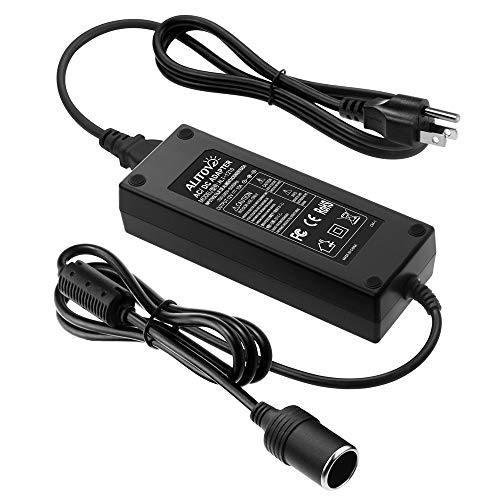
ALITOVE AC to DC Converter 110V to 12V 10A 120W – Best Overall
The ALITOVE is the converter most buyers should get. Ten amps covers the heart of the car-accessory market — the inflators, vacuums, coolers and small fridges its listing names — with headroom above the 5A adapters and without the bulk of a bench supply. It is a plug-and-play brick: wall plug on one end, cigarette-lighter socket on the other, and your car gear works indoors. If your accessory’s label says 10A or less, this is the default answer.
Strengths
- 10A / 120W rating covers most car accessories
- Cigarette-lighter socket matches the plugs car gear already has
- Listing names its target devices honestly: vacuums, inflators, fridges, coolers
Trade-offs
- A device drawing more than 10A will overload it — check labels
- Socket format only; no terminals for hardwired projects
- Single output, so one accessory at a time
| Specification | Detail |
|---|---|
| Input | 110V AC (per listing) |
| Output | 12V DC, 10A, 120W (per listing) |
| Connector | Car cigarette lighter socket |
| Stated uses | Car vacuum, inflator, refrigerator, cooler |
Converters are bought on one number, and 10A is the number that fits the most households. It runs the tire inflator in the garage without starting the car, the car fridge on the patio during a party, the vacuum you prefer for stairs and upholstery. The ALITOVE’s listing is refreshingly specific about its intended devices, which usually signals a maker who understands the category. Its limits are the format’s limits: one socket, one device, and a hard ceiling at its rating. Stay under the ceiling — ideally with a little headroom — and it is the kind of invisible utility purchase you never think about again.
Best for: running typical car accessories from a wall outlet / Not suited for: devices drawing over 10A or hardwired installs
Check the current price on Amazon

Weishuo AC to DC Converter 110V to 12V 15A 180W – Best for High-Draw Accessories
Some accessories — bigger 12V air compressors especially — draw more than 10A, and they are exactly the devices people most want to run from the wall. The Weishuo’s 15A rating exists for them. Its listing leads with car air compressors and refrigerators, the two classic high-draw cases, and states the 15A / 180W ceiling plainly. If your inflator’s label says 12A or 15A, this is your converter; the 10A picks would shut down or overheat doing the same job.
Strengths
- 15A / 180W is the highest lighter-socket rating in this list
- Targets the high-draw devices: compressors and car refrigerators
- Same simple plug-and-play format as the 10A units
Trade-offs
- Overkill and extra cost for light accessories
- Still a single socket — no multi-device use
- Continuous running at the full 15A ceiling is hard on any converter
| Specification | Detail |
|---|---|
| Input | 110V AC (per listing) |
| Output | 12V DC, 15A, 180W (per listing) |
| Connector | Cigarette lighter socket |
| Stated uses | 12V car air compressors and refrigerators |
The 15A class is where converter buying gets serious, because it is where the loads stop being toys. A 12V compressor that draws 14A is a normal product, and feeding it from an undersized converter is the standard way people cook adapters. The Weishuo is specified for that reality. The mature way to use it is with margin: treat 15A as the ceiling for short compressor runs, not a continuous cruise setting, and let the unit cool between long jobs. Bought for the right device, it removes the last reason to idle a car engine just to power its own accessories.
Best for: high-draw 12V compressors and car refrigerators / Not suited for: light accessories that a 5A adapter runs fine
Check the current price on Amazon

AstroAI AC to DC Converter 10A 120W – Best Cord Length and Brand Support
On paper the AstroAI matches the ALITOVE — same 10A class, same socket format, same target devices. The differentiator is reach: the listing states a 7.78-foot cord, which in a real garage is the difference between the converter sitting where the outlet is and sitting where the work is. AstroAI’s presence in the inflator market also matters; this converter is made by a company whose own 12V inflators it will spend its life powering, and the pairing is deliberate.
Strengths
- Stated 7.78 ft cord reaches across real garages and patios
- 10A / 120W covers the mainstream accessory range
- Made by an inflator brand, for inflators and car fridges
Trade-offs
- Same 10A ceiling as the ALITOVE — no extra capacity
- Single socket, one device at a time
- Brand premium over generic 10A bricks
| Specification | Detail |
|---|---|
| Input | 110V AC (per listing) |
| Output | 12V DC, 10A, 120W (per listing) |
| Cord length | 7.78 ft (per listing) |
| Stated uses | Inflator, car refrigerator and other car devices |
Choose between the AstroAI and the ALITOVE on logistics, not specs, because the specs are twins. If your outlet is near your work area, either serves; if your garage outlet is behind storage and your inflator work happens at the driveway end of an extension of patience, the longer cord wins afternoons. There is also a quiet systems argument: a converter from the same brand as your inflator removes one compatibility question from the pairing. Beyond that, this is the same sound 10A formula — respect the ceiling, run one device, and enjoy car gear that works indoors.
Best for: garages where the outlet is far from the work / Not suited for: anyone needing more than 10A
Check the current price on Amazon

Wagan EL9903 AC to DC Power Adapter 5A 60W – Best Certified Small Adapter
The Wagan is for buyers who read certification lines. Its 5A / 60W rating is modest, but the listing states ETL certification, which most of this category’s no-name bricks do not offer, and for a device that sits plugged in powering a fridge for hours, that independent safety listing is a rational thing to pay for. It suits light accessories and smaller portable fridges whose draw fits comfortably under 5A — check the fridge’s label, because larger compressor fridges exceed it.
Strengths
- ETL listed, as stated in the listing — independently safety-tested
- Long-established model from a known power-accessories brand
- Right-sized for light accessories and small portable fridges
Trade-offs
- 5A ceiling excludes compressors and many larger fridges
- Costs more than generic 5A adapters
- Single socket, modest wattage for modern gear
| Specification | Detail |
|---|---|
| Input | 110V AC (per listing) |
| Output | 12V DC, 5A, 60W (per listing) |
| Certification | ETL listed (per listing) |
| Stated use | 12V car portable fridge and accessories |
There are two ways to buy the small end of this category: cheapest brick, or listed product. The Wagan is the listed product, and its decades-long presence in the market is its own kind of evidence. The correct use is light and long — a small fridge ticking over in a garage, a car accessory charging or running gently — where a certified supply running unattended is worth more than extra amps you never draw. The incorrect use is anything with a motor that surges: compressors and big vacuums will humble 5A instantly. Match it to gentle loads and it is the most trustworthy small adapter here.
Best for: light accessories and small fridges, especially unattended use / Not suited for: compressors, vacuums or anything over 5A
Check the current price on Amazon
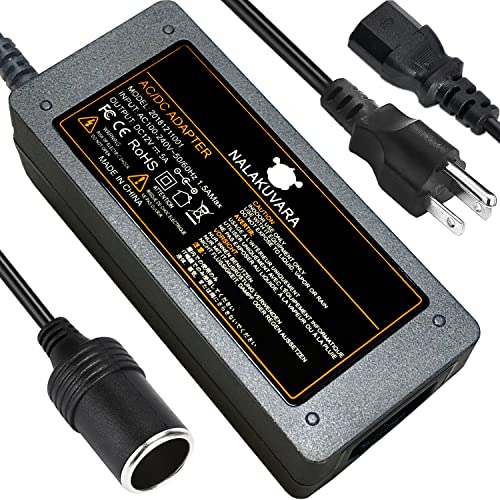
NALAKUVARA AC to DC Converter 110V to 12V 5A 60W – Best Budget Adapter
Not every converter job justifies a premium. If you need to run a low-draw accessory — a small car fan, a light-duty pump, a 12V device whose label reads 3A or 4A — a simple 5A adapter like this one does it at the lowest tier in the list. The listing states the essentials plainly: 110/120V input, 12V output, 5A, 60W, female cigarette-lighter socket. Buy it for a defined light job, not as a general-purpose supply you will later punish with a compressor.
Strengths
- Lowest-cost legitimate entry in this list
- States its 5A / 60W rating plainly in the title
- 110/120V input wording matches household power either way
Trade-offs
- 5A ceiling is firm — motors and compressors need not apply
- No certification stated in the listing
- Generic brand support compared with Wagan or AstroAI
| Specification | Detail |
|---|---|
| Input | 110/120V AC (per listing) |
| Output | 12V DC, 5A, 60W (per listing) |
| Connector | Female cigarette lighter socket |
Budget adapters earn their place when the load is known and small. The failure mode to avoid is mission creep: the adapter bought for a 3A gadget gets borrowed for a 12A inflator ‘just once’, and that is how cheap bricks die and occasionally take a fuse with them. Used inside its rating — with the device’s label checked first — this is a perfectly sensible purchase that frees you from running a car to power its smallest accessories. If your loads are unknown or growing, skip a class and buy the 10A ALITOVE instead; headroom is the cheapest insurance in this category.
Best for: known light loads under 5A on a budget / Not suited for: motors, compressors or unspecified future loads
Check the current price on Amazon

Yaheeda 110V AC to 12V DC Converter 50A 600W – Best Bench Supply for Big Jobs
The Yaheeda is not a bigger version of the other five; it is a different tool. Instead of a cigarette socket, it is a switching power supply with terminal connections, rated at a stated 50A / 600W, aimed at the jobs its listing names: RV systems, pumps, LED strip installations and monitors. If you are powering a fixed 12V system — a workshop bench, an RV’s house loads on shore power, a long LED run — this is the only pick here that belongs in the conversation.
Strengths
- 50A / 600W stated rating dwarfs the socket adapters
- Terminal connections suit permanent and multi-device installs
- Listing names its real jobs: RV, pumps, LED strips, monitors
Trade-offs
- Requires wiring knowledge; not plug-and-play
- No cigarette socket for casual accessory use
- Oversized and inappropriate for a single small accessory
| Specification | Detail |
|---|---|
| Input | 110V AC (per listing) |
| Output | 12V DC, 50A, 600W (per listing) |
| Type | Switching power supply / transformer |
| Stated uses | RV, pump, LED strip, LCD monitor |
Bench supplies like the Yaheeda are bought by people building systems, and judged by different rules: clean terminals, honest continuous rating, and behavior under sustained load. The stated 50A figure should be read the way experienced users read all such supplies — as a ceiling, with continuous cruising done comfortably below it. For an RV owner replacing a tired converter, a hobbyist running pumps, or an installer feeding LED strips from one source, it consolidates what would otherwise be a pile of small adapters. Everyone else should admire it and buy a 10A socket converter, because wiring a bench supply to run one tire inflator is engineering theater.
Best for: RV systems, pumps, LED installs and bench use / Not suited for: casual single-accessory plug-and-play use
Check the current price on Amazon
Comparison Table
The amp column is the whole story: match it to your device’s label, with headroom. Form factor splits the list into socket adapters for portable accessories and one terminal supply for fixed systems.
| Pick | Badge | Key spec | Best for | Amazon |
|---|---|---|---|---|
| ALITOVE AC to DC Converter 110V to 12V 10A 120W | Best Overall | 12V DC, 10A, 120W, lighter socket | running typical car accessories from a wall outlet | Check price |
| Weishuo AC to DC Converter 110V to 12V 15A 180W | Best for High-Draw Accessories | 12V DC, 15A, 180W, lighter socket | high-draw 12V compressors and car refrigerators | Check price |
| AstroAI AC to DC Converter 10A 120W | Best Cord Length and Brand Support | 12V DC, 10A, 120W, 7.78 ft cord | garages where the outlet is far from the work | Check price |
| Wagan EL9903 AC to DC Power Adapter 5A 60W | Best Certified Small Adapter | 12V DC, 5A, 60W, ETL listed | light accessories and small fridges, especially unattended use | Check price |
| NALAKUVARA AC to DC Converter 110V to 12V 5A 60W | Best Budget Adapter | 12V DC, 5A, 60W, budget tier | known light loads under 5A on a budget | Check price |
| Yaheeda 110V AC to 12V DC Converter 50A 600W | Best Bench Supply for Big Jobs | 12V DC, 50A, 600W, terminal bench supply | RV systems, pumps, LED installs and bench use | Check price |
A useful rule emerges from the table: the socket adapters cluster at 5-15A because that is what car accessories draw, and the jump to 50A only happens when the product stops being an adapter and becomes infrastructure. Buy the class your label demands, plus a size of margin.
How to Choose a 110 to 12 Volt Converter
Start at the label of the device you want to power. Every 12V accessory states its current draw in amps, either on the device or in its manual. Your converter’s rating must exceed that number — and for motor-driven devices like compressors and vacuums, which surge at startup, exceed it comfortably. A 10A converter for an 8A inflator is a sane pairing; a 10A converter for a 12A compressor is a shutdown or a cooked brick. This one habit prevents nearly every failure in the category.
Next, choose the form factor honestly. Cigarette-lighter socket adapters are for portable accessories used occasionally: plug in, run the device, unplug, done. A terminal bench supply is for fixed systems that stay wired: RV house power, LED installations, pumps on a bench. Buying a bench supply for occasional accessory use adds wiring work for nothing; buying socket adapters for a permanent install creates a fragile daisy chain. The list above contains both because both buyers exist.
Finally, respect continuous versus peak. Ratings are ceilings. A converter run at its ceiling for hours — a fridge on a hot day is the classic case — lives a harder life than one cruising at half its rating. If your load is continuous, buy a class up. And where a unit will run unattended for long stretches, a stated safety certification like the Wagan’s ETL listing is a legitimate reason to choose it over a marginally cheaper anonymous brick.
Converter vs Inverter: The Direction Test
The fastest way to waste money in power accessories is buying the right device facing the wrong way. A converter, the subject of this guide, steps household AC down to 12V DC: wall power in, car power out. An inverter does the reverse: it takes 12V from a car battery and produces household-style AC for laptops and small appliances. The words sound interchangeable and the products often sit on the same shelf, which is exactly why the confusion persists.
Apply the plug test. If the device you want to run has a cigarette-lighter plug, you need a converter ending in a lighter socket — four of the picks here. If the device you want to run has a household plug and you want to run it from a car, you need an inverter, which is a different product and a different guide. And if you are wiring a permanent 12V system, you need a bench supply with terminals, like the Yaheeda. Naming your plug names your product.
How to Run 12V Car Accessories From a Wall Outlet Safely
The process is simple, and the safety margin comes from two checks done before anything is plugged in. Build this sequence into a habit and a converter becomes invisible infrastructure.
- Read the accessory’s amp draw first: Find the amps on the device label or manual. Motors surge at startup, so the running figure is the floor of what your converter must handle, not the ceiling.
- Match or exceed it with the converter: Choose a converter rated above the draw — ideally with a third to spare for continuous loads like fridges. Never pair a device to a converter rated below it.
- Connect the accessory before switching on: Seat the lighter plug fully in the converter’s socket, then plug the converter into the wall. A fully seated plug avoids the arcing and heat of a half-contact connection.
- Keep the converter ventilated: Set it on a hard surface with air around it, not under cushions or in a closed box. Converters shed heat in proportion to the load you ask of them.
- Watch the first run: Stay nearby the first time any pairing runs. Warm is normal; hot, smelly or cycling on and off means the load exceeds the supply — stop and size up.
- Unplug in reverse order: Wall first, then the accessory. Coil cords loosely and store the converter dry; these bricks live for years when they are not cooked or soaked.
Followed honestly, this routine makes the converter the most boring purchase in your garage — which is the highest praise power equipment can earn. The excitement in this category is always a sizing mistake announcing itself, and the label check is what keeps your setup boring.
The Loads Nobody Thinks Of: A Field Guide to Real Amp Draws
The converter decision lives or dies on amp draws, so it is worth walking the actual landscape of 12V devices and their appetites, because intuition misjudges them badly. At the gentle end sit the small electronics-adjacent loads: 12V fans, LED lighting, phone and tablet charging through car adapters, and small thermoelectric coolers idling along. These live comfortably in the 2-5A world, which is why 5A adapters like the Wagan and NALAKUVARA exist and why they are entirely sufficient for a large class of real uses. The mistake is assuming everything with a lighter plug lives in this gentle world. It does not.
The middle band — roughly 8 to 12 amps — is where the useful machinery lives. Car vacuum cleaners with real suction, mid-size tire inflators, and heated blankets and seat covers all draw here, and they draw hardest at startup, when a motor’s first spin pulls a surge well above its running figure. This is the band the 10A converters serve, and it is why the reviews advise headroom: a 10A converter feeding a vacuum that surges to 11A on startup will protect itself by shutting down, which owners misread as a defective converter when it is actually an honest one.
The heavy end belongs to compressors and compressor fridges. Larger 12V air compressors — the kind that fill truck tires — commonly draw 12 to 15 amps, and a compressor fridge’s startup surge can briefly double its modest running draw. These are the loads the 15A Weishuo exists for, and they are the loads that humble undersized adapters in garages every weekend. Beyond them, the landscape changes character entirely: pumps, RV house systems and LED installations are not accessories but infrastructure, and they belong on the 50A bench supply’s terminals. Read your device’s label, find its band in this landscape, and the correct converter has effectively chosen itself.
Running a Converter for Hours: Fridges, Heat and Patience
Short jobs forgive almost anything; long jobs audit everything. The defining long job in this category is the portable fridge — at a campsite with hookups, in a garage during a party, in a workshop keeping drinks cold — and running one for hours exposes the three things that matter about a converter beyond its headline rating. The first is thermal behavior. A converter working at half its rating sheds its heat easily and runs for days; the same converter at ninety percent of its rating on a hot afternoon is cooking itself slowly, even if it never quite shuts down. This is the practical argument for buying a class up for continuous loads: not capacity you use, but coolness you live with.
The second is placement. A converter buried under luggage in a closed trunk or tucked behind a fridge against a wall cannot breathe, and its lifespan shortens in proportion. Set it on a hard surface with open air around it, keep its vents unblocked, and route its cords so nothing presses on the housing. These sound like fussy instructions until you price the alternative, which is a converter that dies during the hottest weekend of the year, taking the fridge’s contents with it.
The third is the load’s own rhythm. Compressor fridges cycle: a startup surge, a running draw, then rest. A converter sized to the running figure alone will trip on the surges; sized to the surge with margin, it cruises through the cycles indefinitely. This is why the reviews keep repeating the same unglamorous sentence in different forms — read the label, buy headroom, ventilate the unit. In a category with no moving parts and no glamour, those three habits are the entire difference between infrastructure and junk.
Which Converter for Which Job
If your job is the classic one — run the tire inflator, the car vacuum and the cooler from the garage outlet — buy the ALITOVE 10A, or the AstroAI 10A if your outlet sits far from where the work happens. These two are the category’s center of gravity, and the choice between them is a tape-measure decision about cord reach, not a specification debate. Everything else in this guide exists for jobs at the edges of theirs.
If your job involves a compressor-style inflator or a compressor fridge — the loads whose labels read 12A, 14A, 15A — skip the 10A class without a second thought and buy the Weishuo 15A. Undersizing here does not produce slightly worse performance; it produces shutdowns, heat and a dead adapter, usually during the job that mattered. Read the label, respect the label, and let the 15A unit’s headroom do its quiet work.
If your job is gentle and long — a small fridge ticking over for days, a fan, lights, a low-draw accessory that must simply never be interrupted — the Wagan is the pick, and its ETL listing is the reason. For unattended hours, independently certified safety is a feature worth more than amps you will never draw. The NALAKUVARA serves the same gentle band when the load is known, small and supervised, and the budget is the loudest voice in the room.
If your job has terminals — an RV’s house system on shore power, a pump on a bench, a wall of LED strips, several devices on one honest supply — you are not buying an adapter at all, and the Yaheeda 50A is your only correct stop on this list. Buy it, wire it properly, fuse it sensibly, and enjoy infrastructure instead of a pile of bricks. The most expensive converter mistake is not buying the wrong brand; it is buying the wrong species.
Wiring and Accessories for a Converter Setup Done Right
A converter is a simple device, but three accessories separate a tidy installation from a drawer of regrets. The first is an inline fuse or a fused lighter plug for any semi-permanent setup. The converter’s own protection guards the converter; a fuse sized to your device’s draw guards the device and the wiring between them. For the bench supply’s terminal connections, fusing each major branch is the practice that turns a hobbyist hookup into an installation an electrician would nod at.
The second accessory is honest cable. Voltage drop is the silent tax on 12V systems: thin wire over a long run delivers eleven volts where twelve were promised, and motors run weakly and hot in protest. If your converter must sit far from its device — or your bench supply feeds a load across the workshop — step the wire gauge up rather than asking the device to forgive the drop. This matters most for the Yaheeda’s world of pumps and LED runs, where distance is the design condition.
The third is labeling. A converter installation accumulates mystery over time: which brick feeds the fridge, which terminal pair feeds the lights, what the ratings are. A label maker or a strip of tape and a marker, applied on installation day, converts future troubleshooting from archaeology into reading. It is the cheapest accessory in this guide and the one whose absence is cursed most often, usually in the dark, usually by flashlight, usually by the same person who skipped it.
Common Buying Mistakes
Buying an inverter when you need a converter
The classic. An inverter turns car power into household power; it cannot run your 12V inflator from a wall. Check the direction in the title — 110V to 12V — before anything else, because search results mix both freely.
Sizing the converter to the exact amp draw
A converter rated exactly at the device’s draw has no room for motor startup surges or hot-day fridge loads. The result is shutdowns, overheating or a short life. Always buy headroom.
Running a compressor from a 5A adapter
Compressors are among the hungriest 12V accessories, commonly drawing 10-15A. A 5A adapter will not ‘probably manage’ — it will overheat or fail. Match the class to the device, as the reviews above map out.
Daisy-chaining splitters on one socket
A lighter-socket splitter does not add capacity; it divides a fixed rating among more plugs and invites the total to exceed it. One converter, one substantial device, unless the math of every draw is known and small.
Ignoring certification for unattended loads
A converter powering a fridge overnight is infrastructure, not a gadget. For long unattended runs, a stated safety listing is worth choosing deliberately, and ventilation is not optional.
Final Recommendation
Most buyers should buy the ALITOVE 10A: it covers the mainstream accessory range in a simple, fairly priced package, with the AstroAI as the twin to choose when cord reach matters. Step up to the Weishuo 15A if your compressor or fridge draws past 10A — that single label check decides between the two. At the small end, the Wagan is the certified choice for gentle, long-running loads and the NALAKUVARA the budget choice for known light ones.
The Yaheeda stands apart for builders of actual 12V systems, and it should stay apart — it is infrastructure, not an adapter. Whichever class you land in, the discipline is the same: read the device label, buy headroom, ventilate the unit. Do that, and a wall outlet becomes a power source for every 12V tool you own.
Keep exploring the same cluster before you decide: Best 110 And 120 Volt Tire Inflators Best 110 Volt Automobile Air Compressor Tire Pump Best 110 Volt Air Pumps Best 110 220 Volt Wifi Extevder Dual Band Best 110 Volt Spa
Frequently Asked Questions
What size converter do I need for a 12V tire inflator?
Check the inflator’s label. Most portable inflators draw between 10A and 15A, so a 15A converter is the safe universal choice, while a 10A converter suits inflators rated at or below 10A. Never run an inflator from a 5A adapter; the motor draw will overwhelm it.
Can I run a 12V car fridge from a wall outlet?
Yes, with a converter rated above the fridge’s draw. Small thermoelectric coolers often fit under 5A, while compressor fridges can draw more, especially at startup. Check the label, choose the class above it, and give the converter ventilation for long runs.
What is the difference between a converter and an inverter?
A converter steps household AC down to 12V DC, running car accessories from a wall. An inverter does the opposite, making household-style AC from a 12V battery. They are not interchangeable; the plug test decides — a cigarette-lighter plug needs a converter.
Why does my converter get warm or shut down?
Warmth under load is normal; shutdowns or excessive heat mean the device is drawing at or beyond the converter’s rating, or the converter lacks ventilation. Check the amp math, give it air, and size up a class if the pairing is marginal.
Can one converter run several 12V devices at once?
Only if the combined draw stays comfortably under the rating, which is rarely true once a motor is involved. Socket converters are best treated as one-device supplies. For several fixed devices, a terminal bench supply like the 50A pick is the correct architecture.
Is a higher-wattage converter always better?
No. Watts here are just volts times amps, so a higher figure only means a higher amp ceiling. Capacity you never use adds cost and bulk. The right converter is the one rated above your device’s draw with sensible headroom — no more, no less.
Can a converter damage my 12V device?
A correctly matched converter cannot: it supplies the 12V DC the device was designed for, up to its amp rating. Damage enters through mismatch — a device whose startup surge repeatedly slams an undersized converter can suffer undervoltage behavior, and a faulty no-name supply is a risk in any category. The protections are the ones this guide repeats: buy headroom, prefer listed products for long runs, and retire any converter that runs excessively hot or cycles erratically.
Why does my converter’s fan or hum change with the load?
That is normal behavior. Converters work harder as the load rises — switching supplies adjust their effort, cooling fans respond to temperature, and a faint hum under load is the sound of magnetics doing their job. What should concern you is a sudden change: new smells, visible heat discoloration, or a device that begins cycling on and off under a load it previously handled. Those are retirement signals, not quirks.
Can I charge a 12V battery with one of these converters?
No — and the distinction matters. These converters supply 12V DC power to run devices; a battery charger is a different device that manages voltage and current through charging stages to refill a battery safely. Feeding a battery from a plain converter risks overcharging and damage. If your goal is maintaining a car or RV battery from household power, buy a proper battery charger or maintainer, which is a separate and inexpensive category.


