Disclosure: airfryerkitchensupply.com is reader-supported. When you buy through links on our site, we may earn an affiliate commission at no extra cost to you.
Where to buy
Every pick below was checked against Amazon’s own catalogue data before this guide was written, and each linked model is sold through Amazon. Start with the shortlist for the best chopsticks for sushi:
- Antner Natural Bamboo Chopsticks (5 Pairs, 8.8 in) — Best Overall. Check the current price on Amazon before you buy, because listings change.
- MFJUNS Japanese Minimalist Wooden Chopsticks (5 Pairs, 8.8 in) — Best Wooden Set. Check the current price on Amazon before you buy, because listings change.
- Albino Monkey Disposable Bamboo Chopsticks (100 Pairs) — Best for Parties. Check the current price on Amazon before you buy, because listings change.
- Antner Handmade Japanese Wooden Chopsticks Gift Set (5 Pairs) — Best Gift Set. Check the current price on Amazon before you buy, because listings change.
- Japanese Hand-Carved Chopsticks, Blood Wood (1 Pair) — Best Premium Single Pair. Check the current price on Amazon before you buy, because listings change.
- Wooden Japanese Chopsticks with Ceramic Panda Holders (2 Pairs) — Best for Couples and Gifts. Check the current price on Amazon before you buy, because listings change.
The best chopsticks for sushi are almost the opposite of the best for ramen. Sushi is a precision task performed cold: individual pieces, delicate structure, a brief pass through soy sauce, and no broth, no steam and no heavy lifting. The tools that excel are shorter, finer-tipped and more agile, the Japanese dining format, because the job is placement rather than hauling.
That changes the material maths too. Wood and bamboo come into their own at the sushi table: warm in the hand, quiet on ceramic, grippy enough for a piece of nigiri without crushing it. Fiberglass still has a case for households that want one dishwasher-proof set for everything, and a good disposable bamboo pair remains the honest answer for a crowd. The six verified picks below span that whole range, from an everyday bamboo set to a hand-carved single pair made in Japan, so the sushi household can choose its level of ceremony.
A second framing point: sushi households often already own chopsticks, bought for noodles, and wonder whether a dedicated sushi pair is an indulgence. The honest answer is that length is destiny here. A 10.5-inch noodle pair at a sushi platter is a crane at a jewellery bench, usable and wrong. The dedicated short pair is one of the cheapest genuine upgrades in home Japanese cooking, and this guide’s everyday picks are priced like the utility they are.
In this guide
Quick Picks
- Best Overall: Antner Natural Bamboo Chopsticks (5 Pairs, 8.8 in) — the classic Japanese-length bamboo set: fine control for nigiri and maki, natural grip, and a five-pair count for the household sushi night.
- Best Wooden Set: MFJUNS Japanese Minimalist Wooden Chopsticks (5 Pairs, 8.8 in) — a minimalist Japanese wooden set in mixed natural woods with carved pointed tips, made for sushi precision and a calm table.
- Best for Parties: Albino Monkey Disposable Bamboo Chopsticks (100 Pairs) — a hundred pairs of splinter-free disposable bamboo chopsticks made for sushi service, for parties, platters and zero washing up.
- Best Gift Set: Antner Handmade Japanese Wooden Chopsticks Gift Set (5 Pairs) — handmade Japanese wooden chopsticks in a gift box, the presentable face of the sushi table, for hosts and gift-givers.
- Best Premium Single Pair: Japanese Hand-Carved Chopsticks, Blood Wood (1 Pair) — a single hand-carved pair in blood wood, made in Japan, for the sushi devotee who wants one perfect personal instrument.
- Best for Couples and Gifts: Wooden Japanese Chopsticks with Ceramic Panda Holders (2 Pairs) — two wooden pairs with ceramic panda chopstick rests in a gift box, a sushi-for-two set with the rests most sets forget.
How These Picks Were Chosen
Every pick was verified against Amazon’s catalogue data for this site before writing: the brand, material, length, pair count and care claims in each review come from the manufacturer’s own listing, not from roundups or guesswork. Where a listing states a heat resistance or a dishwasher claim, we report it as stated; where it does not, the review says nothing rather than inventing a number.
Selection filtered for the job named in the search first and general quality second. Length was matched to the food, tip texture was matched to how slippery that food is, and material was matched to the heat and washing routine involved. Sets that duplicated another pick’s exact role were cut, so the six slots cover genuinely different ways to solve the same meal.
We also weighted the unglamorous arithmetic of sets: how many pairs arrive, whether the count matches the household the pick claims to serve, and whether the set’s role, dining, cooking or bulk reserve, stays honest. A ten-pair set that cannot survive a dishwasher is a worse family pick than a five-pair set that can, and the reviews score that reality rather than the headline count.
Ramen-specific weighting deserves a sentence of its own: in this category we scored heat behaviour and broth behaviour ahead of appearance, because a pair lives its whole service life in steam and soup. A beautiful pair that warms uncomfortably in the hand, stains in miso or slips when coated fails the ramen test regardless of its table manners elsewhere, and the reviews say so where it applies.
Sushi weighting ran opposite to the ramen guide’s: here we scored tip finesse, hand feel and table quietness ahead of heat tolerance, because nothing at a sushi table is hot, deep or heavy. A pair that would triumph over a steaming bowl can be merely adequate over a platter of nigiri, and the reviews judge each pick by sushi’s own examination, which is placement under delicacy.
Stage accuracy was the first filter in this category, ahead of design appeal. Each pick was classified by the assistance it actually provides, alignment, guidance or transition, and several charming products were cut because their assistance was decorative rather than mechanical. A trainer that does not change the physics of the child’s attempt is a toy shaped like a lesson, and the reviews below only include tools that change the physics.
Within the style, selection weighted the working properties of the northern table: length for communal reach, profiles that do not roll, materials that tolerate broth and shared service, and pair counts matched to how this cuisine is actually eaten, which is together. Decorative sets that could not work a hotpot or survive a festival table were excluded, however handsome their photographs.
The 6 Best Chopsticks for Sushi
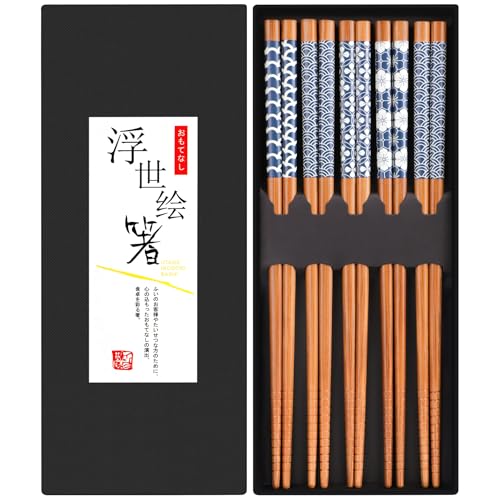
Antner Natural Bamboo Chopsticks (5 Pairs, 8.8 in) — Best Overall
Antner’s bamboo set is the sushi default for a reason. At 8.8 inches it is true Japanese dining length, short enough for fingertip-level control over individual pieces, and bamboo’s natural surface holds a piece of nigiri securely without the death-grip that splits it. Five pairs cover a family sushi night, and the classic styling suits the food.
Strengths
- Japanese 8.8-inch length gives the fine, close control sushi placement demands
- Bamboo’s gentle friction grips rice and fish without crushing delicate pieces
- Light, quiet and warm in the hand, the material sushi was designed around
Trade-offs
- Bamboo wants hand washing for longevity, whatever the listing tolerates
- Too short and light for noodle pots or deep ramen bowls; this is a specialist dining pair
- Natural bamboo will eventually show tip wear and need replacing
| Material | Bamboo |
| Length | 8.8 in / 22.5 cm |
| Pairs | 5 |
| Style | Japanese |
Sushi eating is closer to handling jewellery than to shovelling: each piece is placed, turned, dipped and delivered intact. A short bamboo pair becomes an extension of the fingers in a way a long fiberglass pair never quite does, and the margin shows in the pieces that arrive whole. For households whose Asian cooking centres on sushi and Japanese dishes, this is the set that will be reached for nightly.
Buy it knowing bamboo’s contract: prompt washing, thorough drying, replacement when the tips tire. Within that contract, it is the most sushi-appropriate material in this guide at the most sushi-appropriate length.
The Antner set also travels well between roles at a Japanese table: the same pair that serves nigiri handles miso soup accompaniments, pickles and small shared dishes with the same close control. Households building one Japanese drawer rather than a specialist collection will find this set quietly becoming the default for the whole cuisine, which is the highest compliment a five-pair bamboo set can earn.
Best for: households whose table centres on sushi and Japanese dishes / Not suited for: one-set-for-everything buyers; ramen and noodle work want longer, tougher pairs
Check on Amazon — check price on Amazon for the current listing.
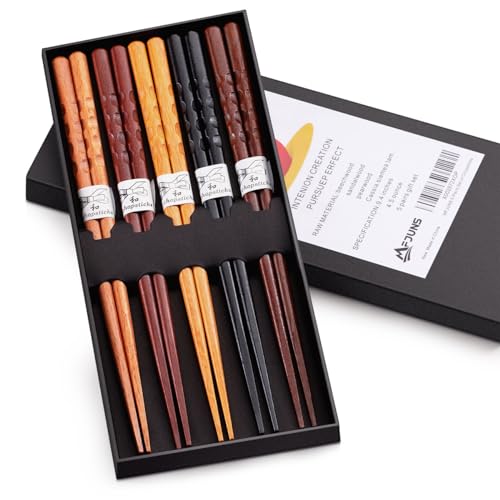
MFJUNS Japanese Minimalist Wooden Chopsticks (5 Pairs, 8.8 in) — Best Wooden Set
MFJUNS builds this set from natural woods, the listing names beech, ironwood, sandalwood and pear among them, with carved vein detailing and pointed non-slip tips. It is the wooden upgrade path from bamboo: denser, smoother, more formal, and shaped specifically with sushi, noodles and rice dishes in mind.
Strengths
- Pointed tips give the finest placement control in this guide for individual sushi pieces
- Natural hardwood density feels substantial and balanced compared with featherweight bamboo
- Minimalist Japanese styling suits a deliberate, uncluttered table
Trade-offs
- Hardwood sets ask for hand washing and drying to protect the finish
- Pointed tips are a precision tool; heavy-handed beginners can spear and split pieces while learning
- Wood selection varies by set, so colour and grain are part of the purchase’s natural variation
| Material | Natural woods |
| Length | 8.8 in |
| Pairs | 5 |
| Tips | Pointed, non-slip |
The pointed tip is the sushi specialist’s instrument: it separates a piece from its neighbours on a shared platter without disturbing them, turns a piece for the soy dip with a flick, and handles garnishes and roe with tweezers-like manners. In a wooden shaft with real density, that precision feels calm rather than fiddly.
This is the set for the household that has graduated from ‘we eat sushi’ to ‘we present sushi’. It rewards the cook who plates at home and the eater who notices tools, while remaining a fully practical daily pair.
Wood care for this set is the standard natural-material minute: wash by hand after the meal, dry tips-up, and store with air around it. Hardwood rewards the routine with a surface that improves slightly with handling, the oils of use polishing what the maker started. Few tools in a kitchen age in the user’s favour; a wooden set kept properly is one of them.
Best for: home sushi makers who plate and present, and wooden-tool loyalists / Not suited for: dishwasher-only households and very young eaters
Check on Amazon — check price on Amazon for the current listing.

Albino Monkey Disposable Bamboo Chopsticks (100 Pairs) — Best for Parties
Every sushi household eventually faces the crowd problem: twenty guests, a platter programme, and four good pairs in the drawer. Albino Monkey’s disposable bamboo, from a Japanese-owned factory, hand-packed and splinter-free per the listing, is the professional answer restaurants themselves use: a fresh, hygienic pair for every guest and compostable bamboo afterwards.
Strengths
- One hundred pairs end the guest-count problem for sushi parties and gatherings
- Splinter-free finishing avoids the splinter roulette of the cheapest disposable sticks
- Bamboo is compostable, a cleaner end-of-life than plastic disposables
Trade-offs
- Disposable by design, so it is the wrong purchase for daily eco-conscious use
- Single-use pairs lack the weight and finish of any reusable pick here
- Round disposable profile is less precise than a shaped reusable pair
| Material | Bamboo, disposable |
| Pairs | 100 |
| Profile | Round |
| End of life | Compostable |
Judge disposables by their job: hygiene at scale and zero logistics. For a sushi party, a fresh pair per guest is not wastefulness, it is how the food is properly served, and bamboo disposables do it without plastic guilt. The splinter-free, hand-packed positioning matters more than it sounds; the difference between a good and bad disposable pair is felt at the lips, once, and remembered.
Keep a pack for gatherings, platters taken to other homes, and lunch service for a crowd, and keep reusables for daily life. Used in its place, this is one of the most sensible purchases in the guide.
Hosts should note the etiquette dividend of disposables done well: a fresh pair per guest is the restaurant standard precisely because it removes every hygiene question from the table, letting the food carry the evening. Keep the pack sealed and dry in a cupboard, and it will wait patiently for the two or three occasions a year when nothing else will do the job as cleanly.
Best for: hosts, party platters and anyone serving sushi to a crowd / Not suited for: daily eaters; reusables are cheaper and better over any month of use
Check on Amazon — check price on Amazon for the current listing.

Antner Handmade Japanese Wooden Chopsticks Gift Set (5 Pairs) — Best Gift Set
Where the MFJUNS set is minimalist, this Antner set is ceremonial: handmade wooden pairs presented in a box, built to be given and to be brought out when the sushi is homemade and the guests matter. The wooden construction keeps all the sushi virtues, warmth, grip, quietness, in a set whose presentation matches a good bottle of sake as a host gift.
Strengths
- Gift-box presentation makes it a complete present with no wrapping decisions left
- Handmade wooden pairs carry the warmth and grip sushi rewards
- Five pairs equip a small dinner party in matched style
Trade-offs
- Ceremonial sets still need hand washing; the box does not change wood care
- As a gift, sizing and style are the giver’s guess about another household’s taste
- Not the set to send to school lunches or lose in a desk drawer
| Material | Wood, handmade |
| Pairs | 5 |
| Presentation | Gift box |
| Style | Japanese |
Chopsticks are a traditional gift in Japanese culture, carrying wishes for longevity and partnership, and a boxed handmade set leans into that meaning properly. For the sushi-loving household on your gift list, this lands with more thought than another bottle, and it gets used weekly rather than shelved.
At your own table, a matched boxed set changes the register of a home sushi night from takeaway-with-better-fish to an occasion. Tools set tone; this set’s tone is care.
A boxed set also solves the storage problem that loose pairs never do: it returns to its box, rests and all accounted for, instead of migrating through the cutlery drawer into single exile. Anyone who has played chopstick-pair matching across a drawer of orphans understands that the box is not packaging; it is the set’s long-term survival system.
Best for: gift-givers and hosts who want a presentable matched set / Not suited for: buyers equipping a high-turnover family drawer; the bamboo workhorse above is that tool
Check on Amazon — check price on Amazon for the current listing.

Japanese Hand-Carved Chopsticks, Blood Wood (1 Pair) — Best Premium Single Pair
This is the connoisseur’s slot: one pair, hand-carved from blood wood, a dense reddish hardwood, made in Japan at 23.5 centimetres. A personal pair is a real tradition, your own chopsticks, kept for your place at the table, and at sushi’s precision end of eating, a perfectly balanced personal pair is a genuine pleasure rather than an affectation.
Strengths
- Hand-carved in Japan from dense blood wood, with the weight and finish machine production does not reach
- A personal pair builds the familiarity that makes delicate sushi handling second nature
- The wood’s natural colour is the decoration; no lacquer theatrics needed
Trade-offs
- One pair only, at a premium tier: this is an instrument purchase, not household equipment
- Premium wood demands hand washing, drying and occasional rest from daily service
- At 9.25 inches it runs slightly long for strict Japanese sushi length, suiting larger hands
| Material | Blood wood |
| Length | 23.5 cm / 9.25 in |
| Pairs | 1 |
| Origin | Made in Japan |
There is a level of sushi enthusiasm at which the meal is a practice, and tools become personal. A hand-carved pair in a serious hardwood gives feedback through the fingers that no moulded pair can: the exact moment a piece is secure, the exact pressure before rice yields. Eaters at that level do not need this paragraph to convince them; eaters not at that level should buy the Antner bamboo and spend the difference on fish.
That honesty is the review: this is the best premium single pair in the guide and the correct purchase for a small, specific audience. If that audience is you, nothing else here substitutes.
Caring for a pair at this level is a small ritual of its own: rinse, wipe, dry, and return it to its rest or case rather than the common drawer. The blood wood will hold its polish for years under that regime and will outlast several generations of everyday sets, which is the economic form of the connoisseur argument, one perfect tool, kept, instead of a procession of adequate ones.
Best for: dedicated sushi enthusiasts wanting a personal, heirloom-grade pair / Not suited for: household equipping; one pair feeds one person beautifully and everyone else not at all
Check on Amazon — check price on Amazon for the current listing.

Wooden Japanese Chopsticks with Ceramic Panda Holders (2 Pairs) — Best for Couples and Gifts
This set understands something the others miss: a sushi place setting includes a rest, and rests are the item nobody owns. Two 9-inch wooden pairs arrive with two ceramic panda holders in a gift box, which makes it the complete sushi-for-two kit and an unusually charming present for couples who cook Japanese at home.
Strengths
- Included ceramic rests complete the place setting, the accessory every other set omits
- Textured pointed tips handle sushi pieces with proper control
- Gift-boxed two-pair format is sized exactly for couples and small households
Trade-offs
- Two pairs only; this is a set for two people, not a family drawer
- Ceramic rests are breakable and need a home in the cupboard between uses
- The panda motif is delightful or deal-breaking depending on the recipient’s taste
| Material | Wood; rests ceramic |
| Length | 9 in |
| Pairs | 2 |
| Includes | 2 ceramic panda rests, gift box |
Rests matter more than their size suggests. A pair laid on the table picks up the table; a pair laid across the bowl drips; a pair on a rest stays clean, composed and ready, which is the entire aesthetic of a sushi setting in one small object. Bundling them with the pairs themselves is simply good product thinking.
As a gift, it solves the couple problem, two of everything, presented, themed, complete, at a tier that feels generous without being extravagant. As a home purchase, it is the fastest route to a sushi table that looks like someone meant it.
The rests deserve a final word as a standalone lesson: once a household owns rests, every pair it owns gets used with them, and the whole table’s hygiene and composure improve for the price of two small ceramics. If this set’s pairs duplicate what you own, the rests alone justify its place in a sushi household’s cupboard, which is an unusual thing to say about the accessory in any category.
Best for: couples building a sushi-at-home ritual and gift-givers / Not suited for: families needing depth; add a five-pair set alongside
Check on Amazon — check price on Amazon for the current listing.
Comparison Table
| Pick | Badge | Key spec | Best for |
|---|---|---|---|
| Antner Natural Bamboo Chopsticks (5 Pairs, 8.8 in) | Best Overall | Bamboo, 5 pairs, 8.8 in / 22.5 cm, Japanese style, dishwasher safe (stated) | households whose table centres on sushi and Japanese dishes |
| MFJUNS Japanese Minimalist Wooden Chopsticks (5 Pairs, 8.8 in) | Best Wooden Set | Natural woods, 5 pairs, 8.8 in, pointed non-slip tips | home sushi makers who plate and present, and wooden-tool loyalists |
| Albino Monkey Disposable Bamboo Chopsticks (100 Pairs) | Best for Parties | Disposable bamboo, 100 pairs, round profile, splinter-free, compostable | hosts, party platters and anyone serving sushi to a crowd |
| Antner Handmade Japanese Wooden Chopsticks Gift Set (5 Pairs) | Best Gift Set | Wood, 5 pairs, handmade, gift box | gift-givers and hosts who want a presentable matched set |
| Japanese Hand-Carved Chopsticks, Blood Wood (1 Pair) | Best Premium Single Pair | Blood wood, 1 pair, 23.5 cm / 9.25 in, hand-carved, made in Japan | dedicated sushi enthusiasts wanting a personal, heirloom-grade pair |
| Wooden Japanese Chopsticks with Ceramic Panda Holders (2 Pairs) | Best for Couples and Gifts | Wood, 2 pairs, 9 in, ceramic panda rests included, gift box | couples building a sushi-at-home ritual and gift-givers |
How to Choose Chopsticks for Sushi
Length runs shorter than for any other food in this series: 8.5 to 9.25 inches is the sushi window. The work is close and precise, turning a piece for the dip, separating neighbours on a platter, placing garnish, and a shorter lever gives finer control, exactly as a shorter brush gives a painter finer lines. If your household also eats noodles nightly, own two lengths rather than compromising either food.
Tips should taper to a genuine point. A pointed tip handles roe, picks up a single edamame, and slides under a piece of nigiri without tearing the rice bed. Blunt, thick tips, fine for noodle hauling, are clumsy here. Inspect listing photos for the taper; the picks above were chosen partly on this evidence.
Material is about touch. Wood and bamboo are warm, light and quiet, and their slight surface tooth holds fish without pressure. Fiberglass is the practical modern alternative for dishwasher households, at a small cost in feel. Lacquered finishes look formal and can be slippery on fish; natural or lightly finished wood is the working choice. Whatever you choose, avoid metal at the sushi table unless your technique is advanced: it is loud on ceramic, cold in the hand and the hardest surface to keep gentle on rice.
Sushi Etiquette That Affects What You Buy
A few customs shape the equipment list. Chopsticks are rested on a rest, not laid across bowls or stuck upright in rice, which is why the panda-rest set exists in this guide and why a set of simple rests is the best accessory purchase a sushi household can make. Passing food from your chopsticks to another person’s is avoided; serve from the platter with the pair reversed or with serving chopsticks, which is one more reason hosts keep a spare clean pair at the table.
Soy sauce technique matters to the fish, not the tools, but it is worth stating in a buying guide because it is the moment pieces die: dip fish-side, lightly, never soak the rice, which disintegrates it and floods the dish. A precise pair, pointed and balanced, makes that light touch physically easier, which is the practical link between etiquette and equipment.
Finally, personal pairs are a genuine tradition, not a marketing invention. Households that eat sushi weekly often keep a named pair per person, washed and returned to its rest. The premium single pair in this guide serves exactly that custom, and the habit, knowing your own tool’s balance, measurably improves handling over time.
Building a Sushi Night Kit Beyond the Pair
The pair is the headline, but a home sushi night runs on a small kit: a rest per setting, a shallow soy dish per setting, a serving pair for the platter, and a spare pair for the dropped and the doubled. Most households assemble this kit accidentally over years; buying it deliberately, guided by the sets in this article, costs little and ends the improvisations, the pair laid across a bowl, the shared dish entered by four personal pairs, that quietly lower a good meal.
Fish quality will always dominate the evening, and no chopstick rescues poor fish. But presentation and handling are the parts of sushi entirely within the home cook’s control, and they are exactly the parts the right short pair, rested properly and used with a cradling grip, improves. Spend on fish first and tools second; just do not skip the tools and wonder why the meal feels like takeaway at home.
Lacquer, Natural Wood and Fiberglass at the Sushi Table
Lacquered pairs are the formal face of Japanese chopsticks, glossy and coloured, and they photograph beautifully. In service, lacquer is smooth, which on fish means slippery, and it chips at the tips with dishwasher or rough use, after which the pair looks tired at exactly the point the eye visits. For ceremony a lacquered set has its place; for weekly sushi, natural wood and bamboo out-serve it.
Fiberglass is the modern guest at this table: unbeautiful to traditionalists, unbeatable on care, and entirely adequate in a fine-tapered short format. The honest hierarchy for sushi is feel first, wood and bamboo, practicality second, fiberglass, ceremony third, lacquer, and a household should know which of the three it is buying before it judges any individual set.
Reading a Sushi Listing Like a Buyer, Not a Guest
Sushi chopstick listings lean on atmosphere, so interrogate them for the working facts: length in a number, material by name, tip shape described or clearly photographed, pair count, and care instructions the seller is willing to commit to. Handmade claims should come with a maker’s name or at least a coherent story; ‘made in Japan’ claims appear in this guide only where the listing itself states them. The picks here passed that interrogation against their manufacturers’ own text.
Price tiers in this category map to labour more than materials: machine bamboo at the base, finished hardwood in the middle, hand-carved single pairs at the top. None of the tiers is a scam and none is a shortcut; they are different amounts of human time in the object, and the buyer who understands that chooses a tier deliberately instead of drifting into one.
The Home Sushi Board: Plating With the Right Pair
Home sushi lives or dies on plating, because the fish available to a home cook is good but the presentation is what separates a sushi night from fish on rice. The pair is the plating tool: pieces are placed, spaced and aligned with the tips, garnish is distributed a pinch at a time, and a stray piece is rescued without fingers ever entering the board. A fine pointed pair, like the wooden picks in this guide, is effectively the tweezers of the sushi board, and cooks who plate seriously feel the difference in the first service.
Work cold and clean: a damp cloth beside the board for wiping tips between fish types, so flavours do not carry and rice does not accumulate on the points. Rice build-up is the silent precision killer at a home board, dulling the tip’s feel within a dozen pieces; the cloth ritual, borrowed from professional counters, restores it in a second and is worth more than any single product in this article.
Serve on the board or a platter with the pieces in loose order of richness, lean fish first, and place a fresh pair and rest at each setting before the first piece lands. That sequence, tools ready before food arrives, is the whole philosophy of the sushi table in miniature, and it costs nothing but forethought.
Rice: The Ingredient Your Chopsticks Actually Handle
Sushi technique is mostly rice technique. The fish is cut by a knife, but every subsequent act, portioning, placing, turning, dipping, delivering, is done to a small bed of seasoned rice that holds together by surface tension and optimism. Understanding that fragility explains every recommendation in this guide: the cradling grip, the pointed-but-gentle tips, the ban on top pressure, the one-bite rule. The chopstick is not moving a solid object; it is escorting a temporary structure, and the tools that respect that arrive with whole pieces.
Rice also explains the damp-cloth ritual and the preference for natural materials at the board. Seasoned rice sticks to dry synthetic tips more readily than to wood, and a tip filmed with rice starch loses the fine feel that placement depends on. Wood and bamboo, wiped on the cloth between pieces, keep their touch the longest, which is a practical reason, beneath all the tradition, that professional sushi counters are wooden-tool environments.
For the home cook, the lesson scales down gracefully: handle pieces as few times as possible, decide the placement before the lift, and let the pair be an extension of a decision already made. Hesitation is what breaks nigiri, far more often than grip. A good short pair rewards decisiveness by doing exactly what the hand intended, and that feedback loop, intention executed cleanly, is the quiet pleasure that keeps people making sushi at home.
How to Handle Sushi With Chopsticks Without Breaking a Piece
Every broken piece of nigiri is a technique problem with a known fix. Work through these habits and the failure rate collapses.
- Pick the piece up from the sides, cradling rather than pinching: pressure belongs on the fish and the rice’s flanks equally, never a hard squeeze from above.
- For the soy dip, turn the piece fish-down with a gentle roll of the wrist and touch the fish only, briefly, to the sauce surface.
- If a piece is fragile, support it from below with the lower chopstick as a shelf while the upper steadies it; think forklift, not tweezers.
- Eat nigiri in one bite where size allows; a half-bitten piece cannot be set down gracefully and will shed its topping.
- Use the blunt ends of your pair, or a serving pair, to take pieces from a shared platter, keeping the eating ends for your own plate.
- Rest the pair on its rest between pieces, tips clean and together, ready for the next placement.
Practise on maki rolls, which forgive everything, and graduate to nigiri; within a few sushi nights the cradling grip becomes automatic.
Caring for Wooden and Bamboo Sushi Chopsticks
Wash wooden and bamboo pairs promptly in warm water with a soft sponge; soy and fish oils left overnight soak into grain and linger. Dry them tips-up in moving air, and store them dry, ideally on or with their rests rather than sealed in a damp drawer. Never soak, never leave them in the wash water while you do other dishes, and keep lacquered or hand-carved pairs out of the dishwasher entirely, whatever a value listing tolerates.
Inspect tips monthly. A pair that has frayed, split or gone soft at the point has finished its service, and at sushi’s precision level a tired tip costs you pieces. Natural materials are a renewable subscription, not a lifetime bond, and the bulk and family sets in this guide are priced for exactly that rhythm.
Sushi for Children: Where the Training Guide Meets This One
Children at a sushi table need the training tools from this site’s companion guide, not shortened adult pairs: an assisted pair lets a child join the meal’s real activity, moving maki from platter to plate, instead of watching it. Households raising sushi eaters do well to run both drawers, the training pairs for the apprentices and the proper short pairs for the adults, and to let graduation to a real bamboo pair be the small ceremony it naturally becomes.
Storing Pairs So They Stay Pairs
More chopsticks are lost to drawer entropy than to breakage: pairs separate, singles migrate, and the set thins by stealth. The defences are simple and worth the paragraph: store pairs together with a simple band or in a divided tray, keep sets in their boxes where boxes exist, and never lend the good pairs to the lunch bag, which is a one-way journey. A household that stores deliberately will still own complete sets in five years; one that does not will own a drawer of widows.
The Guest Drawer Problem, Solved in Advance
Households that serve sushi to guests twice a year face a recurring small embarrassment: not enough presentable pairs. The fix is a dedicated guest set, boxed or bundled, that is never raided for daily use, so it is always complete when the occasion arrives. The gift sets in this guide serve double duty here, bought for the house and kept for its guests, and a guest set is one of those purchases whose value is only ever noticed in its absence, once, at the worst moment.
Common Buying Mistakes
Using long noodle chopsticks for sushi. Length is leverage you do not want at the sushi table. A 10.5-inch pair turns delicate placement into remote control; keep a short pair for sushi.
Pinching nigiri from the top. Top pressure splits the rice bed. Cradle from the sides and support from below, and pieces arrive whole.
Dipping the rice in soy sauce. Rice drinks sauce, floods the dish and disintegrates. Turn the piece and touch fish to sauce only; a precise pointed pair makes this easy.
Buying one pair per household. Sushi is communal. A five-pair set costs little more than two pairs and ends the borrowed-fork embarrassment when guests join.
Putting hand-carved or lacquered pairs in the dishwasher. Heat and detergent strip finishes and split fine wood. The premium pair in this guide is a hand-wash instrument; treat it like the good knife, not the spoons.
Final Recommendation
The Antner bamboo set is the sushi household’s default: correct length, kind grip, honest price tier. Step up to the MFJUNS wooden set for pointed-tip precision and a calmer table, or to the hand-carved blood wood pair if sushi is your craft and a personal instrument is the point.
Hosts should hold the Albino Monkey disposables for crowds and the boxed Antner set for gifts, and couples should look hard at the panda-rest set, the only pick that completes the place setting. Sushi rewards delicacy in tools as much as in fish; choose the pair whose touch matches the food.
Start your shortlist with the Antner Natural Bamboo Chopsticks (5 Pairs, 8.8 in), the MFJUNS Japanese Minimalist Wooden Chopsticks (5 Pairs, 8.8 in) and the Albino Monkey Disposable Bamboo Chopsticks (100 Pairs) — check price on Amazon for each of them first, because those three cover the widest range of needs in this guide.
Keep researching within this category: Best Chopsticks For Noodles Best Chopsticks For Ramen Best Chopsticks For Training Kids Best Chinese Chopsticks Best Chopsticks With Case Best Chopsticks
Frequently Asked Questions
Why are sushi chopsticks shorter than noodle chopsticks?
Control. Sushi work is close placement of individual delicate pieces, and a shorter pair acts like a finer instrument. Noodle work is lifting weight from deep bowls, which rewards length. Serious households own both lengths rather than compromising either dish.
Is bamboo or wood better for sushi?
Bamboo is lighter, cheaper and slightly grippier; hardwood is denser, smoother and more formal, with finer pointed tips available. Both are traditional and excellent. Choose bamboo for family service, wood for presentation and personal pairs.
Can I eat sushi with fiberglass chopsticks?
Yes, and dishwasher households often do. Choose a shorter fiberglass pair with a fine taper if sushi is a regular meal. You trade a little of wood’s warmth and softness for total care-freedom, which many households judge correctly as the right trade for them.
What is a chopstick rest actually for?
Hygiene and composure: it keeps the eating ends off the table between bites and stops pairs rolling onto the floor. It is a standard part of a Japanese place setting, and the panda set in this guide includes rests for exactly that reason.
Are disposable chopsticks acceptable for sushi at home?
For crowds, completely; restaurants serve them for the same hygiene reasons. Choose a splinter-free bamboo disposable rather than the roughest bulk sticks, keep reusables for daily eating, and compost the bamboo afterwards where facilities exist.
How do I stop nigiri falling apart?
Cradle from the sides, support from beneath, dip fish-side only, and eat in one bite. If pieces still fail, check your tips: a frayed bamboo tip or a blunt thick pair makes the technique harder than it should be.


