Disclosure: airfryerkitchensupply.com is reader-supported. When you buy through links on our site, we may earn an affiliate commission at no extra cost to you.
Where to buy
Shopping for the best commercial gas smokers means shopping for freight-class equipment, so this guide links only to verified listings. Every linked pick below is sold through Amazon, which keeps ordering, delivery and returns in one place for a purchase this large. Use the links below to check price on Amazon and confirm the exact configuration before you commit:
- Masterbuilt 40-inch ThermoTemp Propane Smoker MB20051316 — check price on Amazon
- Masterbuilt GS30D Propane 2-Door Smoker — check price on Amazon
- Masterbuilt MPS 230S Propane Smoker, 30-inch — check price on Amazon
- Dyna-Glo DGY784BDP 36-inch Vertical LP Gas Smoker — check price on Amazon
- Pit Boss 3-Series Gas Vertical Smoker — check price on Amazon
- PIQUEBAR Propane Smoker with Cover, 3 Racks — check price on Amazon
Commercial smokers are freight-class purchases for many buyers, so confirm liftgate delivery, pallet size and who unloads before checkout. A smoker that arrives on a pallet at the kerb is only a bargain if you have the staff and equipment to move it the last fifty feet.
Gas is the pragmatic fuel of commercial smoking, and the best commercial gas smokers share a simple virtue: they light instantly, hold temperature through weather that would bully a charcoal fire, and ask almost nothing of the person running them. Propane cabinets dominate this class because the format is honest — a burner under a cabinet, a chip box over the burner, racks above — and because a tank swap takes thirty seconds at any hour of a service day. What gas gives up is romance and a measure of smoke depth; what it returns is a cooker a new hire can run correctly on their first shift.
Be clear about the class boundary, because listings blur it. The giant stainless gas rotisseries behind barbecue counters are dealer-sold machines quoted by sales reps. The commercial gas smokers actually sold through Amazon — and verified for this guide — are large propane cabinets: 30 to 40 inches, hundreds of square inches, built for restaurants, caterers, food trucks and serious event cooking. That is a genuinely useful class, and it is the one reviewed here.
Within it, the decisions are temperature control, doors and size. Thermostat-controlled models hold a set temperature like an oven; manual-valve models ask a little more attention for a simpler machine. Two-door designs keep heat in when you open the chip and water side. The reviews sort those differences by the kitchens they suit.
In this guide
Quick Picks
If you need the short version of the best commercial gas smokers before the detail, start here. Each pick below earned its badge for a different commercial job, and the badge stays the same in the full review further down.
- Best Overall: Masterbuilt 40-inch ThermoTemp Propane Smoker MB20051316 — restaurants and caterers who want oven-like control at maximum gas capacity. — Check on Amazon
- Best Two-Door Value: Masterbuilt GS30D Propane 2-Door Smoker — small restaurants and caterers who reload chips often on long cooks. — Check on Amazon
- Best Compact Commercial Starter: Masterbuilt MPS 230S Propane Smoker, 30-inch — food trucks, cafés and small caterers starting a smoked programme. — Check on Amazon
- Best Spacious Manual Cabinet: Dyna-Glo DGY784BDP 36-inch Vertical LP Gas Smoker — caterers and event cooks who want space without automation. — Check on Amazon
- Best for Patio Presentation: Pit Boss 3-Series Gas Vertical Smoker — restaurants and brewpubs cooking where guests can see the equipment. — Check on Amazon
- Best Budget Commercial Entry: PIQUEBAR Propane Smoker with Cover, 3 Racks — market stalls and first-time commercial smokers on a tight setup budget. — Check on Amazon
Propane logistics decide more commercial gas purchases than any feature: how many tanks you keep, where they are stored, and who swaps them. Every pick here runs on standard propane, so the machine is never the problem — the routine around it is what to plan.
How These Picks Were Chosen
Picks were chosen for burner control first: thermostat models that hold temperature automatically ranked for set-and-forget service, with manual models included where simplicity and price class make them the honest choice. Capacity was judged in usable racks at brisket and butt spacing, not advertised totals. Door design mattered — a separate lower door for chips and water protects the cook every time you reload smoke.
Every linked pick was verified against the airfry site’s Amazon data before earning a link, and the spec boxes quote only those verified listings. Gas-specific checks — hose and regulator practicality, tank placement, outdoor siting — are covered in the buying guide rather than invented as product specs.
The 6 Best Commercial Gas Smokers Reviewed

Masterbuilt 40-inch ThermoTemp Propane Smoker MB20051316 — Best Overall
The ThermoTemp is the propane smoker for people who think in oven logic: a thermostat that cycles the burner to hold your dialled temperature, wrapped in the biggest verified gas cabinet here — 40 inches and 960 square inches. That combination is why it leads this guide.
Strengths
- Thermostat holds a set temperature like an oven — rare in propane smokers
- 960 sq. in. is the largest verified gas capacity in this guide
- Set-and-forget behaviour suits overnight commercial cooks
Trade-offs
- Thermostat parts are one more system than a manual valve
- 40-inch cabinet needs a planned outdoor station
- Gas smoke remains the gentle kind
| Spec | Detail |
|---|---|
| Cooking space | 960 sq. in. (per verified listing) |
| Control | ThermoTemp thermostat temperature control |
| Size | 40-inch vertical cabinet |
| Fuel | Propane gas |
In a commercial rhythm, the thermostat changes who can run the smoker. Loading becomes the skilled part; the machine minds the middle hours itself, through wind and evening cool-downs that would walk a manual valve off target. For overnight briskets and a Saturday of ribs, that is the difference between a cook and a vigil. If you buy one gas smoker for a business, buy the one that holds its number.
Ownership and running costs: Ownership is where the Masterbuilt 40-inch ThermoTemp Propane Smoker MB20051316 earns or loses its place after the first month. Its running costs are the ordinary ones for its class — fuel, chips or pellets where relevant, gaskets, probes and the occasional controller or burner part — and none of them should surprise a buyer who budgets a small maintenance line from day one. What protects the economics is routine: a five-minute check on a schedule catches the worn seal, the tired igniter or the ash-choked fire path while it is still a nuisance rather than a lost service. Kitchens that treat this machine as infrastructure, with a named owner and a log, report the familiar pattern of commercial equipment: boring reliability. Kitchens that treat it as a purchase, finished at checkout, meet the other pattern. The Masterbuilt 40-inch ThermoTemp Propane Smoker MB20051316 rewards the first kind of owner, which is precisely the kind a business should be. The verified headline specification — 960 sq. in. (per verified listing) — frames all of it: keep that number in view when you plan loads, staffing and space, and the machine will do the job its badge promises.
Best for: restaurants and caterers who want oven-like control at maximum gas capacity / Not suited for: buyers who prefer the simplest possible manual machine
Check the current price on Amazon

Masterbuilt GS30D Propane 2-Door Smoker — Best Two-Door Value
The GS30D’s two doors are its whole argument, and it is a good one. The lower door serves the burner, chip tray and water pan; the upper door serves the meat. Every chip reload on a long cook happens without dumping the cooking chamber’s heat — the quiet advantage that keeps temperatures honest across twelve hours.
Strengths
- Separate lower door protects chamber heat during chip and water reloads
- Simple, proven cabinet design with few systems to fail
- A long-standing model with deep parts and knowledge availability
Trade-offs
- Manual burner control asks for periodic checks
- Smaller than the 40-inch class for growing programmes
- Basic feature set — no thermostat, no electronics
| Spec | Detail |
|---|---|
| Design | Two-door propane cabinet (per verified listing) |
| Size | 30-inch class cabinet |
| Fuel | Propane gas |
| Format | Vertical smoker |
Everything else about the GS30D is deliberate simplicity: a manual propane burner, a vertical cabinet, a design that has been in service for years. For a smaller operation that cooks with attention anyway, that simplicity is reliability. It asks for hourly glances and gives back steady, smoky food without a single circuit board in the loop.
Cleaning and daily care: Cleaning decides how long the Masterbuilt GS30D Propane 2-Door Smoker stays pleasant to run. Racks and drip paths want attention while they are still warm, when grease wipes rather than chisels; the fire or chip path wants its ash and residue cleared on a fixed rhythm rather than when performance visibly sags. Build both into the closing checklist with initials attached, because commercial cleaning that depends on memory happens exactly as often as memory allows. The good news is that nothing in this machine’s care routine is skilled work — it is timed work, ten minutes in the right places. The bad news is symmetrical: skip those ten minutes for a month and the machine will collect the debt in flavour, in temperature behaviour and eventually in a deep clean that takes an afternoon. Buyers choosing the Masterbuilt GS30D Propane 2-Door Smoker for small restaurants and caterers who reload chips often on long cooks should cost that daily ten minutes into the decision; it is the real subscription the machine charges. The verified headline specification — Two-door propane cabinet (per verified listing) — frames all of it: keep that number in view when you plan loads, staffing and space, and the machine will do the job its badge promises.
Best for: small restaurants and caterers who reload chips often on long cooks / Not suited for: buyers who want thermostat automation
Check the current price on Amazon

Masterbuilt MPS 230S Propane Smoker, 30-inch — Best Compact Commercial Starter
The MPS 230S is the starter done right: a 30-inch propane cabinet with no pretensions beyond lighting fast, holding temperature and smoking food a small business can sell. For a café adding smoked chicken or a truck building a ribs special, it is the low-ceremony entry into the category.
Strengths
- Compact cabinet fits food trucks’ outdoor setups and small patios
- Simple propane operation a new hire can run correctly
- A sensible first commercial smoker before scaling up
Trade-offs
- Capacity ceilings arrive quickly as a programme grows
- Manual control model — plan the check rhythm
- Single-door designs lose heat on chip reloads
| Spec | Detail |
|---|---|
| Size | 30-inch propane cabinet (per verified listing) |
| Fuel | Propane gas |
| Format | Vertical smoker |
| Colour | Black |
Its limits are the honest limits of its size. A growing programme will want the 40-inch class within a season or two, and the manual burner wants the hourly glance this guide keeps recommending. But as a first commercial smoker — cheap to site, cheap to run, easy to teach — it earns its place, and many operators keep theirs as the overflow cooker after upgrading.
Staffing and workflow fit: In a working kitchen the Masterbuilt MPS 230S Propane Smoker, 30-inch is a colleague, and like a colleague it has a temperament the roster must fit. Its demands are predictable — loading, periodic checks, a defined cleaning moment — which makes it easy to write into prep sheets and shift plans. That predictability is worth more than raw capacity in most businesses, because the cook who runs it also runs three other things. Where this machine sits in the workflow matters too: close enough to the pass that checking it costs steps in single digits, far enough from the line’s traffic that its door is not opened by curiosity. Train the routine to two people, write the temperatures and timings on a card that lives with the machine, and the Masterbuilt MPS 230S Propane Smoker, 30-inch becomes the rare station that survives staff turnover intact. That, more than any feature, is what ‘commercial’ means in practice. The verified headline specification — 30-inch propane cabinet (per verified listing) — frames all of it: keep that number in view when you plan loads, staffing and space, and the machine will do the job its badge promises.
Best for: food trucks, cafés and small caterers starting a smoked programme / Not suited for: high-volume barbecue production
Check the current price on Amazon
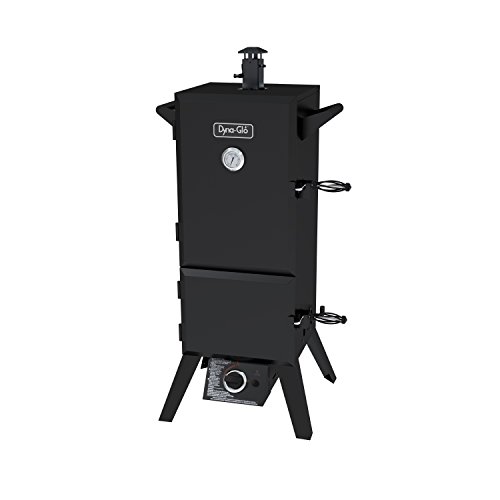
Dyna-Glo DGY784BDP 36-inch Vertical LP Gas Smoker — Best Spacious Manual Cabinet
Dyna-Glo’s 36-inch vertical LP smoker is the big manual cabinet: generous rack room, a powder-coated finish for outdoor life, and a burner that does exactly what the valve tells it. It is the choice for operators who trust a rhythm of checks more than a thermostat.
Strengths
- 36-inch cabinet gives generous rack room in the manual class
- Powder-coated steel suits outdoor commercial siting
- Straightforward burner design is easy to service
Trade-offs
- Manual temperature management through long cooks
- No thermostat or electronics to lean on
- Vertical racks favour some cuts over wide briskets
| Spec | Detail |
|---|---|
| Size | 36-inch vertical LP gas smoker (per verified listing) |
| Finish | Black powder coat |
| Fuel | Liquid propane |
| Format | Vertical cabinet |
Event cooks in particular suit this machine — it travels, it sets up fast, and its capacity swallows the ribs-and-chicken loads that events actually serve. The trade is attention: across a long cook, someone owns the temperature. Teams with that person get a spacious, uncomplicated smoker that will outlast fancier electronics.
Scaling and menu growth: Buyers rarely stay the size they were, so it is worth asking how the Dyna-Glo DGY784BDP 36-inch Vertical LP Gas Smoker behaves as the programme grows. Its ceiling is honest: when loads regularly fill every rack and the schedule regularly wants a second run, the machine is telling you the programme has outgrown a single unit — at which point it typically becomes the second cooker rather than being replaced, handling overflow, specials or the delicate work while a larger unit takes the core. That graceful second life is a real economic virtue, and it is one reason to choose a recognised design over an obscure one: parts, knowledge and resale interest persist. Plan the growth path when you buy — where a second unit would stand, what it would be — and the Dyna-Glo DGY784BDP 36-inch Vertical LP Gas Smoker stops being a purchase and becomes the first step of a system sized for caterers and event cooks who want space without automation. The verified headline specification — 36-inch vertical LP gas smoker (per verified listing) — frames all of it: keep that number in view when you plan loads, staffing and space, and the machine will do the job its badge promises.
Best for: caterers and event cooks who want space without automation / Not suited for: kitchens needing unattended overnight holding
Check the current price on Amazon
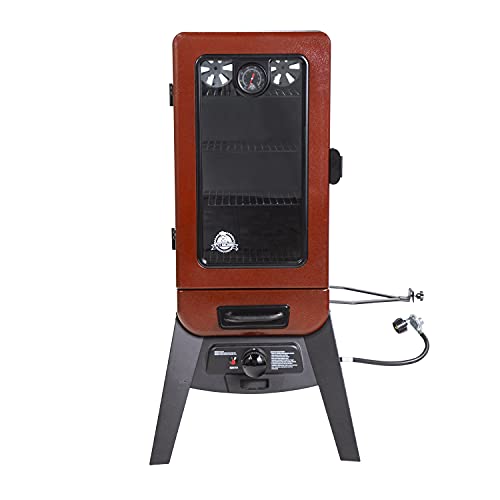
Pit Boss 3-Series Gas Vertical Smoker — Best for Patio Presentation
The Pit Boss 3-Series Gas Vertical brings something the black cabinets do not: a red hammertone finish that looks deliberate in front of guests. Brewpubs and patio kitchens that cook in view of the room get a smoker that reads as part of the show rather than an appliance apology.
Strengths
- Distinctive hammertone finish suits guest-visible patio stations
- Vertical cabinet format stacks racks in a small footprint
- Pit Boss’s gas line is built for regular service use
Trade-offs
- Style-led pick — capacity is mid-class
- Manual-class operation needs the usual check rhythm
- Red finish is a commitment your patio design must want
| Spec | Detail |
|---|---|
| Format | 3-Series vertical gas smoker (per verified listing) |
| Finish | Red hammertone |
| Fuel | Propane gas |
| Style | Cabinet smoker, model 10773 |
Under the finish it is a proper vertical propane cabinet — stacked racks, a small footprint, and the straightforward operation this class is known for. Capacity sits mid-class, so it suits a strong smoked section rather than a whole-menu barbecue programme. Buy it where the cooking is theatre and the menu matches its size.
Who should walk past it: Honesty about fit matters as much as enthusiasm, so here is the other side of the Pit Boss 3-Series Gas Vertical Smoker. It is the wrong machine for maximum-capacity commercial production, and no discount or deadline changes that. It is also the wrong machine for buyers who will not keep its small routines — the checks, the cleaning, the log — because its design assumes an owner who does. And it is the wrong machine bought for a menu that exists only in ambition: equipment should serve the programme you will actually run this season, with the next season’s growth handled by the scaling path rather than by overbuying today. Buyers whose needs match its badge — Best for Patio Presentation, aimed at restaurants and brewpubs cooking where guests can see the equipment — will find it exactly as advertised. Buyers outside that description should take the compliment of a clear ‘not this one’ and choose from the other five with this guide’s blessing. The verified headline specification — 3-Series vertical gas smoker (per verified listing) — frames all of it: keep that number in view when you plan loads, staffing and space, and the machine will do the job its badge promises.
Best for: restaurants and brewpubs cooking where guests can see the equipment / Not suited for: maximum-capacity commercial production
Check the current price on Amazon

PIQUEBAR Propane Smoker with Cover, 3 Racks — Best Budget Commercial Entry
The PIQUEBAR propane smoker is the entry ticket: a vertical cabinet with three removable racks, heavy-duty positioning and a cover in the box. For a market stall or a first smoked special, it covers the fundamentals without the capital commitment of the big cabinets.
Strengths
- Three removable racks simplify loading and cleaning
- Included cover protects an outdoor station between services
- Straightforward vertical design at an entry-level class
Trade-offs
- Smallest capacity in this guide — a starter, not a plant
- Basic controls require attentive operation
- Newer listing with a shorter track record than the majors
| Spec | Detail |
|---|---|
| Racks | 3 removable smoking racks (per verified listing) |
| Format | Vertical propane meat smoker |
| Extras | Cover included in listing |
| Build | Heavy-duty outdoor positioning |
Read it honestly as a starter. Three racks of capacity will ceiling a successful programme quickly — which is the right problem to have — and the controls ask for the attentive rhythm manual gas always asks for. As a way to learn commercial smoking and prove the menu before scaling, it is a rational first step rather than a compromise to apologise for.
Delivery, siting and first month: The first month with the PIQUEBAR Propane Smoker with Cover, 3 Racks decides its reputation in the building, so manage it deliberately. Confirm the delivery route and the final position before it arrives — door widths, floor, clearances and the utility it needs — then commission it empty, then with a cheap load, then with the real programme, in that order. Each stage teaches the team something the next stage depends on: the machine’s hot spots, its recovery habits, its voice. Write those lessons down while they are fresh; the card that lives with the machine is the difference between a cooker one person understands and a cooker the whole kitchen runs. Buyers who invest that first month get the boring, profitable years that follow. The PIQUEBAR Propane Smoker with Cover, 3 Racks is built for those years — the commissioning is simply how you claim them. The verified headline specification — 3 removable smoking racks (per verified listing) — frames all of it: keep that number in view when you plan loads, staffing and space, and the machine will do the job its badge promises.
Best for: market stalls and first-time commercial smokers on a tight setup budget / Not suited for: any programme already cooking at volume
Check the current price on Amazon
Comparison Table
| Pick | Badge | Key spec | Best for |
|---|---|---|---|
| Masterbuilt 40-inch ThermoTemp Propane Smoker MB20051316 | Best Overall | 960 sq. in. (per verified listing) | restaurants and caterers who want oven-like control at maximum gas capacity |
| Masterbuilt GS30D Propane 2-Door Smoker | Best Two-Door Value | Two-door propane cabinet (per verified listing) | small restaurants and caterers who reload chips often on long cooks |
| Masterbuilt MPS 230S Propane Smoker, 30-inch | Best Compact Commercial Starter | 30-inch propane cabinet (per verified listing) | food trucks, cafés and small caterers starting a smoked programme |
| Dyna-Glo DGY784BDP 36-inch Vertical LP Gas Smoker | Best Spacious Manual Cabinet | 36-inch vertical LP gas smoker (per verified listing) | caterers and event cooks who want space without automation |
| Pit Boss 3-Series Gas Vertical Smoker | Best for Patio Presentation | 3-Series vertical gas smoker (per verified listing) | restaurants and brewpubs cooking where guests can see the equipment |
| PIQUEBAR Propane Smoker with Cover, 3 Racks | Best Budget Commercial Entry | 3 removable smoking racks (per verified listing) | market stalls and first-time commercial smokers on a tight setup budget |
Sort the table by control style. The ThermoTemp is the oven-brained outlier that holds a dialled temperature; the two-door and wide-body cabinets trade a little automation for space and simplicity; the compact 30-inch models serve smaller programmes honestly. All of them beat tending charcoal on a windy Tuesday.
How to Choose a Commercial Gas Smoker
Decide your control philosophy first. A thermostat-controlled propane smoker behaves like an oven: set the temperature and the burner cycles to hold it, which is the right answer for overnight cooks and thin staffing. A manual valve model is a burner you trim by hand — simpler, cheaper to buy and to repair, and perfectly capable in the hands of someone who checks in hourly. Neither is wrong; mismatch is what hurts, like buying manual control for a kitchen with nobody to check.
Then doors. Two-door cabinets separate the fire-and-water compartment from the food compartment, so reloading chips mid-cook does not dump the chamber’s heat. On a twelve-hour brisket run with three chip reloads, that is the difference between a steady graph and a sawtooth. Finally, width: a cabinet that fits a full brisket flat, without trimming or angling, is worth more than a taller cabinet that fits more racks of smaller items — unless your menu is ribs and wings, in which case racks win.
Propane Logistics and Safety in a Commercial Setting
Propane is a system, not a tank. Keep at least one full spare, store tanks upright and outdoors per your local rules, and make the swap part of the opening checklist rather than a mid-service surprise. A tank gauge or the simple hot-water test on the tank side prevents the classic failure: a smoker that flames out at hour seven of an overnight cook.
Siting is non-negotiable: propane smokers are outdoor equipment. They produce carbon monoxide and wood smoke, they need clearance from combustibles, and no listing language about convenience changes that. Check hoses and connections with soapy water at the start of each season and after every tank change that feels stiff — leaks announce themselves to the careful.
Build the flame-out plan too. Wind is propane’s enemy at low settings; a sheltered position and a mid-cook check rhythm keep small problems small. Commercial kitchens document these habits because insurers and inspectors both like paper.
Gas Smoke Flavour: Setting Expectations
A propane smoker’s smoke comes from chips smouldering in a box over the burner. The flavour is real but gentler than charcoal or offset cooking, and it arrives mostly in the first hours before bark sets. Menus built on ribs, chicken, turkey and pork — where smoke is one note among rub, sauce and char — suit gas perfectly. Menus selling brisket as a smoke pilgrimage should taste the difference before committing.
You can deepen gas smoke honestly: a full chip box early, a second smoke source like a pellet tube for the first hours, and wood choice — hickory and oak read stronger than fruitwoods at the same quantity. What you cannot do is turn a gas cabinet into an offset by wishing, and this guide will not pretend otherwise.
Thermostat Versus Manual: The Control Decision in Depth
The control question in gas smoking looks technical and is actually managerial. A thermostat model converts temperature into a promise: the dial says a number and the burner cycles to keep it, through wind, dusk and a distracted shift. That promise is what lets a kitchen schedule an overnight cook without scheduling a person beside it, and it is why the ThermoTemp pattern leads this guide. The cost is a control system that can itself fail, and a buyer who values a machine any local technician can fix with hand tools may rationally refuse the trade.
Manual control converts temperature into a practice: a valve setting, a check rhythm, a cook who knows the cabinet’s moods. In steady hands with a written rhythm, manual cabinets produce superb food — generations of barbecue stand behind them — and their simplicity is a genuine form of reliability. What manual control cannot survive is neglect disguised as trust: the hourly check is not optional garnish, it is the control system, and a roster that cannot staff it should not buy it.
Decide by naming names. Write down who checks the smoker at hour two, hour five and hour eight of your longest cook, on your thinnest-staffed day. If the names exist and the rhythm is realistic, manual is a sound economy. If the page stays blank, the thermostat is not a luxury — it is the machine doing a job nobody else will.
Tank Systems, Gauges and the Mid-Cook Flame-Out
More commercial gas cooks are ruined by logistics than by cooking, and the flame-out is the genre’s signature disaster: hour seven of an overnight brisket, an empty tank or a wind-killed flame, and a cabinet of meat cooling into the danger zone. Every element of its prevention is boring, cheap and known. Keep a full spare tank, always. Record the starting tank state in the cook log, always. Check the cooker on a rhythm even when — especially when — it has never failed before.
Tank gauging deserves a sentence of its own because guessing is the norm and the cause. Inline gauges give an estimate; weighing the tank gives the truth; the hot-water trick — warm water down the tank’s side, feeling for the cool line of the liquid level — gives a field answer anywhere. Pick one method, teach it, and put the spare-tank swap on the opening checklist rather than in someone’s memory.
Wind is the second cause and siting is its cure: a sheltered position, the cabinet’s back to the prevailing wind, and no low-flame heroics in a gale. Where wind is chronic, a simple windbreak panel earns its keep in a single saved cook. None of this is equipment to buy so much as discipline to build — which is precisely why it separates professional gas operations from hopeful ones.
Gas in the Wider Fuel Strategy of a Kitchen
Few commercial kitchens run one fuel forever, and gas earns a particular place in a mixed strategy: it is the reliable middle. Where an offset is the flavour flagship used when staffing and occasion allow, a gas cabinet is the weekday guarantor — the cooker that produces the ribs, chicken and pork that must exist every day regardless of who called in sick. Menus built that way stop being hostages to the pit roster.
Gas also serves as the training ground. Its forgiving control lets a new cook learn smoking’s fundamentals — loading, timing, smoke management, resting — without simultaneously learning fire. Skills transfer upward to charcoal and wood later; confidence transfers immediately. Kitchens that develop staff deliberately often start them on gas for exactly this reason.
Finally, gas is the contingency plan. When the flagship cooker is down, when the event moves, when volume spikes beyond the plan, a propane cabinet that lights in a minute and holds temperature all day is the difference between a menu adjustment and a closure. Businesses that think in systems rather than appliances keep a gas smoker in the fleet for the same reason they keep a spare of anything critical.
Your Decision Checklist for a Commercial Gas Purchase
Control first, as this guide has argued throughout: name the people who will check the cooker at hours two, five and eight of your longest cook. If the roster answers confidently, a manual cabinet is a sound, economical buy. If it hesitates, the thermostat model is not an upgrade — it is the purchase. Strike candidates accordingly before comparing anything else, because capacity comparisons between machines your team cannot run are fiction.
Second, doors and reloads: count how many times your longest cook opens the chip box. Three or more reloads make a two-door design worth real money in temperature stability; a programme of short cooks may never notice the difference. Third, geometry: your widest regular cut, laid flat, against the cabinet’s rack — with the water pan and chip box in their working positions, not in the brochure’s empty chamber.
Fourth, the propane system around the machine: tank storage that satisfies your local rules, a spare tank in the budget, a gauge or weighing habit assigned to a named role, and a sheltered standing position chosen before the machine arrives rather than after its first windy flame-out. Fifth, service reality: burners, valves and igniters are the wear parts of this class — favour designs whose parts are findable and whose construction a local technician will recognise. A gas smoker is a decade-long appliance bought in an afternoon; this checklist is how the afternoon earns the decade.
Maintenance Rhythm for Propane Cabinets
Gas smokers reward a short list of habits performed without exception. At every tank change: the soapy-water leak check on the connections, thirty seconds that constitute the cheapest insurance in the building. After every cook: water pan emptied and washed, racks scraped while warm, chip box ash cleared. Weekly in season: burner flame inspected for the even, blue pattern of a healthy port line — yellow, lazy flames mean ports that want cleaning before they mean a cook that underperforms.
Monthly, work the valves and confirm the igniter’s temper, check hoses for the cracking that sun and age write on rubber, and verify the door thermometer against a probe so the kitchen’s habits are built on true numbers. Keep the regulator and hose assembly’s age in the log; these are consumables on a years-long fuse, and replacing them on schedule is cheaper than diagnosing their failure mid-season.
Seasonally, a full degrease and a sheltered-storage decision for machines that winter outdoors. Propane cabinets are simple machines that fail almost exclusively through neglected small things; the rhythm above is the entire difference between a decade of service and a cautionary tale.
Questions to Ask Before You Order a Gas Smoker
Five questions, answered in writing, protect this purchase. Is the temperature controlled by a thermostat or by your valve hand — and does the listing’s language match the manual’s? How many doors does the cabinet have, and which compartment does each serve at hour six of a cook? What is the rack’s true width with the water pan installed? Are burner, valve and igniter parts listed and orderable as spares? And does the warranty contemplate commercial use, or does it quietly assume a patio?
Ask your site three more: where do the tanks live, legally and practically? Who swaps them, and is the spare already in the budget? Is the standing position sheltered enough for your wind, with clearances your insurer would initial? Eight answers, one honest purchase — gas smokers are simple machines, and the failures catalogued in this guide are almost never the machine’s. They are unasked questions arriving on schedule.
How to Set Up a Propane Smoker for a Long Commercial Cook
Step 1: Leak-check and light. Connect the tank, brush soapy water on the fittings and look for bubbles before lighting. Light the burner, confirm a steady flame, and let the cabinet preheat with the water pan filled — the pan is ballast as much as moisture.
Step 2: Season the smoke. Load the chip box and let the first smoke roll before meat goes in. Chips that are already smouldering when the product loads give flavour from minute one instead of a warm-up act.
Step 3: Load fast, close faster. Arrange the meat with airflow gaps, get it in and get the door shut. Note the tank’s weight or gauge reading in the cook log — future you needs to know the starting point.
Step 4: Run the check rhythm. Glance at temperature and flame on a fixed schedule — hourly is typical — and reload chips through the lower door where the design allows. Small corrections early beat rescues late.
Step 5: Finish, rest, and shut down properly. Pull by internal temperature, rest the meat, then close the tank valve first and let the line burn clear before shutting the burner. Empty and wash the water pan while warm; yesterday’s pan water is nobody’s friend.
Common Buying Mistakes
Running out of propane mid-cook. The most common gas failure is a logistics failure. Spare tank, starting check, cook log — pick all three.
Cooking indoors or under a low awning. Propane smokers are outdoor equipment, full stop. Carbon monoxide does not negotiate.
Opening the main door to add chips. If your model has a lower door, use it. If it does not, reload fast and accept the dip — but do not reload more often than the smoke needs.
Trusting the door thermometer. Door gauges are weather vanes, not instruments. Cook on a probe at grate level and internal temperature.
Skipping the leak check. Thirty seconds with soapy water after a tank swap is the cheapest safety procedure in the building.
Forgetting wind. A low flame in a gusty corner is a flame-out waiting for hour seven. Site the smoker sheltered and check it on rhythm.
Final Recommendation
For most commercial buyers, the Masterbuilt ThermoTemp 40-inch is the gas smoker to beat: thermostat control over the largest verified cabinet here. The two-door GS30D is the value workhorse, and the Dyna-Glo 36-inch the simple, spacious manual option. Related guidance lives in Best Propane Smokers and Best 2 Door Gas Smokers; the wider cluster is at Best Commercial Smokers, with meat-led picks in Best Commercial Meat Smokers, rotisserie options in Best Commercial Bbq Smokers Grill Rotisserie and the electric alternative in Best Commercial Electric Smokers.
Shortlist again, for convenience: Masterbuilt 40-inch ThermoTemp Propane Smoker MB20051316, Masterbuilt GS30D Propane 2-Door Smoker, Masterbuilt MPS 230S Propane Smoker, 30-inch. Each link goes to the verified listing used throughout this guide — check price on Amazon there and confirm the configuration before ordering.
Frequently Asked Questions
How long does a propane tank last in a smoker?
A standard tank runs a cabinet smoker for many long cooks — typically well beyond a single brisket session — but consumption varies with temperature, weather and burner size. Commercial users track it with a gauge or tank weight and always keep a full spare.
Is gas-smoked meat as flavourful as charcoal-smoked?
It is lighter. Chips over a gas burner give genuine but gentle smoke, ideal for ribs, poultry and pork. Brisket traditionalists taste the gap; most restaurant guests, eating with rub and sauce, do not.
What does thermostat control actually do?
On the ThermoTemp-style models, a thermostat cycles the burner to hold your set temperature, like an oven. Manual models hold a flame size you set with the valve and check on a rhythm.
Can I use a gas smoker in a food truck or enclosed trailer?
No — propane smokers are outdoor equipment producing carbon monoxide and smoke. Trucks and trailers need equipment rated and vented for that use, which cabinet smokers are not.
Why choose a two-door model?
The lower door opens the chip and water compartment without opening the food chamber, so reloading smoke mid-cook costs almost no heat. Over a long cook with several reloads, that steadiness adds up.
Do gas smokers need seasoning or special startup?
A first empty burn to clear manufacturing residues, a leak check at every tank change, and a filled water pan for long cooks. Beyond that, gas is the lowest-ceremony fuel in smoking.

