Disclosure: airfryerkitchensupply.com is reader-supported. When you buy through links on our site, we may earn an affiliate commission at no extra cost to you.
Where to Buy the Best Chopsticks for Nonstick Pans
Cooking in a nonstick pan with the wrong chopsticks is how coatings die young, so this guide to the best chopsticks for nonstick pans only includes silicone, wood and bamboo tools — no metal picks at all. Every linked set is sold on Amazon; check price on Amazon on the listing, and note the length carefully, because cooking chopsticks run far longer than eating pairs and the right length depends on your pan and pot depth.
- Carrotez Silicone Cooking Chopsticks, 1 Pair, Grey, 12 Inches (Best Overall) — Check on Amazon
- RECOHOME Long Silicone Cooking Chopsticks, 12 Inch (Best for High-Heat and Wok Cooking) — Check on Amazon
- Donxote Wooden Cooking Chopsticks, 16.5 Inches, 2 Pairs (Best Extra-Long for Frying) — Check on Amazon
- YOSUKATA Natural Wooden Long Cooking Chopsticks, Set of 3 Pairs (Best Multi-Length Set) — Check on Amazon
- Joyzan Silicone Chopsticks Set, 5 Pairs, Multicolor (Best Budget Silicone) — Check on Amazon
- GLAMFIELDS Wooden Cooking Chopsticks, 16.5 Inches, 2 Pairs (Best for Hot Pot and Noodle Nights) — Check on Amazon
The best chopsticks for nonstick pans have to satisfy two masters at once. They must be gentle enough to never scratch the coating — which rules out every metal pair, however beautifully made — and capable enough to turn frying food, fish out noodles and work a wok-style pan with confidence. Silicone, wood and bamboo are the three materials that can do both, and this guide is built entirely from them.
A word of honesty about the category: several of the finest chopsticks on Amazon are stainless steel, including excellent long steel cooking pairs, and they are deliberately excluded here. Steel tips on a nonstick coating are a slow-motion accident. If your pans are steel or cast iron, those sets are great; in this guide they would be malpractice, so you will find a note about them rather than a link.
All six picks were verified — the silicone sets in a fresh search for this batch — and the specs quoted come from the listings themselves. As always, no prices are printed; check price on Amazon when you are ready to buy.
In this guide
Quick Picks: The Best Chopsticks for Nonstick Pans at a Glance
Two silicone specialists for pure pan work, then four wood and bamboo options covering extra-long frying, multi-length flexibility, budget silicone for eating-and-cooking, and hot-pot nights.
- Best Overall: Carrotez Silicone Cooking Chopsticks, 1 Pair, Grey, 12 Inches — a single 12-inch silicone pair designed for exactly this job: heat resistant, non-scratch and gentle on cookware — Check on Amazon
- Best for High-Heat and Wok Cooking: RECOHOME Long Silicone Cooking Chopsticks, 12 Inch — food-grade silicone tips, non-slip and scratch-resistant, in colours that are easy to spot in a busy drawer — Check on Amazon
- Best Extra-Long for Frying: Donxote Wooden Cooking Chopsticks, 16.5 Inches, 2 Pairs — the classic 16.5-inch wooden frying length, in wood that a nonstick coating can live with — Check on Amazon
- Best Multi-Length Set: YOSUKATA Natural Wooden Long Cooking Chopsticks, Set of 3 Pairs — three graduated wooden lengths — 11.8, 13 and 14.2 inches — so the tool matches the pot instead of the other way round — Check on Amazon
- Best Budget Silicone: Joyzan Silicone Chopsticks Set, 5 Pairs, Multicolor — five colourful silicone pairs at eating length that can help in the pan and then come straight to the table — Check on Amazon
- Best for Hot Pot and Noodle Nights: GLAMFIELDS Wooden Cooking Chopsticks, 16.5 Inches, 2 Pairs — extra-long wooden pairs sold for noodles, frying and hotpot — the communal-cooking specialist — Check on Amazon
How These Picks Were Chosen
The filter for this guide was absolute: the tip that touches the pan must be silicone, wood or bamboo. Any set with exposed metal at the working end was excluded regardless of quality, which removed several otherwise excellent steel cooking chopsticks from contention.
Within that filter we prioritised cooking lengths — roughly 12 inches and up for pan work — heat tolerance as described by the listings, and tip designs that grip food rather than skate on it. One shorter silicone set is included deliberately for readers who want a single pair that cooks gently and then comes to the table.
We also checked the claims that matter for this use: non-scratch and gentle-on-cookware language in the silicone listings, anti-slip shaping on the wooden pairs, and lengths stated in the titles themselves. Where a listing was silent, the review says so instead of inventing a specification.
The 6 Best Chopsticks for Nonstick Pans, Reviewed

Carrotez Silicone Cooking Chopsticks, 1 Pair, Grey, 12 Inches — Best Overall
If the brief is one pair of chopsticks that lives by the hob and never threatens a coating, this is it. The Carrotez pair is a full 12 inches of silicone, sold explicitly as heat resistant, non-scratch and gentle on cookware — the three promises this entire category exists to keep.
Strengths
- Silicone tips cannot scratch nonstick coatings, full stop
- 12-inch length keeps fingers clear of pan heat while staying controllable
- One-piece silicone cleans completely, with no joints to trap food
Trade-offs
- A single pair, so keen cooks may want a second for two-handed tasks
- Silicone has more flex than wood, which takes adjustment for heavy items
- The modern grey look is purely functional
| Material | Silicone |
| Length | 12 inches |
| Pairs in set | 1 |
| Listing claims | Heat resistant, non-scratch, gentle on cookware |
Silicone’s advantage in a pan is not just softness. It grips. Where a polished wooden tip can skate across an oiled fillet, a silicone tip holds it, which makes turning fish, tofu and dumplings calmer work. It also stays silent against the pan, a small mercy in a quiet kitchen.
The flex question is real but manageable. Silicone bends a little under a heavy chicken thigh where bamboo would not, so technique adapts: slide under food and support it rather than pinching hard from above. For the everyday run of eggs, vegetables, noodles and stir-fries, most cooks stop noticing the difference within a week and start appreciating the grip.
A small technique note for silicone converts: because the tips grip, you can use less squeezing force than wood has trained you to use. Let the material hold the food and your hand will stay relaxed through a whole batch of dumplings — the fatigue difference is noticeable by the third pan.
Silicone also shrugs off the turmeric-and-tomato staining that marks wooden tools permanently, which matters in curry-heavy kitchens: this pair will look the same after a hundred vindaloos as it does today, and for some cooks that alone settles the material question.
Verdict in one line: the purest answer to this search — a pan tool that cannot scratch, full stop.
Best for: nonstick owners who want one dedicated, coating-safe cooking pair by the hob / Not suited for: cooks who regularly lift heavy joints and prefer a rigid wooden tool
Check on Amazon — check price on Amazon before you buy, since listings and bundles change.
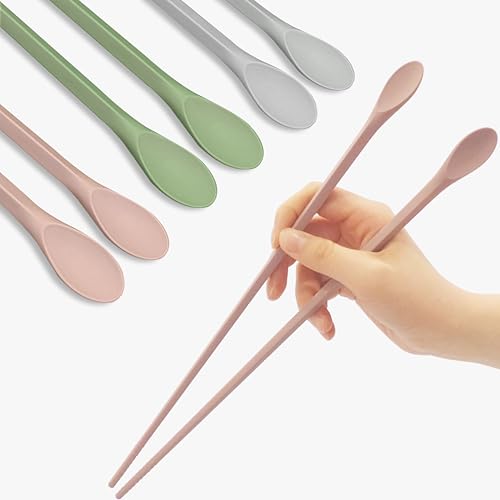
RECOHOME Long Silicone Cooking Chopsticks, 12 Inch — Best for High-Heat and Wok Cooking
RECOHOME’s long silicone pair is aimed squarely at pan work: food-grade tips, a non-slip grip and an explicit scratch-resistant promise for pans, in a 12-inch length that suits woks and deep skillets alike. The colour options are not vanity — a bright pair is a pair you can find in the drawer at speed.
Strengths
- Listing explicitly promises scratch resistance for pans
- Food-grade silicone tips suit high-heat stir-frying and noodle work
- Dishwasher safe, which suits a tool used in oil every day
Trade-offs
- Coloured handles will not match every kitchen’s taste
- Silicone flex applies here too on the heaviest pieces of food
- Sold as a cooking tool; too long for comfortable table use
| Material | Silicone, food-grade tips (per listing) |
| Length | 12 inches |
| Care | Dishwasher safe (per listing) |
| Listing claims | Non-slip, scratch-resistant for pans |
Wok-style cooking in a nonstick pan is the stress test for this category: high heat, constant motion, oil everywhere. A silicone pair built for it removes the background worry that every turn of the wrist is scoring the coating, and that mental freedom genuinely improves the cooking.
The dishwasher point matters more for cooking chopsticks than eating ones. A tool that lives in oil should not need hand-washing theatre after every stir-fry. Rinse, rack, done — and because the whole working end is silicone, there is no wooden core quietly absorbing yesterday’s frying oil.
Colour, used deliberately, is a safety system: many wok cooks dedicate one colour to raw-meat work and another to vegetables and finished food. With several colours in the range, this pair makes that hygiene habit effortless to adopt and impossible to confuse.
Keep one of these pairs exclusively for the wok if your household also fries with wood: a dedicated-tool habit removes the moment of hesitation at the hob, and hesitation beside hot oil is the only truly bad technique in this entire guide.
Verdict in one line: for wok fire and noodle water in nonstick cookware, this is the pair that lets you cook without flinching.
Best for: stir-fry and noodle cooks using nonstick woks and skillets daily / Not suited for: anyone wanting one pair to double at the table, or cooks who dislike silicone flex
Check on Amazon — check price on Amazon before you buy, since listings and bundles change.

Donxote Wooden Cooking Chopsticks, 16.5 Inches, 2 Pairs — Best Extra-Long for Frying
Length is safety equipment when oil is hot. At 16.5 inches, these Donxote wooden pairs keep your hand well clear of spitting frying oil and deep pots, and because they are wood rather than steel, they can do it inside a nonstick pan without endangering the coating.
Strengths
- Extra length is a genuine safety margin over hot oil and steam
- Wood is coating-safe and stays cool to hold over a hot pan
- Two pairs cover the classic two-handed frying and noodle routine
Trade-offs
- Too long for shallow pans and small kitchens; storage needs a tall home
- Wood wants hand washing and drying after oily work
- Fine control of small items takes practice at this length
| Material | Wood |
| Length | 16.5 inches |
| Pairs in set | 2 |
| Intended use | Noodles, frying (per listing) |
There is a reason the 16.5-inch wooden pair is the default tool of noodle shops and home fryers alike. It reaches the bottom of a stockpot, separates noodles as they cook, lifts items from a fryer, and keeps the cook’s knuckles out of the weather. In a nonstick context it has one more virtue: it is the long tool that cannot gouge.
Use the length deliberately. Work with the tips, keep movements small, and let the leverage do the job. New users sometimes wave long chopsticks like drumsticks; a week of noodle soups teaches the economy of motion that makes these feel precise rather than unwieldy.
For noodle work specifically, the technique is to lift and shake rather than stir: raise a bundle of strands, let them fall back through the water, and repeat. At 16.5 inches the motion is all wrist, the strands separate without breaking, and your hand never enters the steam’s serious territory.
Long wooden pairs double as the kitchen’s reach extenders — the jar at the back of the high shelf, the item dropped behind the stove’s edge. Undignified, unadvertised, and used monthly in every real kitchen that owns them.
Verdict in one line: reach, safety and tradition in one length of wood — the fryer’s friend that coatings can live with.
Best for: deep frying, noodle pots and any cook whose pans are deep or whose oil is lively / Not suited for: small shallow pans, tiny kitchens, or anyone who hates hand washing
Check on Amazon — check price on Amazon before you buy, since listings and bundles change.

YOSUKATA Natural Wooden Long Cooking Chopsticks, Set of 3 Pairs — Best Multi-Length Set
Most kitchens own one cooking length and compromise everywhere. This YOSUKATA set of three graduated pairs — roughly 12, 13 and 14 inches — lets a shallow skillet, a saucepan and a wok each get a proportionate tool, all in coating-safe natural wood.
Strengths
- Three lengths end the too-long-for-the-pan, too-short-for-the-pot compromise
- Natural wood is gentle on every coating and comfortable over heat
- A coherent set from a brand known for wok equipment
Trade-offs
- Three pairs to wash, store and keep organised
- Wood care rules apply to all three pairs
- Keen fryers may still want one true 16.5-inch pair for deep oil
| Material | Natural wood |
| Lengths | 11.8, 13 and 14.2 inches |
| Pairs in set | 3 |
| Intended use | Wok cooking (per listing) |
Graduation is the quiet insight here. The shortest pair behaves almost like an eating-plus pair for eggs and small pans; the longest handles wok tosses and taller pots. Cooks who have only owned one length are usually surprised how much of their awkwardness was simply the wrong tool size.
As with all wooden cooking tools, longevity is a care routine: wash, dry, and do not leave them sitting in the pan or the sink. Treated that way, natural wood seasons into a slightly grippier, deeply familiar tool that many wok cooks prefer to any synthetic.
The graduated lengths also solve a teaching problem: new cooks can start on the shortest pair, where control is easiest, and graduate to the longer pairs as pots demand. A set that trains its own user is a set that gets kept.
When the set is new, the longest pair will feel excessive for a week. Persist: the hand recalibrates quickly, and the length you bought for the stockpot becomes the length you reach for in the saucepan too, because distance from steam never stops being pleasant.
Verdict in one line: three lengths that end the compromises — the thinking cook’s set.
Best for: households with several pan and pot sizes, and wok cooks building a proper kit / Not suited for: one-pan minimalists, or deep-fry specialists who need maximum length
Check on Amazon — check price on Amazon before you buy, since listings and bundles change.

Joyzan Silicone Chopsticks Set, 5 Pairs, Multicolor — Best Budget Silicone
Not everyone wants a dedicated cooking tool. This Joyzan set of five silicone pairs works the other way: eating-length chopsticks whose silicone build makes them safe for turning food in a nonstick pan, serving, and then eating the result — one tool, whole meal.
Strengths
- Five pairs at a budget tier makes coating-safe cooking a household default
- Silicone is non-slip at the table as well as in the pan
- Colours help assign pairs to people and spot them in the wash
Trade-offs
- Eating length means fingers sit closer to pan heat than with cooking pairs
- Too flexible and short for deep pots or serious frying
- Multicolor will not suit every table’s style
| Material | Silicone |
| Pairs in set | 5 |
| Colours | Multicolor |
| Care | Dishwasher safe (per listing) |
The use case is the weeknight one-pan dinner: eggs moved in the skillet, vegetables turned, noodles lifted from a shallow pan, then the same pair at the table. For shallow, gentle cooking, a 9-to-10-inch silicone pair is entirely adequate and saves a tool change and a wash.
Know the boundary, though. The moment oil is deep, the pot is tall, or the heat is aggressive, this set should hand over to a 12-inch or longer cooking pair. Used inside its limits, it is the cheapest way to make an entire household’s chopstick habits coating-safe by default.
Budget silicone has one more role worth naming: it is the pair to hand to helpers. Kitchens run on borrowed hands at busy moments, and a coating-safe pair that anyone can grab protects the pans from well-meaning fork and metal-spoon improvisations.
For households with children learning to cook, a short silicone pair like this is the safest first hob tool: coating-safe, burn-resistant at the handle end by distance alone, and forgiving of the enthusiastic stirring that beginners specialise in.
Verdict in one line: the budget way to make a whole household coating-safe by default.
Best for: small households, one-pan weeknight cooking and budget-conscious buyers / Not suited for: deep frying, tall stockpots, or anyone wanting a formal table look
Check on Amazon — check price on Amazon before you buy, since listings and bundles change.

GLAMFIELDS Wooden Cooking Chopsticks, 16.5 Inches, 2 Pairs — Best for Hot Pot and Noodle Nights
Hot pot is where cooking chopsticks earn their keep in company: raw slices go in, cooked pieces come out, and nobody’s fingers should be near the broth. These 16.5-inch GLAMFIELDS wooden pairs are sold for exactly that trio of jobs — noodles, frying and hotpot.
Strengths
- Length keeps hands clear of communal broth, steam and oil
- Wood is safe in nonstick hot-pot inserts and gentle on all cookware
- Two pairs let two cooks work the pot without crowding
Trade-offs
- Strictly a cooking tool; absurd at a place setting
- Hand washing after a long hot-pot session is nobody’s favourite chore
- Storage needs a tall jar or a deep drawer
| Material | Wood |
| Length | 16.5 inches |
| Pairs in set | 2 |
| Intended use | Noodles, frying, hotpot (per listing) |
Communal cooking has its own etiquette that length serves well: long pairs work the shared pot, short pairs eat. Keeping the roles separate is more hygienic and much less chaotic than everyone fishing with their eating sticks, and a dedicated pair of long wooden chopsticks makes the system effortless.
Beyond hot pot, this is the pair that fishes a lost dumpling from a stockpot, tests pasta, and turns items in a deep fryer. If your household’s cooking leans communal and noodle-based, it will be used weekly; if your cooking is solitary and shallow-pan, the Donxote or YOSUKATA picks will fit better.
Hot-pot veterans will know the second use for a pair like this: as the pot’s dedicated raw-side tool, kept visually distinct from everyone’s eating sticks. Length makes the role obvious at a glance, which is exactly what a crowded, steamy table needs.
Two pairs at a hot pot let the table run a system — one pair works the raw side, one serves the cooked — and systems are what keep communal cooking hygienic without anyone making a speech about it. The tool teaches the etiquette by its length alone.
Verdict in one line: hot-pot night, handled — length, wood and manners in one pair.
Best for: hot-pot households, noodle lovers and communal cooking / Not suited for: small-pan solo cooking, or anyone short on tall storage
Check on Amazon — check price on Amazon before you buy, since listings and bundles change.
Comparison Table: Best Chopsticks for Nonstick Pans Side by Side
The deciding columns here are material and length: silicone for pure pan safety and grip, wood for reach and tradition, and length matched to your deepest pot rather than your shallowest pan.
| Pick | Badge | Key spec | Best for |
|---|---|---|---|
| Carrotez Silicone Cooking Chopsticks, 1 Pair, Grey, 12 Inches | Best Overall | Silicone, 12 in, 1 pair, heat resistant, non-scratch | nonstick owners who want one dedicated, coating-safe cooking pair by the hob |
| RECOHOME Long Silicone Cooking Chopsticks, 12 Inch | Best for High-Heat and Wok Cooking | Silicone, 12 in, food-grade tips, dishwasher safe, scratch-resistant per listing | stir-fry and noodle cooks using nonstick woks and skillets daily |
| Donxote Wooden Cooking Chopsticks, 16.5 Inches, 2 Pairs | Best Extra-Long for Frying | Wood, 16.5 in, extra long, 2 pairs | deep frying, noodle pots and any cook whose pans are deep or whose oil is lively |
| YOSUKATA Natural Wooden Long Cooking Chopsticks, Set of 3 Pairs | Best Multi-Length Set | Natural wood, 11.8 / 13 / 14.2 in, 3 pairs | households with several pan and pot sizes, and wok cooks building a proper kit |
| Joyzan Silicone Chopsticks Set, 5 Pairs, Multicolor | Best Budget Silicone | Silicone, 5 pairs, multicolor, dishwasher safe, non-slip | small households, one-pan weeknight cooking and budget-conscious buyers |
| GLAMFIELDS Wooden Cooking Chopsticks, 16.5 Inches, 2 Pairs | Best for Hot Pot and Noodle Nights | Wood, 16.5 in, extra long, 2 pairs, hotpot and frying | hot-pot households, noodle lovers and communal cooking |
Why Is Metal Banned From Nonstick Pans in the First Place?
A nonstick coating is a thin polymer layer bonded to the pan’s metal body. It is tough against food and heat but vulnerable to hard, sharp edges — and a metal chopstick tip is exactly that, dragged across the surface under pressure, hundreds of times per meal. Each pass can score the layer; once scored, the coating begins to fail around the damage.
This is why this guide excludes even excellent steel cooking chopsticks, including long stainless pairs that are perfect for steel pans, woks of carbon steel, and cast iron. The tool is not bad; the pairing is. If your cookware collection is mixed, the safe habit is simple: metal tools live with metal pans, and silicone or wood works everywhere.
Wooden and silicone tips distribute pressure over a softer, wider contact patch. They can still be abused — stabbing at crusted food with any tool is poor practice — but in normal turning, lifting and stirring they leave the coating as they found it.
- Metal tips: banned here, however good the chopsticks are
- Silicone tips: softest contact, best grip, slight flex
- Wood and bamboo tips: firm control, coating-safe, need drying
- Any material: never use chopstick tips as scrapers or knives
Silicone or Wood: Which Cooking Chopsticks Should You Choose?
Choose silicone if your cooking is pan-centred: eggs, stir-fries, dumplings, fish. Its grip on slippery food is the best in this guide, it is indifferent to dishwashers and oil, and it is the most forgiving material a coating can meet. Its costs are flex under heavy loads and a less traditional feel.
Choose wood if your cooking is pot-centred: noodles, frying, hot pot, deep vessels. Wood gives rigid, precise control at long lengths, stays cool in the hand, and carries centuries of technique behind it. Its costs are care — washing and drying by hand — and a finite lifespan measured in years rather than decades.
Many serious home cooks end with one of each: a 12-inch silicone pair at the hob and a 16.5-inch wooden pair in the utensil jar. The two together cost less than one replacement nonstick pan, which is the comparison that actually matters.
What Length of Cooking Chopsticks Do You Need?
Match length to vessel depth, not to bravado. For a standard skillet or frying pan, 12 inches is the balanced choice: enough clearance from the heat, short enough for fine control. For saucepans and noodle pots, 13 to 14.2 inches keeps the hand out of the steam. For stockpots, fryers and hot pots, 16.5 inches is the traditional and correct answer.
Too-long tools in shallow pans are clumsy; too-short tools in deep pots are a burn risk. If you can only own one length and your cooking is varied, 12-inch silicone plus care beats 16.5-inch wood used everywhere — but the graduated YOSUKATA set exists precisely because one length is always a compromise.
A quick home test: hold your current pair over your deepest pot. If your knuckles would sit inside the rim while the tips touch the bottom, that pair is too short for that pot.
How Hot Can Silicone and Wooden Chopsticks Get?
Listings for the silicone picks in this guide describe them as heat resistant and food-grade, and silicone as a material is at home at frying temperatures. Even so, no chopstick of any material should be left resting in a hot pan or sitting in oil while you answer the door; tools are for working, and pans keep heating while you are gone.
Wood chars rather than melts, which is its own warning system, and bamboo behaves similarly. The practical rules are shared: keep tips moving in very hot oil, do not park any pair on a pan edge over a live flame, and retire a pair whose tips have become rough, split or deeply scored, whatever it is made of.
Where a listing states a specific heat figure, trust the listing for that product rather than any general rule — formulations vary, and this guide deliberately quotes claims only from the listings themselves.
Which Kitchen Tasks Suit Cooking Chopsticks Best?
Cooking chopsticks are the precision instrument of the hob. They turn individual pieces — dumplings, prawns, tofu cubes, meatballs — with a delicacy tongs cannot match; they separate noodles as they cook; they fish out a single strand to test for doneness; they arrange, nudge and rescue. Any task where the unit of work is one piece of food belongs to them.
They are equally honest about their limits. Wide, fragile items — a fish fillet, a pancake, a fried egg with a runny yolk — want a spatula’s broad support. Heavy joints want tongs. The skilled cook’s drawer is not a contest; it is a division of labour, and chopsticks hold the precision portfolio.
In a nonstick pan specifically, chopsticks have one more virtue: they replace the fork. Generations of cooks have turned food with a fork without thinking, and forks are coating-killers of the first order. The silicone or wooden pair by the hob removes the temptation at the moment it arises.
How Do You Care for Silicone and Wooden Cooking Chopsticks?
Silicone asks for almost nothing: wash it like any utensil, dishwasher welcome, and inspect the tips now and then for cuts or tears, because damaged silicone should be retired like any damaged tool. It will not stain meaningfully, hold odours, or care about being left in the sink — the lowest-maintenance material in this guide by a distance.
Wood asks for the traditional minute: wash promptly after oily work, dry fully, and store in a jar where air circulates. Left soaking, wooden tips swell and roughen; dried properly, they season into a surface that many cooks find grippier with age. A pair that stays rough or develops a lingering smell after washing has served its term.
Both materials share one rule: keep them out of the pan when the pan is unattended. Tools left in hot oil or across a burner age in minutes what normal use ages in years, whatever they are made of.
Can One Pair of Cooking Chopsticks Serve Every Pan You Own?
Mostly, yes — with the length caveat this guide keeps returning to. A 12-inch silicone pair covers skillets, woks and saucepans for the majority of home cooking, and only deep pots, fryers and hot pots genuinely outgrow it. If your cooking rarely goes deep, the one-pair kitchen is a real and reasonable position.
The cooks who need two pairs are those who fry seriously or host hot pot: depth changes the safety arithmetic, and no technique fully compensates for knuckles inside a pot’s rim. For them, the second pair is not indulgence but equipment, in the same category as an oven glove.
Judge by your last twenty meals, not your ambitions. The pair that matches the cooking you actually do will be reached for daily; the pair bought for the cooking you imagine will guard the back of the jar.
How Do Cooking Chopsticks Compare With Tongs and Spatulas?
Each tool owns a shape of problem. Tongs own the heavy and the hot-from-a-distance: steaks, joints, anything that must be gripped hard and carried. Spatulas own the wide and fragile: fillets, pancakes, eggs. Chopsticks own the many and the small: the thirty dumplings, the separating noodles, the single prawn that needs turning while its neighbours do not.
In a nonstick pan the comparison gains a second axis — coating safety — and there chopsticks in silicone or wood win by default, because the metal versions of all three tools are the ones that end coatings. A kitchen can run metal tongs for the barbecue and still keep the pan drawer entirely silicone-and-wood without feeling deprived.
The cooks who get the most from this guide’s picks use all three tool types in one meal without thinking: spatula for the fillet, chopsticks for the vegetables around it, tongs retired to the grill where they belong. Fluency, not loyalty, is the goal.
What Pan Problems Do Cooking Chopsticks Solve That Nothing Else Does?
Testing doneness is the quiet superpower: one noodle lifted from the pot, one strand of pasta, one piece from the fryer, tasted and judged while the rest cooks on. No other tool samples the food as cleanly, and in noodle cookery — where the difference between perfect and past is ninety seconds — it is the difference between guessing and knowing.
Rescue work is the second: the dumpling that slid under the others, the herb leaf that must leave the oil now, the piece that fell into the gap beside the burner of a neighbour pan. Chopsticks are the tweezers of the kitchen, scaled for food, and a nonstick-safe pair extends that rescue service into the pans that need it most.
Arrangement is the third: placing garnishes, spacing pieces so they fry rather than steam, building the pan’s geography before the heat commits you. Cooks who plate carefully start in the pan, and they start with chopsticks.
How Do You Build a Fully Coating-Safe Hob Drawer?
Audit the drawer by material, not by tool. Anything with an exposed metal working end — forks, steel spatulas, metal tongs, steel chopsticks — moves to the grill and oven tray’s territory. What remains within reach of the nonstick pans is silicone, wood, bamboo and nylon, and the pans’ life expectancy rises immediately.
Fill the gaps by role rather than by catalogue: a silicone pair for pan work, a long wooden pair for pots, a silicone spatula for the wide and fragile, a wooden spoon for sauces. Four tools, every hob job covered, no coating ever threatened by a moment of inattention.
Label the boundary if your household cooks communally: a small jar by the hob holding only the safe tools teaches the rule without a word. Systems that rely on memory fail at midnight; systems that rely on geography do not.
What Should You Do the Day You Buy a New Nonstick Pan?
Give it a coating-safe tool set on day one, before the first meal creates the first temptation. The damage that shortens a nonstick pan’s life is rarely one dramatic gouge; it is the accumulation of a hundred small metal contacts in its first months, each one invisible, all of them permanent.
Read the pan maker’s own utensil guidance and keep it with the pan’s paperwork; where it names materials, it will name the family this guide is built from. Then place the silicone pair and the wooden pair where the cooking happens — not in a drawer across the kitchen, because geography beats intention at the moment oil is hot.
Finally, brief the household in one sentence: metal never touches this pan. A rule stated once, with the safe tools already in place, protects the pan better than any amount of after-the-fact vigilance.
How to Cook With Chopsticks in a Nonstick Pan, Step by Step
Cooking with chopsticks feels different from eating with them: the tool is longer, the food is moving, and the pan is hot. This sequence builds the basic technique safely.
- Choose the pair by vessel: 12-inch silicone for skillets, longer wood for pots, and never metal in a nonstick pan.
- Dry the tips before they meet oil. Wet tips in hot oil spit, whatever the material.
- Use the slide-and-lift for turning: slide the tips under the food, support it, then turn — rather than pinching hard from above, which tears delicate items and stresses silicone.
- For noodles, work with a gentle swirling and lifting motion to separate strands as they soften; the pan’s coating will never notice, and the noodles will not break.
- Rest the pair across a plate or rest between tasks, never across the hot pan rim over a live burner.
- Wash promptly after oily work — silicone straight into the dishwasher, wood by hand — and dry fully before storing.
Within a few meals the motions become automatic, and most cooks find the chopstick’s precision hard to give up: nothing else in the drawer can turn one dumpling, test one noodle and fish out one bay leaf with the same tool.
Common Buying Mistakes
Reaching for the steel pair because it is closest. One meal of metal on coating can start damage that no later care undoes. Store nonstick-safe tools by the hob.
Buying eating length for cooking. Short pairs put fingers in the heat and steam; cooking lengths exist for safety, not style.
Using tips as scrapers. Even wood can harm a coating when used to dig at crusted food. Soak the pan instead.
Leaving chopsticks resting in the hot pan. Heat damages tools and cooks nothing. Rest them on a plate.
Assuming all silicone is equal. Check the listing’s own claims for heat resistance and food-grade tips before trusting a pair at frying temperatures.
Final Recommendation
Start with the Carrotez silicone pair if a nonstick skillet is your main stage: it is the purest answer to this search, built for pans and incapable of scratching them. Add the Donxote 16.5-inch wooden pair when frying and noodle pots enter the picture, and your nonstick cookware is protected at every depth — check price on Amazon for both before you buy.
The RECOHOME pair suits high-heat wok work, the YOSUKATA set suits a many-pots kitchen, the Joyzan set makes a whole household coating-safe on a budget, and the GLAMFIELDS long pair owns hot-pot night. And remember the standing rule that produced this list: steel chopsticks are excellent tools that simply never belong in a nonstick pan.
For the eating side of the drawer, the companion guides below stay in the same family.
The shortlist, one more time: Carrotez Silicone Cooking Chopsticks, 1 Pair, Grey, 12 Inches, RECOHOME Long Silicone Cooking Chopsticks, 12 Inch, Donxote Wooden Cooking Chopsticks, 16.5 Inches, 2 Pairs. Check price on Amazon for each before you decide.
Best Chopsticks For Cooking Best Chopsticks Best Chopsticks For Home Best Chef Chopsticks Best Chopsticks For Food Best Bamboo Chopsticks
Frequently Asked Questions
Can I use stainless steel chopsticks in a nonstick pan just once or twice?
We advise against it entirely. Coating damage is cumulative and invisible at first; a few careful uses may seem harmless, but the habit is what eventually scores the surface. Keep a silicone or wooden pair by the hob so the safe choice is also the easy choice.
Are silicone chopsticks safe at frying temperatures?
The silicone picks in this guide are listed as heat resistant with food-grade tips, and silicone is widely used for high-heat kitchen tools. Follow each listing’s own guidance, keep the tips working rather than resting in the pan, and retire any pair whose surface becomes damaged.
Do wooden chopsticks damage nonstick coatings?
No — wood and bamboo are the traditional coating-safe materials, firm enough for control and soft enough to leave the surface unmarked in normal use. The exception is misuse: digging or scraping at stuck food with any tool is hard on a coating.
What length should I buy for a standard frying pan?
Twelve inches is the balanced skillet length: clear of the heat, precise in the hand. Go longer — 14 to 16.5 inches — for pots, fryers and hot pots, where depth rather than the pan decides.
Can cooking chopsticks replace tongs and a spatula?
For turning, lifting, separating and testing, largely yes — that is their traditional role. Keep a spatula for wide, fragile items like fish fillets and pancakes, where a broad support beats two points of contact.
How do I stop wooden cooking chopsticks from absorbing oil smells?
Wash them promptly after use, dry them fully, and store them in the open air of a utensil jar rather than a closed drawer. Pairs that stay rough or odorous after washing have reached retirement age.


