Disclosure: airfryerkitchensupply.com is reader-supported. When you buy through links on our site, we may earn an affiliate commission at no extra cost to you.
Where to Buy the Best Chopsticks for Food
Every pick in this guide to the best chopsticks for food is sold on Amazon, and most are inexpensive enough that the real decision is material and length, not budget. Use the links below to check price on Amazon for each set, and pay attention to the pair count in the listing title, because a five-pair set and a ten-pair set at a similar shelf position are very different value once you divide by the pair.
- HIWARE 10 Pairs Fiberglass Chopsticks, Black, 9.5 Inches (Best Overall) — Check on Amazon
- Antner 5 Pairs Natural Bamboo Chopsticks, 8.8 Inches (Best Budget) — Check on Amazon
- MUYOS Stainless Steel Chopsticks, 5 Pairs, Silver (Best for Durability) — Check on Amazon
- GLAMFIELDS Japanese Natural Wooden Chopsticks, 5 Pairs, 8.8 Inches (Best for Sushi and Japanese Meals) — Check on Amazon
- Snow Peak Titanium Chopsticks (Best Premium) — Check on Amazon
- LEETOYI Ceramic Chopsticks, Set of 5, White, 9.6 Inches (Best for Presentation) — Check on Amazon
Finding the best chopsticks for food sounds like a five-minute errand, and then you discover that the category quietly splits into fiberglass, bamboo, stainless steel, wood, ceramic and titanium, in lengths from under nine inches to well past sixteen. The honest truth is that almost any well-made pair will move rice and noodles from bowl to mouth. What separates a good set from a drawer of regrets is grip on slippery food, how the material behaves in your dishwasher, and whether the length suits the way you actually eat.
This guide is built for eating first. Cooking chopsticks, trainer chopsticks for toddlers and novelty sets all exist, and some appear in our wider chopsticks coverage, but the six picks below were chosen because they put food in your mouth reliably, meal after meal. Each one was confirmed, so the names, lengths and materials below come from the live listings rather than from memory.
One market reality worth stating up front: there is no single premium tier here that buys you a transformative experience. A mid-range fiberglass or bamboo set already solves grip, washing and durability for most households. The expensive end of this list, titanium, buys lightness and a lifetime of service, not better noodles. Read the picks with your own habits in mind and the right answer usually picks itself.
In this guide
Quick Picks: The Best Chopsticks for Food at a Glance
Six sets, six different answers to the same question. If you only read one line per pick, make it this list; the full reviews below explain who each set suits and where each one falls short.
- Best Overall: HIWARE 10 Pairs Fiberglass Chopsticks, Black, 9.5 Inches — the set we would hand to almost anyone: grippy, dishwasher-proof and sold in a practical ten-pair bundle — Check on Amazon
- Best Budget: Antner 5 Pairs Natural Bamboo Chopsticks, 8.8 Inches — classic Japanese-style bamboo at the friendly end of the category, in a giftable five-pair box — Check on Amazon
- Best for Durability: MUYOS Stainless Steel Chopsticks, 5 Pairs, Silver — hollow-core steel that answers the usual complaint about metal chopsticks being heavy — Check on Amazon
- Best for Sushi and Japanese Meals: GLAMFIELDS Japanese Natural Wooden Chopsticks, 5 Pairs, 8.8 Inches — short, pointed, hand-carved wood in the Japanese style that sushi and sashimi actually call for — Check on Amazon
- Best Premium: Snow Peak Titanium Chopsticks — a single ultralight titanium pair with a carry case, from a Japanese outdoor brand that treats utensils seriously — Check on Amazon
- Best for Presentation: LEETOYI Ceramic Chopsticks, Set of 5, White, 9.6 Inches — porcelain pairs that look like table jewellery and clean up effortlessly, with fragility as the honest catch — Check on Amazon
How These Picks Were Chosen
We started from the chopsticks already verified for this site, then filtered for eating use: lengths roughly between 8.8 and 10 inches, tips shaped for gripping food rather than stirring pots, and materials that survive normal home washing. Sets marketed mainly as cooking tools, party disposables or children’s trainers were set aside for their own guides.
Grip was the first test that mattered. Textured or tapered tips hold a slick noodle or a piece of steamed fish far better than polished round tips, so every pick here has some form of anti-slip shaping. The second test was honesty about care: a set that claims to be dishwasher safe but warps or fades is worse than a hand-wash set that tells you so, and the reviews flag which is which.
Finally, we spread the six picks across materials on purpose. Fiberglass, bamboo, stainless steel, wood, titanium and ceramic each win for a different kind of eater, and a list of six near-identical fiberglass sets would be useless. Prices are never printed in this guide because they drift; check price on Amazon on the listing itself before you decide.
The 6 Best Chopsticks for Food, Reviewed

HIWARE 10 Pairs Fiberglass Chopsticks, Black, 9.5 Inches — Best Overall
If a friend asked for one recommendation with no follow-up questions, this is the set. Fiberglass is the workhorse material of modern chopsticks: it does not warp like bamboo, does not conduct heat like steel, and shrugs off the dishwasher cycle after cycle. Ten pairs means a household can serve a noodle night for guests and still have clean pairs tomorrow.
Strengths
- Textured tips genuinely help with slippery noodles, dumplings and glazed vegetables
- Dishwasher safe with no warping or fading drama, which suits daily use
- Ten pairs covers family dinners and guests without buying twice
Trade-offs
- Fiberglass feels less warm and traditional in the hand than wood or bamboo
- The plain black finish is functional rather than decorative on the table
- At 9.5 inches they are a touch long for small children’s hands
| Material | Fiberglass |
| Length | 9.5 inches |
| Pairs in set | 10 |
| Care | Dishwasher safe (per listing) |
What makes fiberglass the default recommendation is forgiveness. Drop them, soak them, run them through a hot wash, leave them in a steamy dishwasher overnight: they come back the same shape and the same grip. Bamboo asks for a little more care and steel asks your lips to tolerate a colder, heavier feel; fiberglass asks for nothing, which is exactly what a daily eating tool should do.
The balance is middle-of-the-road in a good way. They are light enough for a long meal of small bites, stiff enough to separate a tangle of noodles or lift a piece of braised pork without flexing, and the tip texture is fine rather than aggressive, so it grips food without shredding delicate tofu. For mixed households where one person is a confident user and another is still learning, that middle ground is the sweet spot.
A final ownership note: this is the set most likely to be borrowed, lent and quietly kept by guests who discover they like it. Buy the bundle size that assumes a little attrition and the set will still be complete next year — one more reason the ten-pair format, not the five, is the default recommendation for real homes.
Expect the first week to include one adjustment: fiberglass feels slicker in the fingers than the bamboo many people learn on, until the textured tips and a relaxed grip settle in. Judge the set at the end of the week, not the end of the first meal.
Verdict in one line: if the drawer gets one new set this year, this is the one that will be empty in the dishwasher most often — and that is the highest praise a daily tool can earn.
Best for: everyday family meals, noodle nights and anyone who wants one set that simply works / Not suited for: collectors who want a beautiful single pair, or very young children
Check on Amazon — check price on Amazon before you buy, since listings and bundles change.
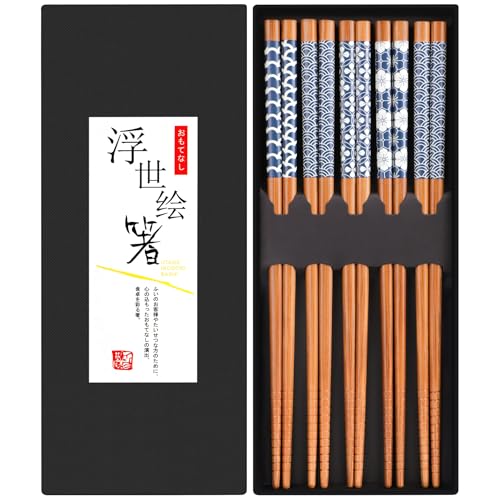
Antner 5 Pairs Natural Bamboo Chopsticks, 8.8 Inches — Best Budget
Bamboo is where most people start, and this Antner set shows why: it is light, warm in the hand, naturally grippy, and cheap enough that losing a pair down the back of the drawer is an annoyance rather than a loss. The 8.8-inch Japanese length suits individual place settings and smaller bowls.
Strengths
- Bamboo’s natural texture grips rice and noodles without any coating tricks
- Shorter Japanese length is easy to control, especially for newer users
- Arrives as a presentable gift set, which suits housewarmings and first apartments
Trade-offs
- Bamboo eventually splinters or stains if it is soaked or washed harshly for years
- Lighter weight feels less substantial to people who prefer a heavier stick
- Five pairs may be short for larger households that eat with chopsticks daily
| Material | Natural bamboo |
| Length | 8.8 inches (22.5 cm) |
| Pairs in set | 5 |
| Style | Classic Japanese |
Bamboo’s reputation as the disposable material is unfair to sets like this one. Reusable bamboo, kept out of long soaks and dried after washing, serves for a long time, and its slight flex and matte surface make it one of the most forgiving materials for learners. Food simply escapes less often than it does from polished steel or lacquered wood.
The honest limitation is lifespan and staining. Strong curries, beetroot and tomato sauces will mark bamboo over time, and a pair left sitting in dishwater will age faster than it should. Treat this set as a consumable with a long life rather than an heirloom, and its value makes complete sense: when a pair finally tires, the replacement cost is trivial.
If you are outfitting a first kitchen, pair this set with one longer cheap pair for cooking and you have covered the entire chopstick map for less than a single premium pair costs. Upgrade later only where your own habits have shown you a reason; bamboo will have taught you what you actually value by then.
Bamboo varies a little from pair to pair in any natural bundle — a shade here, a grain line there. Treat it as the material’s signature rather than a defect; the pair you can identify at a glance becomes, in practice, your pair.
Verdict in one line: the cheapest way to become a chopstick household, and the set against which every later upgrade will have to justify itself.
Best for: first chopsticks, learners, and anyone stocking a kitchen on a budget / Not suited for: buyers who want a buy-it-for-life set or who leave utensils soaking overnight
Check on Amazon — check price on Amazon before you buy, since listings and bundles change.
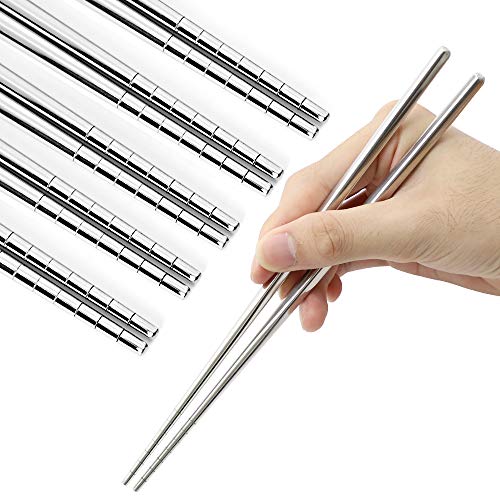
MUYOS Stainless Steel Chopsticks, 5 Pairs, Silver — Best for Durability
Stainless steel is the durability champion of this category: it cannot splinter, stain, absorb flavours or melt, and it will outlast every other material on this page. The usual objection is weight and slipperiness, and MUYOS answers both with a hollow core that keeps the pair light and textured non-slip tips.
Strengths
- Practically indestructible in normal kitchen life, with no staining or odour retention
- Hollow-core build keeps steel from feeling like two knitting needles
- Hygienic, non-porous surface that suits shared family sets
Trade-offs
- Steel still feels colder and harder in the mouth than wood or bamboo
- Can be noisy against ceramic bowls, which some households dislike
- Grips very oily food less forgivingly than bamboo despite the textured tips
| Material | Stainless steel, hollow-core |
| Pairs in set | 5 |
| Tips | Non-slip (per listing) |
| Care | Dishwasher safe (per listing) |
Korean-style steel chopsticks earned their place alongside metal bowls and spoons in everyday eating, and this set follows that tradition: flatter profile, fine tip texture, and a length suited to table use. If your household runs everything through the dishwasher and replaces bamboo sets every year or two, steel ends that cycle.
The trade-off to accept is sensory. Steel transmits the temperature of hot food a little more, clicks against teeth if you are careless, and gives slippery items like marinated mushrooms one extra chance to escape. Confident users rarely notice; beginners sometimes prefer to learn on bamboo or fiberglass first and graduate to steel once their grip is steady.
Steel also wins the travel-adjacent home uses nobody mentions: lunch boxes, desk drawers and picnic kits, where a pair can be rinsed and reused indefinitely and will never arrive snapped. Keep one pair in the bag you actually carry and the disposable-stick habit ends without any effort of will.
If two people in the house disagree about steel — one loves it, one cannot abide it — the silver and black versions of this MUYOS pattern make a diplomatic solution: matched performance, visibly separate pairs, no arguments about whose is whose.
Verdict in one line: buy steel when you are tired of replacing sets, and never think about chopstick shopping again.
Best for: households that prioritise hygiene and longevity, and confident everyday users / Not suited for: beginners still learning grip, or anyone who hates metal-on-ceramic noise
Check on Amazon — check price on Amazon before you buy, since listings and bundles change.

GLAMFIELDS Japanese Natural Wooden Chopsticks, 5 Pairs, 8.8 Inches — Best for Sushi and Japanese Meals
Japanese chopsticks are shorter and more pointed than Chinese styles for a reason: they are precision tools for picking bones from fish, lifting a single piece of sashimi, and working in small individual bowls. This hand-carved wooden set follows that pattern faithfully.
Strengths
- Fine pointed tips excel at fish bones, garnishes and precise placement
- Natural wood warmth and texture suits a Japanese table better than synthetics
- Lightweight control reduces hand fatigue over a long, slow meal
Trade-offs
- Wood wants hand washing and drying; the dishwasher shortens its life
- The short length feels cramped for shared family-style dishes in big bowls
- Pointed tips are less forgiving for children and absolute beginners
| Material | Natural wood |
| Length | 8.8 inches |
| Pairs in set | 5 |
| Style | Japanese, hand-carved (per listing) |
Length is the most misunderstood spec in this category. A 9.5 or 10.5-inch pair is built for reaching into shared dishes and larger Chinese-style bowls; an 8.8-inch Japanese pair keeps your hand closer to the food and your movements smaller. If your chopstick meals are mostly sushi, sashimi, miso and rice bowls, the shorter tool is simply the right one.
Wood also changes the eating experience in a way specs cannot capture. It is quiet against lacquer and ceramic, warm from the first bite, and its slight natural texture helps with the delicate skin of grilled fish. Care is the price: wash, dry, and store them out of steamy dishwasher cycles, and a set like this rewards you for years.
Care tip specific to wood like this: a drop of food-safe oil worked in once or twice a year keeps the surface fed and the grain closed, the same treatment a wooden spoon expects. It takes two minutes, and it is the difference between a set that greys and one that deepens in colour with age.
Shorter Japanese pairs reward a closer seat and a smaller bowl; if your table service runs to large Western dinner plates, test this set at a Japanese-style meal first, where its geometry makes immediate sense, before judging it at a family-style spread.
Verdict in one line: the right length and the right material for a Japanese table — a specialist that knows exactly what it is.
Best for: sushi and Japanese home cooking, and anyone who eats mostly from individual bowls / Not suited for: family-style sharing from big central bowls, or dishwasher-only households
Check on Amazon — check price on Amazon before you buy, since listings and bundles change.

Snow Peak Titanium Chopsticks — Best Premium
Snow Peak built its name on camping gear engineered like jewellery, and its titanium chopsticks bring that same thinking to the table: one pair, feather-light, effectively immortal, and supplied with a case so it can live in a bag and eat anywhere. This is the connoisseur’s pick, not the family’s.
Strengths
- Titanium is ultralight yet stronger than steel sets several times its weight
- Will never rust, stain, or pick up flavours from previous meals
- The included case makes it a genuine everyday-carry and travel pair
Trade-offs
- Premium tier pricing for a single pair, where other picks give you five or ten
- Titanium’s smoothness takes practice on very slippery food
- One pair means it is a personal set, not household stock
| Material | Titanium |
| Pairs in set | 1 |
| Extras | Carrying case included (per listing) |
| Positioning | Premium tier |
Why would anyone pay a premium for one pair of chopsticks? Because titanium removes every compromise at once: the hygiene of metal without the weight, the durability of steel without rust, and a neutrality that never taints delicate food. Backpackers adopted it first, but the same logic suits anyone who eats lunch at a desk, travels for work, or simply likes owning one perfect tool.
Be clear-eyed about what the money does not buy. It will not make a beginner competent, and it will not improve a takeaway eaten over the sink. It is an object-quality purchase: buy it because you will use the same pair for a decade and enjoy it every time, not because the food tastes different.
The case deserves a practical word: it makes this pair the one you can hand to a hygienic-minded guest or carry to a restaurant whose disposables you dislike. Small dignities like that are what premium everyday objects are actually for, and they compound over a decade of meals.
Titanium’s last trick is temperature: it takes on almost none of the food’s heat or the room’s cold, so the first bite of a winter meal away from home feels the same as the last. Small, constant, and exactly what people mean when they call a tool refined.
Verdict in one line: an indulgence with a decade-long alibi; buy it for the person whose hand will hold it daily.
Best for: travellers, campers, minimalists and anyone who wants one personal pair for years / Not suited for: families stocking a drawer, or buyers comparing value per pair
Check on Amazon — check price on Amazon before you buy, since listings and bundles change.

LEETOYI Ceramic Chopsticks, Set of 5, White, 9.6 Inches — Best for Presentation
Ceramic is the smallest corner of the chopstick market, and sets like this LEETOYI porcelain five-pack show both its appeal and its problem. Appeal: a smooth, glossy, completely non-porous pair that looks beautiful on a set table and rinses clean in seconds. Problem: it is, in the end, porcelain.
Strengths
- Porcelain is fully non-porous, so no staining and no lingering flavours
- The glossy white finish elevates a dinner-party table like no plastic can
- Smooth surface is genuinely easy to clean after oily meals
Trade-offs
- Ceramic chips or snaps if dropped on tile or knocked in a crowded drawer
- Glossy tips are the most slippery on this list for noodles and dumplings
- Not a set to hand to small children or use for everyday family chaos
| Material | Porcelain ceramic |
| Length | 9.6 inches |
| Pairs in set | 5 |
| Care | Easy to clean (per listing) |
Choose ceramic when the meal is an occasion. For a carefully plated dinner, porcelain pairs photograph beautifully, feel cool and substantial, and never carry yesterday’s chilli oil into today’s dessert. The 9.6-inch length follows the Chinese table tradition and works well with shared dishes.
Just do not pretend it is a daily driver. One drop onto a hard floor can end a pair, and the smooth tips demand a confident grip. Most households that love ceramic keep it as the good set, exactly like the good plates, and run fiberglass or bamboo for Tuesday nights. That division of labour is the sensible way to own it.
If you fall for ceramic, buy it the way you buy wine glasses: accept that the set of five becomes four someday, and enjoy the four. Households that mourn every chip stop using the good things entirely, which defeats the entire purpose of owning them.
Porcelain also has a sound — a soft, high note against a bowl — that households either find musical or distracting. It is worth one meal’s attention before a celebration debut; better to learn your own preference on a Tuesday than at an anniversary.
Verdict in one line: fragile, impractical and completely worth it on the evenings that matter — which is what occasion pieces are for.
Best for: dinner parties, plated meals and anyone building a ‘good set’ for occasions / Not suited for: everyday family use, children, or anyone prone to dropping utensils
Check on Amazon — check price on Amazon before you buy, since listings and bundles change.
Comparison Table: Best Chopsticks for Food Side by Side
Read the key spec column first: material decides care and grip, length decides which meals feel natural, and pair count decides whether you are buying for a person or a household.
| Pick | Badge | Key spec | Best for |
|---|---|---|---|
| HIWARE 10 Pairs Fiberglass Chopsticks, Black, 9.5 Inches | Best Overall | Fiberglass, 9.5 in, 10 pairs, dishwasher safe | everyday family meals, noodle nights and anyone who wants one set that simply works |
| Antner 5 Pairs Natural Bamboo Chopsticks, 8.8 Inches | Best Budget | Natural bamboo, 8.8 in, 5 pairs, classic Japanese style | first chopsticks, learners, and anyone stocking a kitchen on a budget |
| MUYOS Stainless Steel Chopsticks, 5 Pairs, Silver | Best for Durability | Stainless steel, hollow core, 5 pairs, non-slip tips, dishwasher safe | households that prioritise hygiene and longevity, and confident everyday users |
| GLAMFIELDS Japanese Natural Wooden Chopsticks, 5 Pairs, 8.8 Inches | Best for Sushi and Japanese Meals | Natural wood, hand-carved, 8.8 in, 5 pairs | sushi and Japanese home cooking, and anyone who eats mostly from individual bowls |
| Snow Peak Titanium Chopsticks | Best Premium | Titanium, ultralight, 1 pair, carrying case included | travellers, campers, minimalists and anyone who wants one personal pair for years |
| LEETOYI Ceramic Chopsticks, Set of 5, White, 9.6 Inches | Best for Presentation | Porcelain ceramic, 9.6 in, set of 5, easy to clean | dinner parties, plated meals and anyone building a ‘good set’ for occasions |
Does Chopstick Material Actually Change How Food Tastes and Feels?
Material changes the meal more than most first-time buyers expect, and not through flavour. Nothing on this page will season your food. What changes is friction, temperature and sound. Bamboo and wood offer natural texture that quietly grips; steel and titanium feel precise but colder; fiberglass sits in the middle with engineered grip and neutral feel; ceramic is the smoothest and the most demanding.
There is also a hygiene angle. Non-porous materials — steel, titanium, ceramic and fiberglass — cannot absorb oils or harbour yesterday’s garlic in the grain, which matters for shared household sets. Bamboo and wood are perfectly safe with normal washing, but they do age: fibres lift, stains settle, and eventually a pair is retired. Neither path is wrong; they are different ownership styles.
A practical way to decide: match the material to your washing habits first, because that is where sets actually die. Dishwasher-everything households should start with fiberglass or steel. People who happily hand-wash can choose freely, including the wood and ceramic sets that reward a little care.
- Fiberglass: lowest maintenance, strong grip, plain looks
- Bamboo and wood: warmest feel, best natural grip, finite lifespan
- Steel and titanium: most hygienic and durable, coolest in the mouth
- Ceramic: most beautiful, most fragile, smoothest tips
What Length of Chopsticks Is Right for Eating?
Eating chopsticks cluster between about 8.8 and 10.5 inches, and the difference is cultural as much as ergonomic. Japanese styles run shorter and more pointed, designed for individual bowls and precision work with fish. Chinese styles run longer, designed to reach shared dishes across a lazy Susan without leaning. Korean styles sit between, often in metal, sized for individual settings with shared side dishes.
For a mixed Western household, 9.5 inches is the safest default: long enough for shared bowls of noodles, short enough for a rice bowl at a place setting. Go shorter if your meals are mostly Japanese or if the primary user has small hands or is a child graduate moving up from trainers. Go longer only if shared family-style dishes dominate your table.
Ignore the very long sticks you will see in listings unless you are shopping for cooking. Sixteen-inch pairs are fryer and hot-pot tools; at the table they feel like conducting an orchestra, and they make beginners worse, not better.
How Many Pairs Does a Household Actually Need?
Count place settings, then add spares. A couple that eats with chopsticks twice a week is fine with five pairs. A family of four using them most nights should hold ten, because at any given moment some are in the dishwasher, some are in a lunch bag, and one is always missing in action.
This is why the bundle sizes in this guide matter as much as the materials. A ten-pair fiberglass set and a single titanium pair can both be the right purchase; they solve different problems. Many settled households end up with a two-tier drawer: a generous everyday bundle, plus one or two special pairs for the people who care.
Guests are the forgotten variable. If friends regularly join for hot pot or noodle night, a cheap bulk bamboo reserve in the cupboard saves the good sets from disappearing into takeaway bags.
What Makes Chopsticks Easy or Hard to Grip Food With?
Three things decide grip: tip shape, tip texture and your own technique. Tapered, slightly squared or textured tips hold food with less squeezing force. Perfectly round, polished tips — common on decorative lacquered and ceramic sets — demand more skill and punish oily food.
Technique matters more than gear, though. The stable stick rests on the ring finger and barely moves; the top stick does the work, held like a pencil. Squeezing harder is the classic beginner error: it tires the hand and actually makes food squirt away. A grippy set forgives that learning curve, which is why this guide favours textured tips for general recommendations.
Test any new set with the hard cases before judging it: a single peanut, a slick noodle strand, a piece of steamed fish. If it handles those three, it will handle dinner.
How Do You Test a New Set of Chopsticks in the First Week?
Give any new set the three-food test before you judge it. First, a single peanut or edamame bean: the purest test of tip alignment and fine control. Second, a strand of noodle in broth: the test of grip on something long, wet and unwilling. Third, a piece of steamed fish or soft tofu: the test of gentleness, because a set that shreds delicate food will annoy you for years.
Pay attention to your hand, not just the food. A well-matched set disappears; a badly matched one announces itself as finger fatigue, a grip that keeps sliding up the sticks, or tips that cross when you squeeze. Length is usually the culprit when the hand complains — most adults settle between 9 and 9.5 inches for mixed eating.
Also test the set’s manners: how it sounds on your bowls, how it behaves in your dishwasher or sink, and whether the finish survives the first hot, oily meal. A set that passes the food tests but fails your kitchen’s routines will migrate to the back of the drawer, which is the only real failure that matters.
What Is the Difference Between Everyday and Restaurant Chopsticks?
Restaurant chopsticks are chosen for the house, not the guest: they must survive industrial washing, cost little enough to lose, and work for the least experienced diner at the table. That is why restaurants favour exactly the profile of our top pick — fiberglass or melamine, textured tips, standard length, by the hundred.
Home sets can be more personal because the users are known. A household of confident eaters can choose slippery-beautiful lacquered wood that would fail in a restaurant; a household teaching children can choose grip over grace. The mistake is copying a restaurant’s logic into a home, or a home’s indulgence into a dinner party for twelve beginners.
There is one restaurant habit worth stealing: standardisation. Restaurants keep one length and one style so any two sticks form a pair. Homes that buy the same bundle twice enjoy the same quiet benefit every time they set the table.
Can Chopsticks Be the Only Utensil You Own?
For a large share of the world’s eaters, they already are — paired with a spoon for soups and a bowl lifted to the mouth, which is the technique the tools assume. Western meals ask more of cutlery: food arrives in large pieces that need cutting, and no chopstick will saw a steak.
The practical middle ground many households reach is chopsticks as the default for anything bite-sized, noodle-based, or shared from bowls — which, once the habit forms, is a surprising share of weeknight food. Portioning at the stove or board, rather than at the table, is the small change that makes it work.
None of this requires ideology. The picks in this guide earn their drawer space meal by meal, and a set that gets used four nights a week has justified itself whatever else shares the drawer.
Do Chopsticks Work for Western Food Too?
More of it than tradition suggests. Anything the kitchen has already cut to bite size — pasta shapes, salads, roasted vegetables, meatballs, gnocchi, pierogi — is natural chopstick food, and the sticks’ precision beats a fork at spearing the last olive from a shared bowl. Breakfast is the surprise convert: omelette pieces, sausages and fruit salad all behave.
The honest boundary is food that needs cutting or spreading at the table. Steaks, chops and toast stay with knife and fork, and nobody sensible fights that. The households that use chopsticks most are not purists; they are opportunists who reach for the best tool per plate.
There is also a portion side-effect many people notice and some actively seek: chopsticks slow a meal down and shrink each bite, which makes flavours register and fullness arrive on time. It is not a diet plan, but it is a real property of the tool, and for some eaters it is reason enough to switch the default.
How Should You Store Chopsticks Between Meals?
Dry, separated and reachable is the whole doctrine. A drawer divider or a dedicated slot keeps pairs together and tips unchipped; a utensil jar works for everyday bundles if the tips point up and the jar is not a wrestling ring of metal tools. Ceramic and wood benefit most from the divider, because their enemy is impact, not air.
Avoid the sealed, damp drawer at all costs: natural materials stored wet stay wet, and a musty bamboo pair is a pair retired early. If your kitchen runs humid, the jar on the counter genuinely out-stores the drawer for bamboo and wood.
Travel and lunch kits follow the same rule in miniature: a case or a simple cloth roll keeps a personal pair clean and findable, which is why the premium pick in this guide ships with one. The case is not a luxury flourish; it is the storage doctrine made portable.
A Short Note on Chopstick Etiquette for Home Tables
Home tables are forgiving, but a few habits travel well. Do not stick chopsticks upright in a bowl of rice — in several cultures the image belongs to funeral offerings, and a guest may read it that way. Do not spear food like a fork, point with your sticks, or hover undecidedly over shared dishes; each is the table equivalent of a loud voice.
Passing food stick-to-stick carries the same funereal echo in Japanese custom; put the piece on a small plate instead. And when you rest your sticks, rest them together on a rest or the bowl’s rim, not crossed on the table — order at rest is part of the meal’s calm.
None of this is law in your own kitchen, and no host in this guide’s world will grade you. But the habits cost nothing, they make shared meals smoother, and they are the difference between using chopsticks and being at home with them — which is, after all, what the best set is for.
How Do You Read a Chopstick Listing Like a Pro?
Read the title like a spec sheet, because in this category it is one: material, length, pair count and care claim are all usually there, in that order.
Convert the length before you judge it: 9.5 inches is about 24 centimetres, and a centimetre figure that looks small on the page can be a full size class on the table. Then divide the bundle by its pair count in your head; in this category, value lives in that division and nowhere else.
Finally, read the care claim against the material. Fiberglass and steel claiming dishwasher safety are believable; wood claiming it deserves the slower reading this guide gives it. A listing whose claims match its physics is a listing you can buy from — the whole method of this guide, applied in miniature.
How to Hold Chopsticks Correctly (and Fix the Common Grip Mistakes)
Good grip is a skill, not a talent, and most adults who struggle were simply never shown the two-stick system. Learn it once with any set from this guide and every future set feels easier.
- Rest the lower stick across the base of your thumb and the tip of your ring finger. This stick is the shelf: it should barely move during the whole meal.
- Hold the upper stick like a pencil, between thumb, index and middle finger, about a third of the way from its top end.
- Align the tips. Tap both ends lightly on the table so the points meet evenly; uneven tips are the hidden cause of most dropped food.
- Practise opening and closing by moving only the upper stick, keeping the lower one still, until the tips meet like pincers.
- Start with forgiving food — thick noodles, chunks of vegetable, pieces of omelette — before attempting peas, peanuts or anything in oil.
- Keep your grip relaxed and your hand close to the food. Tension, not the chopsticks, causes most fatigue and most fumbles.
If food still escapes, check the usual suspects in order: tips misaligned, grip too close to the tips, squeezing too hard, or a set whose tips are too polished for your current skill. Changing to a textured fiberglass or bamboo set is a legitimate shortcut while the technique settles.
Common Buying Mistakes
Buying cooking length for the table. Extra-long sticks are fryer tools. At a place setting they reduce control and make learners clumsier.
Judging a set by looks alone. The prettiest lacquered and ceramic pairs often have the slipperiest tips. Grip first, decoration second.
Putting wood and bamboo through years of dishwasher abuse, then blaming the material. High-heat cycles and long soaks are what shorten their lives.
Buying one pair per person with no spares. Chopsticks migrate to lunch bags, desks and takeaway orders. Bundles exist for a reason.
Assuming expensive means better for eating. Premium materials buy durability and feel. A mid-range set already eats perfectly well.
Final Recommendation
For most readers the HIWARE fiberglass set is the answer: ten pairs, real grip, zero care demands, and a price tier that makes the decision easy — check price on Amazon and be done. Households that prefer natural materials should start with the Antner bamboo set and accept its finite lifespan as the trade for warmth and grip.
Choose the MUYOS steel set if hygiene and permanence top your list, the GLAMFIELDS wooden set if your table leans Japanese, the Snow Peak titanium pair if you want one personal set for years of meals at home and away, and the LEETOYI ceramic set when the meal is an occasion and the table deserves it. Whichever you pick, buy enough pairs for real life, and keep a cheap bamboo reserve for guests.
Still deciding between styles? The guides below stay inside the same chopsticks family on this site.
The shortlist, one more time: HIWARE 10 Pairs Fiberglass Chopsticks, Black, 9.5 Inches, Antner 5 Pairs Natural Bamboo Chopsticks, 8.8 Inches, MUYOS Stainless Steel Chopsticks, 5 Pairs, Silver. Check price on Amazon for each before you decide.
Best Chopsticks Best Chopsticks For Beginners Best Bamboo Chopsticks Best Chopsticks For Eating Best Chopsticks For Home Best Chopsticks For Nonstick Pans
Frequently Asked Questions
Are fiberglass chopsticks safe for everyday eating?
Fiberglass chopsticks made for food use are a standard, widely sold category and are designed for exactly this job. They are valued because they do not warp, absorb flavours or degrade in the dishwasher. As with any utensil, retire a pair if the surface ever becomes damaged or frayed.
Can I put wooden and bamboo chopsticks in the dishwasher?
Many listings, including the Antner bamboo set above, are sold as dishwasher safe, and an occasional cycle will not ruin them. Over years, though, heat and soaking dry the fibres and shorten their life. Hand washing and prompt drying is the care routine that keeps natural materials serving longest.
Why do my chopsticks keep dropping noodles?
Usually one of three causes: the tips are not aligned, you are squeezing too hard, or the tips are too smooth for slippery food. Align the tips on the table, relax the grip, and if the problem persists, switch to a textured-tip set such as the fiberglass or bamboo picks in this guide.
What is the difference between Chinese, Japanese and Korean chopsticks?
Chinese styles are longest, built for shared dishes; Japanese styles are shorter and more pointed, built for fish and individual bowls; Korean styles are mid-length, often flat metal, built for use with metal bowls and slippery kimchi. None is better in general — each matches its cuisine.
How often should chopsticks be replaced?
Steel, titanium and fiberglass sets can serve for many years. Bamboo and wood should be retired when they splinter, warp, stain deeply or hold odours after washing. Ceramic is replaced when it chips. When in doubt, replace natural-material pairs rather than nursing damaged ones.
Are longer chopsticks better for beginners?
No. Beginners do better with standard eating length, around 9 to 9.5 inches, and grippy tips. Extra length amplifies every unsteady movement. Save long sticks for cooking, where the distance from hot oil is the point.

