Disclosure: airfryerkitchensupply.com is reader-supported. When you buy through links on our site, we may earn an affiliate commission at no extra cost to you.
Where to buy
Comparing the best 5 burner electric smoothtop cooktops starts with verified listings: a cooktop is a decade-long, hardwired purchase, so every model below was confirmed in Amazon’s catalogue data for this site — exact model, burner count, and control type — before earning a link. Ignore any listing that will not state its cutout dimensions and electrical requirements plainly; the six here do, and the reviews flag what to verify against your own counter before ordering.
- Frigidaire Professional FPEC3077RF 30-Inch Electric Cooktop — check price on Amazon
- VEVOR 30-Inch Built-In Electric Stove Top, 5 Burners, 8600W — check price on Amazon
- Karinear 36-Inch Electric Cooktop, 5 Burner Radiant, 8900W — check price on Amazon
- Jessier 30-Inch Electric Cooktop, 5 Burners, 8600W — check price on Amazon
- 30-Inch Built-In Electric Cooktop, 5 Burner, 9000W, Knob Control — check price on Amazon
- 36-Inch Electric Cooktop, 5 Burner Ceramic Glass, 9200W — check price on Amazon
The best 5 burner electric smoothtop cooktops solve a specific kitchen problem: five cooking zones on a flat glass surface that wipes clean in seconds, without giving up the fifth burner that makes holiday cooking and big-family weeknights manageable. This guide compares six verified models — a legacy-brand flagship from Frigidaire’s Professional line, two high-output 36-inch options, and three 30-inch models that squeeze five burners into the cutout most kitchens already have. The honest landscape: brand-name smoothtops carry better service networks and refined touches like bridge elements and precise low-end simmer control, while the newer value brands compete on raw wattage, touch controls, and timers at aggressive tier positions. Neither side is automatically right. The right choice depends on your cutout, your electrical panel, and whether you value a technician network or a feature list more — and this guide works through all three.
In this guide
Quick Picks
- Frigidaire Professional FPEC3077RF 30-Inch Electric Cooktop — Best Overall: The legacy-brand benchmark: five elements on ceramic glass with stainless trim, Professional-series controls, and a service network behind it. — Check on Amazon
- VEVOR 30-Inch Built-In Electric Stove Top, 5 Burners, 8600W — Best Budget: 8600W across five burners with sensor touch controls, a timer, and a child lock — the feature-per-dollar leader of this guide. — Check on Amazon
- Karinear 36-Inch Electric Cooktop, 5 Burner Radiant, 8900W — Best 36-Inch Value: A 36-inch five-burner surface with both knob and touch control, 8900W, a 99-minute timer, and child lock — space and flexibility together. — Check on Amazon
- Jessier 30-Inch Electric Cooktop, 5 Burners, 8600W — Best Touch-Control Alternative: Another 8600W five-burner in the standard 30-inch footprint, built for 240V hardwired installation — a strong second source in the value tier. — Check on Amazon
- 30-Inch Built-In Electric Cooktop, 5 Burner, 9000W, Knob Control — Best Knob Control: The highest stated output in the 30-inch group at 9000W, with physical knobs, an expandable triple-ring element, and ETL certification. — Check on Amazon
- 36-Inch Electric Cooktop, 5 Burner Ceramic Glass, 9200W — Best Maximum Power: 9200W across five zones on a 36-inch ceramic glass deck with touch control — the output ceiling of this guide. — Check on Amazon
How These Picks Were Chosen
Every candidate had to be a true 5-burner (five-zone) radiant electric smoothtop — not a 4-burner with a warming zone marketed creatively, and not an induction model wearing smoothtop language. Models were verified through the Amazon catalogue for this site so the ASIN, burner count, size, and control style match a real listing. We then ranked on element layout (does the fifth burner fit real pans simultaneously?), total and per-element power, control type and simmer quality, safety features such as child locks and hot-surface indicators, and the manufacturer’s support footprint. Cutout compatibility is called out per model because a cooktop that does not fit your counter is not a bargain at any tier. Prices are deliberately not printed — built-in appliance pricing moves with promotions, and a hardwired purchase should be made on fit and specification, with the live figure checked at the end.
The 6 Best 5 Burner Electric Smoothtop Cooktops, Reviewed

1. Frigidaire Professional FPEC3077RF 30-Inch Electric Cooktop — Best Overall
The FPEC3077RF suits buyers who want the fifth burner without gambling on an unknown brand for a hardwired appliance. Frigidaire’s Professional line brings the details value brands skip: well-spaced elements, a warming capability in the layout, and knobs and fitments that feel engineered. It does not suit bargain hunters — its tier position reflects the badge and the network behind it.
Strengths
- Five genuinely usable elements in a standard 30-inch cutout
- Professional-series build and finish, including stainless trim
- Nationwide parts and service network behind a hardwired purchase
Trade-offs
- Premium tier position versus value-brand rivals with similar wattage
- Knob controls rather than touch, if you prefer a fully flat surface
- Radiant elements cycle on and off — simmer finesse takes practice
| Size | 30 inch built-in |
| Elements | 5 radiant elements |
| Surface | Ceramic glass with stainless steel trim |
| Series | Frigidaire Professional |
What the Frigidaire name buys in a cooktop is not speed — radiant elements across brands heat at similar rates — but confidence in the unglamorous details. The element spacing lets a large skillet and two saucepans coexist without the handle collisions that plague tightly packed 30-inch five-burner layouts, the trim protects the glass edge where pans land hardest, and if an element fails in year six, a replacement exists and a technician within driving distance has seen this model before. For a hardwired appliance you cannot simply unplug and return, that ecosystem is a specification, not a luxury.
In daily cooking it behaves like the mature product it is: strong boils on the large elements, a keep-warm presence for sauces, and controls that respond predictably. Radiant cycling means the lowest settings pulse rather than hold a whisper of heat, so chocolate-melting purists should use a double boiler and move on. Everyone else gets the most complete, lowest-risk 30-inch five-burner smoothtop in this guide.
One ownership detail seals the Frigidaire’s case for many buyers: documentation and community. A Professional-series model accumulates years of installation guides, troubleshooting threads, and technician familiarity, so the answer to any future question — a humming element, a worn knob, a tripped indicator — is a search away rather than a shrug. On an appliance class where the alternative is often a PDF and a prayer, that accumulated knowledge is worth real money across a decade of ownership. Frigidaire’s deck also ages gracefully in the one way photographs cannot show: its controls stay legible. Printed markings under or beside quality knobs survive a decade of wiping where budget touch decals fade into archaeology. An appliance whose settings you can still read in year nine is an appliance you still cook on confidently in year nine, and that quiet durability is the Professional premium’s most honest justification.
Best for: buyers who want brand backing and serviceability in a 30-inch cutout / Not suited for: shoppers prioritizing maximum features per dollar
Check on Amazon — check the current price on Amazon before you buy, because countertop and built-in appliance pricing moves often.

2. VEVOR 30-Inch Built-In Electric Stove Top, 5 Burners, 8600W — Best Budget
The VEVOR suits renovators and landlords who need five burners on a controlled budget and prefer touch controls to knobs. Nine power levels and a per-element timer are features the legacy brands reserve for higher tiers. It does not suit buyers who need a local service network — VEVOR’s support is online-first, and that is the honest trade for its price position.
Strengths
- 8600W total output is strong for the 30-inch class
- Touch controls wipe clean and include a timer and child lock
- Nine power levels give finer control than basic knob rivals
Trade-offs
- Online-first support network rather than local technicians
- Touch controls can be finicky with wet or gloved hands
- Brand’s long-term parts availability is less proven than Frigidaire’s
| Size | 30 inch built-in |
| Total power | 8600W |
| Controls | Sensor touch, 9 power levels |
| Safety | Timer and child lock |
VEVOR’s playbook is to publish the numbers legacy brands whisper: 8600W total, nine levels, timer, child lock, all on a glass radiant surface in a standard 30-inch footprint. In the kitchen those numbers translate to a genuinely quick big-pot boil for the class and low settings that simmer more delicately than the three-position budget cooktops of a decade ago. The touch panel keeps the smoothtop promise best — a single wipe crosses the whole surface with nothing to trap grease.
The compromises live outside the cooking. Support runs through the brand’s online channels, installation documentation is functional rather than luxurious, and if you are the kind of owner who keeps appliances fifteen years, the parts question deserves a thought before the savings seduce you. For a rental upgrade, a flip, a first renovation, or any kitchen where the cooktop’s job is five honest burners at a sane tier, it is the budget pick that does not feel like one.
Renters-turned-owners should note how well this deck suits the ‘first real kitchen’ brief: the touch surface photographs beautifully for a listing or a resale, the child lock speaks to young families, and the timer quietly upgrades weeknight cooking for anyone graduating from a basic range. Value appliances earn their keep by making a modest kitchen feel finished, and a flush glass five-burner deck is the single most visible upgrade a cooktop budget can buy. The VEVOR’s timer deserves a renter-to-owner translation: on a range, timers are decoration; on a touch deck with per-element timing, they become a cooking method — pasta that stops itself, rice that rests off the heat on schedule, a sauce that holds its appointment while the cook handles the door. First-time smoothtop owners consistently report the timer, not the glass, as the feature that changed their weeknights.
Best for: budget renovations, rentals, and feature-focused buyers / Not suited for: owners who prioritize a local service network
Check on Amazon — check the current price on Amazon before you buy, because countertop and built-in appliance pricing moves often.

3. Karinear 36-Inch Electric Cooktop, 5 Burner Radiant, 8900W — Best 36-Inch Value
The Karinear suits cooks remodeling to a 36-inch cutout who cannot decide between knobs and touch — so it includes both. The wider deck spreads five burners far enough apart for genuinely simultaneous large pans, which is the entire point of moving up a size. It does not suit 30-inch kitchens; measure the cutout before falling for the space.
Strengths
- 36-inch deck gives five burners real elbow room
- Dual control styles — knobs for feel, touch for precision
- 8900W with a long 99-minute timer for slow jobs
Trade-offs
- Requires a 36-inch cutout — not a drop-in for 30-inch kitchens
- Two control systems mean a busier surface to learn
- Value-brand support model, like the VEVOR above
| Size | 36 inch built-in |
| Total power | 8900W |
| Controls | Knob and touch, 9 heat levels |
| Timer | 99 minutes, with child lock |
The jump from 30 to 36 inches is the single biggest usability upgrade in this category, bigger than any wattage figure: burners stop competing for the same airspace, a 12-inch skillet stops evicting the sauce pot, and the fifth burner becomes a daily tool instead of a holiday ornament. Karinear’s 8900W deck uses that space well, and the unusual knob-plus-touch control scheme turns out to be practical — knobs for the burners you adjust by feel mid-sear, touch for timed, set-and-forget work.
Nine heat levels and the 99-minute timer cover the slow end of cooking that cheap cooktops fumble, and the child lock matters in a family kitchen where a flat glass deck invites small hands. As with the other value brands here, you are trading legacy service infrastructure for specification and space; in a 36-inch remodel where the budget is already stretched by cabinetry and counters, that trade is often exactly right.
The Karinear’s dual-control scheme has a household-politics benefit nobody markets: different cooks genuinely prefer different interfaces, and a deck that offers both ends the argument permanently. The knob partisan sears on the front burners; the touch partisan runs the timed back burners; dinner happens either way. In shared kitchens — which is to say, in kitchens — that kind of diplomatic design is a feature with daily returns. Karinear’s 99-minute timer quietly serves the slow cookery that radiant decks are rarely credited with: the long braise in a heavy pot, the stock that wants an unattended afternoon, the beans that forgive everything except being forgotten dry. A timer that trusts the cook with real durations turns a weeknight appliance into a weekend one, and the 36-inch Karinear is the only deck in its tier here that makes that offer.
Best for: 36-inch remodels wanting space plus flexible controls / Not suited for: 30-inch cutouts or brand-network-first buyers
Check on Amazon — check the current price on Amazon before you buy, because countertop and built-in appliance pricing moves often.

4. Jessier 30-Inch Electric Cooktop, 5 Burners, 8600W — Best Touch-Control Alternative
The Jessier suits buyers who want the VEVOR formula — five burners, high total wattage, standard cutout — from a different brand, whether for availability, a promotion, or preference. Having two near-identical value options in this guide is deliberate: at this tier, the live price and stock position on the day you buy should decide between them. It shares the class caveat about online-first support.
Strengths
- 8600W across five burners in a 30-inch footprint
- Standard 240V hardwired installation
- Gives shoppers a genuine second option in the value tier
Trade-offs
- Specification and support model mirror its value-tier rivals
- Fewer published ownership reports than longer-running models
- Touch surfaces need dry hands for reliable response
| Size | 30 inch built-in |
| Total power | 8600W |
| Electrical | 240V hardwired |
Cooktop shopping at the value tier is often decided by logistics rather than loyalty: which model is in stock, which is promoted this week, which one’s cutout sheet matches your counter exactly. The Jessier earns its place by matching the class leaders on the fundamentals — five burners, 8600W, a flat glass deck that cleans in one pass — so that a shopper choosing it on availability loses nothing in the cooking.
Treat the pre-purchase checks in this guide’s how-to section as part of the product: verify your cutout against its dimension sheet, confirm your panel can supply the circuit, and plan the hardwired connection with a qualified installer. Do those three things and this class of cooktop delivers years of unglamorous, reliable service — which is all a smoothtop is ever asked to do.
Jessier’s deck also illustrates a shopping principle worth keeping beyond this guide: in a mature value tier, the second brand is not a compromise but a strategy. Identical fundamentals from two makers means promotions alternate, stock rotates, and the patient shopper who watches both listings for a fortnight usually captures the better week. The cooktop does not care which badge won; the burners, the glass, and the cooking are the same where it matters. Jessier buyers should plan one small ritual the legacy brands’ owners skip: photograph the rating label and the box’s specification panel on day one, and store the images with the house documents. Young brands’ documentation lives online and moves; your photographs do not. It is a five-minute insurance policy that makes any future parts or support conversation start from evidence instead of archaeology.
Best for: value-tier shoppers choosing on stock and live price between equals / Not suited for: buyers who want a long published track record
Check on Amazon — check the current price on Amazon before you buy, because countertop and built-in appliance pricing moves often.
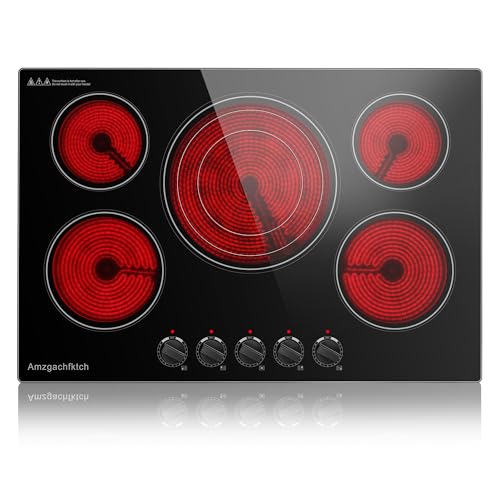
5. 30-Inch Built-In Electric Cooktop, 5 Burner, 9000W, Knob Control — Best Knob Control
This unbranded 9000W model suits cooks who distrust touch panels — landlords, traditionalists, and anyone who cooks with wet hands and wants a knob that answers every time. The expandable triple-ring element adapts one burner to small saucepans or a stockpot, a flexibility trick the touch models above mostly skip. The trade is brand anonymity: certification is real, but there is no legacy name behind it.
Strengths
- 9000W is the strongest stated output among the 30-inch picks
- Knobs work with wet hands, gloves, and zero learning curve
- Triple-ring element flexes between small and oversized pans
Trade-offs
- Unbranded — support and parts run through the seller
- Knobs interrupt the wipe-clean flat surface
- Certification is ETL rather than a household-name badge
| Size | 30 inch built-in |
| Total power | 9000W |
| Controls | Physical knobs |
| Elements | Includes an expandable triple-ring element |
| Certification | ETL certified; 220V hardwired |
There is a durable argument for knobs on a working cooktop: they are tactile, they respond mid-splash, and they will never ask you to dry a fingertip before acknowledging a command. This model pairs that old-school control with the highest total wattage in the 30-inch group and a triple-ring element that solves the classic five-burner problem — the big burner that scorches small pans — by letting one element wear three sizes.
The ETL certification matters and should be said plainly: it means the unit was tested to North American safety standards, which is the correct minimum bar for an unbranded hardwired appliance. Beyond that, ownership is seller-supported, so buy through a channel with a real returns policy and keep the documentation. For knob loyalists, this is the pick that respects the preference without surrendering power.
Landlords should read this model closely, because knobs solve their two classic cooktop problems: tenants cannot break a software interface that does not exist, and a control that reads at a glance — off is off, visibly — reduces the ‘was it left on?’ category of worry. Combined with ETL certification for the paperwork file and the strongest output in its size class, it is the rare unbranded deck that a property owner can specify with a straight face. The triple-ring element deserves a technique note: use the inner ring alone for the small saucepan and the butter, the full rings for the stockpot, and the middle configuration for the everyday skillet — the element is three burners wearing one address, and cooks who learn its personalities stop wasting the big burner’s heat on small work. Flexibility of that kind is what separates a five-burner deck that feels generous from one that merely counts to five.
Best for: knob loyalists and cooks who want maximum stated power / Not suited for: buyers who need a named brand’s service network
Check on Amazon — check the current price on Amazon before you buy, because countertop and built-in appliance pricing moves often.
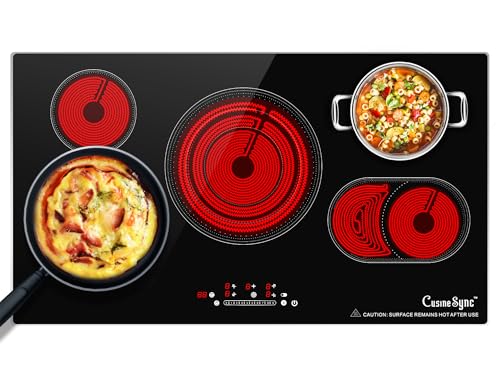
6. 36-Inch Electric Cooktop, 5 Burner Ceramic Glass, 9200W — Best Maximum Power
This 36-inch model suits the cook who runs big pots often — canning, stock-making, pasta for a crowd — and wants the strongest radiant output in the guide spread across a wide deck. It is a specification-led purchase: the numbers lead, the brand follows. Kitchens with 30-inch cutouts or modest electrical panels should look above instead; 9200W asks your panel a serious question.
Strengths
- 9200W total output tops this guide
- 36-inch spacing suits stockpots and canning kettles
- Flat touch-controlled glass cleans in seconds
Trade-offs
- Highest electrical demand here — verify panel capacity first
- Unbranded support model, like the other value-tier picks
- Overkill for small households that rarely run three burners
| Size | 36 inch built-in |
| Total power | 9200W |
| Controls | Touch control |
| Surface | Ceramic glass |
Power in a radiant cooktop shows up as recovery: how fast a burner returns to a boil after cold pasta drops, how a sear survives a crowded pan. At 9200W spread over five zones, this deck has recovery to spare, and the 36-inch width means the big vessels that need that power actually fit side by side. For preserving season, stock weekends, and multi-pot family cooking, it is the most capable surface in this article.
Capability has prerequisites. Confirm the circuit and panel can feed it, confirm the cutout, and confirm the seller’s support terms, in that order, before the live price tempts you. Buyers who do that homework get a great deal of cooktop; buyers who skip it get a very flat, very heavy paperweight until the electrician visits.
Canners and stock-makers will recognize their own requirements in this deck’s numbers: sustained high output under a vessel that covers half the surface, with the neighboring zones still free for the jars, the lids, and the second pot. Preserving season is the one week a year when a cooktop’s ceiling becomes the household’s ceiling, and a 9200W wide deck raises that ceiling higher than anything else in this guide — a niche virtue, but for the households in the niche, the deciding one. A wide deck also changes cleaning mathematics in the owner’s favor: spills spread across more glass instead of concentrating around crowded burners, and the flat touch surface has no knob cluster to detail with a toothbrush. Five minutes with the right cleaner restores the whole 36 inches — the largest cooktop in this guide is, perversely, among the fastest to make look new again.
Best for: high-volume cooks with a 36-inch cutout and a capable panel / Not suited for: 30-inch kitchens or light-duty cooking
Check on Amazon — check the current price on Amazon before you buy, because countertop and built-in appliance pricing moves often.
Comparison Table
| Pick | Badge | Key spec | Best for |
|---|---|---|---|
| Frigidaire Professional FPEC3077RF 30-Inch Electric Cooktop | Best Overall | 30-inch, 5 elements, ceramic glass, stainless steel trim | buyers who want brand backing and serviceability in a 30-inch cutout |
| VEVOR 30-Inch Built-In Electric Stove Top, 5 Burners, 8600W | Best Budget | 30-inch, 5 burners, 8600W, touch control, timer, child lock | budget renovations, rentals, and feature-focused buyers |
| Karinear 36-Inch Electric Cooktop, 5 Burner Radiant, 8900W | Best 36-Inch Value | 36-inch, 5 burners, 8900W, knob + touch control, 99-min timer | 36-inch remodels wanting space plus flexible controls |
| Jessier 30-Inch Electric Cooktop, 5 Burners, 8600W | Best Touch-Control Alternative | 30-inch, 5 burners, 8600W, 240V built-in | value-tier shoppers choosing on stock and live price between equals |
| 30-Inch Built-In Electric Cooktop, 5 Burner, 9000W, Knob Control | Best Knob Control | 30-inch, 5 burners, 9000W, knob control, expandable triple ring, ETL certified | knob loyalists and cooks who want maximum stated power |
| 36-Inch Electric Cooktop, 5 Burner Ceramic Glass, 9200W | Best Maximum Power | 36-inch, 5 zones, 9200W, ceramic glass, touch control | high-volume cooks with a 36-inch cutout and a capable panel |
How to Choose a 5 Burner Electric Smoothtop Cooktop
Fit comes before features, always. Measure your existing cutout — not the cooktop’s outer glass — and compare it with the candidate’s published cutout dimensions, because 30-inch and 36-inch models are families, not exact standards. Then check the electrical side: five-burner radiant decks in this guide run from 8600W to 9200W and hardwire to a dedicated circuit, so your panel’s capacity and breaker size are part of the product decision. If either measurement fails, the conversation ends there, however good the price looks.
With fit settled, judge the layout with your own pans in mind. Put your largest skillet and your stockpot side by side on a mental map of the deck: can they share it? Does the fifth burner accept a real pan or only a butter warmer? Expandable dual- and triple-ring elements are the honest solution to that squeeze, and they matter more than a few hundred watts of headline power. Controls are a lifestyle choice — touch for the cleanest surface and timers, knobs for wet-hand certainty — and neither is wrong.
Finally, weigh support as a specification. A hardwired appliance you will own for a decade deserves a parts pipeline: legacy brands sell theirs openly, value brands support through the seller. Both models can be rational; the irrational move is not knowing which one you bought.
Radiant Smoothtop vs Induction: Which Five-Burner Surface Suits You?
This guide is about radiant smoothtops, but the comparison is worth one section because shoppers cross-shop constantly. Radiant elements heat any flat-bottomed pan — aluminum, cast iron, copper, glass — glow visibly when hot, and cost less to buy in this class. They are slower to respond, hold residual heat after shutoff, and cycle on and off at low settings. Induction heats the pan itself, responds instantly, and keeps the surface cooler, but demands magnetic cookware and usually a higher tier position for five zones.
Choose radiant when your cookware collection is mixed, your budget is firm, and your cooking is the forgiving weeknight kind. Choose induction when speed, simmer precision, and a cooler kitchen justify new pans and a bigger spend — the companion induction guide in this series works through that side in full. What both share is the smoothtop blessing: no grates, no burner wells, one flat wipe between you and a clean kitchen.
How Radiant Smoothtop Elements Actually Behave
A radiant element does not hold a steady temperature the way a gas flame does; it cycles. At full power the element glows continuously, at medium it pulses between on and off in long waves, and at low settings the pulses shorten to brief blushes of heat separated by rests. Understanding that rhythm explains everything about smoothtop cooking: why a pan’s mass matters (heavy pans smooth the pulses into steady heat), why the first minutes on a burner feel slow (the glass itself must come up to temperature), and why residual heat keeps cooking after shutoff — a feature for holding sauces, a hazard for the unwary hand.
Cooking technique adjusts in small, learnable ways. Preheat the pan on medium-high rather than maximum to avoid thermal shock arguments between pan and glass. Move a pan off the element to stop cooking instantly instead of trusting the dial, because the glass will keep giving heat for minutes. Use the residual warmth deliberately — it is free energy for melting butter, warming plates, and holding a finished side dish while the main course catches up. Cooks who learn the rhythm stop missing gas within a month; cooks who fight it blame the cooktop forever.
The glass itself is tougher than its reputation and more specific in its enemies. It tolerates heavy cast iron placed with ordinary care, shrugs off boiling water, and cleans with a dedicated ceramic cleaner that dissolves the polymerized film ordinary detergents smear. Its true enemies are three: sugary spills left to carbonize, which can pit the surface as they cool; abrasive pads, which cloud it permanently; and sliding rough-bottomed pans, which engrave it slowly. Avoid those, and a smoothtop looks new for the life of the elements beneath it.
Sizing the Circuit: What 8600W to 9200W Means for Your Panel
Five-burner radiant decks are among the hungrier appliances in a kitchen, and their appetite deserves a plain explanation. The headline wattage — 8600W to 9200W across this guide — is the theoretical maximum if every element ran at full power simultaneously, a situation real cooking almost never creates, because nobody boils five pots at a rolling maximum at once. Breaker sizing follows the manufacturer’s stated requirement for the model, which already accounts for realistic diversity of use; your job is simply to confirm that the circuit in your wall matches the sheet for the deck you chose.
Older kitchens are where the surprises live. A home wired when a four-burner range on a modest circuit was the norm may need a panel conversation before a 9200W deck arrives, and that conversation is cheapest before the cooktop is in the driveway. The measurement routine in this guide’s how-to section exists precisely to surface that issue while it is still a phone call rather than a restocking fee.
If the panel cannot grow, the answer is not despair — it is the lower-wattage end of this guide, or a four-burner deck, chosen knowingly. Electrical capacity is a property of the house, not a failing of the shopper, and every size of kitchen in this series has an honest pick waiting for it.
Five Burners on 30 Inches: Living With the Squeeze
Buyers choosing between the 30-inch and 36-inch decks in this guide deserve a clear picture of daily life at the smaller size. Thirty inches fits five elements by arranging them with intent: typically two strong burners placed diagonally, medium burners filling the other corners, and the fifth — often a warming or small element — where space remains. The system works when the cook assigns roles: big work travels between the two strong positions, and the small burners handle the supporting cast they were sized for.
The squeeze appears with pan geometry, not burner count. Two 12-inch skillets cannot share a 30-inch deck’s front row, whatever the brochure implies, and a stockpot centered on a rear burner will lean its handles over its neighbors. Households whose cooking leans on oversized pans should read that sentence twice and then read the 36-inch reviews. Households whose pans are the standard 8-to-11-inch fleet will find the 30-inch five-burner deck roomy enough that the squeeze stays theoretical.
One technique dissolves most of the remaining friction: cook in sequence by temperature, not by dish. The high-heat work — searing, boiling — claims the strong burners first and finishes early; the finished pans retire to the small burners to hold warm while the next act takes the strong positions. Run that rotation and a 30-inch five-burner deck feeds a household with the calm of a much larger kitchen, which is, in the end, the entire reason the format exists.
What a Warming Zone Is and Whether You Will Use It
Many five-burner layouts quietly dedicate the fifth element to low, steady warmth rather than full cooking power, and shoppers deserve to know whether that trade serves them. A warming zone holds a finished dish at serving temperature without cooking it further — the gravy at the holiday, the pancakes across a slow breakfast, the soup while the bread finishes. Households that serve in courses use it weekly; households that plate everything at once may never switch it on. Check each model’s sheet for what its fifth element actually does, and count it as a feature only if your table’s rhythm says so.
A Note on Glass Color and Kitchen Light
Smoothtop glass is usually black, occasionally white or gray, and the choice is more practical than it looks. Black glass hides the faint swirl marks of daily wiping and flatters most kitchens, but it shows dust and flour at a glance. White glass brightens a small kitchen and reports every splash honestly — a virtue for the tidy, a burden for the rest. Either way, the glass will be the largest uninterrupted surface in the room, so choose the color for the kitchen you keep, not the kitchen in the photograph.
How to Measure Your Cutout and Prepare for a Cooktop Swap
Most cooktop disasters are measurement disasters that happen before the box opens. This sequence takes fifteen minutes and prevents all of them.
- Kill the breaker to the existing cooktop and confirm it is dead at the unit — you are measuring, not wiring, but habits protect people.
- Lift or slide the old cooktop enough to measure the cutout itself: width, depth, and the counter material’s thickness. Write the numbers down; memory edits measurements.
- Measure the space below the counter too. Drawers, oven tops, and gas or electrical lines under the cutout decide whether the new unit’s depth fits, and surprises here are the expensive kind.
- Check your panel: note the existing cooktop circuit’s breaker size and compare it with the new model’s requirements. A 9200W deck and a modest panel need an electrician’s opinion before, not after, delivery.
- Photograph the existing wiring junction before disconnecting anything. When the installer — or you, if you are qualified — connects the new unit, that photo is the map.
- Keep the old cooktop until the new one is installed and boiling water. A kitchen without any cooktop while a return ships is a special kind of misery.
Common Buying Mistakes
- Measuring the glass instead of the cutout. The glass overhangs; the cutout decides fit. A half-inch error here is the difference between an install and a countertop recut.
- Ignoring the electrical panel. Five-burner decks draw serious power. Verify breaker and wiring capacity before ordering, not from the delivery truck.
- Assuming all five burners fit all five pans. Layout beats count. Check element sizes and spacing against your largest pans, or use expandable-ring models to cheat the geometry.
- Scraping the glass with metal or abrasive pads. Smoothtops clean with a dedicated cleaner and a soft pad. Sugary spills need prompt removal while warm — melted sugar is the one spill that can pit glass.
- Buying the widest deck for a small kitchen’s habits. A 36-inch cooktop for a household that runs two burners is counter space spent, not saved. Match the deck to the cooking.
Final Recommendation
For most buyers the Frigidaire Professional FPEC3077RF is the safe center of this category: five real elements, mature design, and a service network worthy of a hardwired purchase. The VEVOR is the budget answer that keeps the features people actually use, the Karinear is the 36-inch value pick, and the Jessier stands as its equal-footed alternative when stock or promotions favor it. Knob loyalists should take the 9000W knob model seriously, and high-volume cooks with the panel to feed it will get the most from the 9200W 36-inch deck. Whichever you choose, run the measurement routine in this guide before ordering and check the live price at the link last — in that order, and this category will treat you well. The companion guides below cover the gas and induction versions of the five-burner question, plus the budget-cooktop tier as a whole.
Shortlist again, for convenience: Frigidaire Professional FPEC3077RF 30-Inch Electric Cooktop (Best Overall); VEVOR 30-Inch Built-In Electric Stove Top, 5 Burners, 8600W (Best Budget); Karinear 36-Inch Electric Cooktop, 5 Burner Radiant, 8900W (Best 36-Inch Value).
Frequently Asked Questions
Is a fifth burner on a 30-inch cooktop actually usable?
Yes, with layout awareness. On a well-spaced 30-inch deck the fifth element handles a saucepan, kettle, or warming duty while the four mains work — it is a supporting player, not a stockpot throne. If all five of your regular pans are large, step up to a 36-inch deck.
How much power does a 5 burner electric cooktop need?
The models in this guide total 8600W to 9200W and hardwire to a dedicated 240V-class circuit. Your existing cooktop circuit may already suit a like-for-like swap, but a jump in wattage deserves an electrician’s confirmation before installation.
Can I install a smoothtop cooktop myself?
If you are comfortable with hardwired electrical work and local code allows it, a like-for-like swap is a common project. If the circuit, junction, or cutout needs changing, hire it out — the savings from a DIY wiring mistake are negative.
How do I keep the glass from looking cloudy?
Use a ceramic-glass cleaner regularly, lift pans instead of sliding them, and wipe spills before the next heating cycle bakes them on. Cloudiness is usually mineral and polymerized-oil film, and it yields to the right cleaner and patience, not abrasives.
Radiant or induction for a five-burner deck?
Radiant for mixed cookware and firm budgets; induction for speed, precision, and instant response if your pans are magnetic and the tier fits. This guide’s radiant picks are the value side of that fork, and the induction companion guide covers the other.
What should I check before ordering any built-in cooktop?
Cutout width and depth, below-counter clearance, circuit capacity, and the seller’s return terms for a freight-sized item. Those four checks, done in that order, prevent nearly every bad cooktop purchase story ever told.
Can I use cast iron on a smoothtop cooktop?
Yes — cast iron is fully compatible with radiant smoothtops and is, in fact, an excellent partner, because its mass smooths the elements’ on-off cycling into steady heat. The conditions are care, not prohibition: lift the pan instead of sliding it, keep the base clean and free of rough burrs, and avoid dropping it from height onto the glass. Enameled cast iron is the gentlest of all. Generations of cooks run iron on glass daily; the glass only objects to being treated like a countertop.
Best Affordable Induction Cooktops
Best Induction Cooktops
Best Electric Cooktops


