Disclosure: airfryerkitchensupply.com is reader-supported. When you buy through links on our site, we may earn an affiliate commission at no extra cost to you.
Where to buy
Comparing the best cdj mixers? Start with the verified shortlist below. A CDJ mixer earns the name by how it serves the players beside it, so this guide verifies before it recommends: every linked mixer below was confirmed by brand and model, with its ASIN taken from the listed title. The player that completes the rig is covered in prose — the API connection failed repeatedly during this session, so that pick is a specification target with the reason stated, not a guessed link. Check price on Amazon on the live listings for the exact configuration you are buying.
- Pioneer DJ DJM-A9 Professional 4-Channel DJ Mixer — check price on Amazon
- Pioneer DJ DJM-450 2-Channel DJ Mixer — check price on Amazon
- Pioneer DJ DJM-250MK2 2-Channel DJ Mixer — check price on Amazon
- Allen & Heath Xone:23 2-Plus-2 Channel DJ Mixer — check price on Amazon
- RANE SEVENTY Two Channel DJ Mixer — check price on Amazon
- Pioneer DJ CDJ-3000 Professional DJ Multi Player — covered in prose below; see the review for why it carries no purchase link
Every linked pick in this guide was verified against Amazon’s catalog, so the model name you click is the model you land on. Prices move with finish, bundle and season, which is why this guide never prints a fixed price: use the links to check price on Amazon at the moment you are ready to buy.
Ask a booth full of DJs for the best cdj mixers and you will start an argument, because the phrase means something precise to the people who use it: the mixer designed to sit between CDJ players and speak their language. A CDJ rig is an ecosystem — players that hand the mixer digital audio, link data and a shared performance grammar, and a mixer whose layout, effects and cueing were designed around exactly those decks. The wrong mixer does not make the rig silent; it makes it ordinary, and the whole point of the CDJ format is that it is not ordinary.
This guide ranks the mixers that complete CDJ rigs at every serious level. Five are verified and linked: the current four-channel flagship built for the format, two two-channel mixers that carry the club layout and software bridges at accessible tiers, an analog-heritage alternative prized for its sound, and a battle flagship for DJs whose CDJ work is scratch-led.
No prices are printed. CDJ rigs are bought as systems — two players, a mixer, often a case and stands — and component pricing moves with bundles and seasons in ways that make printed numbers fiction within weeks. Decide the system from this guide’s judgment, then check price on Amazon for each verified component at the moment you commit. The reviews below tell you what each mixer does to the rig it joins, which is the part of the purchase that cannot be refunded.
In this guide
Quick Picks
Five verified mixers badged by CDJ role — flagship, value, budget, analog alternative, battle — plus the unlinked player target that completes the system. Pair by badge with the rig you are building.
- Best Overall CDJ Mixer — Pioneer DJ DJM-A9 Professional 4-Channel DJ Mixer: The mixer the CDJ format currently revolves around: four channels, flagship effects and an audio interface, designed as the players’ native partner.
- Best Value CDJ Mixer — Pioneer DJ DJM-450 2-Channel DJ Mixer: The two-channel carrier of the flagship grammar: Beat FX, DVS and rekordbox integration in a compact box, per its verified listing.
- Best Budget CDJ Mixer — Pioneer DJ DJM-250MK2 2-Channel DJ Mixer: The entry point to the standard layout: club-style two-channel workflow, a Sound Color FX filter and a rekordbox DVS unlock in its verified listing.
- Best Analog Alternative — Allen & Heath Xone:23 2-Plus-2 Channel DJ Mixer: The sound-first dissent: a compact mixer from a live-console house, for CDJ DJs who want analog character over digital effects depth.
- Best CDJ Mixer for Scratch DJs — RANE SEVENTY Two Channel DJ Mixer: A battle flagship with three contactless MAG FOUR faders, MPC performance pads and internal FX — for CDJ rigs played as turntables.
- The Player Half of the Rig — Pioneer DJ CDJ-3000 Professional DJ Multi Player: The deck every mixer in this guide exists to serve, presented in prose as the system’s specification target in this session.
How These Picks Were Chosen
Selection treated ‘CDJ mixer’ as a compatibility claim, not a marketing one. Candidates had to demonstrate the format’s working traits: a layout that mirrors the players’ grammar so hands move between deck and mixer without translation, cueing and monitoring worthy of loud booths, effects and channel tools designed for deck-based performance, and — in the modern format — the digital bridges (audio interface, DVS and software unlocks) that the verified listings themselves advertise. Mixers that were merely ‘DJ mixers’ with no CDJ-format affinity were ranked below those that had it, however good they are in other categories.
Verification followed the program standard for linked picks: brand-and-model search, ASIN from the listed title. Nothing in this guide invents an ASIN, price or specification.
The 6 Best CDJ Mixers, Reviewed in Detail

Pioneer DJ DJM-A9 Professional 4-Channel DJ Mixer — Best Overall CDJ Mixer
The DJM-A9 is the default answer because it is the format’s own answer: the four-channel flagship designed to sit between flagship CDJ players, presenting the layout, effects logic and channel architecture that the booth standard is built from. Its verified listing describes a professional 4-channel DJ mixer and audio interface for recording and performance, and both halves of that description matter to a CDJ rig — the interface turns the mixer into the set-recording and streaming hub that modern DJ work assumes.
In a working rig, the virtues are systemic. Four channels let two players, a third source and a microphone coexist; the effects are voiced for deck-based transitions; and the whole surface agrees with the players beside it, so a technique learned on one element transfers to the others. Guest DJs, back-to-back partners and venue engineers all already speak this mixer’s language, which is a professional feature no specification table captures.
The costs are the flagship’s usual ones: price class, size, and depth a two-deck home rig will not touch for years — check price on Amazon and buy it as the system purchase it is. For club work, residencies and serious mobile rigs built on CDJs, it is not the extravagant choice; it is the standard one, and standards are bought precisely because everything else is measured against them.
Strengths
- Native flagship partner for CDJ players
- Four channels plus recording-ready audio interface (Amazon title)
- The layout guest DJs and venues already know
Trade-offs
- Flagship price class and footprint
- Depth wasted on a simple two-deck home rig
- System cost rises with the flagship players it deserves
| Channels | 4-channel (Amazon title) |
| Role | Professional DJ mixer, audio interface for recording & performance (Amazon title) |
Best for: Club, residency and serious CDJ rigs / Not suited for: Small home rigs that need two channels and simplicity
Check the current price on Amazon for the Pioneer DJ DJM-A9 Professional 4-Channel DJ Mixer. You can also see the full listing here to confirm finish, dimensions and what is in the box before you order.

Pioneer DJ DJM-450 2-Channel DJ Mixer — Best Value CDJ Mixer
The DJM-450 exists for the CDJ owner whose rig is two decks and whose ambitions are larger than their channel count. Its verified listing names the inheritance plainly: a 2-channel DJ mixer with Beat FX and DVS, for rekordbox. In practice that means the effects language, the layout logic and the software bridge of the flagship line, compressed into the format a two-player rig actually uses — the value pick not because it is cheap, but because so little of what matters was left out.
For home and small-venue CDJ rigs it is the sweet spot this guide recommends most often. Beat FX carry transitions the way they are carried in booths, DVS lets a laptop library join the physical decks without a second mixer, and the whole unit teaches and rewards exactly the technique the four-channel standard runs on. Pair it with two players and you own a rig that is a scale model of the club system, not a toy beside it.
Its ceiling is structural: two channels means the third source, the backup deck and the elaborate mobile sprawl live elsewhere in this guide, and its effects, while genuine, are a selection rather than the flagship’s full palette. CDJ DJs who know their night is two decks and a performance will find it complete. Those whose night is logistics should buy the flagship.
Strengths
- Beat FX carry the flagship transition language (Amazon title)
- DVS and rekordbox bridge decks and laptop (Amazon title)
- Club grammar in a two-channel footprint
Trade-offs
- Two channels only
- Effects are a selection, not the full flagship palette
- Not the mobile professional’s main mixer
| Channels | 2-channel (Amazon title) |
| Effects | Beat FX (Amazon title) |
| Software | DVS, rekordbox (Amazon title) |
Best for: Two-deck CDJ rigs at home and in small venues / Not suited for: Working DJs needing four channels and backup inputs
Check the current price on Amazon for the Pioneer DJ DJM-450 2-Channel DJ Mixer. You can also see the full listing here to confirm finish, dimensions and what is in the box before you order.

Pioneer DJ DJM-250MK2 2-Channel DJ Mixer — Best Budget CDJ Mixer
Every CDJ career starts somewhere affordable, and the 250MK2 is designed to be that somewhere without teaching bad habits. The verified listing describes a 2-channel club-style workflow with a Sound Color FX filter — one expressive knob that colors transitions the way the big rooms do — and a free rekordbox DVS unlock, so the budget rig can grow a software side the day its owner is ready. The layout is the point: hands trained here are hands trained for the booth standard.
As the mixer in a first CDJ rig, it pairs honestly with two players in a practice or bedroom setup that mirrors the club system in miniature. The money it saves against the value pick funds the things beginners actually run short of — the second player’s case, decent headphones, and music — while surrendering little that a two-deck learner can use.
What it surrenders is depth: the effects palette is the filter and fundamentals, the channel count is two, and the flagship’s interface-and-recording layer is absent. Those are the right things to surrender at this tier. Buy it to learn the format properly; upgrade when your nights, not your envy, demand channels three and four.
Strengths
- Club-style layout teaches the booth standard (Amazon title)
- Sound Color FX filter for expressive transitions (Amazon title)
- Rekordbox DVS unlock included (Amazon title)
Trade-offs
- Two channels and a fundamentals-first palette
- No flagship recording/interface layer
- A learning rig’s mixer, not a working flagship
| Channels | 2-channel (Amazon title) |
| Feature | Sound Color FX Filter (Amazon title) |
Best for: First CDJ rigs, practice setups and budget booths / Not suited for: Working DJs and four-channel productions
Check the current price on Amazon for the Pioneer DJ DJM-250MK2 2-Channel DJ Mixer. You can also see the full listing here to confirm finish, dimensions and what is in the box before you order.
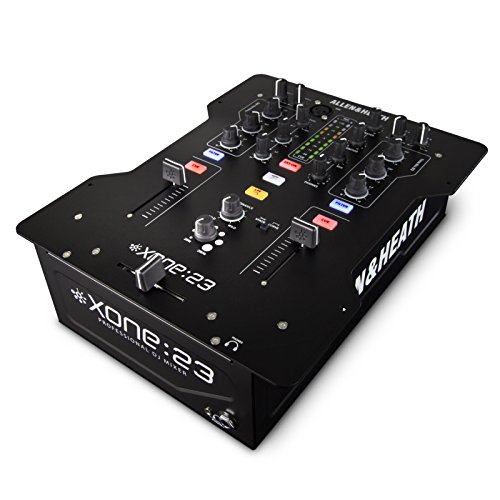
Allen & Heath Xone:23 2-Plus-2 Channel DJ Mixer — Best Analog Alternative
Not every CDJ DJ wants the standard’s digital palette, and the Xone:23 is the credible dissent. From a house famous for live and studio consoles, it offers a 2-plus-2 channel format with the analog channel quality and filtering character that a loyal school of DJs prefers for exactly the music CDJs often carry — long blends, dynamic recordings, sets where the mixer’s sound is part of the aesthetic rather than a neutral pipe.
In a CDJ rig it plays the connoisseur’s role: two full channels for the decks, the plus-two flexibility for an extra source, and a surface that rewards touch and ears over screen-and-preset thinking. For listening bars, home audiophile rigs and DJs whose style is the long, shaded blend, it can be the most satisfying mixer in this guide to actually play on.
Its trade-offs are the standard’s absence: no Beat FX library, no rekordbox-native bridge in its proposition, and a dialect guest DJs must adjust to. If your CDJ life is technique, recording and booth compatibility, stay with the flagship line. If it is sound and feel above all, this is the mixer your ears have been asking for.
Strengths
- Analog channel quality from a console heritage brand
- 2-plus-2 flexibility for decks plus extra source
- A feel-first surface for long, shaded blends
Trade-offs
- No flagship digital effects or software bridge
- A dialect guest DJs must learn
- Two full channels, not four
| Channels | 2-plus-2 channel DJ mixer (Amazon title) |
Best for: Sound-first CDJ DJs and listening environments / Not suited for: DJs needing booth-standard effects and compatibility
Check the current price on Amazon for the Allen & Heath Xone:23 2-Plus-2 Channel DJ Mixer. You can also see the full listing here to confirm finish, dimensions and what is in the box before you order.

RANE SEVENTY Two Channel DJ Mixer — Best CDJ Mixer for Scratch DJs
Some CDJ rigs are played like instruments of rhythm rather than playback, and the RANE SEVENTY is their mixer. Its verified listing is a battle specification: a two-channel DJ mixer for Serato DJ with Akai Professional MPC performance pads, internal DJ FX and three contactless MAG FOUR faders. Contactless faders are the scratch DJ’s core technology — no contact wear, a cut that stays crisp — and three of them, including the channel faders, is a statement of intent no rival in this guide makes.
Paired with CDJs running control or performance workflows, it turns the rig into a routine machine: pads for cues and samples under the same hands that work the decks, internal effects voiced for battle, and a build aimed at the physical life of scratch work. For the DJ whose CDJ set is cuts, juggles and wordplay, this is not an alternative to the flagship — it is the flagship, of a different discipline.
Discipline is the caveat. Its two channels, battle layout and Serato-first proposition serve performance DJs specifically; club-format and rekordbox-centered rigs belong with the Pioneer picks, and long-blend house sets gain nothing from its weapons. Buy it for the art it was built for and it has no peer here.
Strengths
- Three contactless MAG FOUR faders (Amazon title)
- Akai MPC performance pads built in (Amazon title)
- Internal FX voiced for battle performance (Amazon title)
Trade-offs
- Battle-specific layout and Serato-first design
- Two channels only
- Over-armed for blend-based club sets
| Channels | Two channel (Amazon title) |
| Faders | Three contactless MAG FOUR faders (Amazon title) |
| Pads | Akai Professional MPC performance pads (Amazon title) |
Best for: Scratch and performance DJs on CDJ rigs / Not suited for: Club-format and long-blend DJs
Check the current price on Amazon for the RANE SEVENTY Two Channel DJ Mixer. You can also see the full listing here to confirm finish, dimensions and what is in the box before you order.
Pioneer DJ CDJ-3000 Professional DJ Multi Player — The Player Half of the Rig
A CDJ mixer guide that ignored the players would be Hamlet without the prince, so the rig’s other half takes the final pick as a specification target. The current flagship CDJ generation is the booth standard the mixers above were designed around: the jog, pitch, cue and performance grammar that defines the format, shared across venues so completely that the deck itself has become a unit of professional fluency.
As buying guidance, the point is pairing discipline. The flagship mixer realizes its full value beside flagship players; the two-channel picks mirror the same grammar at practice scale; and the battle and analog alternatives assume decks that support their disciplines. Whatever your tier, buy players and mixer as one decision, from one generation’s thinking, and the rig will feel like a single instrument — which is the entire promise of the CDJ format.
No purchase link is offered for the player in this guide, deliberately: Amazon listing data connection failed repeatedly during this session, the local cache holds no verified player entry, and this program does not link what it cannot verify. When you buy, confirm the exact current player listing, its media and disc capabilities, and its bundle, with the same care this guide applied to the mixers.
Strengths
- The booth-standard deck the format is named for
- Shared grammar across venues and generations
- Defines the pairing every mixer here assumes
Trade-offs
- No verified purchase link in this guide (see review)
- Flagship cost per deck; a rig needs two
- Full value realized only in a matched system
Best for: Buyers speccing the complete CDJ system / Not suited for: Anyone needing a linked player recommendation today
This pick is covered without a link. We could not pin it to a listing we trust, so it carries no purchase link; treat it as a specification target to shop against rather than a linked recommendation.
Comparison Table
The CDJ system at a glance: five verified mixers across the format’s disciplines, plus the unlinked player target. Choose the mixer by discipline first — club, value, budget, analog or battle — then pair it with players from the same thinking.
| Pick | Badge | Key spec | Best for |
|---|---|---|---|
| Pioneer DJ DJM-A9 Professional 4-Channel DJ Mixer | Best Overall CDJ Mixer | 4-channel flagship | The CDJ system standard |
| Pioneer DJ DJM-450 2-Channel DJ Mixer | Best Value CDJ Mixer | 2-channel, Beat FX, DVS | Value CDJ rigs |
| Pioneer DJ DJM-250MK2 2-Channel DJ Mixer | Best Budget CDJ Mixer | 2-channel club-style | Budget CDJ learning rigs |
| Allen & Heath Xone:23 2-Plus-2 Channel DJ Mixer | Best Analog Alternative | 2+2 channel, analog character | Analog CDJ rigs |
| RANE SEVENTY Two Channel DJ Mixer | Best CDJ Mixer for Scratch DJs | 2-channel battle flagship | Scratch CDJ performance |
| Pioneer DJ CDJ-3000 Professional DJ Multi Player | The Player Half of the Rig | Flagship CDJ player | Complete the CDJ system |
How to Choose the Best CDJ Mixers for Your Rig?
Choose by discipline before brand. The CDJ format supports at least three distinct arts — the club set, the blended journey and the battle routine — and each has a mixer in this guide designed for it, with the others’ strengths largely irrelevant to it. A club DJ gains nothing from contactless battle faders; a scratch DJ gains nothing from a fourth channel. Naming your discipline honestly is the single highest-value step in CDJ buying, and it collapses this guide’s six picks into one or two finalists immediately.
Then choose by system, not component. Players and mixer should share a generation’s grammar and, where your work uses them, a software bridge — the verified listings here advertise rekordbox DVS unlocks and Serato propositions because the bridge is now part of the instrument. Finally, count the rig’s whole cost, including cases and headphones, and let the tier that funds a complete, balanced system beat the tier that funds one glorious component surrounded by compromises.
- Name your discipline: club, blend, battle or analog
- Buy players and mixer as one system decision
- Value the software bridge your library actually uses
- Budget the complete rig, not the hero component
- Keep booth compatibility in mind if you play out
What Do CDJ Mixers Do That Regular DJ Mixers Don’t?
Three things, in descending order of importance. First, grammar: the layout, EQ curves, effects logic and cueing behavior are designed around the players’ own grammar, so the whole surface feels like one instrument rather than two devices sharing a table. Second, the digital layer: modern CDJ mixers carry audio interfaces, recording paths and software unlocks — advertised in this guide’s verified listings — that integrate the rig with the laptop-and-library reality of current DJing. Third, the network effect: booths, venues and other DJs run the standard, so the standard’s mixer is the one your skills, and your USB of settings and habits, transfer to without translation.
A regular DJ mixer can absolutely mix two CDJs — audio is audio — and the analog alternative in this guide proves the point honorably. What it cannot do is disappear into the format. Whether that disappearance is worth flagship money depends on how much of your DJ life is spent in other people’s booths, which is why this guide badges by discipline and setting rather than declaring one mixer universally best.
Two Channels or Four for a CDJ Rig?
Two channels is the format’s purest form: two decks, one mixer, nothing between the DJ and the blend. It suits practice rigs, focused performance and any setting where the set is the whole job. Four channels is the format’s professional form: the third source for a backup, a guest or a live element, the fourth for the microphone or the room feed, and the routing freedom to survive the failures and opportunities a working night produces.
The deciding question is not ambition but logistics. If your nights are performances, two channels will never limit you and the savings fund players and music. If your nights are events — weddings, corporate, residencies with hosting duties — the four-channel flagship is not showing off; it is staffing. Buy the channel count your calendar describes, and the question answers itself.
How Do You Keep a CDJ Rig Current Without Replacing It?
The CDJ format’s economics reward platform thinking. The mixer and players are the platform; firmware, software bridges and accessories are the updates. DVS unlocks and interfaces — the features this guide’s listings advertise — exist so a rig gains laptop and recording capabilities without a hardware change, and a case-and-cable standard maintained across years keeps the system gig-ready while individual elements evolve.
The upgrade path that wastes money is the sideways one: replacing a two-channel mixer with a slightly different two-channel mixer, or a player with its near-twin. The path that works is generational and role-based — add the recording interface your work now needs, step to four channels when events demand it, move disciplines when your art does. A CDJ rig bought by discipline and grown by role can serve a decade of DJing, which is the format’s real claim on your money.
What Does the Booth Standard Actually Buy You?
The standard’s value is easiest to see from the other side: walk into an unfamiliar booth, on an unfamiliar night, with a headline slot and twenty minutes to sound-check. On the standard rig, your hands already know the mixer, your habits transfer whole, and your entire attention goes to the room and the music. On any other rig, some of that attention is taxed by translation — small, constant, and exactly what you cannot spare when the night is live. That tax, avoided nightly across a career, is what flagship compatibility is worth, and it is why working DJs speak of the standard with a loyalty that looks like brand worship and is actually risk management.
The standard also compounds socially: other DJs can go back-to-back with you without a briefing, engineers can support you without a manual, and venues can maintain the rig you depend on. None of that appears in a specification table, and all of it appears in a working life. Buy the standard when your DJing is public and collaborative; buy the alternatives in this guide, without a shred of guilt, when your DJing is personal, disciplinary or domestic — the standard’s tax only exists where the public booth does.
How Do You Practice on a CDJ Rig So It Transfers to the Booth?
Practice transfers when it is practiced at performance conditions. That means standing, at proper height, with the room system — or a honest monitor — at realistic volume, cueing against noise rather than in a quiet bedroom’s kindness. It means recording sets and listening back with a pen, because the mix you remember and the mix you played are cousins, not twins. And it means rehearsing the unmusical skills with the same seriousness as the blends: the one-deck failure, the corrupt file, the guest DJ arriving mid-set with their own format and expectations.
Structure the practice library the way booths demand: music organized for retrieval at speed, with the certain plays, the bridges and the rescue tracks findable in the dark by muscle memory. A CDJ rig’s screens and systems help, but the professional’s real database is habit. Build the habits on your home rig — whichever tier of this guide it is — and the booth standard will feel less like an exam and more like a larger version of your own instrument.
When Should a CDJ DJ Upgrade the Mixer Instead of the Players?
Upgrade the component that limits the night. If sets are constrained by transitions — effects you reach for that are not there, channels you need for the way your events now run, recording you cannot offer a promoter — the mixer is the bottleneck and the upgrade. If sets are constrained by the decks — library handling, screen information, the feel of the jog under your specific technique — the players are. Most DJs misdiagnose this at least once, buying the glamorous half of the rig while the limiting half stays limiting, which is why this guide insists on the system view from its first page.
A useful test is the last three gigs. Write down what actually frustrated you, in the moment, on the night. The list will name components without ambiguity — and it is almost never the component the marketing cycle is currently excited about. Upgrade from the frustration list, in the order the nights wrote it, and a CDJ rig evolves the way careers do: by need, visibly justified, and paid for by the work it improves.
How Does a CDJ Rig Fit a Home Studio Without Taking It Over?
The home CDJ rig has a footprint problem the booth never faces: it shares a room with a life. The two-channel picks in this guide exist partly for this reason — a standard-grammar rig at domestic scale, on a dedicated stand or desk section, covered when idle, cabled once and left cabled. The discipline that makes it work is the same as the standup mixer’s in the kitchen guides of this program: a defined station, defended against clutter, where the rig is always thirty seconds from playing. A CDJ setup that must be assembled to be practiced on will be practiced on rarely, and practice is the entire point of owning it.
Sound at home deserves the same realism: nearfield monitors at honest volume teach more than a club PA imitation the neighbors veto, and headphone cueing practice at realistic levels prepares the ears the booth will need. Treat the home rig as the booth’s rehearsal room — same heights, same layout handedness, same library organization — and the transfer this guide keeps promising becomes a property of your furniture as much as your technique.
What Accessories Complete a CDJ System?
The system’s unglamorous completions matter in a predictable order. A proper case or coffin first, because CDJ rigs travel and transports hate vibration and dust in equal measure. Quality interconnects and spares second, because the failure you will actually meet is a cable, not a flagship. A stand or booth furniture that puts the rig at correct height third, because technique practiced at the wrong height must be relearned at the right one. Only then the expressive extras — and by then your nights will have written their own list, which will be shorter and truer than any catalog’s.
One accessory deserves singling out for the modern format: the recording path. Whether it is the flagship mixer’s interface or a simple recorder on the booth output, the ability to capture every set is the highest-leverage ‘accessory’ a developing DJ can own, because reviewed sets are how technique compounds. If the budget forces a choice between an effect you will use monthly and recording you will use nightly, this guide’s advice is not close.
A Final Word on Systems
Every durable insight in this guide reduces to one: a CDJ rig is a system, and systems reward coherence over component brilliance. Players, mixer, library, cases and habits either agree with each other or tax each other, nightly. Spend your money and attention on the agreement — matched grammar, rehearsed backups, reviewed recordings — and the format will repay you with the thing it promises every DJ who takes it seriously: nights where the equipment disappears and only the music is left.
How to Set Up a CDJ Rig That Feels Like One Instrument
A CDJ rig’s magic is coherence, and coherence is set up, not bought. Connect the system deliberately, stage it once with care, and rehearse its failure modes in private, and the players and mixer will present themselves to your hands as the single instrument the format promises.
- Place players tight to the mixer on a stable, level surface at proper standing height, screens and jogs unobstructed.
- Connect each player’s output to its corresponding mixer channel, left deck to left channel, and any digital or link connections the system uses.
- Connect the mixer’s main output to the system, master low, and stage each channel’s gain with the loudest track in your library.
- Configure cueing against real playback volume: headphone level, cue mix and booth level set for a loud room, not a quiet one.
- If your mixer offers recording or an interface, set the record path now and capture your practice sets from day one.
- Run a full practice mix across both decks, using transitions and effects as you would in performance, and listen back critically.
- Rehearse the single-deck failure: play a passage using one deck and your backup source until the switch is muscle memory.
Maintain the system’s coherence like a musician maintains an instrument: covers on against dust, cables coiled without strain, firmware and software bridges updated on your schedule rather than the venue’s. A CDJ rig treated as one instrument stays one; treated as a pile of boxes, it slowly becomes three strangers sharing a table.
Common Buying Mistakes
CDJ buying mistakes are system mistakes — components chosen in isolation that never become an instrument. These are the ones to avoid.
Mixing generations and grammars carelessly. Players and mixers from different thinking can work, but the format’s magic is coherence. Pair deliberately, not accidentally.
Buying channels for ambition instead of logistics. Four channels serve events; two serve performance. Buy the count your calendar describes, not your aspirations.
Ignoring the software bridge. DVS and interface features decide whether a laptop library joins the rig gracefully. Check the bridge your work needs before buying.
Judging by effects count. Cueing, layout grammar and channel quality decide nights. Effects are the smallest part of a CDJ mixer’s job.
Skipping the failure rehearsal. A one-deck drill at home is what makes a mid-set failure a shrug instead of a silence. Rehearse it before you need it.
Treating the player as an afterthought. The rig is players plus mixer. Speccing the mixer brilliantly and the decks vaguely produces exactly the imbalance it sounds like.
Final Recommendation
The CDJ system to beat is the DJM-A9 between flagship players: the standard, whole and coherent. Most home and developing rigs should take the same grammar at two-channel scale — the DJM-450 for value and software depth, the DJM-250MK2 to learn on a budget — while sound-first DJs audition the Xone:23’s analog dissent and scratch DJs go directly to the RANE SEVENTY, the battle flagship of this guide. Each is the best CDJ mixer for the discipline its badge names, and discipline, not budget envy, should make your choice.
For the broader CD category, see Best Cd Mixers For Djs and the related guides below.
If you want the short version: start with Pioneer DJ DJM-A9 Professional 4-Channel DJ Mixer, Pioneer DJ DJM-450 2-Channel DJ Mixer, Pioneer DJ DJM-250MK2 2-Channel DJ Mixer. Each is one click away from its live listing, where you can check price on Amazon and confirm the exact configuration.
Best Cd Mixers For Djs Best Cd Mixers Best Cd Mixers For Rock Best Compact Audio Mixers Best Computer Audio Mixers
Frequently Asked Questions
What is a CDJ mixer?
It is a DJ mixer designed to partner CDJ players: the layout, effects, cueing and digital bridges are built around the players’ grammar, so decks and mixer work as one system. The flagship pick in this guide is the current reference for the format.
Can any DJ mixer work with CDJ players?
Yes — audio is audio, and the analog alternative here is proof. What a dedicated CDJ mixer adds is coherence: shared grammar, integrated effects logic and software bridges that make the rig feel like a single instrument.
Do I need four channels for two CDJs?
Not for the decks themselves. Four channels earn their cost when a working night adds backup sources, guests, live elements or hosting. Performance-focused two-deck DJs are fully served by this guide’s two-channel picks.
What is DVS in a CDJ rig?
Digital vinyl system control: control media on the decks drives DJ software, merging a laptop library with physical deck technique. Several verified mixers here include or unlock DVS, which is the modern CDJ rig’s bridge to software.
Why is the CDJ player itself unlinked in this guide?
Its listing could not be verified during this session — Amazon listing data connection failed repeatedly — and this program never links an unverified model.
Why are no prices printed?
CDJ rigs are system purchases whose component pricing moves with bundles and seasons. Each linked mixer leads to its verified live listing, where you can check price on Amazon for the exact configuration.
Are CDJ mixers worth it for home use only?
At the two-channel tiers, yes, if you play out or intend to: the shared grammar means home practice transfers directly to booths. For purely domestic playing with no booth ambitions, a good general DJ mixer can serve — but the CDJ-format picks here remain the safer long-term buy for anyone whose DJing might become public.
How much should a complete CDJ rig budget include beyond players and mixer?
Cases, headphones, stands, quality cables and spares, and the music itself — together a meaningful share of the system total that beginners chronically underfund. A balanced rig at one tier lower outperforms a flagship component surrounded by starved essentials at every real night; budget the system, then choose the tier the complete system can honestly afford.
Is it better to buy one flagship component or a balanced mid-tier system?
A balanced system, at every level this guide covers. A flagship mixer between neglected players, in a poor case, through tired cables, loses to a coherent mid-tier rig on every night that matters. Upgrade components in the order your recorded frustrations demand, and the system stays balanced as it grows — which is the closest thing DJ equipment has to a permanent advantage.


