Disclosure: airfryerkitchensupply.com is reader-supported. When you buy through links on our site, we may earn an affiliate commission at no extra cost to you.
Where to buy
Every pick in this guide to the best 12 volt cooler for travel was verified against its manufacturer’s own Amazon listing before it earned a place here. The shortlist: Alpicool C20, Alpicool 10 Quart, Wagan EL6206, BougeRV 23 Quart, SubSun 27 Quart, Alpicool 28 Quart. Every pick below was verified in its manufacturer’s Amazon listing; the compressor models run on both vehicle DC and household AC, as their listings state, which is the travel-critical detail. The Alpicool C20 is the default travel recommendation, the BougeRV 23 Quart suits high-mileage itineraries, and the Wagan EL6206 covers the solo budget. Check the current price on Amazon for each pick before ordering.
Introduction
The best 12 volt cooler for travel has a harder job than its camping and commuting cousins: it must work in a moving car all day, then keep working in a hotel room, a rental or a relative’s house all night, for days on end, in whatever weather the route crosses. Travel breaks cold chains — and the picks below were chosen to never break yours. Compressor refrigerators with dual vehicle-and-mains power anchor the list, because a set temperature that survives every environment is the whole point of travel refrigeration.
Two thermoelectric picks are included for the lighter travel patterns — solo driving days and mild-weather picnic touring — with their limits stated plainly: they cool relative to the surrounding air and cannot guarantee food-safe temperatures in heat. Size runs from a 6-liter personal box to a 28-quart family unit, because travel loads range from one person’s medication to a family’s week of provisions.
All six products were verified against their manufacturers’ Amazon listings, including capacities, temperature ranges and power inputs. Prices change too often to print honestly, so check price on Amazon for the current figure on the pick that matches your itinerary.
In this guide
Quick Picks
Best Overall — Alpicool C20 Portable Compressor Fridge Freezer (21 Quart): The travel all-rounder: compressor reliability, couple-sized capacity, and dual power that works in the car and the hotel room. Check the current price on Amazon.
Best Compact for Travel — Alpicool 10 Quart Portable Car Fridge: Personal-scale true refrigeration: 9 liters with a stated -4°F floor, for medication, baby food and solo travel. Check the current price on Amazon.
Best Personal Budget — Wagan EL6206 12V 6 Quart Personal Thermoelectric Cooler Warmer: The budget personal pick: a UL Listed 6-liter cooler-warmer for one traveler’s drinks and lunch. Check the current price on Amazon.
Best for Long Drives — BougeRV 12V Refrigerator 23 Quart Portable Freezer: The mileage pick: 23 quarts, a -8°F floor and a stated 15-minute cool-down for multi-day driving itineraries. Check the current price on Amazon.
Best Budget Cooler-Warmer — SubSun 27 Quart Electric Cooler and Warmer: The budget touring pick: 27 quarts of thermoelectric cooling and warming for drinks, picnics and mild-weather travel. Check the current price on Amazon.
Best for Family Travel — Alpicool 28 Quart 12 Volt Refrigerator: The family touring pick: 28 quarts of compressor fridge-freezer space for the family vehicle’s long trips. Check the current price on Amazon.
How These Picks Were Chosen
Travel imposed its own filters. First, continuity: a pick had to plausibly keep food at a known temperature across the whole travel day — car, stop, destination — which favored dual-power compressor models and confined thermoelectric picks to in-motion, personal and picnic roles with their limits labeled. Second, carry-ability: travel coolers get carried into rooms and rentals, so sizes stayed in the range one person can move when loaded, from 6 liters to 28 quarts.
Third, verification: every capacity, temperature range and power claim in this guide traces to the manufacturer’s own Amazon listing. Products that could not be verified were excluded, as was anything subject to a safety recall. The final set balances the real tribes of travel — solo drivers, touring couples, high-mileage road-trippers, budget picnickers and families — rather than ranking one box six ways.
The 6 Best 12 Volt Cooler for Travel Picks, Reviewed in Detail

Top pick
1. Alpicool C20 Portable Compressor Fridge Freezer (21 Quart)
Badge: Best Overall
Travel — as opposed to camping or commuting — means the cooler changes environments daily: the car, the hotel room, the vacation rental, the relative’s spare room. The C20 is built for that itinerary. Its 20 liters of compressor refrigeration hold a set temperature in all of them, and its dual power — 12/24V DC in the vehicle, 110V AC at every stop — means the box never has a night off. Food bought in one town is still properly cold two towns later.
The C20 sits in the sweet spot of the 12-volt market: a genuine compressor fridge-freezer in a 20-liter body that most vehicles can carry without rearranging everything else. The listing confirms both halves of its job title — it works as a fridge and as a freezer — and it runs from 12V/24V DC in the vehicle and 110V AC at home, at a campsite with hookups, or in a hotel room. That dual-power design matters more than it sounds. A cooler that only runs in the car stops being useful the moment you park for two days; the C20 simply moves indoors and keeps working. For buyers cross-shopping thermoelectric boxes, the difference to understand is that a compressor unit like this one cools to a set point and holds it, while a thermoelectric unit only cools relative to the air around it.
Strengths
- Compressor cooling at a 20-liter size that still fits most rear seats and cargo areas
- Dual DC and AC power covers the drive and the destination with no adapter hunt
- Big enough for a weekend of food for two without swallowing the whole trunk
Trade-offs
- Single temperature zone, so frozen items and fresh food share one setting
- 20 liters is a weekend box, not a week-long family solution
- No built-in battery, so engine-off runtime depends on your vehicle or a power station
| Key specs (from the manufacturer’s listing) | |
|---|---|
| Capacity | 21 quart (20 liter) |
| Power | 12V/24V DC and 110V AC |
| Cooling type | Compressor fridge-freezer |
That continuity is the travel-specific virtue. Road food stops being a gamble of gas-station ice and cooler roulette; dietary needs, baby food, medication and the good cheese from the market town all ride at a known temperature. The size is the travel size, too: enough for two people’s provisions and drinks, small enough to carry into a hotel room without a luggage cart. Travelers upgrading from ice will notice the quietest benefit — nothing is ever floating in meltwater, so the snacks and the camera-adjacent cargo stay dry. For most travel patterns, this is the box.
Best for: Road-trippers and touring travelers — couples especially — who want one box that works in every environment the trip passes through. / Not suited for: Solo travelers with minimal loads, who can travel lighter with the 10-quart pick below.
Check the Alpicool C20 on Amazon — check price on Amazon for the current figure, and confirm the included cords and dimensions on the listing before you order.

2. Alpicool 10 Quart Portable Car Fridge
Badge: Best Compact for Travel
Some travel loads are small and non-negotiable: insulin that must stay in range across a desert drive, a baby’s milk and food through a day of connections by car, the specific foods a medical diet requires where no shop will sell them. The Alpicool 10 Quart serves those loads with a real compressor and a stated -4°F to 68°F range in a 9-liter box that fits a footwell and carries into a hotel room like hand luggage.
Nine liters sounds like a toy until you remember what is inside: a real compressor with a stated range from -4°F to 68°F. The Alpicool 10 Quart is built for the jobs where cold has to be guaranteed but volume is small — temperature-sensitive medication on a long drive, a driver’s lunch and drinks in a truck or van cab, a boat’s day provisions, baby food and milk on a family road trip. Thermoelectric minis can approximate some of that on mild days, but they cannot promise a temperature; this box can, because its cooling does not depend on the air around it. The listing names trucks, vans, RVs, campers, SUVs and boats, and that breadth is credible precisely because the footprint is so small — it fits the leftover spaces those vehicles actually have.
Strengths
- Smallest compressor option here — true refrigeration in a 9-liter box
- Stated range reaches -4°F, so it can freeze despite its size
- AC/DC power suits the truck cab, van, boat and campsite equally
Trade-offs
- 9 liters is personal-scale: drinks, lunch and medication, not group catering
- Per-liter cost of tiny compressor boxes is high compared with big ones
- Single small zone means careful packing Tetris for mixed loads
| Key specs (from the manufacturer’s listing) | |
|---|---|
| Capacity | 10 quart (9 liter) |
| Temperature range | -4°F to 68°F (per listing title) |
| Power | AC and DC |
| Cooling type | Compressor fridge-freezer |
Its AC/DC power completes the travel brief: pre-chill at home, run on the road, plug in at the destination. Solo travelers also adopt it as a complete personal fridge — lunch, drinks and snacks for one, properly cold rather than approximately cool, which no thermoelectric mini can promise in a hot car. The limit is volume, and it is absolute: this is a personal appliance. But travel is full of problems that are small, critical and temperature-shaped, and this is the pick that solves exactly those.
Best for: Solo travelers, and anyone traveling with medication, baby food or medical-diet supplies that need guaranteed temperatures in minimal space. / Not suited for: Couples and families provisioning for a trip; you need the C20’s capacity or larger.
Check the Alpicool 10 Quart on Amazon — check price on Amazon for the current figure, and confirm the included cords and dimensions on the listing before you order.

3. Wagan EL6206 12V 6 Quart Personal Thermoelectric Cooler Warmer
Badge: Best Personal Budget
The EL6206 is the smallest, simplest travel cooler here: 6 liters of thermoelectric cooling and warming, UL Listed, sized to ride beside one traveler. It holds a lunch, a few drinks and snacks — the personal ration for a driving day — and flips to warming mode when the day’s plan is a hot meal collected en route.
The EL6206 is the personal end of the 12-volt world: 6 liters of thermoelectric cooling and warming that lives beside one person. It is sized for a driver’s lunch, a few drinks, snacks for a commute or a worksite day, and its listing carries a detail the bigger cheap boxes often skip — UL Listed certification, which matters for a device that sits plugged in for hours. Wagan aims it at cars, RVs and camping, and the 12/24V DC input suits vehicle life. Set expectations by the technology: it cools relative to the cabin air and warms on demand, but it is not a refrigerator and cannot make a hot car food-safe. As a personal lunch-and-drinks companion, though, it replaces the daily ice pack ritual with a plug.
Strengths
- Personal 6-liter size fits a center console area or beside a seat
- UL Listed — a certification detail worth having in an always-plugged-in device
- Cooler and warmer modes cover a driver’s lunch in both seasons
Trade-offs
- 6 liters is a few drinks and a lunch — nothing more
- Thermoelectric cooling is ambient-relative, so no food-safety promises in heat
- DC only in the listing; home use needs an adapter
| Key specs (from the manufacturer’s listing) | |
|---|---|
| Capacity | 6 quart (6 liter) |
| Function | Cooler and warmer |
| Power | 12/24V DC |
| Certification | UL Listed (per listing title) |
Travelers should buy it with clear eyes: thermoelectric cooling is relative to cabin air, so in a hot parked car it cannot protect perishables, and it will never freeze anything. Its home conditions are the moving, air-conditioned hours — which, on a driving trip, is most of the day. Within those hours it replaces the ice-pack ritual with a plug, at a budget tier nothing with a compressor can touch. For the solo driver crossing states with a sandwich and a schedule, it is a rational, cheerful little appliance.
Best for: Solo travelers and drivers who want a personal drinks-and-lunch box for in-motion use at the lowest tier. / Not suited for: Anyone whose travel load is perishable food in hot, parked cars — that is compressor work.
Check the Wagan EL6206 on Amazon — check price on Amazon for the current figure, and confirm the included cords and dimensions on the listing before you order.
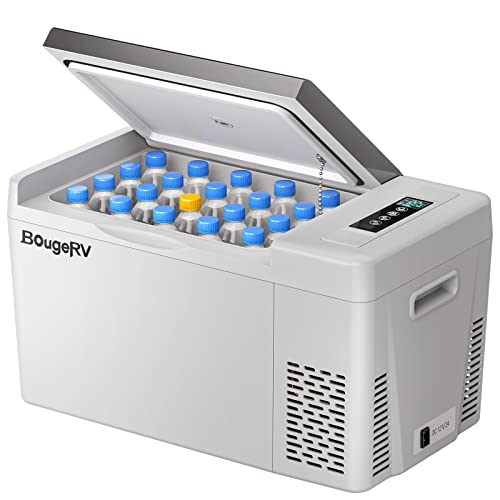
4. BougeRV 12V Refrigerator 23 Quart Portable Freezer
Badge: Best for Long Drives
Long-drive travel has its own rhythm: big mileage days, grocery stops in unfamiliar towns, warm loads going into the box at hot rest areas. The BougeRV 23 Quart is tuned for that rhythm. Its stated 15-minute cool-down to 32°F forgives the warm load and the forgotten pre-chill, and its stated -8°F to 50°F range covers everything from ice cream to salad across a week of driving.
BougeRV’s 23-quart unit competes on speed and depth of cold. The listing states a range from -8°F to 50°F — a lower floor than most of its class — and a 15-minute cool-down to 32°F, which is the feature you feel when the grocery run, the forgotten pre-chill or the late departure puts warm food into the box at the start of a drive. Inside the first quarter hour the box is already at fridge temperature instead of spending the first hour of the trip getting there. It runs on 12/24V DC and 110V AC, works as fridge or freezer, and is sized and priced for the camping and road-trip duty the listing names. For a single traveler or a couple, 23 quarts is the size that keeps giving: big enough to provision properly, small enough to live behind a seat.
Strengths
- Fast stated cool-down — 32°F in 15 minutes — for late starts and warm loads
- -8°F low end undercuts most rivals, giving real freezer headroom
- 23 quarts is the road-trip size: two people’s weekend, one person’s week
Trade-offs
- Single zone, so freezing and chilling share one setting
- Fast-cool modes on compressor boxes draw harder while they work
- Grey finish shows dust and campsite scuffs honestly
| Key specs (from the manufacturer’s listing) | |
|---|---|
| Capacity | 23 quart |
| Temperature range | -8°F to 50°F (per listing title) |
| Cool-down | To 32°F in 15 minutes (per listing title) |
| Power | 12/24V DC and 110V AC |
Twenty-three quarts provisions two travelers properly — breakfasts, picnic lunches, drinks and dinner ingredients — without eating the trunk. The dual power (12/24V DC, 110V AC) keeps the box working in motel rooms, so the trip’s cold chain never breaks overnight. Travelers who measure trips in thousands of miles will appreciate the deeper point: a fast, deep, set-temperature fridge turns food from a logistics problem into a pleasure — local markets become dinner plans instead of risks.
Best for: High-mileage travelers and road-trip couples who load warm, drive long, and want the box cold again before the next state line. / Not suited for: Travelers who mostly fly and rent cars for short hops; a smaller pick travels lighter.
Check the BougeRV 23 Quart on Amazon — check price on Amazon for the current figure, and confirm the included cords and dimensions on the listing before you order.

5. SubSun 27 Quart Electric Cooler and Warmer
Badge: Best Budget Cooler-Warmer
The SubSun makes the budget travel case at useful size: 27 quarts that cool drinks and day food, warm a meal on the return leg, and run on 12V DC on the road or 110V AC at the stop. For travel patterns built on day trips, picnics, markets and mild weather, that covers the actual job — nobody’s holiday was ruined because the picnic drinks were cool rather than refrigerator-cold.
SubSun’s 27-quart box is aimed, per its listing, at camping, travel and picnics, and that targeting is honest: this is a day-and-weekend thermoelectric cooler-warmer, not a portable refrigerator. Its 25 liters hold a family picnic or a couple’s weekend drinks, it cools relative to the surrounding air and warms when you flip the mode, and it plugs into 12V DC on the road or 110V AC at the destination. The right way to judge it is against an ice cooler, not against a compressor fridge: it never needs an ice run, never leaves food swimming in meltwater, and never runs out of cold the way a bag of ice does on day two — but it also never promises the set temperatures a compressor box delivers. For the trips it is built for, that trade is often the right one.
Strengths
- 27 quarts is picnic-and-family-day capacity in a light thermoelectric body
- Warmer mode extends its usefulness beyond summer
- Runs from the car socket or a wall outlet, as the listing states
Trade-offs
- Ambient-relative cooling only — no freezing, no guaranteed food-safe cold in heat
- Thermoelectric efficiency is poor compared with compressor boxes on long runs
- Simple feature set: no battery protection system like compressor fridges offer
| Key specs (from the manufacturer’s listing) | |
|---|---|
| Capacity | 27 quart (25 liter) |
| Function | Cooler and warmer |
| Power | 12V DC and 110V AC |
| Cooling type | Thermoelectric |
The limits deserve their sentence, as with every thermoelectric here: cooling is relative to the air around the box, so in serious heat the interior is cooler-than-outside rather than food-safe, and raw meat and dairy should not be entrusted to it on hot days. Traveled with that understanding — perishables eaten fresh daily, the box carrying drinks, fruit, cheese for the day and picnic supplies — it is a light, simple and inexpensive companion that never asks for ice. Many travelers run exactly this system and spend the savings on the trip itself.
Best for: Budget travelers, picnickers and day-trippers in mild climates whose loads are drinks and day food. / Not suited for: Travelers crossing hot regions with perishable provisions; buy into the compressor tier.
Check the SubSun 27 Quart on Amazon — check price on Amazon for the current figure, and confirm the included cords and dimensions on the listing before you order.

6. Alpicool 28 Quart 12 Volt Refrigerator
Badge: Best for Family Travel
Family travel multiplies everything: more mouths, more drinks, more snacks, more specific small-person requirements that must stay cold. The Alpicool 28 Quart answers with 28 quarts of compressor fridge-freezer space that holds real food-safe temperatures through hot driving days and parked sightseeing stops alike — the assurance that the baby food, the allergy-safe meals and tonight’s dinner are all at the temperature you set.
This 28-quart Alpicool is the middle child of the range, and for many vehicles it is the right size: meaningfully more room than the compact 15- and 20-liter boxes, without the cargo commitment of the 40-liter-plus models. The listing describes a portable freezer and fridge in one, powered by 12/24V DC on the road and 110-240V AC on mains, and names trucks, RVs, campers and SUVs as its home turf. As a compressor unit it holds a set temperature rather than a relative one, which is what makes it a legitimate food-storage appliance rather than a drinks accessory. Buyers stepping up from a thermoelectric cooler will notice the difference on the first hot day: the temperature inside this box is the temperature you chose, not a compromise negotiated with the weather.
Strengths
- 28 quarts splits the difference between day-trip boxes and full expedition fridges
- Fridge-freezer compressor design holds real food-safe temperatures
- Aimed squarely at truck, RV, camper and SUV use, with the power inputs to match
Trade-offs
- Single zone, like most boxes at this size and tier
- Mid-size in every sense — keen campers may still outgrow it
- No integrated battery for parked runtime
| Key specs (from the manufacturer’s listing) | |
|---|---|
| Capacity | 28 quart |
| Power | 12/24V DC and 110-240V AC |
| Cooling type | Compressor fridge-freezer |
The listing’s stated audience — truck, RV, camper, SUV — reads like a family-travel roster, and the dual power (12/24V DC, 110-240V AC) means the box works at the rental house and the hotel as well as on the road. Parents consistently name the same favorite feature, and it is not a feature: no ice. No meltwater soaking the spare clothes, no evening ice hunt in a strange town, no cooler Tetris around a melting block. For the family vehicle that tours, this is the size and the technology that end the cold-storage argument.
Best for: Families touring by car, especially with young children, dietary requirements, or long distances between stops. / Not suited for: Solo and couple travelers, who will find the same technology in smaller, lighter picks above.
Check the Alpicool 28 Quart on Amazon — check price on Amazon for the current figure, and confirm the included cords and dimensions on the listing before you order.
Comparison Table
| Pick | Badge | Key spec | Best for |
|---|---|---|---|
| Alpicool C20 | Best Overall | 21 qt (20 L) compressor fridge-freezer, 12V/24V DC + 110V AC | Road-trippers and touring travelers — couples especially — who want one… |
| Alpicool 10 Quart | Best Compact for Travel | 10 qt (9 L) compressor fridge-freezer, -4°F to 68°F, AC/DC | Solo travelers, and anyone traveling with medication, baby food or medical-diet… |
| Wagan EL6206 | Best Personal Budget | 6 qt (6 L) personal thermoelectric cooler-warmer, 12/24V DC, UL Listed | Solo travelers and drivers who want a personal drinks-and-lunch box for… |
| BougeRV 23 Quart | Best for Long Drives | 23 qt compressor fridge/freezer, -8°F to 50°F, cools to 32°F in 15 min (per listing), 12/24V DC + 110V AC | High-mileage travelers and road-trip couples who load warm, drive long, and… |
| SubSun 27 Quart | Best Budget Cooler-Warmer | 27 qt (25 L) thermoelectric cooler-warmer, 12V DC + 110V AC | Budget travelers, picnickers and day-trippers in mild climates whose loads are… |
| Alpicool 28 Quart | Best for Family Travel | 28 qt compressor fridge-freezer, 12/24V DC + 110-240V AC | Families touring by car, especially with young children, dietary requirements, or… |
How to Choose a 12 Volt Cooler for Travel
Start from your itinerary, not from a spec sheet. Count the longest stretch between reliable shops, the number of travelers, and the environments the cooler must work in. A cooler that only runs in the car fails the travel test the first night it sits in a warm hotel room with tomorrow’s food inside; dual-power models that run on household AC as well as 12V DC are the travel default for exactly that reason.
Match technology to your load’s criticality. Medication, baby food, medical diets and raw ingredients need a compressor’s guaranteed set temperature, in any weather, parked or moving. Drinks, fruit, picnic food and same-day provisions can travel thermoelectric in mild conditions — with the discipline that perishables get eaten fresh and never trusted to a hot parked car. Many travelers split the difference: a small compressor box for the critical load, and the car’s space left free for everything else.
Size for the traveler count you actually are. Solo: 6–10 liters of powered box can be plenty, especially in compressor form. Couples: around 20–23 quarts provisions a trip without trunk domination. Families: 28 quarts and up, or the two-box system of a family fridge plus a drinks solution. And always check the loaded carry: you will personally move this box into rooms and rentals, so weight and handles are travel features, not trivia.
How Do You Keep Food Safe on a Long Road Trip?
The rules are the same as at home, enforced by equipment instead of a kitchen. Keep the fridge at or below 40°F — set a compressor box around 37–38°F to allow for opening swings — and frozen food at 0°F or below. The danger zone between roughly 40°F and 140°F is where bacteria multiply fastest, and food that spends more than about two cumulative hours in it (one hour in serious heat) should be discarded, not debated.
In practice: pre-chill the box and the food before departure; load in eating order so openings are short; keep a cheap fridge thermometer inside and glance at it at fuel stops — it converts worry into information. Cook and chill leftovers promptly, or let restaurants be the leftover plan. When a cooler has failed warm — a thermoelectric in a heat wave, a compressor unplugged overnight — judge by temperature and time, not by hope: when in doubt, throw it out is a food-safety rule, not a waste.
Can You Take a 12 Volt Cooler into Hotels and Rentals?
Yes — and it is one of the best reasons to travel with a dual-power model. A compressor cooler that runs on household AC works in a hotel room like a quiet mini-fridge, without the minibar’s prices or the ice machine’s schedule. Practical etiquette: place it on a hard floor or the bathroom tile rather than carpet, keep its vents clear of curtains and luggage, and expect a soft compressor hum — light sleepers can park it in the bathroom with the door mostly closed.
In rentals and relatives’ homes it simply becomes the overflow or drinks fridge, and hosts usually love it. Two cautions: in hotels, confirm the room’s outlets stay live with the key-card out — many cut power, which silently stops the cooler; a bathroom outlet or a word with the front desk solves it. And when you check out, the pre-departure habit applies: the box leaves cold, loaded cold, and the cold chain rolls on.
Packing a Travel Cooler: The Layer System That Survives a Week on the Road
Travel packing fails in a specific way: everything is in the box, and nothing can be reached without unpacking it at a rest stop. The layer system fixes the geometry. The bottom layer is the deep future — frozen portions and the food for the trip’s final days, packed flat and dense. The middle layer is the rolling present: tomorrow’s and tonight’s ingredients, in containers that stack. The top layer is the traveling day itself — today’s drinks, snacks and lunch — arranged so a single short opening serves the whole stop.
Two travel-specific refinements make the system work across a week. First, a small ‘tonight’ bag inside the top layer: everything the evening’s arrival needs, liftable in one grab, so the box is opened once at the destination instead of five times in a dark parking area. Second, a restock discipline at market stops: new purchases go in cold where possible, warm items go on top to be chilled by the evening, and nothing warm ever gets buried against the frozen layer where it can thaw what it touches.
Travelers who adopt the layers notice the quiet benefit by day three: the box stops being a rummage and becomes a pantry with a known inventory. You know what is left, what tonight is, and what the next town needs to supply — which is the difference between a cooler that supports a trip and a cooler that merely accompanies one.
Traveling With Dietary Needs, Baby Food and Medication: The Cold Chain Rules
For some travelers the cooler is a convenience; for others it is medical equipment with a picnic attached. If you travel with insulin or other temperature-specified medication, expressed milk or formula, or a medical diet whose foods cannot be bought en route, the rules tighten — and they are all satisfiable with the compressor picks in this guide plus three habits.
Habit one: verify, don’t trust. Put an inexpensive thermometer in the box and check it at every stop until you know exactly how your setup behaves in heat, in shade, and parked. Habit two: never break the chain at the destination. The box goes into the room with the luggage and onto household power immediately — a dual-power compressor model exists for precisely this moment. Habit three: keep the critical items in the cabin portion of the load, in the part of the box that opens least, with frozen packs around them as thermal insurance against a power interruption.
What not to do is equally clear. Do not entrust strict-range medication to a thermoelectric box, whose interior temperature is a negotiation with the weather. Do not leave the critical load in a hot trunk while sightseeing. And do not assume a hotel minifridge holds its stated temperature — your own verified box is the more trustworthy appliance, which is a strange sentence that experienced medical travelers will simply nod at.
Rental Cars, Borrowed Cars and Other People’s Vehicles
Travel often means a vehicle that is not yours, and a 12V cooler is one of the easiest upgrades to bring to a borrowed car — with three courtesies and cautions. First, protect the car: a mat or towel under the box guards upholstery and carpet from a heavy appliance’s feet and any condensation, and a secured box protects the car as much as the food in a sudden stop. Second, protect the battery: a rental’s battery history is unknown to you, so parked running should be shorter and battery protection more conservative than in your own car.
Third, confirm the socket. Nearly every vehicle has a 12V accessory outlet, but its location, its power rating and whether it stays live with the ignition off all vary — check during daylight at pickup, not at midnight in a rest area. Travelers who fly-and-drive tend toward the compact picks in this guide for exactly these reasons: they fit unfamiliar footwells, carry through hotels easily, and ask little of a strange vehicle.
The payoff for the small effort is outsized. A rental car with your own verified cold box aboard stops being a compromise and becomes a touring car: markets become dinner plans, leftovers become tomorrow’s lunch, and the trip’s food quality stops depending on what the roadside happens to sell.
How to Run a 12 Volt Cooler Through a Full Travel Day
A travel day has four environments: home, road, stops and destination. Run the cooler through all four with this routine and the cold chain never breaks.
- The night before: chill everything at home. Run the cooler on household power, load food already cold or frozen, and let it sit at temperature overnight. The trip starts with a cold box and cold food, not a promise.
- Departure: transfer fast and plug in immediately. Move the box to the car, secure it with vents clear, and power it as part of your engine-start routine. Set your cruising temperature — around 37–38°F for mixed travel food.
- On the road: open in batches. Decide the stop’s needs before opening the lid; take drinks and food out together. A fridge thermometer inside turns ‘probably fine’ into a number you can see at fuel stops.
- Sightseeing stops: decide the power plan per stop. Short stops in mild weather: a cold, closed compressor box coasts safely. Long stops in heat: keep it powered with battery protection on, or carry the critical items in a small insulated bag — and never leave perishables in a thermoelectric box in a hot parked car.
- Arrival: the box goes in with the luggage. Carry it into the room or rental, switch it to household power, check the key-card outlet trap in hotels, and give its vents breathing room. Tomorrow’s food is now in a fridge that happens to travel.
- The final morning: load cold, drive home, and clean the box the day you return — wipe, dry, store with the lid ajar. The next trip then starts with a box that smells like nothing at all.
Four environments, one unbroken chain: that routine is the entire difference between traveling with a refrigerator and traveling with a box of hopes.
Common Buying Mistakes
Breaking the cold chain at the destination. A cooler that works beautifully in the car and then sits unplugged in a warm room overnight undoes the whole day. Dual-power models exist precisely so the chain continues — plug in on arrival.
The hotel key-card trap. Many hotel rooms cut outlet power when the card leaves the slot, silently stopping your cooler for a day of sightseeing. Test the outlet, use one that stays live, or ask the front desk.
Trusting a thermoelectric box across a hot region. Relative cooling cannot protect perishables when the route crosses serious heat. Critical loads — medication, baby food, raw food — travel compressor or not at all.
Loading warm at every stop. Market finds and leftovers going in warm force the box to work hardest in the hottest hours. Chill purchases promptly, and accept that some warm loads mean eating them that day.
Forgetting the thermometer. Guessing at food temperature for a week of travel is unnecessary stress. An inexpensive fridge thermometer gives you a number at every stop and settles every argument.
Final Recommendation
For most travelers, the Alpicool C20 is the recommendation: a compressor box that works in the car, the hotel and the rental without a break, sized for two people’s real provisions. Solo and critical-load travelers should take the Alpicool 10 Quart; high-mileage drivers, the fast-cooling BougeRV 23 Quart; families, the Alpicool 28 Quart. Solo budget drivers are honestly served by the Wagan EL6206 for in-motion duty, and mild-weather picnickers by the SubSun 27 Quart.
More from this cluster: Best 12 Volt Cooler, Best 12 Volt Cooler For Car, Best 12 Volt Cooler For Camping, Best 12 Volt Cooler For Car Camping and Best 12 Volt Coolers For Cars. Check price on Amazon for your pick, chill it the night before, and let every stop on the route have a fridge waiting.
If you want the shortest path: start with the Alpicool C20, Alpicool 10 Quart, Wagan EL6206 — check price on Amazon for each, compare them against your space and your power plan, and you will land on the right box for your pattern of use.
Frequently Asked Questions
Can a 12V cooler run in a hotel room?
Dual-power compressor models can — they run on household AC as well as vehicle DC, which is why they anchor this travel guide. Watch for hotel rooms that cut outlet power with the key card removed, and give the box vent room and a hard floor where possible.
What size cooler do I need for a road trip?
Solo travelers: a 9–10 liter compressor box covers personal provisions and critical items. Couples: around 20–23 quarts. Families: 28 quarts and up. Size up if canned drinks for everyone ride in the same box — drink volume is the usual surprise.
How do I keep medication cold while traveling by car?
Use a compressor cooler set to the medication’s specified range, with a thermometer inside to verify, and keep the box powered through stops and overnight via dual power. Never rely on a thermoelectric box or ice packs alone for medication that has a strict temperature range — and keep the medication in the cabin, not the trunk, where you can check it.
Is it safe to leave a cooler running in a rental car?
While driving, yes. Parked, the same rules as your own car apply: compressor models with battery protection for shorter stops, unplugged or separately powered for long ones. With rentals, be extra careful — you do not know the battery’s age or health, and a jump start is a worse story in a rented car far from home.
Can I fly with a 12 volt cooler?
The cooler itself can travel as luggage, but it only works where there is a vehicle or mains power at the destination — it is a road-trip appliance, not an airline one. Travelers who fly-and-drive usually buy compact models that fit rental cars and hotel rooms, like the smaller picks in this guide.
Why does my travel cooler smell after a trip?
Because it was stored closed and damp. Empty it the day you return, wipe the interior, dry it fully and store it with the lid ajar. A little baking soda inside during storage keeps the next trip’s first opening pleasant.


