Disclosure: airfryerkitchensupply.com is reader-supported. When you buy through links on our site, we may earn an affiliate commission at no extra cost to you.
Where to buy
If you are shopping for the best bowl mixers, start with the shortlist below. A bowl mixer — the stand mixer, in the language most listings use — is defined by its bowl: its size, its material, and whether the head tilts or the bowl lifts to meet the tools. Every pick below is a current model sold through Amazon, where the listing states the exact bowl capacity, speed count and included tools, which are the three facts worth confirming before any bowl mixer purchase.
- KitchenAid 5.5-Qt Bowl-Lift Stand Mixer KSM55 — check the current price on Amazon and confirm the exact variant on the listing before you order.
- KitchenAid Artisan 5-Qt Tilt-Head Stand Mixer KSM150PS — check the current price on Amazon and confirm the exact variant on the listing before you order.
- Cuisinart Stand Mixer SM-50 5.5-Qt — check the current price on Amazon and confirm the exact variant on the listing before you order.
- Hamilton Beach 4-Qt Electric Stand Mixer — check the current price on Amazon and confirm the exact variant on the listing before you order.
- KitchenAid 7-Qt Bowl-Lift Stand Mixer KSM70 — check the current price on Amazon and confirm the exact variant on the listing before you order.
- Bosch Universal Plus Stand Mixer 6.5-Qt — check the current price on Amazon and confirm the exact variant on the listing before you order.
Choose the bowl first and the mixer follows: capacity for your biggest real batch, bowl-lift stability for heavy dough, tilt-head convenience for everyday baking under cabinets. The six below are the strongest current answer at each size and style.
The best bowl mixers are bought, correctly, bowl first. The bowl decides how much dough you can knead without the machine walking, how much batter you can mix without flour on the ceiling, whether the mixer fits under your cabinets, and how the tools reach the mixture — the difference between a mixer that scrapes its own bowl clean and one that leaves a ring of unmixed flour at the bottom of every bake. Motor headlines come and go; the bowl is the part you will handle, wash and curse or bless at every single use for a decade.
Two architectures divide the category. Tilt-head mixers hinge the motor head back for access: convenient, compact, and ideal for everyday baking, with practical limits when doughs get heavy. Bowl-lift mixers keep the head fixed and raise the bowl on a lever into the tools: more stable under load, happier with big and stiff batches, and the design professionals reach for. A third design, Bosch’s bottom-drive Universal Plus, turns the whole idea sideways and kneads bread dough in a way neither KitchenAid style matches. All three philosophies are represented below, because the right answer depends on what you bake.
Every pick was verified as a current Amazon listing before writing, with capacities, speeds and included tools taken from those listings. The spread covers the realistic field: a 5.5-quart bowl-lift all-rounder, the classic 5-quart tilt-head, a mid-range 5.5-quart value, a budget 4-quart starter, a 7-quart big-batch bowl-lift, and the 6.5-quart bread specialist. Read by your biggest honest batch and your dominant bake, and the shortlist narrows itself.
In this guide
Quick Picks
Six bowl mixers across both architectures and every realistic home batch size. Badges match the full reviews.
Best Overall — KitchenAid 5.5-Qt Bowl-Lift Stand Mixer KSM55
The KSM55 is the modern centre of the KitchenAid range: its listing confirms a 5.5-quart bowl-lift design with 11 mixing speeds, a stainless steel bowl, and flat beater, dough hook and wire whip included. Bowl-lift stability with a home-sized bowl is the combination most serious home bakers actually need, and the 11 speeds give it a gentler low end than older generations for folding and starting flour without a cloud.
Best Tilt-Head Classic — KitchenAid Artisan 5-Qt Tilt-Head Stand Mixer KSM150PS
The Artisan is the bowl mixer most people picture: a 5-quart tilt-head with 10 speed settings and a pouring shield included, per its listing, in Contour Silver. The tilting head makes adding ingredients and swapping tools effortless, the size suits everyday family baking, and no mixer in this guide has a deeper ecosystem of bowls, tools and attachments behind it. It remains the default recommendation for the classic home baker.
Best Mid-Range Value — Cuisinart Stand Mixer SM-50 5.5-Qt
Cuisinart’s SM-50 is the challenger spec: a 12-speed mixer with a 5.5-quart stainless steel bowl, chef’s whisk, mixing paddle, dough hook and a splash guard with pour spout, per its listing, in White Linen. Twelve speeds and a full tool set at the middle of the category make it the value pick for bakers who want bowl-lift capacity numbers in a tilt-head-style package without the premium badge.
Best Budget — Hamilton Beach 4-Qt Electric Stand Mixer
Hamilton Beach’s 4-quart mixer is the honest entry point: its listing confirms seven speeds, planetary mixing for full bowl coverage, a splash guard, 300 watts, and whisk, flat beater and dough hook included, with an easy-carry handle on the machine. Planetary action at the budget end matters — it is the difference between a mixer that reaches the bowl’s edges and one that leaves them to you and a spatula.
Best for Big Batches — KitchenAid 7-Qt Bowl-Lift Stand Mixer KSM70
The KSM70 is the big bowl of the range: its listing confirms a 7-quart bowl-lift mixer with 11 speeds, a half-speed for folding, a Double Flex Edge Beater and four other accessories, in Cast Iron Black. This is the mixer for double and triple batches, holiday production and the baker whose 5-quart bowl has become the recipe’s limiting ingredient. Capacity, stability and accessories all scale up together here.
Best for Bread Dough — Bosch Universal Plus Stand Mixer 6.5-Qt
The Bosch Universal Plus breaks the category’s mould: a 500-watt, 6.5-quart bottom-drive mixer whose listing bundles wire whips, a dough hook and a NutriMill dough hook extender. Instead of a head over the bowl, the drive sits beneath it, and the dough hook kneads with a motion bread bakers swear by. If bread is the main event in your kitchen, this is the specialist the other five are not.
The one-line version: everyday bakers tilt, bread and batch bakers lift, and the Bosch is the kneading specialist that breaks the tie for dough-first kitchens.
How These Picks Were Chosen
Picks were chosen bowl-first, as the search demands. Every model had to verify as a current Amazon listing with an exact title match, so the bowl capacities, speed counts and included tools in each review are listing facts. Models we could not verify were not carried on reputation.
We then weighted what decides ownership satisfaction in this category: bowl capacity against realistic home batches, the stability of the design under dough load, whether the included tools — beater, whip and dough hook at minimum — cover the machine’s stated jobs, and the practicalities of bowl handling, from handles and pouring shields to how the bowl locks and releases. Attachment ecosystems were counted as a genuine long-term asset where they exist, because a bowl mixer is a ten-year purchase.
The six were spread deliberately across architecture and scale rather than ranked as near-duplicates: tilt-head and bowl-lift KitchenAids at two sizes each, Cuisinart’s mid-range challenge, Hamilton Beach’s budget entry, and Bosch’s bottom-drive alternative. Prices move with seasons and colours in this category more than almost any other, so the guide uses check-price links throughout instead of printed figures.
- Bowl capacity, design and tools verified from the current Amazon listing
- Both architectures represented: tilt-head, bowl-lift and bottom-drive
- Included beater, whip and dough hook as listed — no assumed accessories
- Batch guidance stated in household terms, not marketing loaf counts
- Long-term ownership considered: build, ecosystem and bowl handling
- No fixed prices or ratings printed — check price on Amazon for the current figure
The 6 Best Bowl Mixers
Each review covers the baker the machine suits, its strengths, its honest trade-offs, and the listing-verified specifications. Badges match the Quick Picks.
KitchenAid 5.5-Qt Bowl-Lift Stand Mixer KSM55 — Best Overall
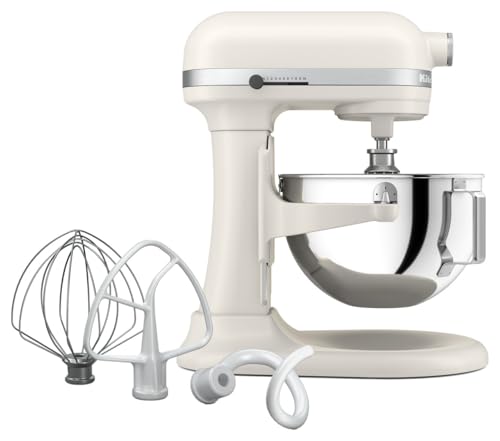
The KitchenAid KSM55 earns Best Overall by putting the professional architecture — bowl-lift — into the size a home kitchen uses weekly. The verified listing confirms the essentials: a 5.5-quart bowl-lift stand mixer with 11 mixing speeds, a stainless steel bowl, and the flat beater, dough hook and wire whip in the box. The bowl-lift mechanism matters more than any single number here. The head never moves, the bowl rises to the tools on a lever, and the whole machine stays planted when a stiff dough tries to push it around — the exact moment tilt-head owners learn their design’s limit.
Strengths
- Bowl-lift stability under heavy doughs and big batches
- 11 speeds with a gentle low end for folding and flour starts
- Stainless bowl plus the three core tools included as listed
Trade-offs
- Bowl-lift access is slightly less casual than flipping a tilt-head back
- Needs cabinet clearance planned around its fixed-head height
- Colour and configuration vary by listing — confirm the exact variant
Key specs (from the manufacturer’s Amazon listing title):
- Bowl: 5.5-quart, stainless steel bowl, per listing title
- Design: Bowl-lift, per listing title
- Speeds: 11 mixing speeds, per listing title
- Included: Flat beater, dough hook, wire whip, per listing title
- Finish: Porcelain White (this listing), per listing title
The KSM55’s real constituency is the home baker who has started to mean it: weekly bread, double batches of cookies at holidays, pizza dough on Fridays, and a stand mixer that must not flinch at any of it. The 5.5-quart bowl is the sweet spot of the range — large enough for serious batches, small enough that a single cake batter still mixes evenly instead of spreading thin. Eleven speeds sound like a detail until you fold whipped egg whites or start a bowl of flour at the lowest setting and nothing erupts. Add KitchenAid’s attachment ecosystem at the front hub, and this is the mixer most buyers can purchase once and keep. Its compromises are ergonomic rather than mechanical: you lift a bowl on and off a locating pin rather than tilting a head, and you must measure your under-cabinet space for a fixed head. Neither matters beside a decade of stable mixing.
Best for: serious home bakers wanting bowl-lift stability in a weekly-use size / Not suited for: tiny kitchens with no under-cabinet clearance for a fixed head
Check the KSM55 Bowl-Lift on Amazon — check price on Amazon and read the full listing details for the current configuration.

KitchenAid Artisan 5-Qt Tilt-Head Stand Mixer KSM150PS — Best Tilt-Head Classic
The KitchenAid Artisan KSM150PS is the defining tilt-head bowl mixer, and its verified listing states the classic formula: a 5-quart tilt-head stand mixer with 10 speed settings and a pouring shield for mess-free mixing included. The Artisan’s case is not novelty but completeness. The tilting head is genuinely the friendliest mechanism for everyday baking — one motion gives you the whole bowl for adding ingredients, scraping and swapping tools — and the 5-quart bowl matches the real size of family cakes, cookie batches and whipped cream jobs.
Strengths
- Tilt-head access is the easiest for adding, scraping and tool changes
- Pouring shield included for cleaner flour and liquid additions
- The deepest accessory and attachment ecosystem in the category
Trade-offs
- Tilt-heads can nod under the stiffest, largest dough loads
- 5-quart bowl is a ceiling for double-batch bakers
- Head must have room to tilt — measure low cabinets and shelves
Key specs (from the manufacturer’s Amazon listing title):
- Bowl: 5-quart, per listing title
- Design: Tilt-head, per listing title
- Speeds: 10 speed settings, per listing title
- Included: Pouring shield, per listing title
- Finish: Contour Silver (this listing), per listing title
Ownership is where the Artisan argues hardest. Extra bowls in glass and ceramic, alternative beaters, and the front-hub attachments — pasta, grinding, spiralling and more — mean the machine grows with a cook’s ambitions instead of being replaced by them, and a generation of shared knowledge means every recipe’s mixer instructions seem written for it. The honest limits are load and size. A stiff double dough can make a tilt-head work and wander in a way the bowl-lift KSM55 shrugs off, and bakers who routinely double recipes will meet the 5-quart ceiling. Within its brief — the everyday and celebration baking of an ordinary household, done easily and enjoyably — the Artisan remains what it has been for years: the classic against which other bowl mixers explain themselves.
Best for: everyday family bakers who value easy access and the widest ecosystem / Not suited for: heavy dough specialists or routine double-batch bakers
Check the Artisan KSM150PS on Amazon — check price on Amazon and read the full listing details for the current configuration.

Cuisinart Stand Mixer SM-50 5.5-Qt — Best Mid-Range Value
The Cuisinart SM-50 is the bowl mixer for buyers who read spec sheets and ask why the famous names cost more. Its verified listing is complete and competitive: 12 speeds, a 5.5-quart stainless steel bowl, a chef’s whisk, mixing paddle and dough hook, and a splash guard with pour spout, in White Linen. On paper it matches or beats the category’s household names at the middle of the range, and in the kitchen it behaves like what it is — a serious, well-equipped home mixer from a maker with decades of food-processor credibility.
Strengths
- 12 speeds — the finest low-speed control in this guide’s mid-range
- Full tool set plus splash guard with pour spout included as listed
- 5.5-quart stainless bowl matches the all-rounder capacity sweet spot
Trade-offs
- Smaller attachment ecosystem than KitchenAid’s front-hub world
- Less colour choice and resale depth than the category leaders
- Tilt-head style access shares the design’s heavy-dough limits
Key specs (from the manufacturer’s Amazon listing title):
- Bowl: 5.5-quart stainless steel bowl, per listing title
- Speeds: 12 speed, per listing title
- Included: Chef’s whisk, mixing paddle, dough hook, splash guard with pour spout, per listing title
- Finish: White Linen (this listing), per listing title
- Model: SM-50NAS, per listing title
The SM-50’s twelve speeds are not a vanity figure: the bottom of the range is where meringues are folded, flour is started without a dust cloud, and butter is creamed without being beaten to oil, and finer steps there are genuinely useful to a careful baker. The included splash guard with a pour spout is the other quietly adult feature — liquid and flour additions during mixing are where home baking gets messy, and Cuisinart simply includes the solution. What the SM-50 does not offer is the surrounding world: fewer attachments, fewer extra bowls, fewer colours, and a thinner second-hand market. Buyers who bake rather than accessorise will find that trade easy to accept, because the mixing itself — the actual job — is thoroughly well served here at a friendlier position in the range.
Best for: value-focused bakers wanting capacity, speeds and a full tool set / Not suited for: attachment collectors who want the largest accessory ecosystem
Check the SM-50 on Amazon — check price on Amazon and read the full listing details for the current configuration.

Hamilton Beach 4-Qt Electric Stand Mixer — Best Budget
The Hamilton Beach 4-Qt Electric Stand Mixer is how a first-time baker gets into bowl mixers without a premium commitment, and its verified listing is more complete than its position suggests: seven speeds, planetary mixing for full bowl coverage, a splash guard, a 300-watt motor, and the whisk, flat beater and dough hook all included. The planetary point deserves emphasis. Cheap mixers historically spun a beater in a circle and left the bowl’s sides unmixed; a planetary action orbits the tool around the bowl while it spins, which is the mechanism every serious mixer uses, here at the friendliest end of the category.
Strengths
- Planetary mixing action for full bowl coverage at a budget position
- All three core tools plus splash guard included as listed
- Easy-carry handle and modest size suit small kitchens and storage
Trade-offs
- 4-quart bowl limits batch size — single batches are its world
- 300 watts is a home-baking motor, not a heavy-dough one
- Lighter build than the premium machines in this guide
Key specs (from the manufacturer’s Amazon listing title):
- Bowl: 4-quart, per listing title
- Speeds: 7 speeds, per listing title
- Action: Planetary mixing for full bowl coverage, per listing title
- Power: 300 watts, per listing title
- Included: Whisk, flat beater, dough hook, splash guard, per listing title
This mixer’s brief is the ordinary baking of a small household: a cake, a batch of cookies, mashed potatoes, whipped cream, a single loaf or a pizza dough. At those jobs, with planetary action doing the reaching, it performs the bowl mixer’s essential magic — hands free, bowl covered, cook doing something else — at a fraction of the leaders’ commitment. Its boundaries are batch and dough weight. A 4-quart bowl and a 300-watt motor define a ceiling that enthusiastic bakers will find within a year, which is why we frame it as an entry point rather than a destination. Bought knowingly — for a starter kitchen, a second home, a student, or a cook testing whether stand mixing suits their life — it is one of the most sensible purchases in this guide, and it teaches exactly the habits its eventual successor will reward.
Best for: first-time bakers and small households wanting planetary action on a budget / Not suited for: batch bakers or regular makers of stiff, heavy doughs
Check the Hamilton Beach 4-Qt on Amazon — check price on Amazon and read the full listing details for the current configuration.

KitchenAid 7-Qt Bowl-Lift Stand Mixer KSM70 — Best for Big Batches
When the bowl itself becomes the constraint, the KitchenAid KSM70 is the answer in this guide: a 7-quart bowl-lift stand mixer whose verified listing confirms 11 speeds, a half-speed for folding, a Double Flex Edge Beater and four other accessories. Everything about it addresses scale with control. The bowl-lift frame keeps a very large, heavy bowl stable under load; the capacity takes double batches that would overflow a 5-quart; and the half-speed — slower than a conventional first gear — folds delicate mixtures in a big bowl without deflating them, which is the detail big-batch bakers actually write home about.
Strengths
- 7-quart bowl takes double and holiday batches in one load
- Half-speed for folding protects delicate mixtures at scale
- Double Flex Edge Beater plus four other accessories included as listed
Trade-offs
- A large, heavy machine that needs a permanent counter home
- Oversized for single small batters, which spread thin in the bowl
- Premium position in the range — buy it for capacity you will use
Key specs (from the manufacturer’s Amazon listing title):
- Bowl: 7-quart, per listing title
- Design: Bowl-lift design, per listing title
- Speeds: 11 speeds plus 1/2 speed for folding, per listing title
- Included: Double Flex Edge Beater and 4 other accessories, per listing title
- Finish: Cast Iron Black (this listing), per listing title
The KSM70 buyer is easy to recognise: they already own a mixer and have hit its ceiling — the double cookie batch that had to be mixed in two loads, the holiday production day that became an endurance event, the bread recipe scaled for a crowd that a smaller bowl refused. For that baker this machine is not an indulgence but a correction, and its refinements (the folding half-speed, the flex-edge beater that scrapes as it mixes) show a design aimed at people who bake in volume and notice waste and extra passes. The cautions are physical and practical. It is big and heavy, it wants a permanent home rather than a cupboard, and a small single batter genuinely mixes worse in a 7-quart bowl than in a 4- or 5-quart one. Keep a smaller tool for small jobs, or be the household whose small jobs are not that small.
Best for: high-volume home bakers, holiday producers and double-batch households / Not suited for: small kitchens or bakers whose batches are single and modest
Check the KSM70 7-Qt on Amazon — check price on Amazon and read the full listing details for the current configuration.
Bosch Universal Plus Stand Mixer 6.5-Qt — Best for Bread Dough
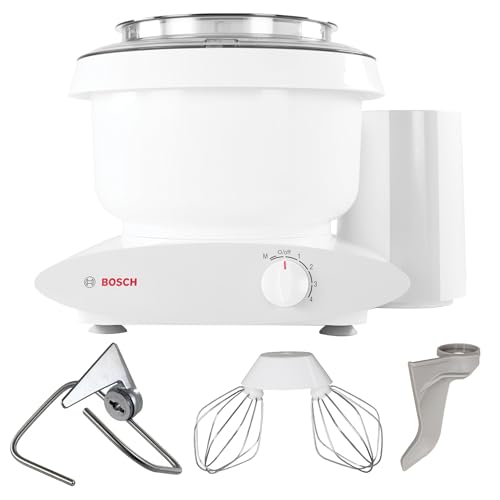
The Bosch Universal Plus is the bowl mixer’s alternative philosophy, and bread bakers have championed it for decades. The verified listing confirms a 500-watt stand mixer with a 6.5-quart capacity, bundled with wire whips, a dough hook and a NutriMill dough hook extender. The design difference is fundamental: there is no motor head hovering over the bowl. The drive is in the base, the bowl sits open and fully accessible, and the dough hook works the dough against the bowl in a kneading action that develops gluten the way bread wants — thoroughly, and in quantities that make overhead mixers labour.
Strengths
- Bottom-drive kneading is the bread specialist’s choice for full batches
- Open 6.5-quart bowl is fully accessible for adding and scraping
- Whips, dough hook and dough hook extender bundled as listed
Trade-offs
- Unfamiliar design has a learning curve for KitchenAid-trained bakers
- Whipping small quantities is less its strength than kneading large ones
- A different accessory world from the KitchenAid ecosystem
Key specs (from the manufacturer’s Amazon listing title):
- Power: 500 watt, per listing title
- Bowl: 6.5 quarts, per listing title
- Included: Wire whips, dough hook and NutriMill dough hook extender bundle, per listing title
Spend time with bread bakers and the Bosch loyalty stops being mysterious. Whole-grain doughs, enriched doughs, double loaves: the Universal Plus kneads them in the bowl without the head-shaking and bowl-climbing that stiff dough inflicts on conventional designs, and the open bowl makes the additions and checks of bread-making — flour corrections, the windowpane test, removing the dough — completely unobstructed. Where it asks for adjustment is everywhere else. The whips and bowl geometry favour volume, so a small quantity of cream or two egg whites is not its finest hour, and its accessory ecosystem, while real, is its own world rather than the category’s biggest. Our guidance is simple: if bread is your mixer’s main job, buy the specialist. If your baking is cakes-first and bread occasionally, the KitchenAids and Cuisinart above are the more natural all-rounders.
Best for: bread bakers kneading full and whole-grain batches regularly / Not suited for: cake-first bakers or anyone whipping small quantities often
Check the Bosch Universal Plus on Amazon — check price on Amazon and read the full listing details for the current configuration.
Comparison Table
Architecture and capacity decide more than brand: read the bowl column first, then the design, then everything else.
| Pick | Badge | Key spec | Best for |
|---|---|---|---|
| KitchenAid 5.5-Qt Bowl-Lift Stand Mixer KSM55 | Best Overall | 5.5-qt bowl-lift, 11 speeds, stainless bowl, 3 tools | serious home bakers wanting bowl-lift stability in a weekly-use size |
| KitchenAid Artisan 5-Qt Tilt-Head Stand Mixer KSM150PS | Best Tilt-Head Classic | 5-qt tilt-head, 10 speeds, pouring shield included | everyday family bakers who value easy access and the widest ecosystem |
| Cuisinart Stand Mixer SM-50 5.5-Qt | Best Mid-Range Value | 5.5-qt stainless bowl, 12 speeds, full tool set | value-focused bakers wanting capacity, speeds and a full tool set |
| Hamilton Beach 4-Qt Electric Stand Mixer | Best Budget | 4-qt, 7 speeds, planetary action, 300W, 3 tools | first-time bakers and small households wanting planetary action on a budget |
| KitchenAid 7-Qt Bowl-Lift Stand Mixer KSM70 | Best for Big Batches | 7-qt bowl-lift, 11 speeds + half speed, 5 accessories | high-volume home bakers, holiday producers and double-batch households |
| Bosch Universal Plus Stand Mixer 6.5-Qt | Best for Bread Dough | 500W bottom-drive, 6.5-qt, whips + dough hook bundle | bread bakers kneading full and whole-grain batches regularly |
How to Choose a Bowl Mixer: Bowl, Lift and Size
Start with capacity, measured against your biggest regular batch — not your biggest ever. A 4- to 5-quart bowl covers single cakes, standard cookie batches and family batters, which is most home baking. A 5.5-quart bowl adds comfortable headroom for bigger batters and single loaves. A 6.5- to 7-quart bowl earns its size only when double batches, multiple loaves or holiday production are routine, because big bowls genuinely mix small quantities worse: a single egg white or a cup of cream spreads too thin for the tools to work. The most common bowl-mixer regret is buying capacity for a batch that happens twice a year.
Next, the mechanism. Tilt-head designs hinge back for the easiest access and suit everyday baking under most cabinets, but they can nod and wander under the stiffest doughs. Bowl-lift designs fix the head and raise the bowl, trading a little casual convenience for stability that heavy-dough and big-batch bakers feel immediately. Bottom-drive, Bosch-style, removes the head entirely and specialises in kneading. None is universally best; each is best at a job, and your dominant bake should choose.
Finally, the bowl itself as an object. Stainless steel is light, durable and usually dishwasher-friendly; glass adds visibility and weight; a handle and a pouring-friendly rim matter every time you move a full bowl of batter. Check how the bowl locks — twist or pin — and whether spare bowls exist for the model, because a second bowl is the cheapest production upgrade in baking: one for whites, one for yolks, no washing between.
- Size the bowl to your biggest regular batch, not your rarest
- Tilt-head for access, bowl-lift for stability, bottom-drive for kneading
- Prefer a handled bowl you can lift full, with confidence
- Confirm the three core tools are included: beater, whip, dough hook
- Plan cabinet clearance for the mixer’s working height, head tilted or bowl raised
Bowl Mixer Attachments and the Second-Bowl Rule
A bowl mixer’s second life is its attachments. Front-hub systems, KitchenAid’s above all, turn the mixer into a pasta maker, grinder, spiraliser and more, which is why ecosystem depth appears in the reviews as a real ownership factor rather than a footnote. If you can see yourself rolling pasta or grinding meat, weight the ecosystem heavily at purchase; retrofitting it later means changing brands. If your ambitions stop at baking, the included tools matter more than the catalogue, and the Cuisinart and Hamilton Beach picks lose nothing by their smaller worlds.
Whatever the brand, buy the second bowl before the third attachment. Production baking stalls at the bowl: egg whites waiting while a batter bowl is washed, dough rising while the bowl is occupied. A spare bowl in the same size, or a smaller bowl for small jobs on a big machine, removes more friction from a baking day than any gadget. It is the least glamorous and most used accessory in most serious home kitchens.
Bowl Mixer Care: Keeping the Machine at Full Strength
Bowl mixers are decade appliances when treated as machines rather than furniture. Wipe flour and batter from the head and hinge or lift mechanism after use — dried batter in a hinge is tomorrow’s stiffness. Wash bowls and tools promptly, dry the bowl’s locking base so it seats cleanly, and never force a tool or bowl that is not seating; misalignment, not load, is what strains these drives. Run heavy doughs at the maker’s recommended low speeds and within stated flour capacities: a mixer that is never asked to do the impossible rarely fails at the possible.
Once a year, check the tools’ clearance above the bowl floor — most designs allow a small adjustment, and a beater that has drifted high leaves the tell-tale ring of unmixed ingredients, while one that has drifted low scrapes and wears. Keep the manual’s capacity chart with your recipes. These are five-minute habits that separate a mixer that ages from one that merely gets old.
- Clean the hinge or lift mechanism, not just the bowl
- Respect stated flour capacities and low speeds for dough
- Check beater-to-bowl clearance yearly and adjust as the manual directs
- Seat bowls and tools fully before every start
- Store tools in or beside the bowl so the set stays together
Sizing Your Recipes to the Bowl You Bought
The most useful bowl-mixer skill is translating a recipe into your bowl’s language. Every bowl has a comfortable working range — roughly from enough mixture for the tools to gather, up to the stated flour or batter capacity with headroom for the mixture to move. Below the range, small quantities smear around the bowl’s floor; the fixes are a smaller bowl if your model offers one, a hand whisk for two egg whites, or simply doubling a keeper recipe and freezing the surplus, which most bakers end up preferring anyway. Above the range, the mixture climbs the tools, the motor labours and the bake suffers; the fix is two batches, mixed in sequence, which a second bowl turns from a chore into an assembly line.
Flour deserves its own rule because it is where bowls and motors are honestly tested. A mixer’s stated flour capacity assumes the maker’s test dough; wetter, heavier home doughs with seeds, fruit or whole grains load the machine harder at the same weight. Start a new heavy recipe at three-quarters of the stated capacity, watch how the machine sounds and whether the dough climbs the hook, and scale up only when the first attempt ran comfortably. That one habit — underloading a new recipe once — is how decade-old mixers stay decade-old, and it costs nothing but a smaller first loaf.
How to Use a Bowl Mixer for Better Baking, Step by Step
Most bowl-mixer disappointment is technique, not machinery. This sequence — the one baking instructors teach — gets the category’s real performance out of any of the six picks.
- Bring ingredients to the right state first: butter softened for creaming, eggs at room temperature for volume, flour measured and ready beside the bowl.
- Fit the correct tool before adding ingredients: flat beater for batters and creaming, whip for eggs and cream, dough hook for dough — never the whip for a stiff mixture.
- Start every job at the lowest speed. Flour and icing sugar go in under a shield, towel or at a crawl until incorporated, then speed rises to the working setting.
- Cream butter and sugar fully before eggs — pale, light and increased in volume — then add eggs gradually so the emulsion holds.
- Add dry ingredients in additions, mixing only until each addition disappears. The bowl mixer’s power makes overmixing effortless, and overmixed batter is tough batter.
- For dough, once the mass forms, knead at the maker’s dough speed only, watching for the dough to clear the bowl’s sides; stop at smooth and elastic rather than by the clock alone.
- Scrape once, deliberately, midway through batters: stop, lower or remove the bowl, scrape the bottom and sides with a flexible spatula, then finish. One scrape beats ten extra seconds of mixing.
- Remove the bowl and tool promptly, and wash while residues are fresh — dried batter on a whip is the only genuinely annoying clean-up this category owns.
Keep notes on your recipes: speed, time and tool for each stage, in the margin. A bowl mixer is a repeatable instrument, and the bakers who love theirs are the ones who can reproduce last month’s success exactly — that notebook is how a good mixer becomes your mixer.
Common Buying Mistakes
Bowl mixers are long-lived and forgiving, which makes the common mistakes mostly about buying and loading rather than breaking. These recur constantly.
- Buying a 7-quart bowl for single-cake baking, then fighting thin, poorly mixed small batches
- Choosing tilt-head for a heavy bread habit, or bowl-lift for a low-cabinet kitchen, without measuring
- Kneading on high speed or beyond the stated flour capacity, which strains any home mixer
- Starting at full speed with flour in the bowl — the classic white-cloud first lesson
- Assuming all listings of the same model include the same tools and bowl; variants differ, so check the listing
- Skipping the second bowl and stalling every production bake at the sink
Final Recommendation
If one bowl mixer must serve most bakers, it is the KitchenAid KSM55: bowl-lift stability, a weekly-use 5.5-quart bowl and 11 speeds in the range’s modern centre. Everyday bakers who value easy access and the deepest ecosystem should take the Artisan tilt-head and never look back, value readers the Cuisinart SM-50, and new bakers the Hamilton Beach for its planetary action at an entry commitment. Big-batch households need the KSM70’s 7 quarts, and bread-first kitchens should seriously consider the Bosch Universal Plus before defaulting to a conventional head.
The surrounding programme covers the neighbouring tools: combo systems that blend and process live in Best Blenders Mixers, the stand-mixer value hunt continues in Best Bargain Stand Mixers, and the same category word on the audio side is explained in Best Beginner Passive Mixers and Best Behringer Mixers. Buy the bowl that fits your baking, and the mixer attached to it will feel right for years.
Before you decide, re-check the shortlist leaders at their current listings: KitchenAid 5.5-Qt Bowl-Lift Stand Mixer KSM55, KitchenAid Artisan 5-Qt Tilt-Head Stand Mixer KSM150PS, Cuisinart Stand Mixer SM-50 5.5-Qt — check price on Amazon for each and confirm the exact variant.
Frequently Asked Questions
What is the difference between a bowl mixer and a stand mixer?
They are the same appliance under two names. Stand mixer describes the machine standing on the counter with a motor head; bowl mixer — the term this guide and many listings use — emphasises the bowl that defines its capacity and handling. When comparing models, ignore the label and compare the facts: bowl capacity and material, tilt-head versus bowl-lift design, speeds, and the tools included in the listing.
Is bowl-lift or tilt-head better?
Each is better at a different job. Bowl-lift keeps the head fixed and raises the bowl, giving superior stability for heavy doughs and large batches — the choice for serious and high-volume bakers. Tilt-head hinges the head back for faster, friendlier access to the bowl, which everyday bakers making cakes, cookies and batters tend to prefer. Cabinet height can decide it for you: a tilt-head needs room to tilt, a bowl-lift needs room for its fixed height plus a raised bowl.
What bowl size do most home bakers need?
A 5- to 5.5-quart bowl covers the great majority of home baking: standard cakes, cookie batches, family batters and single loaves, with headroom to spare. Choose 4 quarts for a small household baking single modest batches, and 6.5 to 7 quarts only when double batches or multiple loaves are routine. Oversizing has a real cost — small quantities mix poorly in a very large bowl because the tools cannot gather them — so the biggest bowl is not the safest purchase.
Can a bowl mixer knead bread dough well?
Yes, within its stated flour capacity and at the low dough speeds the maker specifies. Bowl-lift and bottom-drive designs handle stiff and whole-grain doughs most comfortably; tilt-heads manage standard loaves happily but work harder at the top of their capacity. The dough hook, not the beater, is the tool, and the signs of a finished knead are a smooth, elastic dough that clears the bowl’s sides. Regular heavy bread baking in quantity is the Bosch Universal Plus’s speciality in this guide.
What attachments are actually worth buying?
After a second bowl — the highest-value accessory of all — the worthwhile attachments are the ones matched to your cooking: a flex-edge beater that scrapes the bowl as it mixes, pasta tools for households that make pasta, and a grinder for those who process meat. Front-hub ecosystems differ by brand, with KitchenAid’s the deepest. Buy attachments against recipes you already cook monthly; an attachment bought for an imagined hobby usually stays in its box while the spare bowl works every week.
How long should a bowl mixer last, and how do I help it?
A well-kept bowl mixer from the makers in this guide is a decade-scale appliance. Help it by respecting flour capacities and dough speeds, seating bowls and tools fully, keeping the hinge or lift clean, and checking beater clearance yearly. Most failures trace to chronic overloading rather than age. Treat it as the machine it is — cleaned, loaded honestly and maintained in five-minute habits — and it will outlast several generations of smaller appliances around it.


