Disclosure: airfryerkitchensupply.com is reader-supported. When you buy through links on our site, we may earn an affiliate commission at no extra cost to you.
Where to buy
Every model in this roundup is sold on Amazon and was verified against Amazon’s product data feed for this site before earning its link. Small-oven pricing shifts with promotions, so no static prices are printed here — use the links to check the current price on Amazon, and measure your counter before ordering, because ‘small’ spans everything from a two-slice dorm oven to a flip-up family model.
- Breville BOV450XL Mini Smart Oven — check the current price on Amazon
- Ninja SP101 Digital Air Fry Countertop Oven — check the current price on Amazon
- BLACK+DECKER TO1313SBD Compact Convection Toaster Oven — check the current price on Amazon
- Hamilton Beach Easy Reach Convection Toaster Oven — check the current price on Amazon
- Oster Compact Air Fryer Toaster Oven — check the current price on Amazon
- TOSHIBA 10-in-1 Convection Toaster Oven — check the current price on Amazon
Finding the best consumer small convection ovens is an exercise in honest sizing. The best consumer small convection ovens are not shrunken versions of big ovens — they are a distinct class built for dorms, RVs, studio apartments, small households and second-oven duty, where the counter space is measured in inches and a full range oven is either absent or absurd overkill for reheating pizza and baking a small batch of cookies. Every pick below was verified through this site’s Amazon product data feed.
Convection is what separates this class from a plain toaster oven. A small fan circulates hot air, evening out the hot spots that plague tiny cavities and cutting cooking times on roasted vegetables, frozen snacks and baked goods. In a small cavity the fan matters more, not less: with elements inches from the food, still air scorches tops while bottoms stay pale. All six picks use convection or an equivalent circulated-air system, in footprints from a two-slice compact to a flip-up design that stores vertically.
Capacity claims in this class need translation. ‘Six-slice’ describes toast laid flat, not six servings of dinner; a ’12-inch pizza’ claim means the cavity fits the pan, with the crust close to the elements. The reviews below translate each oven’s marketing capacity into what it realistically cooks — a 9-inch pizza, a small casserole, two chicken breasts, a quarter sheet of cookies — so you can match the oven to your actual meals.
In this guide
Quick Picks
- Breville BOV450XL Mini Smart Oven — Best Overall: Breville’s Element IQ system in the smallest footprint the line offers — eight functions and genuinely even cooking in an oven sized for singles and couples. Check the current price on Amazon.
- Ninja SP101 Digital Air Fry Countertop Oven — Best for Small Families: An XL-capacity oven that flips up against the backsplash when idle — family-size cooking (a 12-inch pizza class cavity) that returns your counter between meals. Check the current price on Amazon.
- BLACK+DECKER TO1313SBD Compact Convection Toaster Oven — Best Budget: The honest budget compact: convection cooking, a 9-inch pizza capacity, timer with stay-on and a removable crumb tray, in a 15.47-inch footprint at the lowest tier here. Check the current price on Amazon.
- Hamilton Beach Easy Reach Convection Toaster Oven — Best Access Design: A six-slice oven whose roll-top door disappears upward instead of dropping into your counter — easier, safer access to a small hot cavity, with a 150–450°F range. Check the current price on Amazon.
- Oster Compact Air Fryer Toaster Oven — Best Compact Air Fryer: Air-fry performance in a compact 18-quart body with five functions and adjustable rack positions — the crisping specialist for small counters. Check the current price on Amazon.
- TOSHIBA 10-in-1 Convection Toaster Oven — Best Feature Set: Ten functions including rotisserie, six-slice capacity, 1500 watts and six accessories in the box — the most complete small-oven package in this guide. Check the current price on Amazon.
How These Picks Were Chosen
Each candidate was verified against the site’s Amazon product data feed: brand, model and function set had to match the listing before the oven earned a link. Models that could not be confirmed were excluded, and no specification appears in this guide that does not come from a verified listing.
The shortlist balances the real axes of small-oven buying: footprint (true compacts versus flip-up storage designs), capacity (snack-and-toast duty versus small-family meals), control quality (simple dials versus Breville’s element-cycling smart system), and the door and access design, which matters daily in a small cavity. Price is discussed in tiers only, because small-appliance pricing moves too often for a printed figure to stay honest.
Badges reflect the household each oven serves best. A dorm oven and a small family’s second oven are both ‘small convection ovens,’ but they are different products, and this guide treats them that way rather than forcing one ladder of better and worse.
The 6 Best Consumer Small Convection Ovens
Breville BOV450XL Mini Smart Oven — Best Overall
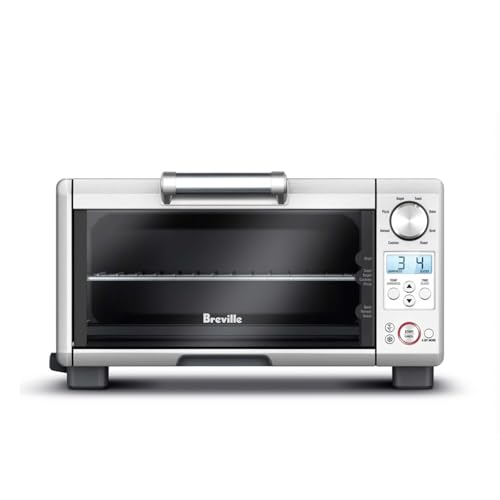
The Mini Smart Oven is the pick for small households that refuse to accept small-oven cooking quality. Breville’s Element IQ system shifts power between elements by function, which is why toast browns evenly and a small casserole bakes through instead of scorching on top — the classic failure of cheap compact ovens. Eight cooking functions cover the realistic small-oven repertoire: toast, bagel, bake, roast, broil, pizza, cookies and reheat.
Its size is the honest limit: this is an oven for one or two people. A 11-inch pizza class cavity handles personal pizzas, a couple of chicken breasts, or a small batch of cookies beautifully, and the brushed stainless build feels like a permanent appliance rather than a dorm disposable. For a studio apartment or a couple’s kitchen where the big oven heats the whole home to bake two potatoes, the Mini earns its counter space every day.
Strengths
- Element IQ power management cooks evenly — rare in this size class
- Eight functions cover the full realistic small-oven repertoire
- Premium build quality that suits permanent counter placement
Trade-offs
- Capacity suits one to two people, not family meals
- Premium tier pricing within the small-oven class
- No air-fry function — convection bake is the closest mode
| Specification | Detail |
|---|---|
| Functions | 8 cooking functions |
| System | Element IQ power distribution |
| Finish | Brushed stainless steel |
| Format | Compact / Mini countertop |
Best for: Small households wanting the best cooking quality per inch / Not suited for: Families needing six-slice or whole-chicken capacity

Check on Amazon — check the current price on Amazon before you buy; listings, bundles and included accessories change over time.

Ninja SP101 Digital Air Fry Countertop Oven — Best for Small Families
The SP101 solves the small-kitchen paradox differently: instead of shrinking the cavity, it shrinks the storage. In use it is an XL oven — air fry, air roast, bake, broil, toast, bagel, dehydrate and keep-warm across eight functions, with room for family-scale batches. When the meal ends, the whole oven flips up and back against the backsplash, reclaiming the counter depth that makes permanent ovens impossible in small kitchens.
The air-fry performance is the headline for families: a wide, shallow cavity spreads food in a single layer, which is exactly what crisping requires, and the digital controls keep settings repeatable. The trade is height — tall items like a whole chicken do not fit a low-profile cavity — and the flip-up mechanism needs the clearance above to swing. For a small family that cooks real dinners, no other design in this guide gives back so much counter.
Strengths
- Flip-up storage returns most of the counter when idle
- XL wide cavity air-fries family batches in a single layer
- Eight digital functions including dehydrate and air roast
Trade-offs
- Low cavity height excludes whole chickens and tall roasts
- Needs vertical clearance to flip up under cabinets
- Wide footprint while in use — measure the counter depth
| Specification | Detail |
|---|---|
| Functions | 8-in-1 including air fry and dehydrate |
| Storage | Flip-up vertical storage |
| Class | XL capacity, low-profile cavity |
| Controls | Digital |
Best for: Small families that cook full dinners but cannot spare permanent counter / Not suited for: Cooks who regularly roast tall items whole
Check on Amazon — check the current price on Amazon before you buy; listings, bundles and included accessories change over time.
BLACK+DECKER TO1313SBD Compact Convection Toaster Oven — Best Budget
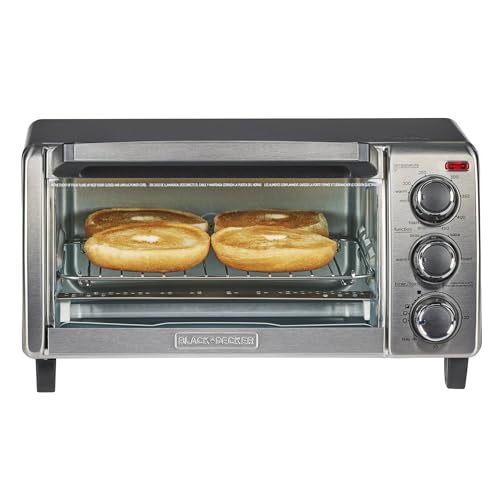
BLACK+DECKER’s TO1313SBD is what most people picture when they say ‘small convection oven’ — and for once the picture is accurate. At 15.47 inches wide it fits the counter corner of a small apartment or dorm-adjacent kitchen, its convection fan evens out baking and reheating, and it takes a 9-inch pizza, which covers the frozen-pizza reality of small-space cooking. The timer includes a stay-on function for longer bakes, and the removable crumb tray keeps the small cavity from becoming a burnt-crumb oven.
Expect budget-tier manners: dials rather than digital precision, and a cavity that rewards staying within its size class. Within that class it is a durable, sensible tool — toast, reheating, small casseroles, frozen snacks and single-serve baking are its home turf. For a first apartment or an office kitchenette, it delivers the convection benefit without the premium.
Strengths
- True compact footprint at just under 15.5 inches wide
- Convection fan plus 9-inch pizza capacity covers daily small meals
- Removable crumb tray and stay-on timer are practical inclusions
Trade-offs
- Dial controls lack digital precision and presets
- Strictly small-batch — not a family dinner oven
- Basic insulation; exterior gets hot in use
| Specification | Detail |
|---|---|
| Width | 15.47 inches |
| Capacity | Fits a 9-inch pizza |
| Features | Convection, timer with stay-on, removable crumb tray |
Best for: First apartments, dorms and office kitchenettes on a budget / Not suited for: Anyone cooking for more than two people
Check on Amazon — check the current price on Amazon before you buy; listings, bundles and included accessories change over time.

Hamilton Beach Easy Reach Convection Toaster Oven — Best Access Design
The Easy Reach’s roll-top door is a genuinely better idea for small ovens. A conventional drop-down door on a compact oven lands on the counter, eats workspace and puts wrists over hot elements when reaching in; Hamilton Beach’s door rolls up and back, opening the whole front of the cavity. In a small oven, where the food is always close to the elements, that access difference is a daily quality-of-life and safety gain.
The oven behind the door is a capable six-slice convection unit with bake, broil and toast functions and a 150–450°F adjustable range — wide enough for low warming through proper roasting temperatures. Auto shutoff suits forgetful households. It gives up the air-fry specialization of the Ninja and the smart-element finesse of the Breville, but for straightforward family-of-two-or-three cooking with the easiest access in the class, it is the thoughtful pick.
Strengths
- Roll-top door gives unobstructed, safer access to the cavity
- Six-slice capacity suits small families
- Wide 150–450°F range with auto shutoff for peace of mind
Trade-offs
- No dedicated air-fry function
- Larger footprint than the true compacts in this guide
- Controls are conventional dials, not digital programs
| Specification | Detail |
|---|---|
| Capacity | 6-slice class |
| Temperature range | 150 to 450°F (verified listing) |
| Door | Roll-top Easy Reach design |
| Safety | Auto shutoff |
Best for: Small families and anyone who struggles reaching into hot ovens / Not suited for: Air-fry specialists wanting a dedicated crisping mode
Check on Amazon — check the current price on Amazon before you buy; listings, bundles and included accessories change over time.
Oster Compact Air Fryer Toaster Oven — Best Compact Air Fryer
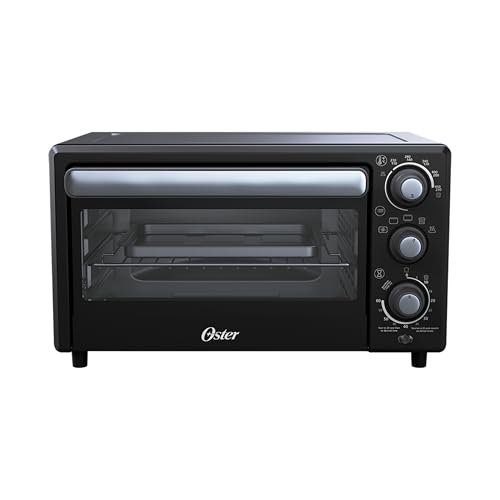
Oster’s compact entry makes one promise — air frying — and builds the oven around it. The 18-quart cavity and adjustable rack positions let you place food at the right distance from the elements for crisping, and the five functions cover the supporting roles (bake, toast and pizza duty among them) without menu-diving complexity. For the small household whose countertop cooking is mostly frozen snacks, wings, fries and reheated pizza, this focus is exactly right.
As a general baker it is more limited than the Breville or Toshiba in this guide — fewer functions, less emphasis on even low-and-slow baking. Judge it as a specialist: if your small oven’s real job is crisp food fast, the Oster does that job in a footprint a small kitchen can keep out permanently.
Strengths
- Air-fry focus with rack positions tuned for crisping
- Compact 18 qt body suits permanent small-counter placement
- Simple five-function operation — no menu complexity
Trade-offs
- Fewer functions than multi-role rivals in this guide
- Baking finesse is secondary to its air-fry mission
- Capacity remains small-batch despite the air-fry efficiency
| Specification | Detail |
|---|---|
| Capacity | 18 qt (compact class) |
| Functions | 5, including air fry |
| Racks | Adjustable rack positions |
Best for: Snack-and-crisping households in small kitchens / Not suited for: Bakers wanting a wide function set and smart controls
Check on Amazon — check the current price on Amazon before you buy; listings, bundles and included accessories change over time.

TOSHIBA 10-in-1 Convection Toaster Oven — Best Feature Set
Toshiba packs the longest feature list in this guide into a six-slice frame: ten functions spanning bake, broil, pizza, toast and a rotisserie — a feature most small ovens skip entirely — driven by LCD knob controls that blend dial tactility with digital readouts. Six accessories are included, so the oven arrives ready for its full repertoire rather than needing a second purchase.
At 1500 watts it has the power for proper roasting temperatures, and the six-slice class capacity makes it the largest conventional (non-flip) oven here — measure your counter accordingly. For a small household that wants one oven to do everything including a rotisserie chicken night, and prefers accessories included over accessories hunted, the Toshiba is the complete-package answer.
Strengths
- Ten functions including rotisserie — rare in the small class
- Six accessories included in the box
- LCD knob controls combine dial feel with digital clarity
Trade-offs
- Six-slice footprint is the largest conventional body here
- Feature depth may exceed what toast-and-reheat users need
- Rotisserie capacity is small-bird scale, as the class dictates
| Specification | Detail |
|---|---|
| Functions | 10-in-1 including rotisserie |
| Capacity | 6-slice class |
| Power | 1500W |
| Included | 6 accessories |
| Controls | LCD knob |
Best for: Small households wanting one oven that does everything / Not suited for: Minimalists who only toast and reheat
Check on Amazon — check the current price on Amazon before you buy; listings, bundles and included accessories change over time.
Comparison Table
| Pick | Badge | Key spec | Best for |
|---|---|---|---|
| Breville BOV450XL Mini Smart Oven | Best Overall | 8 functions, compact smart oven, brushed stainless | Small households wanting the best cooking quality per inch |
| Ninja SP101 Digital Air Fry Countertop Oven | Best for Small Families | 8-in-1 XL, flip-up storage, air fry | Small families that cook full dinners but cannot spare permanent counter |
| BLACK+DECKER TO1313SBD Compact Convection Toaster Oven | Best Budget | 15.47 in wide, fits 9-inch pizza, convection | First apartments, dorms and office kitchenettes on a budget |
| Hamilton Beach Easy Reach Convection Toaster Oven | Best Access Design | 6-slice, roll-top door, 150-450°F | Small families and anyone who struggles reaching into hot ovens |
| Oster Compact Air Fryer Toaster Oven | Best Compact Air Fryer | 18 qt, 5 functions, air fry | Snack-and-crisping households in small kitchens |
| TOSHIBA 10-in-1 Convection Toaster Oven | Best Feature Set | 10-in-1, 6-slice, 1500W, rotisserie, 6 accessories | Small households wanting one oven that does everything |
How to Choose the Best Consumer Small Convection Ovens
Begin with the meals, written down. List what this oven will actually cook in a normal week — toast and reheating only, frozen snacks and pizza, or real small dinners — and let that list, not the function count, drive the choice. A two-function household gains nothing from ten functions; a household roasting vegetables and baking casseroles will feel a snack oven’s limits within a month.
Then measure three spaces: the counter footprint, the height under your cabinets (including flip-up clearance for the Ninja design), and the storage space if the oven will live in a cupboard — a ‘small’ oven that is heavy to move will end up living on the counter anyway, so plan for the counter. Finally, weigh door design and cleaning: in a small cavity you reach in constantly, so access (the Hamilton Beach roll-top) and a removable crumb tray are worth more than an extra preset.
What ‘Small’ Capacity Really Cooks
Translate every capacity claim before comparing. Toast-slice counts measure flat bread, not dinner. Pizza diameter is the most honest small-oven metric: 9-inch ovens are personal-pizza and snack machines; 11–12-inch class ovens handle family frozen pizzas and small casseroles. Quart ratings help too — the 18-quart compact class crisps brilliantly but bakes small.
Height is the forgotten dimension. Wide, low ovens (the flip-up Ninja style) excel at flat foods — pizza, fries, cutlets — and fail at tall ones. Conventional small ovens with taller cavities handle a small chicken or a loaf pan. Match the cavity shape to your food shape and the oven will feel twice its size.
How to Use a Small Convection Oven Well
Small convection ovens reward small adjustments. These habits close most of the quality gap between a compact oven and a full-size one.
- Preheat fully — small cavities heat fast but unevenly at first; five extra minutes stabilizes the temperature.
- Reduce recipe temperature by about 25°F from conventional-oven directions when using convection, and start checking early — circulated air cooks faster.
- Leave air gaps: convection needs space around food. Use the rack position that centres the dish, and never foil-line the cavity floor.
- Rotate once midway for baked goods; even good small ovens have a warmer corner, and one turn evens the batch.
- Use the crumb tray and wipe the cavity weekly — in a small cavity, old grease is always inches from the elements and becomes smoke and off-flavours.
- Let the oven work as your second oven at holidays: rolls, sides and desserts in the small oven free the range for the main event.
If toast browns unevenly, that is information, not failure: note which corner runs hot and rotate accordingly. Every compact oven has a personality; learning yours takes two or three cooks and pays off for years.
Small Ovens in Real Homes: Dorms, RVs and Studio Kitchens
Each small-living situation stresses a different virtue, which is why this guide refuses a single ladder. In a dorm or first studio, the oven is often the only oven: it must toast breakfast, reheat lunch and occasionally bake something ambitious, on a counter shared with everything else the resident owns. There, reliability and a removable crumb tray outrank feature counts, and the budget compacts earn their keep. In an RV, add two constraints — power draw on a limited electrical system and storage that survives motion — and the smallest, simplest ovens win again, for different reasons.
The second-oven household is the opposite case. A family kitchen with a range that is slow to heat and wasteful for small jobs uses the countertop oven daily for the small majority of cooking: reheating slices without sogginess, roasting a side while the range holds the main, baking six cookies without heating the house. There, cooking quality per inch — the Breville’s element management, the Toshiba’s completeness — is what the household actually feels, and the premium tiers justify themselves in a season of weeknights.
Convection in a Tiny Cavity: What the Fan Really Does
In a full-size oven, convection is a refinement. In a cavity the size of a shoebox, it is closer to a necessity, because the geometry is hostile: heating elements sit inches from the food, radiant heat is intense and directional, and still air stratifies into a scorching top layer over a cool bottom. The fan breaks that stratification, washing the food in moving air of even temperature. The visible results are the ones small-oven owners report: frozen snacks that crisp instead of steaming, cookies that bake in one tone instead of two, reheated pizza whose base crisps while the cheese melts.
The fan has limits worth knowing. It cannot create space: an overcrowded tray blocks airflow and steams its contents in any oven, and small cavities punish crowding sooner. It also dries surfaces — wonderful for crisping, less kind to delicate custards and meringues, which is why better small ovens let you bake without convection for those jobs. Treat the fan as the default and still-air baking as the specialist tool, and a small oven’s repertoire quietly doubles.
Running Costs and the Small-Oven Energy Case
A small convection oven heats a small cavity, and the energy arithmetic follows: bringing a compact oven to baking temperature takes a fraction of the energy a full range needs for the same set point, and the meal cooks in a space that is not leaking heat into five cubic feet of unused air. For the one- and two-person households these ovens serve, that is the difference between an oven used daily without a thought and a range avoided all summer because it heats the kitchen.
The honest caveat is duty: a small oven asked to cook a family feast in four sequential batches can spend its advantage in door-openings and reheats. The energy case is strongest exactly where the capacity case is — small households, small meals, second-oven duty. Matched to its household, the small convection oven is not a compromise appliance; it is the correctly sized one, and correct sizing is most of what efficiency ever means.
Accessories That Earn Their Space
Small ovens attract accessory clutter, and small kitchens cannot afford it. The short list that genuinely earns storage: a quarter sheet pan that fits the cavity exactly (measure — ‘fits most ovens’ pans fit few), a small rack for two-level reheating, and the air-fry basket if your oven’s maker offers one fitted to the model. The Toshiba’s included six-accessory kit is the honourable exception that proves the rule: fitted accessories, in the box, sized to the cavity.
Skip the universal kits. Oversized pans block the airflow convection depends on, undersized ones waste the cavity, and a drawer of almost-fitting trays is how small kitchens become unusable. One pan that fits perfectly, washed and reused, outperforms a stack of compromises in every small oven in this guide.
Toast, Reheating and the Daily 90 Percent
Specification sheets sell small ovens on roasts and rotisseries, but ownership is decided by the daily 90 percent: toast at breakfast, reheating at lunch, frozen things at dinner. Judge the picks by those jobs and the ranking reshuffles itself honestly. Toast quality is element geometry plus power management — the Breville’s Element IQ exists because even toast is hard in a small box, and its advantage shows up every single morning rather than on special occasions. Reheating is where convection quietly humiliates the microwave: pastry, pizza and fried foods return crisp instead of steamed, at the cost of minutes instead of seconds.
The practical test before buying is to name your five most-reheated foods and check them against the cavity, not the brochure. Leftover pizza slices want width; a bowl of soup wants height and a stable low temperature; a portion of fries wants the air-fry focus of the Oster or the Ninja’s wide tray. The oven that fits your five foods is the right oven even if a rival wins on functions you will use twice a year.
Safety in Small Spaces
Small ovens live close to things: curtains in a studio, paperwork in a dorm, a child’s reach in a family kitchen. The safety habits are simple and worth stating plainly. Respect the clearance the manual specifies — small ovens vent real heat from their tops and sides, and the flip-up Ninja needs its swing space kept clear, not used as storage. Use the auto-shutoff models’ feature by actually setting timers rather than the stay-on mode for ordinary cooking; the BLACK+DECKER’s stay-on is for deliberate long bakes, not for toast you might forget.
Crumb discipline is a safety practice in this class, not just housekeeping: in a cavity where crumbs sit inches from elements, a neglected tray is the commonest source of smoke and the rare source of worse. The weekly empty-and-wipe rhythm in the how-to section is the whole programme. Small ovens are among the safest cooking appliances ever made when their two rules — clearance and crumbs — are kept, and both rules are free.
How Long a Small Oven Should Last, and When to Replace It
A small convection oven from the serious makers in this guide should serve a household for years of daily use; the value compacts trade some of that horizon for their tier, which is a fair trade when the tier is the point. The wear signs arrive in a predictable order: elements that heat unevenly (one corner’s toast darkens first, permanently), a fan that grows loud or intermittent, a door that no longer seals its heat in. Each is a quality tax on every meal rather than a sudden death.
Replace when the tax exceeds the appliance: when toast needs supervision, when baking needs a mid-cook rescue as routine, or when the fan — the component that makes the oven convection at all — fails. Until then, the cheapest upgrade to any small oven in this guide is the fitted pan and the thermometer habit: knowing your oven’s true temperature with a five-dollar check turns ‘unreliable oven’ complaints into a simple dial correction, in small ovens more often than their owners expect.
The Second-Oven Playbook: Holidays and Batch Days
Owners of small convection ovens in full kitchens discover their appliance’s finest hour twice a year: the holiday meal, when the range is a contested country and every side dish needs a home. The playbook is simple and worth adopting deliberately. The small oven takes the dishes that are small, late or temperature-different: dinner rolls warming at low heat while the bird rests, a casserole of green beans holding its own schedule, pies baking at their temperature rather than the turkey’s. Assign it in the plan, not in the panic, and write its jobs on the same list as everything else.
Batch days are the quieter version of the same lesson. A Sunday of meal prep runs the small oven in relays — roasted vegetables, then baked oats, then a tray of chicken — at a fraction of the range’s energy and none of its heat burden on the kitchen. Households that bought the small oven as a compromise routinely report it becoming the most-used cooking appliance they own; the playbook above is simply that discovery, written down in advance.
Small Oven, Small Footprint: The Sustainability Footnote
There is a modest environmental case for right-sized cooking that deserves one paragraph rather than a sermon. Heating a small cavity to cook a small meal uses materially less energy than heating a large one, meal after meal, year after year — and appliances sized to their households also tend to be kept longer, because they fit the life they serve instead of obstructing it. The durable choice and the economical choice, in this category, are usually the same choice: the oven that matches the household closely enough to be used daily and kept for years.
Teaching a Household to Cook Small
A small convection oven changes a household’s cooking habits in ways worth anticipating. Portions shrink to the cavity, and cooks discover that smaller batches are often better batches: vegetables roasted in a single uncrowded layer, cookies baked six at a time and eaten warm rather than stored, leftovers reheated in the quantity actually wanted. The oven rewards cooking to appetite instead of to package size, and many households find the habit — once the appliance teaches it — spreads to the rest of the kitchen. It is the gentlest argument in this guide: the right-sized tool does not just cook the household’s food; over a year, it quietly edits the household’s idea of how much food a meal needs to be.
A Word on Noise, Heat and Small-Room Comfort
Two ownership realities of small convection ovens deserve plain mention because brochures omit them. The fan makes a sound — a modest working hum on the good models in this guide, more noticeable in a studio at midnight than in a family kitchen at noon; light sleepers in combined living-sleeping spaces should favour the established makers, whose fan engineering is a generation ahead of the cheapest compacts. And the oven warms its room: trivial in winter, noticeable in a small apartment in August, and one more reason the small oven’s efficiency matters — it heats the cook’s space with a fraction of the energy a range would dump into the same room for the same meal.
Neither point should veto the category; both should tune the choice within it. The household that cooks late in a studio and the household that cooks early in a family kitchen are buying the same shelf of ovens with different weightings, and the reviews above were written to serve both readings.
Final Word on Specification Sheets
Read small-oven listings by pizza diameter, cavity height and the crumb tray — the three facts that decide daily happiness — and treat function counts as commentary. The six ovens in this guide were chosen because their working facts are strong where their households actually live: at breakfast, at reheating, at the small daily meals that make up a cooking life. Matched to the right counter, the smallest appliance in the kitchen becomes, improbably and routinely, the most loved one in it.
Delivery Day: The First-Hour Checks
A new small oven deserves twenty minutes of commissioning before its first real meal. Unbox it somewhere washable — packaging sheds — and run the empty oven at a high bake setting for the manufacturer’s burn-off period, with the kitchen ventilated: new elements and cavity coatings always smoke lightly on first heat, and doing this deliberately beats discovering it over a tray of cookies. While it runs, verify the basics against the listing: the functions all select, the timer counts, the door seals evenly, and the fitted pan you measured for actually fits with the door closed. Toast a single slice in each corner position, in turn, and you have mapped your oven’s hot corner before it ever surprises you — the cheapest piece of cooking knowledge you will ever buy, at the price of four slices of bread.
The Countertop Audit: Five Measurements Before You Click
Small ovens are returned for geometry more than for any defect, so take the five measurements that decide fit before ordering. Width and depth of the intended counter spot, obviously. Height to the underside of the cabinet above — with the oven’s door open and, for the flip-up Ninja, with its full swing arc imagined honestly. Distance to the nearest outlet, because small ovens should not live on extension cords. The storage home, if it will have one, measured at its door as well as its interior — many a ‘closable’ cupboard has a lip that defeats the plan. And finally the pan check: your most-used small pan, measured against the cavity figures in the listing. Five measurements, one tape measure, and the oven that arrives is the oven that stays — which, in a small kitchen, is the entire ballgame.
Common Buying Mistakes
Buying by slice count
Six slices of toast is not six servings of dinner. Compare pizza diameter, quart capacity and cavity height against your real meals instead.
Forgetting under-cabinet clearance
Small ovens vent heat upward and flip-up models swing tall. Measure the space including clearance, or the oven migrates to the one counter you needed for prep.
Using full-size temperatures
Convection in a tiny cavity is intense. Full conventional temperatures scorch tops before centres cook — reduce heat and check early until you know your oven.
Skipping the crumb tray clean
In a compact cavity, accumulated crumbs sit close to elements and smoke at ordinary temperatures. The tray exists to be emptied; make it a weekly habit.
Final Recommendation
For most small households, the Breville Mini Smart Oven is the recommendation — the best cooking quality in the smallest serious package. Small families should take the Ninja SP101 and its counter-returning flip-up design; strict budgets belong with the BLACK+DECKER TO1313SBD; anyone who finds small ovens awkward to reach into should choose the Hamilton Beach Easy Reach; crisping specialists get the Oster, and completionists get the Toshiba with its rotisserie and accessory kit.
Whichever you choose, match cavity shape to food shape and the oven will punch above its size. Compare the commercial end of the countertop world too:
Best Commercial Countertop Convection Ovens Best 30 Electric Smoothtop Cooktops Best 30 Gas Cooktops Best 30 Inch 5 Burner Gas Cooktops
Frequently Asked Questions
Is a small convection oven worth it over a regular toaster oven?
For most small households, yes. The fan evens out the hot spots that are unavoidable in a tiny cavity, so baking and roasting succeed instead of scorching on top. If you only make toast, a plain toaster oven suffices; for anything baked or roasted, convection earns its place.
What size pizza fits in a small convection oven?
Compact models such as the BLACK+DECKER fit a 9-inch pizza. Larger small ovens — the six-slice and XL classes — handle 11- to 12-inch pizzas. Check the pizza diameter in the listing, not the slice count, before buying.
Can a small convection oven replace a full oven?
For one- and two-person households, largely yes: baking, roasting, reheating and air frying all work at small scale. It cannot match a range for large roasts, multiple dishes at once, or big-batch baking — which is why many owners use it as a second oven instead.
Why does food cook faster in a small convection oven?
Two reasons: the fan moves hot air across the food’s surface, and the small cavity keeps food close to the heat. Reduce conventional recipe temperatures by roughly 25°F and check earlier than the recipe suggests until you know your oven.
Does the flip-up Ninja really save counter space?
Yes, while stored: it rotates up against the backsplash, returning most of its depth. In use it occupies a wide footprint, and it needs vertical clearance to flip — measure under-cabinet height before choosing it.
How do I clean a small convection oven?
Empty the crumb tray weekly, wipe the interior with a damp cloth once cool, and avoid foil liners on the cavity floor, which block airflow. In a small cavity, grease sits close to the elements, so light-and-often cleaning beats occasional deep cleans.
Can I bake bread in a small convection oven?
Small loaves, rolls and flatbreads, yes — a compact cavity bakes them well, and convection gives an even crust at this scale. Full-size sandwich loaves are the limit: most small cavities lack the height for a risen loaf in a standard pan. Households that bake bread weekly should favour the taller conventional models in this guide over the low-profile designs, and everyone should expect enthusiastic results from rolls, focaccia and pizza dough, which suit the format perfectly.
Where should a small convection oven live in a tiny kitchen?
On the counter it will actually be used from, with its clearances respected — an oven stored in a cupboard gets used monthly, while the same oven living out gets used daily. If counter space truly forbids it, the flip-up Ninja pattern exists precisely for that kitchen. Choose the spot before the model, and let the spot’s measurements veto candidates early rather than after delivery.
Is a small convection oven a good gift for a first apartment?
It is one of the most useful ones, because it is often the only real oven a first apartment’s cooking needs — toast, reheating, baking and roasting in one countertop box. Choose a straightforward model from this guide, include a fitted small pan, and the gift will be used daily rather than admired briefly. Buy for the household you have this year, and the oven will still be right when the household changes around it.