Disclosure: airfryerkitchensupply.com is reader-supported. When you buy through links on our site, we may earn an affiliate commission at no extra cost to you.
Where to buy
All six of the best barbeque smokers below are current-production models sold on Amazon, and every ASIN was verified against the live Amazon catalog before publication — brand and model searched, returned listing title matched, link issued only on a confident match. Check price on Amazon on the listing in front of you before ordering, and read its delivery notes; several of these are freight-weight machines.
- Weber Smokey Mountain Cooker 22-inch — Check the current price on Amazon
- Masterbuilt 40-inch Digital Electric Smoker with Leg Kit MB20070122 — Check the current price on Amazon
- Pit Boss 850 Navigator Series Pellet Grill — Check the current price on Amazon
- Char-Griller Smokin’ Pro Charcoal Grill and Offset Smoker — Check the current price on Amazon
- Dyna-Glo 36-inch Vertical LP Gas Smoker DGY784BDP — Check the current price on Amazon
- recteq RT-B380 Bullseye Pellet Smoker Grill — Check the current price on Amazon
Barbeque — the full spelling, the slow kind, the kind that takes a day and feeds a crowd — is America’s oldest cooking argument, and the best barbeque smokers are the machines that settle it in your favor at home. This guide is the classic roundup of the cluster: six proven smokers across charcoal, electric, pellet, offset, and propane, chosen for the canonical work of the craft — brisket with a bark that crackles, pork butts that pull at a touch, ribs with the bite that competition judges describe and families just devour. If the other guides in this family are specialists, this is the generalist’s honor roll.
What unites the six is not a fuel or a format but a standard: each one is the kind of smoker that owners keep, recommend to brothers-in-law, and cook on for years without an upgrade itch. They span the honest spectrum of involvement — from an electric cabinet you set in the morning to an offset barrel you feed by hand — because barbeque households differ in everything except the destination. The reviews are blunt about each machine’s lean, its labor, and its limits, because a guide that will not tell you what a smoker is bad at is not a guide at all.
A word on tradition, since the spelling invites it. Regional barbeque — Texas brisket, Carolina pork, Kansas City everything, Memphis ribs — was built on whatever cooker the region had: pits, barrels, block houses, drums. The lesson for a modern buyer is liberating. The meat does not care about your machine’s pedigree; it cares about steady heat, clean smoke, and a cook who pays attention. Every pick here delivers the first two. The third is included in the purchase, in the sense that these six make attention pleasant rather than punishing.
In this guide
Quick Picks
- Best Overall — Weber Smokey Mountain Cooker 22-inch: dual grates over a water pan in the bullet that defines charcoal barbeque for home cooks — capacity, stability, and a decade of community knowledge. Check the current price on Amazon
- Best Large Electric — Masterbuilt 40-inch Digital Electric with Leg Kit: 970 square inches of digital cabinet on legs, with a side chip loader — party-scale barbeque with appliance labor. Check the current price on Amazon
- Best Pellet Value — Pit Boss 850 Navigator: 932 square inches, a 30 lb hopper, and the Flame Broiler for finishing — the pellet workhorse with a sear. Check the current price on Amazon
- Best Budget Offset — Char-Griller Smokin’ Pro: 1,130 square inches including the warming rack, dual dampers, and a side firebox — real offset barbeque at an entry tier. Check the current price on Amazon
- Best Gas Vertical — Dyna-Glo 36-inch Vertical LP Gas Smoker: a tall propane cabinet in black powder coat — flame heat, stacked racks, and the fastest starts in this guide. Check the current price on Amazon
- Best Compact Pellet — recteq RT-B380 Bullseye: a kettle-form pellet grill that smokes ribs and chickens and grills like it means it — the small-patio barbeque machine. Check the current price on Amazon
How These Picks Were Chosen
Every model was verified: brand and model searched, the returned listing title matched to the intended product, and only then was the ASIN linked. Specifications in the mini boxes come from those verified listing titles.
Scoring for this flagship roundup weighted the barbeque fundamentals. Smoke quality first — the depth and cleanliness of flavor each format lays on a brisket over ten hours. Temperature character second: not just stability, but how a cooker behaves at hour eight when the cook is tired and the guests are circling. Third, canonical capacity: whole packers, multiple butts, rib racks laid flat. Fourth, the ownership ledger — fuel cost per cook, cleaning burden, parts support, and the size of the owner community whose accumulated knowledge becomes yours. Finally, honesty of positioning: each pick had to be the genuine article of its kind, not a diluted version trading on a category’s name.
Regional loyalty was deliberately ignored. A Texas-style brisket has been cooked beautifully on every format in this guide, and Carolina pork has forgiven every cooker ever built. Buy the machine that fits your life; the regions will meet you at the table.
The 6 Best Barbeque Smokers

Weber Smokey Mountain Cooker 22-inch — Best Overall
Every tradition needs its standard instrument, and for home barbeque the 22-inch Smokey Mountain is it. Two full grates stacked over a water pan inside a porcelain-enameled bullet: a brisket rides the top, butts or ribs the bottom, and the whole assembly cruises in the smoking band for hours on a ring of charcoal with wood chunks buried in it. It is not the most automated smoker here, nor the cheapest, nor the largest. It is the one against which the others are measured, because its balance of flavor, capacity, stability, and price has never been beaten as a complete package.
Strengths
- Charcoal-and-chunk smoke with genuine depth — the flavor benchmark for the non-offset formats.
- Water-pan stability makes long cooks calm; the minion method stretches a charcoal load across a brisket.
- Porcelain enamel, universal parts, and the deepest owner knowledge base in home smoking.
Trade-offs
- Lower-grate access is a lift-and-reach operation mid-cook.
- Door and joint leaks until seasoned or gasketed — a rite of passage, priced in tape.
- Your hands are the controller; there is no probe readout but the one you bring.
- Format: 22-inch vertical bullet charcoal smoker (per Amazon listing)
- Grates: dual cooking grates; porcelain-enameled kettle; temperature control dampers (per Amazon listing)
The WSM’s deepest virtue is that it teaches barbeque itself. Damper management, charcoal arrangement, smoke color, the stall, the rest — the whole curriculum is here, taught gently by a cooker that forgives the tuition. Owners graduate to offsets and keep the Weber; they buy pellet grills and keep the Weber. It is the permanent resident of serious patios, and the easiest recommendation in this entire cluster.
Best for: the classic barbeque education and all-round home production. / Not suited for: cooks wanting automation or a grill’s sear. Check the current price on Amazon

Masterbuilt 40-inch Digital Electric Smoker with Leg Kit MB20070122 — Best Large Electric
The 40-inch Masterbuilt is the production cabinet: 970 square inches across chrome racks, digital temperature control, a side wood chip loader that renews smoke without opening the door, and a leg kit that raises the whole operation to working height. For barbeque at gathering scale — a butt, two chickens, trays of wings and beans, all riding at once — it delivers the volume with the least labor of any pick here, and its consistency across a calendar year of cooks is the quiet argument electric owners make.
Strengths
- 970 square inches of stacked, digitally held cooking space — the party batch without the fire watch.
- Leg kit ergonomics: loading and unloading at standing height matters at hour ten.
- Set-and-hold temperature that ignores wind, cold snaps, and the cook’s social obligations.
Trade-offs
- Electric smoke is the mildest here; bark is good, not legendary.
- Rack width asks briskets to be trimmed or chosen with the tape measure in mind.
- Wants outdoor power and weather shelter for its controls.
- Cooking space: 970 sq in (per Amazon listing)
- Configuration: digital electric vertical with leg kit and side wood chip loader (per Amazon listing)
- Racks: chrome smoking racks
Judge this cabinet by its calendar: it is the smoker of school-night salmon, holiday turkey production, and the host who cooks for twenty while also being one of the twenty. Its barbeque is the gentle, crowd-pleasing kind — pulled pork that disappears, chicken that stays moist, ribs that need no apology — produced with a reliability the fire-based picks admire from a distance.
Best for: hosts, batch cooks, and consistency-first households. / Not suited for: bark maximalists or off-grid cooking. Check the current price on Amazon

Pit Boss 850 Navigator Series — Best Pellet Value
The 850 Navigator is the pellet pick for barbeque households that also grill without apology: 932 square inches of cooking space, a 30 lb hopper, WiFi and Bluetooth connectivity, a meat probe, a 180–500°F range — and the Flame Broiler, the sliding plate that opens direct flame under the food and gives this pellet machine a sear the rest of its class envies. It is the workhorse specification of the pellet aisle, at the tier Pit Boss has made its name undercutting.
Strengths
- Capacity plus hopper: overnight briskets and party ribs without a refill or a worry.
- Flame Broiler finishing — ribs glazed over open flame, steaks with honest char.
- Connected monitoring for the long cooks barbeque is built on.
Trade-offs
- Controller finesse trails the premium pellet names; expect a working band, not a laser line.
- Open-flame mode demands a clean grease tray — discipline is part of the feature.
- Pellet smoke, even well managed, is the cleaner and milder dialect of the language.
- Cooking space: 932 sq in (per Amazon listing)
- Hopper: 30 lb (per Amazon listing)
- Range: 180–500°F with Flame Broiler, LCD controller, meat probe (per Amazon listing)
The Navigator’s barbeque case is throughput with a finish. It smokes the brisket while you sleep, holds the ribs while you work, and then — the trick no cabinet can do — flames the final glaze onto the ribs at serving time. Households that entertain from their smoker will find it the most complete tool in this guide for the money’s tier, and its owners tend to cook on it constantly, which is the highest praise any machine earns.
Best for: entertaining households wanting pellet ease, capacity, and a sear. / Not suited for: temperature-graph perfectionists. Check the current price on Amazon

Char-Griller Smokin’ Pro — Best Budget Offset
The Smokin’ Pro is barbeque’s folk instrument: a barrel charcoal grill with a side firebox offset, dual damper control, a chrome warming rack, and 1,130 square inches of total cooking area, at the entry tier of the market. It asks its owner for the traditional offset homework — gasket the doors, season the steel, learn the fire — and in return it delivers the genuine article: wood-smoked barbeque indistinguishable at the table from cookers at multiples of its tier.
Strengths
- Real offset fire path: the deepest smoke in this guide, at the lowest tier.
- Enormous total area including the warming rack — crowd cooking without crowd money.
- Doubles as a full-size charcoal grill when the fire moves into the chamber.
Trade-offs
- Thinner steel means a livelier fire to tend and shorter intervals between fuel.
- Budget fit and finish: plan the seasoning and sealing session before the first cook.
- Firebox-area paint works hard and will want touch-ups over the years.
- Cooking area: 1,130 sq in including warming rack (per Amazon listing)
- Firebox: side fire box with dual damper control (per Amazon listing)
- Model: CG30044223
There is a straight line from the Smokin’ Pro to every great backyard pitmaster: they all started on a cooker that made them learn. This one teaches fire, smoke, and patience at a price that forgives the learning, and it feeds a crowd while doing it. If your barbeque ambitions are large and your budget is honest, this is where the tradition starts.
Best for: aspiring pitmasters and budget crowd cooking. / Not suited for: set-and-forget cooks or the mod-averse. Check the current price on Amazon
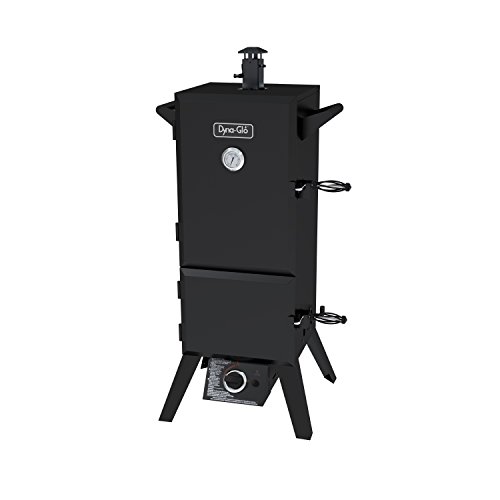
Dyna-Glo 36-inch Vertical LP Gas Smoker DGY784BDP — Best Gas Vertical
The Dyna-Glo vertical is barbeque on a valve: a 36-inch propane cabinet in black powder coat, stacking its racks in a tall chamber over a gas burner with a wood chip tray for smoke. It lights in seconds, stabilizes in minutes, and asks almost nothing across a cook except the occasional chip renewal — which makes it the pick for cooks whose barbeque happens on weeknights and whims as often as on planned Saturdays.
Strengths
- Fastest path from decision to smoke in this guide.
- Vertical racks suit the stacked classics: ribs, chickens, sausage, trays of sides.
- No ash, no charcoal storage, no cord — a tank and chips are the whole logistics.
Trade-offs
- Analog temperature control — a valve and a gauge — wanders more than digital systems.
- Smoke comes in chip loads that fade; long cooks need renewals for full flavor.
- Rack width is cabinet width: the widest briskets need a trim or a different pick.
- Format: 36-inch vertical LP gas smoker (per Amazon listing)
- Finish: black powder coat (per Amazon listing)
- Model: DGY784BDP
The Dyna-Glo’s defenders make a frequency argument, and it is a strong one: the best barbeque smoker is the one that gets lit. A cabinet that starts like a stove gets lit on Tuesdays, and a household eating smoked chicken thighs and ribs twice a week is eating more barbeque — and getting better at it — than the household with a heroic cooker and a monthly ritual. For the frequent and the spontaneous, this is the guide’s recommendation.
Best for: frequent, spontaneous barbeque and propane households. / Not suited for: digital precision or maximum brisket width. Check the current price on Amazon

recteq RT-B380 Bullseye — Best Compact Pellet
The Bullseye is the pellet grill reimagined as a kettle: a round, direct-fire-form machine from recteq — the brand whose controllers are the pellet class’s precision benchmark — built to smoke and grill in the footprint of the charcoal kettle it replaces. Its listing tells the story plainly: ribs, brisket, chicken, searing, smoking, on 100% wood pellets, from a cooker that lives happily on a small patio or deck.
Strengths
- recteq controller discipline in a compact, kettle-style form — steady smoke, honest grill heat.
- The small-patio pellet answer that does not feel like a compromise model.
- Direct, simple cooking geometry that suits weeknight grilling as much as weekend ribs.
Trade-offs
- Compact capacity: briskets are a considered fit, crowds are a batching exercise.
- No cavernous hopper class endurance — check fuel on the longest cooks.
- Pellet smoke character, with all the format’s usual terms and conditions.
- Format: kettle-form wood pellet smoker grill (per Amazon listing)
- Fuel: 100% wood pellets (per Amazon listing)
- Intended cooks: ribs, brisket, chicken, searing and smoking (per Amazon listing)
The Bullseye is the pick for the cook whose barbeque life happens in a smaller space but refuses to shrink in ambition. It carries recteq’s reputation for temperature honesty into the format most households actually have room for, and it converts kettle loyalists — the largest tribe in outdoor cooking — to pellet convenience without asking them to change their patio’s geography.
Best for: small patios, kettle converts, and two-to-four-person barbeque. / Not suited for: crowd production or maximum capacity. Check the current price on Amazon
Comparison Table
| Pick | Badge | Key spec | Best for |
|---|---|---|---|
| Weber Smokey Mountain 22-inch | Best Overall | Dual grates, water pan, porcelain bullet | The classic barbeque education |
| Masterbuilt 40-inch Electric with Leg Kit | Best Large Electric | 970 sq in, digital, side chip loader | Party batches with appliance labor |
| Pit Boss 850 Navigator | Best Pellet Value | 932 sq in, 30 lb hopper, Flame Broiler | Entertaining, capacity, and a sear |
| Char-Griller Smokin’ Pro | Best Budget Offset | 1,130 sq in, dual dampers, side firebox | Real offset flavor at entry tier |
| Dyna-Glo 36-inch Vertical LP Gas | Best Gas Vertical | 36-inch propane cabinet | Fast, frequent, spontaneous cooks |
| recteq RT-B380 Bullseye | Best Compact Pellet | Kettle-form pellet grill | Small patios, kettle converts |
How to Choose a Barbeque Smoker
Choose by the barbeque you actually dream about, in food and in labor. If the dream is a brisket you tended like a campfire story, buy the fire formats — the bullet for the gentle version, the offset for the full one. If the dream is a table full of smoked food and a cook who was present for the party, buy the controlled formats — electric for the purest version, pellet for the most versatile. If the dream is barbeque on a Tuesday, buy the propane cabinet and never look back. The mistake is buying someone else’s dream; the forums are full of offsets sold by pellet people and cabinets sold by fire people, all of them excellent machines in the wrong life.
The canonical capacity question
Barbeque capacity is brisket-shaped. Ask of any smoker: does a whole packer brisket lie flat with room around it? Does a second grate or rack take the beans, the second butt, the ribs for the people who do not eat brisket? The 22-inch bullet, the 40-inch cabinet, the big pellet and the offset here all answer yes in their own geometry. The compact picks answer “yes, with a trim and a plan” — which is fine for households whose canonical cook is ribs and chicken, and limiting only when brisket is the point.
Smoke depth, ranked honestly
For buyers who rank flavor first: offset splits deepest, charcoal with chunks next, pellets a clean third, chips in gas and electric cabinets the gentlest. But depth is a preference, not a virtue — competition judges reward balance, children reward gentleness, and many a family has voted with its forks for the cabinet’s lighter touch. Know your table. The rest of the choice — labor, capacity, cost per cook — is covered in this cluster’s specialist guides, and the wisest buyers read their own calendar before they read any rankings, including this one.
Budget tiers and the five-year view
Barbeque smokers sort into entry (the Smokin’ Pro’s tier), mid (bullets, cabinets, gas verticals, compact pellets), and premium (large connected pellets and beyond). Across five years, fuel and parts narrow the gaps: the entry offset eats charcoal and splits generously; the electric sips; the pellet eats bags at a steady, budgetable rate. The durable rule is to buy the best-built machine in the tier your commitment justifies — a mid-tier cooker used weekly is a better life than a premium cooker used monthly or an entry cooker outgrown by spring.
Reading owner reviews without being fooled
When you research these six beyond this guide, read owner reviews for patterns rather than verdicts. A smoker with a thousand cooks behind it will have complaints — about a door, a probe, a paint chip — and the complaints are useful precisely because they repeat: they tell you the machine’s known homework. Be wary of the two uninformative extremes, the one-cook rave and the one-cook condemnation, and weight the reviews that mention a second season. Barbeque smokers reveal themselves over time, and the owners who report back after a year of Saturdays are the witnesses worth hearing.
How to Cook a Brisket on Any of These Six
The brisket method that travels across all six formats is a study in what changes and what does not. What does not change: trim the packer to a smooth shape with a modest fat cap, season with confidence (salt and coarse pepper carry Texas brisket; a fuller rub carries the others), cook fat-side toward the heat, and judge the end by probe tenderness — the flat should offer almost no resistance — rather than by any clock. Rest it wrapped, at least an hour, and slice against the grain, the flat in pencil-thick slices and the point in cubes or thicker cuts.
What changes is fire management. On the bullet: a full charcoal ring, chunks buried, dampers set once and trusted. On the offset: a coal bed first, then small splits on a rhythm, smoke kept thin and pale. On the pellet and electric machines: fill the fuel, set the number, and spend your attention on the wrap decision and the rest instead of the fire. On the propane cabinet: chips renewed on schedule and a probe doing the watching. The stall will come for all of them — that plateau where the temperature stops rising — and the answer is the same everywhere: wrap if the bark is set and the schedule matters, or wait it out if it does not. Six machines, one brisket, and a method that respects both.
The Regional Styles, and What They Teach a Home Cook
Texas teaches brisket minimalism: salt, pepper, post oak, patience — and the confidence to let good meat and clean smoke speak. Carolina teaches pork patience and the vinegar finish that cuts through richness. Kansas City teaches generosity — everything on the menu, sauce as a proud layer rather than an apology. Memphis teaches the dry rub’s authority on ribs, sauce served at the side like a suggestion. A home cook does not need to enlist in any of these armies; the styles are a library of techniques, and the six smokers in this guide can cook from any volume in it. Borrow the brisket discipline from Texas, the pork finish from Carolina, the rib rub from Memphis, and the hospitality from Kansas City, and your backyard develops a style of its own — which is what every region’s tradition was, once.
Keeping a Barbeque Smoker for the Long Haul
Barbeque smokers age by their dirtiest inch: the firebox floor under wet ash, the cabinet seal behind grease, the pellet fire pot under its own dust. The long-haul routine is short enough to memorize, and forgiving enough that skipping it once costs nothing while skipping it always costs the machine. Ash out cold, grease path emptied, grates brushed warm. Seals and dampers checked with the seasons. Fuel stored dry enough to trust. A cover that actually fits, on a spot that actually drains. Do these and the machines in this guide repay with the only feature that never appears in a listing: they become your smoker — seasoned, known, and predictable in the way that makes the tenth year of barbeque better than the first. There is a moment, usually in the second season, when a cook stops consulting instructions and starts consulting memory — when the dampers get set by feel and the fire gets built by habit — and that moment is the true delivery date of every machine on this page.
Ribs: The Cook That Decides Backyard Reputations
Brisket is barbeque’s marathon, but ribs are its reputation — the cook your neighbors will actually judge, because ribs are what they order, what they remember, and what they will compare against the place across town. The fundamentals are mercifully consistent across all six machines here. Choose the cut honestly: spare ribs for the full, meaty, traditional experience, baby backs for the leaner, quicker version. Remove the membrane from the bone side — it is the difference between a clean bite and a chewy argument. Season with a rub that balances salt, sugar, and warmth, and give it time to set while the cooker stabilizes.
The cook itself is a study in cues over clocks. Ribs ride in the smoking band until the color deepens to mahogany and the meat pulls back from the bone ends; the bend test — lift the rack from one end and watch the surface crack without the rack breaking in two — is the doneness signal every tradition respects. Wrapping for a middle stretch with a little butter, honey, or juice is the competition inheritance: it tenderizes and enriches, and it is optional in direct proportion to your patience. Sauce, in the sauced traditions, goes on at the end and sets in the cooker’s residual heat. Rest them briefly, slice between the bones with the rack bone-side up so you can see your cuts, and serve without ceremony. Do this well on any machine in this guide and your backyard’s reputation is settled law.
The Barbeque Pantry and Toolkit
Great barbeque is mostly groceries and a handful of tools. The pantry: kosher salt and coarse black pepper as the foundation, paprika, garlic and onion powders, brown sugar, and a mustard for binding rubs; apple cider vinegar for spritzes and Carolina finishes; butcher paper for wraps; a cooking oil with a high smoke point for grates and seasoning. The woods: oak for the all-round fire, hickory for emphasis, apple and cherry for the gentle work. The tools: a dual-probe thermometer above all, long tongs, a wide spatula, heat gloves, a spray bottle, a sharp slicing knife for brisket, and a cooler that doubles as a resting chamber. That is the whole armory. Everything beyond it — and the catalog is endless — should have to argue its way into your kitchen against the standard of these few things used well and often.
The Second-Cooker Question
Most serious barbeque households eventually own two cookers, and this guide’s picks pair predictably. The bullet plus a pellet grill is the classic marriage: charcoal depth on Saturdays, appliance ease all week. The offset plus an electric cabinet pairs the ceremony with the production line — the brisket gets the fire, the sides and the second meats get the cabinet. The kamado-minded solve it differently, with one ceramic doing everything for years. What rarely works is two cookers with the same personality: two offsets double the labor, two cabinets double the mildness. If a second purchase is in your future, buy the complement, not the twin — and let the first cooker be the one whose labor you love, because it will still be the one you light when it matters.
Your First Four Cooks: A Curriculum That Works on Any of the Six
Cook one: a pork butt, chosen because it forgives everything a new smoker-cook pair does to each other. You will learn your machine’s fuel rhythm, its hot spots, and its true cruising temperature, and you will eat well regardless — pulled pork covers a multitude of educational sins. Cook two: ribs, spare or back, to learn time-and-cue cooking and your household’s rub preference. This is the cook where the bend test replaces the clock in your habits, permanently. Cook three: a whole chicken, spatchcocked, to learn the two-stage temperature lesson — smoke for flavor, heat for skin — that separates adequate poultry from the kind people request.
Cook four: the brisket, now approached with a machine you understand and hands that have rested, wrapped, and sliced before. Trim it conservatively, season it classically, and give it the whole day and the full rest. Most cooks find the fourth cook tastes like the fortieth, because the curriculum front-loads the judgment that brisket demands. Thereafter, the repertoire is yours: sausage and jerky in the cabinets, fish where the format suits it, vegetables and sides in every spare corner. Barbeque mastery, it turns out, is mostly a well-ordered first month.
Chicken: The Underrated Final Exam
Ask experienced pitmasters which cook exposes a fraud and many will say chicken, not brisket. Brisket forgives with fat and time; chicken keeps receipts. The skin must render and crisp while the breast stays moist and the thighs reach their silky best — a temperature choreography that punishes single-setting thinking. The winning pattern on every machine in this guide is the two-stage cook: smoke low for the flavor foundation, then finish hot — vents open, controller up, or a move to the machine’s fierce zone — until the skin sets. Spatchcocking flattens the bird so it cooks evenly enough for the choreography to work, and a dry brine the night before seasons it to the bone while drying the skin for its crispy finale. Serve a chicken cooked this way beside any brisket and watch which plate empties first; the result recalibrates many cooks’ ambitions, profitably.
Common Buying Mistakes
Buying for the region instead of the cook. Your life determines the right machine; the meat’s tradition will adapt, as it has for two centuries. The Texas brisket tradition was born on brick pits and raised on offsets, yet it cooks beautifully today on bullets and pellet grills in Austin backyards — because what the tradition actually demands is clean smoke, steady heat, and salt-and-pepper confidence, all of which travel across machines.
Chasing smoke depth as a score. Deeper is a dialect, not a grade. Match the smoke to your table’s palate. Remember that smoke is one ingredient among salt, fat, rub, and time — a brisket with perfect smoke and no seasoning discipline loses to a balanced one from a milder machine every time, at every table, in every region.
Underestimating the rest. More briskets are ruined after the cook than during it. Budget the hour; tent the meat; slice at the table. The rest is not dead time in the schedule — it is when the juices redistribute and the texture sets, and a brisket sliced in haste weeps its moisture onto the board instead of staying in the meat. Plan dinner around the rest the way you plan around the cook, and protect it from hungry guests with the same firmness.
Trusting the first cook. Every smoker here has a personality that takes three cooks to learn. Judge on the fourth. The first cook teaches the machine’s assembly quirks, the second its fuel appetite, the third its weather moods — and only then does the cooking become the variable instead of the equipment. Cooks who return a smoker after one disappointing brisket have usually returned a perfectly good machine and kept the inexperience that caused the brisket.
Neglecting the grease and ash ledger. The unglamorous routine is the lifespan. Ten minutes per cook is the whole secret. Put the routine on the same footing as the recipe — written down, done in order, finished before the cook sits down to eat — and it stops being a chore that competes with dinner and becomes part of the cook itself, which is how the owners of twenty-year-old smokers have always treated it.
Final Recommendation
If one smoker must be named for barbeque in general, it is the Weber Smokey Mountain 22-inch — the standard by which the field is judged. Hosts and batch cooks should take the Masterbuilt 40-inch Electric; entertainers who grill as much as they smoke, the Pit Boss 850 Navigator; aspiring pitmasters, the Char-Griller Smokin’ Pro; spontaneous cooks, the Dyna-Glo Vertical; and small-patio perfectionists, the recteq Bullseye. Whichever of the six earns your patio, give it the four-cook curriculum before you judge it, keep a simple log of the first season’s fires and finishes, and buy the probe thermometer before the second brisket rather than after the first dry one. Barbeque rewards the cook who treats the machine as a long acquaintance — and every machine on this page has a decade of dinners in it for the household that does. The rest of the cluster goes deeper by specialty: Best Backyard Smokers, Best Bar Bq Smokers, Best Barbecue Smokers Grills, Best Backyard Offset Smokers, Best Backyard Pellet Smokers, Best Backyard Heavyduty Smokers.
Frequently Asked Questions
What is the best all-around barbeque smoker for a beginner?
The Weber Smokey Mountain in either size is the classic answer: forgiving, capable, and supported by more collective knowledge than any other home smoker. If you want zero fire management, start with a digital electric cabinet and add a charcoal cooker when curiosity strikes. Either way, follow the four-cook curriculum in this guide — butt, ribs, chicken, brisket — and choose your first machine for the cook you will do second, not the feast you might do someday: the beginner who smokes twice a month on a modest machine learns faster and eats better than the one intimidated by a flagship.
How long does a brisket take?
Roughly an hour to an hour and a half per pound at smoking temperatures, varying with the cooker, the meat, and the stall — and it is done when a probe slides into the flat with almost no resistance, not when the clock says so. Always add a full hour of rest to the plan. Practically, this means brisket is a decision made the day before: start it in the morning for a late dinner, or the night before on the formats that run unattended well, and treat any schedule that requires a brisket to finish at an exact hour as a schedule designed by someone who has not met the stall.
Which fuel tastes most like traditional barbeque?
Wood and charcoal, in that order — the offset and bullet formats. Pellet smoke is the same language in a cleaner accent; electric and propane cabinets speak it most softly. Traditional is a spectrum in practice, and every region’s tradition began on whatever burned locally. It is also worth remembering that tradition includes technique as much as fuel: the Texas brisket cooked on a pellet grill with discipline tastes more traditional than the same brisket rushed on an offset with a dirty fire. Fuel sets the ceiling; the cook decides how close to it dinner gets.
Do I need to wrap brisket and pork butts?
Need, no; often wise, yes. Wrapping in butcher paper after the bark sets speeds the cook through the stall and protects moisture, at a small cost to bark firmness. It is a tool for schedules and dry-prone cuts, not a rule. Learn to read the bark first — dark, set, and resistant to a fingernail scratch — because wrapping before the bark forms steams it away, while wrapping after preserves it. Pork butts forgive an early wrap; brisket flats repay a patient one. When in doubt on a first cook, wrap the butt and leave the brisket naked, and compare notes at the table.
What size smoker for a family of six?
The mid-size class in this guide — an 18- or 22-inch bullet, a 30- to 40-inch cabinet, a 550- to 850-class pellet grill — covers family-of-six barbeque with room for guests. Go larger when briskets regularly share the grate with other mains. Think in menus rather than headcounts: six people eating ribs needs less cooker than six people eating brisket, beans, corn, and chicken off the same fire. And remember that a smoker’s second grate or fourth rack is real capacity — vertical designs feed six from footprints that look, on paper, too small for the job. When two sizes both fit the menu, choose the one whose fuel and labor you prefer, because a family-of-six household will light the cooker it enjoys twice as often as the one it merely owns.
How do I keep smoked meat moist when reheating?
Reheat gently and sealed: wrapped in foil with a splash of its own juices or a little broth, in a low oven, until just hot. Pulled pork and brisket slices both reward patience here; the microwave is the enemy of everything you spent twelve hours creating. For whole leftover cuts, slice only what you will serve and reheat the piece whole when possible — an unsliced brisket flat reheats like it was cooked yesterday, because its moisture never got the chance to leave. Freeze in flat, dated bags, thaw in the refrigerator, and yesterday’s production becomes next week’s best dinner with almost no loss.


