Disclosure: airfryerkitchensupply.com is reader-supported. When you buy through links on our site, we may earn an affiliate commission at no extra cost to you.
Where to buy
If you are shopping for the best audio mixers live work demands, buy through Amazon and confirm the exact variant on the listing — channel count, rack versus surface format and powered versus unpowered versions hide behind similar model names. For most working bands and venues the modern center of this guide is the Behringer XR18, a stage-box digital mixer that mixes from a tablet; start there and move toward the surface mixers if your hands prefer faders.
- Behringer X AIR XR18 — check the current price on Amazon and confirm the exact configuration on the listing before you order.
- Yamaha TF1 — check the current price on Amazon and confirm the exact configuration on the listing before you order.
- Allen & Heath QU-16C — check the current price on Amazon and confirm the exact configuration on the listing before you order.
- Soundcraft Ui12 — check the current price on Amazon and confirm the exact configuration on the listing before you order.
- Mackie ProFX16v3 — check the current price on Amazon and confirm the exact configuration on the listing before you order.
- Yamaha EMX5 — check the current price on Amazon and confirm the exact configuration on the listing before you order.
Live mixing forgives nothing. In a studio you can stop, rewind and re-balance; in a room full of people, the feedback squeal, the buried vocal and the dead channel happen in public and in real time. The best live mixers are therefore built around different virtues than studio boards: enough microphone inputs for the whole band plus spares, monitor sends so each musician hears what they need, processing that prevents problems (feedback control, limiting, sensible EQ) rather than merely shaping tone, and a failure plan — because the show continues whether the mixer cooperates or not.
The category has quietly split in two. Stage-box digital mixers — the XR18 and Soundcraft Ui12 here — put the inputs on stage where the microphones are, and move the mixing surface to a tablet or laptop that can stand anywhere in the room, including the one place a traditional mixer can never be: in the audience, hearing what the audience hears. Surface digital consoles like the Yamaha TF1 and Allen & Heath QU-16C keep physical faders and add recall, multitrack recording and deep processing. And the analog workhorses — the Mackie ProFX16v3 and Yamaha’s powered EMX line — persist because some gigs reward simplicity, immediacy and a mixer that can also drive the speakers.
Count your real inputs before reading further: a four-piece band with full drum miking, two guitars, bass DI, keys and three vocals is already past twelve channels, and the mixer that “should be enough” is the one that ruins the first festival slot. Every pick below states its honest ceiling.
All six picks were verified as current Amazon listings on 2026-11-20. Live gear pricing swings hard with promotions, so this guide prints none — check the current price on Amazon under the full model name and variant.
In this guide
Quick Picks
- Best Overall — Behringer X AIR XR18: an 18-channel stage-box mixer with Midas preamps, tablet control and multitrack USB — mix from the audience, record the show, carry it in a rack bag.
- Best Surface Console — Yamaha TF1: a 16-channel digital console with motorized faders, a touchscreen and Yamaha’s one-knob processing — digital power with analog manners.
- Best for Recording Live — Allen & Heath QU-16C: a rack-mountable digital console with multitrack recording to USB media and Allen & Heath processing — the live desk that brings the show home.
- Best Budget Digital — Soundcraft Ui12: a 12-input stage-box mixer controlled from any browser — Lexicon, dbx and DigiTech processing heritage at a budget tier.
- Best Analog for Bands — Mackie ProFX16v3: sixteen channels of Onyx preamps and GigFX with USB recording — the analog band mixer for rooms that want hands, not tablets.
- Best Powered Mixer — Yamaha EMX5: a 12-input powered mixer with built-in amplification and DSP — mixer and amp in one box for passive-speaker PA rigs.
How These Picks Were Chosen
We screened live mixers on show-night criteria. Input count and preamp quality first, with headroom for a loud drummer and a quiet vocalist on adjacent channels. Monitor capability second: the number of aux sends decides how many separate monitor mixes the band can have, and insufficient monitors cause more bad gigs than insufficient effects ever will. Third, problem-prevention processing: high-pass filters everywhere, feedback suppression or at least fast parametric EQ on outputs, and compressors for vocals and bass. Fourth, operability under pressure — can a competent engineer run this surface, in the dark, having never seen it before?
Excluded were DJ mixers, studio boards with no monitor sends, and toy digital mixers whose wireless cannot survive a room full of phones. The survivors span the modern live landscape: two stage-box digitals, two surface digitals, one analog-plus-USB band mixer, and one powered mixer for the PA-in-a-box gig.
The 6 Best Audio Mixers for Live Sound
Behringer X AIR XR18 — Best Overall
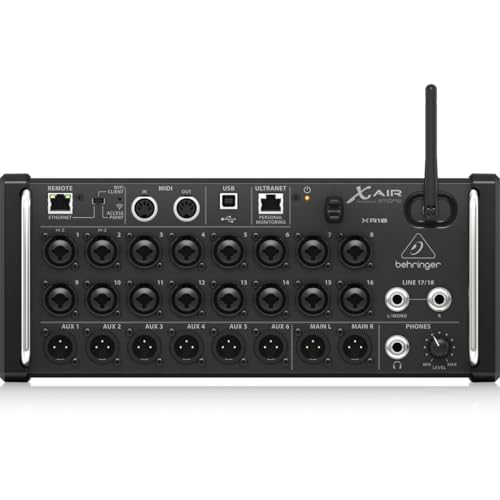
The XR18 changed what a small-venue mixer is. Sixteen Midas-designed preamps and eighteen channels live in a stage box that sits where the cables are — on stage — while the engineer mixes from a tablet anywhere in the room, most importantly from the audience’s position, hearing the show the audience hears. Every channel carries full digital processing: parametric EQ, compression, gate and effects, and six aux sends build real monitor mixes for the band.
Its multitrack USB interface records every channel separately, turning every gig into a potential live album or a virtual-soundcheck source — play last night’s recording through the mixer at soundcheck and refine the mix with no band present. For working bands mixing themselves, venues on a budget and churches with volunteer engineers saving scenes per service, the XR18’s combination of capability, size and tier remains the category benchmark.
Strengths
- Mix from anywhere: the engineer hears the room, not the side of the stage
- 16 Midas preamps, full per-channel processing and six monitor sends
- Multitrack recording and virtual soundcheck transform rehearsals and gigs alike
Trade-offs
- No physical surface — a dead tablet battery is a show problem; carry a backup device
- Built-in Wi-Fi is fine for small rooms; serious venues add an external router
- Deep features live in an app that rewards one evening of learning before the first gig
| Specification | Detail |
|---|---|
| Channels | 18 inputs, 16 mic preamps (Midas) |
| Buses | 12-bus architecture, 6 aux sends |
| Control | Tablet/computer app, built-in Wi-Fi |
| Recording | Multitrack USB interface |
Reliability practice makes or breaks stage-box mixing: bring a dedicated router for crowded venues, keep a wired laptop connection as the backup path, and save the show’s scene before doors. Bands that adopt those three habits report the XR18 as the most liberating gear purchase they have made; bands that trust room Wi-Fi and a single phone write the horror stories.
Best for: working bands, small venues and churches mixing their own sound from stage or room / Not suited for: engineers who refuse to mix without physical faders — see the TF1 and QU-16C
Check the current price on Amazon for the Behringer X AIR XR18.

Yamaha TF1 — Best Surface Console
The TF1 is Yamaha’s argument that digital consoles should behave like mixers, not computers. Seventeen motorized faders (sixteen channels plus master) sit under real hands, a touchscreen handles the deep editing, and Yamaha’s TouchFlow operation plus one-knob compression and EQ presets — voiced per instrument type — let a competent volunteer reach a good mix quickly and an expert reach a great one without menu archaeology.
Sixteen D-PRE preamps with recallable gain, ample aux sends for monitors, and scene memory for recurring events make the TF1 a natural house console for schools, churches and small theaters, where the operator changes weekly and the setup must return exactly. It records and integrates with Yamaha’s stage boxes as the system grows, which protects the investment when the room’s ambitions do.
Strengths
- Physical motorized faders and a walk-up-and-mix layout
- Preset-assisted processing speeds soundcheck for rotating operators
- Yamaha reliability and a growth path via stage boxes
Trade-offs
- Larger and heavier than stage-box mixers; it is furniture, not a gig-bag item
- Premium tier over the XR18 — justified by the surface, not by channel count
- Touchscreen depth still rewards training for the house team
| Specification | Detail |
|---|---|
| Channels | 16 inputs, D-PRE preamps |
| Faders | 17 motorized (16 + master) |
| Control | Touchscreen, TouchFlow operation |
| Extras | Scene memory, one-knob EQ/comp presets |
The TF1’s best feature is social: a guest engineer can run it. In venue and school life, where tonight’s operator met the console this morning, that walk-up usability prevents more bad shows than any processing specification. Budget the training hour anyway — presets accelerate a mix, they do not replace listening.
Best for: venues, schools and rental engineers who need a real surface anyone competent can walk up to / Not suited for: bands wanting the smallest possible footprint — the stage-box picks travel lighter
Check the current price on Amazon for the Yamaha TF1.

Allen & Heath QU-16C — Best for Recording Live
The QU-16C pairs a proper digital mixing surface — motorized faders, per-channel processing, scene recall — with the live engineer’s favorite party trick: multitrack recording straight to USB media, no laptop required, plus multitrack streaming to a computer when one is present. Sixteen Allen & Heath preamps, four effects engines drawn from the company’s flagship heritage and a rack-mountable chrome-edition frame suit installed and touring small-format rigs alike.
For bands, the workflow is transformative: record the show, then mix it in the studio from the actual performance, or run virtual soundchecks from last week’s files. For venues, the QU-16C’s iPad control and layered fader banks keep a compact surface feeling larger than it is, and its scene system serves the church-to-club weekly rotation gracefully.
Strengths
- Multitrack recording to USB media with no computer at the gig
- Allen & Heath effects and processing pedigree
- Rack-mountable — installs cleanly in house and touring racks
Trade-offs
- 16-channel ceiling is real for festival-style changeovers
- Chrome-edition rack format assumes a rack-centric rig
- Premium tier; stereo-only recorders cost far less if multitrack is unused
| Specification | Detail |
|---|---|
| Channels | 16 inputs, digital processing per channel |
| Recording | Multitrack to USB media and computer |
| Faders | Motorized, layered banks |
| Extras | 4 FX engines, iPad control, scene recall |
If your band’s business includes live releases, content or simply honest post-gig review, the QU-16C’s recording habit pays for itself in material. Pair it with a fast, generous USB drive, format media as the manual directs, and make “arm the recording” a line in the soundcheck checklist — the one show you forget is inevitably the best one.
Best for: bands and venues that record every show multitrack and engineers who love the QU workflow / Not suited for: buyers needing more than 16 channels at the surface — the QU family’s larger frames are the step up
Check the current price on Amazon for the Allen & Heath QU-16C.

Soundcraft Ui12 — Best Budget Digital
The Ui12’s radical feature is its ordinariness of control: any device with a browser — phone, tablet, laptop, any brand — becomes the mixing surface, with no app store involved. Inside, Soundcraft assembled an all-star processing bench: Lexicon reverbs, dbx compression and the dbx AFS feedback suppression that automatically hunts ringing frequencies, a genuine blessing for volunteer engineers and loud small rooms.
Twelve inputs (eight microphone preamps) suit acoustic acts, duos, trios and speaking-led events, and the Ui12’s stage-box form keeps cable runs short. Its limits are equally clear — a full drum kit plus band will outgrow it, and browser control depends on the network you give it — but within its format it delivers digital mixing’s core benefits, recall and processing depth, at the friendliest tier in this guide.
Strengths
- Any-browser control: no app, no platform lock-in
- dbx AFS automatic feedback suppression protects inexperienced engineers
- Lexicon effects and full per-channel processing at a budget tier
Trade-offs
- 8 mic preamps cap the format at small acts and speech events
- Network-dependent control — bring router discipline from day one
- No multitrack recording; capture is a stereo affair
| Specification | Detail |
|---|---|
| Inputs | 12 total, 8 mic preamps |
| Control | Browser-based, any device |
| Processing | Lexicon FX, dbx dynamics and AFS feedback suppression |
| Form | Stage-box, rack ears available |
The Ui12 is the right first digital mixer for a small venue precisely because its automation forgives: AFS guards the room while the volunteer learns, scenes save the Sunday setup, and the browser interface means the replacement tablet is whatever is in the building. Grow into its ceiling knowingly and it will never embarrass you inside it.
Best for: duos, trios, small churches and cafés wanting digital mixing and feedback control on a budget / Not suited for: full bands — twelve inputs with eight mic preamps is the honest ceiling
Check the current price on Amazon for the Soundcraft Ui12.
Mackie ProFX16v3 — Best Analog for Bands
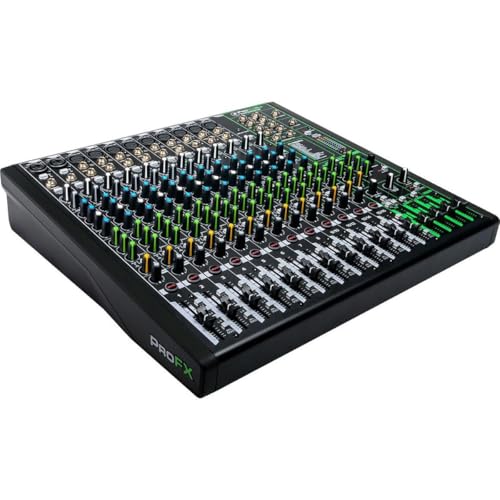
The ProFX16v3 keeps the analog faith with modern manners: sixteen channels with Onyx preamps, a GigFX effects engine for the vocal reverb and delay every band mix needs, monitor sends for the wedges, and USB recording so the night’s mix — and, per its listing, multitrack capture — survives the drive home. Every control is a physical control, visible at a glance, grabbable in the dark, with no network, no app and no boot time between the van and the downbeat.
For rehearsal rooms, churches with analog-trained volunteers and bands that mix from stage with a foot on a monitor, that immediacy is not nostalgia — it is operational fitness. The ProFX16v3 will not recall last week’s scene or suppress feedback automatically; it will also never ask for a firmware update at soundcheck, and its failure modes are the kind a working musician can diagnose by looking at it.
Strengths
- Sixteen real channels with Onyx preamps at an analog tier
- USB recording brings the analog show home
- Zero boot, zero network, zero app — the mixer is simply on
Trade-offs
- No scene recall: every setup is dialed by hand and ear
- Processing depth per channel trails the digital picks
- Effects are a shared engine — one flavor at a time
| Specification | Detail |
|---|---|
| Channels | 16, Onyx preamps |
| Effects | GigFX engine |
| Recording | USB interface (see listing for modes) |
| Build | Steel chassis, sealed controls |
Choose analog deliberately and the ProFX16v3 rewards you with the fastest soundchecks in this guide once the band’s settings are marked and learned. Keep a settings sheet in the cable case — tape marks and a phone photo of the surface — and the analog workflow’s one true weakness, recall, shrinks to a five-minute ritual.
Best for: bands, churches and small venues preferring an analog surface with modern recording / Not suited for: engineers needing scene recall and per-channel digital processing depth
Check the current price on Amazon for the Mackie ProFX16v3.

Yamaha EMX5 — Best Powered Mixer
The powered mixer survives because some gigs are one trip from the car: the EMX5 combines a 12-input Yamaha mixer, a serious built-in power amplifier for passive main speakers, monitor output and SPX-derived DSP effects in a single carry. Solo performers, school assemblies, fitness and dance instructors, houses of worship with simple needs — the EMX5’s audience values the collapse of mixer, amp and effects into one reliable unit with Yamaha’s feedback suppression on board.
Its stereo architecture and shared effects mark its ceiling: this is a main-and-monitor PA heart, not a multitrack recording console. Within that job it is superbly judged — one-knob compression on voice channels, graphic EQ for the room, and power enough for small-to-medium rooms with efficient passive speakers. If your speakers are passive and your crew is you, the EMX5 is the honest pick.
Strengths
- Mixer, amplifier and effects in one carry — the fastest PA setup in this guide
- Yamaha feedback suppression and one-knob vocal compression
- Powers passive mains directly with a monitor path
Trade-offs
- Stereo mixer architecture; no multitrack or scene recall
- Useless amplification if your speakers are already powered
- Shared effects engine and small-format EQ precision
| Specification | Detail |
|---|---|
| Inputs | 12 inputs, stereo powered mixer |
| Amplifier | Built-in power for passive speakers |
| Effects | DSP with SPX-derived programs |
| Extras | Feedback suppressor, graphic EQ |
Match speakers honestly: the EMX5’s amplifier is generous for its class, but efficient speakers in the right size room remain the formula. Buy the EMX5 as a system decision — mixer-amp plus the passive speakers it will drive for years — and it becomes the most economical live rig in this entire guide per show performed.
Best for: solo acts, duos, schools and venues running passive speakers who want one box to carry / Not suited for: powered-speaker rigs — you would pay for amplification you cannot use
Check the current price on Amazon for the Yamaha EMX5.
Comparison Table
| Pick | Badge | Key spec | Best for |
|---|---|---|---|
| Behringer X AIR XR18 | Best Overall | 18 channels, 16 Midas preamps, tablet control, multitrack USB | working bands, small venues and churches mixing their own sound from stage or room |
| Yamaha TF1 | Best Surface Console | 16 channels, motorized faders, touchscreen | venues, schools and rental engineers who need a real surface anyone competent can walk up to |
| Allen & Heath QU-16C | Best for Recording Live | 16 channels digital, multitrack to USB, rack-mountable | bands and venues that record every show multitrack and engineers who love the QU workflow |
| Soundcraft Ui12 | Best Budget Digital | 12 inputs, browser control, dbx feedback suppression | duos, trios, small churches and cafés wanting digital mixing and feedback control on a budget |
| Mackie ProFX16v3 | Best Analog for Bands | 16 channels, Onyx preamps, GigFX, USB | bands, churches and small venues preferring an analog surface with modern recording |
| Yamaha EMX5 | Best Powered Mixer | 12 inputs, built-in power amp, DSP FX | solo acts, duos, schools and venues running passive speakers who want one box to carry |
How to Choose the Best Audio Mixers for Live Sound
Count inputs from the stage plot, not the band photo. Kick, snare, two overheads or a hat mic, bass DI, two guitars (mic or DI each), stereo keys, three vocals and a playback feed is a completely ordinary fifteen channels. Add one spare for the guest, the broken channel and the instrument someone buys next month. Mixers in this guide span twelve to eighteen inputs; choose the one whose ceiling is above your real plot, because submixing drums to free channels is a compromise you will hear all night.
Monitor sends decide the band’s night. Each distinct wedge or in-ear mix needs its own aux: a singer, a drummer and a shared mix for the rest is three. The XR18’s six auxes and the surface consoles’ generous sends exist because monitor poverty — not front-of-house quality — is what musicians actually complain about in the car home.
- Digital stage-box (XR18, Ui12): mix from the room, tiny footprint, network discipline required.
- Digital surface (TF1, QU-16C): physical faders, recall, walk-up usability for guest engineers.
- Analog (ProFX16v3): instant, legible, no recall — best when one operator owns the setup.
- Powered (EMX5): only when speakers are passive; otherwise the amplifier is dead weight and dead budget.
- Recording: multitrack (XR18, QU-16C) if the band releases or reviews shows; stereo if the recording is a souvenir.
Budget honestly around the whole system: a mixer upgrade that forces new monitor wedges, a router, cases and cables costs what it costs. The tiers here run from the Ui12’s budget digital to the surface consoles’ premium, and the correct tier is the one that leaves money for the speakers and microphones the audience actually hears.
Soundcheck Discipline: Where Live Mixes Are Actually Won
Every mixer in this guide can produce a good show; the difference between good and bad nights is the forty minutes before doors. Ring out the monitors first — raise each wedge until it threatens feedback, cut the offending frequency, and bank the headroom — because a monitor system with margin lets singers relax and pitch better. Then line-check loudest-first, set gains with real performance intensity, and build the house mix from the vocal outward: the audience came for the song, and the song lives in the lead vocal.
Save everything the mixer allows you to save: scenes, channel libraries, the show file on a second device. Live sound’s oldest law is that the night you cannot recall the setup is the night the setup mattered most. Digital buyers, that law is your purchase justification — honor it by actually pressing save.
In-Ear Monitors Versus Wedges: The Mixer Implications
The monitor decision reshapes the mixer specification more than any other in live sound. Wedges forgive: a band can share two or three mixes, the audience hears some of it as warmth, and the mixer’s aux count can stay modest. In-ear systems are individually honest: every musician wants their own mix, at their own balance, with their own effects level — and the aux count becomes the mixer’s defining number. The XR18’s six aux sends and the surface consoles’ monitor architectures exist because the in-ear transition is the live industry’s dominant trend, driven by hearing protection, stage volume and the consistency of hearing the same mix in every room.
Budget the transition as a system: mixer auxes, transmitter or wired body-pack channels, and the earphones themselves. Bands mid-transition often run a hybrid — singer and drummer on in-ears, the rest on two wedge mixes — which the picks here all support, provided the aux arithmetic is done before purchase. Do the arithmetic from the stage plot, write it into the mixer comparison, and let it veto otherwise attractive boards: a mixer with two fewer auxes than the band needs is not a bargain at any discount.
Festivals, Changeovers and the Guest-Engineer Test
House and festival work adds a criterion home and band buyers can ignore: the fifteen-minute changeover. The mixer that serves it recalls the previous act’s scene instantly, presents a surface a guest engineer can read at a glance, and labels its inputs in a house standard order that survives personnel changes. Digital recall (TF1, QU-16C, and the stage-box pair via their apps) transformed this work; the analog ProFX16v3 answers it with the oldest technology of all — a surface so legible that the changeover is a re-patch and a line check, with settings carried in the engineer’s head and hands.
Whichever philosophy a venue chooses, the discipline is the same: a house input list, a default scene or surface state that every show starts from, and a rule that deviations get saved or noted before the room empties. Live mixers are often blamed for changeover chaos that belongs entirely to missing paperwork. The consoles in this guide all provide the technical means; the venue provides the culture, and culture, as usual, is the load-bearing element.
Power, Cases and the Unglamorous Half of Live Reliability
Live mixers die of logistics more often than of electronics. The stage-box pair need clean power and a protected rack or bag; the surface consoles need cases that make their weight a two-minute load rather than a negotiation; every digital option needs its control device charged, its firmware current and its show files backed up somewhere that is not the device itself. None of this appears in specification tables, and all of it appears in the stories engineers tell about the night the music stopped.
Build the reliability kit when you buy the mixer, not after the first failure: a spare tablet or laptop loaded with the control app, an external router for stage-box work, a small UPS or at minimum a quality surge strip for the mixing position, spare network and USB cables, and printed screenshots of your core scenes. The total cost is a fraction of any console in this guide, and it converts the digital workflow’s theoretical fragility into a practical robustness that analog partisans underestimate — right up until their surface’s one irreplaceable knob meets the one dropped flight case.
Backup Plans: What the Professionals Carry That Amateurs Mock
Ask a touring engineer what separates professional live sound from enthusiastic live sound and the answer is rarely a console model; it is the backup plan. For the mixers in this guide the plan has four cheap components. A second control device for digital and stage-box systems, charged and loaded. A stereo recording or playback path that bypasses the main mixer entirely — the humble phone-into-two-channels rescue that has saved more shows than any flagship feature. Spare channels mapped and labeled in advance, so a failed input is a thirty-second re-patch rather than a diagnosis performed in front of an audience. And the show’s settings exported or photographed somewhere other than the console, because a mixer that loses its memory the afternoon of the show is only a crisis for the engineer who trusted it exclusively.
None of this diminishes the picks here — the XR18’s ubiquity, the TF1’s and QU-16C’s house reliability and the ProFX16v3’s analog legibility are exactly why professionals build plans around them rather than around lesser boards. The plan is not pessimism; it is the recognition that live sound happens in public, in weather, on borrowed power, and the audience paid for the music rather than for a seminar on mean time between failures. Carry the spares, save the scenes, and let the show’s only surprises be musical.
Training the Volunteer: A System for Rooms Without a House Engineer
Churches, schools and community venues share a staffing reality: the mixer is run by whoever cares most, not by whoever knows most. The mixers in this guide serve that reality unevenly, and the difference should drive institutional purchases. Scene recall (all the digital picks) converts one competent setup into a hundred competent services; presets (the TF1’s one-knob processing) compress the learning curve for gain and EQ; automatic feedback suppression (the Ui12’s dbx AFS) insures the room against the volunteer’s first loud mistake. An institution buying for volunteers should weight those three features above channel count it will rarely use.
Pair the technology with a one-page house document: the input list in its permanent order, the three scenes that cover every event type, the monitor rules, and the phone number of the one person who truly knows the system. Laminate it, tape it inside the mixer case, and rehearse the handover once with each new volunteer at a quiet weekday hour rather than at a panicked pre-service minute. Live sound in volunteer rooms is a teaching problem wearing an equipment costume, and the rooms that sound consistently good are the ones that solved the teaching.
Rental and Resale: The Live Mixer’s Second Economy
Live mixers participate in a working economy beyond their first owner, and the models in this guide were chosen partly inside it. The XR18’s ubiquity means every rental house stocks it, every freelance engineer knows it and a band can hire an identical spare in any city — an ecosystem value no specification table captures. The Yamaha and Allen & Heath surfaces carry the same professional familiarity into installed and rental fleets, and the Mackie’s analog legibility makes it the perpetual rehearsal-room and backup board. When a live mixer is also a business asset — for a venue, a church with events, a band that hires itself out — that second economy deserves a line in the decision: the mixer the local ecosystem already speaks is worth a premium over the marginally better stranger, because on show night, familiarity is a feature with a cash value.
Reading a Spec Sheet Like an Engineer, Not a Shopper
Live-mixer specifications reward a translator’s eye. Input counts include line inputs that cannot take a microphone; the number that matters is microphone preamps, and this guide states it for every pick. Aux counts may include stereo pairs counted twice; ask how many independent mono monitor mixes the board truly builds. Effects counts describe the library, not the simultaneous engines. And the wireless specification on a stage-box mixer describes the radio in a quiet lab, not in your venue full of phones — which is why the router advice in this guide is repeated until it sounds like nagging. Read every specification by asking “counted how, measured where, true when?” and the spec sheet becomes an honest document. The mixers here survive that reading, which is a meaningful part of why they are here.
The Congregation, the Classroom and the Club: One Mixer, Three Rooms
The same sixteen channels live three different lives across a week in most towns, and the mixers in this guide were screened against all three. The congregation needs speech intelligibility above all, volunteer-proof recall and monitor restraint; the classroom needs durability, legibility and a surface a teacher can run between lessons; the club needs headroom, monitor generosity and the stamina for a loud Saturday. A mixer that serves the week honestly — scenes for Sunday, a default state for the school day, a band setup for the weekend — is worth more to a multi-use room than a specialist that serves one of the three brilliantly and the others reluctantly. When you evaluate the picks against your room, score them against your whole calendar, because that is the workload the purchase actually signs for.
How to Set Up a Live Mixer From Load-In to Downbeat
A repeatable load-in routine turns a new room into a known room. Work in this order and the downbeat stops being a gamble.
- Place the mixer or stage box first and run power from one clean source; stage-box users, mount the router high and clear of bodies and metal.
- Run the snake and inputs in a fixed channel order you reuse every show, and label both ends — future-you at midnight thanks present-you.
- Ring out monitors before the band arrives in full: gain, EQ cuts for feedback margin, then set each musician’s mix at soundcheck volume.
- Line-check and gain-stage loudest-first with real playing intensity, high-pass everything that is not kick or bass, and set vocal compression before the singer asks for more reverb.
- Build the house mix vocal-first, add the band underneath in order of importance to the song, and walk the room — the mix position lies, the corners and the bar tell the truth.
- Save the scene or photograph the surface, arm the recording if your mixer offers it, and mute every channel that is not in the show.
After the show, note what the room did: the frequencies you cut, the monitor complaints, the channel that misbehaved. Live mixing is a memory sport, and the engineers who write it down are the ones whose second night in a room sounds like their tenth.
Common Buying Mistakes
Live-mixer mistakes are public and immediate; the standard set is below, with the fix attached to each.
- Under-counting inputs and submixing the drum kit into oblivion on night one.
- Starving the monitors: one shared mix for five musicians guarantees four unhappy performers and a worse show.
- Trusting venue Wi-Fi with a stage-box mixer in a room full of phones — bring a router, always.
- Skipping the monitor ring-out and meeting feedback for the first time in front of an audience.
- Buying a powered mixer for powered speakers, or an unpowered mixer with no amplifier plan for passive ones.
- Never saving the scene: digital recall is the feature you paid for; an unsaved show file is analog mixing at digital prices.
Final Recommendation
For most live buyers, the recommendation is the Behringer XR18: sixteen Midas preamps, genuine monitor capacity, multitrack recording and the freedom to mix from the audience make it the most capable small-format live mixer per dollar and per pound in this guide. Rooms that need a walk-up surface should take the Yamaha TF1; bands that record every show, the Allen & Heath QU-16C. Small acts on a budget get digital’s benefits from the Soundcraft Ui12, analog loyalists get sixteen honest channels from the Mackie ProFX16v3, and passive-speaker rigs get the one-box Yamaha EMX5.
Confirm the exact format — rack, surface, powered — and the current price on Amazon under the full model name before ordering. Live mixers earn their money in public; buy the one whose ceiling, sends and workflow match the shows you actually play.
Start your shortlist with Behringer X AIR XR18, Yamaha TF1, Allen & Heath QU-16C — check the current price on Amazon for each and compare the exact configurations side by side before you decide.
Related guides in this series: Best Audio Mixers For Studios · Best Audio Mixers For Pc · Best Audio Mixers For Streaming Twitch · Best 12 Channel Mixers · Best 16 Channel Mixers
Frequently Asked Questions
How many channels do I need for a live band mixer?
Plot the stage honestly: full drum miking alone can take five to eight inputs, then add bass, guitars, keys, playback and every vocal. Most four-piece bands land at fourteen to eighteen inputs. Buy above your plot — the XR18’s eighteen and the 16-channel surfaces exist precisely at this boundary — and keep one spare channel for the inevitable surprise.
Stage-box digital or a traditional surface?
Stage-box mixers (XR18, Ui12) put inputs on stage and let you mix from the audience on a tablet — transformative for self-mixing bands and small venues, at the cost of network discipline and no physical faders. Surfaces (TF1, QU-16C) suit house engineers, guest operators and anyone who thinks with their hands. Both are fully professional; choose by who mixes and from where.
What are monitor sends and how many do I need?
Each aux send feeds an independent monitor mix — what one musician hears. A singer, a drummer on in-ears and a shared band mix is three; five individual in-ear mixes is five. Count your performers’ actual needs and treat aux count as a first-order specification, equal to input count.
Can a live mixer record the show?
Yes — the XR18 and QU-16C record multitrack (every channel separately), the QU even straight to USB media without a laptop. Analog and budget digital picks capture the stereo mix. If the band releases live material or reviews performances, multitrack recording is worth prioritizing at purchase, not retrofitting later.
Do I need a powered mixer?
Only if your main speakers are passive. A powered mixer like the Yamaha EMX5 includes the amplifier those speakers need. If your speakers are powered (most modern rigs), the amplifier is unusable weight — buy an unpowered mixer and put the savings into channels or processing.
How do I stop feedback at live shows?
Ring out the system at soundcheck: raise monitors slowly, cut the frequencies that ring, and bank headroom before the audience arrives. Keep microphones behind the main speakers, use high-pass filters on vocals, and consider automatic suppression (the Ui12’s dbx AFS) if volunteer engineers run your room. Technique beats gear, but gear that helps technique is welcome.
Do I need a separate monitor engineer or mixer for monitors?
Only at a scale beyond this guide’s picks: dedicated monitor consoles belong to tours with many in-ear mixes and a second engineer. For club, church and band work, one mixer with sufficient aux sends — run by the house engineer or a band member — is the professional norm, and every digital pick here can also hand musicians personal control of their own mix through apps, which is the modern middle path between one shared mix and a second console.
How loud should the system be, and can the mixer help?
Loud enough for the music’s energy at the audience’s position and no louder — a judgment the mixer supports with metering, output limiting and EQ that removes the harshness often mistaken for insufficient volume. Engineers who chase level with faders when the real problem is a brittle frequency balance damage hearing and reputations; the processing in these consoles exists to fix the balance first. Set a sane limit, literally, with the output limiter, and mix inside it.


