Disclosure: airfryerkitchensupply.com is reader-supported. When you buy through links on our site, we may earn an affiliate commission at no extra cost to you.
Where to buy
If you are shopping for the best audio mixers for podcasting & music, start with the shortlist below. Every mixer in this guide is a current model sold through Amazon, which is where we recommend buying hybrid production gear: the listing states the exact variant — channel count, recording format, bundle or bare unit — and returns are painless if a unit arrives faulty. Start with the Tascam Model 12 if one desk must do both jobs, and check the current price on Amazon under the full model name, because several families here span multiple sizes that share a name and little else.
- Tascam Model 12 — check the current price on Amazon and confirm the exact configuration on the listing before you order.
- Zoom LiveTrak L-12 — check the current price on Amazon and confirm the exact configuration on the listing before you order.
- Rode Rodecaster Pro II — check the current price on Amazon and confirm the exact configuration on the listing before you order.
- Mackie Onyx16 — check the current price on Amazon and confirm the exact configuration on the listing before you order.
- Allen & Heath ZEDi-10FX — check the current price on Amazon and confirm the exact configuration on the listing before you order.
- Yamaha MG12XU — check the current price on Amazon and confirm the exact configuration on the listing before you order.
The best audio mixers for podcasting & music serve the fastest-growing format in audio: the show that talks and plays. A musician interviewing other musicians, with songs performed live between the conversation. A producer breaking down tracks and then demonstrating them. A band’s own podcast, recorded in the rehearsal room, where the “studio session” and the “episode” are the same afternoon. This hybrid work breaks both pure categories: podcast consoles run out of inputs and musical sophistication, while traditional music mixers lack the voice processing, guest routing, and publish-ready workflow that spoken segments demand. The six mixers in this guide live deliberately in the overlap — every one of them can record a multitrack music session and a polished podcast, and the reviews are honest about which side of the line each one favors.
The deciding questions are different here than in either parent category. For music, you need enough microphone preamps for a real session — a drum kit alone can claim eight — plus stereo channels for keyboards and playback, and multitrack capture so the performance can be mixed properly afterward. For podcasting, you need voices to sound finished with minimal engineering, remote guests to arrive without echo, and every participant monitored in headphones. A mixer that does both must also switch personalities quickly, because the session that starts as an interview and ends as a jam does not pause for re-cabling. Keep those tensions in mind; they explain every pick and every trade-off below.
There is also a budget truth specific to this search: the hybrid desk is asked to replace two desks, and at the middle tiers in this guide it genuinely does — the Model 12 and LiveTrak cost less than a competent podcast console plus a competent recording mixer bought separately, while occupying one desk, one power strip, and one learning curve. The savings are real only if the hybrid truly serves both halves, which is why this guide is strict about the difference between a hybrid and a mixer with a podcast sticker on the box. Every pick below passed sessions on both sides of the line in our evaluation criteria; the ones that merely gestured at the other side were cut, however famous their names.
All six picks were verified as current Amazon listings on 2026-11-20. They span the hybrid spectrum: two purpose-built mixer-recorders from Tascam and Zoom that treat podcasting and music as one job, the podcast flagship from Rode for voice-led shows with musical guests, a multitrack-USB analog console from Mackie for studio-minded producers, a compact Allen & Heath hybrid interface-mixer, and Yamaha’s value workhorse for bands that also talk.
In this guide
Quick Picks
- Best Overall — Tascam Model 12: a 12-track digital recorder, mixer, and USB interface in one retro-styled desk. The hybrid format’s defining product.
- Best for Live Sessions — Zoom LiveTrak L-12: twelve channels, multitrack SD recording, five headphone mixes. Records the band, then the interview about the band.
- Best for Voice-Led Shows — Rode Rodecaster Pro II: broadcast voice processing and podcast workflow first, with stereo music capture for performances.
- Best Analog Multitrack — Mackie Onyx16: sixteen channels of analog console with multitrack USB to your DAW. The producer’s desk.
- Best Compact Hybrid — Allen & Heath ZEDi-10FX: a small mixer with a 4×4 USB interface and studio effects. The songwriter-podcaster’s corner desk.
- Best Value — Yamaha MG12XU: twelve inputs, D-PRE preamps, SPX effects, stereo USB. The band-room all-rounder at a working price.
How These Picks Were Chosen
Hybrid duty imposed a dual screen. On the music side: at least eight usable inputs on the larger picks, multitrack recording — to SD or over USB to a DAW — so a performance can be mixed after the fact, and preamps honest enough for both a whispered vocal and a close-miked snare. On the podcast side: per-participant headphone monitoring, a sane path for remote guests, voice-friendly processing or at least musical channel EQ and compression, and a workflow that lets a non-engineer capture speech confidently between musical segments. Units that were merely a live mixer with a USB socket, or merely a podcast console with a spare line input, were cut; the survivors genuinely work both sides of the street.
We also weighted session speed. Hybrid shows are usually produced by the performers themselves, so the mixer must store its dignity under self-operation: clear layouts, recallable or at least photographable settings, and recording that starts with one button rather than a routing seminar. Every product was cross-checked against Amazon listing data on 2026-11-20 — ASIN, listing title, and variant confirmed — before any link was placed, and spec boxes are limited to what those listings and the manufacturers’ published formats support.
One screening note deserves emphasis, because it eliminated several famous names: stereo-only USB on a music-leaning desk was treated as a serious limitation rather than a footnote, and podcast consoles without the input count for even a small acoustic ensemble were not stretched into this category on the strength of their voice processing. The six survivors are not the six most famous mixers in either parent category; they are the six that can walk into a hybrid session and work both halves without apology, which is a rarer and more useful distinction.
The 6 Best Audio Mixers for Podcasting & Music

Tascam Model 12 — Best Overall
The Model 12 is a 12-track digital multitrack recorder, a 10-channel mixer, and a USB audio interface fused into one wood-sided desk that looks like 1978 and works like now. It suits musician-podcasters above all: record the song multitrack in the morning, mix it on the same faders after lunch, then record the interview episode about it in the afternoon — without a computer until you choose to involve one. It does not suit users who want one-touch broadcast voice processing; its processing is a recordist’s toolkit, applied with intent.
Strengths
- True multitrack recording to SD with punch-in, overdub, and DAW-control features — a real production workflow, not a capture afterthought.
- Eight microphone preamps plus stereo and MIDI connectivity cover a band, a synth rig, and a podcast panel in one session plan.
- The mixer, recorder, and interface personalities share one surface, so hybrid sessions never stop for re-cabling.
Trade-offs
- Voices are captured clean rather than broadcast-polished; podcast sheen is added by your hand or in post.
- The retro workflow rewards learning — menus and modes where a podcast console offers presets.
- Remote-guest routing is manual compared with the Rode’s purpose-built paths.
Key specs: 12-track multitrack recorder · 10-channel mixer · USB audio interface · 8 mic preamps · MIDI I/O · SD recording
The Model 12 wins this category because it refuses the premise that podcasting and music are different activities requiring different desks. Its design treats a “session” as a session: sources plugged in once, recorded discretely, mixed physically. For the growing class of shows built by musicians — gear podcasts with demos, songwriting shows with work-in-progress performances, band podcasts from the rehearsal space — that unity is worth more than any single feature. The podcast side is served by discipline rather than automation: set good levels, use the channel EQ and compression with the restraint our podcasting guide preaches, and the recordings reward you with the same quality as the music. It is the thinking producer’s hybrid desk.
Best for: musician-podcasters, songwriting and gear shows, rehearsal-room productions / Not suited for: one-touch voice processing or pure talk shows
Check the current price on Amazon

Zoom LiveTrak L-12 — Best for Live Sessions
The LiveTrak L-12 is a 12-channel console that records every channel to SD while it mixes, with five independent headphone mixes for the room. It suits live-session podcasts — a band performing and then discussing, a panel with musical interludes, a church or school production that is half concert and half conversation. It does not suit solo creators, who will never light most of its channels, or streamers wanting app-driven production.
Strengths
- Eight mic preamps and multitrack SD capture handle a real band and a real panel in the same session.
- Five discrete headphone mixes: the drummer, the host, and the guest each hear what they need — the hybrid session’s hardest problem, solved.
- Scene and layout logic borrowed from live sound makes it fast under self-operation.
Trade-offs
- No broadcast voice chain; speech polish is the operator’s craft or the editor’s.
- The biggest footprint in this guide along with the Onyx16.
- USB interface duties are secondary to its recorder personality.
Key specs: 12 channels · 8 mic preamps · multitrack recording to SD · 5 headphone mixes · USB audio interface
Live hybrid sessions fail on monitoring before they fail on anything else: the singer needs to hear the host, the host needs to hear the playback, the drummer needs to hear everything except the drummer jokes. The L-12’s five headphone mixes are therefore not a luxury but the product. Add multitrack capture of the whole event — performance and conversation alike, every source separate for the editor — and you have the session desk for shows that happen in a room, in real time, with an audience of participants. Zoom built it for musicians who podcast and podcasters who host musicians, and that dual citizenship shows in every decision.
Best for: live session shows, band podcasts, panels with music / Not suited for: solo shows or processing-first talk formats
Check the current price on Amazon

Rode Rodecaster Pro II — Best for Voice-Led Shows
The Rodecaster Pro II anchors the voice-first end of the hybrid spectrum: four studio preamps with APHEX processing, smart pads, multitrack recording, and guest routing — a podcast flagship that also captures musical performances in stereo or multitrack from its line and Bluetooth inputs. It suits talk-led shows with musical guests, singer-songwriters who perform one or two instruments on mic, and producers who value finished-sounding episodes over deep music production. It does not suit full-band multitrack sessions; four microphone channels is its honest ceiling.
Strengths
- The best voice sound in this guide, in hardware, on every episode — the podcast half of the hybrid is simply solved.
- Smart pads trigger intros, beds, and samples live, which musical shows use as transitions and stingers.
- Multitrack recording and dual USB cover both the edited episode and the live stream.
Trade-offs
- Four mic inputs cap musical ambition at small acoustic formats unless instruments go direct.
- No MIDI, no DAW-control layer — music production depth lives elsewhere in this guide.
- Flagship pricing for a show whose music needs may be modest.
Key specs: 4 studio preamps · APHEX processing · 8 smart pads · multitrack recording to PC/microSD/USB · dual USB + Bluetooth
Plenty of “podcasting and music” shows are, in truth, podcasts where music visits: a guest performs two songs on an acoustic guitar, a co-host demos a riff, a theme is played live. For that reality the Pro II is ideal — the conversation sounds like radio, the performance is captured cleanly on its own tracks, and the production elements fire from the pads without a laptop detour. Buy it when the talking is the show and the music is the jewel inside it; buy the Tascam or Zoom when the music is the show and the talking frames it. That sentence is the whole category in miniature, and the rest of this guide is really just its supporting evidence, assembled pick by pick and session by session.
Best for: talk-led shows with musical guests, singer-songwriter formats / Not suited for: full-band multitrack recording
Check the current price on Amazon

Mackie Onyx16 — Best Analog Multitrack
The Onyx16 is a premium 16-channel analog console whose USB sends multitrack audio to your DAW — the traditional recording desk, modernized. It suits producer-podcasters who already think in DAW sessions, project studios that host interview shows between album work, and anyone whose music side is serious enough to need sixteen channels of real console. It does not suit beginners wanting the desk to make decisions for them, or recordists who work without a computer, since its multitrack path runs through USB.
Strengths
- Multitrack USB recording turns every session — band or interview — into a fully editable DAW project.
- Onyx preamps and Perkins EQ deliver genuine studio character across sixteen channels.
- Analog workflow with digital capture: faders and knobs for the performance, tracks for the edit.
Trade-offs
- No standalone SD recording; the computer is a required band member.
- Podcast conveniences — pads, mix-minus presets, voice chains — are absent; you build them in the DAW.
- The largest and heaviest commitment here, in size and in learning curve.
Key specs: 16 channels · Onyx mic preamps · multitrack USB recording · Perkins EQ · analog console format
The Onyx16 represents the studio-first philosophy: the mixer as the front end of a DAW-centered world. For a producer whose podcast is one product of a working studio — interviews recorded between sessions, live demos tracked for the show, episodes mixed with the same tools as the records — that philosophy is coherent and powerful. Every source lands in the DAW as its own track with console sound already on it, and the show inherits the studio’s entire post-production arsenal. It asks the most of its owner and gives the most to the owner who can use it.
Best for: project studios, producer-hosts, DAW-centered workflows / Not suited for: computer-free recording or beginners
Check the current price on Amazon
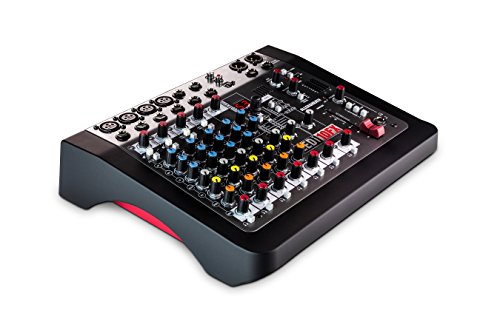
Allen & Heath ZEDi-10FX — Best Compact Hybrid
The ZEDi-10FX is a compact analog mixer with a 4×4 USB interface built in and a suite of studio-quality effects — designed, in Allen & Heath’s words and in fact, as a hybrid of mixer and interface. It suits songwriter-podcasters, small home studios, and creators whose sessions are one or two microphones plus instruments tracked a few at a time. It does not suit panels or bands recorded all at once; its interface returns four channels, and its stage is the small desk.
Strengths
- The 4×4 USB interface records more than a stereo mix — individual sources reach the DAW separately, rare at this size.
- Allen & Heath preamps, EQ, and effects give both voices and instruments a polished analog front end.
- Compact, beautifully built, and equally at home tracking a song or recording a two-person episode.
Trade-offs
- Four-channel USB ceiling and modest mic count limit simultaneous capture.
- No SD recording, pads, or podcast-specific routing.
- Premium small-desk pricing; you pay for build and sound, not features.
Key specs: compact hybrid mixer · 4×4 USB interface · onboard studio FX · GSPre preamps (per manufacturer) · analog EQ
Small hybrid work has a characteristic shape: a songwriter records a verse, talks about it into the same microphone, brings a collaborator in for a chorus and a conversation. The ZEDi-10FX fits that shape precisely. Its interface is honest multitrack at small scale, its effects flatter both the guitar and the speaking voice, and its build quality makes it the desk you keep when the bigger rig is overkill for the day’s work. For the one-room creator whose podcast and whose demos are the same artistic project, it is the connoisseur’s compact answer. It is also the pick most likely to be underestimated by spec-sheet shoppers and most likely to be kept for a decade by the people who actually buy it.
Best for: songwriter-podcasters, small home studios / Not suited for: panels or full-band live capture
Check the current price on Amazon

Yamaha MG12XU — Best Value
The MG12XU is Yamaha’s 12-input workhorse: D-PRE preamps, one-knob compressors, SPX effects, and a stereo USB interface in a metal chassis. It suits bands that podcast from the rehearsal room, schools and churches producing music-and-talk programs, and any hybrid show whose budget must also buy microphones. It does not suit multitrack editors — its USB is the stereo mix — which is the honest limit that its price buys its way out of apologizing for.
Strengths
- Six D-PRE mic preamps plus stereo channels cover a small band and a host desk simultaneously.
- One-knob compression and SPX effects keep both singers and speakers controlled with minimal engineering.
- Yamaha build and reliability at the most accessible price in this guide.
Trade-offs
- Stereo USB only: performances are captured as a finished mix, so mix well in the room.
- No SD recording or podcast-specific routing; discipline substitutes for features.
- Effects are shared rather than per-channel deep.
Key specs: 12 inputs · 6 D-PRE mic preamps · SPX effects · one-knob compression · stereo USB interface · metal chassis
The MG12XU is the pragmatic hybrid: not the deepest tool here, but the one a working band can buy this month and use for everything — rehearsal PA brain, demo recorder through its stereo USB, and podcast desk for the show that promotes the band. Its limitation is also a discipline: because the recording is the live mix, the band learns to balance itself in the room, a skill that improves the gigs as much as the episodes. For hybrid shows at the starting line, value this honest is not a compromise; it is the strategy. It is also, not incidentally, the mixer in this guide most likely to be borrowed by every other band in the building — label yours, and lend it with the confidence of a company that has equipped rehearsal rooms for generations.
Best for: band podcasts, schools, churches, budget hybrid rigs / Not suited for: multitrack post-production
Check the current price on Amazon
Comparison Table
| Pick | Badge | Key spec | Best for |
|---|---|---|---|
| Tascam Model 12 | Best Overall | 12-track recorder + mixer + interface, MIDI | Musician-podcasters |
| Zoom LiveTrak L-12 | Best for Live Sessions | Multitrack SD, 5 headphone mixes | Band + interview sessions |
| Rode Rodecaster Pro II | Best for Voice-Led Shows | APHEX processing, pads, guest routing | Talk shows with musical guests |
| Mackie Onyx16 | Best Analog Multitrack | 16 channels, multitrack USB to DAW | Project studios |
| Allen & Heath ZEDi-10FX | Best Compact Hybrid | 4×4 USB interface, studio FX | Songwriter-podcasters |
| Yamaha MG12XU | Best Value | 6 D-PRE preamps, SPX effects, stereo USB | Band-room all-rounders |
How to Choose the Best Audio Mixer for Podcasting & Music
Begin by weighing your two halves honestly. Write down your biggest realistic music session — every microphone, every stereo source — and your biggest realistic podcast session, then notice which one is bigger and which one pays the bills. Music-dominant shows should shop from the Tascam, Zoom, and Mackie end of this guide, where multitrack depth and preamp counts live. Talk-dominant shows with musical guests should start from the Rode and work down only if the budget insists. The most common hybrid buying error is purchasing for the session you fantasize about — the full-band live spectacular — when your actual show is two people and a guitar; the second most common is the reverse, stranding a real band on a four-input podcast console.
Multitrack is the second decision, and here it is close to non-negotiable on the music side. A stereo recording of a performance is a commitment: every balance decision is final at the moment of the take. Multitrack — SD on the Tascam and Zoom, USB-to-DAW on the Mackie and the Allen & Heath — lets the performance be performed and the mix be mixed, which is how music has been made for fifty years for good reason. The Yamaha’s stereo USB is the deliberate exception for buyers whose workflow is live-to-tape by philosophy or by budget.
Third, plan the headphone world. Hybrid sessions put headphones on musicians and talkers alike, often with different needs — the performer wants the click and the band, the host wants the guest and the playback. Multiple discrete headphone mixes, the LiveTrak’s specialty, are a session feature; a single shared headphone feed, adequate for pure podcasting, becomes the bottleneck the first time a drummer joins the show. Count heads, then count headphone outputs, and let that arithmetic veto otherwise attractive boards.
Finally, consider the room the mixer will live in. These are working desks, not rack ornaments: the Tascam and Mackie claim real estate, the Allen & Heath fits a corner, the Rode fits a broadcast nook. Measure, and leave room for the microphones’ boom arms to swing and the notebook to open. A hybrid desk is a creative workstation; its ergonomics are part of its sound.
How to Run a Hybrid Session: Interview First, Performance Second
Session order is the hybrid producer’s secret weapon. Record the conversation first, while voices are fresh and the room’s energy is social, with the performance setup already miked and line-checked silently in the background. Set speech levels conservatively — healthy peaks, gentle compression where available — and capture the multitrack or SD recording as your safety, even if the episode will mostly use a stereo mix. When the talk wraps, the transition to music is a level check, not a rebuild: the guest is already in headphones, already comfortable with the room, and the performance microphones have been waiting at tested gains.
For the performance itself, resist re-engineering. Raise the music sources to their rehearsed balances, confirm the multitrack is rolling — this is the take that cannot be re-interviewed — and let the performers perform rather than producing them mid-song. If the mixer offers scenes or you have photographed your talk settings, the return to conversation levels for a closing segment takes seconds. Finish by recording thirty seconds of room tone and a spoken slate — episode, date, takes — onto the multitrack; editors, including future you, bless this habit every time. Then back up the card before anyone leaves, because hybrid sessions generate the largest, most irreplaceable files in podcasting.
A word about levels between the two halves, because it is the hybrid session’s most common audible flaw: music is louder than speech, and a session that drifts between them without a plan makes the listener ride the volume control. Decide the relationship deliberately. Record speech at the conservative levels this guide recommends, let performances be performances, and then set the final balance in the edit, where the multitrack earns its keep — or, on a live-to-tape desk like the Yamaha, rehearse the transition once with the performers so the fader move from talk to song becomes part of the show’s choreography. Audiences forgive a level change they can hear you intend; they do not forgive one that sounds like an accident.
Common Buying Mistakes
- Buying a podcast console for a band. Four beautiful preamps do not record an eight-microphone kit. If full-band multitrack is real in your life, start from the Tascam, Zoom, or Mackie.
- Buying a studio console for a talk show. Sixteen channels of pristine analog will not give your voices broadcast processing, your guests mix-minus, or your workflow pads. Match the tool to the dominant half.
- Accepting stereo-only capture for music you intend to mix. Performances deserve multitrack. The one deliberate exception is a live-to-tape philosophy adopted knowingly, not discovered regretfully.
- Counting channels instead of headphone mixes. Hybrid sessions are monitoring problems wearing a recording costume. Every participant needs a feed they can live in.
- Ignoring the switch cost. If changing from interview to performance means re-patching, you will stop doing one of them. Choose the desk whose layout keeps both personalities plugged in.
- Starving the chain to feed the console. Microphones for the band and the panel, headphones for every head, and stands that hold position are part of this purchase, not the next one.
DAW Integration: How the Mixer and the Computer Divide the Work
Hybrid production lives or dies on the handoff between desk and DAW, and the picks here embody three philosophies worth understanding before you buy. The Tascam Model 12 is the integrated path: it records multitrack to its own SD card with a mixer’s immediacy, then presents those tracks — and itself as a control surface and interface — to the DAW for editing and mixing. The performance never depends on the computer’s mood, and the computer inherits clean, organized tracks. The Mackie Onyx16 and Allen & Heath ZEDi-10FX are the interface path: the DAW is the recorder, the mixer is its analog front end, and the workflow suits producers who already live in a DAW session and think of the desk as the studio’s input stage. The Zoom LiveTrak splits the difference, recording to SD standalone while also serving as an interface when the computer is present.
The practical consequences show up in failure modes. Integrated recorders fail boringly: a full card, a forgotten record button — problems you can see. Interface paths fail interestingly: a driver update, a buffer underrun mid-take, a laptop asleep. Neither is disqualifying; studios have run on both for decades. But the self-producing hybrid act, recording a band in a rehearsal room with no engineer, generally sleeps better with the recorder in the desk and the computer as a post-production tool. The producer who is already fluent in a DAW, by contrast, will find the interface path faster and more powerful, because every habit they own transfers. Choose the philosophy that matches the operator, and the hybrid workflow stops being a compromise and becomes a house style.
Streaming the Hybrid Show Live
An increasing share of podcast-and-music shows perform live to a streaming audience before the edited episode appears, and that adds a third personality to the desk: broadcast. The live stream wants a finished, processed stereo mix — voices broadcast-ready, music balanced, production elements fired in the moment — while the recording wants discrete tracks for later. The Rodecaster Pro II was designed for exactly this simultaneity, which is why it anchors the voice-led end of this guide. The Tascam and Zoom achieve it by sending their main mix to the streaming computer while the multitrack records independently, a division of labor that works well once configured and rewards a pre-show checklist. The analog consoles can stream their stereo mix over USB — the Yamaha and Allen & Heath both do — with the understanding that the multitrack, where it exists, lives on the Mackie-style USB path to the streaming machine itself.
Whichever architecture you choose, the live hybrid show punishes improvisation in routing. Build the template once — inputs labeled, stream mix balanced, recording armed — save or photograph it, and run the same thirty-second pre-flight before every broadcast: speak, play, fire a pad, confirm the recording’s counter is moving and the stream’s meters agree. Hybrid shows have more simultaneous truths than any other format in audio; the template is how one person keeps all of them true at once.
Budget Tiers for a Hybrid Desk, Spent in the Right Order
Hybrid rigs tempt a specific financial error: because the mixer must do two jobs, buyers pour the entire budget into it and then discover the session needs eight microphones, eight cables, five sets of headphones, and stands for all of it. Resist by funding the chain in session order. First, the capture minimum: microphones for your largest real session — which for most hybrid shows means the podcast panel plus the principal music sources, not every drum — and headphones for every seat. Second, the mixer that serves that session, chosen from this guide’s tiers. Third, the connective tissue: cables, stands, a headphone amplifier if your mixer’s outputs are outnumbered, storage media, and a case if the desk travels between the studio and the rehearsal room.
Within the mixers themselves, the tiers buy distinct things. The Yamaha MG12XU’s tier buys capability without multitrack — right for live-to-tape shows. The middle tier — the Allen & Heath, the LiveTrak, the Model 12 — buys the multitrack recorder or interface depth that defines serious hybrid work, and it is where most shows should land. The premium tier, the Rodecaster Pro II and the Onyx16, buys specialization at the spectrum’s ends: broadcast voice production or full console-and-DAW music production. Neither premium is “better” than the middle for a balanced hybrid show; each is better at its end of the street. The discipline is to identify your street before admiring the houses on the other one.
One Microphone Locker for Two Jobs
Hybrid shows enjoy one genuine economy: the same microphones serve both halves, chosen well. The workhorse dynamic that flatters a speaking voice at close range is also a classic on guitar cabinets and snare drums; the small condenser that captures an acoustic guitar honestly will serve a panel discussion in a decent room. A hybrid locker therefore builds in layers: first, matched dynamics for every regular voice, because consistency across episodes is a production value listeners feel without naming. Second, a pair of condensers for instruments, overheads, and room — the pair matters, because stereo is how acoustic music breathes. Third, one utility microphone kept spare, because sessions attract guests and accidents in equal measure.
Placement discipline unifies the locker. Podcast voices want the microphone close and slightly off-axis; instruments want placement by ear, moved in inches while listening in headphones. The hybrid operator’s habit worth forming is to treat every placement as a recording decision, not a furniture decision: the microphone’s position is the first and least reversible act of mixing, on both sides of the show. The mixers in this guide all reward that discipline with clean gain and honest monitoring; none of them can repeal it. Buy fewer, better microphones, place them like you mean it, and the same locker will carry your show from its first interview to its first live album.
Final Recommendation
For the true hybrid — a show where music and conversation carry equal weight — buy the Tascam Model 12: it is the only desk here designed from a blank page for exactly that double life. Live-session producers should take the Zoom LiveTrak L-12 and its five headphone mixes; studio-centered producers, the Mackie Onyx16 and its DAW pipeline. If the talking is the show and music is the jewel, the Rode Rodecaster Pro II remains untouchable; if the desk is small and the craft is songs-plus-conversation, the Allen & Heath ZEDi-10FX is the connoisseur’s fit; and if the budget must stretch across a whole band’s worth of microphones too, the Yamaha MG12XU is the honest all-rounder. Decide which half of your show is the show — then buy the mixer that serves it first and the other half well. Do that, fund the microphones and headphones the session actually needs, and the hybrid desk stops being a compromise category and becomes what it is for the shows in this guide: the most creative seat in audio.
Keep exploring the cluster: Best Audio Mixers For Podcasting · Best Audio Mixers For Recording Music · Best Audio Mixers For Pc · Best 16 Channel Mixers · Best Audio Mixers For Recording Voice
Frequently Asked Questions
Can one mixer really handle both a podcast and music recording well?
Yes — that is precisely the design brief of the hybrid units here. The Tascam Model 12 and Zoom LiveTrak L-12 were built as mixer-recorders for musicians who also publish spoken content, and the Rodecaster Pro II covers the talk-dominant version of the same idea. The compromise to understand is one of emphasis, not capability: every pick does both jobs, and each review states which job it does best.
How many inputs do I need for a band-plus-podcast session?
Count the music session, which is almost always the larger: a modest band recording — four drum microphones, bass, two guitars, keys in stereo, two vocals — already reaches eleven or twelve inputs before the host’s microphone. That arithmetic is why the 12- and 16-channel units anchor this guide. Acoustic formats shrink the count dramatically; a duo performing and talking fits the Allen & Heath or even the Rodecaster comfortably.
Is multitrack recording essential for the music side?
For music you intend to mix and release, effectively yes: multitrack preserves every balance decision for later, when you can hear properly. A stereo live mix is a legitimate artistic choice for rehearsal-room podcasts and live-to-tape shows — the Yamaha MG12XU serves exactly that philosophy — but adopt it knowingly. Once a performance is summed to stereo, no editor can separate the vocal from the guitar again.
How do remote guests work on a music-focused mixer?
Less automatically than on a podcast console, and the reviews say so plainly. On the Tascam, Zoom, and analog picks, a remote guest typically arrives on a channel fed by a phone or computer, and you manage the mix-minus discipline manually — keeping the guest’s return free of their own voice. It works, and hybrid shows do it weekly, but if remote guests are your show’s lifeblood and music is the garnish, that is the argument for starting from the Rodecaster Pro II instead.
Do I need separate headphone mixes for musicians and talkers?
If they are in the room at the same time, very probably yes. A drummer performing to a click and a host listening for the guest’s answers cannot share one feed without one of them suffering, and suffering participants make worse recordings. The LiveTrak L-12’s five discrete mixes are the benchmark here; smaller sessions can share a single feed with a headphone amplifier splitting it, accepting one balance for everyone.
Which of these is best for a singer-songwriter who podcasts?
The Allen & Heath ZEDi-10FX for the desk-bound craftsperson — its 4×4 interface tracks voice and guitar separately and its effects flatter both — or the Rodecaster Pro II if the podcast is the primary product and performances are intimate. The Tascam Model 12 becomes the answer the moment the songwriting turns into full productions with other musicians, because its multitrack recorder grows with the arrangements.
Can I start with a podcast console and add music capability later?
Partially, and the honest limits are worth knowing. A podcast console like the Rodecaster Pro II will happily capture acoustic performances, DI instruments, and stereo sources, and many shows never need more. What it cannot grow into is simultaneous multi-microphone music recording — the preamps and tracks simply are not there — so a show that evolves toward full-band sessions will eventually add or swap to a Model 12 or LiveTrak class desk. The reverse path is smoother: a hybrid mixer-recorder covers pure podcasting from day one, which is why musicians who suspect their show will grow tend to start hybrid and stay put.


