Disclosure: airfryerkitchensupply.com is reader-supported. When you buy through links on our site, we may earn an affiliate commission at no extra cost to you.
Where to buy
Every product in this guide to the best audio mixers was verified against Amazon’s own catalog data before it earned a place here, and Amazon is where we recommend buying in this category: the listing states the exact variant, the returns window protects you if a unit arrives with a fault, and marketplace pricing in this category moves often enough that a printed figure would mislead you. Use the links below to check the current price on Amazon for each pick.
- Yamaha MG16XU — Best Overall: check price on Amazon
- Mackie ProFX16v3 — Best for Live Bands: check price on Amazon
- Allen & Heath ZED-16FX — Best Sound Quality: check price on Amazon
- Soundcraft EFX12 — Best Effects: check price on Amazon
- Behringer XENYX QX1204USB — Best Value: check price on Amazon
- Mackie Mix8 — Best Compact and Budget: check price on Amazon
Ask a room of engineers for the best audio mixers and you will start an argument, because the honest answer depends on the room, the act and the operator. This guide cuts through it the practical way: six boards, each verified against the retailer’s catalog data, each the right answer to a different version of the question — the all-purpose standard, the gigging band’s tool, the sound-quality pick, the effects specialist, the value play and the compact minimum.
What unites the six is more important than what divides them. Every one comes from a maker whose preamps behave at real-world gain, every one can be learned by a competent operator in an afternoon, and every one will still be working when trends in mixer fashion have turned over twice. The differences are in emphasis, and emphasis is what you are actually buying.
Prices are not printed here, deliberately: mixer pricing moves with promotions and bundles, and a stale figure helps nobody. Each pick’s tier is described in words; check the current price on Amazon through the links when you are ready to buy.
In this guide
Quick Picks
- Yamaha MG16XU — Best Overall. The default board for bands, churches and venues that need one mixer to do everything well — Check on Amazon
- Mackie ProFX16v3 — Best for Live Bands. Gigging bands that record every show and need compression on tap — Check on Amazon
- Allen & Heath ZED-16FX — Best Sound Quality. Listeners first: the board for buyers who hear differences and care — Check on Amazon
- Soundcraft EFX12 — Best Effects. Vocal-led acts where the reverb quality is part of the sound — Check on Amazon
- Behringer XENYX QX1204USB — Best Value. Maximum capability per budget unit for bands equipping from scratch — Check on Amazon
- Mackie Mix8 — Best Compact and Budget. Solo performers, presenters and anyone whose mixer must fit in a gig bag — Check on Amazon
How These Picks Were Chosen
The candidate pool began with every current mixer from the established live-sound makers that we could verify against catalog data — model names, channel formats and feature sets all confirmed against actual listings. Anything unverifiable was excluded, however strong its reputation, because a guide that describes products from memory eventually describes products that no longer exist.
Evaluation weighted preamp behaviour, EQ usefulness, effects quality where fitted, subgrouping and routing for real shows, build for the intended life, and operator learnability. No prices or scored ratings appear in this guide; tier positioning is given in words, and the links let you check the current price on Amazon for any pick.
The 6 Best Audio Mixers

Yamaha MG16XU — Best Overall
If a committee of working engineers had to pick one board to standardise on, this is the shape of the answer: sixteen inputs, D-PRE preamps, SPX effects, subgroups for organising a mix, and Yamaha’s institutional reliability. It fits a full small band with inputs to spare, a worship team with a choir corner, or a venue that hosts something different every night. It is an analog board in a digital age, which is precisely its appeal for teams with rotating operators. Buyers who need scene recall or multitrack recording should read the digital guide in this series instead; buyers who need a board that any competent operator can walk up to and run will find nothing better balanced.
Strengths
- Sixteen inputs with subgrouping for organised mixes
- D-PRE preamps stay clean across voices and instruments
- SPX effects cover the full working palette
- Reliability record that venues build schedules around
Trade-offs
- Stereo USB only — no multitrack recording
- No scene recall for multi-act bills
- Size and weight assume a semi-permanent home
| Specification | Detail |
|---|---|
| Channels | 16-input, 6-bus |
| Preamps | D-PRE |
| FX | SPX effects |
| USB | Audio interface |
The MG16XU’s excellence is cumulative rather than spectacular: the preamps do not colour, the EQ does not misbehave, the effects do not cheapen, and the layout teaches itself. Subgroups are the feature working engineers value most here — drums or backing vocals gathered under one fader each, so the mix can be steered rather than rebuilt mid-show. Across a year of Fridays, that steadiness compounds into confidence, and confidence is audible.
Best for: Bands, churches and venues wanting one dependable all-purpose board / Not suited for: Acts needing digital recall or multitrack recording
Check on Amazon — check the current price on Amazon before you decide, because bundles and variants change.
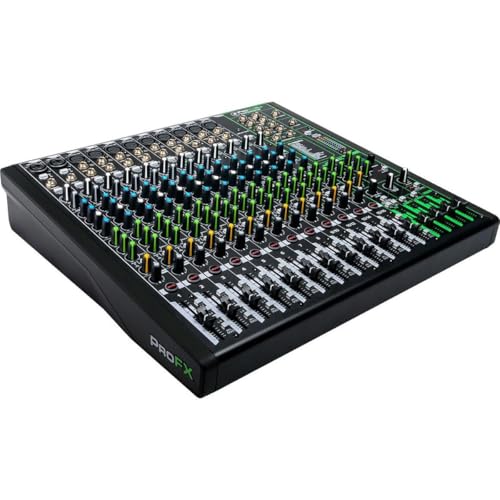
Mackie ProFX16v3 — Best for Live Bands
The ProFX16v3 is the gigging band’s version of the same idea: sixteen channels, Onyx preamps with genuine headroom, one-knob compressors where singers plug in, and a GigFX engine voiced for live work rather than studio subtlety. The USB recording captures the show for the band’s page and the post-mortem. It suits self-engineered bands who mix from stage or trust one member at the board. It gives the Yamaha a real fight on sound and beats it on gig-focused features; it concedes a little on the institutional, decade-in-a-cupboard feel. Neither concession matters on a Friday night with a paying audience.
Strengths
- Onyx preamps with headroom for loud stages
- One-knob compressors on mic channels control live vocals
- GigFX effects voiced for live rooms
- USB captures the stereo show mix
Trade-offs
- Stereo recording only, like its class
- Effects engine is shared across channels
- Slightly less institutional feel than the Yamaha
| Specification | Detail |
|---|---|
| Channels | 16 |
| Preamps | Onyx |
| FX | GigFX engine |
| USB | Recording interface |
Live sound rewards the board that solves problems at speed, and the compressors are this board’s problem-solvers: a singer who leans in on choruses stops swamping the mix without the engineer hovering. The GigFX reverbs are tuned to read in noisy rooms, where a studio-subtle tail disappears entirely. Bands that record their gigs will find the stereo USB honest and useful — a true document of the night, balance and all.
Best for: Self-mixing and engineer-led gigging bands / Not suited for: Studios needing multitrack capture
Check on Amazon — check the current price on Amazon before you decide, because bundles and variants change.

Allen & Heath ZED-16FX — Best Sound Quality
Allen & Heath built its name in rooms where sound quality outranked everything, and the ZED-16FX carries that priority into this class: DuoPre preamps, musically voiced EQ and onboard effects that flatter rather than decorate. It suits the engineer who mixes with their ears open — acoustic acts, jazz, theatre, worship teams with real musicianship. The layout is more deliberate than grab-and-go, rewarding a regular operator over a rotating cast. If your board changes hands weekly, the Yamaha’s neutrality is safer; if one pair of hands runs it and sound is the point, this is the connoisseur’s pick of the six.
Strengths
- DuoPre preamps with a refined, open character
- EQ voiced for musical correction, not surgery
- Effects that integrate rather than sit on top
- Build quality that feels a class up
Trade-offs
- Rewards a regular operator; less idiot-proof for rotas
- Stereo USB recording only
- Premium positioning within its class
| Specification | Detail |
|---|---|
| Channels | 16 |
| Preamps | DuoPre |
| FX | Onboard effects |
| USB | I/O |
The ZED difference announces itself on acoustic sources: a fingerpicked guitar keeps its body, a voice keeps its grain, and the reverb wraps around both instead of floating above them. Engineers describe this as the board getting out of the way at a higher level. It asks a little more of the operator — gains set with care, EQ used with intent — and returns the investment every time the room goes quiet for a ballad.
Best for: Regular-operator rigs where sound quality leads / Not suited for: Rotating-volunteer venues needing maximum simplicity
Check on Amazon — check the current price on Amazon before you decide, because bundles and variants change.

Soundcraft EFX12 — Best Effects
Some acts are their effects: the ballad singer, the worship band, the acoustic duo in a stone room. The EFX12 pairs Soundcraft’s preamp design with a Lexicon effects processor — the rack name behind decades of records — and for vocal-led work that pairing is the argument. Twelve channels fit small acts rather than full bands, and the feature list is focused rather than long. Buyers needing sixteen inputs should take the Yamaha or Mackie; buyers whose signature sound lives in the reverb tail will forgive this board its smaller count every night.
Strengths
- Lexicon reverb and delay quality leads this class
- Preamps designed for clean vocal gain
- Focused feature set — little to learn wrong
- Strong choice for installed small-venue work
Trade-offs
- Twelve channels cap full-band use
- One effects processor shared across the mix
- Fewer modern extras than feature-led rivals
| Specification | Detail |
|---|---|
| Channels | 12 |
| FX | Lexicon effects processor |
| Preamps | Soundcraft GB30 lineage |
| Format | Rack-friendly footprint |
Lexicon’s algorithms earn their reputation in the decay: the tail of the reverb sounds like a space rather than a repetition, so a voice can sit in it at levels that would turn lesser processors washy. For a singer-songwriter or a worship vocal team, that quality is not garnish — it is the difference between a performance that feels produced and one that feels amplified. Keep the rest of the mix dry and disciplined, and the EFX12 makes small acts sound expensive.
Best for: Vocal-led small acts and installed venues / Not suited for: Full bands needing sixteen channels
Check on Amazon — check the current price on Amazon before you decide, because bundles and variants change.

Behringer XENYX QX1204USB — Best Value
The QX1204USB is the value engineer’s board: XENYX preamps with compressors, a Klark Teknik effects processor, British-style EQ and USB in a frame priced for bands buying their first real mixer. It suits rehearsal spaces, starter live rigs and community groups where the budget is fixed and the needs are real. The trade is refinement — preamps and build are competent rather than distinguished — and the board rewards correct gain staging more than the premium picks do. Run it with discipline and it produces shows its price has no business producing.
Strengths
- Klark Teknik effects are a genuine step above generic DSP
- Compressors on mic channels tame new singers
- British EQ is forgiving for inexperienced hands
- Full USB interface included
Trade-offs
- Preamps a class below Onyx and D-PRE
- Build suited to careful handling
- Manual study required to get its best
| Specification | Detail |
|---|---|
| Channels | 12-input, 2/2-bus |
| Preamps | XENYX with compressors |
| FX | Klark Teknik multi-FX |
| USB | Audio interface |
Value boards live or die on whether their headline features are real, and the Klark Teknik processor is real — the reverbs hold together at working levels, which is where budget effects usually dissolve into fizz. Pair that with compression for the vocalists and you have the two tools that most improve a young band’s live sound, in one box, at the entry price. That is a coherent product, not a parts list, and it is why this board anchors so many first rigs.
Best for: First rigs, rehearsal rooms and fixed-budget groups / Not suited for: Engineers prioritising preamp refinement
Check on Amazon — check the current price on Amazon before you decide, because bundles and variants change.

Mackie Mix8 — Best Compact and Budget
The Mix8 is the honest minimum: eight channels, three-band EQ, phantom power and Mackie’s clean layout in a chassis that travels in a gig bag. It suits solo performers, public speakers, small ceremonies and as a sub-mixer for keyboards or drums on bigger rigs. It has no onboard effects and no USB, and it pretends otherwise nowhere. Buyers who need reverb for vocals should step to the ProFX line; buyers who need a small, dependable analogue front end for two microphones and some playback will find this board outlasts fancier purchases in the same bag.
Strengths
- Genuinely portable without feeling disposable
- Clean, simple layout anyone can run
- Phantom power supports condenser mics
- Works for years as a sub-mixer after upgrading
Trade-offs
- No onboard effects — vocals are dry unless you add them
- No USB recording
- Eight channels is a hard ceiling
| Specification | Detail |
|---|---|
| Channels | 8 |
| EQ | 3-band |
| Format | Compact metal chassis |
| Phantom | +48V on mic inputs |
Small mixers earn their keep in the gigs nobody writes songs about: the wedding ceremony in a garden, the conference breakout room, the solo set in a café corner. The Mix8 handles those with zero drama — two mics up, playback in, a touch of EQ, done. Its second life is equally valuable: keyboardists and drummers use boards like this to premix their own rigs into one stereo feed, which is why so many Mix8s stay in service long after their owners buy bigger boards.
Best for: Solo acts, presenters and sub-mixing duties / Not suited for: Anyone needing onboard reverb or recording
Check on Amazon — check the current price on Amazon before you decide, because bundles and variants change.
Comparison Table
| Pick | Badge | Key spec | Best for |
|---|---|---|---|
| Yamaha MG16XU | Best Overall | Analog, D-PRE preamps, SPX effects | The default board for bands, churches and venues that need one mixer to do everything well |
| Mackie ProFX16v3 | Best for Live Bands | Analog, Onyx preamps, GigFX | Gigging bands that record every show and need compression on tap |
| Allen & Heath ZED-16FX | Best Sound Quality | Analog, DuoPre preamps, onboard FX | Listeners first: the board for buyers who hear differences and care |
| Soundcraft EFX12 | Best Effects | Analog with Lexicon effects | Vocal-led acts where the reverb quality is part of the sound |
| Behringer XENYX QX1204USB | Best Value | Analog, Klark Teknik FX, compressors | Maximum capability per budget unit for bands equipping from scratch |
| Mackie Mix8 | Best Compact and Budget | Compact analog, 8 channels | Solo performers, presenters and anyone whose mixer must fit in a gig bag |
How to Choose the Best Audio Mixers for Your Work
Match the board to the operator, not just the act
The most underrated specification in mixing is who will run the board. A single skilled engineer can exploit the Allen & Heath’s refinement or a digital board’s depth; a rotating cast of volunteers needs the Yamaha’s transparency, where every control is visible and nothing hides in a menu. Be honest about your rota before you be ambitious about your feature list — the best mixer is the one your actual operator runs well on a tired Friday night.
Solo performers mixing themselves from stage should weight simplicity and compactness even higher: the Mix8 and the smaller frames exist because a board you can run between songs beats a board you admire from behind a singer.
Count microphones, then add two
Your channel requirement is your microphone count plus playback and instrument inputs, plus two spare channels for the guest, the extra vocalist, the night something feeds back and a channel must be abandoned mid-show. Spare channels feel like waste in the shop and like genius in the second month. Full bands should read the 16-input picks as their starting point; small acts gain nothing from hauling channels they never open.
Subgroups, available on the larger picks, matter once channels multiply: gathering backing vocals or a drum kit under one fader each turns a sixteen-fader juggling act into a mix you can steer. If your act is growing, subgroups are the feature to buy ahead of need.
Preamps and effects: where the sound actually lives
Across this guide, the audible differences concentrate in two places. Preamps decide how clean your quietest source can be amplified; named families like D-PRE, Onyx and DuoPre earn their mentions by staying composed at gains where generic preamps hiss. Effects decide the space your vocals sit in; Lexicon and GigFX engines earn theirs by producing tails that sound like rooms. Spend your attention, and your tier, in that order.
Everything else — channel cosmetics, display brightness, app companions — is workflow preference. Valuable, but secondary, and never a reason to accept weaker preamps.
How to Set Up a Live Mix From Scratch in Fifteen Minutes
[‘This sequence works on every board in this guide and scales from a duo to a full band.’]
- Line check in silence. With gains down, connect everything, then bring each channel up alone: speak or play, set the preamp gain to healthy peaks, confirm the speaker tells the truth. No music yet — diagnosis first.
- Build the foundation. Start with the loudest rhythmic element, add bass and harmonic instruments, keeping the master near unity and balancing on faders.
- Place the vocals last and on top. Lead vocal first, set clearly above the band, then backing vocals tucked beneath it. Add compression now if the board offers it, catching peaks only.
- Dress with effects sparingly. Raise the vocal reverb until audible, then retreat slightly. Check from the back of the room, not the board — effects read louder at distance.
- Walk the room. Listen from three positions during a full song. Fix what you hear with the smallest EQ move that works, and write down every change.
- Photograph the board. Analog recall is a camera. Your future setup time just halved.
Common Buying Mistakes
Buying channels you will never open
Oversized boards cost more, haul worse and intimidate volunteer operators. Buy for your real microphone count plus two spares, and let a growing act — not a hypothetical one — trigger the upgrade.
Judging a mixer by its effects list
A hundred effect presets matter less than one reverb that sounds like a room. Audition the vocal reverb above all, and weight preamp noise over preset counts.
Ignoring the operator learning curve
A board the team cannot run confidently will be run timidly, and timid mixing sounds worse than simple equipment run boldly. Match complexity to your rota’s real skills.
Forgetting monitors in the plan
The audience mix is half the job; performers who cannot hear themselves perform worse. Confirm the board’s auxiliary sends can feed the monitor setup your act actually uses.
Skipping the line check to save time
Every skipped check is borrowed time repaid mid-show with interest. Fifteen quiet minutes before doors is the cheapest insurance in live sound.
Final Recommendation
If one board must be named, it is the Yamaha MG16XU — the standard against which the others define themselves. Bands that live on stage should seriously consider the Mackie ProFX16v3 instead; listeners should audition the Allen & Heath; vocal-led small acts, the Soundcraft; new rigs on fixed budgets, the Behringer; and anyone whose mixer must travel in a bag, the little Mackie Mix8. The best audio mixer is the one matched to your act and your operator — this guide’s job was to make that match obvious.
Related guides in this series: Best Audio Mixers For Beginners · Best Audio Mixers For Home Studios · Best Audio Mixers Digital For Live · Best Audio Mixers For Karaoke
The Preamps, Compared Honestly
Since preamps decide so much of what these boards sound like, they deserve a direct comparison. Yamaha’s D-PRE aims at neutrality: what goes in comes out, amplified, with the least editorialising — which is why institutions love it and why some rock engineers call it polite. Mackie’s Onyx adds a shade of forwardness that helps vocals cut through a loud band without EQ heroics, and its headroom forgives the guitarist who turns up mid-set. Allen & Heath’s DuoPre is the audiophile of the three, preserving low-level detail — fret noise, breath, the grain of a voice — that the others round off, provided the operator sets gains with matching care.
Soundcraft’s preamps sit close to Yamaha’s neutrality with a slightly warmer low end, a character that flatters acoustic acts. Behringer’s XENYX, the value pick’s engine, is the honest trailer of the group: clean at moderate gains, audibly less composed when a quiet source demands everything the knob has. None of this is visible in a specification table, and all of it is audible within a minute of plugging in a good microphone — which is why, if you can audition one thing before buying, it should be your own microphone through the preamp, at your own singing volume.
Monitor Mixes: The Half of Mixing Nobody Advertises
Ask performers what ruins a show and they rarely mention the front-of-house mix; they mention not hearing themselves. Monitor mixing — the separate balances sent to stage wedges or in-ear systems — is half the craft, and a board’s auxiliary sends decide how much of that half you can do. The larger picks in this guide offer the sends to run distinct monitor mixes, so the singer hears more voice while the drummer hears more click and bass. The compact picks offer fewer, which is fine for a solo act monitoring themselves and limiting for a band.
Practical monitor craft is mostly restraint. Give each performer their own voice or instrument loudest, the rhythmic anchor second, and everything else as seasoning. Ring out feedback at soundcheck volume plus a margin, because performers always ask for more at show time. And remember that a monitor mix the band trusts makes the main mix easier — confident performers play tighter, sing in tune and stop signalling for changes mid-song. When you compare boards, count aux sends with the same seriousness as inputs; your band will thank you in the only currency that matters, which is a better performance.
The Room Is the Loudest Instrument
No mixer in this guide can defeat a bad room, and understanding that will save you from blaming good equipment. A village hall with parallel walls and a low ceiling adds its own reverb, flutter and boom to everything the board produces; the correct response is less — less effects send, less low end, lower overall volume — because the room is supplying the rest uninvited. Outdoor shows invert the problem: no reflections return energy to the audience, so mixes need more level, more effects and more low end than indoor habits suggest.
Speaker placement does more than any EQ section: speakers forward of the microphones, aimed at the audience and away from walls, at ear height or above. Engineers call this gain before feedback, and it is free. Walk the room during soundcheck and listen where the audience will actually stand, because the mix position is often the worst seat in the house. A mid-priced board in a well-placed system will out-sound a premium board fighting its own speakers every night of the week — the picks above assume you will give them that chance.
New or Second-Hand: An Honest Word
Mixers tempt second-hand buyers like few products, because analog boards age visibly rather than expiring digitally. A used board from the makers in this guide can be excellent value — if you test every channel, every fader’s full travel, every effects return, with a microphone and patience. Scratchy pots can sometimes be cleaned; a dead channel, a noisy bus or a failing power supply converts a bargain into a repair bill with a handle. Institutions and first-time buyers should generally buy new and take the warranty; experienced hands who can test thoroughly may hunt used with this guide’s shortlist as their map, since a board that was worth recommending new is the same board worth rescuing used.
The Pre-Purchase Checklist
Before money moves, run this list against your act. One: microphone count today, plus two spare channels. Two: monitor mixes needed, counted per performer who wants their own. Three: recording ambition — stereo documents, or multitrack, which exits this product class. Four: the operator’s honest skill and appetite for learning. Five: transport — does the board live in a venue or in a car, and does the budget include its case. Six: the unglamorous companions — cables, a spare of each critical one, gaffer tape, a torch. A board chosen against those six answers will still feel right in year three, which is the only review period that counts.
EQ Without Fear: A Beginner’s Map That Experts Still Use
Every channel’s EQ divides into neighbourhoods, and learning their characters removes the mystery. The low shelf governs weight and boom — cut it on vocals to remove room rumble and proximity muddiness, use it gently on bass instruments to add foundation. The low-mids are where mud lives: a small cut here on guitars and keys opens space for everything else, and it is the first place experienced engineers look when a mix feels crowded. The high-mids carry presence and intelligibility — the consonants of a lyric, the attack of a piano — and they are also where harshness hides, so moves here should be small and judged at show volume, not soloed.
The high shelf adds air and shimmer, flattering cymbals and acoustic guitars, and unforgiving of sibilance in a loud vocal. Two working rules cover most situations: cut before you boost, because subtraction cleans while addition piles up; and make one move at a time, then listen to the whole mix rather than the channel alone. A mix is a negotiation between sounds, and EQ is how each sound agrees to occupy its own territory. The boards in this guide all provide the tools for that negotiation; the map above is how you conduct it.
Cables, Cases and the Supporting Budget
Every mixer purchase secretly includes a second purchase, and planning it prevents the classic failure of a fine board defeated by a three-metre cable. Budget for balanced XLR leads in the lengths your stage actually needs, two spares beyond the count, and a cable tester if the rig travels — testers pay for themselves the first time they identify the guilty lead in thirty seconds instead of thirty minutes. Instrument leads, a DI box for bass and acoustic guitars, and a small toolkit complete the working kit.
The case deserves its own paragraph because it is where budgets go to be short-sighted. A mixer that travels unprotected ages in dog years: knobs shear, corners crack, faders ingest the dust of a hundred car boots. A padded bag suits the compact picks; the 16-channel frames deserve a proper case if they move weekly. None of this is exciting, and all of it is the difference between a five-year board and a two-year board, which makes it the highest-return spending in the entire purchase after the preamps themselves.
Mixing Vocals: Where Every Board Earns Its Money
Vocals are the product. Audiences forgive a modest guitar tone and forget a keyboard pad, but the lead voice is the song as far as everyone outside the band is concerned, so vocal craft deserves the board’s best resources: the best preamp channel, the compressor if there is one to spare, and the first effects you dial in. Start with the microphone six inches from the singer’s mouth and the gain set for their loudest honest note, not their soundcheck murmur — singers always give more at showtime, and headroom is the board’s promise to absorb it.
EQ the voice for the room you are in: cut lows until the muddiness leaves, find the presence region that makes words intelligible at the back, and stop. Reverb should be felt as size rather than heard as an effect; in a live room, the building adds its own, so the board’s contribution is usually less than the soundcheck suggests. Backing vocals sit lower, drier and slightly darker than the lead — contrast, not volume, is what separates them in the listener’s ear. Get these habits right and any board in this guide will make your singer sound like the main event, which is the entire job.
When the Mixer Is Not the Problem
A troubleshooting honesty section, because buyers often replace mixers that were never at fault. Hiss usually traces to a gain set too low at the source and too high at the board, or to a failing cable, before it traces to a preamp. Hum is almost always a grounding or power story — two circuits, one laptop charger, a dimmer on the same ring — and no mixer upgrade cures it. Distortion that appears only on loud passages is headroom being spent somewhere in the chain, and the meter bridge will show you where if you watch it during the loudest song rather than the quietest.
The discipline is to change one thing at a time and listen for the specific symptom, not the general impression. Swap the cable before the channel, the channel before the board, and the power source before everything. Engineers who work this way discover that most mixer problems are system problems wearing a mixer’s face — and they keep good boards for a decade while their less methodical colleagues fund the second-hand market.
A Word on Brands and What Their Names Actually Promise
Mixer brands carry reputations earned in specific rooms, and reading them correctly helps you buy. Yamaha’s name promises institutional steadiness — the board a venue installs and forgets, supported for years. Mackie’s promises working-musician practicality: features chosen by people who load their own gear, at prices bands actually have. Allen & Heath’s promises sound quality as the first priority, the choice of engineers who listen for a living. Soundcraft’s promises a studio lineage brought to live work, with effects heritage in its corner. Behringer’s promises capability per unit of budget, a proposition that has quietly improved for a decade and now includes genuinely respected processing names. None of these promises is marketing fog; each is visible in the picks above, in what each maker chose to spend its budget on.
The buyer’s task is to match the promise to the priority. A school does not need the audiophile board; a jazz club does not need the indestructible one; a young band does not need either as much as it needs compression and a Klark Teknik reverb at a price that leaves money for cables. Read the badges in this guide as those promises made specific, and the shortlist resolves itself.
Setting Up for Different Kinds of Rooms
A wedding marquee, a stone church and a pub back room ask three different mixes from the same board. The marquee absorbs sound and flatters nothing: keep effects modest, diction crisp, and overall level generous, because fabric and open sides swallow energy. The stone church supplies seconds of natural reverb, so the board’s effects should retreat to nearly nothing and the low end should be disciplined — the building is already mixing, and your job is to not fight it. The pub back room is small, loud and close: lower everything, protect the front rows from the high-mids, and accept that the best mix is often the quietest one that still feels like an event.
The transferable skill is diagnosing the room in the first minute: clap once and listen. A long tail means restraint with effects and bass; a dead thud means the mix can carry more of both; a flutter echo between walls means speaker aim matters more than any processor you own. Engineers who build this habit stop blaming boards for rooms, and start producing recognisably good sound in all three — which, in the end, is what the audience means when they say a band sounded professional.
The Soundcheck Script Every Team Should Steal
Run the same order every time and soundchecks stop being negotiations. Drums first, alone, because everything else balances against the loudest acoustic source. Bass next, locked to the kick in the room rather than in headphones. Then guitars and keys together, finding their separate EQ territories before a voice enters. Vocals last, on top, with effects added only after the dry voice is intelligible at the back. One full song, one set of small corrections, and the discipline to stop — because a soundcheck that runs long spends the band’s freshness, which is also an ingredient in the show.
Write the running order on the setlist and keep it with the board. Teams that adopt a script discover the hidden benefit: problems become comparable across nights. When Tuesday’s mix differs from Friday’s, a fixed procedure means the variable is the room or the performance, not the method — and that is information an engineer can act on, rather than a mystery to re-litigate at every venue.
Growing Into the Board You Bought
Every board in this guide has a second curriculum hidden inside the first. The beginner who buys the Mix8 for two microphones discovers subgroup thinking the day a keyboard joins the act. The band that buys sixteen channels for ten inputs discovers, in the spare four, the freedom to leave a guest vocal and a playback channel permanently wired. Growth room is not waste; it is the board absorbing your act’s future without a second purchase, and it is why this guide repeatedly advises two spare channels rather than an exact fit.
The complementary discipline is knowing when growth has genuinely outrun the tool — when the monitor count, the recording ambition or the channel list exceeds the platform’s design rather than your current habits. That day arrives later than buyers fear and earlier than sentimental owners admit. When it comes, the boards here retire honourably: to rehearsal rooms, to monitor duty, to the youth team’s cupboard. A mixer that serves two roles across a decade has paid for itself in the only accounting that matters.
One last encouragement for the undecided: every engineer you admire started on a board smaller than the ones in this guide and produced shows audiences loved, because the craft lives in gain staging, listening and restraint rather than in any specification. Buy the pick that matches your act and your operator, learn it the way the setup sections describe, and let a year of real shows — not a week of comparison shopping — be the judge. That is how the best audio mixers earn the adjective: in use, over time, in rooms full of people who never think about the board at all.
Frequently Asked Questions
What is the best all-round audio mixer here?
The Yamaha MG16XU, because it balances channel count, preamp quality, effects and operator-friendliness with no weak point — the board a venue can standardise on. Specialists beat it in their niches, which is what the other badges are for.
Analog or digital — which should a band choose?
Analog for simplicity, rotating operators and instant access; digital for scene recall, remote control and processing depth. This guide is analog-led because most small acts are operator-limited, not feature-limited; the companion guide to digital mixers for live work covers the other path.
How important are subgroups?
Once you pass about ten live channels, very. Gathering drums or backing vocals under single faders lets you steer the mix instead of rebuilding it, and it is the feature engineers miss most when it is absent.
Can these mixers record?
Most picks record their stereo mix over USB — ideal for gig documents and rehearsal review. Multitrack recording, where each input becomes its own track, is a different product class covered in the home studio guide in this series.
What size mixer does a church need?
Count simultaneous microphones — pulpit, worship team, choir, instruments — add playback and two spares. Most small churches land at twelve to sixteen inputs, which is why the 16-input frames anchor this guide.
Why no prices or star ratings?
Both change constantly and neither survives contact with a real shortlist. Tier positioning in words plus a live price check through the links gives you information that is still true when you buy.


