Disclosure: airfryerkitchensupply.com is reader-supported. When you buy through links on our site, we may earn an affiliate commission at no extra cost to you.
Where to buy
Every product in this guide to the best audio mixers for beginners was verified against Amazon’s own catalog data before it earned a place here, and Amazon is where we recommend buying in this category: the listing states the exact variant, the returns window protects you if a unit arrives with a fault, and marketplace pricing in this category moves often enough that a printed figure would mislead you. Use the links below to check the current price on Amazon for each pick.
- Yamaha MG06X — Best Overall for Beginners: check price on Amazon
- Mackie Mix8 — Best Budget for Beginners: check price on Amazon
- Behringer XENYX 802S — Best for Streaming Beginners: check price on Amazon
- Allen & Heath ZED-6 — Best Built Beginner Board: check price on Amazon
- CAD Audio MXU2 — Best Simple Two-Channel Start: check price on Amazon
- Soundcraft Notepad-8FX — Best Beginner Board With Effects: check price on Amazon
The best audio mixers for beginners share a trait their marketing rarely mentions: they forgive. A first board will be gain-staged wrong, EQ’d enthusiastically and asked to make a nervous first performance sound like a record — and the right board absorbs those lessons without punishing them audibly. The six picks here were chosen for that forgiveness, in six different shapes: the all-round teacher, the budget honest board, the streaming starter, the built-like-a-tank purist, the two-channel minimum and the reverb-equipped confidence builder.
Every pick is a current model verified against the retailer’s catalog data, from makers whose beginner boards are famous for surviving their owners’ learning curves and remaining useful afterwards. None requires a manual the size of a novel; all of them teach the same transferable craft — gain, balance, restraint — that runs every board in every guide in this series.
Prices are not printed, because they move; tiers are described in words, and the links let you check the current price on Amazon when you are ready. Buy once, learn properly, and let your second board — if you ever need one — be a choice rather than a rescue.
In this guide
Quick Picks
- Yamaha MG06X — Best Overall for Beginners. A first board that sounds professional from day one and never embarrasses its owner later — Check on Amazon
- Mackie Mix8 — Best Budget for Beginners. The cheapest first board that still teaches real mixing — Check on Amazon
- Behringer XENYX 802S — Best for Streaming Beginners. New streamers and podcasters who need the computer connected from the start — Check on Amazon
- Allen & Heath ZED-6 — Best Built Beginner Board. Buyers who want their first board built like their last one — Check on Amazon
- CAD Audio MXU2 — Best Simple Two-Channel Start. One microphone, one source, zero confusion — the podcast and voiceover starter — Check on Amazon
- Soundcraft Notepad-8FX — Best Beginner Board With Effects. Beginners whose vocals need reverb and whose desk needs a small footprint — Check on Amazon
How These Picks Were Chosen
We restricted candidates to current, verifiable models from established makers, confirmed against catalog listings for model, format and features. Beginner suitability was judged on layout clarity, tolerance of gain mistakes, the presence (or honest absence) of vocal effects, connection to a computer where the badge implies it, and build quality sufficient to survive a first year of enthusiastic handling.
We also weighed second-life value: a beginner board that becomes a useful sub-mixer or presentation board after an upgrade is a better purchase than one that becomes clutter. No prices or scored ratings are printed anywhere in this guide; tier descriptions and live price checks through the links carry that information honestly.
The 6 Best Audio Mixers for Beginners

Yamaha MG06X — Best Overall for Beginners
Beginners need two contradictory things: simplicity now and quality that survives their improvement. The MG06X threads that needle — six inputs, D-PRE preamps, Yamaha’s SPX effects for vocals, and a layout so clear that the manual is a formality. It suits the new singer, presenter, small worship team or creator who wants their first board to also be a keeper. Six inputs is the honest ceiling: a growing band will outgrow it, at which point it retires to rehearsal or presentation duty rather than the cupboard of shame. As a first purchase, it teaches correct habits on equipment that rewards them.
Strengths
- D-PRE preamps forgive beginner gain mistakes gracefully
- SPX reverb makes a first vocal sound finished
- Layout is learnable in one sitting
- Yamaha build means it survives being a first board
Trade-offs
- Six inputs cap any band ambitions
- Stereo USB recording is not part of this compact format’s brief — verify your recording plan
- No channel compression for uneven singers
| Specification | Detail |
|---|---|
| Channels | 6-input |
| Preamps | D-PRE |
| FX | SPX effects |
| Format | Compact stereo mixer |
What beginners actually buy with the MG06X is confidence: the board never becomes the reason a performance sounded amateur. The reverb is the feature new owners mention most — a voice that sounded exposed in the bedroom suddenly sits in a space, and the performer relaxes, and the performance improves in ways no specification captures. That feedback loop is the real product, and it is why this little Yamaha has started more sound careers than boards three times its size.
Best for: New performers, presenters and small teams buying a first quality board / Not suited for: Bands needing more than six inputs
Check on Amazon — check the current price on Amazon before you decide, because bundles and variants change.

Mackie Mix8 — Best Budget for Beginners
If the budget is the first fact, the Mix8 is the first board: eight channels, phantom power for a condenser microphone, three-band EQ and Mackie’s clean layout at the entry price of respectable equipment. It suits students, solo performers, schools and anyone whose alternative is a no-name board with mystery preamps. There are no onboard effects, so vocals run dry unless your microphone or room supplies the space — beginners with vocal ambitions should weigh the Yamaha above. What the Mix8 teaches, it teaches correctly: gain, EQ, balance, in that order, with nothing to hide behind.
Strengths
- Lowest respectable entry point in this guide
- Phantom power supports a proper condenser mic
- Layout mirrors big boards — skills transfer upward
- Metal chassis survives student life
Trade-offs
- No onboard reverb — dry vocals out of the box
- No USB recording path
- Preamps are honest, not refined
| Specification | Detail |
|---|---|
| Channels | 8 |
| EQ | 3-band |
| Phantom | +48V |
| Format | Compact metal chassis |
The Mix8’s educational value is its honesty. With no effects to sweeten mistakes, a beginner hears exactly what their gain staging and microphone position are doing, and improves at the speed of that feedback. Paired with a decent dynamic microphone, it covers speeches, ceremonies, solo gigs and classroom work without complaint, and its second life as a keyboard or drum sub-mixer means the purchase is never wasted even after the inevitable upgrade.
Best for: Students and first-time buyers on a strict budget / Not suited for: Singers who need onboard reverb from day one
Check on Amazon — check the current price on Amazon before you decide, because bundles and variants change.

Behringer XENYX 802S — Best for Streaming Beginners
Streaming beginners have a specific first-board problem: the mixer must talk to the computer cleanly, take a microphone and a second source, and not require an engineering course. The 802S answers with a USB streaming interface built in, XENYX preamps and an eight-input frame that covers a mic, a guest, game or music sources and a phone. It suits new creators whose stage is a desk. It is a streaming-first tool — live bands should take the gig-oriented picks in the companion guide — and its preamps serve speech and content better than they serve a loud stage.
Strengths
- USB streaming interface removes the first creator hurdle
- Eight inputs cover guests and multiple sources
- Compact desk footprint
- Simple signal path from mic to audience
Trade-offs
- Built for desks, not stages
- Preamps tuned for content, not high-gain live work
- Effects are minimal — processing lives in your software
| Specification | Detail |
|---|---|
| Channels | 8-input |
| Preamps | XENYX |
| USB | Streaming interface |
| Format | Premium analog compact |
The 802S understands its user’s real workflow: the mix is built once, the stream runs for hours, and the board’s job is to disappear. Its USB path keeps the chain short — microphone in, stream out, no interface spaghetti — which for a beginner removes the three commonest sources of hum, level chaos and despair. Add a decent microphone and the limiting factor becomes the content, which is precisely where a creator wants the limit to be.
Best for: New streamers, podcasters and desk creators / Not suited for: Live bands needing a stage board
Check on Amazon — check the current price on Amazon before you decide, because bundles and variants change.

Allen & Heath ZED-6 — Best Built Beginner Board
The ZED-6 is the connoisseur’s beginner board: an ultra-compact six-input mixer whose preamps descend from Allen & Heath’s large consoles, in a chassis that feels machined rather than moulded. It suits the beginner who hates buying twice — the singer-songwriter, the classical duo, the presenter with standards. There are no onboard effects and no USB, a purism that will send streaming beginners to the Behringer and reverb-seekers to the Yamaha. What remains is the cleanest small analog front end in this guide, and a board that will be borrowed by professionals long after its owner upgrades.
Strengths
- Console-lineage preamps in a beginner format
- Build quality a class above the price tier
- Pure, simple signal path — nothing to learn wrong
- Holds its appeal as a sub-mixer forever
Trade-offs
- No effects and no USB — a deliberate purist
- Six inputs is a hard ceiling
- Premium positioning among compact boards
| Specification | Detail |
|---|---|
| Channels | 6-input |
| Preamps | GSPre |
| Format | Ultra-compact |
| Heritage | Allen & Heath console line |
Small boards are usually where manufacturers save money invisibly; the ZED-6 is where one chose not to. The preamps’ headroom means a beginner’s gain mistakes produce slightly imperfect sound rather than distortion, and the whole unit teaches by rewarding care. If your first year of mixing is about voices and acoustic instruments recorded or amplified simply, this is the board whose limitations you will never hear — only its clarity.
Best for: Quality-first beginners with voices and acoustic sources / Not suited for: Streamers needing USB, or singers needing onboard reverb
Check on Amazon — check the current price on Amazon before you decide, because bundles and variants change.

CAD Audio MXU2 — Best Simple Two-Channel Start
Some beginners do not need a mixer family; they need one microphone to sound good on Zoom, in a podcast and over a backing track. The MXU2 is exactly that: two channels with XLR combo inputs, a USB interface, and controls a nervous first-timer can master in ten minutes. It suits voiceover artists, solo podcasters, online teachers and karaoke-at-home singers with one mic. It is not a band tool, not expandable, and not pretending — its virtue is the total absence of the features its owner would never use, at a size that lives on the desk permanently.
Strengths
- Two channels is the whole learning curve
- XLR combo inputs take mics or instruments
- USB connects straight to the computer
- Desk-friendly size encourages daily use
Trade-offs
- No growth path — a second guest means a new board
- No onboard effects
- Minimal EQ for problem rooms
| Specification | Detail |
|---|---|
| Channels | 2 |
| Inputs | XLR combo |
| USB | Audio interface |
| Format | Desktop compact |
The MXU2’s lesson for beginners is that channel count is not a virtue. Most solo creators use two inputs for years, and a board shaped to that truth — everything within reach, nothing buried — gets used daily while a larger board gathers settings anxiety. Voiceover and teaching work in particular rewards this simplicity: the session starts on time, the levels are where you left them, and the technology leaves the conversation entirely.
Best for: Solo podcasters, voiceover artists and online teachers / Not suited for: Anyone hosting guests or playing in a group
Check on Amazon — check the current price on Amazon before you decide, because bundles and variants change.
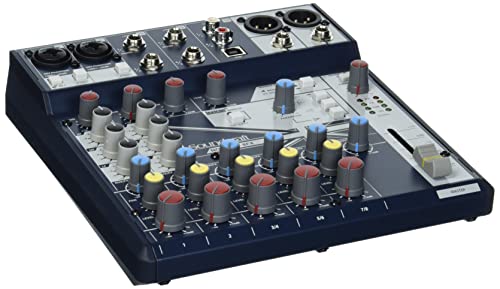
Soundcraft Notepad-8FX — Best Beginner Board With Effects
The Notepad-8FX gives the beginner the one effect that matters — a Lexicon reverb that makes a new voice sound placed rather than exposed — in a small-format board with USB for recording the practice sessions that make beginners into performers. It suits singing beginners, worship soloists and creators who perform as well as speak. The small format means close-spaced controls, and live bands should look at the gig guides instead. For a desk or a small room, its combination of forgiving effects and honest preamps is the gentlest on-ramp in this guide.
Strengths
- Lexicon reverb flatters new voices kindly
- USB records practice for honest review
- Compact format suits desks and small rooms
- Soundcraft preamps keep the dry signal clean
Trade-offs
- Small controls reward small adjustments — and patience
- Not a live-band board
- Channel count suits solo and duo work
| Specification | Detail |
|---|---|
| Format | Small-format |
| FX | Lexicon effects |
| USB | I/O |
| Preamps | Soundcraft mic pres |
Reverb is a beginner’s confidence technology, and Lexicon’s version is the kind one in this class: it suggests a room rather than announcing an effect, so a new singer hears themselves as they hope to sound and sings up to it. The recording path closes the learning loop — practice, listen back, adjust one thing. Beginners who use that loop weekly improve faster than any equipment upgrade can make them, and this board is built around exactly that loop.
Best for: Singing beginners and solo performers at a desk or small room / Not suited for: Groups needing more than a duo’s worth of inputs
Check on Amazon — check the current price on Amazon before you decide, because bundles and variants change.
Comparison Table
| Pick | Badge | Key spec | Best for |
|---|---|---|---|
| Yamaha MG06X | Best Overall for Beginners | Compact analog with SPX effects | A first board that sounds professional from day one and never embarrasses its owner later |
| Mackie Mix8 | Best Budget for Beginners | Compact analog, 8 channels | The cheapest first board that still teaches real mixing |
| Behringer XENYX 802S | Best for Streaming Beginners | Analog with USB streaming interface | New streamers and podcasters who need the computer connected from the start |
| Allen & Heath ZED-6 | Best Built Beginner Board | Ultra-compact analog, GSPre preamps | Buyers who want their first board built like their last one |
| CAD Audio MXU2 | Best Simple Two-Channel Start | 2-channel USB mixer | One microphone, one source, zero confusion — the podcast and voiceover starter |
| Soundcraft Notepad-8FX | Best Beginner Board With Effects | Small-format analog with Lexicon effects | Beginners whose vocals need reverb and whose desk needs a small footprint |
How to Choose Your First Audio Mixer
Start with your real input count — today, not someday
Write down what will actually plug in during your first month: one microphone, perhaps a guitar, perhaps a phone for backing tracks. That honest list — usually two to four inputs — is your board size, and every pick above maps to a version of it. Buying a sixteen-channel first board does not make you a sixteen-channel performer; it makes you a beginner with more knobs to set wrong. The two spare channels rule from the main guide applies gently here: one or two spares for a guest, not twelve for a fantasy.
If your near future genuinely includes a band, skip to the main audio mixers guide and buy the 12- or 16-channel class once. If it includes streaming, guests on a podcast or solo performance, this guide’s picks are the correct size of ambition.
Effects: the beginner’s real dividing line
The single feature that most changes a beginner’s experience is onboard reverb for the voice. A dry beginner vocal sounds exposed, which makes the performer tentative, which makes the performance smaller. Boards with quality effects — the Yamaha’s SPX, the Soundcraft’s Lexicon — close that loop kindly. Boards without effects — the Mackie Mix8, the Allen & Heath ZED-6 — teach cleaner habits and pair with microphones and rooms that supply their own space. Neither is wrong; know which beginner you are. Singers should almost always choose the reverb.
What you do not need as a beginner: deep effects menus, app control, or processing per channel. Those are second-board pleasures. Your first board’s job is to make gain staging and balance into reflexes.
The computer question
If any part of your plan involves recording, streaming or online teaching, the board must talk to your computer — look for the USB-equipped picks and save yourself the interface detour. If your plan is purely live — speeches, ceremonies, small performances — USB is dead weight and the purist picks serve you better. Decide this before shopping, because it halves the shortlist instantly, and because retrofitting a recording path later costs more than choosing it now.
How to Set Up Your First Mixer Without Fear
[‘Fifteen unhurried minutes, in this order, and your first board will sound like you hoped.’]
- Unbox onto a clear desk and connect in order. Microphone into channel one with an XLR cable. Speakers or headphones into the main output. Computer by USB if your board has it. Power last.
- Set everything to neutral. EQ knobs at their centre detent, effects off, gains at minimum, faders down. Neutral is your home position — return here whenever sound confuses you.
- Raise the gain, not the fader. Speak or sing at real volume and turn channel one’s gain until the meter shows healthy peaks. This is gain staging, the one skill that matters most, and you have just done it.
- Bring the fader up slowly until you hear yourself at a comfortable level. Add the second source the same way, balancing with faders, gains untouched.
- Add reverb like salt. If your board has effects, raise the vocal’s effect control until the voice gains a sense of room, then back off a touch. Taste, adjust, trust your ears over any number.
- Record one minute and listen back. On headphones, honestly. Note one thing to improve, change only that, and stop. You are now ahead of most first-time owners.
Common Buying Mistakes
Buying the biggest board the budget allows
Channels are not progress. A small board you understand completely produces better sound than a large board you operate nervously, and the leftover budget buys the microphone that actually determines your sound.
Skipping the microphone to afford the mixer
The chain is only as good as its first link. A modest board with a good microphone outperforms a fine board amplifying a poor one, every time, in every room.
Maxing the gain because louder feels better
Gain set too high distorts and hisses; gain set correctly and volume raised on the fader stays clean. Learn the difference in week one and your recordings will thank you for years.
Using every knob because it is there
Beginner mixes drown in well-meant EQ and effects. Start flat and dry, add one thing at a time, and remove anything whose absence you cannot hear.
Never recording yourself
The board cannot teach you; the playback can. A minute of honest recording per practice session is the fastest mixing education available at any price.
Final Recommendation
Buy the Yamaha MG06X if you sing or present and want one board to start and keep. Buy the Mackie Mix8 if the budget is strict and your work is speech and simple music. Streamers start on the Behringer 802S, purists on the Allen & Heath ZED-6, solo podcasters on the CAD MXU2, and singing beginners who record their practice on the Soundcraft Notepad-8FX. Then stop shopping and start the setup sequence — the best beginner mixer is the one that disappears into your first good performance.
Related guides in this series: Best Audio Mixers · Best Audio Mixers For Home Studios · Best Audio Mixers For Karaoke · Best Small Audio Mixers
The Microphone Matters More Than the Mixer
Every beginner budget conversation eventually reaches the same arithmetic: the microphone converts your voice into electricity, and everything downstream can only preserve or damage what it captures. A dynamic microphone — the stage standard — forgives untreated rooms, background noise and enthusiastic volume, which is why it is the correct first microphone for most beginners in this guide. A condenser microphone hears more detail and more room, rewarding quiet, treated spaces and punishing noisy ones. Neither is better in the abstract; they are matched to environments the way the mixers here are matched to jobs.
Practical pairing rules follow. Singers performing live: dynamic microphone, reverb-equipped board. Podcasters in a spare bedroom: dynamic microphone again, close up, with the board’s gain doing quiet, clean work. Voiceover and recording in a treated corner: condenser, phantom power on, and the purist preamps of the ZED-6 or the CAD’s simplicity will shine. Teachers and presenters: whichever microphone keeps you closest to it consistently, because distance variation is the beginner problem no EQ can repair. Spend the microphone money before the second-mixer money, always — the upgrade order in this entire category is microphone, then room, then board, then everything else.
A Practice Method That Actually Works
Mixing is learned by loop, not by reading, and the loop is short: perform a little, record it, listen honestly, change one thing. The USB-equipped picks exist in this guide partly to make that loop frictionless — the Soundcraft’s recording path and the Behringer’s streaming interface turn every practice into evidence. Keep the recordings. A month of weekly two-minute clips documents improvement more convincingly than any purchase, and the day something sounds wrong, the archive tells you when it changed.
Structure the practice around the three reflexes. Gain first: set levels for your loudest honest passage until the meter behaviour is predictable. Balance second: with two sources playing, practise making each one lead in turn using faders alone. Restraint third: perform once with every effect off, then add the minimum that improves it, and notice how small that minimum is. Beginners who run this loop for a month operate their boards like second-year owners, because in the only sense that matters — hours of deliberate feedback — they are.
Your Room Is Half Your Sound
Beginners blame equipment for what rooms do, so a short course in domestic acoustics belongs in this guide. Bare parallel walls reflect sound back at the microphone and the listener, blurring speech and making reverb — yours or the board’s — sound washy. Soft furnishings are treatment: a rug, curtains, a bookshelf and an upholstered chair will improve a spare-room recording more than any mixer upgrade at this level. Record or perform facing into the furnished part of the room, microphone close, and the room’s contribution shrinks to something EQ can politely ignore.
For live beginners the room lesson is placement. Speakers in front of the microphone, pointed at the audience and away from walls, at head height or above, will prevent more feedback than any processor you can buy this year. Keep overall volume at the level the room can hold rather than the level the amplifier can reach. These are unglamorous truths, and they are why experienced performers sound good on modest boards in difficult rooms while beginners struggle on excellent ones: the craft is mostly arrangement, and arrangement is free.
The Sensible Upgrade Path
First boards are beginnings, and knowing the path prevents both premature upgrades and dead ends. The typical journey runs: this guide’s board, mastered; a better microphone, when the voice outgrows the first; then, only if the work demands it, a larger board for more inputs or a digital platform for recall. Notice what is not on the path: a same-size board with more features. Lateral upgrades are where beginner budgets go to evaporate, because the sound in the room barely changes while the savings do.
The picks here were chosen to age well along that path. The Yamaha becomes the rehearsal and presentation board. The Allen & Heath becomes the sub-mixer professionals borrow. The streaming Behringer stays on the desk when a stage board joins the family. Buy with that second life in mind and the first purchase never becomes a sunk cost — it becomes the foundation of a small, sensible equipment ecosystem that grows one justified piece at a time.
Troubleshooting for Beginners: The Five Usual Problems
It hums. Almost always a power or cable story: laptop charger on a different circuit, a cheap cable, a phone charger nearby. Power everything from one strip, swap cables one at a time, and the hum will confess. It feeds back. The microphone can hear the speaker too well — move the speaker forward of the mic, turn down, and resist reaching for EQ first. It sounds distant. You are too far from the microphone; halve the distance before touching any control. It distorts on loud notes. A gain is too high somewhere — find the first meter that hits the red and reduce that control, not the master. It sounds fine live and terrible recorded. The recording hears the room the audience’s brains filtered out; get closer to the microphone and soften the room, in that order.
Notice the pattern: four of the five are arrangement and gain problems, not equipment failures. That ratio holds for professionals too, which is why this guide spends its words on method. A beginner who internalises these five diagnoses owns a skill that transfers to every board they will ever touch — including the large ones waiting in the other guides in this series.
Your First Ninety Days: A Simple Progression
Month one is for the reflexes: gain staging until it is boring, one source at a time, recorded and reviewed weekly. By its end you should be able to set up your board in the dark, metaphorically and nearly literally. Month two adds the second source and the art of balance — a guest’s voice against yours, a guitar against a backing track — plus the first honest experiments with EQ, one band at a time, always returning to flat to compare. Month three is performance: a full practice set, speech or stream run end-to-end without stopping, recorded, and reviewed for exactly three improvements, no more.
Keep a notebook through all ninety days — settings that worked, problems and their fixes, the microphone distance that suits your voice. That notebook becomes your personal manual, worth more than the printed one because it is written in your room, for your sources, in your words. Beginners who keep it stop being beginners on schedule; beginners who rely on memory repeat month one four times and call it experience.
Speech, Singing and Streaming: Three Beginner Dialects
The same board speaks three dialects. For speech — teaching, presenting, podcasting — the priorities are intelligibility and consistency: microphone close, gain steady, EQ flat or with a gentle low cut, effects off or nearly. The audience should forget the technology entirely. For singing, the board becomes an instrument of confidence: reverb present, EQ shaped to the voice, and the performer hearing themselves well enough to relax into the performance. Small rooms forgive everything except a dry, exposed beginner vocal, which is why the effects-equipped picks lead this guide for singers.
Streaming mixes the dialects: speech intelligibility for the commentary, music balanced beneath it, and a level discipline that keeps the loudest moment below the platform’s ceiling. The streaming pick’s USB path exists to make that discipline simple — one chain, set once, checked on the recording rather than guessed. Whichever dialect is yours, learn it deliberately rather than blending all three; a board set with intent for one job will always outperform a board vaguely ready for everything.
What Good Sounds Like: Calibrating Your Ears
Beginners often ask how to know when a mix is right, and the honest answer is reference. Keep two or three professional recordings in your genre — a podcast whose voice you admire, a live vocal performance, a streamer’s audio — and compare your recordings against them at matched volume. You are listening for specific things: how close the voice feels, how much room surrounds it, where the music sits relative to the words. Your board can reach those targets at this level more often than marketing suggests; what it cannot do is tell you the target, which is why references matter.
Volume-matched comparison is the discipline inside the trick: louder always sounds better to an untrained ear, so equalise playback levels before judging, or you will chase brightness and level instead of quality. Ten minutes of this comparison weekly calibrates a beginner’s ears faster than any tutorial, and it converts the vague ambition to sound professional into a set of audible, achievable specifics.
Confidence Is a Feature: The Psychology of the First Board
It is worth saying plainly, because equipment guides rarely do: the first board’s most important output is the performer’s confidence. A beginner who hears themselves sounding placed, clear and supported sings and speaks better within minutes — posture changes, breath deepens, the material improves. A beginner fighting hiss, feedback and a confusing layout performs smaller, and learns to dread the equipment. Every pick in this guide was chosen with that psychology in view: forgiving preamps, kind reverbs, layouts that explain themselves. The specifications serve the feeling, and the feeling serves the performance.
Protect that confidence deliberately. Set the board up before the audience — or the stream, or the class — arrives, so your first sound is a prepared one. Keep the settings notebook open at the page that worked last time. And when something goes wrong, return to neutral and rebuild in the order this guide teaches, rather than improvising in a panic. Composure is a learnable part of the craft, and the first board, chosen well, is where it is learned.
A Final Word on Lessons, Teachers and Community
Equipment starts the journey; people finish it. A single session with an experienced engineer watching you set gains will correct habits that months of solo practice can entrench, and most churches, schools and community studios contain such a person, usually flattered to be asked. Online communities for each discipline in this series are generous with specific, hard-won advice — bring them your recordings and your exact problem, and they will repay the specificity. The boards in this guide are the right tools. Pair them with one teacher, one notebook and one honest recording a week, and the beginner label will expire faster than the warranty does.
Two Worked Examples: The Singer and the Teacher
Consider the singer first: a beginner with a guitar, a village hall and a monthly open-mic. Her honest input list is voice and guitar — two channels — and her honest problem is confidence in a live room. The Yamaha MG06X answers both: the D-PRE preamp keeps her quiet verses clean, the SPX reverb places her voice, and the layout lets her run it from the stage between songs. Her upgrade path is a better microphone in month four and nothing else for a year, because nothing else is the limiting factor. That is what a correctly bought first board looks like: the shopping ends and the performing begins.
The teacher’s case is different in every variable except the happy ending. He teaches music online, needs his voice and a piano audible to students on laptops, records lessons, and shares his screen more than any stage. His board is the Behringer 802S or the CAD MXU2 — USB-native, desk-sized, set once and forgotten — with a dynamic microphone close to his mouth and the piano on the second input, balanced once and marked. His limiting factor was never channels; it was the friction of starting each lesson. Both examples follow the guide’s method: honest inputs, honest job, board chosen to disappear.
Gifts, Classrooms and Shared Boards: A Note for Institutions
Many first boards are bought by someone else — a parent for a teenager, a school for a music room, a church for its youth team — and shared boards have their own buying logic. Durability and simplicity outrank features, because the board will be set up by many hands and stored by whoever is last out. The Mackie and Yamaha picks lead for this duty, and the kindest accessory an institution can add is a laminated one-page setup card: the order of operations from this guide, the standard settings photographed, and the name of the person to ask. Institutions that do this discover their board sounds the same in December as it did in September, which is the entire definition of a successful shared purchase.
For the gift buyer specifically: pair the board with the microphone if the budget allows the pair, or give the board alone without apology — either is a complete, generous start. What not to give is the largest board in the shop. Beginners are inspired by equipment they can master, and quietly intimidated by equipment they cannot, and the difference shows within a month in whether the board is out and playing or boxed and respected.
Finally, a reassurance worth printing: there is no wrong pick in this guide, only mismatched ones — and the mismatch is always visible in advance if you answer the three questions honestly. What will plug in? Do you sing? Does a computer join in? Answer those, take the badge that matches, and spend the energy you saved on the microphone, the notebook and the first month of practice. That is the whole secret, and it was never really about the mixer.
And if, a year from now, you find yourself explaining gain staging to a newer beginner — with this same board between you, sounding exactly as good as the day it arrived — you will have the only review of a first mixer that has ever mattered.
Keep the box and the manual for the first year, by the way — not from superstition, but because the manual’s signal-flow diagram will suddenly make sense in month three, when a question arises that this guide did not anticipate, and because a complete, boxed board is the one a friend can borrow, a school can accept, or a future upgrade can trade in without apology. Small habits, like small mixers, compound.
Welcome to the craft. It is mostly listening, and it starts now.
Now set it up, make the first recording, and hear how far a well-chosen first board can take you.
Frequently Asked Questions
What size mixer does a beginner actually need?
Usually four to eight inputs — a microphone, an instrument, a phone or computer, and a spare for a guest. The picks here span two to eight channels precisely because honest beginner setups do.
Do I need effects on my first mixer?
If you sing, yes — a good onboard reverb transforms a beginner’s confidence and the audience’s experience. For speech, presentations and podcasts, effects matter far less than a clean preamp.
Can a beginner mixer record to a computer?
The USB-equipped picks can, directly, in stereo — enough for podcasts, streams, lessons and practice review. Boards without USB need a separate interface to record.
What microphone should pair with a first board?
A good dynamic microphone is the forgiving default for live and untreated rooms; a condenser suits quiet, treated spaces and recording. Either way, spend on the microphone before upgrading the mixer.
How long will a beginner board last?
The picks here are built to survive the learning years and serve afterwards as sub-mixers, presentation boards or rehearsal tools. Beginners outgrow channel counts, not quality.
Is a mixer hard to learn?
The basics — gain, balance, a touch of EQ and reverb — take an afternoon, and this guide’s setup sequence is genuinely all of it. Depth exists for later; competence is quick.


