Disclosure: airfryerkitchensupply.com is reader-supported. When you buy through links on our site, we may earn an affiliate commission at no extra cost to you.
Where to buy
Every linked pick in this guide to the best basic kitchen faucets was verified against Amazon’s catalog on 2026-11-20, so the model numbers below are the exact faucets you will land on. Start with the Delta Foundations B4410LF for the best all-round basic faucet with a side sprayer, the Delta Foundations B1310LF for the honest minimum spend, and the FORIOUS Pull-Down if your “basic” still needs a pull-down sprayer. Check the current price on Amazon for each pick — we never print static prices, and basic faucets are the most promotion-driven corner of the category.
“Basic” is the most honest word in faucet shopping, and this guide treats it with respect rather than as a consolation prize for a small budget, because the households shopping this search are usually solving a real problem on a real deadline. A basic kitchen faucet does one job — deliver mixed hot and cold water to a sink, reliably, for years — without sensors, spring coils, or design statements. The buyers are landlords, budget remodelers, first-home owners, cabin and workshop keepers, and anyone replacing a failed faucet this weekend with money that has other plans. The trap in this corner of the market is that “basic” is also where the disposable products live, the anonymous faucets our best-and-worst guide warns about. The line between basic and disposable is not price; it is whether the faucet has a real manufacturer, a standard cartridge, and metal where it counts. Every pick below is on the right side of that line.
In this guide
Quick Picks
- Best Overall Basic: Delta Foundations B4410LF — single handle, side sprayer, 4-hole deck, Delta parts everywhere.
- Best Budget Basic: Delta Foundations B1310LF — the honest minimum: single handle, 3-hole deck, no sprayer, full Delta support.
- Best Two-Handle Basic: Moen Chateau 7906 — the classic two-handle chrome faucet that has plumbed decades of American kitchens.
- Best Traditional with Side Sprayer: Delta Windemere 21996LF — two-handle traditional styling, side sprayer, 4-hole 8-inch deck.
- Best Basic High-Arc: Moen Banbury CA87000SRS — two-handle high arc in Spot Resist Stainless for pot-filling clearance on a basic budget.
- Best Basic with Pull-Down: FORIOUS Pull-Down — SUS 304 construction, 3 spray modes, ceramic cartridge, 1-or-3-hole fit at a value tier.
How These Picks Were Chosen
Verification followed the cluster rule: each model was searched by brand and model, the returned Amazon title matched to the intended faucet, and only then did we take the ASIN. For this guide we then applied the basic-faucet test, which is stricter than it sounds. One: a named manufacturer with a parts catalog — the cartridge for the exact model must be findable by number. Two: a conventional deck pattern (3-hole, 4-hole, or 1-or-3 with plate) so the faucet drops into the existing sink without surgery. Three: no proprietary consumables — nothing about the faucet should require the original seller’s continued existence. Four: construction honesty — metal spouts and standard valving over plastic theater.
Those tests eliminated most of the ultra-cheap field, including listings that undercut these picks on price, because their cartridges are unfindable and their brands are storefronts. What survived is a list dominated by Delta’s Foundations line and Moen’s classic lines — which is not favoritism but arithmetic: at the basic tier, the big American brands’ scale makes their entry models both cheap and supportable, a combination the import value class can match on price or on support but rarely on both. The one value-brand pick, FORIOUS, earned its slot with verified SUS 304 construction, a ceramic cartridge, published certifications in its listing data, and a coherent product line — and carries the class’s standard caveat about long-term parts depth, stated in its review.
The 6 Best Basic Kitchen Faucets
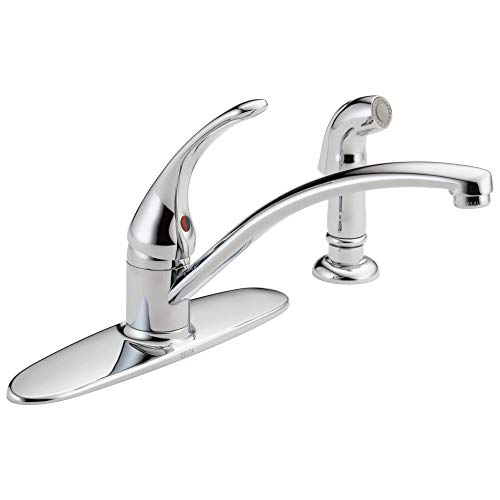
Delta Foundations B4410LF — Best Overall Basic
The B4410LF is what a basic faucet should be in 2026: a single-handle chrome faucet with a side sprayer, built for the standard 4-hole deck that fills American suburbs, on Delta’s Foundations platform — which means a standard cartridge, integrated supplies, and a warranty administered by a company that answers. The single handle gives one-handed temperature control; the side sprayer gives the rinsing reach a fixed spout lacks; the deck pattern matches the sink you already have. It suits landlords standardizing a rental fleet, budget remodels, and any household whose faucet criteria begin and end with “works, forever, cheaply serviced.” It will not impress anyone visually, and households that rinse big cookware daily may still prefer the pull-down pick below. As the default answer to “just give me a good basic faucet,” it has no serious rival on this page.
Strengths
- The complete basic package: single handle plus side sprayer on the most common deck pattern in the country.
- Foundations platform parts are stocked everywhere Delta is sold — which is everywhere.
- Chrome finish: the cheapest to produce, the easiest to match, and the most forgiving to maintain.
Trade-offs
- Side sprayer means a diverter and hose — two more wear items than the sprayer-free B1310LF.
- Styling is anonymous by design; it will not lift a kitchen’s design.
- Requires the 4-hole deck (or a 3-hole plus sprayer hole) it was designed for.
| Spec | Detail |
|---|---|
| Model | B4410LF (verified via API) |
| Deck | 4-hole, single handle, side sprayer |
| Finish | Chrome |
| Platform | Delta Foundations, standard cartridge |
The ownership story is the recommendation: when this faucet eventually needs attention — a cartridge at year eight, a sprayer hose at year ten — the parts are a hardware-store errand and the labor is a YouTube-length job. Landlords should note the fleet logic: one model across many units means one spare cartridge on the shelf serves every kitchen you own. That is what “basic” buys when it is bought correctly.
Best for: rentals, budget remodels, and standard 4-hole sinks / Not suited for: design-led kitchens or pull-down devotees. Check the current price on Amazon.
Delta Foundations B1310LF — Best Budget Basic
Strip the B4410LF of its sprayer and you have the B1310LF: single handle, 3-hole deck, fixed spout, chrome — the honest minimum viable faucet from a real manufacturer, and our budget pick because its floor is a floor of substance. There is nothing here to upsell and nothing here to fear: the same Foundations cartridge ecosystem, the same support, one less hose and diverter to maintain. It suits the tightest remodel budgets, utility and laundry-adjacent kitchen sinks, cabins, and any installation where the sink’s work is filling and washing at the bowl. The fixed spout’s limits are the honest trade: rinsing is confined to the spout’s swing, and big awkward items get washed by maneuvering them, not the water. If your household cooks daily with sheet pans and stockpots, the small step up to a sprayer model will pay for itself in the first month of Sundays.
Strengths
- The lowest-cost entry into a fully supported platform — cheap to buy, cheap to keep.
- Fewest possible wear parts of any pick here: no sprayer, no hose, no diverter.
- 3-hole deck compatibility covers the most common replacement scenario.
Trade-offs
- No spray function at all.
- Fixed spout reach limits rinsing of large items.
- Chrome-only, anonymity-grade styling.
There is a discipline this faucet teaches the whole category: at the bottom of the market, subtraction is a feature. Every component not present cannot leak, clog, or obsolete itself. For the sink whose job is water, plainly delivered, the B1310LF is not the cheap version of the right faucet — it is the right faucet, with the extras correctly identified as extras.
Best for: tightest budgets, utility sinks, cabins, simple kitchens / Not suited for: daily big-cookware households. Check the current price on Amazon.

Moen Chateau 7906 — Best Two-Handle Basic
The Chateau is a piece of American plumbing history that never left the catalog: a two-handle, chrome, centerset kitchen faucet of the pattern that has served in rentals, farmhouses, and first homes for decades. Two handles mean total temperature clarity — hot is hot, cold is cold, and any guest or grandparent can run it — and Moen’s cartridge support for the Chateau family is the kind of long-tail availability that makes plumbers nostalgic. It suits traditional households, multi-generational homes, and replacements on two-handle decks where the household’s habits are set. The design’s age shows in the honest places: no sprayer on this configuration, a modest arc that asks tall pots to tilt, and styling that reads “apartment standard” to modern eyes. For the buyer who wants exactly the faucet their previous one was, only new, this is it.
Strengths
- Decades-long production run: cartridges and trim are among the most available in the industry.
- Two-handle clarity for every user, with individually serviceable hot and cold sides.
- Moen support and a price tier that respects a budget — check price on Amazon.
Trade-offs
- No sprayer; fixed spout with a modest arc.
- Two-handed temperature blending is slower with messy hands.
- Dated styling for contemporary kitchens.
The Chateau’s real specification is its installed base: a faucet this common is a faucet every plumber has serviced and every parts counter stocks. In the basic tier, where the purchase is fundamentally about not thinking about the faucet again, that ubiquity is worth more than any feature on any rival’s box.
Best for: two-handle households, like-for-like replacements, rentals / Not suited for: sprayer needs or modern styling. Check the current price on Amazon.

Delta Windemere 21996LF — Best Traditional with Side Sprayer
The Windemere dresses the basic formula in traditional styling: two handles with period-flavored silhouettes, a side sprayer, and an 8-inch 4-hole deck layout, at 11.63 inches of height — enough arc for respectable pot filling without leaving the basic tier. Its listing-verified details include a cartridge tested to a half-million uses, the kind of unglamorous durability datum that matters more than any finish name. It suits traditional kitchens doing a budget refresh, older homes with the 8-inch deck pattern, and buyers who want their basic faucet to at least look like it belongs in the room. The two-handle, two-handed caveat applies as with the Chateau, and the traditional styling is a commitment: in a modern kitchen it will look like a guest.
Strengths
- Traditional design at a basic price — the room gets a finished look, not a placeholder.
- Side sprayer restores rinsing reach to the two-handle format.
- Cartridge durability testing published in the model’s data — substance behind the styling.
Trade-offs
- 8-inch 4-hole pattern required; not a 3-hole drop-in.
- Two-handle operation, with its usual speed trade-off.
- Traditional look only; no modern finish story in this listing.
| Spec | Detail |
|---|---|
| Model | 21996LF (verified via API) |
| Height | 11.63 in (verified via API) |
| Deck | 4-hole, 8 in centers, side sprayer |
| Handles | Two-handle, traditional |
Choose the Windemere when the kitchen is traditional and the budget is basic and neither fact is negotiable. It demonstrates the healthiest pattern in this tier: a major brand putting its real cartridge platform under honest styling at an honest price, with the sprayer included because the format needs it.
Best for: traditional kitchens on basic budgets with 8-inch decks / Not suited for: 3-hole sinks or one-handed cooks. Check the current price on Amazon.

Moen Banbury CA87000SRS — Best Basic High-Arc
The Banbury answers the basic tier’s most common frustration — the low arc that makes pot filling a tilting exercise — with a two-handle high-arc design in Moen’s Spot Resist Stainless. The high arc clears stockpots and canning jars properly; the two handles keep the traditional control scheme; the finish hides the fingerprints and spots that chrome advertises. It suits canning and stockpot households on a budget, two-handle loyalists who need clearance, and kitchens matching stainless appliances without leaving the basic tier. The trade-offs mirror its format: two-handed blending, no pull-down, and a deck pattern to verify before ordering. Within those lines, it is the most capable fixed-spout faucet in this guide.
Strengths
- High-arc clearance at a basic tier — the pot-filling problem solved without a format change.
- Spot Resist Stainless: the low-maintenance finish, matched to appliance suites.
- Moen’s cartridge ecosystem and support behind it.
Trade-offs
- No sprayer in the headline configuration; reach is the spout’s swing.
- Two-handle blending, as with all traditional picks here.
- High arc needs cabinet and shelf clearance checks above the sink.
The Banbury is the pick for the household that cans, brines, and boils — the kitchens where the faucet’s most important dimension is the space under its spout. It proves the basic tier is not a low-arc ghetto: the clearance is available without leaving the budget, provided you accept the two-handle terms.
Best for: stockpot and canning kitchens on a budget / Not suited for: one-handed operation or sprayer-dependent rinsing. Check the current price on Amazon.

FORIOUS Pull-Down — Best Basic with Pull-Down
Some households’ “basic” still includes a pull-down sprayer, and this FORIOUS is the value-class way to get one without buying a disposable: SUS 304 stainless construction, a ceramic cartridge, three spray modes (stream, spray, pause), a 1.8 GPM flow, cUPC and NSF/ANSI/CAN 61 certifications in its verified listing data, and a 1-or-3-hole fit with a 10-inch deck plate, at 14.76 inches of height. It suits budget remodels that refuse to give up the pull-down, renters upgrading with permission, and first kitchens. The caveats are the value class’s, stated as plainly here as in our other guides: parts depth and finish refinement trail Delta and Moen, and the brand’s long-term continuity is the buyer’s accepted risk. What separates it from the anonymous field is that the fundamentals — material, cartridge type, certifications, coherent product line — verify.
Strengths
- Full pull-down function with 3 modes at a basic-tier spend.
- Verified certifications (cUPC, NSF/ANSI/CAN 61) and SUS 304 construction in the listing data.
- Flexible 1-or-3-hole fit with the deck plate included.
Trade-offs
- Parts availability in year eight is a hope, not a network.
- Pull-down hose management applies: keep the under-sink loop clear.
- Finish and refinement a tier below the majors.
| Spec | Detail |
|---|---|
| Height | 14.76 in (verified via API) |
| Flow rate | 1.8 GPM (verified via API) |
| Deck | 1 or 3 hole, 10 in deck plate |
| Spray modes | Stream / spray / pause, 18 in hose |
Bought knowingly, the FORIOUS is the correct budget pull-down: the sprayer function that makes modern kitchens work, on fundamentals that check out, at a price that leaves room in the remodel budget for the sink it deserves. Bought as a ten-year heirloom, it would be a misunderstanding — and this guide’s job is to make sure nobody buys it that way.
Best for: budget pull-down seekers and flexible decks / Not suited for: buyers who need guaranteed decade-scale parts support. Check the current price on Amazon.
Comparison Table
| Pick | Badge | Key spec | Best for |
|---|---|---|---|
| Delta Foundations B4410LF | Best Overall Basic | Single handle, side sprayer, 4-hole | Rentals, standard decks |
| Delta Foundations B1310LF | Best Budget Basic | Single handle, 3-hole, no sprayer | Tightest budgets |
| Moen Chateau 7906 | Best Two-Handle Basic | Two-handle chrome centerset | Traditional replacements |
| Delta Windemere 21996LF | Best Traditional + Sprayer | 11.63 in, 4-hole 8 in, side sprayer | Traditional budget refresh |
| Moen Banbury CA87000SRS | Best Basic High-Arc | Two-handle high arc, Spot Resist | Stockpots, canning |
| FORIOUS Pull-Down | Best Basic Pull-Down | 14.76 in, 1.8 GPM, 3 modes, SUS 304 | Budget pull-down seekers |
How to Choose a Basic Kitchen Faucet
Basic buying is deck-first, like everything in this cluster, but simpler: count holes, and the shortlist writes itself. Four holes with a sprayer hole point to the B4410LF or the Windemere; three holes point to the B1310LF or the FORIOUS with its plate; two-handle decks point to the Chateau, Windemere, or Banbury by arc height. Next, the sprayer question, which is the basic tier’s only real feature decision: households that rinse large items need one (side sprayer or pull-down), households that wash at the bowl do not, and the sprayer-free models repay their simplicity with fewer wear parts. Be honest about the sheet pan in your life.
Then apply the disposable filter, which matters more at this tier than any other: can you find this model’s cartridge for sale by number, from a seller who is not the faucet’s own storefront? Is the spout metal? Does the brand publish certifications you can check? The picks here pass; much of the price-adjacent field does not, and the price gap between a disposable faucet and a Foundations is small enough that the supported faucet is cheaper by the first repair — usually by the first year. Finally, think in fleets and futures: a landlord standardizing on one model, a homeowner keeping the box’s model tag under the sink, a remodeler choosing the deck pattern the next faucet will also fit. Basic faucets are bought rarely and used constantly; the choosing should be boring, and boring is a compliment.
How to Install a Basic Kitchen Faucet Fast
Basic faucets are the fastest installs in the category — no control boxes, no power, often integrated supply lines — and a prepared swap runs under an hour. The time is won or lost before the new box opens: confirm your angle stops close fully (replace any that weep, while the water is off anyway), photograph the old installation’s connections, and have a basin wrench, a bucket, and towels staged. Remove the old faucet, clean the deck to flat bare surface, and dry-fit the new one to confirm the plate covers the holes and the handle clears the backsplash. Connect supplies hand-tight plus a quarter turn, flush through the faucet with the aerator removed for thirty seconds, then test hot, cold, and sprayer (where fitted) while watching every joint with a dry paper towel. Recheck after the first hot cycle. That is the whole liturgy; the basic tier’s reward for its simplicity is an installation a careful beginner can finish before lunch.
Basic Faucets for Landlords: The Fleet View
Landlords are this category’s professional buyers, and their logic deserves its own section because it generalizes to anyone maintaining more than one kitchen. The fleet principle is standardization: one model, everywhere, so that one spare cartridge, one spare sprayer hose, and one set of installation knowledge covers every unit you own. The Foundations picks dominate this guide precisely because they standardize well — the B4410LF for 4-hole units, the B1310LF for 3-hole units, same platform, same parts channel, same afternoon-length service call when a tenant reports a drip. The cost math is unforgiving in the fleet’s favor: an anonymous faucet that saves a small amount per unit but requires full replacement at first failure costs more by the second year of a tenancy cycle, and it costs it at the worst time — between tenants, on a turnover deadline, with a plumber’s emergency rate attached.
Tenant-proofing is the fleet view’s second principle, and it favors exactly the faucets here: metal spouts that survive being used as handles, cartridges that tolerate being forced past their stops, finishes (chrome above all) that can be cleaned with whatever the tenant uses without recording the insult. It argues against pull-downs in standard rentals — hoses are the most abused component in a tenant’s kitchen — and for the side sprayer, whose failure mode is benign and whose replacement is a five-minute job. It also argues for photographing every installation and keeping a one-line record per unit: model, install date, cartridge type. The landlords who treat faucets this way stop having faucet emergencies; the ones who buy whatever is cheapest that week have them forever. None of this requires spending more. It requires spending the same, on a platform, on purpose.
When Basic Is Not Enough: Honest Upgrade Triggers
This guide sells basic faucets, so it should also name the conditions under which you should not buy one. Trigger one: the household cooks seriously every day. High-volume cooking weaponizes a faucet’s limits — the fixed spout’s rinsing radius, the low arc’s pot clearance — into daily friction, and the correct purchase is a proper pull-down from our other guides, bought once. Trigger two: mobility limits in the household. Arthritis, injury, or aging can turn a two-handle basic into an obstacle and a stiff single lever into a negotiation; lever ergonomics and even sensor operation (see the automatic guides) are accessibility decisions, not luxuries, when hands are the constraint. Trigger three: the sink itself is being replaced with a statement piece. A farmhouse or designer sink under a placeholder faucet looks unfinished in a way that photographs badly and lives worse; match the faucet’s ambition to the sink’s.
Trigger four is subtler: water quality. In districts with aggressive hard water, the cheapest cartridges — including, honestly, some in this guide’s value pick — live shorter lives, and the mid-tier platforms with better valving can be the cheaper decade-scale buy. And trigger five: the home is a long-term hold being remodeled once. A faucet is a fifteen-year object installed during a one-time opening of the walls and cabinets; economizing to the basic tier during a full remodel saves the smallest line in the budget at the highest inconvenience exchange rate. Basic is the right answer for rentals, refreshes, second sinks, cabins, and honest budget kitchens. Know which of those you have — and if you have none of them, let this guide’s discipline (platform, cartridge, deck) travel with you up the price ladder instead.
Keeping a Basic Faucet Alive for a Decade
The maintenance covenant for a basic faucet is short enough to memorize, and it is the difference between the ten-year outcome and the four-year one. Monthly: run a finger around the aerator and rinse it if the stream splutters — thirty seconds, no tools, and it protects the cartridge from the back-pressure and grit that shorten its life. Quarterly: open the cabinet and look — not at the faucet, at the floor and the fittings — with a dry hand; the leaks that rot cabinets are slow, silent, and visible months before they are expensive. Annually: work the angle stops a quarter turn and back, so they remain closable on the day you need them, and check the sprayer hose (where fitted) for stiffness or weeping at its crimps. At the first drip: replace the cartridge promptly rather than forcing the handle harder, because a forced cartridge scores its seat and converts a cheap part swap into a faucet replacement.
Two environmental notes complete the covenant. In hard-water homes, the aerator rinse is not optional garnish; it is the main event, and a simple whole-house sediment filter, where the plumbing sheds grit, pays for itself in cartridge life across every faucet in the building. In freeze-prone installations — cabins, unheated workshops, seasonal homes — the winterization rule is absolute: drain the lines and leave the faucet open, because no basic faucet at any price survives trapped water in a hard freeze, and the spring discovery of a split body is the category’s most avoidable obituary. Do these few things and the faucets in this guide will bore you for a decade, which is the highest praise a basic faucet can earn.
Common Buying Mistakes
- Confusing basic with disposable. A basic faucet has a brand, a cartridge standard, and metal in the water path. A disposable has a price and a photograph. Learn the difference before the leak teaches it.
- Buying the sprayer configuration for the wrong deck. A 4-hole faucet on a 3-hole sink leaves a sprayer with nowhere to live. Count first.
- Skipping the sprayer you actually need. The reverse error: saving a little on a fixed spout, then rinsing sheet pans in frustration for a decade.
- Ignoring the stops. Ancient angle stops that will not close turn a one-hour swap into a whole-house shutoff adventure. Test them first.
- Over-tightening plastic supply nuts. Hand-tight plus a quarter turn; the wrench-happy crack fittings and create the leak they feared.
- Throwing away the model information. Keep the box end or a photo of the model tag under the sink. Future cartridge purchases depend on it.
Basic Faucets in Cabins, Workshops, and Second Homes
The basic tier’s natural habitat extends well past the primary kitchen, and the choosing shifts with the building. In a cabin or second home, the faucet’s enemies are absence and winter: long idle stretches dry out lesser seals, and a single hard freeze with charged lines ends any faucet regardless of tier. The correct cabin purchase is therefore the most conventional faucet on the most standard platform — the Chateau and Foundations picks are the archetypes — installed with a drain-down routine the least handy family member can execute: stops closed, lines drained, faucet left open. Resist the pull-down here; its hose holds water in a loop that drains last and freezes first. In a workshop or garage sink, the enemies are abuse and chemistry: the faucet will be operated with greasy hands, knocked by lumber, and asked to fill buckets at full bore for years. Two-handle models win this posting because gloved and filthy hands manage them best and because each side services independently; the Windemere and Chateau are the workshop answers, and their chrome finishes are chosen for indifference, not beauty.
Guest houses and in-law suites make a subtler case: the users are honored guests or family, the usage is intermittent, and the faucet should be instantly legible to a stranger at midnight. That argues for the single-handle Foundations models — one lever, obvious logic, no instructions taped to the wall — and against anything with a trick. Across all these postings the fleet principle from the landlord section applies in miniature: if the second building’s faucet shares the main house’s platform, one spare cartridge in one drawer serves both roofs. Basic faucets reward households that think of them as infrastructure, and infrastructure is bought once, standardized, and forgotten on purpose.
What Each Dollar Buys: The Anatomy of a Basic Faucet
Buyers at this tier reasonably ask where the money goes, since two faucets can look identical in a thumbnail and differ threefold in price. The first dollar buys the body: cast or formed metal with real wall thickness versus zinc or plastic shells that imitate the weight with inserts. The second buys the cartridge: a standardized ceramic or washerless unit from a platform with a production run, versus a proprietary insert molded for one production batch of one listing. The third buys the finish’s honesty: chrome plated to a standard that survives a decade of cleaning, versus decorative coatings that pit at the spout tip within two years. The fourth buys the paperwork — published certifications, an installation manual written by someone who has seen the product, a warranty with an administrator. And the fifth buys the network: the warehouse shelf, the hardware-store peg, the support line.
The disposable field’s trick is to photograph the first dollar and skip the other four. The picks in this guide were chosen because their manufacturers spend on all five, visibly, in ways a buyer can audit before purchase: the cartridge search, the certification lookup, the manual download. That audit — five minutes, no tools — is the whole skill of basic-tier buying, and it transfers to every other tier in this cluster. A faucet is not cheap or expensive in the abstract; it is cheap or expensive per year of service, and the five dollars above are what the years are made of.
Final Recommendation
Most basic buyers should buy the Delta Foundations B4410LF and be done: complete, supported, and cheap to keep. The tightest budgets take the B1310LF, two-handle traditionalists take the Moen Chateau or the Windemere with its sprayer, stockpot households take the Banbury, and pull-down holdouts take the FORIOUS with eyes open. Keep reading in the cluster: Best American Standard Kitchen Faucets, Best American Made Kitchen Faucets, Best And Worst Kitchen Faucets, Best Bar Style Kitchen Faucets, Best Automatic Kitchen Faucets.
Replacing a Faucet in an Older Home: What the Basic Tier Teaches
Most basic faucets are bought as replacements, and older homes add chapters the new-build guides skip. The first is archaeology: the existing faucet may be a widespread, a centerset, or a wall-mount; the supply stops may be gate valves older than the occupants; the deck may be cast iron whose holes have enamel ridges that defeat modern gaskets until they are cleaned to bare, flat metal. Photograph everything from above and below before a single nut turns, and buy the replacement against the photographs — the deck pattern in the picture is the specification, and it outranks any memory of what the sink “probably” is. The second chapter is the stops: test them a week before the swap, because a stop that will not close converts a faucet job into a plumbing job, and discovering that with the old faucet already out is how weekends are lost. Replace suspect stops during the same shutoff; the parts are cheap and the water is already off.
The third chapter is kindness to the next person, who may be you in ten years: leave the installation better than you found it. Label the stops, coil the model tag where it can be found, choose the faucet whose successor will fit the same deck, and resist exotic configurations in a house that will outlive your taste. Older homes reward the basic tier’s deepest virtue — conventionality — because every future repair inherits your choices. A basic faucet, correctly chosen and documented, is how a hundred-year-old kitchen gets twenty-first-century reliability without surrendering its character; the Chateau and Windemere picks exist in this guide precisely for those houses.
Frequently Asked Questions
Are basic faucets a false economy in a home I own long-term?
Not when they are platform faucets. The economics turn on service life, and a Foundations or Chateau-class faucet’s life is measured in the same decade-plus units as mid-tier models, because the wear parts and bodies are drawn from the same engineering culture. What the basic tier gives up is features and finish, not years. The false economy lives one rung down, in the disposable class, where the second purchase is already scheduled. If your long-term home wants a pull-down or a sensor, buy it for the daily pleasure — but do not let anyone tell you the basic platform faucet was the risky choice. It is the conservative one.
How long should a basic kitchen faucet last?
A basic faucet from a real platform — the Foundations and Chateau class — should serve 10 to 15 years with a cartridge refresh along the way, because its body and valving are the same fundamentals as the brands’ pricier lines. A disposable faucet’s life is its first wear part, often two to four years, because the part cannot be replaced. The purchase prices are closer than the lifespans, which is the entire economics of this guide.
Is a side sprayer or a pull-down better at the basic tier?
For a deck that already has the fourth hole, a side sprayer is the simpler, cheaper reach — a trigger hose with no docking to maintain. A pull-down integrates the spray into the spout, which is tidier and reaches further, but adds hose-and-weight management under the sink. At the basic tier we lean side sprayer for replacements (the hole is already there) and pull-down for new decks being drilled to order.
Can I replace a two-handle faucet with a single-handle one?
Usually, yes, if the deck pattern cooperates: many single-handle basics include a deck plate that covers a standard 3-hole pattern, and a leftover fourth hole can host a dispenser or a cap. Widespread two-handle decks (8-inch centers with separate holes) are the harder case — measure the spread and check the plate’s coverage before ordering, or choose a two-handle successor like the Windemere or Banbury and keep the household’s habits intact.
What is the cheapest faucet I should actually buy?
The cheapest faucet whose cartridge you can buy separately, from a brand with a parts catalog — in practice, the entry models of the major brands, like the B1310LF here. Below that line, the savings are borrowed against a full replacement at the first drip. Check price on Amazon for the current number, but shop the criterion, not the absolute floor: supported and basic beats unsupported and cheaper, every year of the faucet’s life.
Should I buy the extended warranty or protection plan on a basic faucet?
Generally no, and the reasoning is this guide in one line: the faucet’s own manufacturer warranty plus its replaceable cartridge already cover the realistic failure paths, and the protection plan’s premium approaches the cost of the cartridge it would theoretically save you. The money is better spent one rung up the platform ladder, or on the angle stops and supply lines whose failure the plan would not cover anyway. Protection plans make their most sense on complex electronics; a basic faucet is the opposite purchase — simple, warranted, and repairable by design — and it should be bought that way.
What flow rate should a basic faucet have?
The regulated mainstream: most current kitchen faucets are built to the prevailing standards — up to 1.8 gallons per minute nationally, with stricter limits in some states — and the verified FORIOUS listing in this guide confirms 1.8 GPM for that model. In daily terms that fills a gallon jug in about half a minute and rinses adequately; if a basic faucet feels weak, the cause is almost never its rating but a scaled aerator or low house pressure, in that order of likelihood. Clean the aerator before blaming the faucet, and measure the house before replacing it.
Do basic faucets come with supply lines?
Many modern basics include integrated supply lines — Delta’s Foundations models use integrated InnoFlex-style lines on much of the line — which removes two leak points and speeds installation. Verify for the exact model at purchase, and if your stops are the older 1/2-inch style rather than 3/8-inch compression, have adapters ready. Integrated lines also mean the line length is fixed, so confirm the reach from faucet to stops in deep or offset cabinets.
My basic faucet drips. Is it worth repairing or should I replace it?
Repair it, if it is one of this guide’s platforms: a drip at the spout is almost always the cartridge, the part designed to be replaced, at a cost that is a small fraction of a new faucet and a half-hour of labor. A drip at the base points to O-rings, also serviceable. Replace the faucet instead when the body itself is compromised — corrosion at the base, a cracked spout, a sprayer hose on a model whose hose is unfindable — or when the faucet is an anonymous unit whose cartridge cannot be identified. The decision rule is the guide’s thesis in miniature: platforms get repaired; disposables get replaced, once, with a platform.
What tools do I need to swap a basic faucet?
The honest kit is short: a basin wrench for the mounting nuts (the one specialty tool that earns its drawer space), an adjustable wrench for supply connections, a bucket and towels, a flashlight, and penetrating oil for elderly hardware. Plumber’s putty or silicone only if the specific model’s manual calls for it — most modern basics seal on gaskets. Everything else is patience, and the patience is best spent on the old faucet’s removal, which is where swaps are won and lost.
Is chrome really the best finish for a basic faucet?
For the basic brief — lowest cost, easiest care, universal matching — yes. Chrome is the most durable inexpensive finish, hides its age well, and never fights the room. Stainless-look finishes like the Banbury’s Spot Resist cost a little more and buy fingerprint resistance and appliance matching. At this tier, finish should be the last decision, after deck, sprayer, and platform; both finishes here sit on faucets worth owning.


