Disclosure: airfryerkitchensupply.com is reader-supported. When you buy through links on our site, we may earn an affiliate commission at no extra cost to you.
Where to buy
Every linked pick in this guide to the best automatic kitchen sink faucets was verified against Amazon’s catalog on 2026-11-20, so the model numbers below are the exact listings you will land on. Start with the Kohler Maxton Touchless (R26281-SD-CP) for the easiest fit on a standard sink deck, the WEWE Touchless with Soap Dispenser for the budget sensor route, and the Kohler Graze with Konnect (K-22068-WB-VS) if you want voice control measured out at the sink. Check the current price on Amazon for each pick — we never print static prices.
This guide is the practical sibling of our automatic faucets roundup, and the division of labor between the two is deliberate: sensor rankings live there, sink-by-sink fit decisions live here, and a reader who lands on either page gets a complete answer rather than half of one. If you arrived here first, buy from this page with confidence — the picks overlap where the categories overlap, and differ where the questions differ. That one ranks the sensor systems; this one starts from your sink. “Kitchen sink faucet” is the phrase buyers use when the question is really about fit: will an automatic faucet work with my deck holes, my shallow bowl, my crowded cabinet, my lack of an outlet? The honest answer is that the sink decides more than the sensor does. A touchless faucet that fights your deck geometry, splashes your shallow bowl, or strands its battery pack behind a reverse-osmosis tank will annoy you daily no matter how good its electronics are. So the picks below are organized by installation reality — standard decks, tight cabinets, budget retrofits, deep farmhouse bowls — with the sensor discussion kept where it belongs: second, after the fit.
In this guide
Quick Picks
- Best Overall for Standard Sinks: Kohler Maxton Touchless (R26281-SD-CP) — brand-name sensor, pull-down format, soap dispenser included for the fourth hole.
- Best for Matte Black Suites: Moen Essie MotionSense Wave (87014EWBL) — Moen’s single-wave sensor on the friendly Essie platform, in matte black.
- Best Budget Sensor Faucet: WEWE Touchless with Soap Dispenser — sensor activation, 3-mode sprayer, 1- or 3-hole fit, dispenser in the box.
- Best Temperature Feedback: OWOFAN Touchless with Temperature LED — the LED ring reads water temperature at a glance while the sensor runs the water.
- Best Spring Design on a Budget: GIMILI Touchless Spring Faucet — commercial-style spring spout with motion-sensor activation, single-hole install.
- Best Smart Sink Faucet: Kohler Graze with Konnect (K-22068-WB-VS) — touchless plus voice control that can pour measured amounts on command.
How These Picks Were Chosen
Verification followed the house rule: every model was searched by brand and model, the returned Amazon title was matched to the intended product, and only then did we take the ASIN. In this category that discipline protects you from a specific trap — near-identical listings for the same faucet with and without the sensor, distinguished by a suffix letter. If the title does not say touchless, sensor, or the brand’s sensor system name, it is the manual version, whatever the photos imply.
Selection then ran on fit criteria. Deck compatibility came first: the picks span 1-hole, 1-or-3-hole with deck plate, and dispenser-using configurations so that standard American sink decks — the overwhelming majority — are covered without hole surgery. Cabinet reality came second: each pick’s control box and battery arrangement had to be plausible in a real under-sink space shared with a disposal and cleaning supplies. Sensor quality came third, and here we split the list deliberately: three picks come from the major brands with full parts pipelines (Kohler, Moen), and three are value-tier sensor faucets (WEWE, OWOFAN, GIMILI) chosen because their parent brands at least maintain coherent product lines and support channels within the value class — with the honest caveat, stated in their reviews, that their long-term electronics support is thinner than the majors’. A buyer who wants the ten-year answer should buy from the first group; a buyer who wants to live touchless at a budget tier, eyes open, is who the second group serves.
The 6 Best Automatic Kitchen Sink Faucets

Kohler Maxton Touchless (R26281-SD-CP) — Best Overall for Standard Sinks
The Maxton is the automatic faucet we recommend when the sink is a normal American sink — three holes, maybe four, standard depth, cabinet with a disposal — and the owner wants touchless without a project. Kohler’s touchless activation lives in a conventional high-arch pull-down body, the lever manages temperature in the familiar way, and the included soap dispenser gives the fourth hole a job instead of a cap. Polished chrome is the finish in this verified listing: the easiest finish to match with an existing sink and the most forgiving under hard water. It suits first-time automatic buyers, family kitchens, and refreshes where the sink stays and only the faucet changes. Buyers wanting a stainless or matte finish at this tier will need to step to Kohler’s or Moen’s higher lines, and the spray head is a simpler unit than the flagship three-function heads.
Strengths
- Standard-deck friendliness: pull-down format, conventional footprint, dispenser included for 4-hole sinks.
- Kohler’s sensor system and parts catalog behind a value-tier model — the support story survives the price.
- Chrome’s durability and match-anything neutrality in a category full of house-specific finishes.
Trade-offs
- Simpler spray head than flagship Kohler models; no Sweep or Boost modes.
- Chrome-only in this verified listing.
- Battery-powered sensor: plan the pack’s placement for the inevitable change.
What makes the Maxton the fit-first winner is how little it asks of the sink. The deck footprint is the one plumbers have installed ten thousand times; the control box is compact; the hose path is the standard pull-down loop. In a category where exotic models can demand exotic cabinets, boring is a compliment. If your sink is standard and your ambition is a calmer, cleaner daily routine at the tap, this is the automatic faucet that behaves like a replacement instead of a renovation.
Best for: standard 3- and 4-hole sinks and first-time touchless owners / Not suited for: finish-specific suites or flagship spray features. Check the current price on Amazon.

Moen Essie MotionSense Wave (87014EWBL) — Best for Matte Black Suites
Moen’s Wave system — one sensor on top of the spout, one wave to start or stop — transplanted into the Essie body and finished in matte black: that is this pick in one sentence, and it is a strong sentence. The Essie is Moen’s friendliest pull-down platform (it anchors our best-and-worst guide’s best side in its manual form), with Power Clean spray and Reflex docking, and the Wave electronics add the hands-free layer without changing the faucet’s manners: the handle always works, batteries power the sensor with an optional AC path, and guests survive unaided. Matte black is the finish modern farmhouse and contemporary kitchens keep asking for, and Moen’s version holds up better than the no-name blacks. It suits black-fixture suites, family kitchens, and anyone whose sink deck is the standard 1-to-3-hole pattern the Essie family covers with its plate. Traditional polished-metal kitchens should stay with the Maxton or the chrome class generally.
Strengths
- Wave’s single top sensor is the easiest automatic gesture to learn and the hardest to trigger accidentally.
- Essie platform underneath: Power Clean spray, Reflex docking, Duralock install, deep parts support.
- Matte black from a major brand, with a finish warranty behind it.
Trade-offs
- Matte black shows mineral deposits in hard-water homes; a wipe-down habit is part of ownership.
- Battery pack needs an accessible home in the cabinet.
- Design temperature is modern-farmhouse; polished traditional kitchens need not apply.
The Essie’s specific virtue at a sink is proportion: its arc and reach are tuned to standard double and single bowls rather than oversized showpiece sinks, so the sensor’s working zone and the spray pattern land where a normal kitchen needs them. Pair that with the Wave’s calm behavior — no zone at the spout base to set off while stacking dishes — and you have the automatic faucet most likely to be loved by the whole household rather than tolerated by it.
Best for: matte black suites and family sinks of standard size / Not suited for: hard-water homes unwilling to wipe down, or polished-metal traditional kitchens. Check the current price on Amazon.
WEWE Touchless with Soap Dispenser — Best Budget Sensor Faucet
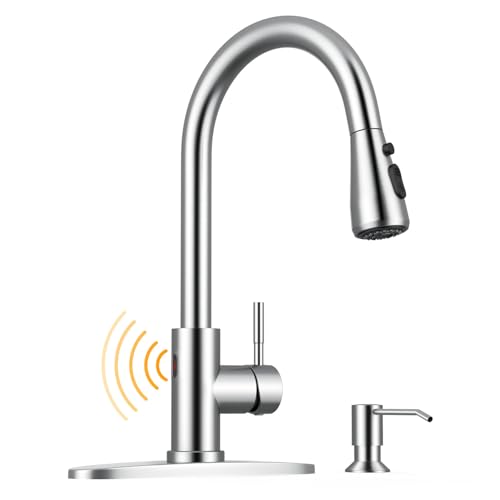
Now the value tier, entered honestly. This WEWE set pairs a sensor-activated pull-down faucet — 3-mode sprayer, 360-degree swivel, SUS 304 stainless construction, ceramic cartridge, 1- or 3-hole fit — with a matching soap dispenser, at a budget positioning (check price on Amazon) that undercuts the major brands’ sensor models decisively. WEWE is a real, coherent value brand — it maintains a product line and support channels, and its manual faucets appear in our basic guides’ orbit — which is why it, rather than an anonymous listing, carries this slot. The caveats are the class’s caveats, stated plainly: electronics support is thinner than Kohler’s or Moen’s, the sensor’s tuning is less refined (expect a learning week), and the long game — a replacement control box in year six — is a hope rather than a catalog page. It suits budget remodels, secondary sinks, rental upgrades where the owner maintains the unit, and buyers who want to trial touchless living at consumable-adjacent money.
Strengths
- Full sensor pull-down plus dispenser at a budget tier, with flexible 1- or 3-hole fit.
- SUS 304 construction and ceramic cartridge — the manual fundamentals are not faked.
- 3-mode sprayer and easy-clean nozzles match the majors’ feature checklist.
Trade-offs
- Sensor refinement and electronics parts depth trail the major brands clearly.
- Long-term support depends on a value brand’s continuity; keep the manual and model details.
- Finish and fit-and-finish are a tier below the majors on close inspection.
Bought with open eyes, this is a rational faucet: the manual plumbing underneath is sound, so even a pessimistic electronics outcome leaves you with a working pull-down whose sensor you can retire, rather than a bricked fixture. That asymmetry — decent faucet first, sensor as a bonus layer — is exactly how value-tier automatics should be judged, and it is why this set earns a recommendation while the feature-stacked anonymous units in our best-and-worst guide earn a warning.
Best for: budget touchless trials, secondary sinks, owner-maintained rentals / Not suited for: buyers who need a guaranteed ten-year electronics pipeline. Check the current price on Amazon.

OWOFAN Touchless with Temperature LED — Best Temperature Feedback
The OWOFAN’s party trick is genuinely useful at a sink: an LED indicator that reads the water temperature visually, so the hand-test — run water, dab, wait, dab again — becomes a glance. Combined with its motion sensor and pull-down format in brushed nickel, it makes a coherent pitch to households with children or elderly users, where knowing the water is safe before it touches skin is a daily concern, and to anyone who fills baby bottles, proofing bowls, or aquarium buckets at the kitchen sink. OWOFAN sits in the same value class as the WEWE above — a real product line, thinner long-term electronics support than the majors — and its spring sibling appears in our cache of verified faucets. The LED is also, honestly, the kind of feature that can age into a gimmick if its sensor drifts; the faucet underneath must carry the purchase, and here the lead-free stainless construction and single-handle manual path do that work.
Strengths
- Temperature LED gives instant, touch-free feedback — a real safety convenience for mixed-age households.
- Motion-sensor activation with a conventional manual path.
- Lead-free stainless construction claims, in the value class’s better tier.
Trade-offs
- The LED system is one more electronic component in a value-tier support ecosystem.
- Sensor polish and docking refinement trail the major brands.
- Feature-led listings in this class change revisions; verify the exact model at purchase.
Choose the OWOFAN when temperature certainty is the actual job — the nursery-adjacent kitchen, the grandparent’s sink, the baker who proofs yeast at precise warmth. For everyone else it is a pleasant extra on a competent value sensor faucet; for those households it is the feature that justifies the category.
Best for: households with children or elderly users, temperature-sensitive tasks / Not suited for: buyers prioritizing decade-scale electronics support. Check the current price on Amazon.

GIMILI Touchless Spring Faucet — Best Spring Design on a Budget
The commercial spring silhouette — exposed coil, high arc, pull-down wand on a flexible neck — is the most theatrical shape in kitchen faucets, and this GIMILI brings it to a single-hole deck with motion-sensor activation at a value positioning. It suits deep single bowls and farmhouse sinks where the spring format’s height and reach make sense, small kitchens that want one statement piece, and cooks who like the pro-style ability to swing the wand anywhere in the bowl. Single-hole installation is the simplest deck story in this guide. The value-class caveats apply in full — sensor support depth, finish refinement — and the spring format has its own: the coil collects kitchen grease and needs a cleaning habit, and the tall silhouette overwhelms shallow bowls and low cabinets. GIMILI’s manual faucets verified credibly in our research for this cluster, which is why its sensor model gets the spring slot over anonymous rivals.
Strengths
- Pro-style spring format with sensor activation, in a single-hole install.
- Excellent wand freedom for deep, wide bowls — the spring neck goes where rigid arcs cannot.
- Hands-free smart control at a value tier, from a brand with a coherent line.
Trade-offs
- Spring coil is a grease magnet; budget a cleaning routine.
- Tall format splashes in shallow bowls — match it to a deep sink.
- Value-class electronics support, as with the WEWE and OWOFAN picks.
The spring format is a commitment to a look and a way of working: the wand lives in your hand more than in its dock, rinsing becomes a directed activity, and the sink turns into a small workstation. In a deep farmhouse bowl that is a joy; in a shallow double bowl it is a splash generator. Let the sink decide — which is, after all, this entire guide’s thesis.
Best for: deep farmhouse bowls and pro-style looks on a budget / Not suited for: shallow sinks, low cabinets, or grease-averse cleaners. Check the current price on Amazon.

Kohler Graze with Konnect (K-22068-WB-VS) — Best Smart Sink Faucet
At the top of the automatic category sits the Graze: Kohler’s touchless faucet with Konnect voice control, which can turn water on and off by command and — the genuinely new capability — pour measured amounts on request, dispensing a cup or a pot’s worth without a measuring jug in your other hand. For bakers who scale recipes, households filling coffee reservoirs and pet bowls to the same line daily, and cooks whose hands are never free at the right moment, measured dispensing is not a demo trick; it is a workflow. The Graze’s conventional virtues hold too: a proper pull-down platform, Kohler valving, Vibrant Stainless finish, and a parts pipeline worthy of the price. The costs are the smart category’s: it needs power and a connected setup, the voice layer depends on your smart-home ecosystem cooperating, and the premium is the steepest in this guide — check price on Amazon and be sure the measured-pour feature maps to your actual cooking before paying for it.
Strengths
- Measured dispensing by voice — a capability no manual or merely-touchless faucet offers.
- Full touchless operation plus app and voice control layers, on a flagship Kohler platform.
- The strongest support and parts story in this guide, behind the most advanced electronics.
Trade-offs
- Requires power and smart-home setup; renters and the Wi-Fi-averse should pass.
- Premium tier — the intelligence is the price.
- More systems to maintain: firmware, connectivity, and the sensor stack.
The Graze is the pick for the kitchen that is already smart and the cook who measures. Everyone else should read its inclusion as a map of where the category is going rather than a recommendation to overspend: the Maxton and Essie above deliver ninety percent of the automatic experience — clean hands, calm sensors, sound plumbing — without asking your faucet to join the network.
Best for: smart kitchens, bakers, measured-pour workflows / Not suited for: renters, minimalists, or anyone whose router is a stranger. Check the current price on Amazon.
Comparison Table
| Pick | Badge | Key spec | Best for |
|---|---|---|---|
| Kohler Maxton Touchless | Best Overall for Standard Sinks | Touchless pull-down, dispenser included, chrome | Standard decks, first-timers |
| Moen Essie MotionSense Wave | Best Matte Black | Top wave sensor, Power Clean, Reflex | Black suites, family sinks |
| WEWE Touchless + Dispenser | Best Budget | Sensor, 3 modes, 1-or-3 hole, SUS 304 | Budget trials, second sinks |
| OWOFAN Touchless LED | Best Temperature Feedback | Motion sensor + temperature LED | Kids, elderly, bakers |
| GIMILI Touchless Spring | Best Spring on a Budget | Spring spout, sensor, single hole | Deep farmhouse bowls |
| Kohler Graze Konnect | Best Smart | Voice control, measured dispensing | Smart kitchens, bakers |
How to Choose an Automatic Faucet That Fits Your Sink
Measure the sink before you shop the sensor; this guide exists because the order matters. Start with the deck: count holes, measure the spread, and note anything already living in them — a dispenser, a filtered-water tap, an air gap for the dishwasher. Map each candidate to the deck honestly: 1-or-3-hole models with plates cover the standard patterns; the fourth hole wants a dispenser (two picks here include one) or a cap. Then measure the bowl: depth decides whether a tall or spring faucet will splash (shallow bowls want moderate arcs), and the bowl’s center decides whether the spout reach lands water in the middle or on the far rim. Farmhouse apron sinks add a third check — faucet placement behind a wide apron can push the spout’s landing point short of the bowl’s center, which is a daily annoyance no sensor can fix.
Next, the cabinet audit, which automatic faucets make mandatory. The control box needs a mounting spot on a cabinet wall; the battery pack needs to live within your reach; the pull-down hose needs its loop; and if the model is AC-powered, a constant (unswitched) outlet must exist or be added — the disposal’s switched outlet does not count. Photograph the cabinet, measure the clear wall patch, and count the competing tenants (disposal, RO system, water softener plumbing) before ordering. Finally, the splash test of the imagination: picture your tallest pot under the arc, your shallowest rinse in the bowl, and a child standing on a stool at the sensor. The right pick survives all three pictures.
Sensor choice, when fit allows more than one, follows the household logic of our automatic guide: wave for calm, presence for workstation cooking, budget sensors for trials and second sinks, voice for the measured and the connected. But note how far down this list the sensor came — that is the correct priority order for a purchase that begins, as this search does, at the sink.
How to Retrofit an Automatic Faucet onto an Existing Sink
Most retrofits are straightforward swaps with two extra steps. Remove the old faucet and clean the deck to bare surface — automatic faucets often reuse the same holes, and old putty ridges are the top cause of both leaks and crooked sensor alignment. Dry-fit the new unit and check three alignments before tightening: handle swing against the backsplash, sensor window unobstructed by the spout’s own arc or a window frame behind, and deck plate coverage of every legacy hole. Mount the control box early, while the cabinet is empty of the new plumbing, on the wall patch you identified in your audit; route sensor and power cables in their own path, never lashed to the pull-down hose, whose movement will chafe anything attached to it.
Connect water last, flush the lines with the aerator removed, then power the electronics and calibrate at the sink with your real cookware — dark pans, glass, steel — at your real working heights. Run a full evening’s routine through it before declaring victory: fill, rinse, wash, wipe down. Retrofits fail socially, not mechanically — a household that was not briefed will fight the sensor for a week — so end the install with the one-minute lesson: the gesture, the temperature default, and the manual fallback with the power off. Write the battery date on the pack with a marker while you are under there; future you sends thanks.
Sensor Placement and Splash Geometry at Real Sinks
Because this search begins at the sink, it deserves the geometry lesson the glossy guides skip. A faucet’s stream leaves the spout at a height and lands at a distance set by the arc’s reach; the bowl must be deep enough, at that landing point, to absorb the stream’s energy without rebound. The rule of thumb installers use — spout height above the bowl floor versus bowl depth — explains most splash complaints: a tall arc over a shallow bowl lands water with energy the bowl cannot contain, and the counter pays. Automatic faucets add one variable: the sensor’s zone sits in the same space as the stream’s path, so a dish parked in the zone holds the water on. In a deep bowl that is a feature — hands-free rinsing of the parked dish. In a shallow bowl it is a sprinkler with an audience. This is why the GIMILI spring pick is fenced to deep farmhouse bowls and why the Maxton and Essie, with their standard-kitchen proportions, are the default recommendations for standard sinks: their geometry was designed around the bowls most houses actually have.
Reach deserves the same realism. Measure from the faucet’s mounting center to the bowl’s drain center: the spout reach should land the stream at or slightly behind the drain for comfortable washing. Apron-front sinks push the faucet back and eat reach; thick stone backsplashes do the same. If your measurement comes up short, no sensor quality compensates — the water lands on the near slope, dishes crowd the back of the bowl, and rinsing becomes a juggling act. Choose a longer-reach model or accept a deck-mounted position adjustment at install. Conversely, a very long reach over a small bowl parks the stream against the far wall of the sink, which is its own splash pattern. Fit is a matching exercise in both directions, and the tape measure is the whole method.
Power Routing Under Real Cabinets
The under-sink cabinet of a real kitchen contains a disposal, a dishwasher line, an RO system in many homes, a small chemical warehouse, and — in the automatic era — your faucet’s brain. Route for the reality. The control box mounts high on a side wall, above the flood line of any plausible leak and clear of the disposal’s vibration, which loosens what it touches over months. Cables run in gentle loops with drip discipline: any cable that dips below its connections can conduct a leak’s water along its length, so keep the low point of every loop above the cabinet floor and the connections at the top of the loop. The battery pack deserves a dedicated, labeled spot at the cabinet’s front edge — not because it is elegant, but because the person changing it will be kneeling, in a hurry, with a flashlight in their teeth.
If your cabinet hosts an RO system, plan the faucet’s hose loop and the RO’s tubing as neighbors from the start: the pull-down hose’s weight needs a clear vertical fall, and RO tanks are exactly the size and shape to steal it. A hose that rests against a tank retracts halfway and docks weakly, which owners misdiagnose as a faucet defect for years. Shift the tank, guide the hose, or choose a model whose weight path can be routed to the cabinet’s other side. These are ten-minute decisions during installation and ten-month annoyances if skipped — the difference between an automatic faucet that feels factory-fitted and one that feels like a science project is almost entirely this cabinet choreography.
Budget Tiers for Automatic Sink Faucets, in Plain Terms
We never print static prices, so the ladder in words: the value tier (WEWE, OWOFAN, GIMILI here) buys a sound manual faucet with a sensor layer whose long-term support is the gamble. The middle tier (Maxton) buys a major brand’s sensor and parts pipeline on a conventional platform. The upper tier (Essie Wave, and the flagships in our automatic guide) buys better faucets under the electronics — docking, spray technology, finishes. The smart tier (Graze) buys capabilities, not just activation. Allocate by expected tenure: a sink you will keep for a decade deserves the middle tier at least, because the electronics’ second half of life is where the tiers separate; a trial, a rental you maintain, or a second sink can honestly live at the value tier. Check price on Amazon for the current numbers at each rung before deciding.
Common Buying Mistakes
- Shopping the sensor before measuring the sink. Deck pattern, bowl depth, and cabinet space eliminate more models than any feature comparison.
- Buying the manual version by mistake. Sensor and non-sensor variants share photos and near-identical names; the title must name the sensor system. Verify the suffix.
- Putting a spring or tall-arc faucet over a shallow bowl. Height plus shallow depth equals a permanently wet counter.
- Stranding the battery pack behind the RO tank. Mount it where a human hand can reach in year two, in the dark, holding batteries.
- Assuming the disposal outlet powers an AC model. It is switched and shared; AC faucets need constant power.
- Expecting value-tier electronics to have flagship support. The WEWE, OWOFAN, and GIMILI picks are honest value — buy them for the faucet underneath, with the sensor as a bonus layer.
Automatic Faucets on Farmhouse, Bar, and Utility Sinks
The main kitchen sink is not the only sink, and the fit logic travels. On a farmhouse apron sink, the winning combination is reach plus restraint: a spout long enough to land past the apron’s setback, an arc tall enough for canning pots, and a sensor zone that does not fire every time someone leans on the apron front — top-sensor (Wave) and lever-managed (Maxton) systems behave best here, and the spring format earns its keep in the deep bowl. On a bar or prep sink, the automatic case is weaker and should be argued honestly: a small second sink used for ice and rinsing gains little from a sensor, and the money is usually better spent on the main sink’s faucet — unless the bar sink serves a household member whose mobility makes hands-free water a genuine aid, in which case a compact value-tier sensor is a kind purchase. Utility and laundry sinks sit between: hands are often genuinely filthy there (garden, garage, paint), which is the sensor’s best argument, but the environment is rough on electronics and the faucet is often a consumable by design. If you automate the utility sink, choose the value tier, mount the control box high and dry, and keep expectations calibrated.
One cross-sink warning: sensor faucets multiply battery schedules. A household with three automatic faucets has three packs on three clocks, and the one that dies will be the one over the sink you need that morning. Standardize brands where you can — the same batteries, the same gestures, the same fallback logic — and keep a single kitchen drawer kit with spares for all of them. The convenience of automatic water is real, but it is a small system, and systems reward a little administration.
What Renters and Landlords Should Know About Automatic Sink Faucets
Automatic faucets cross property lines in ways manual ones do not, so a short word for both sides of the lease. Renters: a battery-powered, single-hole automatic faucet with a deck plate is one of the most reversible upgrades in a kitchen — it installs on the existing holes, needs no electrician, and the original faucet can be reinstalled at move-out in under an hour, provided you keep it, its hardware, and a note of how it was plumbed. Keep the landlord’s written permission anyway; a faucet is plumbing, and plumbing is the lease’s business. Choose from the battery models here — the Maxton, the Essie Wave, or the value tier — and skip AC and smart models, whose outlet and network requirements make them poor guests in someone else’s property.
Landlords: the calculus from our automatic guide holds — tenants will not maintain your sensor’s batteries or learn its moods, and the service call is yours. If the unit’s rent supports the feature, standardize on one battery model across properties, keep a spare control box and a battery schedule with the property records, and write the one-minute household briefing into the move-in packet, fallback included. If the rent does not support it, a quality manual faucet from our basic guide is the professional choice, and nobody’s tenancy was ever lost over a good manual faucet. Either way, the deck and cabinet measurements in this guide are the landlord’s friend: a faucet that fits the existing holes is a faucet that does not generate a plumbing bill at turnover.
Final Recommendation
For the standard American sink, buy the Kohler Maxton Touchless and enjoy the quiet life. Matte black suites take the Moen Essie Wave; budget trials take the WEWE set; temperature-anxious households take the OWOFAN; deep farmhouse bowls take the GIMILI spring; and connected kitchens take the Kohler Graze. Keep exploring the cluster: Best Automatic Kitchen Faucets, Best Basic Kitchen Faucets, Best American Standard Kitchen Faucets, Best And Worst Kitchen Faucets, Best Bar Style Kitchen Faucets.
Frequently Asked Questions
What if my sink is a wall-mount or widespread deck?
Then the automatic category largely passes you by, and honesty requires saying so: sensor faucets are overwhelmingly single-hole and 1-or-3-hole designs, because that is where the market and the control-box geometry live. Widespread 8-inch decks can sometimes host a single-hole automatic on a large deck plate, but the result covers holes rather than honoring the pattern, and purists will see it. Wall-mount sinks have no mainstream automatic option at all. For those sinks, the right purchase is a quality manual faucet — our antique and American-made guides cover the wall-mount and widespread cases — possibly paired with an under-sink sensor adapter as an experiment, with the adapter’s limits understood from the start.
How long does installation take compared with a manual faucet?
Budget roughly half again the manual time: the deck and water work is identical, and the addition is control-box mounting, cable routing, power, and calibration — thirty to forty-five unhurried minutes on a first install, less the second time. The calibration step is the one not to skip: five minutes testing the sensor against your own pots and hands at working heights prevents the week of household complaints that gives the category a bad name. Total for a prepared DIYer: an afternoon, including the briefing of the household, which counts as part of the installation.
Does a touchless faucet need a special sink or countertop material?
No. The sensor lives in the faucet, not the sink, so stainless, fireclay, cast iron, composite, and stone installations are all equally compatible; the material questions are the manual ones — deck thickness at the mounting hole, and whether the counter’s underside gives the mounting hardware and control box a clean home. One material nuance deserves a mention: highly reflective polished-metal sinks can bounce an infrared sensor’s signal in ways that slightly widen its effective zone, which a day of calibration absorbs. Beyond that, if a manual faucet fits your sink, its automatic counterpart almost certainly does too.
Will an automatic faucet fit my existing sink holes?
Usually, yes. Most automatic kitchen faucets are single-hole designs sold with a deck plate that covers the standard 3-hole pattern, and several picks here fit 1-or-3-hole decks natively. A fourth hole can host the included soap dispenser (Maxton, WEWE) or a cap. The patterns that need planning are 8-inch widespread decks and wall-mount sinks, which automatic models rarely serve; measure your deck first, as this guide’s buying section details.
Do I need an electrician to install an automatic kitchen sink faucet?
Not for battery-powered models — the majority here — which install like manual faucets plus a battery pack. AC-powered models need a constant-power outlet under the sink; if one is not present (the disposal’s switched outlet does not qualify), an electrician’s visit to add a receptacle is the correct move. The smart Graze additionally assumes your home network reaches the kitchen reliably.
Why does this guide include budget sensor faucets if support is thinner?
Because the honest alternative — pretending the value tier does not exist — sends budget buyers to anonymous listings with no support at all. The WEWE, OWOFAN, and GIMILI picks are real product lines whose manual plumbing is sound, so the worst realistic outcome is a good faucet whose sensor retires early, not a dead fixture. We state the trade-off in each review and steer ten-year buyers to Kohler and Moen.
Can an automatic faucet splash more than a manual one?
The faucet’s arc and the bowl’s depth decide splashing, not the sensor — with one exception: a sensor that starts water the instant a dish enters its zone can catch an empty, shallow bowl at full stream before you position the dish. Presence-zone models reward a beat of placement discipline. Match arc height to bowl depth as the buying guide describes, and an automatic faucet splashes exactly as much as its manual twin.
What should I do with my old faucet’s extra deck hole?
Give it a job: two picks here include a soap dispenser sized for the standard fourth hole. Alternatives are a filtered-water tap, a dishwasher air gap where code requires one, or a simple color-matched hole cover. What not to do is leave it open — an uncovered deck hole is a leak path straight into the cabinet, and it will find the one week you are on vacation to prove it.
My under-sink cabinet is packed. Can I still install one?
Usually, with choreography. The control box needs a palm-sized patch of cabinet wall and the battery pack a reachable corner; the pull-down hose needs one clear vertical channel for its weight. A cabinet with a disposal alone is fine. A cabinet with a disposal, an RO tank, and a pull-out trash system may require moving the RO tank a few inches or routing the hose to the other side — ten minutes of rearrangement, best done while the old faucet is already out. If literally no wall patch exists, choose a model whose control box can mount to the cabinet floor’s raised back edge per its manual, or reconsider: a sensor faucet whose brain is buried will be hated at the first battery change.
Does the sensor work with a deep farmhouse sink?
Yes — deep bowls are the sensor’s friend, because dishes sit low in the bowl, below the rim, inside a well-defined zone, and splashing is contained by the depth. The checks that matter are reach (the spout must land water past the apron setback, near the drain) and zone behavior (a top-sensor or lever-managed system avoids false triggers from leaning on the apron). The GIMILI spring and the Essie Wave in this guide are the farmhouse-friendly picks; measure the setback before ordering anything.
How do I know if a listing is really the touchless version?
Read the title like a contract: it must name the sensor system or say touchless/sensor explicitly — MotionSense Wave, Response, Touchless Activation, Motion Sensor. Manufacturers sell the same body in manual form under a near-identical name, and marketplace photos are often shared between variants. Every pick in this guide was verified by exact title match for precisely this reason; apply the same suspicion to any model you add to the shortlist.


