Disclosure: airfryerkitchensupply.com is reader-supported. When you buy through links on our site, we may earn an affiliate commission at no extra cost to you.
Where to buy
Every pick in this guide to the best all steel kitchen faucets was verified against Amazon’s catalogue data at research time, and every one is a stainless steel faucet — SUS 304 construction confirmed in the verified listings, not inferred from a silver finish. Use the links to check the current price on Amazon, and confirm your sink’s hole pattern against each review before ordering; most of these fit 1- or 3-hole decks with an included plate.
- WEWE Pull-Down Kitchen Faucet, 15.7-Inch — Check on Amazon
- FORIOUS Kitchen Faucet with Pull Down Sprayer — Check on Amazon
- OWOFAN Kitchen Faucet with Pull Down Sprayer, Spring Design — Check on Amazon
- VAPSINT Kitchen Faucet with Pull Down Sprayer — Check on Amazon
- FEELSO Kitchen Faucet with Pull Down Sprayer — Check on Amazon
- LUFG Kitchen Faucet with Pull Down Sprayer and Deck Plate — Check on Amazon
The best all steel kitchen faucets share one defining virtue: with stainless steel, the finish is not a coating on the faucet — it is the faucet. There is no plated layer to chip, no painted surface to peel, and no mystery alloy underneath waiting to corrode where the finish fails. A 304-grade stainless faucet that is scratched can be re-grained; one that is neglected for a year can be cleaned back to honesty in an afternoon. For buyers whose previous faucet died by its surface, that is not a detail. It is the entire argument.
This guide selected strictly: every pick’s verified listing confirms SUS 304 stainless steel construction — the food-grade alloy the commercial kitchen world standardised on — paired with a ceramic cartridge. What the guide did not do is pretend steel is the whole story. Stainless faucets still use polymer supply-line cores, aerators and silicone spray nozzles, because those parts must flex or shed scale; and steel has its own honest weaknesses, covered in the reviews, including fingerprints on un-treated surfaces and a cooler, crisper feel than brass.
The six picks span the stainless market’s real range: three versatile pull-downs at value-to-mid tiers, a spring-design model, a tall-arc option and the most thoroughly certified faucet in the set. If your brief is ‘steel, verified, once’, it is below.
In this guide
Quick Picks
Six verified SUS 304 faucets. They divide on height, spray design and certification depth — not on material, which is the point.
- WEWE Pull-Down Kitchen Faucet, 15.7-Inch — Best Overall All-Steel: SUS 304 construction, a ceramic cartridge, three spray modes and tool-free installation at a mid-value tier — the stainless default recommendation. — Check on Amazon
- FORIOUS Kitchen Faucet with Pull Down Sprayer — Best Budget All-Steel: SUS304 construction, ceramic cartridge, three modes and a deck plate for 1- or 3-hole sinks — the lowest-cost route into verified steel. — Check on Amazon
- OWOFAN Kitchen Faucet with Pull Down Sprayer, Spring Design — Best Spring-Design Steel: Lead-free NSF-certified stainless in a commercial spring format, with dual spray modes and a deck plate for 1- or 3-hole sinks. — Check on Amazon
- VAPSINT Kitchen Faucet with Pull Down Sprayer — Best Certified Value: 304 stainless, lead-free NSF certification, three spray modes and an 18-inch retractable hose, with DOE/CEC certification on the listing. — Check on Amazon
- FEELSO Kitchen Faucet with Pull Down Sprayer — Best Tall-Arc Steel: A 16.38-inch high-arc in lead-free NSF-certified SUS304, with three modes and a 20-inch hose — the tall steel option for deep sinks. — Check on Amazon
- LUFG Kitchen Faucet with Pull Down Sprayer and Deck Plate — Best Certification Depth: SUS 304 construction carrying the full certification set — NSF/ANSI 372, NSF 61 and cUPC — with three modes, a swivel spout and a deck plate. — Check on Amazon
How These Picks Were Chosen
The catalogue was filtered by a single hard rule: the verified listing had to state SUS 304 stainless steel construction explicitly. Finishes described merely as ‘stainless look’ or ‘brushed nickel’ over an unnamed body were excluded, however attractive, because an all-steel guide that guesses at bodies is worthless. Ceramic cartridges were required alongside, since a permanent body deserves a serviceable valve.
Survivors were then judged on the working virtues — spray modes, hose reach, docking behaviour, hole fit and certification depth, where NSF and cUPC marks were read as the quality signals they are. The result is a shortlist with an unusual property for this category: the budget end and the premium end are made of the same honest material, so the reviews can spend their words on design and execution, where the real differences live.
The 6 Best All Steel Kitchen Faucets, Reviewed in Depth

WEWE Pull-Down Kitchen Faucet, 15.7-Inch — Best Overall All-Steel
This WEWE model is the stainless default: SUS 304 construction confirmed in the verified listing, a ceramic cartridge, three spray modes, easy-clean nozzles and braided 304 supply hoses — a detail most listings do not even specify. At 15.7 inches it sits in the versatile height band, its flow is the standard 1.8 GPM class with the listings to prove it, and the brand promises a tool-free installation that owner reports broadly support. One honest flag: this configuration is 1-hole fit with no deck plate included, so multi-hole sinks need a plan.
Strengths
- Confirmed SUS 304 body and braided 304 supply hoses
- Ceramic cartridge, 3-mode sprayer, easy-clean nozzles
- Certified flow class (CEC listed 1.8 GPM, cUPC, NSF 61 & 372 per listing data)
Trade-offs
- 1-hole fit, no deck plate included — check your sink first
- Docking finesse a class below flagship brands
- Brushed finish shows water marks without spot-resistant treatment
Key specs: SUS 304, height 15.7 in, 1.8 GPM, ceramic cartridge, 3 modes, 1-hole fit (per verified listing data)
The specification reads like a checklist written by someone who has read faucet failure reports: the right alloy, the right cartridge, hoses specified rather than assumed, certifications named rather than implied. In daily use the three spray modes cover the real work — stream for filling, spray for rinsing, and a pause that saves the dash across the sink with a running wand — and the nozzles rub clean of scale with a fingertip, which in hard-water homes is a weekly mercy.
The 1-hole caveat is the one genuine gate. On a single-hole sink or a counter drilled for it, this is the easiest strong recommendation in the guide. On a 3-hole sink you will be sourcing a plate or accepting covers, and the FORIOUS below — same material family, plate included — becomes the smarter buy. Steel buyers tend to be measurers by temperament; measure the deck, and if it fits, buy with confidence.
Best for: single-hole sinks wanting verified steel at a fair tier / Not suited for: 3-hole sinks unwilling to source a deck plate
Check on Amazon — check the current price on Amazon before ordering, and confirm the configuration matches what is described here.

FORIOUS Kitchen Faucet with Pull Down Sprayer — Best Budget All-Steel
The FORIOUS is the budget steel benchmark, and its verified specification is why: SUS304 stainless construction, a ceramic cartridge, 1.8 GPM flow, three spray modes with pause, an 18-inch hose and certification to NSF/ANSI/CAN 61. It includes the deck plate its WEWE rival omits, fitting 1- or 3-hole sinks out of the box, and its maker markets it — accurately — from farmhouse kitchens to campers and laundry rooms, anywhere an honest steel faucet is wanted without ceremony.
Strengths
- Verified SUS304 at the guide’s friendliest tier
- Deck plate included for 1- or 3-hole sinks
- 3 modes, 18-in hose, recognised certifications
Trade-offs
- Wand and docking feel are value-class
- Brand support horizon shorter than legacy makers’
- Finish is brushed steel without spot-resistant treatment
Key specs: SUS304, height 14.76 in, spout height 6.69 in, 1.8 GPM, ceramic cartridge, 3 modes (per verified listing data)
Steel on a budget usually means a rumour of steel; here the listing commits to the alloy, the cartridge type and the standards, which is what allows this guide to recommend it without asterisks. The living experience is a class below the flagships in the small tactile ways — the dock’s final seat, the handle’s damping — and entirely their equal in the ways that involve water: flow, spray coverage, and a body that will not corrode, peel or embarrass itself in year five.
Its versatility list is a genuine second argument. The same faucet that serves a farmhouse kitchen serves the laundry tub, the bar sink and the RV galley, because steel does not care which room it is in and the format fits them all. For second sinks and sane budgets, this is the steel pick; for a forever kitchen’s main sink, the refinement gap may argue for spending up within this guide.
Best for: budgets, 3-hole sinks, laundry/bar/RV and second sinks / Not suited for: buyers wanting flagship tactile refinement
Check on Amazon — check the current price on Amazon before ordering, and confirm the configuration matches what is described here.

OWOFAN Kitchen Faucet with Pull Down Sprayer, Spring Design — Best Spring-Design Steel
The OWOFAN is the steel guide’s athlete: a spring-design pull-down in lead-free, NSF-certified stainless steel, whose wand travels with a freedom no fixed-arc faucet matches. The verified listing adds the substance behind the silhouette — a ceramic cartridge tested across half a million cycles, dual spray modes from gentle stream to high-pressure, and a deck plate covering 1- or 3-hole decks. For cooks who rinse sheet pans and fill pots beside the sink, the format is a revelation.
Strengths
- Stainless, lead-free and NSF certified
- Spring wand reach exceeds any fixed-arc pick here
- Serious cartridge cycle testing
Trade-offs
- Commercial styling is not for every kitchen
- Needs clearance for the spring’s working arc
- Value-brand long-term support versus legacy makers
Key specs: Stainless steel (lead-free, NSF certified), height 16 in, 1 or 3-hole with plate, dual-mode spray, ceramic cartridge (per verified listing data)
The spring format’s virtue is geometric: the wand is a tool on a tether rather than a fixture on a pivot, so it reaches the far corner of a farm sink, the pot on the adjacent counter and the bucket on the floor with equal indifference. In stainless, the assembly avoids the cheap spring faucets’ signature failure — a wand perch that loosens into a permanent dangle — provided the dock is used as designed and the spring is not treated as a handle.
Clearance and taste are the gates. The spring needs air to work in, and its industrial honesty suits some kitchens and fights others. Where it fits — literally and aesthetically — it is the most capable steel faucet in this guide, and the one working cooks will defend at parties.
Best for: farmhouse sinks, keen cooks, commercial-style kitchens / Not suited for: low-clearance or traditional-look installations
Check on Amazon — check the current price on Amazon before ordering, and confirm the configuration matches what is described here.

VAPSINT Kitchen Faucet with Pull Down Sprayer — Best Certified Value
VAPSINT’s pull-down competes on paperwork as much as plumbing: 304 stainless steel construction, lead-free NSF certification, and DOE/CEC certification noted in the verified listing data — the compliance profile of a faucet taking the standards seriously at a value tier. Three spray modes and an 18-inch retractable hose cover the working brief, and the 1-to-3-hole fit with its deck arrangement suits the farmhouse, RV, laundry and bar settings its maker names.
Strengths
- 304 stainless with lead-free NSF certification
- DOE/CEC certification noted — efficiency taken seriously
- 3 modes and 18-in retractable hose
Trade-offs
- No verified overall height in the listing data — measure on arrival against your clearance
- Value-tier tactile refinement
- Support horizon is the usual value-brand caveat
Key specs: 304 stainless steel, 1.8 GPM class, 3-mode sprayer, 18-in retractable hose, 1 to 3-hole (per verified listing data)
Certifications are the least glamorous and most honest language in this category: they mean an outside body tested the waterway’s lead content and the faucet’s efficiency claims, which matters most in exactly the settings this faucet targets — rental properties, RVs and second homes where the buyer is also, in effect, a small landlord of the water supply. The VAPSINT assembles those credentials at a price that makes compliance the default rather than the upgrade.
The missing verified height is handled the way this guide handles every gap: stated, not filled. Check the delivered dimensions against your space before installation day. Buyers who value tested-and-certified over tall-and-specified will find this the most reassuring value pick in the steel set.
Best for: rentals, RVs and buyers who shop by certification / Not suited for: buyers needing a confirmed tall-arc dimension in advance
Check on Amazon — check the current price on Amazon before ordering, and confirm the configuration matches what is described here.

FEELSO Kitchen Faucet with Pull Down Sprayer — Best Tall-Arc Steel
FEELSO’s entry is the tall traditionalist of the steel set: a 16.38-inch high arc in SUS304 stainless, lead-free and NSF certified per the verified listing, with three spray modes and a 20-inch pull-down hose. Where the OWOFAN achieves reach through its spring, the FEELSO achieves it through stature — the classic high-arc answer for deep farmhouse bowls and the tallest stockpots, in a silhouette that suits the kitchens that have them.
Strengths
- Tallest verified arc in this guide at 16.38 in
- SUS304, lead-free, NSF certified
- 20-in hose extends the tall arc’s usefulness
Trade-offs
- Tall arcs splash shallow sinks — pair it with depth
- Value-tier brand support
- High arc needs cabinet and window clearance checks
Key specs: SUS304, height 16.38 in, 3 modes, 20-in hose, 1 or 3-hole, CEC listed (per verified listing data)
Height is a pairing decision, and the FEELSO makes the pairing explicit: over a deep single bowl it is magnificent, giving the wand a high home and the pot room to live under it; over a shallow double it will decorate the counter with spray. The 20-inch hose compounds the advantage where the pairing is right, reaching across wide farmhouse bowls that defeat standard wands.
Construction and certification match the guide’s standard — the correct alloy, the correct cartridge class, the paperwork in order — so the decision reduces to geometry and taste. Deep-sink households wanting steel in a classic profile have found their pick; everyone else should take the compliment of its height as a warning and choose a lower arc.
Best for: deep farmhouse and single-bowl sinks / Not suited for: shallow sinks or low-clearance installations
Check on Amazon — check the current price on Amazon before ordering, and confirm the configuration matches what is described here.
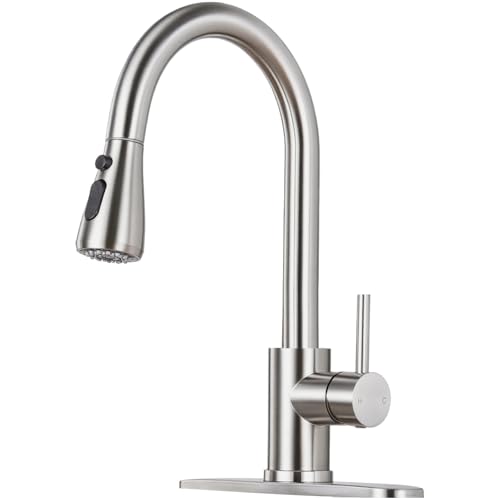
LUFG Kitchen Faucet with Pull Down Sprayer and Deck Plate — Best Certification Depth
The LUFG closes the guide with the deepest certification file of the set: its verified listing names NSF/ANSI 372 (the lead-content standard), NSF 61 (drinking-water system components) and cUPC alongside the SUS 304 construction — the complete paperwork portfolio a cautious buyer, a landlord or a code-conscious renovator could ask for. Three spray modes, a 360-degree swivel spout, an 18-inch hose and an included deck plate complete a specification with no obvious box unticked.
Strengths
- Full certification set: NSF372, NSF61 and cUPC
- SUS 304 construction with deck plate included
- 360° swivel and 3 modes cover the working brief
Trade-offs
- No verified height in the listing data — confirm on delivery
- Value-tier brand and tactile class
- Certification depth exceeds most households’ needs — a virtue with a price of zero regrets
Key specs: SUS 304, 3 spray modes, 360° swivel, 18-in hose, 1 or 3-hole with plate, NSF372/NSF61/cUPC (per verified listing data)
There is a buyer this faucet was made for: the one who reads standards for a living, fits out rentals, or simply believes that water deserves paperwork. For that buyer the LUFG is not the sixth pick in this guide but the first, because its certifications answer questions the other listings leave open. For everyone else it remains a thoroughly specified steel faucet whose extra diligence costs nothing in daily use.
As with the VAPSINT, the unverified height is stated rather than invented — plan the installation check accordingly. What is verified is the material and the testing, and in an all-steel guide those are the headline facts. Buy it for the paperwork, keep it for the steel.
Best for: landlords, code-conscious renovators and certification-first buyers / Not suited for: buyers needing a confirmed height before ordering
Check on Amazon — check the current price on Amazon before ordering, and confirm the configuration matches what is described here.
Comparison Table
Same alloy throughout — so the table compares what actually differs: height, format, fit and certification depth.
| Pick | Badge | Key spec | Best for |
|---|---|---|---|
| WEWE Pull-Down Kitchen Faucet, 15.7-Inch | Best Overall All-Steel | SUS 304, 15.7 in, 1-hole | single-hole sinks wanting verified steel at a fair tier |
| FORIOUS Kitchen Faucet with Pull Down Sprayer | Best Budget All-Steel | SUS304, 14.76 in, plate incl. | budgets, 3-hole sinks, laundry/bar/RV and second sinks |
| OWOFAN Kitchen Faucet with Pull Down Sprayer, Spring Design | Best Spring-Design Steel | Stainless, 16 in, spring design | farmhouse sinks, keen cooks, commercial-style kitchens |
| VAPSINT Kitchen Faucet with Pull Down Sprayer | Best Certified Value | 304 SS, NSF lead-free, 3 modes | rentals, RVs and buyers who shop by certification |
| FEELSO Kitchen Faucet with Pull Down Sprayer | Best Tall-Arc Steel | SUS304, 16.38 in, 20-in hose | deep farmhouse and single-bowl sinks |
| LUFG Kitchen Faucet with Pull Down Sprayer and Deck Plate | Best Certification Depth | SUS 304, NSF372/61 + cUPC | landlords, code-conscious renovators and certification-first buyers |
How to Choose an All Steel Kitchen Faucet
With material settled, choose on geometry. Height first: match the arc to your sink’s depth — tall arcs (the FEELSO class) over deep bowls, moderate arcs (the WEWE and FORIOUS class) over standard sinks — and check the cabinet and window clearance above the deck. Fit second: count your holes and confirm the deck plate story, because the best steel faucet in this guide is 1-hole only and the second-best includes its plate; the wrong assumption here is the category’s commonest return. Format third: fixed arc for classic kitchens, spring design for cooks who use the wand as a tool.
Then read the certifications as a quality shortcut. NSF 61 and 372 speak to the waterway’s safety, cUPC to code compliance, and CEC or DOE listings to tested efficiency — a value brand carrying the full set, like the LUFG here, is telling you something good about its factory. Finally, the steel-specific checks: confirm the listing says 304 (or 18/8, 18/10) rather than merely ‘stainless’, because 200-series stainless exists, costs less and corrodes more; and plan for fingerprints, which plain brushed steel shows honestly and a soft cloth answers in seconds.
Living With Stainless: Care, Fingerprints and Honest Weaknesses
Stainless steel’s care routine is short and specific. Wipe with the grain, not across it, using a soft cloth; clean with mild soap or a dedicated stainless cleaner; and treat limescale early with a gentle descaler so it never graduates to abrasion. Fingerprints are the alloy’s famous weakness — real, visible, and answered by the same ten-second wipe; buyers who know they will never wipe should choose a spot-resistant finished faucet from our all-around guide instead, in full knowledge that they are trading steel’s permanence for a coating’s convenience.
What steel never asks for is refinishing. It does not chip, peel or blister, it tolerates the chemicals of a real kitchen, and a decade of scratches can be blended back with a re-graining pad — the only faucet finish that can be restored rather than replaced. That permanence is the proposition: not the prettiest finish on delivery day, but the same finish, essentially forever. Households that value the second sentence over the first are this guide’s readers, and they will not be disappointed.
How to Install a Stainless Pull-Down Faucet
The standard pull-down sequence applies, with steel-specific care at the deck and the finish. Keep tools padded and hands clean — the first fingerprints are a rite of passage, not a defect.
- Shut off both supplies, drain and remove the old faucet, and clean the deck completely — old sealant ridges will rock a new faucet and break its seal.
- Confirm the hole pattern against the new faucet and its deck plate before anything is opened fully; steel faucets reward the measurer.
- Seat the faucet with its gasket as directed, supporting its weight while the mounting hardware is tightened evenly from below.
- Connect the supply lines to the correct inlets, checking that braided lines are not kinked, and route the sprayer hose in a free loop with its weight unobstructed.
- Verify the wand docks, retracts and swivels through its full arc without the hose snagging on valves or pipework.
- Restore water slowly, inspect every joint with a dry hand through all spray modes and temperatures, and flush the aerator and nozzles.
- Finish with a soft-cloth wipe along the grain — and keep that cloth under the sink, because it is now part of the faucet’s household.
On stone and composite decks, follow the faucet maker’s sealing guidance exactly and never overtighten mounting hardware against a brittle counter — steel faucets are heavy, and even, moderate torque is the specification, not a challenge.
Common Buying Mistakes
Assuming ‘stainless finish’ means a steel body. A stainless-look coating over an unnamed alloy is the category’s oldest trick. This guide required the listing to state SUS 304 construction — so should you.
Buying 200-series steel unknowingly. Cheaper stainless grades corrode faster in kitchen chemistry. The grade — 304 — is the specification that matters, and honest listings state it.
Pairing a tall arc with a shallow sink. Steel or not, geometry is geometry: height over shallowness means splash. Match the arc to the bowl.
Cleaning across the grain with abrasives. Stainless shows scratches in the direction you make them. Soft cloth, with the grain, gentle cleaners — forever.
Forgetting the deck plate question. One of this guide’s best faucets is 1-hole only. Count the holes before the box is opened, not after.
304 vs 316 vs 200-Series: A Stainless Buyer’s Field Guide
Stainless is a family, not a material, and the grade decides the decade. 304 — the grade every pick in this guide carries — balances chromium and nickel for excellent corrosion resistance in kitchen conditions and is the world’s default for food equipment. 316 adds molybdenum for harsher, saltier environments; it is superb and, in kitchen faucets, rarely necessary or offered. The 200-series substitutes manganese for nickel to cut cost, and pays for it with measurably weaker corrosion resistance — the grade behind most ‘stainless’ faucet disappointment stories.
The practical rule is one sentence long: if the listing does not name the grade, assume it is not 304. Every pick here names it, which is not a coincidence but the selection criterion. A faucet is a water appliance that lives wet for fifteen years; the grade of its steel is as fundamental as the engine metal in a car, and it deserves the same refusal to accept vagueness.
Steel Bodies and the Parts That Are Not Steel
Completeness requires the same honesty this site applies in its all-metal guide: a stainless faucet’s body, spout and handle are the steel you are buying, while its supply-line cores, aerator, spray-face nozzles and internal seals use engineered polymers and silicone, because those jobs require flex, replaceability or scale-shedding softness. The cartridge — the part that wears — is ceramic in every pick here, which is a harder and longer-wearing valve material than any steel.
Judge the construction by consequence, as always: the steel body is the part whose failure ends the faucet’s life and whose corrosion would flavour your water, and it is exactly the part this guide verified. The polymer supporting cast is replaceable, standardised and, in the certified picks, tested for drinking-water safety. That division of labour is not a compromise of the all-steel idea; it is what the idea looks like when engineers rather than advertisers define it.
Stainless Steel and Kitchen Hygiene
There is a reason commercial kitchens are surfaced in stainless steel, and it transfers directly to the faucet: the alloy’s surface is non-porous, so it gives bacteria and grime nowhere to live, and it tolerates the cleaning chemistry that porous or coated surfaces cannot. A stainless faucet can be wiped down with the same confidence as the sink it serves, and its waterway — in the certified picks here, tested to drinking-water standards — presents the same honest surface to your water as a commercial line does.
Hygiene also has a maintenance dimension owners control: the aerator and spray face are the faucet’s mouth, and they collect the kitchen’s aerosols and the water’s minerals impartially. The rub-clean nozzles and removable aerators across this guide’s picks exist so that the mouth can be kept as clean as the body promises. A monthly rinse and an occasional descale keep the whole system at the standard the material sets — a small ritual with an outsized effect on taste as well as cleanliness.
Pairing a Steel Faucet With Sinks, Counters and Appliances
Stainless faucets enjoy one design superpower: they match the sink. A stainless faucet over a stainless sink reads as a single considered object, and over farmhouse aprons, undermount bowls and commercial-style troughs it is effectively the house style. Against other surfaces the pairing logic is equally simple — brushed steel sits comfortably with stone, composite and butcher block, and its neutrality lets the counter or the cabinetry carry the room’s personality while the faucet stays in the working class where it belongs.
The cautions are about sheen discipline. Mixing a bright polished steel faucet with brushed appliances creates a subtle discord the eye registers without naming; matching the brush direction and approximate sheen across the room’s metals — faucet, handles, appliances, lighting — is the quiet skill in professional kitchen photographs. This guide’s picks are uniformly brushed, which is the forgiving choice: brushed steel agrees with almost everything and hides the evidence of agreement being used daily.
Steel Faucets Outdoors, in Laundries and in Second Kitchens
The settings beyond the main kitchen are where stainless quietly dominates, and several picks in this guide are marketed for exactly those rooms. In laundry and utility sinks, steel tolerates the detergents, dyes and solvents that attack coated finishes, and a pull-down wand is the difference between rinsing a bucket gracefully and wrestling it. In bar and outdoor-adjacent kitchens, the alloy shrugs off humidity and temperature swings that age lesser constructions, and its commercial look is native rather than costumed.
For second kitchens, rentals and guest suites, steel’s argument is managerial: it cannot be ruined by a tenant’s cleaning product, it shows its condition honestly at inspection, and its certified waterways answer the duty-of-care questions before they are asked. The FORIOUS, VAPSINT and LUFG in this guide were chosen with those rooms explicitly in mind — the main kitchen gets the romance, but the working rooms are where steel earns its reputation.
The Resale and Renovation View of a Steel Faucet
Renovators ask what a faucet choice says about a kitchen, and stainless says something specific: that the person who specified it cared about materials more than fashion. Buyers and valuers read a steel faucet alongside a steel sink and sound appliances as evidence of a kitchen built to be used, which ages far better in a listing than the season’s statement finish. The faucet will also, unlike a coated statement piece, look essentially new in the photographs whenever the sale happens — permanence is a resale strategy, not just an engineering one.
The practical renovation advice follows: if a kitchen is being built to sell within a few years, a mid-tier verified steel faucet from this guide delivers the material story without the flagship spend, and its certifications transfer with the house papers as quiet proof of diligence. If the kitchen is being built to keep, the same logic simply runs longer. Either way, steel is the rare choice that flatters both timelines.
Installing Steel in Stone and Composite Counters
Stone and composite counters raise the stakes of a faucet installation, because the deck cannot be re-drilled casually and must not be cracked by enthusiasm. Steel faucets are heavy, and the mounting discipline matters: even, progressive tightening rather than full torque on one side, the manufacturer’s gasket or seal used exactly as directed, and no improvised sealants that stain stone or attack composite resins. Where the counter’s hole is oversized from a previous faucet, a proper escutcheon or plate — included with several picks here — restores both the seal and the appearance.
The reward for the care is a pairing that lasts as long as the counter itself, which in stone is measured in generations. A steel faucet is one of the few fixtures that can be specified on that timescale without irony, and renovators working in permanent materials should let the fixture list rise to the counter’s standard rather than beneath it.
Steel Faucets and Water Softeners, Filters and Wells
Three water situations deserve a steel-specific note. Softened water is gentler on every faucet and kinder to stainless in particular, reducing the spotting that is the alloy’s one cosmetic weakness; households with softeners will find steel at its most effortless. Under-sink filtration pairs naturally with the certified waterways in this guide, and the faucet neither knows nor cares that its supply was polished upstream — flow rates assume standard pressure, so an exhausted filter cartridge, not the faucet, is the usual suspect when flow fades.
Well water asks for vigilance rather than different hardware: sediment accelerates aerator clogging, and iron can film any surface, steel included, if left to sit. The maintenance calendar in this guide — aerator rinses, nozzle rubs, an occasional gentle descale — was written for exactly those supplies. Steel’s advantage is that the calendar works: nothing in the routine can damage the material it is cleaning.
Why Commercial Kitchens Standardised on Steel — and What Homes Borrow
The commercial kitchen’s material choice was made under pressures homes never face: health codes, chemical cleaning, thermal shock and twenty-hour days. Stainless won that contest so completely that its presence now signals professionalism even in a domestic room, but the transferable lesson is not the look — it is the reasoning. Choose the material that tolerates your worst cleaner, your hardest water and your busiest hour, and the everyday becomes effortless by comparison.
Homes borrowing the commercial playbook should borrow it selectively: the steel, the certifications and the cleanability, yes; the scale, the spring towers and the institutional austerity, only where the household genuinely cooks that way. This guide’s six picks were chosen as the domestic translation of a commercial verdict — the same alloy, sized and styled for a family’s sink. That translation, done honestly, is the whole of the all-steel case.
A Closing Note on Permanent Things
Kitchens are full of objects competing to be replaced — gadgets with seasons, finishes with fashion cycles, appliances with countdown timers built in. A stainless steel faucet declines the competition. It is the same object on the day of the house’s sale as on the day of its installation, asking only to be wiped, occasionally descaled, and otherwise left to the work it was made for. In a room defined by churn, that permanence has a value beyond engineering: it is one decision a household makes exactly once, correctly, and never revisits. The six faucets in this guide were verified to the standard that permanence requires — the alloy named, the cartridge right, the certifications in order where they matter. Measure your deck, match the arc to your sink, and then enjoy the rarest experience in home improvement: a purchase that simply stops being a topic.
Final Recommendation
The WEWE 15.7-inch is the all-steel default for single-hole sinks: verified 304, the right cartridge, the right hoses, a fair tier. The FORIOUS is its budget twin with the deck plate the WEWE lacks, and between them they cover most kitchens that come to this guide. The OWOFAN serves the cooks, the FEELSO serves the deep sinks, and the VAPSINT and LUFG serve the buyers — landlords, renovators, the professionally cautious — for whom certification is a feature, not paperwork.
Whichever you choose, you are buying the one finish that cannot fail, because it is not a finish at all. The three routes most readers choose between are: WEWE Pull-Down 15.7-Inch, FORIOUS Pull Down Sprayer, LUFG with Deck Plate.
Keep exploring the same cluster before you decide: Best All Around Kitchen Faucets Best All Metal Kitchen Faucets Best Affordable Kitchen Faucets Best 3 Hole Kitchen Faucets
And one final, practical word for the measurers this guide keeps addressing: photograph your sink deck and your under-sink cabinet before you order, with a tape measure in frame. The photograph settles hole counts, clearances and valve positions more reliably than memory ever will, and it travels to the store, the plumber and the returns desk with equal authority. Steel buyers tend to be evidence-minded people; the deck photograph is their natural instrument. Take it, choose from the six verified names above with the confidence the evidence gives you, and let the faucet take its place among the permanent things.
Keep the removed packaging until the faucet has passed its first week of family service, and keep the paperwork permanently. A steel faucet’s documentation is brief — a model number, a cartridge type, a purchase date — but it unlocks every future part, claim and conversation with the maker, and a permanent appliance deserves a permanent record. File it with the house papers, where the next decade will know to look.
That small filing habit, multiplied across every appliance in the house, is how well-kept homes stay well-kept — and how a faucet bought once stays bought, serviced and understood for the whole of its long working life.
With the paperwork filed and the routine understood, the faucet can get on with its one job: being forgotten, daily, for years.
Related guides
Frequently Asked Questions
What does SUS 304 mean, and why does it matter?
SUS 304 is the Japanese-designated equivalent of 304-grade stainless steel — the food-industry standard alloy, with corrosion resistance suited to a permanently wet kitchen life. The grade matters because cheaper 200-series stainless looks identical on delivery day and corrodes noticeably sooner. Every pick in this guide states 304 explicitly.
Is a stainless faucet’s finish really permanent?
In the sense that matters, yes: there is no coating to chip or peel, because the surface is the material itself. Scratches can be blended by re-graining, and limescale cleans off without damaging a finish layer — which is why stainless is the commercial kitchen standard.
Do stainless faucets show fingerprints?
Yes — plain brushed stainless shows fingerprints and water marks honestly, and this guide will not pretend otherwise. A soft-cloth wipe answers it in seconds. If your household will never wipe, a spot-resistant coated faucet from our all-around guide is the happier purchase.
Are all parts of a stainless faucet steel?
No — supply-line cores, aerators, spray nozzles and seals are polymer or silicone by design, and the cartridge is ceramic. The body, spout and handle — the structural, water-contacting, life-deciding parts — are the steel this guide verified.
Can a stainless faucet rust?
304 stainless is highly corrosion-resistant but not magically immune: prolonged contact with harsh chemicals, steel-wool fragments or heavy chloride deposits can mark it. Normal kitchen use with basic care keeps it bright for decades, which is why it is the commercial standard.
Which steel faucet suits a 3-hole sink?
Choose a model with an included deck plate — the FORIOUS, OWOFAN, FEELSO and LUFG in this guide cover 1- or 3-hole decks. The WEWE overall pick is 1-hole only, so 3-hole owners should either select a plate-included model or source a matching plate.


