Disclosure: airfryerkitchensupply.com is reader-supported. When you buy through links on our site, we may earn an affiliate commission at no extra cost to you.
Where to buy
Every pick in this guide to the best all metal kitchen faucets was verified against Amazon’s catalogue data at research time, with construction details — brass bodies, stainless construction, ceramic cartridges — taken from the verified listings rather than marketing summaries. Use the links to check the current price on Amazon, and read the honesty note in the introduction first: it defines what ‘all metal’ can and cannot mean on a modern pull-down faucet, so you buy with accurate expectations.
- KRAUS Oletto KPF-2820SFS Pull Down Kitchen Faucet — Check on Amazon
- Moen Arbor 7594SRS Pulldown Kitchen Faucet — Check on Amazon
- Delta Lenta 19802Z-SP-DST Kitchen Faucet — Check on Amazon
- Moen Essie 87014SRS Pulldown Kitchen Faucet — Check on Amazon
- OWOFAN Kitchen Faucet with Pull Down Sprayer, Spring Design — Check on Amazon
- WEWE High-Arc Pull-Down Kitchen Faucet — Check on Amazon
Shoppers looking for the best all metal kitchen faucets are usually fleeing a specific disappointment: a faucet that looked like metal and turned out to be plastic with ambitions — a wand that cracked, a handle that flexed, a finish that peeled off a polymer body. This guide serves that buyer, but it starts with the truth the category owes you: no modern pull-down faucet is literally one hundred percent metal. The supply hoses are braided lines with polymer cores, the aerator is plastic or silicone, spray faces use rubber nozzles so scale can be rubbed away, and internal waterways may use engineered polymers by design. Anyone promising otherwise is selling you a slogan.
What ‘all metal’ can honestly mean — and what this guide selected for — is metal where it decides durability and feel: a brass or stainless steel body, a metal handle and wand construction wherever the design allows, a ceramic cartridge, and metal mounting hardware. Those are the parts that flex, crack, corrode and peel on lesser faucets. Judged by that standard, the six picks below are the metal-forward end of the verified catalogue: a brass-bodied Kraus, two substantial Moens, a Delta with a designer’s silhouette, a stainless spring faucet and a stainless budget benchmark.
One more expectation to set: metal costs money and adds weight, and a metal wand is heavier in the hand — most owners read that as quality, some as effort. The reviews note the trade where it matters, so you can choose your kind of solidity.
In this guide
Quick Picks
Metal-first picks, ranked by how much of the faucet is genuinely metal and how well the rest is executed.
- KRAUS Oletto KPF-2820SFS Pull Down Kitchen Faucet — Best Overall All-Metal: A confirmed brass body, ceramic cartridge and spot-free finish in a 16.6-inch pull-down — the most metal-forward mainstream faucet we verified. — Check on Amazon
- Moen Arbor 7594SRS Pulldown Kitchen Faucet — Best Traditional Metal: Moen’s elegant high-arc in Spot Resist Stainless with Reflex docking and Power Boost — the refined, established-brand metal option. — Check on Amazon
- Delta Lenta 19802Z-SP-DST Kitchen Faucet — Best Modern Metal: A tall, architectural single-hole pull-down in SpotShield Stainless — Delta’s design-forward metal option with ShieldSpray cleaning power. — Check on Amazon
- Moen Essie 87014SRS Pulldown Kitchen Faucet — Best Versatile Metal: Metal Moen construction with the widest fit in the guide — 1- to 4-hole configurations, deck plate and a soap dispenser included. — Check on Amazon
- OWOFAN Kitchen Faucet with Pull Down Sprayer, Spring Design — Best Spring-Design Stainless: A commercial-style spring pull-down in lead-free NSF-certified stainless steel, with dual spray modes and a 500,000-cycle-tested ceramic cartridge. — Check on Amazon
- WEWE High-Arc Pull-Down Kitchen Faucet — Best Budget Metal: SUS 304 stainless construction, a ceramic cartridge and a 20-inch pull-down reach at the friendliest tier in this guide — the value metal benchmark. — Check on Amazon
How These Picks Were Chosen
Selection began in the verified faucet catalogue with a construction filter: only models whose listings or fetched details confirmed metal body construction — brass or stainless steel — and ceramic cartridges were eligible. Models whose construction could not be confirmed were excluded rather than assumed, which is why some famous names do not appear: in an all-metal guide, unverified construction is a disqualification, not a detail.
Judging then weighed the metal content where hands and water actually meet — body, handle, wand and mounting — alongside the category’s usual virtues: docking, spray behaviour, hole fit and support horizon. The introduction’s honesty note applies to every pick equally: hoses, aerators and spray faces use modern polymers in all of them, including the flagships, because that is how good faucets are now built.
The 6 Best All Metal Kitchen Faucets, Reviewed in Depth

KRAUS Oletto KPF-2820SFS Pull Down Kitchen Faucet — Best Overall All-Metal
The Oletto leads this guide because its construction is not a rumour: the verified listing confirms a brass body and ceramic cartridge, and the faucet’s weight in the hand testifies to both. Brass is the traditional faucet metal for sound reasons — it machines beautifully, resists the wet environment indefinitely, and gives handles and wands a dense, damped feel that no polymer construction imitates. Add a spot-free stainless finish and a 1.8 GPM flow and the Oletto is the metal buyer’s default answer.
Strengths
- Confirmed brass body — the benchmark faucet material
- Ceramic cartridge and quality mounting hardware
- Spot-free finish keeps the metal looking like metal
Trade-offs
- Tall 16.6-inch stance can splash shallow sinks
- Metal wand is noticeably heavier — a preference call
- Single-hole format needs planning on multi-hole decks
Key specs: Brass body, ceramic cartridge, flow 1.8 GPM, height 16.63 in, spout height 8.75 in, reach 8.88 in (per verified listing data)
Spend a week with a brass-bodied faucet after a plastic-bodied one and the difference stops being abstract: the handle meters with a damped precision, the wand returns to its dock with authority, and nothing anywhere flexes, creaks or feels borrowed. That tactile solidity is what all-metal shoppers are actually buying, and the Oletto delivers more of it per dollar than any other verified pick in this guide.
The ownership outlook matches the construction. Brass bodies do not corrode through, ceramic cartridges are replaceable wear items rather than terminal failures, and Kraus supports its lines with available parts. If your sink is deep enough for the height — measure, because the arc is tall — this is the faucet to buy when the brief is ‘metal, properly, once’.
Best for: construction-first buyers with standard-to-deep sinks / Not suited for: shallow sinks, or anyone who prefers a featherweight wand
Check on Amazon — check the current price on Amazon before ordering, and confirm the configuration matches what is described here.

Moen Arbor 7594SRS Pulldown Kitchen Faucet — Best Traditional Metal
The Arbor is the metal pick for buyers who want an established American brand’s engineering with a more graceful silhouette than the workhorse models. Its verified details confirm the kit that matters — Reflex docking that guides the wand home, Power Boost for a stronger spray on demand, Spot Resist Stainless finish — wrapped in a curved, transitional design that suits kitchens the Oletto’s modernism might fight with.
Strengths
- Reflex docking and Power Boost spray
- Spot Resist finish suits hard-water homes
- Moen’s support and cartridge ecosystem
Trade-offs
- Curved traditional styling is a taste commitment
- Premium brand pricing
- Boost is a spray mode, not a flow miracle — supply limits apply
Key specs: Height 15.5 in, Reflex docking, Power Boost, Spot Resist Stainless (per verified listing data)
The Arbor’s case is the decade view. Moen’s metal-bodied mainstream lines have the deepest service culture in the category: cartridges on every plumbing counter, wands and hoses orderable, and a warranty operation that answers the phone. The faucet itself behaves like the flagship it is — the wand docks with the guided certainty Reflex is known for, the handle’s arc is long and precise, and Power Boost earns its button on roasting-pan day.
Choose the Arbor over the Kraus if brand infrastructure and transitional styling outrank the last degree of heft; choose it over the Adler in our all-around guide if your kitchen deserves the prettier object and your budget agrees. Either way you are buying the same proposition: metal construction, mainstream support, and a faucet that will still be serviceable when the kitchen around it gets its next refresh.
Best for: transitional kitchens wanting brand-backed metal quality / Not suited for: strict budgets or ultra-modern schemes
Check on Amazon — check the current price on Amazon before ordering, and confirm the configuration matches what is described here.

Delta Lenta 19802Z-SP-DST Kitchen Faucet — Best Modern Metal
The Lenta brings the metal brief into a contemporary kitchen: a tall 16.25-inch architectural profile, a single-hole installation, and Delta’s SpotShield finish technology to keep the stainless presentable. Delta’s pull-downs in this class pair the looks with the brand’s ShieldSpray mode — a concentrated jet inside a protective shield of water that genuinely reduces the splash-back of aggressive rinsing — making the Lenta the modernist’s working faucet rather than merely a sculptural one.
Strengths
- Striking modern design with real working features
- SpotShield finish resists spots and fingerprints
- Tall arc suits deep, contemporary sinks
Trade-offs
- Height demands a deep sink to avoid splash
- Single-hole format limits sink compatibility
- Design-led tier pricing
Key specs: Height 16.25 in, single hole, SpotShield Stainless finish (per verified listing data)
Modern faucets are often accused of prioritising the photograph over the decade, so the Lenta’s defence rests on its maker: Delta’s cartridge and parts ecosystem is as durable as the category offers, and the faucet’s working details — the spray shield, the docking, the handle action — are engineered rather than styled. In a contemporary renovation with a deep single bowl, it delivers the metal experience in the dialect that kitchen speaks.
As with the Oletto, the height is the gating measurement. Pair sixteen-plus inches of arc with a shallow sink and you will rinse the counter as often as the dishes. Pair it with the deep sink it was drawn for and it is the most dramatic fully-practical faucet in this guide.
Best for: contemporary kitchens with deep single-bowl sinks / Not suited for: shallow sinks or multi-hole decks without adaptation
Check on Amazon — check the current price on Amazon before ordering, and confirm the configuration matches what is described here.
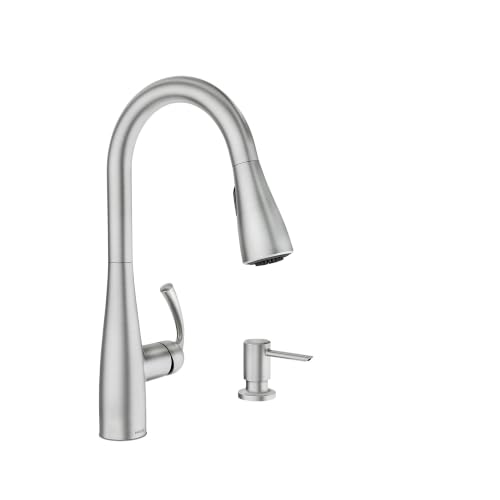
Moen Essie 87014SRS Pulldown Kitchen Faucet — Best Versatile Metal
The Essie earns its metal-guide place by combining Moen’s mainstream metal construction with the most forgiving installation in the catalogue. Verified configurations span one to four holes with the deck plate included, the package adds a soap dispenser, and the working kit — Reflex docking, Power Clean spray, Duralock connections — is the brand’s proven set. For a renovation on an existing sink, it is the metal faucet least likely to meet a hole pattern it cannot answer.
Strengths
- Fits 1, 2, 3 or 4-hole decks with plate included
- Soap dispenser included
- Reflex docking, Power Clean, Moen support
Trade-offs
- Transitional looks rather than a design statement
- Dispenser bottle is one more under-sink item
- Brand premium over value-tier stainless models
Key specs: Height 15.75 in, 1/2/3/4-hole configurations, dispenser included, Reflex, Power Clean (per verified listing data)
Renovation reality is the Essie’s home turf. Existing sinks present every hole pattern history has devised, and a metal faucet that answers all of them — while turning the spare hole into a dispenser instead of a scar — removes the commonest project failure before it happens. The construction and support are the mainstream Moen proposition described throughout this guide, which is precisely the point: versatility without a quality discount.
If your sink is a known single-hole and your design is settled, the sleeker picks above will tempt you fairly. If your project has any uncertainty in it at all — an inherited sink, a counter you are keeping, a dispenser on the list — the Essie is the metal faucet that absorbs uncertainty for a living.
Best for: renovations on existing sinks of any hole pattern / Not suited for: single-hole minimalists with a settled design
Check on Amazon — check the current price on Amazon before ordering, and confirm the configuration matches what is described here.

OWOFAN Kitchen Faucet with Pull Down Sprayer, Spring Design — Best Spring-Design Stainless
The OWOFAN brings the professional spring silhouette into the metal guide with credentials the verified listing states plainly: lead-free, NSF-certified stainless steel construction, a ceramic cartridge tested across half a million cycles, and dual-mode spray from stream to high-pressure. The exposed spring design is not theatre — it lets the wand travel further and dock at angles a fixed arc cannot reach, which is why commercial kitchens adopted it.
Strengths
- Stainless steel construction, lead-free and NSF certified
- Spring design gives the wand exceptional reach and freedom
- Cartridge cycle-tested to a serious standard
Trade-offs
- Commercial look divides households
- Spring wands demand clearance above and around
- Value-brand support horizon versus the legacy makers
Key specs: Height 16 in, 1 or 3-hole with deck plate, SUS stainless construction, dual-mode spray, ceramic cartridge (per verified listing data)
Judge the spring format on work, not looks: the wand undocks into a genuinely free tool that can chase a sheet pan’s corners, fill a pot on the counter beside the sink, and rinse a farmhouse bowl wall-to-wall, then springs back to its perch. In stainless, with a certified lead-free waterway, the OWOFAN delivers that format without the construction compromises that plague cheap spring faucets — the category’s usual failure being a spring and wand assembly that loosens into a dangle within a year.
Clearance is the gating check: the spring’s working arc needs air above the sink and freedom from low cabinets and window sills. Kitchens that can give it room — and cooks who actually use a wand as a tool — get the most functionally liberated faucet in this guide, in honest metal, at a mid-tier position.
Best for: keen cooks wanting maximum wand freedom in stainless / Not suited for: low-clearance sinks or traditional-look kitchens
Check on Amazon — check the current price on Amazon before ordering, and confirm the configuration matches what is described here.
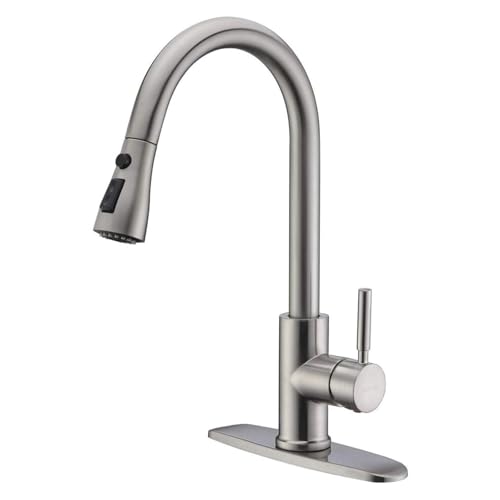
WEWE High-Arc Pull-Down Kitchen Faucet — Best Budget Metal
WEWE’s high-arc pull-down is the budget end of honest metal: the verified listing confirms SUS 304 stainless steel construction, a ceramic cartridge, three spray modes and a 20-inch pull-down reach, fitting 1- or 3-hole sinks. It has been a persistent value favourite in this category for years, and its specification explains why — the materials line reads like faucets costing far more, because in this design, it essentially is.
Strengths
- SUS 304 stainless body at a budget tier
- Ceramic cartridge and 3-mode sprayer
- Generous 20-inch pull-down reach; rub-clean silicone nozzles
Trade-offs
- Docking and finish finesse trail the flagship brands
- Long-term parts support is the value-tier question
- Brushed nickel only in this configuration
Key specs: SUS 304 stainless, ceramic cartridge, 3 modes, 20-in pull-down reach, 360° swivel, 1 or 3-hole (per verified listing data)
The WEWE is the faucet to cite when someone claims metal construction requires flagship money. Stainless throughout the body, a cartridge of the correct type, spray modes that cover the work, and a reach figure some premium wands do not match — the compromises live in the last ten percent: the dock’s final click, the finish’s depth, the brand’s decade-hence parts shelf. For a first home, a rental upgrade or a second sink, that is an intelligent place to save.
It also serves as this guide’s honesty anchor: if the WEWE’s specification satisfies you, the premium picks above are buying refinement and support rather than a different category of object. If those refinements are what you came for — and after a plastic faucet funeral, they often are — the Kraus and the Moens are waiting. Either conclusion is a good purchase made with open eyes.
Best for: budget metal buyers, rentals and second sinks / Not suited for: buyers wanting flagship docking feel and support
Check on Amazon — check the current price on Amazon before ordering, and confirm the configuration matches what is described here.
Comparison Table
Construction first: the table leads with what each faucet is actually made of, because that is this guide’s entire premise.
| Pick | Badge | Key spec | Best for |
|---|---|---|---|
| KRAUS Oletto KPF-2820SFS Pull Down Kitchen Faucet | Best Overall All-Metal | Brass body, 16.63 in, 1.8 GPM | construction-first buyers with standard-to-deep sinks |
| Moen Arbor 7594SRS Pulldown Kitchen Faucet | Best Traditional Metal | 15.5 in, Reflex, Power Boost | transitional kitchens wanting brand-backed metal quality |
| Delta Lenta 19802Z-SP-DST Kitchen Faucet | Best Modern Metal | 16.25 in, single-hole, SpotShield | contemporary kitchens with deep single-bowl sinks |
| Moen Essie 87014SRS Pulldown Kitchen Faucet | Best Versatile Metal | 15.75 in, 1–4 hole, dispenser incl. | renovations on existing sinks of any hole pattern |
| OWOFAN Kitchen Faucet with Pull Down Sprayer, Spring Design | Best Spring-Design Stainless | 16 in, spring, stainless, dual-mode | keen cooks wanting maximum wand freedom in stainless |
| WEWE High-Arc Pull-Down Kitchen Faucet | Best Budget Metal | SUS 304, 3 modes, 20-in reach | budget metal buyers, rentals and second sinks |
How to Shop for Metal Construction Without Being Fooled
Read listings like an auditor. The phrases that carry information are specific: ‘brass body’, ‘SUS 304 stainless steel’, ‘ceramic cartridge’, ‘lead-free’ with a certification named. The phrases that carry none are atmospheric: ‘metal-look’, ‘premium materials’, ‘high-quality construction’ unaccompanied by a material. Where a brand sells both, check the exact model’s details rather than the range’s reputation — value lines within famous brands quietly substitute materials, and flagship lines within value brands, like several picks here, quietly do the opposite.
Then allocate your scepticism correctly. The body, handle, spout and mounting hardware are where metal decides the decade. The wand is where brands compromise first, because a metal wand is heavy and a polymer wand is cheap — ask, where the listing does not say. Hoses, aerators and spray faces will be polymer in every faucet you can buy, including the best in this guide, and that is engineering, not deception: flexible lines must flex, and rubber nozzles shed scale better than metal ones. Judge a faucet by whether its compromises are the honest kind.
Brass vs Stainless Steel Faucet Bodies
The two honest body metals divide by temperament. Brass is the traditionalist: dense, warm in the hand, superbly corrosion-resistant in the body itself, and the material of most premium mainstream faucets — its surface takes finishes beautifully, which is why brass-bodied faucets wear stainless-look and nickel finishes over a brass heart. Stainless steel is the modernist: the finish is the material, so there is nothing to peel, the surface is hard and hygienic, and 304-grade stainless shrugs off kitchen chemistry indefinitely; its bodies are typically lighter than brass and its feel is crisper.
Neither outlasts the other in any way a household will measure. Choose brass for heft and for the deepest brand support, stainless for a finish that cannot wear through and for the spring and value designs where it dominates. What matters is that the body is one of them — the failure stories that send shoppers to this guide almost never begin with either.
How to Install a Metal Pull-Down Faucet and Protect Its Finish
Installation follows the standard pull-down sequence; metal faucets add two considerations — weight during mounting, and finish care from the first day.
- Shut off both supplies, drain the old faucet, disconnect its lines into a bucket, and remove it, cleaning the deck to bare, sound material.
- Dry-fit the new faucet first: confirm the hole pattern, deck plate coverage and — on tall or spring models — clearance to cabinets and sills above.
- Seat the gasket or seal as directed; on stone counters, use only the sealant approach the manufacturer specifies for the finish.
- Mount the faucet and tighten hardware evenly — metal bodies are heavier, so support the faucet from above while a helper tightens below, rather than letting it hang on its studs.
- Connect supplies, route the sprayer hose in a free loop with its weight unobstructed, and confirm the wand’s dock and retraction before the water returns.
- Restore water gradually, check every joint dry-handed through all modes, and flush the aerator and spray face to clear debris.
- Wipe the finish down with a soft cloth as the final step — the first of many; metal finishes reward soft cloths and punish scouring pads for life.
Keep the cartridge and finish documentation with the house papers. A metal faucet’s whole proposition is the long term, and the long term runs on part numbers.
Common Buying Mistakes
Believing ‘all metal’ literally. Hoses, aerators and spray faces are polymer in every modern faucet. Judge the body, handle, wand and hardware — and distrust any seller who claims otherwise.
Buying the range instead of the model. Famous brands sell plastic-bodied value lines; value brands sell metal flagships. Verify the exact model’s construction, as this guide did.
Ignoring wand weight. A metal wand’s heft reads as quality to most and effort to some. If small hands or arthritis are in the household, weigh the preference before buying.
Scouring the finish. Metal finishes die by abrasive pads and harsh chemicals, not by water. Soft cloth, mild soap, and limescale treated gently and early.
Skipping the cartridge question. Ask how the cartridge is replaced and whether it is stocked. A metal body with an orphaned cartridge is a statue, not a faucet.
Where Plastic Hides in Modern Faucets — and Where It Matters
An honest map of a modern pull-down: the body, spout and handle are the metal you are paying for in this guide’s picks. The wand is the contested zone — flagship wands may be metal or high-grade polymer over a metal core, and the listing rarely boasts about it either way, so treat wand construction as a question to ask rather than a fact to assume. The hose is a braided line with a polymer core by necessity. The aerator, flow straighteners and spray-face nozzles are polymer or silicone by design, because they must be replaceable, flexible or scale-shedding. The cartridge’s heart is ceramic — a material that out-wears every metal in the building for this job.
Ranked by consequence, the compromises that matter are a plastic body (flex, cracking, finish failure), a plastic handle (the part your hand judges daily), and orphaned internals. The compromises that do not matter are the engineered polymers doing jobs metal does badly. An all-metal purchase, properly understood, eliminates the first list entirely — which is exactly what the six picks here were selected to do.
The Weight Test and Other Showroom Heuristics
If you handle faucets in a showroom, three quick tests separate construction from cosmetics. Heft the wand and body: metal announces itself in density, and a faucet that feels like its photograph is usually honest. Work the handle slowly: a quality ceramic cartridge meters with an even, damped resistance from stop to stop, without grit, play or a plastic creak at the extremes. Dock and undock the wand ten times: the seat should be positive and identical every time, because you are rehearsing year five, not day one.
None of these tests require expertise, and together they replicate most of what this guide’s verification established on paper. Where you cannot handle the exact model, weight the written specification the same way: named materials, named cartridge type, named certifications. In faucets, as in tools, the makers of honest objects tend to say exactly what they are made of.
Metal Faucets in Hard-Water Country
Hard water is the stress test that reveals what a faucet is made of, in both senses. Scale builds fastest where water sits and evaporates: the aerator, the spray face, the wand’s dock and the cartridge’s seals. Metal bodies tolerate the descaling this demands — a vinegar soak for the aerator, a gentle wipe for the face, rubber nozzles rubbed clean — where plated plastic finishes often cloud, pit or lift under the same regime repeated for years. The ceramic cartridges in every pick here are the other half of the defence, since their polished discs resist the scratching that mineral grit inflicts on lesser valves.
The practical calendar for a hard-water home is simple: descale the aerator when the stream deforms, rub the spray nozzles monthly, and never let a white crust establish itself on the finish, because established scale invites the abrasive rescue that finishes die from. Do that, and a metal faucet in hard-water country will look better at year ten than a coated faucet in soft water — the material was chosen for exactly this fight.
Handles, Levers and the Ergonomics of Metal
A metal handle is not merely a prettier handle; it is a different instrument. Its mass damps the lever’s motion, so small adjustments to temperature — the difference between warm and scalding for a child’s hands — can be made finely and repeatably, and the stops at each end of travel arrive with a certainty that teaches the hand the faucet’s map within a week. Lever length multiplies the effect: the long levers on this guide’s mainstream picks can be worked with a wrist, a forearm or the back of a knuckle, which matters to cooks and to anyone whose grip is not what it was.
There is one honest counterweight, and this guide has noted it in the reviews: mass is effort for small or arthritic hands, and a featherweight polymer lever on a good cartridge can be the kinder daily tool. The all-metal brief is a preference for substance, not a law of nature — which is why the verdicts here name the trade rather than hiding it, and why trying a handle in a showroom, where possible, outranks any paragraph in this article.
What a Metal Faucet Does to a Kitchen’s Sound and Feel
An underappreciated difference between construction classes is acoustic. A metal-bodied faucet sounds like itself: the wand docks with a low, finished note, the lever’s stops are quiet thuds rather than clicks, and water hammer in the lines is damped by the body’s mass rather than amplified by a hollow shell. In open-plan homes where the kitchen shares air with the living space, that composure is a daily, if rarely articulated, pleasure — the same reason heavy doors feel luxurious in cars.
Feel compounds similarly. The spout does not flex when a heavy pot bumps it, the wand does not twist in the grip, and nothing about the object suggests it is negotiating with its own materials. None of this appears in specification tables, and all of it is what owners mean, a year in, when they say a faucet feels ‘solid’. This guide’s verification chased the materials on paper; this section is the reminder of why the paper mattered.
Refinishing, Repairing and the Second Decade
The strongest argument for metal construction is written in year eleven. A brass or stainless body can be serviced indefinitely: cartridges swap, hoses and wands are orderable for mainstream models, finishes can be professionally renewed, and even a tired brushed surface can be re-grained. The faucet’s skeleton — the expensive, plumbed, mounted part — simply does not have a built-in expiry date, which is why plumbers’ vans carry cartridges rather than replacement faucets for the brands in this guide.
Plan for that second decade at purchase: keep the model number and cartridge type with the house papers, buy from lines with a parts culture, and treat the first cartridge change, whenever it comes, as maintenance rather than failure. A plastic-bodied faucet’s second decade is usually spent in a landfill. A metal one’s is spent exactly where the first was — over your sink, working. That asymmetry is the entire economic case for this guide’s brief.
Metal Faucets and Water Quality
Construction material touches water quality at two points: the waterway the water travels, and the surfaces it rests against in the aerator and spray face. Lead-free certified metal waterways — a legal requirement for modern faucets in the United States and a stated feature on several picks here — are the baseline a buyer should refuse to go below, and the certification marks named in this guide’s reviews are the evidence to look for rather than a seller’s assurance. Brass waterways have carried drinking water safely for a century under those standards; stainless waterways present the same inert surface as commercial food lines.
The owner’s half of water quality is stagnation discipline: run the tap briefly after long absences, keep the aerator clean, and never let a little-used faucet sit charged with weekend-old water for the Monday coffee. Metal cannot legislate for standing water — but unlike some materials, it adds nothing of its own to it, which is the entire point of choosing it.
Buying Metal Faucets Second-Hand and for Rentals
Metal construction changes the second-hand and rental calculus in ways worth a paragraph. A used mainstream metal faucet with an available cartridge is a genuinely rational purchase for a workshop, a rental or a first renovation, because its wear parts are replaceable and its body does not age out — a proposition that collapses entirely for plastic-bodied models, whose used value is mostly risk. Inspect the cartridge’s smoothness, the wand’s dock and the finish at the base, where water stands, and budget a new cartridge and hoses into any used price.
For landlords, the argument compounds: a metal faucet survives tenants, accepts standard parts from any plumbing counter, and presents honestly at inspections. The premium over a budget plastic model is recovered the first time a replacement is not needed — a sentence property managers can verify from their own ledgers.
The Environmental Ledger of a Fifteen-Year Faucet
Durability is the least marketed and most real sustainability claim in the kitchen. A metal faucet that serves fifteen years with one cartridge change embodies a fraction of the material and transport cost of three plastic-bodied faucets serving five years each, and its body is recyclable at the end in a way composite constructions are not. Add the water dimension — ceramic cartridges that keep metering accurately instead of dripping, and flow rates tested to their stated class — and the metal brief turns out to be the environmental brief wearing work clothes.
None of this requires sacrifice, which is the point worth keeping: the longest-lived option in this category is also the best-feeling and, across its life, usually the cheapest. Buying once, in honest material, is the whole sermon — for the kitchen’s sake and for every other sake that follows from it.
A Closing Note on Buying Substance
This guide began with a disappointment — the faucet that pretended to be metal — and it is worth ending on why the disappointment stings enough to power a whole category of searches. A kitchen faucet is touched more than almost any object in a home, and the hand is an honest instrument: it knows the difference between substance and costume within a week, and it remembers the verdict at every use for years. Buying real metal is therefore not snobbery about materials; it is respect for the most repeated physical interaction in the house. The six faucets above were verified, weighed and specified so that the hand’s verdict and the listing’s claims agree. Choose any of them with your sink measured and your expectations set by the honesty notes in these pages, and the daily evidence will keep confirming the decision long after the price is forgotten — which is, in the end, the only definition of value this category has ever had.
Final Recommendation
The Kraus Oletto is the all-metal default: confirmed brass, ceramic cartridge, premium feel, sane specification. The Moen Arbor and Essie bring the same proposition with the deepest support culture in the business — the Arbor for looks, the Essie for impossible hole patterns — and the Delta Lenta is the modernist’s version with a finish engineered to stay presentable.
The OWOFAN proves stainless spring design can be both honest and capable, and the WEWE proves SUS 304 construction exists at a budget tier for buyers whose scepticism is aimed at prices rather than materials. Buy the metal where your hands live, and the decade will take care of itself. The three routes most readers choose between are: KRAUS Oletto KPF-2820SFS, Moen Arbor 7594SRS, WEWE High-Arc Pull-Down.
Keep exploring the same cluster before you decide: Best All Around Kitchen Faucets Best All Steel Kitchen Faucets Best Affordable Kitchen Faucets Best 2 Hole Kitchen Faucets
One more practical mercy of metal construction deserves the final word: forgiveness. A metal faucet tolerates the household’s real life — the pot knocked against the spout, the teenager’s enthusiastic lever work, the cleaner that was stronger than intended — with a resilience that fragile constructions spend on their first owner and never recover. Finishes can be renewed, cartridges replaced, wands re-ordered; the body endures through all of it, holding the geometry that makes the rest worth repairing. When the reviews in this guide praise heft and solidity, this is the long translation of those words: not that the faucet feels expensive today, but that it will still be entirely itself after a decade of being lived with. For an object touched a hundred times a week, there is no higher compliment and no better buying criterion.
Keep the removed packaging until the faucet has survived its first week of family service, and keep the paperwork forever. A metal faucet’s documentation is short — a model number, a cartridge type, a date — and it is the key to every future kindness the manufacturer can do you.
That small filing habit, multiplied across a house, is how well-kept homes stay well-kept.
With the paperwork filed and the routine understood, the faucet can get on with its one job: being forgotten, daily, for years.
Frequently Asked Questions
Is any kitchen faucet really 100 percent metal?
No. Every modern pull-down uses polymer supply-line cores, aerators and usually silicone spray nozzles, by engineering necessity. ‘All metal’ honestly means a metal body, handle and hardware with a ceramic cartridge — the parts that decide durability — and that is the standard this guide selected against.
Is brass or stainless steel better for a faucet body?
Both are excellent and effectively permanent in home service. Brass is denser and dominates premium mainstream faucets, taking applied finishes over a brass core. Stainless — 304 grade — has no finish to wear through and suits modern and spring designs. Choose by feel and design; distrust any third material offered as equivalent.
How can I tell if a faucet is plastic before buying?
Look for named materials in the specification: ‘brass body’ or ‘SUS 304’ are claims a maker can be held to. Vague phrases like ‘premium construction’ with no material named, suspiciously light shipping weight for the size, and prices far below the metal market are the tells. This guide excluded every model whose construction could not be verified.
Does a metal faucet need special care?
Only gentleness: soft cloths, mild cleaners, and limescale addressed early with appropriate gentle descalers rather than abrasives. The metal itself is the low-maintenance part of the proposition — it is the finish you are protecting, and finishes reward decades of soft treatment.
Are metal faucets worth the premium over plastic-bodied ones?
For a main kitchen faucet used dozens of times daily for a decade or more, the construction difference is the difference between a fixture and an appliance you replace. For a little-used utility sink, a good value faucet — including the stainless budget pick here — is the rational spend.
What is a ceramic cartridge and why does it matter?
It is the valve that meters your water, using polished ceramic discs that resist wear far longer than rubber-washer or plastic cartridges. It is the single most important internal component for a faucet’s service life, and every pick in this guide uses one.

