Disclosure: airfryerkitchensupply.com is reader-supported. When you buy through links on our site, we may earn an affiliate commission at no extra cost to you.
Where to buy
The best all around kitchen faucets have to fit your sink’s hole pattern, clear your tallest pots and survive a decade of daily use — so every pick below was verified against Amazon’s catalogue data at research time, with hole configuration, height and flow details taken from the verified listings. Use the links to check the current price on Amazon, and confirm your sink’s hole count against the review notes before ordering: it is the one measurement that decides whether installation takes twenty minutes or a weekend.
- Moen Adler 87233SRS Pulldown Kitchen Faucet — Check on Amazon
- Delta Essa 9113-AR-DST Kitchen Faucet — Check on Amazon
- KRAUS Oletto KPF-2820SFS Pull Down Kitchen Faucet — Check on Amazon
- Moen Essie 87014SRS Pulldown Kitchen Faucet — Check on Amazon
- KOHLER Simplice K-596 Kitchen Faucet — Check on Amazon
- FORIOUS Kitchen Faucet with Pull Down Sprayer — Check on Amazon
The best all around kitchen faucets are not the most exotic faucets in the catalogue. They are the ones that disappear into a kitchen’s life: a pull-down sprayer that docks where it should, a single handle that meters temperature without a fight, an arc high enough for a stockpot and low enough to avoid splashing a shallow sink, and a finish that wipes clean and stays honest for years. This guide exists for the majority of buyers who do not have a special requirement — just a sink, a family, and a wish to buy this appliance once.
Versatility, defined properly, has four parts. Fit: the faucet must match your sink’s holes or cover them with its deck plate. Reach: the sprayer hose must actually reach the corners of a double sink and the pot sitting beside it. Manners: the spray should switch modes positively, dock magnetically or mechanically without drooping, and not blast a shallow bowl into a countertop flood. And endurance: a ceramic cartridge, metal construction where it counts, and a brand that will still sell you a cartridge in ten years.
The six picks below cover that brief at every tier: two Moens with the category’s best docking manners, a sculptural Delta, a brass-bodied Kraus with a premium hand-feel, a Kohler with the cleverest spray in the business, and a budget FORIOUS that covers the fundamentals for a fraction of the money. All are pull-down single-handle designs, because that is what ‘all-around’ has honestly come to mean.
In this guide
Quick Picks
Six faucets, six strengths, one shared brief: fit almost any kitchen and be forgotten about, daily, for years.
- Moen Adler 87233SRS Pulldown Kitchen Faucet — Best Overall: The default recommendation for most kitchens: Power Clean spray, Reflex docking that actually retracts, a deck plate for 1- or 3-hole sinks, and a spot-resistant finish. — Check on Amazon
- Delta Essa 9113-AR-DST Kitchen Faucet — Best Modern Design: A sculptural single-hole pull-down in Arctic Stainless for kitchens where the faucet is part of the design — with Delta’s magnetic docking underneath the looks. — Check on Amazon
- KRAUS Oletto KPF-2820SFS Pull Down Kitchen Faucet — Best Premium Feel: A brass-bodied pull-down with a ceramic cartridge, 1.8 GPM flow and a spot-free finish — the weight and solidity pick for buyers who judge with their hands. — Check on Amazon
- Moen Essie 87014SRS Pulldown Kitchen Faucet — Best for Flexible Installs: The install-anywhere Moen: configurations for 1- to 4-hole sinks, a soap dispenser in the package, Reflex docking and Power Clean spray. — Check on Amazon
- KOHLER Simplice K-596 Kitchen Faucet — Best Spray Functions: Three spray functions including the blade-like Sweep and a Boost mode, magnetic DockNetik docking and temperature memory — the cleverest wand in the guide, in matte black. — Check on Amazon
- FORIOUS Kitchen Faucet with Pull Down Sprayer — Best Budget: The value benchmark: SUS304 stainless construction, a ceramic cartridge, three spray modes and a deck plate for 1- or 3-hole sinks, at a budget-tier price. — Check on Amazon
How These Picks Were Chosen
Candidates were drawn from the verified faucet catalogue assembled through the site’s Amazon data connection, and only models whose listing titles and fetched details matched the faucets reviewed were kept. For an all-around guide that verification focused on the versatility facts: hole configurations and deck plates, overall and spout heights, flow rates where listed, spray functions and docking systems. Faucets that were specialised — bridge designs, pot fillers, commercial spring monsters — were excluded however excellent, because this brief is the mainstream one.
Judging then weighed the daily experience in order: docking reliability, spray usefulness, handle feel, cleaning behaviour of the finish, and the brand’s support horizon. Rated flow figures quoted are from the verified listings. No pick here is a specialist; each earned its place by being good at everything a normal kitchen asks, and the reviews say plainly where each one’s compromises live.
The 6 Best All Around Kitchen Faucets, Reviewed in Depth

Moen Adler 87233SRS Pulldown Kitchen Faucet — Best Overall
The Adler is the faucet this guide would install in a rental, a family kitchen or a first renovation, because it gets the fundamentals measurably right. Moen’s Reflex system guides the pull-down wand back into its dock smoothly instead of leaving it dangling by Friday, Power Clean delivers a concentrated spray that shifts stuck food without a soak, and the Spot Resist stainless finish genuinely reduces the fingerprint-and-waterspot wiping that makes stainless a chore in hard-water homes.
Strengths
- Reflex docking retracts and seats the wand reliably
- Power Clean spray is concentrated where rinsing needs force
- Deck plate included — fits 1- or 3-hole sinks
Trade-offs
- Design is handsome but safe — not a statement piece
- Spot Resist finish costs more than plain chrome versions
- Single spray pattern pairing is practical rather than luxurious
Key specs: Height 14.56 in, 1 or 3-hole with deckplate, Power Clean spray, Reflex docking (per verified listing data)
Live with a pull-down faucet and the docking becomes the whole review: a wand that droops is a daily irritation, and the Adler’s guided retraction is the mainstream benchmark for avoiding it. The 14.5-inch height is the versatile middle — tall enough for a pasta pot under the arc with the wand parked, modest enough not to turn a shallow sink into a splash zone, especially with the aerated stream doing the gentle work and Power Clean reserved for the roasting pan.
Moen’s support horizon seals the all-around case. Cartridges, wands and finishes for a mainstream Moen remain orderable for years, the warranty culture is established, and every plumber in the country has fitted one. If your kitchen brief is ‘excellent, normal, done’, this is the faucet the brief describes — the one the rest of this guide has to beat, and mostly doesn’t.
Best for: most kitchens wanting a proven, versatile pull-down / Not suited for: buyers wanting a dramatic design statement
Check on Amazon — check the current price on Amazon before ordering, and confirm the configuration matches what is described here.

Delta Essa 9113-AR-DST Kitchen Faucet — Best Modern Design
The Essa is what happens when the all-around brief is handed to a design studio: a clean, Euro-modern silhouette in Delta’s Arctic Stainless, a single-hole installation that suits contemporary counters, and — importantly — no sacrifice of the working details. Delta’s MagnaTite docking snaps the wand home with a magnet, the kind of positive seat you feel every single time, and the pull-down sprayer covers the sink’s corners with the hose length a double bowl demands.
Strengths
- Genuinely handsome modern design
- Magnetic docking seats the wand with a positive snap
- Single-hole install suits minimalist counters
Trade-offs
- Single-hole format may need a plate or a new sink for multi-hole decks
- Design-led pricing above the mainstream Moens
- Touch variant exists separately — this is the manual model
Key specs: Height 15.25 in, single hole, pull-down sprayer, Arctic Stainless (per verified listing data)
Design faucets earn suspicion in practical guides, usually fairly, so the Essa’s defence is that its beauty is load-bearing: the smooth arc is easy to wipe, the single lever falls naturally to hand, and the magnetic dock outperforms the friction docks that design-led rivals often hide behind. In a kitchen renovation where the faucet is one of the few visible ‘fixtures’ left, that combination of looks and manners is the whole argument.
Check the hole pattern before falling for it. The Essa is a single-hole faucet; on a 3-hole sink you will be adding a deck plate solution or accepting visible unused holes with covers, and on a farmhouse sink with a faucet deck it fits beautifully. Delta’s cartridge ecosystem and support are as long-lived as Moen’s, so the design premium buys no ownership penalty — just a prettier decade.
Best for: modern renovations and single-hole sinks / Not suited for: traditional kitchens or strict budgets
Check on Amazon — check the current price on Amazon before ordering, and confirm the configuration matches what is described here.

KRAUS Oletto KPF-2820SFS Pull Down Kitchen Faucet — Best Premium Feel
Pick up the Kraus Oletto’s wand and the review writes itself: this is a brass-bodied faucet, and the density is immediately apparent. The verified listing confirms the construction story — brass body, ceramic cartridge, spot-free stainless finish — along with a 1.8 GPM flow and a 16.6-inch overall height that gives it the stature for large sinks and deep pots. Kraus built its name selling this kind of solidity direct, and the Oletto is the line’s mainstream ambassador.
Strengths
- Brass body — the premium construction material, felt in the hand
- Ceramic cartridge and quality internals
- Spot-free finish and generous 16.6-inch height
Trade-offs
- Taller arc can splash in shallow sinks
- Heavier wand is a preference, not a universal good
- Single-hole format needs planning on multi-hole sinks
Key specs: Flow 1.8 GPM, height 16.63 in, spout height 8.75 in, spout reach 8.88 in, brass body, ceramic cartridge (per verified listing data)
Construction is this guide’s recurring theme because a kitchen faucet cycles its cartridge thousands of times a year and lives in a permanently wet, chemically varied environment. Brass bodies resist that environment the way they have for a century, ceramic cartridges meter smoothly for years, and the Oletto pairs both with the modern conveniences — pull-down reach, dual spray behaviour, spot-free finish — that define the current category. It feels like the faucet equivalent of a well-made tool.
The height deserves a measurement check: at over sixteen inches with a high spout, it is glorious over a deep single bowl and theatrical over a shallow one, where the drop turns rinsing into weather. Deep-sink households, home chefs and anyone who fills stockpots daily will rank this first in the guide. Shallow-sink households should take the Adler’s moderation instead — versatility is partly a property of your sink, not just the faucet.
Best for: deep sinks, keen cooks and construction-first buyers / Not suited for: shallow sinks, where the tall arc splashes
Check on Amazon — check the current price on Amazon before ordering, and confirm the configuration matches what is described here.
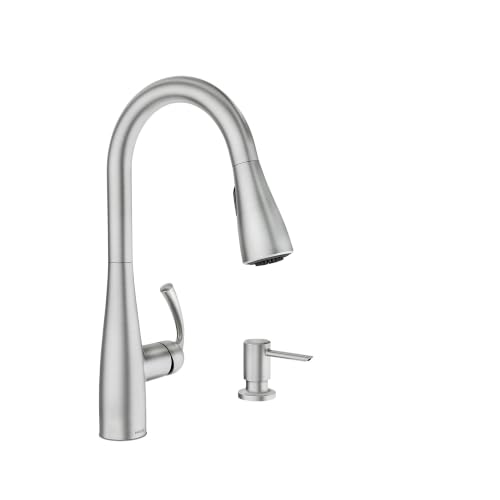
Moen Essie 87014SRS Pulldown Kitchen Faucet — Best for Flexible Installs
The Essie is the problem-solver of the Moen range and, for awkward sinks, the most versatile faucet in this guide. Its verified listing confirms configurations spanning one to four holes with the deck plate included — which means it fits the sink you have, including the odd legacy four-hole deck — and the package includes a soap or lotion dispenser, filling the fourth hole with something useful instead of a blanking cap. Reflex docking and Power Clean carry over from its Adler sibling.
Strengths
- Widest hole compatibility here: 1, 2, 3 or 4-hole installs
- Soap dispenser included in the package
- Reflex docking and Power Clean spray
Trade-offs
- Transitional styling will not thrill design-led renovators
- Dispenser adds an under-counter bottle to refill
- Shares the range’s premium over budget brands
Key specs: Height 15.75 in, 1/2/3/4-hole configurations with deck plate, soap dispenser included, Reflex, Power Clean (per verified listing data)
Renovations are where the Essie earns its keep. The commonest faucet-project derailment is discovering the sink’s hole pattern does not match the beautiful faucet already unboxed; the Essie’s spread of configurations, plus a dispenser that productively occupies a spare hole, removes that failure mode almost entirely. Installers like it for the same reason: one faucet that answers whatever the deck presents, with Moen’s Duralock quick-connect making the under-sink work civilised.
As a daily faucet it is the Adler’s equal in manners, with a slightly taller stance at 15.75 inches and a more traditional curve to the arc. If your project involves an existing sink of uncertain provenance, a soap dispenser on the wish list, or a household that values sorted-over-stunning, the Essie is the all-around pick with the fewest possible surprises.
Best for: renovations on existing sinks, especially 3- and 4-hole decks / Not suited for: minimalist single-hole purists
Check on Amazon — check the current price on Amazon before ordering, and confirm the configuration matches what is described here.

KOHLER Simplice K-596 Kitchen Faucet — Best Spray Functions
The Simplice is the engineer’s favourite in this guide. Its three-function sprayhead offers a standard stream, a Boost that raises flow for filling and blasting, and Kohler’s Sweep — a wide, blade-shaped spray that pushes debris across a pan or a sink bowl like a squeegee, and which owners consistently describe as the feature they did not know they needed. DockNetik magnetic docking and ceramic disc valves complete a specification aimed at people who use a sprayer as a tool, not an accessory.
Strengths
- Sweep spray genuinely changes rinsing and sink-cleaning
- Boost mode adds flow on demand
- Magnetic docking and ceramic disc valves
Trade-offs
- Matte black shows water spots more than spot-resistant finishes
- Feature-rich head is more complex than basic wands
- Premium-tier pricing
Key specs: 3-spray design (stream / Sweep / Boost), DockNetik magnetic docking, ceramic disc valves, high arch (per verified listing data)
Most multi-spray faucets offer variations on a shower. The Simplice’s Sweep is a different idea — a flattened fan of water with real pushing power — and in practice it clears a roasting pan’s debris field and rinses a farm sink’s corners faster than any needle spray, while Boost answers the ‘this pot takes forever’ complaint within the limits of your supply. Temperature memory, which returns the water to your last setting, is the quiet luxury you notice on the second day.
The matte black finish is the honest caveat: it looks superb in the right kitchen and shows mineral spotting more readily than the spot-resistant stainless finishes elsewhere in this guide, so hard-water households should choose with eyes open or look at the same model family’s other finishes. As a working tool, though, the Simplice is the most capable faucet here, and keen cooks will rank it first.
Best for: keen cooks who use the sprayer as a primary tool / Not suited for: hard-water homes wanting a spot-hiding finish in this colourway
Check on Amazon — check the current price on Amazon before ordering, and confirm the configuration matches what is described here.

FORIOUS Kitchen Faucet with Pull Down Sprayer — Best Budget
FORIOUS is the budget pick that makes the budget case honestly. The verified listing confirms the fundamentals a cheap faucet usually fakes: SUS304 stainless steel construction, a ceramic cartridge, 1.8 GPM flow, three spray modes including a pause, an 18-inch hose and certification to the standards that matter. It fits 1- or 3-hole sinks with its deck plate and is marketed — credibly — across farmhouse kitchens, campers, laundry rooms and bars, which is another way of saying it is built to be useful anywhere.
Strengths
- SUS304 construction and ceramic cartridge at a budget tier
- Three spray modes including pause
- Deck plate covers 1- or 3-hole sinks; certified to NSF/ANSI/CAN 61
Trade-offs
- Docking and wand feel are a class below the Moen/Kohler systems
- Brand support horizon is shorter than the legacy makers’
- Finish is good, not flagship
Key specs: Flow 1.8 GPM, height 14.76 in, spout height 6.69 in, SUS304, ceramic cartridge, 3 modes, 18-in hose (per verified listing data)
The right question about a budget faucet is not ‘is it as good as the Adler?’ — it is ‘where exactly does it fall short, and do I care?’ With the FORIOUS the shortfalls are tactile and long-term: the wand’s dock is less assured, the handle’s action less silky, and the brand’s decade-hence cartridge availability less certain. The water, meanwhile, comes out exactly the same, the spray modes are genuinely useful, and the construction materials are honestly specified — a combination that serves renters, renovators on a budget, and second-sink installations extremely well.
It is also this guide’s recommendation for the utility end of the house — laundry, bar and workshop sinks — where its versatility list reads like a job description. Buy it with clear eyes as a well-made value faucet rather than a flagship in disguise, and it will not disappoint you.
Best for: budgets, rentals, laundry/bar/RV sinks and first renovations / Not suited for: buyers wanting flagship docking feel and decade-long brand support
Check on Amazon — check the current price on Amazon before ordering, and confirm the configuration matches what is described here.
Comparison Table
All six are single-handle pull-downs; they divide on fit, spray cleverness, construction and price tier. The table keeps the deciding facts in one place.
| Pick | Badge | Key spec | Best for |
|---|---|---|---|
| Moen Adler 87233SRS Pulldown Kitchen Faucet | Best Overall | 14.56 in, 1/3-hole, Reflex dock | most kitchens wanting a proven, versatile pull-down |
| Delta Essa 9113-AR-DST Kitchen Faucet | Best Modern Design | 15.25 in, single-hole, magnetic dock | modern renovations and single-hole sinks |
| KRAUS Oletto KPF-2820SFS Pull Down Kitchen Faucet | Best Premium Feel | 16.63 in, brass body, 1.8 GPM | deep sinks, keen cooks and construction-first buyers |
| Moen Essie 87014SRS Pulldown Kitchen Faucet | Best for Flexible Installs | 15.75 in, 1–4 hole, dispenser incl. | renovations on existing sinks, especially 3- and 4-hole decks |
| KOHLER Simplice K-596 Kitchen Faucet | Best Spray Functions | 3-spray incl. Sweep + Boost | keen cooks who use the sprayer as a primary tool |
| FORIOUS Kitchen Faucet with Pull Down Sprayer | Best Budget | 14.76 in, SUS304, 3 modes | budgets, rentals, laundry/bar/RV sinks and first renovations |
How to Choose an All Around Kitchen Faucet
Begin under the sink, not above it. Count the holes in your sink or counter — one, two, three or four — and note whether a deck plate can cover extras; that single fact, plus whether you want a soap dispenser in a spare hole, eliminates half the catalogue correctly. Next, measure for height honestly: the distance from deck to the top of the arc must clear your cabinets or window trim above, and the spout height must clear your tallest pot with room to manoeuvre — while a very high arc over a shallow sink will splash, which is a property of the pairing, not the faucet.
Then judge the working parts in the order you will feel them: docking first, because a drooping wand is a daily curse; spray modes second, favouring a genuinely useful second mode — a concentrated clean, a sweep, a boost — over a gallery of showers; handle action third, where ceramic cartridges and established brands earn their money; and finish last, where spot-resistant treatments matter in hard-water homes and matte finishes demand more wiping. Flow rates in this guide’s picks cluster at the standard 1.8 GPM class, which balances rinsing power against water rules in most states; lower-flow variants exist for stricter jurisdictions. Buy the faucet that wins on docking and fit, and the rest is taste.
Pull-Down vs Pull-Out vs Spring: A Quick Format Guide
All six picks are pull-downs, and that is a deliberate verdict rather than an oversight. Pull-down faucets pair a high arc with a wand that travels downward into the sink, which suits deep bowls and pot-filling and keeps the hose’s working length where the water is. Pull-out designs, with lower arcs and longer wands, suit shallow sinks and wide counter work but give up pot clearance. Professional spring faucets look dramatic and rinse brilliantly, yet their height, splash and price make them specialists rather than all-rounders. For the mainstream brief — one faucet, every job, no drama — the pull-down’s decade of dominance is earned, and the differences that matter live inside the format: docking, spray and construction, which is where this guide spends its attention.
How to Install a Pull-Down Kitchen Faucet, Step by Step
A like-for-like pull-down swap is among the most satisfying DIY jobs in a kitchen. Work clean, work in order, and keep a towel and a torch under the sink.
- Turn off the hot and cold supplies under the sink, open the old faucet to drain pressure, and disconnect the supply lines into a small bucket.
- Remove the old faucet’s mounting hardware — the step that takes longest on corroded fittings — and clean the deck thoroughly of old sealant and scale.
- Check the new faucet’s hole requirements against the deck; fit the deck plate if your sink has extra holes, and seat any gasket or seal as directed.
- Feed the new faucet’s lines and hose through the deck, position the faucet, and tighten the mounting hardware evenly from below.
- Connect supplies to the correct inlets, route the sprayer hose with its weight so it hangs in a free loop with nothing to snag on, and confirm the wand docks and retracts.
- Restore the water, then check every joint with a dry hand while a helper runs the faucet through its modes and temperature range.
- Flush the aerator and spray head for a minute to clear installation debris, and re-check the joints again the following day.
If your shut-off valves weep, seize or predate the house’s last renovation, replace them while the cabinet is empty — it is the cheapest plumbing insurance in the entire project, and the one step future-you will applaud loudest.
Common Buying Mistakes
Not counting the holes. Hole pattern is the faucet project’s first fact. Count before you shop, and know whether a deck plate or dispenser will cover the spares.
Buying height by looks alone. Too tall splashes a shallow sink and can foul cabinets; too low fights every stockpot. Measure the pairing, not the product photo.
Ignoring the docking. A wand that droops by month two will annoy you for a decade. Docking systems are a headline feature for a reason — weight them like one.
Strangling the hose loop. The sprayer hose needs a free-hanging loop with its weight unobstructed. A loop snagged on pipework is a wand that will not retract.
Skipping the flush. New installations shed debris that clogs aerators and spray faces. Flush before first use and clean the aerator again in a week.
Finishes, Explained: Spot-Resistant, Brushed, Matte and Chrome
A finish is a maintenance contract written in colour. Spot-resistant stainless treatments — Moen’s Spot Resist in this guide, and their equivalents elsewhere — genuinely reduce the visible fingerprinting and water-spotting that make plain stainless a daily wipe-down in hard-water areas, and for family kitchens they are worth their modest premium. Brushed nickel hides a multitude of sins and suits transitional kitchens. Matte black is the designer’s favourite and the hard-water owner’s penance: every mineral deposit announces itself, so buy it for a soft-water home or a high-wiping tolerance. Chrome remains the easiest finish to clean and the hardest to date, at the cost of showing every splash until you do.
Underneath every finish in this guide sits the same advice: the finish is a coating on a body, and the body’s material — brass, stainless, or lesser alloys — decides the faucet’s decade. This guide’s picks specify their construction honestly, and the all-metal and all-steel companion guides go deeper for buyers who want to shop by material first.
Cartridges and the Ten-Year View
The part of your faucet that will actually wear is the cartridge, and the all-around wisdom is simple: ceramic-disc cartridges from established makers last for many years, fail gracefully by dripping rather than flooding, and remain replaceable long after purchase. When you buy a mainstream Moen, Delta, Kohler or Kraus, you are partly buying that cartridge ecosystem — the certainty that a modest part, a standard tool and a free afternoon restore the faucet to new in year nine. Budget brands have improved enormously, and this guide recommends one happily, but the support horizon is the honest line between the tiers. A faucet is a ten-to-fifteen-year purchase; choose the one whose tenth year you can picture.
Water Pressure, Flow and the Aerator: Getting the Performance You Paid For
A faucet’s showroom performance and its kitchen performance differ by one variable: your home’s water pressure and the state of its aerator. The 1.8 GPM class shared by this guide’s picks is measured at a standard pressure; homes with low pressure will see gentler flow from any faucet, and homes with very high pressure may find spray modes livelier than intended. Before blaming a new faucet for weak flow, remove and rinse the aerator — installation debris collects there in the first week by design, which is why the installation sequence in this guide ends with a flush and an early re-check.
Aerators are also the cheapest performance upgrade in the kitchen: a clogged or scaled aerator turns a good stream into a spitting fan, and a replacement costs less than the coffee you drank while reading reviews. Keep the removed aerator’s size noted with the faucet’s paperwork, descale it in vinegar when the stream degrades, and the all-around performance you bought remains the performance you have in year five.
Single-Handle vs Two-Handle in a Modern Kitchen
Every pick in this guide is a single-handle design, and the reasoning deserves one honest paragraph. A single lever meters flow and temperature in one motion, can be nudged with a wrist or an elbow when hands are floury, and leaves the deck uncluttered for the pull-down hose to do its work — which is why the format owns the mainstream. Two-handle faucets persist for good reasons of their own: a traditional aesthetic, precise independent control, and in some jurisdictions a service culture built around them. They pair poorly with pull-down wands, however, and ask two hands of a cook who rarely has one.
Temperature memory and anti-scald limits, found on several designs in this class, quietly improve the single-handle case further: the faucet returns to your usual setting and resists accidental full-hot swings. For households with children or elderly cooks, those details matter more than a third spray mode. The all-around verdict stands — single handle, ceramic cartridge, pull-down wand — and the rest of this guide is the argument for which one.
Keeping a Pull-Down Faucet Young: The Maintenance Calendar
An all-around faucet asks for three small rituals. Monthly: wipe the finish with a soft cloth, run the wand through its dock a few times to confirm the seat, and glance at the hose loop under the sink for snags or chafing. Quarterly: unscrew the aerator, rinse its screens, soak it briefly if scale is building, and exercise the spray-mode button or toggle so mineral deposits never glue it in one position. Annually: look at every under-sink joint with a dry hand and a torch, check the mounting hardware’s snugness, and confirm the shut-off valves still turn — the day you need them is the wrong day to learn they have seized.
None of this requires a plumber, and all of it together takes less time than one service call’s hold music. The faucets in this guide were chosen partly for how gracefully they accept this calendar: standard cartridges, available wands and hoses, finishes that forgive. A decade of service is not luck; it is fifteen minutes a quarter, compounding.
Faucets for Households That Cook: What Changes at the Margins
Households that cook seriously lean on three faucet behaviours the casual kitchen barely notices. The first is hose honesty: the stated reach must survive contact with a real double sink, a sheet pan and a stockpot on the counter, which is why this guide weighted docking and hose behaviour so heavily. The second is spray discipline — a mode that stays selected under pressure, a stream that does not aerosolise half the rinse water across the cook, and in the Kohler’s case a sweep that genuinely moves debris. The third is one-handed everything: lever, wand and mode changes operable with a wrist while the other hand holds the chicken.
If that portrait is your kitchen, the ranking inside this guide quietly reorders itself: the Simplice and the Kraus rise, the prettier moderation of the Adler remains the family default, and the budget FORIOUS becomes the second-sink specialist it was born to be. All-around does not mean identical — it means the compromises are chosen rather than suffered, and a cooking household simply chooses different ones.
Soap Dispensers, Air Gaps and the Fourth Hole
The spare hole in a sink deck is a small design decision with daily consequences, and this guide’s Essie — with its dispenser included — forces the question productively. A deck-mounted soap dispenser clears the counter of its most persistent bottle, refills from above on modern designs, and turns an inherited hole from a scar into a feature. The alternatives each have their constituency: a blanking cover for minimalists, an air-gap cap where local code pairs one with a dishwasher, or a filtered-water tap for households that will actually maintain the filter.
Decide the fourth hole before the faucet arrives, because retrofitting a dispenser into a finished installation means working under a mounted faucet in a cabinet that has resumed its life as storage. Like most of this guide’s advice, it is unglamorous, cheap and permanent — the three qualities that separate kitchens that work from kitchens that merely photograph well.
When the All-Around Answer Is to Call a Plumber
This guide encourages the DIY installation and also knows its border. Call a plumber when the shut-off valves fail their test, when supply lines need moving rather than connecting, when the sink or counter itself is being changed in the same project, or when anything under the sink is corroded enough to crumble at a wrench’s suggestion. The economics are plain: a plumber’s hour costs less than a cabinet floor, and the faucet will be installed, levelled and warrantied in a single visit.
There is no virtue lost in the call. Professional installation also creates the paper trail — invoice, model, date — that warranties and future cartridge orders run on. The all-around kitchen is not the one where everything was done by hand; it is the one where everything was done properly, by whoever was best placed to do it.
A Note on Water Taste and New Faucets
New faucets, like new kettles, can lend the first days’ water a faint newness — a trace of manufacturing and installation that the commissioning flush exists to remove. Run every mode for a full minute at installation, repeat briefly the next morning, and judge the water only after that ritual. If a taste persists beyond the first days, look to the supply lines and the aerator before the faucet itself, and check whether a new under-sink filter elsewhere in the system is the true author.
The longer view is reassuring: the certified waterways across this guide’s picks are tested for drinking-water contact, and a faucet that has been flushed and lived with for a week contributes nothing to taste at all. First impressions in plumbing, as in much else, should be given a week to settle before they are believed.
Teaching the Household the New Faucet: A Small, Real Thing
Every faucet change reteaches a household’s hands, and the teaching goes better when it is deliberate. Show everyone where the spray mode changes and how the wand prefers to dock — with a seat, not a slam — and agree on the house rule that the hose is never yanked to its limit as a measuring tape. Children, in particular, learn a docking system in a day if it is demonstrated once and will fight a vague one for a year. Put the aerator tool, if the model uses one, in the cutlery drawer rather than the toolbox, because the person who needs it will be standing at the sink with wet hands. And keep the old faucet’s paperwork ritual for the new one: model, cartridge type and purchase date, photographed into the household’s records before the box is recycled. None of this is in any manual, and all of it is the difference between a faucet that is owned and a faucet that is merely installed. The all-around kitchen runs on these small agreements far more than on any single appliance — the faucet is simply where they are practised daily.
Final Recommendation
For most kitchens, the Moen Adler remains the all-around answer: docking that behaves, spray that works, a finish that forgives, and a brand that will out-support us all. Take the Essie if your sink’s holes are awkward, the Delta Essa if design leads the renovation, the Kraus Oletto if your sink is deep and your standards are tactile, and the Kohler Simplice if you cook seriously and rinse constantly.
The FORIOUS holds the budget end with more honesty than most flagships manage. Measure the holes, mind the height, weight the docking — and then enjoy a decade of not thinking about your faucet. The three routes most readers choose between are: Moen Adler 87233SRS, KRAUS Oletto KPF-2820SFS, KOHLER Simplice K-596.
Keep exploring the same cluster before you decide: Best All Metal Kitchen Faucets Best All Steel Kitchen Faucets Best 2 Hole Kitchen Faucets Best Affordable Kitchen Faucets
One last encouragement: if you are replacing a faucet that has annoyed you for years, notice how quickly the annoyance is forgotten once the new one simply works. That forgetting is the product. Buy for it.
Frequently Asked Questions
What makes a kitchen faucet ‘all-around’?
Versatility across the four things a kitchen actually asks: fitting common hole patterns, clearing normal pots without splashing normal sinks, a pull-down sprayer that docks reliably, and construction that lasts a decade. Every pick in this guide was chosen against that brief rather than for a single special talent.
How do I know how many holes my sink has?
Count the openings in the sink deck or counter behind the bowl, including any occupied by a sprayer or soap dispenser. If you are replacing a faucet, the existing setup tells you the count. Deck plates cover extra holes for 1- or 3-hole installs on many models, and the Essie in this guide covers up to four.
Is 1.8 GPM enough flow for a kitchen faucet?
For nearly all home use, yes — it is the standard class for the picks here, balancing rinsing and filling performance against water-efficiency rules. Boost modes, like the Kohler’s, raise flow temporarily where the supply allows. Very low-flow 1.5 GPM variants exist for strict jurisdictions and feel noticeably gentler.
Why does docking matter so much?
Because it is the interaction you perform dozens of times a week for a decade. Magnetic and guided systems seat the wand positively every time; weak friction docks loosen and droop. It is the single feature owners praise or curse most in long-term reviews.
Can I install a pull-down faucet myself?
A like-for-like swap is a well-established DIY job with basic tools, as the step-by-step here shows. Budget extra time for removing a corroded old faucet, and hire a plumber if shut-off valves need replacing or supply lines need modification.
Which finish is easiest to live with?
Spot-resistant stainless and brushed finishes hide daily evidence best; chrome cleans easiest but shows splashes until wiped; matte black looks striking and shows mineral spotting most. In hard-water homes, spot-resistant treatments earn their premium.


