Disclosure: airfryerkitchensupply.com is reader-supported. When you buy through links on our site, we may earn an affiliate commission at no extra cost to you.
Where to buy
Every faucet in this guide is sold on Amazon, where you can confirm that the deck plate is included in the box before ordering — that plate is what makes a 3-hole installation work. Start with our top pick, the Moen Adler 87233SRS on Amazon, and compare the FORIOUS pull-down, the FEELSO pull-down, the VAPSINT pull-down, the LUFG pull-down and the WEWE high-arc pull-down. Check the current price on Amazon for each model and finish, and measure your deck’s outer-hole spread before ordering anything.
Introduction: the three-hole deck is the American standard
The best 3 hole kitchen faucets serve the most common sink deck in the country. The three-hole pattern — typically three holes in a row, with the outer pair spaced 8 inches apart on standard sinks — became the default because it accommodates both histories of the kitchen faucet: a single-lever faucet mounted in the center hole with a deck plate (escutcheon) covering the outer two, or a faucet whose components use the holes directly. Nearly every modern pull-down is sold as a “1 or 3 hole” faucet for exactly this reason: mount it through one hole on a modern counter, or set it on its included plate over a classic three-hole deck. This guide is about choosing the best of those faucets for the three-hole case specifically — which means judging the plate as carefully as the faucet, because on your deck, the plate is half the installation.
Every pick below was verified through Amazon data for this site: the manufacturer’s own data had to confirm 1-or-3-hole mounting with the plate included (or, in one case, a verified 1-to-3-hole range), along with the model, finish and feature set we describe. That verification matters because “fits 3-hole sinks” is among the most casually repeated claims in faucet listings, and the failure mode is always the same — the box arrives without a plate, or with a plate too short to cover an 8-inch spread, and the outer holes sit exposed. The six faucets here span the realistic field: Moen’s Adler as the big-brand benchmark, and a strong group of direct-to-consumer pull-downs (FORIOUS, FEELSO, VAPSINT, LUFG, WEWE) whose listings publish the deck details — plate size, hole range, deck thickness — that three-hole buyers actually need.
Measure your deck before shopping. The standard three-hole spread is 8 inches between the outer holes’ centers, and a standard deck plate is about 10 inches long to cover them with margin. Decks also exist at other spreads, and older sinks occasionally surprise. You also need the deck thickness and a look underneath: a plate-mounted faucet still anchors through the center hole, and the mounting hardware needs clearance from the sink’s underside ribs and any disposal flange. Five minutes with a tape now is the whole difference between a Saturday install and a return.
This guide is written for the three-hole owner specifically, which is a more specific reader than “faucet buyer.” You are not choosing a deck; you have one. Your questions are the plate’s coverage, the mounting tolerances, and which of the dozens of 1-or-3 faucets deserves your standard deck. We have tried to answer exactly those questions and to be transparent where a manufacturer’s data runs out — two of the picks do not publish a verified overall height, and we say so in their reviews rather than borrowing a number from a retailer’s infographic. On a category where fit is the whole game, that transparency is the product.
In this guide
Quick Picks
- Best Overall: Moen Adler 87233SRS — 1 or 3 hole with deckplate, Power Clean spray, Reflex docking, Spot Resist Stainless. Check the current price on Amazon
- Best Budget: FORIOUS Pull-Down — 10-inch deck plate included, three spray modes, 1.8 GPM, published mounting ranges. Check the current price on Amazon
- Best Features: FEELSO Pull-Down — 1 or 3 hole with plate, three modes, 20-inch hose, 16.38-inch height. Check the current price on Amazon
- Best Compact Budget: VAPSINT Pull-Down — fits single-hole to three-hole sinks, three modes, 1.8 GPM, quick claimed install. Check the current price on Amazon
- Best for RV and Laundry: LUFG Pull-Down — deck plate included, NSF372 / NSF61 / cUPC credentials, three modes, 18-inch hose. Check the current price on Amazon
- Best Long Reach: WEWE High-Arc Pull-Down — 1 or 3 hole fit, 20-inch pull-down reach, rub-clean silicone nozzles. Check the current price on Amazon
How These Picks Were Chosen
The first filter was the plate: the manufacturer’s data had to confirm 3-hole capability with the escutcheon included, because a three-hole guide that recommends faucets requiring a separate plate purchase has failed at its job. We verified each model — configuration, spray modes, hose lengths, certifications and dimensions as published by the brand. Then we ranked on the ownership factors: docking reliability, cartridge quality and published cycle testing, spray versatility, finish behavior, and the realism of the support channel behind the brand. Where a brand’s data was silent on a point a buyer would care about — an overall height, a plate length — we treated the silence as information and said so in the review, because on a fit-driven purchase, an unstated dimension is a risk the buyer is entitled to see priced into the recommendation.
The list is honest about its shape: one national brand and five direct-to-consumer models. That is the three-hole market as it stands — the big brands sell excellent 1-or-3 faucets (the Adler represents them, and the Moen Essie’s even wider 1-to-4-hole kit is covered in our 2-hole and 4-hole guides), while the value innovation in this category — published mounting tolerances, three-mode heads at budget tiers, long hoses — is currently coming from the direct brands. Each review states who should skip the pick, and the prose is explicit about the trade: brand infrastructure versus specification transparency and price tier.
Where are Delta and Kohler in this guide? Their mainstream pull-downs are predominantly sold and specified as single-hole faucets, with escutcheon compatibility that varies by model and is not always stated as an included plate in the manufacturer’s Amazon data. Delta models appear throughout this site’s other faucet guides in the roles their data supports — the Boyd with its dispenser in the 2-hole guide, the Lenta and Essa in the height guides, the Windemere in the two-handle guides. Rather than stretch a Delta into this list on the strength of retailer copy, we kept this guide to the faucets whose 3-hole-with-plate configuration we could verify end to end. That is the same standard applied to every category in this batch, and it is why a shorter list of certain configurations beats a longer list of probable ones.
Budget Tiers on a Three-Hole Deck
The budget tier here (FORIOUS, VAPSINT, LUFG) has matured to the point of including the things that used to cost real money: three spray modes, ceramic cartridges, stainless bodies, certifications and included plates with published tolerances. What it has not replicated is the support infrastructure — the cartridge at a local counter, the finish program across a whole collection, the warranty handled by a national network. The mid tier, represented by the Adler, buys exactly that infrastructure plus the best docking system in the category. There is no premium tier of consequence specific to three-hole decks, because premium faucets are deck-agnostic — they ship with plates as a matter of course and compete on design and technology instead. For a three-hole owner, the practical advice is simple: if the faucet is for your own long-term kitchen, the mid tier’s infrastructure is worth it; for rentals, flips and secondary sinks, the current budget tier is genuinely sufficient, which was not true five years ago.
The 6 Best 3 Hole Kitchen Faucets

Moen Adler 87233SRS — Best Overall
The Adler is the benchmark 1-or-3-hole faucet: a deckplate in the box for the three-hole deck, Moen’s Power Clean spray and Reflex docking, a Spot Resist Stainless finish, and a 14.56-inch overall height that suits standard cabinets. It suits the mainstream three-hole kitchen completely — family use, standard 33-inch sinks, remodels keeping the sink. It does not suit buyers wanting three spray modes or a pause function.
Strengths
- Deckplate included for a clean 3-hole installation, per Moen’s verified data.
- Power Clean spray delivers a concentrated, higher-force rinse; Reflex docking seats the wand reliably.
- National parts network and Duralock quick-connect installation.
Trade-offs
- Two spray functions rather than three modes.
- Conservative styling.
- Mid-tier price positioning against the direct brands in this guide.
Spec snapshot (verified): Install: 1 or 3 hole, deckplate included · Overall height 14.56 in · Dimensions 7.5 x 10.25 x 14.5625 in · Finish: Spot Resist Stainless · Spray: Power Clean, dual function
On a three-hole deck, the Adler’s plate does its job invisibly — full coverage of the outer holes, a gasket that seals the deck line, and a faucet whose engineering is a generation ahead of the budget field in the two places owners feel daily: the smoothness of the lever and the certainty of the dock. The Reflex system deserves its reputation; the hose is designed to retract rather than merely be weighted, so the wand comes home with a soft, positive seat thousands of times in a row. For the standard American kitchen, this is the three-hole faucet to buy once.
It is also the pick whose supporting ecosystem is deepest: the Adler is one of the highest-volume faucets in the country, which means its cartridge, its wand and its hose are stocked everywhere, its installation video library is extensive, and any plumber you might ever call has fitted one before. In a category where the budget alternatives compete on features, the Adler competes on the total ownership experience — and on a deck pattern this standard, that experience is the rational thing to buy.
Best for: mainstream three-hole kitchens wanting the brand benchmark / Not suited for: buyers wanting a pause mode or three spray patterns

FORIOUS Pull-Down — Best Budget
FORIOUS built its listing the way three-hole buyers wish everyone did: the 10-inch deck plate is named, the mounting hole range (1.30–1.38 inches) and maximum deck thickness (1.5 inches) are published, and the faucet itself is a three-mode, 1.8 GPM pull-down in SUS304 stainless at a budget tier. It suits three-hole decks in family kitchens, rentals, laundry rooms and RVs. It does not suit buyers who need a national parts counter.
Strengths
- 10-inch deck plate included — sized for the standard 8-inch spread with margin.
- Three spray modes (stream, spray, pause) and an 18-inch pull-down hose.
- Published mounting tolerances and cUPC / NSF 61 certification in the manufacturer’s data.
Trade-offs
- Online-only brand support.
- Deck thickness limit of 1.5 inches excludes the thickest stone counters.
- Finish choice is narrow.
Spec snapshot (verified): Install: 1 or 3 hole, 10-in deck plate · Overall height 14.76 in · Spout height 6.69 in · Flow 1.8 GPM · Mounting hole 1.30–1.38 in · Max deck 1.5 in
The FORIOUS is the budget pick we can recommend without a paragraph of caveats, because its manufacturer publishes the numbers that decide fit. The pause mode is the daily delight — stop the water at the wand while moving between vessels — and the five-layer finish shrugs off the spotting that makes cheap chrome look tired. Keep the brand’s support channel bookmarked for the cartridge years from now; at this tier, that is the correct and sufficient plan.
Best for: three-hole decks on a budget, including rentals and utility rooms / Not suited for: decks thicker than 1.5 inches or brand-network loyalists

FEELSO Pull-Down — Best Features
The FEELSO pairs its included deck plate with the longest feature list in this guide’s value tier: three spray modes, a 20-inch pull-down hose, 360-degree swivel, a 16.38-inch height, SUS304 construction and a ceramic cartridge the manufacturer rates beyond 500,000 cycles, with CEC listing. It suits busy family three-hole kitchens and farmhouse sinks. It does not suit low cabinets — at 16.38 inches it is the tallest pick here — or brand loyalists.
Strengths
- Three modes plus a 20-inch hose — the widest working radius in this guide.
- Deck plate included for 1 or 3 hole decks; pre-installed components for a fast DIY fit.
- Published cartridge cycle testing and certifications in the manufacturer’s data.
Trade-offs
- Tallest pick — verify cabinet clearance.
- Brand support is online-only.
- Lever and wand feel are a half-step behind the Moen benchmark.
Spec snapshot (verified): Install: 1 or 3 hole, deck plate included · Overall height 16.38 in · Hose: 20-in pull-down · Body: SUS304 stainless · Certifications: CEC listed per manufacturer
Features are only worth listing if they change daily use, and the FEELSO’s do: the extra hose length reaches the counter beside the sink, the pause mode frees a hand, and the tall arc swallows stockpots. On a three-hole deck it installs like the others — plate down, faucet through, connections under — and then out-works most of them. It is the value pick for households that cook in volume and measure a faucet by what it does on a Sunday afternoon.
Best for: busy family three-hole kitchens wanting maximum features per dollar / Not suited for: low cabinets or brand-first buyers

VAPSINT Pull-Down — Best Compact Budget
VAPSINT’s faucet covers the three-hole case in the manufacturer’s own words — it fits single-hole to three-hole sinks — with three spray modes, a 1.8 GPM flow, an 18-inch retractable hose and 360-degree high-arc swivel, in lead-free 304 stainless with DOE and CEC certification in the manufacturer’s data. It suits compact kitchens, apartments, RVs and laundry sinks on three-hole decks. It does not suit buyers who want published dimension tables — this listing’s data is thinner on measurements — or premium heft.
Strengths
- Verified 1-to-3-hole fit range with quick-install design and accessories included.
- Three modes including pause, with a detachable, easily replaced cartridge design.
- Light, compact faucet that suits smaller sinks and thinner decks.
Trade-offs
- No verified overall height in the manufacturer’s data — measure your clearance expectations accordingly and confirm on the listing.
- Lightweight build feels less substantial than the brass and brand benchmarks.
- Online-only support.
Spec snapshot (verified): Install: 1 to 3 hole · Flow 1.8 GPM · Hose: 18-in retractable · Modes: stream, spray, pause · Body: SUS 304 stainless, lead-free · Certifications: DOE and CEC per manufacturer
The VAPSINT is the honest compact-budget option: it tells you its hole range, its flow and its certifications, and it keeps the feature that matters (three modes with pause) while skipping the spec-sheet theater. Its cartridge is designed to be user-replaceable, which in this tier is a meaningful longevity feature — the part most likely to wear is the part the owner can swap. For an apartment or a rental three-hole deck, it is the right amount of faucet. Its light weight, which reads as a compromise in a main kitchen, is arguably an asset on the thin stainless decks of apartments and RVs, where a heavy faucet flexes the deck every time the wand is pulled.
Best for: compact and rental three-hole decks on a tight budget / Not suited for: buyers wanting published dimensions or premium build feel
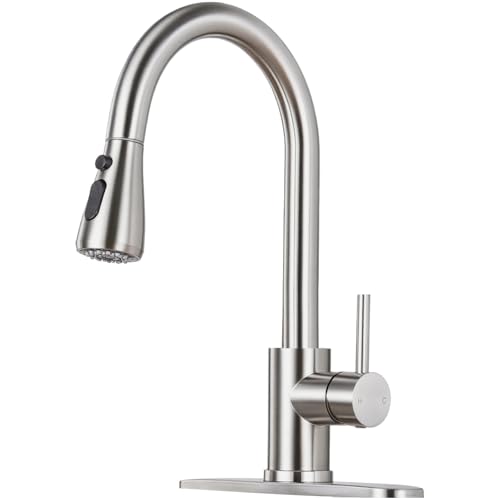
LUFG Pull-Down — Best for RV and Laundry
LUFG’s pull-down arrives with a deck plate, three spray modes, an 18-inch hose and a certification set — NSF372, NSF61 and cUPC — that reads like it was written for people who check. The manufacturer positions it across kitchen, RV, laundry, farmhouse and bar sinks, in 1-hole or 3-hole installations. It suits exactly those secondary and hard-working sinks. It does not suit buyers wanting verified height data or a national brand.
Strengths
- Deck plate and installation tools included — a complete box for a 3-hole deck.
- Certification set (NSF372, NSF61, cUPC) published in the manufacturer’s data.
- Three modes with automatic sprayer retraction and 360-degree swivel.
Trade-offs
- No verified overall height published — confirm clearance on the listing.
- Brand support is online-only.
- Utilitarian styling.
Spec snapshot (verified): Install: 1 or 3 hole, deck plate included · Hose: 18-in · Modes: stream, spray, pause · Body: SUS 304 stainless · Certifications: NSF372, NSF61, cUPC per manufacturer
Secondary sinks are where three-hole decks cluster outside the main kitchen — the laundry room that inherited a deck, the RV galley, the bar sink — and the LUFG is specced for that life: certified materials, a plate in the box, tools in the box, and a sprayer that retracts on its own. It is not the faucet for a design-led main kitchen, and it does not pretend to be. It is the right faucet for the room where the work is. Secondary sinks also tend to be the ones whose faucets are replaced by owners rather than plumbers, in tight cabinets, with the household’s one free Saturday — and a complete-box product with its own tools respects that reality in a way a bare faucet does not.
Best for: RV, laundry, bar and utility three-hole sinks / Not suited for: design-led main kitchens or dimension-first buyers
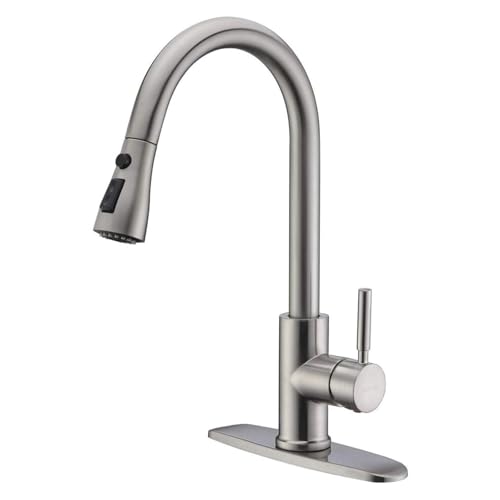
WEWE High-Arc Pull-Down — Best Long Reach
This WEWE model distinguishes itself with a 20-inch pull-down reach — the working radius that decides whether the wand reaches a pot on the counter, the far bowl of a double sink, or the floor-level pet bowl. The manufacturer’s title data confirms 1 or 3 hole fit, three-mode sprayer, soft silicone rub-clean nozzles, 360-degree swivel and SUS 304 construction with a ceramic cartridge. It suits large and double sinks on three-hole decks. It does not suit buyers wanting a deck plate experience verified beyond the title data — confirm the plate’s inclusion on the listing — or brand loyalists.
Strengths
- 20-inch pull-down reach — the longest working radius in this guide.
- Rub-clean silicone nozzles for hard-water maintenance in seconds.
- Three spray modes and full 360-degree swivel.
Trade-offs
- Specification depth beyond the title data is thinner than the FORIOUS or FEELSO listings.
- Online-only brand support.
- A long hose needs a clear, generous loop under the sink to retract cleanly.
Spec snapshot (verified): Install: 1 or 3 hole · Reach: 20-in pull-down · Nozzles: soft silicone, rub-clean · Body: SUS 304 · Cartridge: ceramic (per Amazon title data)
Reach is the underrated spec in this category, because it is the one that decides whether the pull-down feature is a convenience or a party trick. Twenty inches of it turns the wand into a true second water source at the sink — filling, rinsing and washing down without moving vessels to the stream. Pair that with nozzles you clean with a fingertip and the WEWE becomes the practical pick for big-sink households, provided your under-sink loop has the room the hose needs. Do confirm the deck plate’s presence for your configuration on the listing before ordering, since this model’s data is thinner than the FORIOUS’s exemplary sheet.
Best for: large and double sinks wanting maximum wand reach / Not suited for: cramped under-sink cabinets
Comparison Table
| Pick | Badge | Key spec | Best for |
|---|---|---|---|
| Moen Adler 87233SRS | Best Overall | Deckplate incl., Power Clean | Mainstream kitchens |
| FORIOUS Pull-Down | Best Budget | 10-in plate, 3 modes | Budget decks |
| FEELSO Pull-Down | Best Features | 20-in hose, 16.38 in tall | Busy families |
| VAPSINT Pull-Down | Best Compact Budget | 1-to-3 hole, 1.8 GPM | Apartments, rentals |
| LUFG Pull-Down | Best for RV and Laundry | Plate incl., NSF/cUPC | Secondary sinks |
| WEWE High-Arc | Best Long Reach | 20-in pull-down reach | Large double sinks |
How to Choose a 3 Hole Kitchen Faucet
Verify the plate first: it must be included, and it must be long enough for your spread — about 10 inches of plate for the standard 8-inch spread. A plate that barely covers the holes leaves the gasket line at the hole edges, which is where leaks and rocking start. Second, check the deck thickness against the faucet’s published maximum (the FORIOUS states 1.5 inches; thicker stone decks need a model that publishes a longer mounting range). Third, choose the faucet above the plate by the usual hierarchy: docking system, cartridge quality and published testing, spray modes matched to your cooking, then finish. Fourth, plan the under-sink loop: every pick here is a pull-down, and the hose needs a clear vertical channel regardless of brand.
One decision three-hole owners should make consciously: plate or components? This guide’s picks are plate-mounted single faucets, which is the modern pattern. The alternative — a faucet whose handles and spout mount through the three holes individually — is the two-handle and widespread world, covered in our two-handle guides. Plate mounting wins on choice (the entire modern pull-down catalog is open to you) and on future flexibility (the deck stays standard). Component mounting wins on traditional looks. Decide by the kitchen, not by habit.
How to Install a Faucet on a 3 Hole Deck
Shut off the stops, remove the old faucet, and clean the deck across all three holes — the plate’s gasket needs a flat, clean line, and old sealant ridges are the main cause of plate leaks. Set the plate with its gasket over the holes, then the faucet through the plate’s center opening. From below, thread the mounting hardware and snug it evenly; check from above that the plate sits square and covers the outer holes with margin on both sides before final tightening. Connect the supplies, attach the pull-down hose and clip the counterweight at the marked position with a clear loop.
A note on removing the old faucet, because on three-hole decks it is often the longest step of the day: the old mounting nuts have typically been in place for a decade or more, in the damp dark under a sink, and they behave accordingly. Penetrating oil applied the night before, a basin wrench for the awkward angles, and a willingness to cut a seized nut with a rotary tool rather than twist the whole faucet are the three things that separate a forty-minute removal from a three-hour one. Once the deck is bare, resist the urge to rush — the cleaning and dry-fit stage is where this installation is actually won.
Flush with the aerator removed, test every spray mode, and paper-towel every joint. Problem: the plate rocks slightly → the deck is uneven or debris sits under the gasket; lift, clean, reseat — do not overtighten to compensate, which bows the plate. Problem: the outer holes peek out at the plate’s ends → your spread is wider than the plate covers; measure honestly and choose a longer-plate model rather than sealing the gap with silicone, which fails and looks like failure. Problem: the wand stops docking after a week → the hose loop has settled onto stored items; clear the channel and re-clip the weight at its mark.
The Deck Plate, Taken Seriously
On a three-hole deck, the escutcheon plate is not an accessory — it is a structural and sealing component, and it deserves the scrutiny usually reserved for the faucet itself. A good plate is long enough to cover the outer holes with margin (about 10 inches for the standard spread), rigid enough not to flex when the faucet is torqued by a heavy pull on the wand, and gasketed along its full footprint so that the daily splash at the faucet’s base does not migrate through the outer holes into the cabinet. Plate flex is the hidden quality divider in this category: a thin, flexible plate lets the whole faucet micro-rock, which owners feel as cheapness every time they dock the wand, and which works the mounting loose over years. The Adler’s plate, as part of a national brand’s kit, is the benchmark; among the direct brands, the FORIOUS’s named 10-inch plate with published tolerances is the one that treats the component with the same seriousness.
There is also a cosmetic dimension. The plate defines the faucet’s footprint on your deck, and its finish must match the faucet exactly — a mismatch that bundled kits eliminate by definition and separate purchases often fumble. If your deck’s holes are stained or ringed from the old faucet (they will be), the plate is your friend: it covers the evidence. Clean the deck anyway before installation, because the gasket seals to the surface, and because the one time you will see under that plate again is years from now, when whatever you trapped under it has had time to become a problem.
Spray Modes, Docking and Hoses: Comparing the Six Honestly
Across this guide, the spray story splits in two. Moen’s Adler offers two functions but engineers them for force — Power Clean is a deliberately concentrated rinse — and docks with the Reflex system, the most proven retraction design in the category. The direct brands offer three modes including pause, which is the more versatile daily toolkit, with docking by counterweight. Neither approach is wrong; they optimize different kitchens. Heavy roasting and baking households should weight the Adler’s force and dock. Households that fill pots on the counter, wash produce constantly and move the wand between vessels should weight the pause mode — it is the feature owners mention most after a month of use.
Hose length is the quiet spec: the FEELSO and WEWE picks publish 20-inch-class reach, the FORIOUS and VAPSINT 18-inch hoses, and the practical difference shows at the edges of a double sink and at the counter beside it. Every hose, regardless of length, needs the same under-sink discipline — a clear vertical loop, the weight clipped at the manufacturer’s mark, and nothing stored in the loop’s path. More three-hole installs “fail” from a blocked loop than from every faucet defect combined, and the fix is always free.
Three-Hole Remodel Scenarios
Scenario one is the straight replacement: working three-hole sink, tired faucet. Any pick here drops in over a weekend morning; choose by tier and spray preference. Scenario two is the countertop replacement that keeps a three-hole drilling pattern — common when a laminate or stone counter is drilled to match the old sink’s deck. The plate-mounted pattern means the new counter’s holes and the faucet’s plate were designed for each other; just confirm deck thickness against the faucet’s published maximum before the stone is cut, because that number is much harder to change afterwards. Scenario three is the sink upgrade within a kept counter: a new drop-in sink with a three-hole deck replacing an old one. Here the plate again forgives everything — hole spacing differences between old and new sinks vanish under a 10-inch plate, which is precisely why this pattern became the standard.
Scenario four is the conversion: a three-hole owner tempted by a one-hole designer faucet or a two-handle component faucet. Both are legitimate — the one-hole faucet simply uses its plate, and the two-handle route is covered in our companion guides — but the conversion to avoid is drilling new holes in a sound deck to chase a faucet that has a plate-mounted equivalent. Decks outlive faucets; keep the deck standard and let faucets come and go.
Maintenance for Plate-Mounted Pull-Downs
The plate adds one maintenance item to the standard routine: the gasket line. Once or twice a year, run a fingernail along the plate’s edge; if the gasket has lifted or the plate has developed any rock, snug the mounting hardware from below before water finds the outer holes. Everything else is the category standard — aerator rinsed of scale, silicone nozzles rubbed clean on the models that have them, finishes wiped with a damp cloth rather than abrasive cleaners, and the hose loop audited whenever the under-sink cabinet gets reorganized. Cartridges in this guide are ceramic across the board, and the replacement logic follows the brands: Moen’s is a national-counter part, while the direct brands’ cartridges are ordered from the brand — one more reason to keep the model information from your order confirmation somewhere it will survive a phone upgrade.
How to Measure Your Three-Hole Deck (Five Minutes, No Tools Beyond a Tape)
Measurement one: the spread. Hook the tape in the center of the left hole and read to the center of the right hole. Eight inches is standard; write down whatever you actually find, because “about eight” is how the wrong plate gets ordered. Measurement two: hole diameter. Most faucet holes are around 1.35 inches; the FORIOUS publishes a mounting range of 1.30–1.38 inches, which shows how tight the tolerances can be — a hole enlarged by a previous owner’s improvisation may need the plate’s coverage checked, not assumed. Measurement three: deck thickness, taken at the sink’s edge or from below where the deck’s underside is visible. Compare it with the faucet’s published maximum before ordering, not during installation.
Measurement four is the one everyone skips: the under-deck survey. Shine a light under the sink and map what the mounting hardware and the hose loop will meet — the disposal’s position, the sink’s reinforcing ribs, the supply stops’ locations, and any shelf or filter that has colonized the space. Pull-down faucets need a vertical channel for the hose; if the channel is occupied, plan the reorganization as part of the project rather than discovering it with the old faucet already out. Five measurements, five minutes, and the installation becomes the easiest part of the remodel.
Finishes on a Plate-Mounted Faucet
A plate doubles the visible finished surface at the sink, which changes the finish calculus slightly. Spot-resistant stainless finishes (the Adler’s Spot Resist) earn their keep here because the plate sits exactly where splashes land and dry. Chrome plates show every dried droplet at the faucet’s base — the most-viewed square inches in the kitchen — and owners of chrome plate-mounted faucets should expect a wipe-down rhythm. Brushed nickel sits between the two. Whatever you choose, the plate and faucet must be the same product’s finish: cross-brand plate purchases are the most common finish mismatch in this category, because “brushed nickel” is a family name, not a color standard, and two brands’ versions differ visibly at arm’s length. Bundled kits exist to make this a non-decision; take the hint.
Common Buying Mistakes
- Assuming the plate is included. In this category, “fits 3-hole” without “deck plate included” in the manufacturer’s data is a claim to verify, not to trust.
- Not measuring the spread. Standard is 8 inches between outer holes; nonstandard decks need plate length checked, not assumed.
- Ignoring deck thickness. Published maximums vary; thick stone defeats short mounting hardware.
- Choosing by spray modes alone. Docking and cartridge quality decide year three of ownership; spray modes decide week one of it.
- Blocking the hose loop. The universal pull-down failure, and always a storage problem rather than a faucet defect. Clear the channel before the install, not after the first dock failure.
- Reusing the old faucet’s supply lines to save time. Old lines are the cheapest component in the system and the one whose failure floods cabinets. Fit the new lines that come in the box, or new braided lines, every time.
Final Recommendation
Buy the Moen Adler if you want the benchmark three-hole faucet with a national parts network standing behind it for the long term. The FORIOUS is the budget pick with the best-published fit data; the FEELSO maximizes features; the VAPSINT and LUFG cover compact and secondary sinks; the WEWE maximizes reach. For the neighboring patterns, see Best 2 Hole Kitchen Faucets and Best 4 Hole Kitchen Faucets; for two-handle component mounting on multi-hole decks, Best 2 Handle Kitchen Faucets; and for the value field overall, Best Affordable Kitchen Faucets.
Frequently Asked Questions
What is a 3-hole kitchen sink configuration?
Three holes in a row on the sink deck or counter, usually with 8 inches between the outer holes’ centers. Modern faucets mount through the center hole and cover the outer holes with a deck plate; traditional faucets mount a component in each hole. The pattern became the American standard because it serves both faucet generations, which is why a three-hole deck never truly goes obsolete: whatever the current faucet fashion is, a configuration exists that mounts on your deck, and the plate system means the entire modern pull-down catalog is available to you without drilling or filling.
Can I install a 1-hole faucet on a 3-hole sink?
Yes — that is exactly what the included deck plate is for, and every pick in this guide is a 1-or-3-hole faucet with the plate in the box. The reverse (a faucet needing three mounting points on a one-hole counter) is not possible without drilling, which on stone counters is a fabricator’s job and on a finished kitchen is a decision to make with the counter’s warranty in mind.
What if my 3-hole spread is not 8 inches?
Measure it and match the plate: the plate must cover both outer holes with margin. Standard plates around 10 inches cover the 8-inch spread; unusual spreads need the plate length verified in the manufacturer’s data before ordering, or a component-mount faucet designed for your spacing. Spreads narrower than standard are common on bar sinks and some imported sinks, and spreads wider than standard appear on a minority of older American decks — both are workable, but only with the plate length treated as a specification to confirm rather than a detail to hope about.
Do I need plumber’s putty under the deck plate?
Most modern plates seal with an included gasket and need no putty; follow the faucet’s instructions. Putty is for specific sink materials and older designs, and some manufacturers prohibit it on certain countertop materials because it can stain. The gasket, a clean deck and even tightening do the work. If your deck is slightly uneven — common on older stainless sinks that have flexed over the years — a gasket alone may not bridge a visible dip at the plate’s edge; in that case a thin bead of kitchen-and-bath silicone under the plate’s perimeter (not in place of the gasket, but supplementing it at the low spot) is the accepted field fix, tooled neatly and left to cure before the faucet sees water.
Can a 3-hole faucet include a soap dispenser?
Not within the three holes — a plate-mounted faucet uses the center and covers the outers. Dispensers need a fourth hole (see our 4-hole guide) or a countertop-mounted position drilled separately. Some owners mount a dispenser through the counter beside the sink where the material allows drilling.
Are budget 3-hole faucets reliable?
The credible ones in this guide publish their evidence: ceramic cartridges with cycle testing (FEELSO), certifications such as cUPC and NSF (FORIOUS, LUFG), and stated mounting tolerances. What you give up versus Moen is the parts network and finish range. In this category, a transparent listing is the reliability signal.
Can I use a 3-hole faucet without the deck plate?
On a one-hole counter, yes — that is the “1” in “1 or 3 hole,” and every pick here supports it by leaving the plate off. On your three-hole deck, no: without the plate, the outer holes are open to every splash, and the faucet’s base is not designed to seal them. If you dislike plates aesthetically, the alternative is a component-mount faucet (two-handle or widespread) that uses the holes directly — a different category with its own guides on this site — not a plate faucet with the plate discarded.
How do I stop water getting under the deck plate?
Three things: a clean, flat deck before installation (old sealant ridges are the usual culprit), the included gasket seated along the plate’s full footprint, and even mounting torque — snug both sides progressively rather than fully tightening one side first, which cocks the plate. If water appears under the sink after install, check the plate line before suspecting the faucet’s connections; a dry paper towel at each joint will tell you which system is weeping.


