Disclosure: airfryerkitchensupply.com is reader-supported. When you buy through links on our site, we may earn an affiliate commission at no extra cost to you.
Where to buy
Every faucet below is sold on Amazon, where you can confirm the exact configuration — sprayer or dispenser in the fourth hole — before ordering. Start with the Cinwiny 2-handle faucet with sprayer on Amazon, and compare the Delta Windemere 21996LF, the Moen Essie 87014SRS, the Moen Belfield 7255SRS, the Delta Boyd with dispenser and the Moen Bexley 87403. Check the current price on Amazon for each configuration, and confirm your deck’s spread and fourth-hole position before ordering anything.
Introduction: four holes means every component gets a home
The best 4 hole kitchen faucets serve the most capable deck pattern in the American kitchen, full stop. Four holes means the faucet never has to compromise on anything: spout and handles (or a plate-mounted faucet) across the main holes, and the fourth hole doing real work — a side sprayer for rinsing and filling beyond the sink, or a soap dispenser that clears the bottle off the counter. This is the deck that the classic two-handle era was designed around from the beginning, and it remains the pattern with the most complete faucets built specifically for it. If your sink has four holes, you do not need plates pretending to be faucets or covers pretending the holes are not there at all; you need a faucet that uses the deck exactly as it was designed.
This guide verifies every pick through Amazon data for this site, because four-hole configurations are where listing confusion peaks: the same model families ship in 3-hole and 4-hole variants, with sprayers, with dispensers, and with neither, under nearly identical names. The six below are the configurations we could confirm completely — two true four-hole two-handle sets with sprayers (Cinwiny, Windemere), the one pull-down whose manufacturer data explicitly covers 4-hole installation (Moen Essie, with its included dispenser), the traditional Belfield two-handle with side spray, Delta’s Boyd bundled with its dispenser, and Moen’s entry-level Bexley. Together they cover the two things a fourth hole can be in practice: a sprayer or a dispenser, at every tier that matters to buyers in this category today.
Before shopping, map your deck. Four-hole decks usually run an 8-inch spread across the faucet holes with the fourth hole in line, but offset fourth holes exist, and the spread between the handle holes on widespread decks varies. Measure the outer spread, note the fourth hole’s position, and check underneath for obstructions — the sprayer hose and the dispenser bottle both need vertical room that a disposal or filter may already occupy.
It is worth pausing on what “best” can mean for this deck, because four-hole buyers are usually renovating rather than building new, and renovation changes the criteria. The best four-hole faucet is rarely the most advanced faucet in the store; it is the one whose configuration matches a deck that already exists, whose parts will be available for the deck’s remaining life, and whose fourth-hole component matches the household’s actual habits. Every pick in this guide was chosen against those criteria, which is why the list contains a budget centerset, two traditional brand sets, two dispenser arrangements and an entry-level brand faucet — and no touch-activated showpiece that would leave the fourth hole as an afterthought.
In this guide
Quick Picks
- Best Overall: Cinwiny 2-Handle with Sprayer — true 4-hole centerset (3 holes faucet + 1 sprayer), 1.8 GPM, 47-inch sprayer hose, complete kit with supply lines. Check the current price on Amazon
- Best Traditional: Delta Windemere 21996LF — verified 4-hole 8-inch installation with side sprayer, cartridge tested to 500,000 uses, deck gasket seal. Check the current price on Amazon
- Best Pull-Down for 4 Holes: Moen Essie 87014SRS — verified 1, 2, 3 or 4-hole installation, Power Clean spray, Reflex docking, dispenser included for the fourth hole. Check the current price on Amazon
- Best Two-Handle Traditional: Moen Belfield 7255SRS — two-handle high arc with side spray, Spot Resist Stainless, Duralock install. Check the current price on Amazon
- Best with Dispenser: Delta Boyd 19893Z-SPSD-DST — pull-down with matching soap dispenser, ShieldSpray, MagnaTite docking. Check the current price on Amazon
- Best Budget Brand: Moen Bexley 87403 — two-handle levers with side spray hose in chrome, national-brand support at an entry tier. Check the current price on Amazon
How These Picks Were Chosen
The screen was configuration truth: the manufacturer’s data had to account for all four holes — a faucet pattern plus a sprayer or dispenser for the fourth — for the exact listing linked. We verified each model, reading feature and specification data rather than photographs (photographs in this category routinely show a sprayer that the shipped configuration does not include). Survivors were ranked on how completely they use the deck, sprayer or dispenser quality, cartridge serviceability, finish, and the support channel behind the brand. We also checked the under-sink story for each pick — hose routing for sprayers, bottle clearance for dispensers, loop space for pull-downs — because a four-hole faucet is four installations sharing one cabinet, and a pick that wins on the deck but loses in the cabinet is not a recommendation we are willing to publish.
The list deliberately spans both fourth-hole philosophies. Sprayer-first buyers get the Cinwiny, Windemere, Belfield and Bexley; dispenser-first buyers get the Essie and Boyd. It also spans the mounting philosophies: true component mounting (the two-handle sets) versus a modern pull-down that treats four holes as one of its rated configurations (the Essie) or arrives with its dispenser as a designed pair (the Boyd). A four-hole deck is the most flexible pattern in the kitchen; the guide’s job is to match that flexibility to the household, not to declare one philosophy the winner.
Two exclusions deserve a sentence each, because four-hole shoppers will meet both. First, the many pull-down faucets whose listings say “fits 4-hole sinks” while meaning “the plate is long” — a plate that spans four holes without assigning the fourth is a covering strategy, not a four-hole faucet, and it is covered honestly in our 3-hole guide’s terms rather than here. Second, two-handle sets sold without any fourth-hole component, which are three-hole faucets regardless of how the retailer’s photograph arranges them. Both are legitimate products in their own categories; this guide’s standard is that a four-hole pick must account for the fourth hole with a working component, verified in the manufacturer’s data.
A Brief History of the Four-Hole Deck
The four-hole deck is a fossil of good ideas. The first three holes belong to the era of separate hot and cold valves — the standard American sink from the early twentieth century onward. The fourth arrived with the side sprayer, which spread through suburban kitchens in the post-war decades as the must-have convenience, and for roughly forty years the four-hole pattern was simply what a proper kitchen sink looked like. The single-lever and pull-down eras then taught the industry to cover holes rather than use them, and the deck plate became the peace treaty between old sinks and new faucets.
What is interesting now is the partial reversal: the dispenser has given the fourth hole a second career, and the two-handle revival in traditional and farmhouse design has restored component mounting to fashion. A four-hole deck in 2026 is not a legacy constraint — it is the only deck that can run every faucet philosophy, from a commercial two-handle set to a touch pull-down with a dispenser. Owners of these decks are, without usually knowing it, the least constrained faucet buyers in the market. This guide is written in that spirit: use the deck’s full capability, in whichever philosophy suits the kitchen.
The 6 Best 4 Hole Kitchen Faucets

Cinwiny 2-Handle Kitchen Faucet with Sprayer — Best Overall
The Cinwiny is the rare budget faucet that specifies its four-hole pattern exactly: three holes for the 8-inch centerset faucet, one for the side sprayer, in the manufacturer’s own data — along with a 1.8 GPM maximum flow, a 360-degree high-arc spout with 7.28-inch reach, a sprayer hose of 47 inches with up to 33 inches of extendable reach, and a complete kit including 32-inch supply lines. It suits modern and farmhouse four-hole decks, budget remodels and utility sinks. It does not suit buyers who need a national brand’s parts counter.
Strengths
- True, explicitly specified 4-hole configuration — no variant guessing.
- Published sprayer dimensions (47-in hose, up to 33-in reach) that beat most brand listings for transparency.
- Complete installation kit including supply lines, in lead-free SUS304 stainless.
Trade-offs
- Online-only brand support; keep the model documentation.
- Brushed nickel only in this configuration.
- Centerset pattern is fixed at 8 inches — not for widespread decks.
Spec snapshot (verified): Configuration: 2-handle centerset + side sprayer, 4-hole (3+1) · Spread: 8-in centerset · Flow: 1.8 GPM max · Spout reach 7.28 in, 360° swivel · Sprayer hose 47 in, reach up to 33 in · Supply lines: 32 in included
What makes the Cinwiny the overall pick is that it treats the four-hole deck as a system and publishes the system’s numbers. The sprayer’s reach is bucket-on-the-floor territory, the swivel spout covers the basin’s center, and the separate handles mix with a precision single levers approximate. At its budget tier, the honest caveat is infrastructure rather than function: source parts through the brand and keep the paperwork. For a four-hole deck being renovated on a real budget, it is the most completely specified option we verified at any tier.
Its centerset format deserves one practical note: because the faucet components share an aligned 8-inch pattern, the Cinwiny is the fastest install in this guide — the components locate themselves, alignment is built into the pattern, and the included 32-inch supply lines remove the most common mid-install parts run. For a rental turnover or a first four-hole project, that installation forgiveness is worth as much as the sprayer reach.
Best for: four-hole decks wanting a fully specified, complete kit on a budget / Not suited for: widespread decks or brand-network loyalists

Delta Windemere 21996LF — Best Traditional
Delta’s Windemere states its four-hole credentials in the manufacturer’s data: “Fits 4-hole 8 in. center installations,” with a matching side sprayer, a gasket seal at the deck, and a cartridge valve tested to last at least 500,000 uses. It suits the standard American four-hole deck in a traditional kitchen, at a value tier with national-brand engineering. It does not suit widespread decks or buyers wanting a spot-resistant finish — this configuration is chrome.
Strengths
- Verified 4-hole, 8-inch installation with sprayer — the classic pattern, exactly specified.
- Published cartridge endurance (500,000-use testing) and a deck gasket against under-faucet leaks.
- Delta’s Brilliance finish testing and national parts availability.
Trade-offs
- Chrome shows spots and fingerprints.
- Lower profile (11.63 in overall) limits the tallest docked clearance; the sprayer compensates.
- Fixed centerset spacing.
Spec snapshot (verified): Configuration: two-handle with side sprayer · Install: 4-hole, 8-in centers · Dimensions: 8 x 10.25 x 11.63 in · Finish: chrome · Valve: cartridge, 500,000-use tested per Delta
The Windemere is what happens when a national brand aims at the heart of the replacement market: the most common deck in the country, a configuration stated in plain language, engineering money spent on the valve and the seal. Its lower arc is a feature in disguise for the shallow sinks and low cabinets of the homes that have these decks — and where clearance runs out, the sprayer does the tall work. For a traditional four-hole kitchen that values correctness over drama, this is the pick. Delta’s support structure completes the argument: the Windemere’s cartridge is a stocked, numbered part, and the faucet’s documentation states its installation pattern so plainly that a competent handyman can quote the job from the listing alone.
Best for: standard 4-hole decks and traditional value remodels / Not suited for: widespread spacing or spot-resistant finishes
Moen Essie 87014SRS — Best Pull-Down for 4 Holes
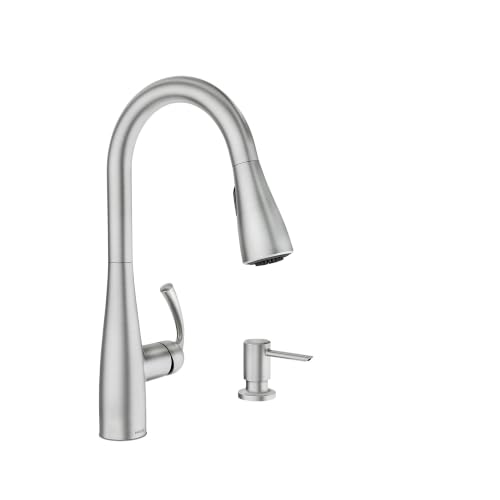
Most pull-downs meet a four-hole deck with a plate and a shrug. The Essie meets it with a rating: Moen’s verified data lists the Essie for 1, 2, 3 or 4-hole configurations with the deck plate included, and the included dispenser — fillable with soap or lotion — gives the fourth hole its job when the faucet mounts through the plate pattern. Add Power Clean spray, Reflex docking and Spot Resist Stainless. It suits four-hole owners who want a modern pull-down without abandoning the deck. It does not suit buyers who want the fourth hole to be a sprayer — the Essie’s fourth hole is the dispenser.
Strengths
- Only pull-down here manufacturer-rated for 4-hole installation.
- Included dispenser completes the deck in one box.
- Moen’s current spray and docking technology with Duralock installation.
Trade-offs
- Fourth hole is committed to the dispenser, not a sprayer.
- Transitional styling.
- 15.75-inch height needs the usual cabinet check.
Spec snapshot (verified): Install: 1, 2, 3 or 4 hole, deck plate included · Overall height 15.75 in · Dimensions 8.78 x 2.31 x 15.75 in · Finish: Spot Resist Stainless · Spray: Power Clean, Reflex system · Accessory: soap/lotion dispenser included
The Essie is the bridge between the four-hole past and the pull-down present, and it is engineered like one: the configuration kit is complete, the technology is current, and the dispenser turns the deck’s extra hole from a covering problem into a daily convenience. If your household’s fourth hole should dispense soap while a modern wand does the rinsing, this is the most coherent product in the category. It is also the safest four-hole purchase for an uncertain deck, because its rated range (1 through 4 holes) means a miscounted or mis-measured deck is a configuration change, not a return.
Best for: four-hole owners wanting a modern pull-down plus dispenser / Not suited for: buyers wanting a side sprayer in the fourth hole

Moen Belfield 7255SRS — Best Two-Handle Traditional
The Belfield is the premium traditional expression of the four-hole pattern: two lever handles and a high-arc spout across the main holes, a coordinated side spray in the fourth, Spot Resist Stainless throughout, Duralock quick-connect underneath and ADA-compliant levers. It suits traditional and transitional kitchens where the faucet is a considered purchase. It does not suit modern styling or buyers who prefer a wand.
Strengths
- The complete coordinated configuration from a current Moen collection.
- Spot Resist finish across a lot of visible metal — handles, spout and sprayer.
- NSF 61 certification and ADA levers per Moen’s data.
Trade-offs
- Sprayer and diverter are wear items a pull-down does not have.
- Traditional styling commits the room.
- Premium tier within this guide.
Spec snapshot (verified): Configuration: two-handle high arc with side spray · Finish: Spot Resist Stainless · Install: Duralock quick connect · Compliance: ADA, NSF 61 per Moen data · Also in Oil Rubbed Bronze (7255ORB)
Where the Cinwiny wins on specification transparency and the Windemere on value engineering, the Belfield wins on coherence: every visible component was designed together, finished with Moen’s best residential finish technology, and backed by the deepest parts channel in the category. In a traditional kitchen that will keep this faucet for fifteen years, coherence and parts are the purchase. The sprayer covers the rinsing and filling work; the high arc covers the pots; the levers cover the hands of every cook in the house. It is also the pick that ages most gracefully in photographs and in person, because a coordinated collection does not date the way an assembled arrangement can — a consideration that matters in the rooms where family life is documented.
Best for: traditional four-hole kitchens buying for the long term / Not suited for: modern styling or wand loyalists

Delta Boyd 19893Z-SPSD-DST — Best with Dispenser
The Boyd is Delta’s designed pair: a pull-down faucet and its matching soap dispenser in SpotShield Stainless, with ShieldSpray technology, DIAMOND Seal valve and MagnaTite magnetic docking in the manufacturer’s verified data. On a four-hole deck it mounts the faucet on its plate and sets the dispenser in the fourth hole — a modern arrangement that looks factory-planned because it is. It suits family kitchens that will use a dispenser daily. It does not suit sprayer-first households.
Strengths
- Faucet and dispenser designed and finished as a set — no finish-matching gamble.
- ShieldSpray’s contained, forceful cleaning stream per Delta’s data.
- MagnaTite docking and a valve Delta rates at twice the industry standard.
Trade-offs
- Fourth hole committed to soap.
- Bundled finish is SpotShield Stainless; other finishes change the set.
- Dispenser refills are a recurring small chore.
Spec snapshot (verified): Configuration: pull-down faucet with included soap dispenser · Finish: SpotShield Stainless · Docking: MagnaTite · Spray: ShieldSpray · Valve: DIAMOND Seal (per Delta listing data)
The Boyd and the Essie solve the same deck two ways: Moen with maximum configuration flexibility, Delta with a curated pair and stronger spray technology. Delta’s ShieldSpray is a genuine differentiator for messy cleanup — a concentrated stream corralled by a water shield that keeps the blast in the sink — and the dispenser’s finish match is guaranteed by the bundle. If your fourth hole is destined for soap and your cooking is the enthusiastic kind, the Boyd is the four-hole faucet designed for you. Its one planning note is under the sink: the dispenser bottle and the pull-down hose loop are neighbors, so route the loop first and set the bottle where the loop is not, rather than discovering the negotiation after both are installed.
Best for: four-hole family kitchens wanting faucet plus matched dispenser / Not suited for: side-spray households

Moen Bexley 87403 — Best Budget Brand
The Bexley brings the four-hole classic layout to the entry tier from a national brand: chrome two-handle levers with a side spray hose, in a configuration Moen’s data describes as easy to adjust with flexible cleaning at the sink. It suits landlords, first remodels and utility kitchens that want Moen’s cartridge ecosystem without the mid-tier spend. It does not suit finish-driven projects or high-arc seekers.
Strengths
- Full classic configuration — two handles plus sprayer — at an entry tier.
- Moen parts support behind the wear items (cartridges, sprayer hose).
- Lever handles suit wet, soapy or limited-grip hands.
Trade-offs
- Chrome only, with spotting upkeep.
- Plain styling and a conventional arc.
- Listing data is thinner than Moen’s premium lines — verify the deck pattern before ordering.
Spec snapshot (verified): Configuration: 2-handle lever with side sprayer · Finish: chrome · Line: Moen Bexley 87403 (per Amazon title and feature data)
Four-hole decks live disproportionately in rental and starter homes, which is exactly where the Bexley’s proposition lands: the configuration is complete, the brand’s parts exist everywhere, and the price tier respects the property’s economics. It will not be admired, and it will be fixed in twenty minutes in year nine with a part from any plumbing counter in America. For its buyer, that is the whole review. Property managers should note the operational detail that makes the Bexley (and the Windemere) attractive at scale: every wear item on these faucets can be replaced by a maintenance tech with hand tools and a parts-store run, without shutting the unit down for a faucet replacement — the arithmetic that decides what a portfolio of kitchens costs to run.
Best for: rentals and budget four-hole remodels wanting brand support / Not suited for: premium finishes or design projects
Comparison Table
| Pick | Badge | Key spec | Best for |
|---|---|---|---|
| Cinwiny 2-Handle with Sprayer | Best Overall | True 4-hole, 33-in sprayer reach | Complete budget kit |
| Delta Windemere 21996LF | Best Traditional | 4-hole 8-in, 500k-use cartridge | Traditional value |
| Moen Essie 87014SRS | Best Pull-Down for 4 Holes | Rated 1–4 hole, dispenser incl. | Modern wand + soap |
| Moen Belfield 7255SRS | Best Two-Handle Traditional | High arc + side spray | Long-term traditional |
| Delta Boyd 19893Z-SPSD-DST | Best with Dispenser | Dispenser set, ShieldSpray | Family kitchens |
| Moen Bexley 87403 | Best Budget Brand | Levers + spray hose | Rentals, first homes |
How to Choose a 4 Hole Kitchen Faucet
Assign the fourth hole first — sprayer or dispenser — because it halves the list instantly. Sprayer households should then choose between the complete traditional sets (Cinwiny for specification value, Windemere for Delta engineering, Belfield for the premium traditional package, Bexley for the entry brand tier). Dispenser households choose between flexibility (Essie) and a curated pair with stronger spray tech (Boyd). Next, confirm the pattern: 8-inch centerset for the Cinwiny and Windemere; the Belfield family’s widespread-style arrangement; the plate pattern for the Essie and Boyd. Measure your spread rather than assuming — four-hole decks are old enough to contain surprises, including fifth holes drilled by previous owners and hidden under the current faucet’s base.
Then apply the ownership filters: cartridge and diverter parts availability (the national brands’ decisive advantage), finish behavior in your water, and handle ergonomics for the household’s hands. Finally, check the under-sink map: a sprayer hose needs a clear loop on its side of the cabinet, a dispenser bottle needs vertical clearance and refill access, and a pull-down’s hose loop needs its own channel. Four components, four space claims — the deck is only half the installation.
How to Install a 4 Hole Kitchen Faucet
Shut off the stops, remove the old faucet and clean the deck at all four holes. For a component set (Cinwiny, Windemere, Belfield, Bexley), set each component with its gasket — spout, handles — snugging mounting hardware evenly and checking handle alignment from above before final tightening; then feed the sprayer hose through the fourth hole and connect it to the diverter outlet, routing a smooth loop. For a plate-mounted pull-down (Essie, Boyd), set the plate and faucet first, then mount the dispenser in the fourth hole and fill it after the plumbing is tested, not before — a full dispenser bottle is an awkward thing to work around.
Connect hot left and cold right, flush each side with the aerator removed, and test the fourth-hole component specifically: cycle the sprayer and confirm the diverter switches cleanly (spout stops, sprayer runs full), or run the dispenser pump until soap draws. Paper-towel every joint, then exercise the sprayer or wand through full travel and check again — hose joints confess under movement. Problem: a handle sits rotated → loosen, square it, retighten with a helper watching. Problem: sprayer sputters → debris in its head; rinse and refit. Problem: dispenser pump will not prime → the pickup tube is above the soap level or kinked; reseat the bottle and pump slowly until it draws.
Four-hole installs take longer than any other pattern in this batch of guides — four components, four sets of hardware, and an under-sink cabinet that must accommodate all of them — so plan the job in the right order and light. Do the faucet’s water connections first, while the cabinet is emptiest; mount the fourth-hole component last; and leave the dispenser bottle empty (or the sprayer unclipped) until the leak test passes, because both are easier to fit into a proven-dry cabinet than to work around in a wet one. Photograph the finished under-sink arrangement before you reload the cabinet: in three years, when a cartridge needs changing, that photograph is the map.
Sprayer or Dispenser: the Fourth-Hole Decision in Depth
The sprayer’s case is functional breadth. A side sprayer rinses the whole basin including the corners a fixed spout cannot reach, fills vessels that do not fit under the spout — including a bucket on the floor, with reach like the Cinwiny’s up-to-33-inch working radius — and washes produce with a free hand. Its costs are mechanical: a hose, a diverter, and a trigger head that will eventually be replaced. The dispenser’s case is daily frequency and counter aesthetics. It is used more times per day than any sprayer, it removes the soap bottle from the sink’s edge permanently, and its only wear item is a pump. Its cost is opportunity: the hole it occupies cannot be a sprayer.
Households resolve this by cooking style more than by budget. Bake-and-roast households with sheet pans and stockpots lean sprayer. Households whose sink work is mostly glasses, produce and hand-washing lean dispenser. Households that genuinely do both should know the honest workaround: a pull-down faucet (the wand covers sprayer duties) plus a dispenser in the fourth hole — which is precisely the Essie and Boyd pattern, and the reason those two picks exist in a four-hole guide dominated by two-handle sets. The wand is not identical to a side spray — it cannot reach a floor bucket — but for in-sink work it covers the sprayer’s role while the dispenser takes the hole.
Four-Hole Deck Patterns: Centerset, Widespread and Plate
Three mounting grammars share the four-hole name. The centerset pattern (Cinwiny, Windemere) fixes the faucet components at an 8-inch spread on a shared or aligned base — the pattern of the post-war American deck, and the easiest to shop for because the dimensions are standard. The widespread pattern (the Belfield family’s arrangement) mounts each component independently, tolerating handle spreads from about 8 to 16 inches; it suits stone counters drilled to a design rather than to a standard, and it demands you measure your actual spread. The plate pattern (Essie, Boyd) treats the four holes as a field to be organized by a modern faucet: plate over the main holes, accessory in the fourth. It is the most forgiving of odd decks and the least traditional in appearance.
Identifying your grammar is a tape-measure exercise: if the faucet holes are at a fixed 8-inch spread with the fourth in line, all three grammars are open to you. If the handle holes are wider or irregularly spaced, widespread or plate. If the deck is stone and the holes were drilled for a specific previous faucet, plate patterns forgive the most. Write the measurements on the same note as the hole count; together they are your deck’s identity, and every faucet decision in this category follows from them.
Maintaining a Four-Component Installation
Four holes means four components with four maintenance rhythms, and the owners who enjoy these faucets longest are the ones who keep a simple annual circuit. The cartridges (two, on the two-handle sets) are decade-scale parts; exercise both handles fully each week so neither side seizes from disuse. The sprayer’s circuit is the diverter and hose: run the sprayer weekly, inspect the hose loop when you are under the sink for any other reason, and treat a spout that dribbles during sprayer use as a diverter asking for a flush before it asks for a part. The dispenser’s circuit is the pump: flush it with warm water when it sputters, rinse the bottle at refill time, and keep the pickup tube fully submerged.
The deck itself is the fourth component. Splash lands at the bases of four fittings, so the gasket lines deserve a look twice a year, and the area under the sink beneath the fourth hole deserves a specific check — sprayer and dispenser leaks both present there first, quietly, and a thirty-second look with a flashlight is the difference between reseating a hose and replacing a cabinet floor. None of this is burdensome; it is simply the honest upkeep of the most capable deck pattern, and it is lighter than the maintenance of the appliances on either side of the sink.
Budget Tiers Among Four-Hole Faucets
The entry tier — the Bexley from the brand world, the Cinwiny as the specification-led budget alternative — buys the complete configuration with serviceable components. The mid tier — Windemere, Essie, Boyd — buys engineered finishes, published endurance testing, stronger spray technology and designed dispenser pairings. The premium traditional tier — Belfield — buys collection coherence and the deepest finish program. Notably, four-hole is the one deck category where the entry tier is not a compromise pattern: the classic layout is old enough that its engineering is fully mature at every price, and the differences as you spend are finish, refinement and support rather than basic capability. Buy the tier that matches how long the faucet will stay and who will maintain it, and the category will not disappoint you at any of them.
Four Holes and Water: Flow, Sprayers and Efficiency
A four-hole installation does not change a faucet’s flow rating — the Cinwiny’s verified maximum is the residential-standard 1.8 GPM, and the two-handle Moen and Delta sets sit in the same modern residential class unless a specific model states otherwise. What the fourth hole changes is how water gets used. A side sprayer concentrates the faucet’s flow into a directed tool, which for rinsing tasks is more water-efficient than running the full spout stream and moving dishes through it; a dispenser eliminates the small but constant waste of the countertop soap bottle’s drips and over-pumps. Owners in states with a 1.8 GPM residential cap should note that every residential pick in this guide sits within the modern standard, and that the one higher-flow faucet in this batch of guides — the commercial M-Dura in our 2.2 GPM guide — is a commercial product for commercial settings, not a four-hole residential option.
The sprayer has one more efficiency-adjacent virtue worth naming: it shortens the distance between the water outlet and the work. Rinsing a pan under a fixed spout means maneuvering the pan; rinsing it with a sprayer means maneuvering the water, which is faster, and faster rinsing is shorter rinsing. In a household that hand-washes daily, that difference is the four-hole pattern’s quiet daily dividend — unglamorous, unmeasured on any spec sheet, and felt every evening at the sink.
Common Buying Mistakes
- Buying the 3-hole variant of a 4-hole name. Model families ship both; verify the configuration in the manufacturer’s data for the exact listing.
- Leaving the fourth hole unassigned. An unused hole needs a proper fitted cover at minimum; a working sprayer or dispenser is the better answer.
- Assuming the spread. Measure the outer spread and the fourth hole’s exact position — older decks deviate more often than they conform.
- Forgetting under-sink space claims. Sprayer loops, dispenser bottles and pull-down hoses all need room the disposal may already occupy down there.
- Crossing hot and cold on two-handle sets. Hot to the left handle — the classic, avoidable error, and on a four-component install the one most likely to be discovered only after the cabinet is reloaded.
- Treating the fourth hole as an afterthought. Its component has its own hose, bottle or lines, its own under-sink space claim, and its own maintenance rhythm. Plan it with the faucet, not after it.
Final Recommendation
For a four-hole deck on a budget, the Cinwiny is the most completely specified complete kit we verified. Traditional buyers should take the Windemere for value or the Belfield for the premium package; dispenser households should take the Essie for flexibility or the Boyd for its designed pair and spray technology; landlords should take the Bexley and keep its model number on file. For brand-specific depth, see Best 4 Hole Kitchen Faucets Moen; for the sprayer-first view, Best 2 Handle Kitchen Faucets With Side Spray; and for the neighboring patterns, Best 3 Hole Kitchen Faucets and Best 2 Hole Kitchen Faucets.
Frequently Asked Questions
What is the fourth hole on a kitchen sink for?
Traditionally, and still most commonly, a side sprayer. The modern alternative is a soap dispenser; it can also host a filtered-water tap or a dishwasher air gap where codes require one. This guide’s picks cover the sprayer (Cinwiny, Windemere, Belfield, Bexley) and dispenser (Essie, Boyd) assignments. If your deck’s fourth hole currently holds an air gap — recognizable by its small capped dome — check your local code before reassigning it, because in some jurisdictions the air gap is required equipment for the dishwasher, and its function would need to be preserved or replaced by an approved alternative rather than simply deleted for a dispenser.
Can I install a 3-hole faucet on a 4-hole sink?
Yes, with the fourth hole assigned to a separate accessory (dispenser, sprayer if the faucet has a diverter, or a filter tap) or closed with a proper hole cover. What you cannot do is leave it open — it is a direct water path into the cabinet. Note also that a three-hole faucet’s plate will not cover a fourth hole that sits outside the plate’s span, which on in-line decks it usually does; plan the fourth hole’s component or cover as part of the same purchase, not as an afterthought discovered at installation.
What is the standard 4-hole spread?
Most commonly an 8-inch spread across the faucet holes with the fourth hole in line, but widespread decks vary (handles 8 to 16 inches apart) and older decks deviate in both spread and fourth-hole position. Measure your actual spread and fourth-hole position before choosing between centerset and widespread models, and measure from hole center to hole center rather than edge to edge — the two figures differ by a full hole diameter, which is more than enough to order the wrong mounting pattern with complete confidence.
Sprayer or dispenser in the fourth hole — which is better?
The one your household will use daily. Kitchens that rinse large items, fill buckets or wash down the sink get more from a sprayer; kitchens that hand-wash constantly and hate counter clutter get more from a dispenser. Both are legitimate; the mistake is leaving the hole idle. If the household genuinely cannot decide, the pull-down-plus-dispenser pattern (Essie, Boyd) is the evidence-based hedge: the wand covers in-sink sprayer work, the dispenser covers the daily soap, and the only capability surrendered is filling a bucket on the floor — a task most households perform rarely enough to forgive.
Can I convert a 4-hole deck to a single-hole faucet?
Effectively yes, with a long deck plate or individual hole covers — but you are discarding the deck’s capability to do it. If a single-hole designer faucet is the goal, plate it properly and assign the fourth hole to a dispenser so the deck still earns its keep. The conversion worth avoiding is the half-finished one: a single-hole faucet on a short plate with two holes left open or caulked, which looks improvised and admits water. Whatever the deck ends up running, it should run it completely.
Do 4-hole faucets cost more to maintain?
Slightly, in parts count: a sprayer adds a hose and diverter to the wear list, a dispenser adds a pump. On the national-brand picks here those are inexpensive, stocked parts — the maintenance premium is real but small, and it buys the most capable deck configuration in the kitchen.
What if my fourth hole is offset or in an odd position?
Offset fourth holes are common on older decks and are actually friendly to hose-fed components: a sprayer does not care whether its hole is in line, only that the hose loop below is clear, and a dispenser cares even less. What offset holes do rule out is a rigid one-piece base that expects all four holes in a perfect line — another reason to confirm the mounting grammar (centerset, widespread or plate) against your deck’s actual geometry rather than its nominal pattern. Measure the offset, note it, and choose the component-mounted or plate picks accordingly.
Can I run both a sprayer and a dispenser on a 4-hole deck?
Only if a fifth position exists or the faucet integrates one of them. A pull-down faucet with a sprayer wand plus a dispenser in the fourth hole — the Essie and Boyd pattern — is the practical way to have both functions on four holes. A two-handle set with a side sprayer uses all four holes itself, leaving no home for a dispenser unless the counter beside the sink can be drilled for one, which is a fabricator decision on stone and a straightforward one on laminate or wood.


