Disclosure: airfryerkitchensupply.com is reader-supported. When you buy through links on our site, we may earn an affiliate commission at no extra cost to you.
Where to buy
This comparison of the best 110 volt heaters includes only models verified on Amazon through the Creators API. Prices in this category move with the weather and with promotions, so none are printed — check the current price on Amazon via the links below, and confirm each listing’s stated wattage, thermostat and safety features before you order.
- TMHEI 1500W PTC Ceramic Space Heater — Best All-Round Compact
- Oprunsy 1500W Ceramic Space Heater — Best Budget Compact
- DAHTEC 1500W Electric Space Heater (ETL Certified) — Best Certified for Garage & Greenhouse
- KELDFORD 1600W PTC Portable Heater — Best for Workshops
- Buyplus Greenhouse Heater with Digital Thermostat — Best Precision Thermostat
- GiveBest Space Heater with Thermostat (Desk Model) — Best for Desks
Comparing the best 110 volt heaters side by side teaches one lesson faster than any other: they are all working with the same raw material. A standard 110–120V circuit sustains about 1,500 watts, so every heater in this roundup — tower, compact, utility, garage — converts electricity to heat at essentially the same maximum rate. What you are actually choosing between is delivery: how the warmth is spread, how precisely it is controlled, how safely it is packaged, and which rooms and routines it fits. That is a more useful comparison than the wattage arms race the category pretends to run.
This roundup therefore deliberately spans types rather than crowning six near-identical compacts. It includes a thermostat-controlled portable for steady room heat, a budget ceramic for desks, a garage-and-greenhouse ceramic with independent certification, a tilting PTC workshop heater, a digital-thermostat model for precise frost and greenhouse duty, and an oscillating compact with remote for shared spaces. Between them they cover the realistic map of what plug-in heaters are for.
Every specification in the spec boxes comes from the model’s verified Amazon listing, checked through the Creators API. Where a maker claims a coverage area or a heat-up time, it is attributed to the listing — and the sizing guide below gives you the arithmetic to test those claims against your own rooms before believing any of them, ours included.
In this guide
Quick Picks
Best All-Round Compact — TMHEI 1500W PTC Ceramic Space Heater: The complete compact formula: PTC ceramic heat with thermostat, remote, 70° oscillation and both overheat and tip-over protection, for home, office or desk.
Best Budget Compact — Oprunsy 1500W Ceramic Space Heater: The budget benchmark: a 1,500W ceramic with three modes, a thermostat and both key protections, claiming heat in two seconds — the essentials, kept.
Best Certified for Garage & Greenhouse — DAHTEC 1500W Electric Space Heater (ETL Certified): The certified utility compact: ETL-listed, thermostat-controlled, three modes, and explicitly built by its maker for garages, greenhouses and workshops.
Best for Workshops — KELDFORD 1600W PTC Portable Heater: The workshop tool: a metal-housed PTC heater with a 90° tilting head, three settings and tip-over safety — heat you aim at the job, in a finish you can spot across the garage.
Best Precision Thermostat — Buyplus Greenhouse Heater with Digital Thermostat: Precision holding power: a 1,500W heater with a digital thermostat and overheat protection, built to keep greenhouses, garages and patios at an exact temperature.
Best for Desks — GiveBest Space Heater with Thermostat (Desk Model): The desk specialist in its purest form: 1500W/750W ceramic heat with a thermostat and both protections, quiet enough for an office and small enough for a cupboard in May.
How These Picks Were Chosen
Verification was mechanical and strict: brand-and-model searches through this site’s Creators API connection, with ASINs attached only where the returned listing title confirmed the product and the features we describe. Models whose listings could not confirm a thermostat or safety set were passed over, however familiar their names.
Diversity was the second criterion, applied on purpose. A plural-heaters roundup should read like a map of the category: at least one utility-class heater for garages and greenhouses, one certified model, one precision-thermostat model, one workshop-aimable model, and compacts for the desk and the shared room. Six compacts in a row would have been an easier list and a worse one.
The third criterion was honesty of specification. Listings that state their wattage, settings and protections plainly were favoured over listings built on superlatives. No prices or rating figures appear in this article — in a seasonal, promotion-driven category, both would be fiction within weeks.
The 6 Best 110 Volt Heaters Compared: Every Type Worth Buying
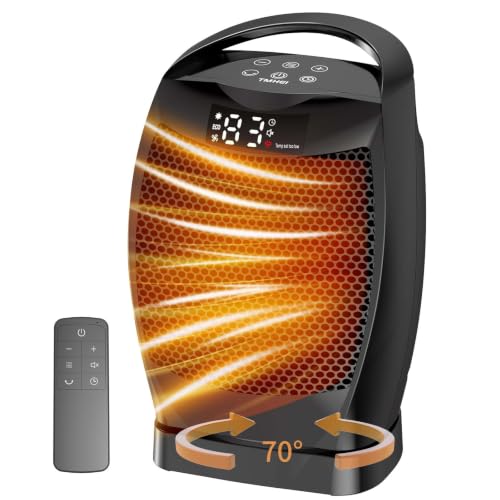
TMHEI 1500W PTC Ceramic Space Heater — Best All-Round Compact
If the modern compact heater has a standard specification, this is it — and the TMHEI states every line of it in its listing: thermostat, remote, wide oscillation, and the two safety protections that matter, wrapped around a fast PTC ceramic core.
Strengths
- Complete control set: thermostat plus remote plus oscillation
- Both overheat and tip-over protection explicitly stated
- PTC ceramic heats quickly and suits desk-to-room coverage
Trade-offs
- Value-brand provenance beside the longest-established names
- Oscillating compacts sit low; warmth pools at sitting height best
- Full feature set means more controls to learn than a utility heater
| Power | 1500W PTC ceramic |
| Controls | Thermostat and remote |
| Oscillation | 70° |
| Safety | Overheat and tip-over protection |
| Use | Home, office, desk (per listing title) |
Compacts are bought for convenience, and convenience is a checklist: reach the temperature without crossing the room (remote), hold it without thinking (thermostat), share it between two chairs (oscillation), and trust it near furniture (the stated protections). The TMHEI is the pick that ticks every line in one listing, which is why it leads a comparison article — it is the reference implementation of its class. In use, PTC ceramic’s fast warm-up suits the stop-start rhythm of home working, and the oscillation makes it a room heater rather than a purely personal one. Its honest limits are class limits: it will not heat a hall, and its brand history is shorter than the industry’s elders. As the default compact recommendation, though, it is the one the others in this list must argue against.
In daily rotation the TMHEI settles into the role its specification promises: the heater nobody thinks about. The remote lives on the desk, the thermostat holds the room, the sweep covers both chairs. That invisibility is the compact class’s highest achievement, and it depends on the unglamorous details being right — a thermostat that does not hunt, an oscillation that does not click, protections that never announce themselves. First-time compact buyers often ask which single model to start with; in a comparison that exists to differentiate, this remains the answer for the median room.
Best for: Homes and offices wanting one compact that does everything / Not suited for: Rough utility spaces or buyers who want the oldest brand names only
Check the current price on Amazon

Oprunsy 1500W Ceramic Space Heater — Best Budget Compact
Budget heaters earn suspicion honestly — the category’s cheapest models cut the thermostat and the protections. The Oprunsy is the counter-example worth listing: three modes, a thermostat, and tip-over plus overheat protection all present in its verified listing.
Strengths
- Thermostat and both core protections survive the budget cut
- Three modes cover warm-up, maintain and fan duties
- Fast-heat ceramic suits bedrooms, offices and desks
Trade-offs
- Budget build and finish; expect functional, not premium
- No remote or oscillation at this tier
- Heat-up claims are maker figures — fast in practice, regardless of the exact seconds
| Power | 1500W ceramic |
| Modes | 3 modes |
| Controls | Thermostat |
| Safety | Tip-over and overheat protection |
| Heat-up | 2-second heat claim (per listing title) |
The right way to read this heater is as a checklist of what did not get cut. Thermostat: present, so it can hold a bedroom temperature overnight instead of blasting. Tip-over protection: present, so a knocked heater cuts out. Overheat protection: present. Three modes: present, so it is not a one-speed blast furnace. That is the entire safety-and-control core of heaters several tiers up, and its presence at the budget end is exactly why this model makes a comparison list that excludes many pricier, vaguer rivals. What the tier does show is in materials and refinement — housing feel, control polish, brand support depth. For a spare room, a student desk or a first heater, those are the right things to economise on; the things it refused to economise on are the right ones too.
Budget heaters live or die on whether their savings were taken from the right places, and a season with the Oprunsy answers the question plainly: the savings are in the shell and the badge, not in the thermostat or the protections, and those are the savings a buyer can live with. It also makes the ideal second heater — the spare-room, guest-room or student-room unit bought without deliberation because its checklist is complete. Comparison articles exist to find exactly this: the point below which cutting further would cut something that matters. This model sits on that point.
Best for: Budget buyers who refuse to compromise on thermostat and safety / Not suited for: Buyers wanting remotes, oscillation or premium finish
Check the current price on Amazon

DAHTEC 1500W Electric Space Heater (ETL Certified) — Best Certified for Garage & Greenhouse
In spaces full of stored value — a garage with a car and tools, a greenhouse with a season of plants — independent safety certification stops being a footnote. The DAHTEC leads with ETL certification and a maker-stated brief covering exactly those spaces.
Strengths
- ETL certification is independent verification of safety standards
- Thermostat and three modes suit both frost duty and work sessions
- Ceramic heat is fast — the listing claims seconds, and the class delivers quick warmth
Trade-offs
- Compact zone coverage; not a whole-garage furnace
- Fan-ceramic noise is present, if modest
- The adjustable angle is a trim feature, not a mounting system
| Power | 1500W ceramic |
| Certification | ETL certified (per listing title) |
| Controls | 3 heat modes and thermostat |
| Use | Garage, greenhouse, workshop (per listing title) |
| Angle | 15° adjustable |
Certification is the least exciting and most rational reason to choose one heater over another, and it is rarer in listings than it should be — many sellers simply never state it. The DAHTEC states it, and pairs it with the control set utility duty needs: a thermostat to hold a greenhouse above frost or a workshop at working temperature, and modes to separate those jobs. Its maker names garages, greenhouses and workshops in the listing itself, which aligns the product with buyers who will run a heater for long hours in buildings they are not sitting in. That alignment — certified, thermostat-controlled, utility-intended — makes it this roundup’s recommendation for any heater that will work unattended-adjacent duty, with the standard cautions about clearances and direct wall-outlet power applying as always.
Certification has a second audience beyond the buyer: insurers, landlords and the person in the household who asks the sensible questions. A heater that will run in a garage or greenhouse for long hours is easier to defend — to all of them — when an independent lab has tested it to the standard. That defensibility, plus a thermostat suited to holding duties, is why the DAHTEC is this list’s recommendation for any space you are not sitting in. In attended rooms its virtues are merely good; in unattended ones they are the argument.
Best for: Garages, greenhouses and workshops, especially for held temperatures / Not suited for: Living-room duty where quiet and looks lead
Check the current price on Amazon

KELDFORD 1600W PTC Portable Heater — Best for Workshops
Workshop heating is directional: the work is under the car, at the bench, at floor level. The KELDFORD’s tilting head, metal body and high-visibility finish make it the heater shaped like a tool rather than an appliance.
Strengths
- 90° tilt aims heat up, level or down at the task
- Metal housing tolerates the knocks of a working space
- Tip-over cut-off is the essential protection for a floor unit among busy feet
Trade-offs
- Listed in a 1600W class — confirm the rating on the listing and give it a dedicated circuit
- Manual settings only; no thermostat for unattended temperature holding
- Fan-driven PTC heat loses the draught battle that radiant wins
| Type | PTC, portable |
| Settings | 3 manual settings |
| Head | 90° tilt |
| Body | Metal housing |
| Safety | Tip-over protection (per listing title) |
A note on wattage first, because this guide does not hide it: the KELDFORD is listed in a 1,600W class, above the usual 1,500W plug-in norm. Verify the exact figure on the listing, and treat the unit as a maximum-draw appliance that gets its own circuit — the breaker is the referee, and it does not negotiate. On the product itself, the design intelligence is in the tilt and the case. A heater that can aim at a mechanic on a creeper or up at a bench worker solves the real problem, which is rarely temperature in the abstract and usually cold hands at a specific task. The metal housing and tip-over safety acknowledge the environment honestly. It is a supervised-session tool, not a frost guard — for that job, the certified thermostat models in this list are the right picks — and within its session role it is one of the most practical heaters here.
Treat the KELDFORD as you would a power tool, because that is its design language: stored with the tools, deployed for a job, aimed, used, and put away. Its tilt head makes it the only heater here that serves floor-level work properly, and its metal case is the only one that shrugs off being clipped by a trolley jack. The wattage-class caution in its main review is not a dismissal — it is the same respect you would give any maximum-draw tool. Workshops run on such respect, and this heater belongs to that world completely.
Best for: Active workshop and garage sessions with a specific work position / Not suited for: Unattended or overnight temperature holding
Check the current price on Amazon

Buyplus Greenhouse Heater with Digital Thermostat — Best Precision Thermostat
Some heating jobs are about a number: hold 5°C in the greenhouse, hold 10°C around the stored car, hold the workshop ready. A digital thermostat is the instrument for number-shaped jobs, and it defines this heater.
Strengths
- Digital thermostat holds set temperatures more precisely than dial controls
- Overheat protection for long, unattended-adjacent runs
- Fast heat-up serves patio and workspace sessions too
Trade-offs
- Precision is wasted in draughty spaces that cannot hold any temperature
- Positioned at greenhouse and patio use — check size and mounting for garage plans
- No oscillation; it is a control specialist, not a room-spreader
| Power | 1500W |
| Controls | Digital thermostat |
| Safety | Overheat protection |
| Use | Garage, greenhouse, patio (per listing title) |
| Heating | Fast heating (per listing title) |
Dial thermostats on budget heaters can wander several degrees around their setting; across a winter of frost protection, that wander is the difference between protected plants and a heating bill with nothing to show for it. A digital thermostat tightens the band, cycling the heater in a narrow range around the number you chose — which is why this model, though sold toward greenhouses and patios, earns its place in a heaters roundup read by garage owners too. The same precision serves a workshop kept at a civilised baseline so tools, batteries and finishes are never stone cold. It is not the heater for spreading warmth around a family room, and it will not rescue a building that leaks heat faster than 1,500W replaces it. For holding a temperature in a space that can keep one, it is the most exact tool in this list.
The Buyplus also illustrates a buying principle this whole roundup runs on: match the control to the consequence. A degree of drift in a bedroom is a shrug; a degree of drift across freezing in a greenhouse is a dead crop, and around stored paint or a classic car it is real money. Precision thermostats are cheap insurance where the consequence is priced in plants and property. Owners who adopt that principle stop asking which heater is best and start asking which heater is best at their job — the question every pick in this article was chosen to answer.
Best for: Greenhouses, frost protection and any space needing an exact held temperature / Not suited for: Draughty spaces or whole-room comfort heating
Check the current price on Amazon

GiveBest Space Heater with Thermostat (Desk Model) — Best for Desks
GiveBest’s desk heater is the category’s quiet constant: a compact ceramic with the two power settings, thermostat and protections that desk duty actually requires, sold in this form because the formula works.
Strengths
- 750W low setting maintains a desk zone cheaply after warm-up
- Thermostat plus both protections — the full desk-duty checklist
- Compact and quiet enough for shared offices
Trade-offs
- Personal zone only; it will not heat a room for a group
- No remote or oscillation — controls are on the unit
- Basic finish, as expected at its tier
| Power | 1500W / 750W settings |
| Type | Ceramic desk heater |
| Controls | Thermostat |
| Safety | Overheat and tip-over protection |
| Positioning | Safe and quiet (per listing title) |
Desk heating is an economics story as much as a comfort one. One person working from home in a cool house faces a choice between heating the whole building and heating a one-metre bubble — and the bubble, at 750W on its maintaining setting, costs a fraction as much. This GiveBest is built precisely for that bubble: fast ceramic warm-up on high, a thermostat to hold the zone, tip-over protection for a unit that lives near feet and chair castors, and a size that vanishes into storage when the season turns. Its sibling in the companion guide covers the same ground from a single-heater angle; here it stands as the desk class representative in a six-type comparison, and it holds the place comfortably. Buy it for the job it names and it will not be the purchase you regret.
There is a final, unfashionable virtue to record: this heater is boring in the way infrastructure should be. It has been the same product, doing the same desk job, while trendier compacts launched and vanished around it. For a purchase measured in winters, that continuity predicts the ownership experience better than any feature list — parts, replacements and second units remain gettable, and the first unit simply continues. In a comparison of six, it is the pick with the fewest surprises in either direction, which for a desk heater is praise.
Best for: Home offices and single-desk heating through winter / Not suited for: Rooms, groups, or anyone needing remote control
Check the current price on Amazon
Comparison Table
| Pick | Badge | Key spec | Best for |
|---|---|---|---|
| TMHEI 1500W PTC Ceramic Space Heater | Best All-Round Compact | 1500W PTC, thermostat, remote, 70° oscillation | Homes and offices wanting one compact that does everything |
| Oprunsy 1500W Ceramic Space Heater | Best Budget Compact | 1500W ceramic, 3 modes, thermostat, tip-over + overheat protection | Budget buyers who refuse to compromise on thermostat and safety |
| DAHTEC 1500W Electric Space Heater (ETL Certified) | Best Certified for Garage & Greenhouse | 1500W ceramic, ETL certified, thermostat, 3 modes | Garages, greenhouses and workshops, especially for held temperatures |
| KELDFORD 1600W PTC Portable Heater | Best for Workshops | 1600W-class PTC, 90° tilt, metal housing | Active workshop and garage sessions with a specific work position |
| Buyplus Greenhouse Heater with Digital Thermostat | Best Precision Thermostat | 1500W, digital thermostat, overheat protection | Greenhouses, frost protection and any space needing an exact held temperature |
| GiveBest Space Heater with Thermostat (Desk Model) | Best for Desks | 1500W/750W ceramic, thermostat, tip-over + overheat protection | Home offices and single-desk heating through winter |
Heater Types, Compared Honestly
Every heater in this article converts electricity to heat at the same efficiency — effectively all of it, since electricity has nowhere else to go. Types differ in delivery, not efficiency. Ceramic and PTC fan heaters warm air quickly and suit rooms and desks. Radiant and infrared heaters warm people and objects directly and suit draughty spaces and benches. Towers spread air heat across rooms with oscillation; compacts concentrate it in zones; utility and milkhouse designs trade finish for durability and frost features.
So the comparison that matters is a matching exercise: room size and sealing, where people sit, whether the heater runs attended or holds a temperature alone, and how much noise the space tolerates. The six picks were chosen so that each of those profiles has a correct answer on the page — choosing well is mostly refusing to buy a type whose strengths are irrelevant to your room.
The Sizing Rule and the Circuit Rule
Two rules govern every plug-in heater purchase. The sizing rule: plan on roughly 10 watts per square foot for primary heating of an insulated room, which caps one 1,500W heater at about 150 square feet of true comfort — beyond that it is a zone heater or a supplement, whatever the listing claims. The circuit rule: a full-power heater belongs on its own circuit where possible, plugged directly into a wall outlet, never through a power strip or a light extension lead, because 1,500W continuous is close to a standard circuit’s honest limit.
Both rules explain most heater disappointment. Undersized expectations make good heaters feel weak; shared circuits make breakers trip and owners blame the product. Apply the two rules before ordering and the heater you receive will feel like the heater you researched.
- ~1,500W is the ceiling for every standard outlet — plan zones accordingly
- 10W per sq ft for primary comfort in insulated rooms
- One heater, one circuit, direct wall outlet
- Thermostat + protections are the features that separate classes
- Insulation and draught-proofing beat any product upgrade
What to Pay For — and What Is Marketing
Worth paying for: a real thermostat (digital if the job is precision holding), tip-over and overheat protection stated in the listing, independent safety certification where stated, oscillation for shared rooms, and a remote where the heater will live out of reach. These change daily life with the product.
Not worth paying for: wattage claims above the plug-in ceiling, coverage claims that defy the sizing rule, and heat-up times measured in single seconds — all modern ceramics are fast, and the difference between two seconds and three has never warmed anyone. Judge listings by the features they state plainly; the picks in this article were chosen by exactly that standard.
Radiant vs Fan Heat: How the Choice Feels in Real Rooms
Specifications flatten the difference between heater types; bodies do not. Fan-driven ceramic heat announces itself: a moving warmth, a faint sound, a room that warms as a volume. Radiant heat is silent and directional — warmth as light, felt on the skin facing the element, absent the moment you turn away. Neither is superior; they suit different rooms and different people, and the mismatch explains most returns in this category. A reader who buys a fan heater for a draughty workshop has bought air-warming for a building that leaks air. A sleeper who buys a radiant panel for a bedroom has bought a heater that warms one side of the bed.
The practical test is to picture the coldest moment the heater must fix. Cold hands at a bench: radiant, aimed. A cold room before guests arrive: fan and oscillation, given twenty minutes. A nursery through the night: the quiet fan ceramic with the best thermostat. A greenhouse at 3 a.m.: whichever certified thermostat model holds the number. Run that moment honestly and the type chooses itself — the six picks then reduce to the best example of the type your moment named.
The Heater Wardrobe: Why Households End Up With Three
Talk to households that heat well with plug-ins and a pattern emerges: they do not own a heater, they own a small wardrobe of them. A quiet thermostat compact owns the bedroom. A desk heater owns the office hours. A utility unit owns the garage, the frost nights and the emergencies. Each was bought for one job, at the tier that job justifies, and each is unremarkable at the others’ work — which is precisely why the system works.
This is worth stating in a comparison article because it reframes the purchase: you are not choosing the one heater for your life, you are choosing the heater for this job, and the others can follow in later winters at leisure. Bought that way — job by job, type by type — a household assembles better heating for less money than one heroic all-purpose purchase ever delivers, and every pick in this roundup has a defined place in the wardrobe.
Reading Heater Listings Like an Engineer
A closing skill, transferable to every listing you will ever meet in this category. Read for the stated, not the suggested: wattage (and whether it exceeds what a circuit should give), thermostat type, the named protections, certification marks, and the exact contents of the box. Discount every superlative that is not attached to a number, and run every coverage claim through the 10-watt rule. Note what the listing does not say — a heater whose listing never mentions tip-over protection probably does not have it, and silence in a spec sheet is information.
Applied consistently, that reading method reproduces this article’s shortlist from the raw marketplace in an afternoon — which is the point of teaching it. Categories change models every season; the physics and the reading method do not change at all.
Heaters in Rentals, Dorms and Small Flats
Plug-in heaters are the heating system of last resort and first convenience in rented homes, and the rental context adds rules of its own. Check the tenancy before the purchase: some leases restrict space heaters outright, and many dormitories ban them entirely — a ban that exists because of exactly the power-strip and clutter habits this guide warns against. Where they are allowed, the renter’s specification is compact, protected and thermostat-led, because rented wiring is an unknown quantity and rented rooms are small.
Small flats reward the zone philosophy most of all: one heater, moved deliberately between the room being lived in and the room being slept in, outperforms any fixed arrangement. The compacts in this roundup were chosen with that portability in mind — light enough to carry nightly, quick enough to make the move worthwhile. Buy the protections, respect the circuit, and a single plug-in heater becomes a small flat’s entire climate strategy.
A Note on Heaters for Workshops, Studios and Hobby Rooms
Hobby spaces make one more heater profile worth naming, because they combine several demands at once: long occupied hours like an office, valuables that dislike cold like a garage, and occupants who sit still — at a bench, an easel, an instrument — and therefore feel cold more than active people do. The winning specification is a thermostat compact with oscillation for the room, or radiant aimed at the work position where the hobby is stationary, plus the discipline of a timer so the space is warm when the hobby hour begins.
Materials matter to the choice too: adhesives, finishes, paints and instrument woods all prefer a room that never fully freezes, which argues for a low background hold rather than session-only heating. That is the Buyplus pattern from this list applied indoors, and it is how a hobby room stays both comfortable and kind to the things the hobby is made of.
How We Would Spend Three Different Budgets
Readers often ask for the comparison reduced to money, and while this guide prints no prices — they change too fast to print honestly — the spending shapes are stable enough to describe. At the careful end: one certified, thermostat-led compact for the most-used room, bought once and kept for years. Nothing else. That single purchase, placed and used as this guide describes, delivers the majority of what plug-in heating offers any household.
In the middle: the bedroom-and-office pair — a quiet thermostat compact where you sleep, a desk heater where you work — which covers the two zones where modern households actually spend their indoor lives. At the committed end: the full wardrobe of the earlier section, adding oscillation for the living room and a utility unit for the garage and frost duty. Notice what does not appear at any level: a premium-priced single heater bought for wattage bragging rights. The money in this category is best spent on coverage and controls, in that order, at every budget.
Environmental Notes: Electric Heat in Context
Electric resistance heating has a reputation problem it only partly deserves. At the point of use it is perfectly efficient — every watt becomes heat in the room — and it produces no indoor emissions, no flue losses and no combustion risk. Its environmental cost is decided upstream, by how the grid generates, and at the meter, by how much of it you use. That second factor is entirely in the owner’s hands, and it is where this guide’s whole philosophy points: zone heating, thermostat discipline and timers are environmental measures as much as economic ones.
Used that way — heating occupied rooms to comfort while the rest of the building rests — a set of plug-in heaters can reduce a household’s total heating energy against the alternative of warming every room all day. Used as an always-on substitute for a heating system, it cannot. The products are identical in both stories; the strategy is the footprint. Buy the heater that fits the zone, then run it like the zone is the point — because it is.
Final Thoughts: Buying Once, Buying Right
Heaters are decade purchases disguised as seasonal ones, and the comparison habit that serves buyers best is to slow down at exactly the points this article slowed down: the type, the thermostat, the protections, the circuit. Everything else — finishes, feature counts, marketing adjectives — is weather. The six heaters compared here will not be the six on sale next year, but the method that selected them will still work, on whatever replaces them, because it is built on physics and fit rather than on models. That is the real deliverable of a roundup like this one: not a list to obey, but a way of choosing that stays right.
One Last Distinction: Comfort Heat vs Background Heat
Most heater disappointment traces back to confusing two different services. Comfort heat is what you feel: a warm room, warm hands, a pleasant evening. Background heat is what the building feels: pipes unfrozen, materials unharmed, a space that never drops to the temperatures that cause damage. They need different temperatures, different controls and often different heaters — comfort wants responsiveness, background wants a thermostat that is trustworthy at five degrees in an empty building at 3 a.m.
Before any purchase in this category, name which service you are buying, or whether you are buying both with two different tools. The roundup above contains honest candidates for each, labelled by the duty their controls suit. Buyers who make that one distinction clearly almost never return a heater — and buyers who skip it almost always blame the product for a mismatch that was decided at the moment of ordering.
How to Set Up Multiple Heaters Around a Home Safely
Many households end up with two or three plug-in heaters. Used with a plan, they are efficient zone heating; used carelessly, they are tripped breakers and worse.
- Map your circuits first: know which outlets share a breaker, and never plan two full-power heaters on one circuit.
- Assign each heater a zone and a job — bedroom overnight, office by day, garage frost duty — and write the plan down for the household.
- Place each heater on a stable surface with clear space around it, away from bedding, curtains and stored clutter.
- Plug every heater directly into its wall outlet; remove power strips and extension leads from the plan entirely.
- Set thermostats and timers per zone so heaters run when their zone is used, not on a whole-house schedule.
- Test the arrangement under real load — heaters plus the usual appliances — and adjust zones if any breaker objects.
- Review monthly: dust the grilles, check cords, and confirm the clearances have not been eaten by storage creep.
If your heating plan needs more simultaneous zones than your circuits allow, that is the signal to involve the main heating system or an electrician — not to defeat the protection that is telling you the truth.
Common Buying Mistakes
Comparing heaters by wattage. They are all at the same ceiling. Compare delivery, controls and safety — the things that actually differ.
Believing room-size claims without the maths. Run 10W per square foot against the claim. Listings that survive the arithmetic are the ones worth shortlisting.
Two heaters, one circuit. The breaker trip is not a nuisance; it is the protection working. Re-plan the zones across circuits.
Buying features for the wrong job. A precision thermostat in a draughty garage and a session heater on frost duty are the same mistake in mirror image. Match controls to duty.
Storing heaters dirty and cords kinked. Dust-choked grilles cause overheat shut-offs, and kinked cords are next winter’s failure. Clean and coil loosely at season’s end.
Final Recommendation
Forced to name one heater for an average home, this roundup points to the TMHEI: the complete compact specification, fairly delivered. But the honest answer of a comparison article is that the best heater is the type matched to your space — the Oprunsy for budget rooms, the DAHTEC where certification and utility duty matter, the KELDFORD for aimed workshop work, the Buyplus for precision holding, and the GiveBest for the desk that started the search.
Whichever you choose, apply the two rules — size by the arithmetic, power by the circuit — and the heater will perform exactly as this page describes. In a category where every product shares the same ceiling, that matching is the whole of the art.
Start with TMHEI 1500W PTC Ceramic Space Heater, or Oprunsy 1500W Ceramic Space Heater if your needs are narrower, and keep DAHTEC 1500W Electric Space Heater (ETL Certified) on the shortlist as the alternative.
Related guides in this series: Best 110 Volt Heater, Best 110 Volt Electric Heater, Best 110 Volt Garage Heaters, Best 110 Volt Baseboard Heater, Best 110 Volt Garage Heater, Best 110 Volt Flat Irons.
Frequently Asked Questions
Are all 110 volt heaters really the same power?
Essentially, yes. A standard household circuit sustains about 1,500W continuously, so virtually every plug-in heater tops out there regardless of brand or price. Differences live in delivery (fan, radiant, oscillation), controls, safety systems and build — which is what this comparison grades.
Which type of heater is cheapest to run?
They all convert electricity to heat at the same efficiency, so running cost is decided by strategy: zone heating, thermostat discipline, lower maintaining settings and timers. A 750W desk heater warming one worker is cheaper than any 1,500W heater warming a house — the savings are in the plan, not the product.
Can I run two plug-in heaters at once?
Yes, if they are on separate circuits. Two on one 15-amp circuit will trip the breaker. Map your outlets to breakers first — the how-to section above walks through setting up a multi-heater home safely.
What safety features should a heater have?
At minimum: overheat protection and, for floor models, tip-over shut-off — both stated in the listing. Independent certification (such as ETL) is a further plus, and a thermostat is essential for any unattended temperature-holding duty. Every pick in this article was screened on those lines.
Why does my heater keep shutting off?
Usually the overheat protection doing its job: check for blocked intakes, dust build-up, or placement too close to furniture. If it trips the room’s breaker instead, the circuit is overloaded — move other loads. A heater that shuts off with clear airflow and a free circuit should be retired and replaced, not overridden.
Is a heater with more modes better?
Only if the modes map to your routines — a low quiet mode for nights, a low-wattage mode for maintaining a desk zone, fan-only for summer. Modes you never select are decoration; the thermostat and protections matter more than the mode count.


