Disclosure: airfryerkitchensupply.com is reader-supported. When you buy through links on our site, we may earn an affiliate commission at no extra cost to you.
Where to buy
Every model in this guide to the best 110 volt flat irons was verified on Amazon through the Creators API before being included. Flat iron prices swing with promotions constantly, so no prices are printed here — check the current price on Amazon through the links below, and confirm the plate size in the listing title before ordering, because several brands sell near-identical irons in three widths.
- BaBylissPRO Ultra Sleek Flat Iron, Nano Titanium 1.5 Inch — Best Overall
- BaBylissPRO Ultra Sleek Flat Iron, Nano Titanium 1 Inch Extended Plates — Best for Precision and Curls
- TYMO Flat Iron Hair Straightener and Curler 2 in 1 — Best Fast-Heating 2-in-1
- Remington Shine Therapy 2 Inch Hair Straightener — Best for Long Hair on a Budget Tier
- 7MAGIC Nano Titanium 1.7 Inch Flat Iron — Best for Thick Hair (Dual Voltage)
- MiroPure Flat Iron Hair Straightener 1 Inch Titanium — Best Budget Travel Pick
The search for the best 110 volt flat irons starts with a reassuring fact: 110 volt is simply standard North American household power, so virtually every flat iron sold for the US market is a “110 volt flat iron” in the only sense that matters — it plugs into your bathroom outlet and works. The distinction that actually deserves your attention is the opposite one: single-voltage irons that run only on 110–120V versus dual-voltage irons rated 110–220V (or 110–240V) that also work overseas. If you never leave North America, a standard-voltage iron is all you need and often gets you a better iron for the same tier. If you travel, dual voltage is the feature that decides whether your iron works in a European hotel or quietly refuses — or worse, is damaged by a converter mismatch.
Beyond voltage, the choices that shape your results are plate material, plate width and temperature control. Titanium plates heat fast and hold high, even heat — the professional choice for thick, coarse or resistant hair. Ceramic plates heat more gently and evenly at lower temperatures, suiting fine or damaged hair. Width is a matching exercise: 1 inch irons are the versatile default that can also curl, 1.5–2 inch irons cover more hair per pass on long, thick hair, and narrow plates win on short hair and fringes.
The six irons below were chosen to cover that map honestly. BaBylissPRO’s Ultra Sleek line anchors the professional end in three widths, TYMO and Remington cover the versatile and wide-plate middle, and 7MAGIC and MiroPure serve thick hair and budget buyers — with the dual-voltage status of each model stated plainly in its spec box, verified from its listing, so travellers can shop with certainty.
In this guide
Quick Picks
Best Overall — BaBylissPRO Ultra Sleek Flat Iron, Nano Titanium 1.5 Inch: The professional default: nano titanium plates in the versatile 1.5 inch width, a ceramic heater, five digital heat settings and a long 9 ft cord for real styling freedom.
Best for Precision and Curls — BaBylissPRO Ultra Sleek Flat Iron, Nano Titanium 1 Inch Extended Plates: The 1 inch professional option with extended plates: the width that straightens and curls, with an LED display and the same ceramic-heater, five-setting system as its bigger sibling.
Best Fast-Heating 2-in-1 — TYMO Flat Iron Hair Straightener and Curler 2 in 1: A 1 inch titanium 2-in-1 that heats in seconds and offers unusually fine temperature adjustment — 32 settings — plus automatic shut-off for peace of mind.
Best for Long Hair on a Budget Tier — Remington Shine Therapy 2 Inch Hair Straightener: The wide-plate value pick: 2 inch ceramic plates infused with argan oil and keratin, from a mainstream brand — maximum coverage per pass for long hair.
Best for Thick Hair (Dual Voltage) — 7MAGIC Nano Titanium 1.7 Inch Flat Iron: Built for thick hair: 1.7 inch nano titanium plates, MCH heating in 15 seconds, a 290–450°F range, damp-to-dry capability — and confirmed dual voltage 110–220V for travel.
Best Budget Travel Pick — MiroPure Flat Iron Hair Straightener 1 Inch Titanium: The budget pick that still ticks the important boxes: 1 inch titanium plates, 15-second MCH heat-up, negative-ion positioning, auto shut-off — and dual voltage for travel.
How These Picks Were Chosen
Models were verified one by one through the Creators API on this site’s Amazon connection: each iron was searched by brand and model, and the ASIN was used only where the returned title confirmed the plate material, width and features we intended to describe. Spec boxes quote only what those verified titles state — plate size, heater type, heat settings and voltage where the title declares it.
Voltage claims were treated with particular care because the keyword demands it. Where a listing title states dual voltage (110–220V), the spec box says so. Where the title is silent, the iron is described as a standard US-voltage model — which is the correct assumption for US-market irons — without inventing a dual-voltage claim the manufacturer did not print.
The set was then balanced across real hair types rather than price points alone: a professional 1.5 inch flagship, its 1 inch sibling for precision and curling, a fast-heating 2-in-1, a wide argan-oil ceramic for long hair, a damp-to-dry wide titanium for thick hair, and a budget 1 inch with genuine travel credentials. No prices and no rating figures appear anywhere in this guide; both change too often to print honestly.
The 6 Best 110 Volt Flat Irons for Home Styling

BaBylissPRO Ultra Sleek Flat Iron, Nano Titanium 1.5 Inch — Best Overall
BaBylissPRO is the brand working stylists actually buy, and the 1.5 inch Ultra Sleek is its most useful home iron: wide enough to make quick work of long or thick hair, narrow enough to keep control near the roots, and built around a proper digital temperature system.
Strengths
- Nano titanium plates deliver fast, even heat that resistant hair responds to
- Five digital settings let you match heat to hair type instead of guessing
- 9 ft cord gives genuine freedom of movement at a vanity or salon station
Trade-offs
- 1.5 inch plates are clumsy for very short hair and tight curls
- Professional-tier pricing within this guide — no printed price, but expect the top end
- No dual-voltage claim in the listing, so frequent overseas travellers should look below
| Plates | Nano titanium, 1.5 inch |
| Heater | Ceramic heater |
| Heat settings | 5 digital settings |
| Cord | 9 ft |
| Voltage | Standard US voltage (dual voltage not stated in listing) |
What separates a professional iron from a drugstore one is not maximum temperature — it is temperature stability. Plates that sag in heat as they pass through a thick section force a second pass, and the second pass is where damage doubles. The Ultra Sleek pairs titanium plates with a ceramic heater, a combination designed to recover heat quickly between passes, and the five digital settings span the range from fine-hair gentle to coarse-hair assertive without the vague “low-medium-high” dial of cheaper tools. The 1.5 inch width is the sweet spot most stylists recommend for home users with medium to long hair: fewer passes than a 1 inch, far more manoeuvrable than a 2 inch. The 9 ft cord sounds like a spec-sheet detail until you have styled hair at a mirror that is not directly above an outlet. Treat this as the benchmark pick of the guide — the iron the others are measured against — and choose a sibling width or a rival only when your hair type or travel habits argue for it.
Ownership details round out the case. The 9 ft cord is a professional inheritance — stylists work around chairs, and home users inherit the benefit at awkwardly placed vanity outlets. The housing is built for daily handling rather than occasional use, which is the quiet difference between pro tools and consumer ones across a five-year life. Care is minimal: wipe the plates cold, store it without wrapping the cord tightly around the body, and the iron will simply be there, at temperature, every morning. For buyers who style daily and buy tools the way chefs buy knives, this is the end of the search rather than a step in it.
Best for: Medium to long hair, including thick hair, styled regularly at home / Not suited for: Very short hair, or buyers who need confirmed dual voltage for travel
Check the current price on Amazon

BaBylissPRO Ultra Sleek Flat Iron, Nano Titanium 1 Inch Extended Plates — Best for Precision and Curls
If you straighten and curl with the same tool, the 1 inch width is the one to own — and this version’s extended plates recover some of the coverage you give up versus wider irons, while keeping the manoeuvrability that curling demands.
Strengths
- 1 inch width is the true all-rounder: straightening, waves and curls
- Extended plates cover more hair per pass than standard 1 inch irons
- LED display makes your chosen temperature unambiguous and repeatable
Trade-offs
- Still slower than a wide iron on very long, thick hair
- Titanium’s assertive heat needs care on fine or fragile hair — use the lower settings
- Same professional tier as the 1.5 inch model
| Plates | Nano titanium, 1 inch, extended length |
| Heater | Ceramic heater |
| Heat settings | 5 digital settings with LED display |
| Cord | 9 ft |
| Voltage | Standard US voltage (dual voltage not stated in listing) |
Extended plates are a quietly clever compromise. A standard 1 inch iron forces a choice between control and speed; lengthening the plates keeps the narrow profile that gets close to roots and wraps hair for curls, while adding back a useful share of per-pass coverage. In practice this is the iron for the largest range of real heads: short to medium hair outright, and long hair for anyone who also curls and is willing to take a few more passes when straightening. The LED display matters more than it seems — repeatable temperature is repeatable results, and hair responds very differently twenty degrees apart. Titanium’s fast, high heat is a virtue on resistant hair and a responsibility on fine hair; the five digital settings exist precisely so fine-haired users can stay low, and they should. Pair it with heat protectant and one-pass discipline and this is arguably the most versatile single iron in the guide.
The extended-plate design also rewards a specific technique: because the plates are longer, a slightly slower glide covers the same ground, and slower glides are where smooth, sealed results come from. Curlers will find the plate length gives a more even wrap and a more uniform curl than stubby 1 inch irons produce. As with its sibling, ownership is professional-grade uneventful — fast, repeatable, durable — with the single discipline titanium always demands: respect the temperature settings, because the iron will happily deliver more heat than fine hair should ever meet, and the five digital steps exist to be used, not maxed.
Best for: Short to medium hair, and anyone who curls with their flat iron / Not suited for: Very long, very thick hair styled in a hurry every day
Check the current price on Amazon

TYMO Flat Iron Hair Straightener and Curler 2 in 1 — Best Fast-Heating 2-in-1
TYMO has built its name on making straightening feel less like a chore, and this 2-in-1 leans into speed and adjustability: near-instant heat-up, a temperature control with far more steps than rivals, and an auto shut-off that forgives a rushed morning.
Strengths
- 10-second heat-up removes the wait that derails weekday styling
- 32 temperature settings give the finest control in this guide
- Automatic shut-off is a real safety feature in busy households
Trade-offs
- Brand is younger than the professional names here
- Fine temperature granularity is wasted if you always use one setting
- Champagne finish shows its age differently than plain housings — a taste point
| Plates | Titanium, 1 inch |
| Heat-up | 10 seconds (per listing title) |
| Temperature | 32 adjustable settings |
| Safety | Automatic shut-off |
| Voltage | Standard US voltage (dual voltage not stated in listing) |
Two features define this iron in daily life. The first is the heat-up time: ten seconds changes behaviour, because an iron that is ready before you have sectioned your hair gets used on days a slow iron gets skipped. The second is the temperature ladder. Thirty-two settings sounds like excess until you have fine hair that fries at temperatures coarse hair needs — granular control lets you find the lowest temperature that still straightens in one pass, which is the single best habit for hair health. The 2-in-1 shaping follows the modern pattern of rounded plate edges that let the iron double as a curling tool, and at 1 inch it sits in the versatile width class alongside the BaBylissPRO above. Automatic shut-off rounds out a package clearly designed around real mornings rather than spec-sheet duels. It does not carry the professional lineage of the top picks, but on features-per-morning-saved it is the easiest iron here to recommend to a busy generalist.
Daily-life details decide whether the TYMO’s spec sheet translates into loyalty, and two stand out. The auto shut-off removes the low-grade anxiety of the rushed departure — did I turn it off? — which for many households is worth more than any styling feature. And the granular temperature ladder quietly teaches better habits: users who can nudge temperature in small steps learn exactly what their hair needs, and tend to settle lower than they expected, which is where long-term hair health lives. Add the near-instant heat-up and this is the iron designed most completely around the weekday morning as it is actually lived.
Best for: Busy users who style daily and want speed plus fine temperature control / Not suited for: Purists who prefer established professional brands
Check the current price on Amazon
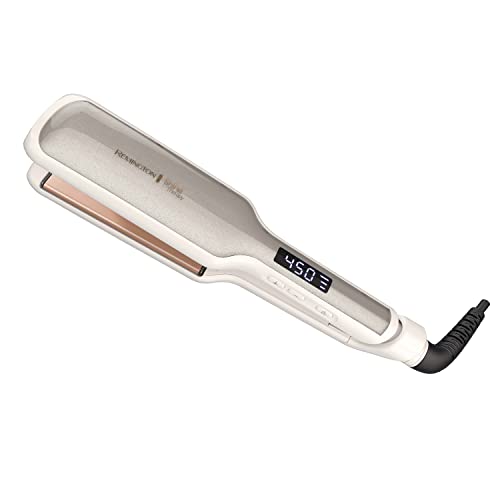
Remington Shine Therapy 2 Inch Hair Straightener — Best for Long Hair on a Budget Tier
Long hair changes the maths of straightening: passes multiply, arms tire, and a wide iron stops being a luxury. Remington’s 2 inch Shine Therapy pairs the widest plates in this guide with ceramic’s gentler heat and an infused-plate shine pitch, at the accessible end of the market.
Strengths
- 2 inch plates give the fastest coverage of long or thick hair in this guide
- Ceramic plates heat gently and evenly — kinder to fine or processed hair
- Mainstream brand with easy availability and support
Trade-offs
- 2 inch width cannot get close to roots or handle short hair and fringes well
- Too bulky to curl with — this is a straightening-only tool
- Infused-plate benefits are a coating story; technique and protectant matter more
| Plates | Ceramic, 2 inch, infused with argan oil and keratin |
| Brand | Remington |
| Positioning | Shine and frizz-reduction focus (per listing title) |
| Voltage | Standard US voltage (dual voltage not stated in listing) |
Judge this iron on the job it is built for: getting through a lot of long hair quickly and gently. Ceramic is the right plate choice for that brief at this tier — it distributes heat evenly and avoids the hot-spot harshness cheap metal plates can produce — and the 2 inch width roughly halves the passes a 1 inch iron needs on long lengths. The argan oil and keratin infusion is best understood as a friction and finish aid rather than a treatment; your results will still be decided by sectioning, slow single passes and heat protectant. What the wide format cannot do is detail work: roots, fringes, short layers and curls are all outside its competence, which is why households with varied hair often pair a wide iron like this with a 1 inch for finishing. As a one-job tool for long hair at a sensible tier, though, it is the most honest value in the line-up.
The Remington also makes a sensible household second iron: in homes where one person has long hair and another has short, the wide iron handles the long-hair bulk work while a 1 inch handles detail — a pairing that costs less than one premium do-everything tool and serves both heads better. Its ceramic plates are the forgiving choice for younger users learning to straighten, too, since ceramic’s gentler heat punishes technique errors less than hot titanium does. Judge it as the specialist it is — long hair, fast, gentle, accessibly tiered — and it is one of the easiest recommendations in this guide.
Best for: Long, thick hair straightened regularly, where speed matters / Not suited for: Short hair, root detail, fringes, or curling
Check the current price on Amazon

7MAGIC Nano Titanium 1.7 Inch Flat Iron — Best for Thick Hair (Dual Voltage)
Thick, coarse hair is the hardest brief in straightening, and the 7MAGIC is specified for it without apology: wide titanium plates, a high 450°F ceiling, fast MCH heating and even damp-to-dry styling — plus the dual voltage the travellers in this category keep asking for.
Strengths
- Specification aimed at thick hair: wide titanium plates and a 450°F top end
- Dual voltage 110–220V confirmed in the listing — genuinely travel-ready
- MCH heater reaches temperature in about 15 seconds
Trade-offs
- 450°F is more heat than fine or damaged hair should ever meet — discipline required
- Damp-to-dry styling still stresses hair; fully dry hair remains the gentler default
- Lesser-known brand beside the professional names in this guide
| Plates | Nano titanium, 1.7 inch |
| Heater | MCH, 15-second heat-up (per listing title) |
| Temperature range | 290–450°F (per listing title) |
| Voltage | Dual voltage 110–220V (per listing title) |
| Safety | Auto shutoff |
Coarse hair exposes weak irons instantly: plates cool mid-pass, edges stay wavy, and the user compensates with repeat passes that do the real damage. The 7MAGIC’s answer is thermal headroom — MCH heating for fast recovery, titanium plates for even high heat, and a width that keeps pass counts sane. Used well, that headroom should reduce total passes, which is the healthiest way to straighten resistant hair: the right temperature once beats a lower temperature three times. The damp-to-dry claim is best treated as an occasional time-saver rather than a routine, since styling damp hair is inherently harder on it. The confirmed dual voltage is a genuine differentiator in this guide — this is one of only two picks whose listing states 110–220V outright, making it the thick-hair choice that also survives international travel without a converter gamble. Respect the temperature dial, start lower than you think, and it earns its specialist place.
A note on the damp-to-dry feature, since it headlines the listing: it is genuinely useful on the mornings that produce it — hair at eighty percent dry, time at fifty percent of need — but it should stay the exception. Fully dried hair, protected and straightened in single passes, remains the routine that keeps thick hair healthy across years, and this iron is more than capable of that routine with its fast MCH recovery. Used as a high-headroom tool with discipline — temperature matched to the section, not the maximum — the 7MAGIC gives thick-haired buyers the thing they are actually shopping for: an iron that finishes the job in the passes their hair can afford.
Best for: Thick, coarse or resistant hair — including travellers needing dual voltage / Not suited for: Fine, fragile or heavily damaged hair
Check the current price on Amazon

MiroPure Flat Iron Hair Straightener 1 Inch Titanium — Best Budget Travel Pick
Budget irons usually cut the features that matter and keep the ones that photograph well. The MiroPure is the exception in this guide: its verified listing confirms titanium plates, fast MCH heating, dual voltage and auto shut-off — the practical core of irons several tiers above it.
Strengths
- Dual voltage confirmed — the budget traveller’s pick
- Titanium plates and 15-second heat-up at the lowest tier in this guide
- Auto shut-off included, which many budget irons omit
Trade-offs
- Build and finish are budget-grade beside the professional picks
- 1 inch width means more passes on long, thick hair
- Brand support and longevity are the open questions at this tier
| Plates | Titanium, 1 inch |
| Heater | MCH ceramic, 15-second heat-up (per listing title) |
| Voltage | Dual voltage (per listing title) |
| Safety | Auto shut-off |
| Positioning | Negative ion (per listing title) |
The honest way to judge a budget iron is by what it refuses to compromise. Voltage: dual, confirmed. Heat system: MCH ceramic with titanium plates and a 15-second heat-up, which in practice means even heat and quick recovery for normal hair. Safety: auto shut-off present. That is a specification list that respects the buyer, and for fine to medium hair — the majority — the styling results will be closer to the premium picks than the tier gap suggests. Where the savings live is in the hand: lighter housing, simpler controls, and the statistical reality that budget tools are built to a price across every component. For a first iron, a travel iron (where losing or breaking it would not sting), or a guest-bathroom spare, those are acceptable trades. For daily styling of demanding hair over years, the professional picks above remain the better investment. As the entry point to this category, though, the MiroPure is easy to defend.
The MiroPure also earns a mention as the iron to lend, gift or keep in the guest bathroom — roles where a premium tool would be wasted and a bad tool would be an embarrassment. Its dual voltage quietly doubles that usefulness for households that host travelling guests. Longevity expectations should stay calibrated: this is a budget tool that performs above its tier, not a professional tool in disguise, and heavy daily use on demanding hair will find its limits sooner than the BaBylissPRO pair above. Within its honest brief — first iron, travel iron, spare iron — it is the strongest value on this page.
Best for: First-time buyers, travellers, and fine-to-medium hair on a budget / Not suited for: Heavy daily use on very thick hair over many years
Check the current price on Amazon
Comparison Table
| Pick | Badge | Key spec | Best for |
|---|---|---|---|
| BaBylissPRO Ultra Sleek Flat Iron, Nano Titanium 1.5 Inch | Best Overall | 1.5″ nano titanium plates, 5 digital heat settings, 9 ft cord | Medium to long hair, including thick hair, styled regularly at home |
| BaBylissPRO Ultra Sleek Flat Iron, Nano Titanium 1 Inch Extended Plates | Best for Precision and Curls | 1″ extended nano titanium plates, LED display, 9 ft cord | Short to medium hair, and anyone who curls with their flat iron |
| TYMO Flat Iron Hair Straightener and Curler 2 in 1 | Best Fast-Heating 2-in-1 | 1″ titanium, 10s fast heating, 32 temp settings, auto shut-off | Busy users who style daily and want speed plus fine temperature control |
| Remington Shine Therapy 2 Inch Hair Straightener | Best for Long Hair on a Budget Tier | 2″ ceramic plates, argan oil & keratin infused | Long, thick hair straightened regularly, where speed matters |
| 7MAGIC Nano Titanium 1.7 Inch Flat Iron | Best for Thick Hair (Dual Voltage) | 1.7″ nano titanium, 290–450°F, dual voltage 110–220V | Thick, coarse or resistant hair — including travellers needing dual voltage |
| MiroPure Flat Iron Hair Straightener 1 Inch Titanium | Best Budget Travel Pick | 1″ titanium, 15s heat-up, dual voltage, auto shut-off | First-time buyers, travellers, and fine-to-medium hair on a budget |
How to Choose the Right Flat Iron for Your Hair
Match the iron to your hair in this order: plate material, plate width, temperature range. Titanium suits thick, coarse and resistant hair because it transfers heat assertively and recovers fast; ceramic suits fine, medium and damage-conscious hair because its heat is gentler and very even. Width follows length and volume: 1 inch for short to medium hair and for anyone who curls, 1.5 inch as the long-hair all-rounder, 1.7–2 inch when long, thick hair makes pass count your main enemy.
Temperature discipline matters more than maximum temperature. The right setting is the lowest one that straightens your hair in a single slow pass: fine hair often needs far less than the dial offers, while coarse hair may need the upper range. An iron with more, finer settings — digital five-step or TYMO’s 32-step ladder — makes finding that point easier and your results repeatable.
- Thick/coarse hair: titanium plates, wider widths, higher temperature ceiling
- Fine/damaged hair: ceramic plates, lower settings, single-pass technique
- Short hair and curling: 1 inch plates, ideally with rounded edges
- Long hair daily styling: 1.5–2 inch plates to cut pass count
- Travellers: dual voltage stated in the listing — nothing less counts
110 Volt, Dual Voltage and Travel: What Actually Matters
A “110 volt” flat iron is simply a US-standard iron: North American outlets supply roughly 110–120V, and every iron sold for this market is built for it. No adapter, no thought required at home. The travel question is different. Much of the world runs on 220–240V, and plugging a single-voltage US iron into that supply — even through a plug adapter, which changes only the shape — can destroy the iron and create a safety hazard.
Dual-voltage irons solve this properly by accepting 110–220V (sometimes printed 110–240V); with one of those and a simple plug adapter, you can style anywhere. Two picks in this guide state dual voltage in their verified listings: the 7MAGIC (110–220V) and the MiroPure. For the others, the listings make no dual-voltage claim, so treat them as home-market irons. Voltage converters exist, but they are bulky, finicky with high-wattage heat tools, and a poor substitute for buying the right iron.
Technique: Straighter Results with Less Damage
Equipment is half the result; technique is the other half, and it is free. Always start with fully dry hair unless your iron is specifically a damp-to-dry model, and always use heat protectant — it is the cheapest insurance in the whole routine. Work in sections no wider than the plates and no thicker than they can heat evenly; a too-thick section is the real reason most people need second passes.
Move the iron in one slow, steady pass — roughly the speed of counting “one-two” per section — rather than several fast ones. Let each section cool before touching it, because hair sets as it cools. Finish with the plates barely kissing the ends, where hair is oldest and most fragile. Follow that routine and a mid-tier iron will outperform a premium iron used carelessly, every single time.
Plate Materials Explained: Titanium, Ceramic and Tourmaline
Plate material is the flat iron decision with the most marketing wrapped around it, so here is the unadorned version. Titanium is a metal plate: it heats fast, transfers heat to hair assertively, and holds temperature through thick sections. It is the professional choice for coarse, resistant hair, and the risky choice for fine hair in careless hands. Ceramic is a coating or solid plate that heats more slowly but very evenly, with no hot spots; it is gentler, and the default recommendation for fine, medium and damage-conscious hair. Tourmaline is a mineral coating, usually over ceramic, marketed on ionic frizz reduction — a real but modest effect that should never outweigh the base plate decision.
The heater behind the plate matters as much as the plate: MCH (metal ceramic heater) systems, named in several listings in this guide, heat in seconds and recover temperature quickly between passes, which is what “professional” performance actually feels like in use. When you compare two irons with the same plates, the one with the better heater and finer temperature control will style better — a hierarchy worth remembering when listings compete on adjectives instead.
How Long Should a Flat Iron Last — and When to Replace It
A decent flat iron should serve for years, and the failure modes announce themselves clearly when the end comes. Plates that no longer heat evenly — one end hotter, sections needing a second pass that never used to — signal a tired heater or damaged coating. A cord that crackles, kinks permanently or loses power at certain angles is not a quirk; it is a retirement notice, and a safety one. Housings that no longer close evenly, or plates with chips and scratches that snag hair, will damage hair on every pass they are asked to make.
Extend the life you get with three habits: wipe plates clean when cold so product does not bake into a dragging film; never wrap the cord tightly around the iron, the single most common cause of cord failure; and store the iron somewhere it is not crushed or dropped. Buyers who follow those rules routinely get half a decade or more from the professional picks in this guide — which reframes their higher tiers as the cheaper cost per year of any irons on the page.
Heat Protectant and Product Basics
No iron, however good, should meet unprotected hair. Heat protectants — sprays, creams and serums formulated for thermal styling — form a sacrificial layer that measurably reduces the damage each pass does, and they are the cheapest component of the entire routine. Apply to damp hair before drying for the most even coverage, comb through, and let the hair dry fully before the iron touches it, unless you are deliberately using a damp-to-dry model.
After styling, a small amount of lightweight serum on the ends restores the look of moisture and tames flyaways; keep it off the roots, where it reads as grease by midday. The rest of the product story is restraint: layers of styling products bake onto plates, drag during passes and transfer back onto hair, which is why the plate-wiping habit in the care section matters. Iron, protectant, finishing serum — a three-product routine that covers ninety percent of what flat iron users actually need.
Swivel Cords, Heat Mats and the Small Accessories That Matter
Two accessories separate a pleasant styling station from an annoying one. A heat-resistant mat or pouch protects counters from a cooling iron and gives the tool a defined home — several accidents in this category are simply a hot iron set down on the wrong surface during a distracted moment. And a swivel cord, where fitted, quietly prevents the cord tangling that makes morning styling a wrestling match; where it is not fitted, storing the iron with the cord loosely looped preserves the cable’s life.
Sectioning clips are the third unglamorous essential: the one-pass technique this guide teaches is impossible without them, because unsectioned hair is how irons get blamed for technique’s failures. None of these items costs much, all of them outlast several irons, and together they are the difference between owning a flat iron and owning a styling setup.
How to Use a Flat Iron for Smooth, Healthy-Looking Results
This routine works with every iron in this guide and is the difference between hair that is straight for a day and hair that stays healthy for years.
- Wash, condition and dry your hair completely; apply heat protectant evenly through the lengths and ends.
- Set the iron to the lowest temperature you expect to work — you can step up a setting if a test section resists, but you cannot undo too much heat.
- Divide hair into sections with clips: bottom layer first, then sides, then the crown, each section narrower than your plates.
- Clamp a section near the roots (not on the scalp), and glide down in one slow, steady pass, keeping light, even tension.
- Let the section cool untouched for a few seconds to set, then move on — resist the urge to immediately re-pass.
- For curls with a 1 inch iron, clamp, rotate the iron a half turn, and glide slowly so the hair wraps the rounded edge.
- Finish with a light serum on the ends only, and switch the iron off — or trust, but still verify, the auto shut-off.
Store the iron cool and cord-loose: wrapping a hot cord tightly around the plates is the most common way these tools die early. Give plates an occasional wipe once cold to remove product build-up, which otherwise bakes on and drags.
Common Buying Mistakes
Using maximum heat by default. The top of the dial is for the coarsest hair only. Find the lowest temperature that works in one pass — your ends will thank you within a month.
Straightening damp hair with a standard iron. Unless the model is explicitly damp-to-dry rated, wet hair plus hot plates means steam damage. Dry first, always.
Taking sections that are too thick. Thick sections heat unevenly, force repeat passes, and cause the frizz people blame on the iron. Smaller sections are faster overall.
Assuming a plug adapter makes a US iron travel-safe. Adapters change shape, not voltage. Only a dual-voltage iron is safe on 220V supplies — check the listing before you pack.
Skipping heat protectant to save time. It takes twenty seconds and is the single most effective damage-prevention step in the entire routine.
Final Recommendation
For most buyers, the BaBylissPRO Ultra Sleek 1.5 inch is the flat iron to buy: professional heat stability, the most useful width, and controls that make results repeatable. Choose its 1 inch extended-plate sibling if you curl as often as you straighten, and consider the TYMO if morning speed and fine temperature steps matter most. Long hair on a sensible budget points to the Remington 2 inch; thick, resistant hair points to the 7MAGIC — which, like the budget MiroPure, also carries the confirmed dual voltage that travellers need.
Whichever iron lands in your bathroom, remember that the voltage question is settled the moment you buy the right model for where you live and travel, and the results question is settled by sectioning, protectant and one-pass discipline. Buy the iron that matches your hair, then let technique do the rest.
Start with BaBylissPRO Ultra Sleek Flat Iron, Nano Titanium 1.5 Inch, or BaBylissPRO Ultra Sleek Flat Iron, Nano Titanium 1 Inch Extended Plates if your needs are narrower, and keep TYMO Flat Iron Hair Straightener and Curler 2 in 1 on the shortlist as the alternative.
Related guides in this series: Best 110 Volt Female Vibrators, Best 110 Volt Heaters, Best 110 Volt Garage Heater, Best 110 Volt Spa, Best 110 Volt Air Conditioner, Best 110 Volt Winches.
Frequently Asked Questions
What does “110 volt flat iron” actually mean?
It means the iron is built for standard North American household power (110–120V) — which is true of essentially every flat iron sold in the US. It only becomes a real question when you travel: countries on 220–240V require a dual-voltage iron, or you risk damaging a single-voltage model.
Which picks in this guide are dual voltage?
Two listings state it outright: the 7MAGIC (110–220V) and the MiroPure (dual voltage). The other models make no dual-voltage claim in their listings, so treat them as US-voltage irons for home use. When in doubt, the printed listing specification is the only version worth trusting.
Titanium or ceramic plates — which is better?
Neither in the abstract. Titanium heats fast and holds assertive, even heat, suiting thick and coarse hair. Ceramic heats more gently and evenly at moderate temperatures, suiting fine, medium or damaged hair. Match the plate to your hair type, not to marketing.
What temperature should I use?
The lowest temperature that straightens a section in one slow pass. Fine hair usually sits at the low end of an iron’s range; coarse hair may need the upper end. Start low, test a section, and step up only if needed — excessive heat is the main cause of straightening damage.
Can I curl with a flat iron?
Yes, with the right width: 1 inch irons with rounded plate edges are the standard choice, which is why two picks in this guide are 1 inch models. Wide 1.7–2 inch irons are straightening tools only — they cannot wrap hair effectively.
How long should a flat iron last?
A well-kept iron should serve for years. The usual failure points are the cord (from tight wrapping) and plate coatings (from baked-on product). Store the cord loose, wipe plates clean when cold, and a mid-tier iron will outlast expectations; professional models add build quality on top of the same care rules.


