Disclosure: airfryerkitchensupply.com is reader-supported. When you buy through links on our site, we may earn an affiliate commission at no extra cost to you.
Where to buy
If you are shopping for the best 10 channel mixers, start with the shortlist below. Every mixer in this guide is a current model sold through Amazon, which is where we recommend buying live-sound gear at this level: you can confirm the exact variant — with or without effects, with or without USB — on the listing, and returns are painless if the board arrives with a scratchy fader. Start with the Yamaha MG10XU if you want the safest all-round buy, and check the current price on Amazon for the exact model name, because several picks below share a family name across different channel counts.
- Yamaha MG10XU — check the current price on Amazon and confirm the exact configuration on the listing before you order.
- Mackie ProFX10v3+ — check the current price on Amazon and confirm the exact configuration on the listing before you order.
- Allen & Heath ZEDi-10FX — check the current price on Amazon and confirm the exact configuration on the listing before you order.
- Allen & Heath ZED-10FX — check the current price on Amazon and confirm the exact configuration on the listing before you order.
- Yamaha MG10 — check the current price on Amazon and confirm the exact configuration on the listing before you order.
- RCF F-10XR — check the current price on Amazon and confirm the exact configuration on the listing before you order.
The best 10 channel mixers sit in the most useful size class in small-format live sound: big enough for a duo or trio with instruments, a worship team corner, a podcast panel or a busy karaoke rig, small enough to live in a gig bag and set up in five minutes. Ten channels sounds generous until you count honestly — two or three microphones, a guitar, a keyboard in stereo, a phone or laptop for playback — and discover the board is full. That is exactly why this size sells so well, and why choosing well matters.
One counting warning before the list, because it decides whether a board fits your act: manufacturers count inputs differently. A ’10-channel’ mixer typically offers four true microphone inputs plus stereo line channels that bring the total to ten. If your act has five singers, a 10-channel board is already too small no matter what the box says. Every review below states the layout plainly, and the buying guide explains how to count your own inputs before you spend anything.
All six picks were verified as current Amazon listings on 2026-11-20, and they split into clear camps: dependable Japanese all-rounders, a modern streaming-friendly board with Bluetooth, two British boards built around sound quality and recording, and an Italian outsider that touring engineers respect. There is no filler here — each one is the right answer for somebody, and the verdicts say who.
In this guide
Quick Picks
Best Overall — Yamaha MG10XU. The default recommendation in this size class for a reason: clean D-PRE preamps, a genuinely usable SPX effects section, a metal chassis, and a USB connection for recording the stereo mix. If you do not know which 10-channel board to buy, this is the one that will not embarrass you in any small-venue job.
Best for Streaming and Podcasting — Mackie ProFX10v3+. The modernised take on the format: Onyx preamps, the GigFX+ effects engine, USB recording for streams and podcasts, and Bluetooth for walk-in music and backing tracks without burning a channel pair on a cable. The pick for creators who also play live.
Best for Recording — Allen & Heath ZEDi-10FX. The recording specialist: a compact analogue board that doubles as a 4×4 USB interface, so it can record channels separately instead of only the stereo mix, with guitar DI inputs and a deep effects library modelled on Allen & Heath’s bigger desks.
Best Sound Quality — Allen & Heath ZED-10FX. The audiophile’s small board: Allen & Heath’s GSPre preamps and musical British EQ, DI inputs for guitars, and effects with tap tempo, in a desk that predates the streaming era and simply concentrates on sounding good through a PA.
Best No-Frills Value — Yamaha MG10. The MG10XU’s dry sibling: the same D-PRE preamps, the same metal build, the same honest layout — without the effects processor. For speech, lectures, ceremonies and any rig with outboard or software effects, you stop paying for a section you will never switch on.
Best for Working Bands — RCF F-10XR. The engineer’s outsider pick: RCF is an Italian pro-audio house better known for loudspeakers, and its F-series boards bring that working-band mentality — sturdy hardware, clean gain, effects and recording in a board you rarely see in roundup lists but often see in rehearsal rooms.
How These Picks Were Chosen
We chose these six by starting from the jobs a 10-channel board actually gets hired for: small bands, houses of worship, podcast and streaming desks, fitness and dance instructors, and mobile DJs who need microphones plus playback. For each job we asked what decides satisfaction a year in — preamp quality, whether the effects are usable or novelty, whether the USB connection records a stereo mix or a real multitrack, and whether the board survives being carried around weekly.
Verification was strict. Each model below was matched to a live Amazon listing, and the specs in the mini spec boxes come from those listings and the manufacturers’ published configurations — nothing is copied from roundup sites. Boards that only exist as marketplace bundles of discontinued models were excluded, as were no-name boards whose channel counts collapse under inspection. Where a pick has a known limitation — a stereo-only USB feed, for instance — the trade-offs say so in plain terms.
The 6 Best 10 Channel Mixers

Yamaha MG10XU — Best Overall
The MG10XU suits the widest range of buyers in this guide: small bands, worship teams, schools, podcasters and presenters who need one board that simply works every time. Its four microphone inputs cover a vocal group or a drum-light acoustic act, the stereo channels take keyboards and playback, and the one-knob compressors on the first channels tame uneven singers without any engineering knowledge. If your needs are ordinary and your priority is reliability, start and finish here.
Strengths
- D-PRE mic preamps are clean and quiet at this tier
- SPX effects are musical and gig-ready, not novelty presets
- Metal chassis and a long production history with strong parts support
Trade-offs
- USB records the stereo mix only — no multitrack recording
- Four mic inputs is the ceiling; five vocalists means a bigger board
- No Bluetooth playback, unlike the newest rivals
| Spec | Detail |
|---|---|
| Inputs | 10 inputs; 4 mic/line with D-PRE preamps |
| Effects | Built-in SPX effects processor |
| USB | USB audio interface for recording and playback |
| EQ | 3-band EQ on mono channels |
Yamaha’s MG line has owned this category for years because it gets the fundamentals right in the right order: preamps first, then EQ, then effects, then convenience. The D-PRE preamps have enough clean gain for dynamic microphones on quiet singers, the compressors genuinely help inexperienced users, and the SPX reverbs and delays are the same family of effects Yamaha puts in far more expensive desks. In weekly use the board’s virtues are boring ones — it sets up fast, it never surprises you, and every knob does what its label promises. The stereo-only USB is the one modern shortcoming, and it only matters if multitrack recording is in your plan; for recording a service, a rehearsal or a stream mix, stereo is exactly what you need.
Best for: Small bands, worship teams and presenters who want the safest, most proven 10-channel board / Not suited for: Anyone who needs multitrack USB recording or more than four microphone inputs
Check the current price on Amazon for the Yamaha MG10XU.

Mackie ProFX10v3+ — Best for Streaming and Podcasting
Buy the ProFX10v3+ if your board lives a double life — streaming or podcasting at a desk during the week, small gigs at the weekend. Bluetooth playback sounds like a small thing until you have run a fitness class, a wedding drinks set or a rehearsal from a phone; it frees the stereo channel and removes the cable that always goes missing. The USB recording modes are designed around creators rather than engineers, which is precisely the point.
Strengths
- Bluetooth playback built in — no channel wasted on a phone cable
- Onyx preamps with plenty of clean gain for podcast microphones
- GigFX+ effects are voiced for vocals and quick live use
Trade-offs
- Creator-focused layout is less conventional for old-school live engineers
- Bluetooth adds a pairing step that can fluster a rushed setup
- Like most boards here, USB is a mix feed rather than full multitrack
| Spec | Detail |
|---|---|
| Inputs | 10 channels with Onyx mic preamps |
| Effects | GigFX+ effects engine |
| Connectivity | Bluetooth playback plus USB recording |
| Focus | Live streaming, podcasting and band practice (per listing) |
Mackie understands who actually buys 10-channel mixers now, and it is as often a streamer or a podcaster as a band. The v3+ generation leans into that reality: the USB side is designed to get a good-sounding mix into a computer with minimal fuss, the effects are one-knob friendly, and Bluetooth handles the playback duties that dominate real small events. None of that compromises the live side — Onyx preamps are a genuine step up in this class, and the board is built to be carried. If your microphone count is modest and your workflow involves a computer every day, this is the most current-feeling board in the guide.
Best for: Streamers, podcasters and gigging musicians who want Bluetooth and easy USB recording / Not suited for: Purists who want a purely conventional live desk with no creator features
Check the current price on Amazon for the Mackie ProFX10v3+.
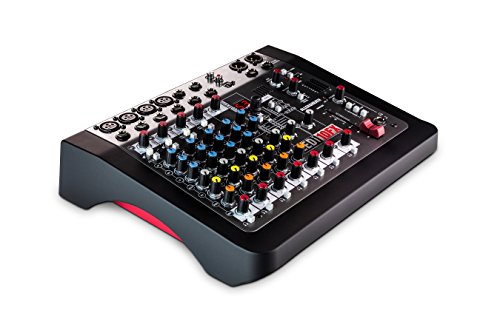
Allen & Heath ZEDi-10FX — Best for Recording
Choose the ZEDi-10FX if recording matters as much as the gig. Songwriters who demo while they rehearse, bands who want rehearsal tapes they can actually mix afterwards, and podcasters who need each microphone on its own track will all use the 4×4 interface that the rest of this list lacks. The guitar DIs mean an electric guitarist can plug straight in without a DI box, which quietly removes a whole category of setup friction.
Strengths
- 4×4 USB interface records multitrack, not just the stereo mix
- Dedicated guitar DI inputs for direct recording
- Allen & Heath preamp and EQ pedigree from its live consoles
Trade-offs
- Multitrack is 4 channels, not all 10 — plan what you capture
- Smaller, denser layout rewards careful hands in dark venues
- Effects depth can tempt beginners into over-processing vocals
| Spec | Detail |
|---|---|
| Inputs | 10 channels; hybrid mixer/interface design |
| USB | 4×4 USB interface — multitrack recording |
| Effects | 61 studio-quality FX models (per listing) |
| Inputs note | Guitar DI inputs for direct instrument recording |
Most small mixers treat USB as an afterthought — a stereo tap of the main mix. The ZEDi treats the board as an interface that happens to mix, and that inversion is why it wins the recording slot. Four tracks in and out is enough to capture two microphones and a stereo instrument separately, which is the difference between a rehearsal recording you can fix and one you can only endure. The effects library, drawn from Allen & Heath’s flagship modelling, is deeper than anything else here. As a pure live board it is compact and capable; as a hybrid, nothing else in this guide does what it does.
Best for: Songwriters, bands and podcasters who want real multitrack recording from a small board / Not suited for: Users who never record and would rather have the simplest possible live layout
Check the current price on Amazon for the Allen & Heath ZEDi-10FX.

Allen & Heath ZED-10FX — Best Sound Quality
The ZED-10FX is for the buyer who hears the difference. Acoustic acts, jazz and folk ensembles, and venues where the board feeds good speakers and quiet rooms will appreciate preamps and EQ that flatter rather than merely amplify. Its layout — fewer mic inputs, more stereo line channels — suits acts built around keyboards, playback and a couple of quality microphones rather than a wall of vocalists. If your act is two voices and a lot of instruments, this is your board.
Strengths
- Preamp and EQ voicing that flatters acoustic instruments and voices
- DI inputs handle guitars and bass without extra boxes
- Effects include tap-tempo delays that sync to the song
Trade-offs
- Fewer true mic inputs than the Yamaha or Mackie — count your vocalists
- USB is stereo only, and the design predates Bluetooth entirely
- Premium positioning within this size class
| Spec | Detail |
|---|---|
| Inputs | 10 channels; mic/line/DI plus 3 stereo line channels (per listing) |
| Effects | Onboard FX with tap tempo |
| USB | USB I/O for stereo recording and playback |
| Build | Allen & Heath small-format console construction |
There is a reason ZED boards turn up in the bags of engineers who could choose anything small: the EQ does useful things at every position and the preamps stay composed when a singer gets loud. The ZED-10FX trades raw input count for input quality and flexibility — DI-equipped channels, generous stereo provision — which is the right trade for instrument-heavy small acts. It is not the board for a five-piece vocal group, and the guide will not pretend otherwise. It is the board for the duo whose guitarist plugs straight in, whose keyboard player runs stereo, and whose audience sits close enough to hear all of it.
Best for: Acoustic and instrument-led acts who prioritise sound quality over mic count / Not suited for: Bands with four or more vocal microphones
Check the current price on Amazon for the Allen & Heath ZED-10FX.

Yamaha MG10 — Best No-Frills Value
Buy the MG10 if effects genuinely are not your job. Presenters, schools, houses of worship running speech and playback, DJs who need microphone channels beside a controller, and recordists who add reverb in software all fit. A dry board is also one less thing to set wrong under pressure: there is no effects return to feed back, no preset to recall. In installed and educational settings, that simplicity is a feature that outlasts any preset list.
Strengths
- Same D-PRE preamps and build as the effects model
- Nothing to misconfigure — ideal for non-technical operators
- Suits speech, education and playback rigs perfectly
Trade-offs
- No onboard reverb — singers used to a wet vocal will miss it
- No USB interface on this variant
- Bands expecting an all-in-one board should buy the MG10XU instead
| Spec | Detail |
|---|---|
| Inputs | 10 inputs with D-PRE preamps |
| EQ | 3-band EQ (per listing) |
| Effects | None — dry board |
| Use | Live performance, lectures and recording (per listing) |
Recommending a board without effects in a list of do-everything mixers requires the buyer to know their use case, and a large share of real 10-channel use is speech, playback and ceremony work where reverb is at best unnecessary and at worst a feedback risk in reverberant halls. For those buyers the MG10 is the MG10XU with the irrelevant third removed and the essentials untouched: clean preamps, sensible EQ, balanced outputs, and Yamaha’s build. Pair it with powered speakers and you have the definitive school-hall and conference rig. Singers should not buy it; institutions should buy two.
Best for: Speech, education, ceremony and playback rigs that never use effects / Not suited for: Singers and bands who expect onboard reverb and delay
Check the current price on Amazon for the Yamaha MG10.

RCF F-10XR — Best for Working Bands
The F-10XR suits gigging musicians who value hardware feel and headroom over brand familiarity. RCF builds for the professional market first, and the F-series inherits that attitude: the board feels like equipment rather than electronics. Bands running their own PA in bars and clubs, where the mixer gets carried, stacked and occasionally knocked, will appreciate a desk designed by a company whose main business is the speakers it feeds.
Strengths
- Pro-audio build quality from a loudspeaker-first manufacturer
- Effects and recording in one compact board
- Less common choice — often overlooked next to the big two brands
Trade-offs
- Smaller user community than Yamaha or Mackie when you need setup advice
- Fewer bundle deals and accessories listed than the mainstream rivals
- Check the exact variant on the listing — the F-series spans several sizes
| Spec | Detail |
|---|---|
| Inputs | 10 channels |
| Effects | Built-in FX section |
| Recording | USB recording capability (per listing) |
| Origin | RCF — Italian professional audio manufacturer |
Every category has a pick that working users respect more than casual buyers do, and in small mixers that is currently RCF. The F-10XR does nothing revolutionary; it simply executes the format with professional intent — sensible gain structure, usable effects, recording provision, and construction that tolerates a working life. For a band choosing its first serious board, the mainstream picks offer bigger communities and more tutorials. For a band choosing its second board, having learned what actually breaks and what actually matters, the RCF is frequently where the search ends.
Best for: Gigging bands who want professional build and feel over brand familiarity / Not suited for: First-time buyers who want the largest possible pool of tutorials and user advice
Check the current price on Amazon for the RCF F-10XR.
Comparison Table
| Pick | Badge | Key spec | Best for |
|---|---|---|---|
| Yamaha MG10XU | Best Overall | 10 inputs, D-PRE preamps, SPX effects, USB | Small bands, worship teams and presenters who want the safest, most proven 10-channel board |
| Mackie ProFX10v3+ | Best for Streaming and Podcasting | Onyx preamps, GigFX+, Bluetooth and USB | Streamers, podcasters and gigging musicians who want Bluetooth and easy USB recording |
| Allen & Heath ZEDi-10FX | Best for Recording | 4×4 multitrack USB interface with DI inputs | Songwriters, bands and podcasters who want real multitrack recording from a small board |
| Allen & Heath ZED-10FX | Best Sound Quality | British EQ and preamps with DI inputs and FX | Acoustic and instrument-led acts who prioritise sound quality over mic count |
| Yamaha MG10 | Best No-Frills Value | D-PRE preamps and 3-band EQ, no effects | Speech, education, ceremony and playback rigs that never use effects |
| RCF F-10XR | Best for Working Bands | 10 channels with FX and recording, pro-audio build | Gigging bands who want professional build and feel over brand familiarity |
How to Choose a 10 Channel Mixer
Count microphones first, channels second
The headline number is marketing; the microphone count is reality. List everything you will plug in at your biggest regular show. Each singer and each miked instrument needs a mic input with phantom power available for condensers. Keyboards, phones and playback take stereo line channels and usually consume two numbers at once. If your count of true microphones exceeds four, most 10-channel boards are already too small — step up to a 12- or 16-channel model rather than planning to ‘manage’, because you will not manage; you will leave someone unplugged.
Effects: onboard, outboard, or none
Decide where reverb and delay will come from before you buy. Onboard effects, as on the Yamaha MG10XU and Mackie above, are the simplest path for singers and the reason most small bands should insist on them. Outboard or software effects suit recording-led setups like the ZEDi-10FX. And a meaningful share of buyers — speech, education, ceremonies — need none at all, which is what the dry MG10 exists for. Paying for an effects engine you never enable is the most common overspend in this category.
Understand what the USB actually records
USB on a small mixer can mean three different things: a stereo tap of the main mix, a configurable mix feed for streaming, or a true multitrack interface that records channels separately. They are not interchangeable. Stereo is fine for archiving a service or a gig. Streaming feeds add routing conveniences. Multitrack — the ZEDi-10FX’s 4×4 design — is what you need if you intend to mix recordings afterwards. Read the listing for the board you choose and match the USB type to the job, because this is the spec buyers most often discover too late.
Preamps and EQ decide how it sounds
Two boards with identical channel counts can sound noticeably different, and the difference lives in the microphone preamps and the EQ. Named preamp families in this guide — Yamaha’s D-PRE, Mackie’s Onyx, Allen & Heath’s GSPre designs — exist because clean, quiet gain is hard to do cheaply. If you use dynamic microphones on quiet sources, or record anything, weight preamp quality heavily. EQ is the other half: a musical 3-band EQ you can fix a voice with beats a complicated EQ you cannot.
Budget tiers in this category
Without printing prices: the budget tier buys you the dry and value boards, entirely respectable for speech and simple rigs. The mid-range — where the MG10XU and ProFX10v3+ sit — is the value sweet spot for most buyers, adding effects and USB. The premium end of this size class buys sound quality and recording depth, as with the Allen & Heath pair. The step that is never worth making is paying premium money for channel count you do not need in a 10-channel frame; spend on preamps and features instead.
Matching a 10 Channel Mixer to Your Act
Channel counts are abstract until they meet a real line-up. This section maps the common 10-channel acts to the boards that fit them, so you can sanity-check the reviews against your own stage plot before ordering.
The acoustic duo or trio
Two or three voices, a guitar or two, maybe a cajon or a keyboard. Four mic inputs cover you exactly, with the stereo channels free for keys and interval music. The ZED-10FX flatters this act’s sound; the MG10XU covers it with less fuss and a USB recording of the gig. Your enemy is not channel count but headroom for guests — a fourth voice at a wedding gig has ended more duo plans than any equipment failure.
The worship corner
A small worship team — two singers, a keyboard, an acoustic guitar, a playback track for the songs nobody can play — is the classic MG10XU installation, with the dry MG10 as the speech-and-playback variant for chapels and halls. Compressors matter here more than anywhere, because volunteer singers vary, and the board must forgive them automatically. Plan the service recording at purchase time; retrofitting it is how churches end up with a laptop balanced on the piano.
The podcast or panel desk
Four microphones, a computer, and a need for clean, separate-ish feeds. The ZEDi-10FX is the specialist: its multitrack USB gives each voice its own track for editing, which is the difference between a podcast that sounds produced and one that sounds captured. The Mackie ProFX10v3+ serves the live-streaming version of the same desk, where the mix is the product and Bluetooth handles the stingers and beds.
The fitness and events instructor
One headset or handheld microphone, a phone full of music, and a room that changes every day. This act should buy the ProFX10v3+ and never think again: Bluetooth removes the cable ritual, the preamps handle a working voice at class volume, and the board survives being carried daily. Effects are for the occasional sung number and the announcements; the real spec here is setup speed, and it is the metric this guide weighted most for this act.
Ten Channels in the Real World: Power, Transport and Care
The reviews cover sound; this section covers ownership — the unglamorous logistics that decide whether a 10-channel board is still your favourite purchase in year three.
Power and cabling discipline
A small board’s power supply is its most fragile component and its most commonly lost one. Label it, keep it with the board, and carry a spare cable set as a matter of policy: two microphone cables more than you need, one spare mains lead, and the USB cable the board actually shipped with, since not all USB cables carry data reliably. Coil cables over-under so they lie flat for a decade; a board surrounded by good cables outperforms a better board surrounded by failing ones at every single show.
Cases, bags and the car-boot test
Ten-channel boards live in transit. A padded bag is the minimum; a hard case is the answer if the board shares a vehicle with speaker stands and hardware. Whichever you choose, the board should travel with its power supply in the same case, its faders protected from pressure, and nothing stacked on its knobs. Most small-board damage is not electronic at all — it is a bent fader shaft from a bag dropped on its face, and it is entirely preventable for the price of a case.
Cleaning and the five-year board
Dust is the enemy that works slowly: it enters faders and sockets and becomes crackle. Keep the board covered when stored, blow out the faders occasionally with air, and never eat or drink over an open desk at a show. If a fader does turn scratchy, exercise it gently through its travel a few dozen times before calling a technician — many contact issues are dust films that movement clears. Boards treated this way are the ones still being recommended in forums ten years on.
How to Set Up a 10 Channel Mixer for a Small Gig
A small board rewards a calm, repeatable setup routine. The sequence below gets a duo or trio from cases-open to soundchecked without the two classic small-gig failures — feedback in the first song and a recording that captured nothing. It assumes powered speakers, which is how most 10-channel rigs are used.
- Place the mixer where the operator can hear the room, not behind the speakers; run power and keep a torch and spare cables in the mixer bag.
- Connect the main outputs to the powered speakers with balanced cables, speakers off or turned down, before any input is plugged in.
- Plug in microphones and instruments channel by channel: vocal mics first, then DI instruments, then stereo playback sources in the stereo channels.
- Set every channel’s gain with the fader down: have the singer perform at show volume, raise gain until the signal is healthy without clipping, then back off slightly.
- Build the mix on faders, then shape with EQ — cut before you boost, and use high-pass thinking for voices: clarity first, warmth second.
- Add effects last and sparingly: a short reverb on vocals, returned low in the mix. If you can clearly hear the effect, it is usually too much for a small room.
- Set the playback channel for walk-in music and check phone or Bluetooth levels before doors, not during the first song.
- If you are recording, start the capture and record thirty seconds of the soundcheck, then play it back. This single habit prevents every silent-recording disaster.
- Ring out feedback gently: raise the vocal mic until it just threatens, note the offending EQ region, and trim it rather than turning everything down.
- Tape or photograph your final settings. Next week’s setup becomes a two-minute recall instead of a fresh experiment.
Pack down in reverse and coil cables properly; small boards die from bad cables and crushed bags far more often than from electronics. A setup routine like this is also the real difference between the boards in this guide — the best one is the one whose layout makes your routine fastest.
Troubleshooting
Problem: one channel hisses while the others are quiet. Check the gain first — a channel gained up for a quiet source amplifies its own noise floor. Then swap the cable and the microphone from a quiet channel: if the hiss follows the cable, you have found it. Hiss that survives both swaps, on one channel only, is a board fault worth a warranty call.
Problem: the recording captured the room but not the board. On stereo-USB boards, confirm the computer selected the mixer — not its own internal microphone — as the input device, and that the mixer’s USB routing is set to the main mix. The thirty-second soundcheck recording in our setup routine exists precisely to catch this while it is still free to fix.
Problem: feedback only when the singer moves. A moving singer finds the room’s feedback points that a static soundcheck misses. Lower the monitor level a notch, move the singer’s working area out of the speaker’s direct line, and trim the EQ frequency that rings when they pass the danger spot. Technique beats volume: teach the singer to keep the microphone close and the feedback margin grows.
Common Buying Mistakes
Counting channels instead of microphone inputs
A ’10-channel’ board with four mic preamps cannot run five singers. Buyers discover this at the first rehearsal. Count your microphones, then count stereo sources, and only then look at headline channel numbers — or step up a size while returns are still easy.
Buying effects twice, or not at all
Singers who buy the dry board miss reverb every gig; speech users who buy the effects board paid for a section that stays off for a decade. Both errors come from shopping the spec sheet instead of the job. Decide your effects source first, then choose the variant that matches.
Assuming USB means multitrack
Most small boards send only the stereo mix over USB. If your plan involves mixing individual voices and instruments afterwards, you need a true interface design like the ZEDi-10FX’s 4×4 — or a different product class entirely. Discovering this after the session is the category’s most expensive misunderstanding.
Gain staging by fader position
New operators set gains randomly and then wonder why one channel hisses and another distorts. Gain is set per source, at the input, with the performer at real volume; faders are for balance afterwards. Five minutes of proper gain staging improves a cheap board more than an expensive board set badly.
Leaving no spare channel
A board that is exactly full on day one is too small. Guests sit in, a keyboard goes stereo, a playback device appears. One or two spare channels is not waste; it is the difference between a flexible rig and a new purchase. If your count lands at ten exactly, read the 12-channel guides before you buy.
Final Recommendation
For most buyers the answer is the Yamaha MG10XU: proven preamps, usable effects, honest build, and a layout any volunteer can run. Creators should take the Mackie ProFX10v3+ for its Bluetooth and streaming-friendly USB; recordists the Allen & Heath ZEDi-10FX for true multitrack; acoustic acts the ZED-10FX for sound quality; institutions the dry MG10; and working bands who value hardware the RCF F-10XR.
Count your microphones before you order, decide your effects and recording needs in advance, and the board you choose will still be the right board in five years — which is the real test in this category.
If two picks remain tied for you, choose by workflow: the Yamaha MG10XU for a board anyone can run, or the Mackie ProFX10v3+ for a board built around a computer and a phone. Add the Allen & Heath ZEDi-10FX only when recording is a genuine second job, and it will earn its place every session.
A final word on how to read this guide against your own situation, because the best board on paper is regularly the wrong board in a particular room. Start from the operator: if the person mixing is you, experienced and consistent, weight the sound-quality and recording picks heavily, because you will extract what they offer. If the operator is a rotation — volunteers, students, band members taking turns — weight clarity and forgiveness, which is why the Yamaha defaults so often in these pages. Then weight the room: a dry, small room forgives almost everything, while a reverberant hall punishes effects excess and rewards the dry board and the careful gain staging in our setup routine. Then weight the calendar: a board used weekly justifies the mid-tier on durability alone, while a board used monthly can honestly live at the value end. None of these weightings appears on a spec sheet, and together they decide more of your satisfaction than any preamp’s name. The six boards here were chosen so that every weighting lands on a real answer — there is no scenario in this size class that ends in ‘none of the above’. Pick by your operator, your room and your calendar, in that order, and the board will feel less like a purchase and more like a member of the act: present at every show, doing its job without being discussed, which is the highest compliment live-sound equipment ever earns.
Keep exploring the cluster: Best 12 Channel Mixers Best 12 Channel Audio Mixers Best 12channel Mixers Best 16 Channel Digital Mixers List Best 16 Channel Mixers Best 10 Quart Mixers
Related guides
Frequently Asked Questions
How many microphones can a 10 channel mixer actually handle?
Typically four. Most 10-channel boards in this guide offer four true microphone preamps, with the remaining inputs arranged as stereo line channels for keyboards and playback. Acts with five or more singers should step up to a 12- or 16-channel board rather than trying to split or share microphone inputs.
What is the difference between the MG10XU and the MG10?
Effects and USB. The MG10XU adds Yamaha’s SPX effects processor and a USB audio interface to the same D-PRE preamps, EQ and chassis as the dry MG10. Singers and bands want the XU; speech, education and playback rigs are better served — and better value — with the plain MG10.
Can a 10 channel mixer record multitrack?
Only some. Most send a stereo mix over USB, which is fine for archiving and streaming. The Allen & Heath ZEDi-10FX in this guide is the exception, with a 4×4 USB interface that records channels separately. If multitrack recording is central to your plan, that distinction should drive your choice more than any other spec.
Do I need phantom power on a small mixer?
If you use condenser microphones — common for choirs, overheads, acoustic instruments and studio-style podcast mics — yes. All the boards in this guide provide it on their mic channels. Dynamic microphones, the live-vocal standard, do not need it, and phantom power does not harm them when connected with balanced cables.
Is Bluetooth on a mixer worth having?
For playback, genuinely yes. The Mackie ProFX10v3+ in this guide uses Bluetooth for walk-in music, backing tracks and class instruction, which frees a stereo channel and removes a cable from the setup. It is not a reason to buy a board by itself, but in real small-event work it is used constantly.
Which 10 channel mixer is best for a church or worship team?
The Yamaha MG10XU is the usual answer: four clean mic inputs, one-knob compressors that help volunteer operators with uneven singers, built-in effects for a little warmth, and a layout a rotating team can learn. If the team records services for later mixing, the ZEDi-10FX’s multitrack USB is worth the step sideways.
Can I expand a 10 channel mixer later with a second mixer?
You can cascade a second small board into a stereo channel for extra inputs, and it works as an emergency measure, but gain staging and monitoring become awkward quickly. If expansion is a real plan rather than a remote possibility, buying the 12- or 16-channel board now is cheaper than the two-board workaround in money and in patience.
What speakers pair well with a 10 channel mixer?
A pair of powered PA speakers in the 10- or 12-inch class covers most 10-channel acts — rooms up to a couple of hundred people — and keeps the system simple, since the mixer needs no separate amplifier. Buy the speakers with the same honesty as the board: for speech and acoustic work, clarity beats wattage; for DJ playback, low-end extension matters more.
Should I buy a 10 channel mixer with a built-in amplifier?
Powered mixers — with amplification built in — exist in this size class, but none made this guide, because the modern default of powered speakers makes a separate amplifier section redundant weight and cost for most buyers. A powered mixer still makes sense for a fixed install driving passive speakers you already own. For everyone else, the unpowered boards here plus powered speakers is the more flexible and more upgradeable system.


