Disclosure: airfryerkitchensupply.com is reader-supported. When you buy through links on our site, we may earn an affiliate commission at no extra cost to you.
Where to buy
Every linked pick in this guide to the best baby formula mixers was verified against Amazon’s catalog on 2026-11-21, so the model names and specifications below are the models you will actually land on. Start with Dr. Brown’s Formula Mixing Pitcher (Blue), Baby Brezza One Step Mixer Pitcher, Papablic Glass Breast Milk Pitcher with Mixer (Blue). Any pick described without a link is flagged honestly as unlinked in our notes. Check the current price on Amazon from any pick’s link, because finishes, bundles and stock rotate often.
The best baby formula mixers solve one physical problem: powdered formula wants to clump, and the obvious fix — shaking the bottle — whips in air that becomes foam and bubbles in your baby’s feed. Every pick here was verified as a named, traceable product, and each one dissolves powder by stirring, blending or wand-mixing rather than shaking.
A note before the picks: a mixer changes the stirring, never the recipe. Your formula manufacturer’s instructions govern water temperature, ratios and storage times, and your paediatrician’s guidance governs your baby’s feeding — this guide simply matches tools to routines. Batch pitchers serve parents who prepare ahead; the electric pitcher serves high-volume daily batching; the wand serves fresh-per-bottle families.
Key Takeaways
- A mixer changes the stirring, never the recipe — the formula manufacturer’s instructions govern ratios, temperature and storage.
- Stirring dissolves without the air that shaking whips in.
- Batch mixing demands a time habit: note when every batch was made.
- Match the format to your routine: pitcher for batching, electric for daily volume, wand for fresh-per-bottle.
In this guide
Quick Picks
- Best Overall: Dr. Brown’s Formula Mixing Pitcher (Blue) — the reference batch pitcher: blade mixing that dissolves without aerating.
- Best Electric Mixer: Baby Brezza One Step Mixer Pitcher — electric one-step mixing for up to 28 oz, designed to avoid air bubbles.
- Best Glass Pitcher: Papablic Glass Breast Milk Pitcher with Mixer (Blue) — glass body, wide mouth and a mixing handle — the pleasant batch routine.
- Best for Batch Tracking: WEMOH Borosilicate Glass Pitcher with Upgraded Mixer, 32oz — a time tracker built into a 32 oz borosilicate batch pitcher.
- Best Handheld Wand: Prince Lionheart Versa Formula Mixer with Bonus Espresso Wand — mixes in the bottle itself — the fresh-per-feed and travel answer.
- Best Grip and Sleeve: COMI Glass Breast Milk Pitcher, Formula Mixing Pitcher 32oz (Green) — glass with a silicone sleeve for grip, plus handle-lid blending.
How These Picks Were Chosen
Every product in this guide was verified against Amazon’s catalog for airfryerkitchensupply.com on 2026-11-21: we searched by brand and product name, matched the returned listing title, and only then took the ASIN used in the links. Formula feeding equipment is a category full of near-identical listings, so this verification step is what separates a named, traceable product from anonymous white-label stock.
Ranking weighed mixing effectiveness first — a formula mixer exists to dissolve powder fully without whipping in air — then capacity against a realistic day of feeds, cleaning effort, material (glass versus plastic), and how the design behaves at 3 a.m. with one hand occupied. Every pick is a mixing or batch-preparation tool; none of them replaces the formula manufacturer’s preparation instructions, which always govern water temperature, ratios and storage times.
We deliberately mixed categories: classic stirring pitchers, glass batch pitchers with mixing lids, an electric one-step mixer, and a handheld wand. Different households batch differently — some prepare a day at once under their paediatric guidance, others mix per bottle — and the right tool follows the routine, not the other way round.
The 6 Best Baby Formula Mixers

Dr. Brown’s Formula Mixing Pitcher (Blue) — Best Overall
Dr. Brown’s mixing pitcher is the category’s reference design: a batch pitcher whose lid-mounted mixing blade spins as you pump the handle, dissolving powder through the water instead of whipping air into it. It suits parents who prepare several bottles ahead — for night feeds, childcare or twins — and want the batch mixed once, properly.
Strengths
- Mixing action is designed to dissolve powder without aerating the formula
- Batch preparation turns night feeds into a pour, not a project
- A long-established baby-feeding brand with wide availability
Trade-offs
- Batch mixing means following storage guidance strictly — mixed formula has a fridge life
- Plastic construction, for those who prefer glass
- One more item in the washing-up rotation
| Type | Manual mixing pitcher |
| Mixing method | Rotating mixing blade on a stirring handle |
| Colour | Blue |
The pitcher’s virtue is mechanical honesty: the blade moves formula through the water column until the powder is genuinely dissolved, which is what stops the clumps that clog teats and the foam that becomes swallowed air. Parents batch-mixing for daycare or the night shift will feel the difference at 3 a.m., when a prepared bottle pours in seconds. The disciplines are real — mixed formula must be refrigerated promptly and used within the manufacturer’s stated window, and the pitcher joins the daily sterilising routine — but within those rules this is the tool that defines the category for a reason.
A practical note on the Dr. Brown’s routine: the pitcher earns its place when it is washed with the bottles and stored with them, not in a separate cupboard where the 3 a.m. brain must remember geography. Colour variants of the same pitcher exist in the listing family — the blue verified here — which some households use to colour-code batch days or breast milk versus formula vessels. However you organise it, the pitcher’s job is to make the safe routine the easy routine, and its design is entirely in service of that.
Over the months of formula feeding, the Dr. Brown’s Formula Mixing Pitcher (Blue) will be washed hundreds of times, and its long-term value is set by how gracefully it absorbs that rhythm: seals that stay supple, markings that stay legible, surfaces that do not harbour residue in a crevice nobody can reach. The picks in this guide were chosen partly on exactly this evidence — a mixer that is annoying to wash is a mixer that stops being washed properly, and the routine matters more than the tool.
Best for: Parents batch-preparing bottles for nights, childcare or multiples / Not suited for: Per-bottle mixers who never prepare ahead. Check on Amazon to check the current price on Amazon.

Baby Brezza One Step Mixer Pitcher — Best Electric Mixer
Baby Brezza’s One Step pitcher motorises the job: press, mix, and the electric action blends up to 28 ounces of formula with the listing’s explicit design goal of no air bubbles. It suits parents who batch-mix daily and want the most hands-off, consistent result — and the portability suits travel and grandparents’ houses.
Strengths
- Electric mixing is consistent and one-handed in practice
- Designed specifically to mix without introducing air bubbles
- 28 oz capacity covers a full day for many babies
Trade-offs
- Electric means charging or batteries and one more device to maintain
- Higher tier than manual pitchers
- Batch storage rules apply exactly as with manual mixing
| Type | Electric mixing pitcher |
| Capacity | Mixes up to 28 oz per the listing |
| Mixing method | Electric one-step mixing, designed to avoid air bubbles |
| Portability | Portable design for travel |
Consistency is the electric pitcher’s argument. A tired parent’s hand-mixing varies; the Brezza’s does not, and the no-air-bubble design goal addresses the foam problem at the source rather than by technique. The 28-ounce capacity matches a realistic day of feeds for many babies, and the portable format means the same routine works on holiday or at the grandparents’. The costs are device costs — keeping it charged, cleaning around a motorised lid, a higher tier price. For households mixing a batch every single day, the labour saved repays them; occasional mixers should take a manual pitcher.
The Brezza’s portability deserves its due: a mixer that travels to the grandparents’ house keeps the baby’s routine identical in a different kitchen, and routine is half of feeding success. It also suits parents returning to work, where a consistent morning batch made by a half-awake human benefits from a machine’s consistency. The ownership costs — charging, careful cleaning around the motorised parts — are the standard costs of any small appliance, and daily users will find them trivial against the labour returned.
When the formula months end, the Baby Brezza One Step Mixer Pitcher either retires to the cupboard of baby history or, in the case of the glass pitchers and the wand, graduates to ordinary kitchen work. Either ending is honourable. What matters is the stretch in between, where a well-chosen mixer turned a repeated, anxious task into a calm routine — the most any feeding equipment can honestly promise.
Best for: Daily batch-mixers who value consistency and one-step operation / Not suited for: Occasional mixers, and minimalists avoiding another chargeable device. Check on Amazon to check the current price on Amazon.
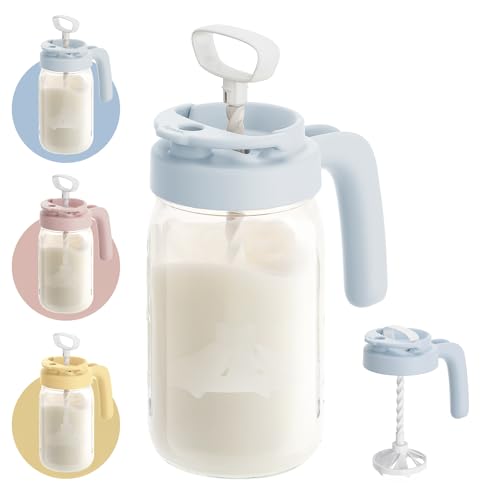
Papablic Glass Breast Milk Pitcher with Mixer (Blue) — Best Glass Pitcher
Papablic’s glass pitcher brings the mixing handle to a glass body with a wide mouth, a leakproof BPA-free lid and top-rack dishwasher cleaning. It suits parents who prefer glass for anything stored in the fridge, and pumping parents who pool expressed milk as well as formula in the same vessel routine.
Strengths
- Glass body avoids plastic contact for stored milk and formula
- Wide mouth makes powder addition and cleaning genuinely easy
- Leakproof lid suits fridge storage and transport
Trade-offs
- Glass is heavier and breakable — a real factor one-handed at night
- Dishwasher guidance is top-rack; check your rack layout
- Capacity suits batch users; per-bottle mixers need less
| Material | Glass |
| Lid | BPA-free, leakproof |
| Mixing method | Built-in mixing handle |
| Cleaning | Top-rack dishwasher safe |
| Mouth | Wide mouth |
Glass changes the daily experience in small ways that add up: it does not hold yesterday’s smell, it shows the mixture’s clarity so you can see undissolved powder, and it scrubs clean without a film. The wide mouth is the underrated feature — powder goes in without a dusting across the counter, and a bottle brush actually fits. The mixing handle keeps the low-air stirring action of the category inside the sealed pitcher, so batch preparation and fridge storage happen in one vessel. Handle it with the respect glass deserves and it is the most pleasant pitcher here to live with.
Papablic’s wide mouth has a second benefit beyond powder and brushes: it makes the pitcher a genuinely usable jug after the formula months, for batch drinks and fridge storage, which softens the single-purpose guilt of baby equipment. The glass also suits pumping parents pooling milk across a day, where seeing the volume and clarity at a glance is part of the routine. Treat the top-rack dishwasher guidance literally — glass survives dishwashers well, but lids and seals last longer out of the bottom rack’s heat.
Over the months of formula feeding, the Papablic Glass Breast Milk Pitcher with Mixer (Blue) will be washed hundreds of times, and its long-term value is set by how gracefully it absorbs that rhythm: seals that stay supple, markings that stay legible, surfaces that do not harbour residue in a crevice nobody can reach. The picks in this guide were chosen partly on exactly this evidence — a mixer that is annoying to wash is a mixer that stops being washed properly, and the routine matters more than the tool.
Best for: Parents who prefer glass storage and batch preparation / Not suited for: Anyone worried about drops — a plastic pitcher forgives more. Check on Amazon to check the current price on Amazon.

WEMOH Borosilicate Glass Pitcher with Upgraded Mixer, 32oz — Best for Batch Tracking
WEMOH’s borosilicate pitcher adds the feature batch-feeding households actually ask for: a time tracker on a 32-ounce glass body with an upgraded mixing mechanism, marketed for multi-baby feeding. Knowing when a batch was made is not a nicety — it is the core safety habit of batch preparation — and building it into the pitcher beats a strip of masking tape.
Strengths
- Time tracker builds batch-age awareness into the vessel
- Borosilicate glass handles temperature changes well
- 32 oz capacity is sized for twins and multi-baby days
Trade-offs
- Glass weight plus a full batch is a two-hand lift
- Time tracker only helps if you set it — a habit to build
- Larger capacity is wasted on single per-day small batches
| Material | Borosilicate glass |
| Capacity | 32 oz (36 oz max) per the listing |
| Features | Time tracker |
| Cleaning | Dishwasher safe |
| Lid | BPA-free, leakproof |
Every batch-mixing household develops a system for remembering when the pitcher was made; the WEMOH simply makes the system part of the object. The borosilicate body tolerates the fridge-to-warm-water transitions of daily use better than ordinary glass, the capacity genuinely covers twins or a heavy feeding day, and the upgraded mixer keeps the low-clump, low-air action the category promises. The remaining discipline is yours — set the tracker every time, without exception — but a tool that invites the right habit is worth more than one that leaves it to memory and tape.
The WEMOH’s time tracker only works if setting it becomes reflexive, so build the reflex deliberately: tracker first, then bottles into the fridge, every time, in that order. Borosilicate’s thermal tolerance also means the pitcher tolerates being filled with warm water for a batch without the thermal-shock anxiety of ordinary glass — a small but real relaxation in a tired parent’s risk calculations. For twins, where batch volumes and feeding frequency double every error, those margins are the product.
When the formula months end, the WEMOH Borosilicate Glass Pitcher with Upgraded Mixer, 32oz either retires to the cupboard of baby history or, in the case of the glass pitchers and the wand, graduates to ordinary kitchen work. Either ending is honourable. What matters is the stretch in between, where a well-chosen mixer turned a repeated, anxious task into a calm routine — the most any feeding equipment can honestly promise.
Best for: Batch-mixing households, especially with twins or multiples / Not suited for: Small-batch or per-bottle feeders who will not use the capacity. Check on Amazon to check the current price on Amazon.

Prince Lionheart Versa Formula Mixer with Bonus Espresso Wand — Best Handheld Wand
The Versa takes the opposite approach to the pitchers: instead of batching, it mixes in the bottle, with a handheld wand sized for formula. It suits per-bottle parents — those who mix fresh for each feed — and travellers who cannot carry a pitcher routine with them.
Strengths
- Mixes in the bottle — no batch, no storage questions
- Small enough for a changing bag or travel kit
- Bonus espresso wand gives it a second life in the kitchen
Trade-offs
- Per-bottle mixing means the job repeats every feed
- Wand technique matters — keep it submerged to limit air
- Not a solution for childcare batch preparation
| Type | Handheld formula mixer wand |
| Extras | Bonus espresso wand included per the listing |
Fresh-per-bottle feeding has a real constituency: no fridge maths, no batch ageing, formula made at the moment of need. The Versa serves it properly, dissolving powder in the bottle itself rather than asking a spoon to do a job spoons do badly. The technique is simple — wand submerged, brief mix, let any bubbles settle before feeding — and the tool rinses in seconds. The espresso wand bonus is a genuinely useful second career once the formula months end. For travel, night feeds away from home and fresh-mix households, this is the right-sized answer.
The Versa’s technique is worth stating plainly: fill the bottle with water at the instructed temperature, add powder, immerse the wand fully before switching on, mix briefly, and let the bottle stand a moment so any surface bubbles clear. Done that way, in-bottle mixing is as gentle as pitcher stirring and faster than spoon work. The espresso wand bonus extends the tool’s life into the parents’ own drinks — a rare baby product with an afterlife, and a small argument for it at the margin.
Over the months of formula feeding, the Prince Lionheart Versa Formula Mixer with Bonus Espresso Wand will be washed hundreds of times, and its long-term value is set by how gracefully it absorbs that rhythm: seals that stay supple, markings that stay legible, surfaces that do not harbour residue in a crevice nobody can reach. The picks in this guide were chosen partly on exactly this evidence — a mixer that is annoying to wash is a mixer that stops being washed properly, and the routine matters more than the tool.
Best for: Fresh-per-bottle feeders and travelling families / Not suited for: Batch preparers and childcare settings. Check on Amazon to check the current price on Amazon.

COMI Glass Breast Milk Pitcher, Formula Mixing Pitcher 32oz (Green) — Best Grip and Sleeve
COMI’s glass pitcher wraps its 32-ounce body in a silicone protective sleeve and blends through an easy-blend handle lid. The sleeve is the differentiator: grip security and a measure of drop protection on the material parents prefer but fear handling one-handed at night.
Strengths
- Silicone sleeve adds grip and cushions knocks
- Handle-lid blending keeps mixing inside the sealed pitcher
- Glass body with leakproof, BPA-free lid
Trade-offs
- Sleeve or not, it remains glass — drops are still drops
- Green colourway only in this listing
- Batch storage discipline applies as with all pitchers
| Material | Glass with silicone protective sleeve |
| Capacity | 32 oz |
| Mixing method | Easy-blend handle lid |
| Cleaning | Dishwasher safe |
| Lid | Leakproof, BPA-free |
The honest objection to glass pitchers is the 3 a.m. fumble, and COMI is the only pick that answers it directly. The silicone sleeve gives a wet, one-handed grip something to hold and takes the edge off counter knocks; combined with the blending handle in the lid, the pitcher mixes, stores and pours as one sealed unit. Capacity matches the other glass picks at 32 ounces, and dishwasher cleaning keeps it in the daily rotation without hand-washing penance. It does not make glass unbreakable — nothing does — but it makes glass noticeably easier to live with.
The COMI’s sleeve also insulates: a pitcher of warm mixed formula keeps its temperature a little longer on the counter during a multi-bottle pour, and a cold stored batch sweats less into the hand. These are small comforts, but feeding is a game of small comforts repeated eight times a day. The green colourway is distinctive enough to serve as the household’s designated formula vessel at a glance — in a fridge shared with lookalike jugs, instant identification is a safety feature in itself.
When the formula months end, the COMI Glass Breast Milk Pitcher, Formula Mixing Pitcher 32oz (Green) either retires to the cupboard of baby history or, in the case of the glass pitchers and the wand, graduates to ordinary kitchen work. Either ending is honourable. What matters is the stretch in between, where a well-chosen mixer turned a repeated, anxious task into a calm routine — the most any feeding equipment can honestly promise.
Best for: Glass-preferring parents worried about grip and knocks / Not suited for: Anyone needing a colour other than green, or who prefers plastic’s lightness. Check on Amazon to check the current price on Amazon.
Comparison Table
| Pick | Badge | Key spec | Best for |
|---|---|---|---|
| Dr. Brown’s Formula Mixing Pitcher (Blue) | Best Overall | Rotating mixing blade on a stirring handle | Parents batch-preparing bottles for nights, childcare or multiples |
| Baby Brezza One Step Mixer Pitcher | Best Electric Mixer | Mixes up to 28 oz per the listing | Daily batch-mixers who value consistency and one-step operation |
| Papablic Glass Breast Milk Pitcher with Mixer (Blue) | Best Glass Pitcher | BPA-free, leakproof | Parents who prefer glass storage and batch preparation |
| WEMOH Borosilicate Glass Pitcher with Upgraded Mixer, 32oz | Best for Batch Tracking | 32 oz (36 oz max) per the listing | Batch-mixing households, especially with twins or multiples |
| Prince Lionheart Versa Formula Mixer with Bonus Espresso Wand | Best Handheld Wand | Bonus espresso wand included per the listing | Fresh-per-bottle feeders and travelling families |
| COMI Glass Breast Milk Pitcher, Formula Mixing Pitcher 32oz (Green) | Best Grip and Sleeve | 32 oz | Glass-preferring parents worried about grip and knocks |
How to Choose a Baby Formula Mixer: Start With Your Routine
The right mixer follows how you actually feed. If you prepare several bottles ahead — for night feeds, a partner’s shift, childcare or twins — a batch pitcher is the tool, and the choice narrows to material and mixing mechanism. If you mix fresh for every feed, a pitcher is fridge clutter and a handheld wand or a small pitcher you use one bottle at a time serves better. Be honest about the routine before shopping; the most common mistake in this category is buying for an imagined routine.
Whichever route you take, the manufacturer’s instructions for your formula govern everything that matters — water temperature, the powder-to-water ratio, and how long mixed formula keeps. A mixer is a dissolving tool, not an authority; this guide’s job is to help you choose the tool that makes following those instructions easiest.
Pitchers, Electric Mixers and Wands: The Three Formats
Manual batch pitchers stir powder through water with a blade or mixing handle, dissolving clumps without shaking — shaking a bottle is what whips in the air that becomes foam and bubbles. They are simple, silent and cheap to run, and they ask for fridge discipline in return.
Electric pitchers automate the same job with consistent speed and duration, which is why their listings emphasise bubble-free mixing; they suit high-volume daily batching and repay their higher tier in labour. Handheld wands mix in the bottle itself — nothing to store, nothing batch-sized to wash — and suit fresh-per-bottle feeding and travel.
Glass or Plastic, Capacity and Cleaning
Glass pitchers do not retain odours, show the mixture’s clarity so undissolved powder is visible, and scrub clean without a film; they are heavier and breakable. Plastic pitchers are light and forgiving of drops but can hold smells over time. The listings in this guide state their materials plainly, and the verified picks include both — choose by your handling reality, especially one-handed at night.
Capacity should match a real day: too small and you mix twice, too large and formula sits ageing. Cleaning decides long-term love — wide mouths, dishwasher-safe parts and few crevices keep a pitcher in daily use instead of in the cupboard. Every pick here was chosen partly on how it washes.
Mixing Technique: Dissolving Without Air
Whatever the tool, the principle is the same: move the water through the powder gently and thoroughly rather than agitating violently. Add water first at the temperature your formula’s instructions specify, add powder, then mix with a stirring or swirling action until no dry pockets remain — check the base and corners, where powder hides. If bubbles do form, a short rest lets them rise and clear before feeding.
Hygiene is the other half of technique. Mixing equipment joins the same washing and sterilising routine as bottles, batch-mixed formula is refrigerated promptly and used within the manufacturer’s window, and any feed that has been started and left is discarded per the guidance on your formula’s packaging. The best mixer is the one that makes this whole routine feel easy enough to do properly at 3 a.m.
How to Mix a Batch of Formula With a Pitcher, Step by Step
Wash and prepare
Wash hands, then wash and sterilise the pitcher and mixing parts exactly as you do bottles. Set out the formula tin, a clean scoop and the bottles the batch will fill.
Measure the water first
Add the full batch’s water to the pitcher at the temperature your formula’s instructions specify. Water first keeps the ratio honest — powder added to a measured volume cannot quietly concentrate the feed.
Add powder level by level
Add the scoops your formula’s ratio requires for that water volume, using level, unpacked scoops. Scatter the powder across the surface rather than dumping it in one mound, so it wets evenly.
Mix with the pitcher’s action
Use the pitcher’s blade, handle or electric cycle to stir until the liquid is uniformly cloudy with no dry pockets at the base or corners. Avoid shaking the pitcher — stirring is what keeps air out.
Check, then pour
Hold the pitcher to the light: undissolved powder shows as flecks or a gritty base. Mix again briefly if needed, then pour into bottles, letting any surface bubbles settle before sealing.
Label, refrigerate, track
Note the time the batch was made — a pitcher’s time tracker, a phone note or tape on the lid — and refrigerate promptly. Use within the window your formula’s packaging states, and warm individual bottles as needed rather than reheating the batch.
Wash immediately after
Rinse the pitcher as soon as it empties; dried formula is dramatically harder to remove. Wash, sterilise with the bottles, and air-dry before the next batch.
Common Buying Mistakes
Shaking bottles to mix
Shaking whips air into formula, creating foam and bubbles. Stirring and swirling dissolve powder without the air — that is the entire point of these tools.
Guessing the batch age
Batch mixing without noting the time is how formula outlives its safe window. Use a tracker, a note or tape — every time, without exception.
Adding powder before water
Powder-first measuring distorts the ratio. Water first, in the full measured volume, then powder by the formula’s stated ratio.
Improvising ratios or temperatures
The formula manufacturer’s instructions are the recipe. A mixer changes the stirring, never the proportions.
Letting equipment skip the washing routine
Pitchers and wands contact the same food as bottles and deserve the same washing and sterilising discipline.
Buying capacity for an imagined routine
A 32-ounce pitcher for a baby who takes two small fresh bottles a day is clutter. Match the tool to the real feeding pattern.
Twins, Multiples and the Arithmetic of Volume
Parents of twins or multiples meet a different arithmetic: double the bottles, double the washing, and night feeds that arrive in stereo. For these households the batch format is not a preference but a logistics system, and capacity stops being a convenience specification — the 32-ounce glass pitchers in this guide, the WEMOH with its time tracker above all, exist because a smaller vessel means a second batch in the middle of the day and a second chance to lose track of a batch time.
The routine that survives multiples is the one with the fewest decisions: same pitcher, same station, same tracker habit, bottles filled and labelled in one pass. Electric mixing earns a second look here too — the Baby Brezza’s consistency across a large batch removes the under-mixed bottom layer that a tired hand can leave in a full pitcher. Whatever the tool, multiples reward system over improvisation more starkly than any other feeding situation.
Support people are part of the system as well: a partner, grandparent or night helper who can execute the routine identically because it is written down beside the station. The best mixer for a multiples household is therefore partly a communications device — the one whose operation needs no explanation at 3 a.m. Choose, document, and let the system carry what memory cannot.
The First Month of Night Feeds: What Actually Changes
Parents consistently describe the same first-month arc with a proper mixer: the feed preparation stops being a task and becomes a motion. The batch is made after the evening wash-up, the pitcher waits in the fridge with its time noted, and the 3 a.m. feed is a pour and a warm rather than a measuring exercise conducted in the dark with a crying accompaniment. The equipment did not change the baby; it changed the parent’s night.
The second change is subtler: confidence. A feed that is visibly smooth, bubble-free and correctly measured removes one variable from the new parent’s long list of worries. That is not a medical claim — it is the ordinary human relief of a job done properly with a tool designed for it, and it is why this category, humble as it looks, inspires unusual loyalty.
By the second month the mixer has usually disappeared into the kitchen’s geography — pitcher by the bottles, wand in the travel bag — which is the fate of all good feeding equipment. Choose the one whose routine you can sustain on your worst night, not your best, and it will earn that disappearance.
Washing and Sterilising: Building the System Around the Mixer
A formula mixer joins the feeding system, so its washing should be designed, not improvised. The workable pattern mirrors the bottles: rinse immediately after use, wash in hot soapy water or the dishwasher where the listing allows, sterilise on the same cycle as the bottles, and air-dry on a clean rack rather than a tea towel. Equipment that shares the bottles’ rhythm never becomes the forgotten item breeding yesterday’s residue in a corner.
Design the geography too. Pitcher, bottles, scoops and drying rack within one reach of each other turns batch preparation into a single station task; scattered equipment turns it into a treasure hunt conducted one-handed. Parents consistently report that the routine, once stationed, takes minutes — the mixer is not the burden, the disorganisation was.
Replace on condition, not calendar: seals that no longer seal, lids that warp, glass that chips, wand heads that fray. Baby equipment is inexpensive precisely so that worn pieces can be retired without sentiment, and a mixer is a food-contact surface held to the same standard as the bottles it fills.
Feeding Away From Home: Travel, Childcare and the Other Kitchen
Every feeding routine eventually leaves its own kitchen, and the mixer choice shows its second face there. Batch households travelling to family need the routine to survive a strange fridge: a pitcher that seals genuinely, a time-tracking habit that travels with it, and bottles filled before the journey for the journey itself. The wand pick in this guide exists for the opposite strategy — mix fresh wherever you land, with nothing to keep cold.
Childcare settings reward the clearest systems: a labelled pitcher, a written batch time, and instructions a carer can follow without interpretation. If a grandparent or nursery will use your equipment, choose the pick whose operation you can explain in one sentence — for most households that is the classic stirring pitcher — and write the formula’s own instructions beside it.
Whichever strategy travels, the constants do not change: the manufacturer’s ratios and temperatures, prompt refrigeration of batches, and discarding what the guidance says to discard. Equipment flexes; the rules do not.
Three Feeding Routines, Three Tools
The night-shift household batch-mixes before bed: a pitcher of formula waits in the fridge, bottles pour in seconds, and the sleeping parent’s shift stays asleep. This is the Dr. Brown’s and glass pitchers’ home ground, and the time-tracking habit is its admission price. The second routine is the pumping parent’s: expressed milk pooled across the day in a glass pitcher, formula mixed in the same vessel on other days — the Papablic, WEMOH and COMI pattern.
The third routine belongs to the fresh-feeders and travellers: no batches, no fridge maths, a bottle mixed at the moment of hunger wherever the day has taken the family. The Prince Lionheart wand serves them, and the pitchers in this guide would serve them badly — as clutter. Naming your routine honestly is the whole of the buying decision; the reviews above simply execute it.
The Science of a Calm Bottle: Clumps, Air and Temperature
Formula powder clumps because its particles hydrate unevenly: the outside of a powder mound turns to gel before water reaches the middle, sealing dry powder inside. Stirring tools defeat this by dispersing powder through moving water a little at a time, which is why adding powder gradually to water — never the reverse — and mixing with a sweeping stir produces a smooth feed where shaking produces foam and lumps.
Air is the second variable. Bubbles whipped into a feed do not vanish in the bottle; they are swallowed, and while this guide makes no medical claims, parents universally prefer a calm, bubble-free feed for comfort and for accurate volume measurement — foam makes a bottle look fuller than it is. Every pick here exists to mix without aerating, and the resting minute after mixing, which lets stray bubbles rise and pop, is part of the technique.
Temperature discipline completes the picture: prepare with water at the temperature your formula’s manufacturer specifies, cool or warm individual bottles rather than the batch, and treat storage windows as rules rather than guidelines. The equipment in this guide makes the disciplined routine easier; it cannot make an undisciplined one safe, and no honest guide should pretend otherwise.
Final Recommendation
The full shortlist, for convenience: Dr. Brown’s Formula Mixing Pitcher (Blue), Baby Brezza One Step Mixer Pitcher, Papablic Glass Breast Milk Pitcher with Mixer (Blue), WEMOH Borosilicate Glass Pitcher with Upgraded Mixer, 32oz, Prince Lionheart Versa Formula Mixer with Bonus Espresso Wand, COMI Glass Breast Milk Pitcher, Formula Mixing Pitcher 32oz (Green). Each link lands on the exact model verified for this guide; check the current price on Amazon there before you decide.
For most batch-preparing parents, the Dr. Brown’s pitcher is the starting point — the category’s reference design at a manual pitcher’s simplicity. Glass households should choose between the Papablic (wide mouth, dishwasher ease), the WEMOH (time tracker, twins capacity) and the COMI (sleeve grip). Daily high-volume batchers should consider the Baby Brezza electric; fresh-per-bottle and travelling families should take the Prince Lionheart wand.
Whichever tool you choose, build the three habits that make it work: water first, note the batch time, and wash the mixer with the bottles. Parents setting up the wider feeding station may also want our cluster guides to Best Baby Formula Mixers companion products in the same programme — and remember that technique, not equipment, is what keeps formula mixed gently and safely.
Frequently Asked Questions
Why not just shake the bottle?
Shaking dissolves powder by violence, and the violence whips air into the feed as foam and bubbles, which the baby then swallows along with the milk. Stirring and pitcher-mixing dissolve the same powder with far less air — that difference is the entire reason this product category exists.
How long does batch-mixed formula keep?
Follow the window stated on your formula’s packaging — mixed formula is refrigerated promptly, used within the manufacturer’s stated period, and a bottle that has been fed from is treated per the same guidance, which generally means discarding leftovers. When in doubt, the packaging and your paediatrician outrank any guide, including this one.
Glass or plastic pitcher — which is better?
Glass does not hold odours, shows undissolved powder clearly and scrubs clean; plastic is lighter and forgives drops. Both appear among our verified picks. Choose by your handling reality — especially one-handed, at night, over hard floors.
Can these pitchers also mix breast milk?
Several picks are dual-purpose by design — the Papablic, WEMOH and COMI listings describe breast milk pitchers with formula mixing, used for pooling expressed milk under the pitcher method. Follow your lactation and paediatric guidance for storage times, which differ from formula.
Is an electric mixer worth it over a manual pitcher?
If you batch-mix every day, the consistency and one-step operation repay the higher tier and the charging routine. If you mix occasionally or per bottle, a manual pitcher or the wand does the same job with less apparatus.
How do I know the powder is fully dissolved?
Hold the pitcher or bottle to the light and look for flecks, streaks and a gritty layer at the base — powder hides in corners and at the bottom. A fully mixed batch is uniformly cloudy. If in doubt, mix briefly again; undissolved clumps can clog teats mid-feed.


