Disclosure: airfryerkitchensupply.com is reader-supported. When you buy through links on our site, we may earn an affiliate commission at no extra cost to you.
Where to buy
Each grill below was confirmed as a live Amazon listing before being included. Check the current price on Amazon for the Traeger Ironwood 885, the Traeger Pro 22, the Pit Boss 440 Mahogany, the recteq Bullseye RT-B380, the Weber Searwood 600, and the Cuisinart Wood Pellet Grill & Smoker. Pellet grill prices move with the seasons and with model-year changeovers, so the live listing is the only number to budget by.
Introduction: The Grill That Replaced Gas
The best wood pellet grills won the backyard by answering a simple question better than gas ever could: what if the grill that cooks dinner also flavored it? A pellet grill feeds hardwood pellets into a fan-blown fire under digital control, so it lights with a button, holds a temperature like an oven, and wraps everything it cooks in real wood smoke — light at grilling heat, deeper when you run it low. For the household whose grill works three weeknights a week, that combination is transformative: burgers with a wood-fired edge, chicken that tastes like a cookout instead of a chore, and the option — always there, never obligatory — to smoke ribs on Saturday with the same machine. This roundup judges pellet grills as grills first: preheat speed, searing honesty, grate quality, temperature manners at cooking heat, and the weeknight usability that decides whether a grill becomes furniture or family.
The six picks span the category’s honest range. Traeger’s Ironwood 885 is the polished all-rounder; the Pro 22 is the classic, simpler Traeger that defined the category; Pit Boss’s 440 Mahogany is the budget door into real pellet grilling; recteq’s Bullseye is the high-heat specialist that grills hotter than pellet orthodoxy allows; Weber’s Searwood 600 is the searing-focused flagship of a grill-first design; and Cuisinart’s compact barrel is the small-patio answer. Between them they cover nearly every budget and backyard, and the sections after the reviews take up the two questions that decide satisfaction: how to actually grill well on pellets, and which spec-sheet claims to ignore. A reader in a hurry can go straight to the comparison table; a reader deciding for the next decade of dinners should take the long way through, because the differences that matter — controller temperament, grate mass, hopper logic, ecosystem — are exactly the ones a table compresses away.
One expectation, set honestly at the start: a pellet grill is not a gas grill with better flavor and no other differences. It preheats more slowly, it asks for pellets and periodic ash clearing, and its sear has a ceiling that two picks here were chosen specifically to push against. What it returns for those small disciplines is flavor and versatility no gas grill can imitate — and for most households that trade, once tasted, is permanent. The reviews that follow are written for the cook making that trade with open eyes.
In this guide
Quick Picks
- Best Overall: Traeger Ironwood 885 — 885 square inches, WiFIRE, Super Smoke, and the most polished grilling manners in the mainstream class. Check the current price on Amazon.
- Best Classic: Traeger Pro 22 — 572 square inches, an 18-pound hopper, and the straightforward controls that made pellet grilling mainstream. Check the current price on Amazon.
- Best Budget: Pit Boss 440 Mahogany — 518 square inches with a flame broiler and digital control at the category’s friendliest tier. Check the current price on Amazon.
- Best for High-Heat Grilling: recteq Bullseye RT-B380 — a kettle-style pellet grill that runs far hotter than conventional pellet designs for true searing. Check the current price on Amazon.
- Best for Searing: Weber Searwood 600 — Weber’s pellet grill engineered around rapid, high-heat direct cooking with connected control. Check the current price on Amazon.
- Best Compact: Cuisinart Wood Pellet Grill & Smoker — 465 square inches of 8-in-1 pellet cooking sized for smaller patios. Check the current price on Amazon.
How These Picks Were Chosen
The brief for this list was grilling performance, so the filter differed from a smoker roundup’s: a pick had to reach and hold genuine grilling temperatures, present a grate worth searing on, and behave well in the fifteen-to-forty-minute cooks that dominate real grill usage. Low-and-slow ability was required — a pellet grill that cannot smoke is a poor pellet grill — but it was the second criterion, not the first, and several famous smoking-first models were left to the companion guides for exactly that reason.
Judging then weighed the weeknight virtues. Preheat behavior: how fast the grill reaches cooking temperature and how much additional time the grates need to load with heat, because grate heat, not air heat, sears food. Temperature honesty: the gap between the display and the grate, and how the controller handles the lid openings that grilling involves constantly. Fuel manners: pellet consumption at grilling temperatures, where pellet grills burn fastest, and hopper size against a week of dinners. Build: lid sealing, grate material, and the grease routing that keeps high-heat grilling safe. Each pick finally took the role it wins outright — all-rounder, classic, budget, heat specialist, sear specialist, compact — so the list reads as six answers rather than six attempts at the same answer.
The 6 Best Wood Pellet Grills

Traeger Ironwood 885 Wood Pellet Grill & Smoker — Best Overall
The Ironwood 885 is what a pellet grill looks like when a mature maker sweats the details: 885 square inches of cooking space, the D2-driven WiFIRE system with app control and a hopper pellet sensor, Super Smoke mode for low cooks, and double-wall construction in the lower body that steadies temperatures and trims pellet use. As a grill, its virtues are consistency and calm — it comes to temperature predictably, recovers after lid openings like an appliance should, and its grates deliver even browning across the whole surface rather than a hot stripe over the burn pot. Burgers, chicken pieces, chops, and vegetables all emerge with that unmistakable wood-fired edge, and the same machine smokes a brisket the following weekend without a single accessory.
Strengths
- The most complete grilling package in the mainstream pellet class.
- Pellet sensor ends the empty-hopper surprise on long cooks.
- Even heat across the grate — no burn-pot hot stripe to manage.
Trade-offs
- Premium-mainstream price; budget picks undercut it heavily.
- Searing is strong radiant work, not the open-flame class of the specialists below.
- Preheat is pellet-paced, not gas-instant.
For the household buying one pellet grill to be the grill — the default outdoor cooker for years — the Ironwood is the safest pair of hands in the category. Its owners grill more, not less, as the months pass, because the machine never makes a weeknight cook feel like a project. That usage compounding is the real return on its price, and it is why it anchors this list.
Best for: households wanting the best all-round pellet grill as their main cooker / Not suited for: sear absolutists or strict budgets
Check the current price on Amazon

Traeger Pro 22 Wood Pellet Grill & Smoker — Best Classic
The Pro 22 is the grill that taught America what a pellet grill was: 572 square inches, an 18-pound hopper, a meat probe, and Traeger’s straightforward digital controller in a barrel design of disarming simplicity. It lacks the Ironwood’s insulation, pellet sensor, and Super Smoke branding, and in exchange offers the category’s most proven platform — a grill whose behaviors are documented by a decade of owners and whose parts and covers exist everywhere. As a grill it is honest and capable: proper heat for weeknight cooking, even results, and the Traeger smoke signature at low settings for weekend ribs.
Strengths
- The most proven, best-supported platform in pellet history.
- Simple controls with nothing to misunderstand.
- 18-pound hopper covers long cooks without refills.
Trade-offs
- Single-wall body burns more pellets in cold and wind.
- No Wi-Fi on this classic configuration — monitoring is manual.
- Top-end searing is the gentlest of the Traeger pair here.
The Pro 22 suits the buyer who values the known over the new: a grill whose every quirk has a forum answer, whose ownership costs are predictable, and whose cooking is thoroughly satisfying. It is also the natural upgrade target’s baseline — many Ironwood owners started here and speak of it fondly — which is its own kind of review. If the budget reaches one Traeger and the cooking is family-scale, this remains a deeply sensible door into the category.
Best for: buyers who want the proven classic at family scale / Not suited for: cooks wanting app control and cold-weather insulation
Check the current price on Amazon

Pit Boss 440 Mahogany Series Wood Pellet Grill — Best Budget
The 440 Mahogany is the budget pellet grill that does not feel like an apology: 518 square inches of cooking space in an attractive mahogany finish, a digital control board with an LED readout, a meat probe, and Pit Boss’s flame broiler lever, which slides open a direct-flame path over the fire pot for finishing. That broiler is the budget story’s headline — it gives the cheapest grill on this list a searing trick the classic Traeger lacks — and the rest of the package is sensibly judged: enough space for a family’s dinner or a couple of rib racks, a small hopper suited to its size, and construction that prioritizes the cooking over the cosmetics.
Strengths
- Flame broiler adds direct-flame finishing at a budget tier.
- 518 square inches is honest family capacity.
- Mahogany finish looks a class above its price.
Trade-offs
- Small hopper means refills on long smokes.
- Controller swings wider than PID-class rivals.
- Thinner build; a cover and sheltered spot are mandatory kindnesses.
As a first pellet grill or a second home’s cooker, the 440 is the easiest yes in this guide. It grills weeknight dinners with real wood flavor, smokes a respectable pork butt on weekends, and costs its owner so little anxiety that experimentation — the soul of getting good at this — comes naturally. Budget buyers should spend the savings on pellets, a cover, and protein, in that order.
Best for: first pellet grill buyers and second-home patios / Not suited for: overnight brisket cooks or precision smoking
Check the current price on Amazon

recteq Bullseye RT-B380 Pellet Grill — Best for High-Heat Grilling
The Bullseye breaks pellet orthodoxy on purpose: a kettle-style pellet grill, shaped like the classic charcoal kettle, that runs dramatically hotter than barrel-style pellet grills — into true searing and pizza-adjacent territory — while still smoking at the low end. The kettle form is the trick: a smaller, focused chamber where the fire’s energy concentrates instead of dissipating across a big barrel. recteq’s controller quality and stainless-forward build ride along, making the Bullseye the pellet grill for the cook whose grilling is mostly hot and fast but who refuses to surrender the smoke option.
Strengths
- High-heat ceiling far beyond conventional pellet grills — real searing, real pizza potential.
- Kettle format heats fast and uses pellets efficiently at grilling temps.
- recteq build and controller steadiness.
Trade-offs
- Kettle capacity suits everyday grilling, not party loads or multiple briskets.
- Its riot-mode heat demands respect and a clean grease path.
- Low-and-slow space is modest compared with the barrels here.
Think of the Bullseye as the pellet grill for charcoal-kettle people: the shape, the speed, and the sear feel like home, while the auger and controller remove the chimney-lighting and vent-fiddling that kept weeknight grilling rare. Steak night is its showcase — a smoke kiss at low heat, then a ferocious finish — and it performs that sequence better than any other pellet grill in this roundup.
Best for: hot-and-fast grillers who want pellet convenience with kettle soul / Not suited for: big-capacity smokers
Check the current price on Amazon

Weber Searwood 600 Wood Pellet Smoker Grill — Best for Searing
Weber aimed the Searwood directly at the pellet category’s sore spot. Its design brief is rapid, high-heat grilling — fast startup, fast preheat, and a direct-cooking system that puts genuine char on food — backed by Wi-Fi and Bluetooth control and Weber’s unmatched parts and dealer network. As a grill it behaves like the gas grills Weber built its name on, except the fire is hardwood: quick to light after work, composed at temperature, and capable of a low smoking simmer when the menu changes. For households migrating from a Weber gas grill, the Searwood is the shortest learning curve in this entire guide.
Strengths
- The strongest searing performance among the barrel-style pellet grills here.
- Fast startup narrows the weeknight gap with gas to almost nothing.
- Weber’s service and parts depth is the industry’s safest bet.
Trade-offs
- Smaller cooking area than the Ironwood or the big Pit Boss class.
- Smoke at grilling temperatures is minimal — smoke low first, then sear.
- A younger platform than Traeger’s, with less accumulated owner lore.
The Searwood is the pellet grill for grillers — people whose outdoor cooking is eighty percent hot and fast and who have been waiting for a pellet machine that respects that ratio instead of apologizing for it. Its reverse-sear workflow, described in the technique section below, is the single best steak method available on any pellet grill in this list.
Best for: gas-grill migrants and hot-and-fast households / Not suited for: cooks who mostly smoke large cuts
Check the current price on Amazon
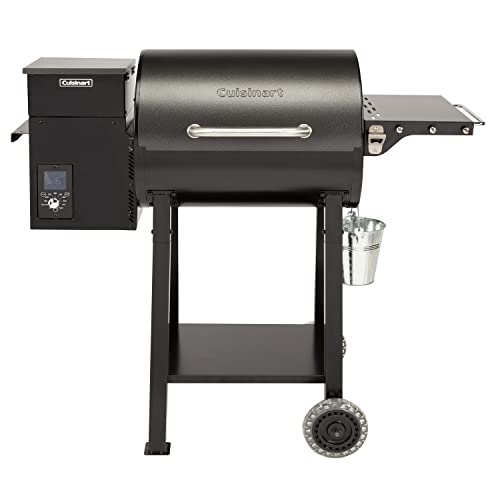
Cuisinart Wood Pellet Grill & Smoker — Best Compact
Cuisinart’s barrel pellet grill packs the category’s full repertoire — the listing counts eight cooking functions across its 465 square inches — into a footprint and price aimed at smaller patios and smaller households. It grills, smokes, roasts, and braises under digital control, with a windowed pellet hopper and a tidy, appliance-like design language that suits its kitchen-brand heritage. Capacity is the honest limit: this is a grill for two to four people, a couple of racks of ribs, a modest pork butt — everyday cooking, not event catering — and within that brief it performs with a competence that makes larger grills feel excessive for small homes.
Strengths
- Full pellet versatility in a compact, patio-friendly footprint.
- Appliance-grade design and controls from a kitchen brand.
- An accessible tier for small households entering the category.
Trade-offs
- 465 square inches caps ambitious cooks; no whole packer briskets.
- Smaller hopper and thinner build than the category’s heavyweights.
- Searing is adequate rather than a headline.
For the couple, the small family, or the patio measured in feet, the Cuisinart is the right-sized pellet grill — and right-sized grills get used, which is the whole game. It also serves admirably as a second grill beside a large smoker, handling weeknight duty while the big machine rests. Buy it for the cooking you do weekly and it will not disappoint.
Best for: small households and compact patios / Not suited for: crowds or brisket maximalists
Check the current price on Amazon
Comparison Table
| Pick | Badge | Key spec | Best for |
|---|---|---|---|
| Traeger Ironwood 885 | Best Overall | 885 sq in, WiFIRE, Super Smoke | The main-grill all-rounder |
| Traeger Pro 22 | Best Classic | 572 sq in, 18 lb hopper | Proven simplicity |
| Pit Boss 440 Mahogany | Best Budget | 518 sq in, flame broiler | Real pellet grilling, lowest tier |
| recteq Bullseye RT-B380 | Best High-Heat | Kettle-style, very high max temp | Searing and speed |
| Weber Searwood 600 | Best Searing | High-heat direct cooking design | Gas migrants, steak nights |
| Cuisinart Pellet Grill 465 | Best Compact | 465 sq in, 8-in-1 | Small patios, small households |
How to Choose a Pellet Grill When Grilling Is the Point
Most pellet grill advice is written by smokers for smokers, which leaves grill-first buyers decoding the wrong spec sheet. If grilling is your main act, rank the virtues differently. First comes heat delivery at the grate: not the advertised maximum air temperature, but how much energy the grate itself holds and returns when cold food lands. Heavy grates, compact chambers, and direct-flame features are the physical answers, which is why the Bullseye’s kettle and the Pit Boss’s broiler punch above their prices. Second comes preheat honesty: a grill that reaches temperature in twelve minutes but whose grates need ten more is a twenty-two-minute grill, and knowing your machine’s true ready time is the difference between weeknight ease and weeknight friction. Third is recovery — grilling means opening the lid constantly, and controllers with real authority, in bodies with real insulation, shrug off openings that leave lesser grills sagging.
Size for the grill load, not the smoke load: the binding constraint for most households is a dozen burgers, eight chicken thighs, or four steaks with vegetables, all on the main grate at once, and that footprint is smaller than brisket math suggests. A 500-to-600-square-inch grill serves most families’ grilling completely; the jump to 850-plus earns its keep when smoking joins the repertoire in earnest. Hopper size matters less for grillers — a week of dinners sips what a single brisket drinks — but pellet storage still deserves a dry plan, because grilling temperatures expose stale fuel fastest: weak heat, lazy flame, and a cook who blames the grill for the bag’s sins. Finally, weigh the ecosystem you are marrying: covers, grates, pizza attachments, and parts availability differ by brand, and the grill you can accessorize is the grill that grows with your cooking instead of being replaced by it.
How to Grill on a Pellet Grill: Preheat, Zones, and the Reverse Sear
Pellet grilling technique is mostly thermal patience. Start the grill earlier than instinct suggests and let it run past its ready beep: the controller reports air temperature, but the grates are still drinking heat, and the extra ten minutes of soaking is what turns pale, steamed-looking chicken skin into properly rendered, browned skin. Keep the lid down between flips with a discipline gas grillers find unnatural — every opening dumps the heat you banked — and arrange food with the burn pot’s geography in mind: most barrel grills run a warmer stripe near the center or the stack side, and a single rotation halfway through the cook evens what the design cannot. Dry food grills better than wet food on every fuel, and doubly so here, where the heat is convective as much as radiant: pat proteins dry, oil the food rather than the grate, and let salt do its work in advance when the schedule allows.
The reverse sear is the pellet grill’s signature move and deserves its reputation. Set the grill low with its smoke mode if it has one, and cook thick steaks or chops gently until the interior sits twenty degrees below target, resting in smoke the whole way. Pull the meat, raise the grill to its maximum — or open the flame broiler, or move to the Bullseye’s high heat — and sear briefly per side. The result is a steak with a smoke depth no direct method builds and a crust formed on meat already warm through, so the gray overcooked band under the surface nearly vanishes. Once a household learns this sequence, the pellet grill stops being “the easy grill” and becomes the steak grill, which is the moment the category’s promise fully lands.
Pellet Grill vs. Gas Grill: The Honest Weeknight Comparison
Since most pellet grills replace a gas grill, the comparison deserves candor rather than cheerleading. Gas wins on ignition speed, full stop: five minutes from knob to cooking is a real weeknight virtue, and households cooking in fifteen-minute windows will feel the pellet grill’s longer runway. Gas also wins on raw searing simplicity and on fuel logistics — a tank exchange beats bag storage for the space-poor. Pellet wins on flavor by a margin that is not subtle, on versatility by an even larger one — no gas grill smokes a brisket or bakes a cobbler credibly — and on temperature honesty, holding a set point through a cook the way an oven does rather than the way a burner knob hopes. Pellet also wins the guests’ verdict, reliably: food from a wood fire tastes like an occasion, and that effect survives familiarity.
The deciding question is therefore not which fuel is better but which cook you are on a Tuesday. If Tuesday means speed above all, keep the gas grill and let a pellet machine be the weekend smoker — a division of labor many two-grill households swear by, and the reason our grill-smoker combo guide exists. If Tuesday has twenty minutes of grace in it, the pellet grill’s flavor dividend pays out three nights a week, and the gas grill becomes the one gathering dust. Neither answer is a failure of judgment; buying the wrong answer for your actual Tuesdays is.
Common Buying Mistakes
The signature mistake of this category is buying a smoker-shaped pellet grill for a grilling life: the big barrel optimized for low-and-slow, purchased by a household that grills hot five nights a week and smokes twice a year, then complains that pellet grills cannot sear. The picks above are deliberately grill-weighted; match the shape to the cooking. The second mistake is trusting maximum-temperature claims without asking about grate mass and chamber size — heat you cannot store is heat you cannot sear with — and the third is its mirror: dismissing pellet grills’ searing entirely based on the weakest examples, when the Bullseye and Searwood class machines exist precisely to answer it.
Fourth, buyers under-budget the consumables and care: pellets by the bag, a cover, ash vacuuming, and the occasional igniter across the years. A pellet grill is an appliance with a fire in it, and its maintenance is measured in minutes per month — but they are compulsory minutes, and skipping them manufactures the failures that fill one-star reviews. Fifth, do not buy capacity by warming-rack arithmetic; compare main grates, picture your largest regular grill load, and let the brisket fantasies be served by the grill-smoker guides if they ever come true. Finally, beware the cheapest no-name tier below even the Pit Boss pick: controllers, augers, and fans are wear parts, and a grill whose maker cannot supply them is a disposable appliance wearing a category’s clothing.
The Pellet Question: Flavor, Cost, and Storage for Grill-First Households
Grillers burn pellets faster than smokers do — high temperatures are thirsty work — so the fuel deserves a griller’s plan rather than a smoker’s afterthought. Flavor first: at grilling temperatures the smoke note is a background accent, which means the assertive woods that smokers prize can overwhelm delicate foods at close range; a versatile oak blend is the griller’s house pellet, with hickory reserved for beef and burgers that welcome the punch, and fruit woods for the chicken and fish that dominate weeknight grills. Many experienced pellet grillers keep exactly two bags open — the house blend and one accent — and resist the collector’s shelf of half-used flavors, because open bags age and absorb the garage’s humidity while they wait.
Cost follows burn rate, and the honest summary is that pellet grilling costs more per cook than propane and less than eating out about it — a trade nearly every owner makes gladly once the flavor lands. The controllable waste is stale fuel: pellets that have dulled, swollen, or turned dusty burn weakly at exactly the high temperatures grilling demands, producing the “my grill won’t get hot” complaint that fills support forums every spring. Store bags sealed, off the floor, and rotate stock so the oldest bag burns first; empty the hopper if the grill will sleep through a humid month, because the hopper is a storage bin with an auger attached, and it preserves pellets no better than an open sack. Grill-first households that build this small fuel discipline find their grills hotter, their cooks steadier, and their opinions of the category considerably higher than the households that treat pellets as gravel.
Two-Grill Households: Where a Pellet Grill Fits Beside Charcoal or Gas
A large share of pellet grill owners keep a second fire, and the division of labor that emerges is worth knowing before you decide a pellet grill must do everything. The charcoal kettle or kamado typically keeps the high ceremonies: the steak night sear, the pizza at full blast, the cook where tending the fire is itself the entertainment. The pellet grill takes everything else — the weeknights, the long smokes, the big roasts, the mornings when biscuits bake outside because the kitchen is hot. Gas, where it survives, becomes the emergency appliance: the five-minute hot dogs, the power-outage-proof burner, the sidekick for sauces. Households that plan this ecology deliberately buy each machine for its strength instead of asking one machine to be three, and their satisfaction with all of them runs higher.
The practical consequence for this roundup’s buyer is permission: choosing the Ironwood for its all-round polish does not require pretending it sears like charcoal, and choosing the Bullseye for its heat does not require pretending it smokes like a big barrel. Buy the pellet grill for the eighty percent of your cooking it will own, let a second fire — owned already, or bought cheaply later — hold the remainder, and the patio becomes a system rather than a compromise. The cooks who love this category most are almost never the ones who demanded it replace everything; they are the ones who let it be superb at what it is.
First Month on a Pellet Grill: The Cooks That Teach the Machine
New pellet grill owners learn fastest from a deliberate sequence rather than random enthusiasm. Cook one should be chicken thighs at a moderate roasting temperature: forgiving, quick, and brutally informative about your grill’s evenness — the thigh that browns first is marking your hot zone for free. Cook two is burgers at full heat, where you learn your true preheat time and how the grates behave under a full, fatty load, including where the grease goes and how the grill handles it. Cook three is the low end’s audition: a rack or two of ribs run slow, which teaches the smoke character of your pellets, the controller’s steadiness across hours, and the hopper’s real appetite at smoking temperatures. By the end of those three cooks you know your grill’s personality — its hot stripe, its honest ready time, its display-versus-grate offset — and every subsequent cook is built on knowledge instead of hope.
The fourth cook is where households diverge by ambition: the reverse-seared steak for the grill-first cook, the pork butt for the smoke-curious. Both are within a new owner’s reach precisely because the first three cooks calibrated the machine. What derails beginners is skipping the calibration and opening with a brisket for twelve guests, then blaming the category for a scheduling ambush. Pellet grills forgive more than any other wood cooker, but they still reward the cook who treats the first month as an apprenticeship — short, delicious, and deliberately sequenced — over the cook who treats it as a product launch.
Grate Material, Decoded: What Your Food Actually Touches
The grate is the one part of a pellet grill in direct contact with dinner, and its material quietly decides more results than the controller does. Porcelain-enameled steel, the category’s default, is the balanced citizen: it heats evenly enough, releases food well, resists rust, and asks only that you avoid metal-on-enamel violence with scrapers. Porcelain over cast iron is the sear upgrade — the iron’s mass stores heat that brands food on contact, while the enamel keeps maintenance civilized — and it is the single most effective accessory change a barrel-grill owner can make for steak night. Bare cast iron sears hardest of all and demands the most: seasoning, oiling, and rust vigilance in exchange for a surface that improves for years if tended and sulks if ignored.
Stainless rod grates are the durability play: they will never chip or rust through in a home cook’s lifetime, they clean with a brush and indifference, and they sear adequately without ever being the best at it — the choice of owners who value permanence over peak crust. Thickness matters within every material: a heavy grate of any kind outperforms a thin one, because stored heat is the sear. When comparing grills, lift the grate if you possibly can; when upgrading, buy mass before pattern, since diamond marks photograph well but thermal mass cooks. And whichever material you run, its best friend is the fully soaked preheat from the technique section — the finest grate in the world, asked to sear while still warming, will steam a steak as sadly as the cheapest.
Final Recommendation
Buy the Traeger Ironwood 885 if one pellet grill must do everything for years; the Pro 22 if proven simplicity appeals; the Pit Boss 440 Mahogany if the budget leads; the recteq Bullseye if your grilling runs hot and fast; the Weber Searwood 600 if you are leaving gas for wood and want the landing soft; and the Cuisinart 465 if the patio is small and the household smaller. Then do the one thing that separates satisfied pellet grill owners from the rest: start the grill when you start the prep, keep the lid down while it cooks, and let dinner taste like the reason you bought a wood-fired grill in the first place.
Related reading in this cluster: Best Wood Pellet Grill Smokers, Best Wood Pellet Smokers, Best Wood Grills, Best Wifi Pellet Grills, Best Wood Pellet Grill Memphis Grills Elite, and Best Wood Oven Pizza Grills.
Frequently Asked Questions
What is the difference between a pellet grill and a pellet grill smoker?
Mostly emphasis in design and marketing rather than a hard boundary: machines sold as pellet grills tend to prioritize the hot, fast end and weeknight usability, while pellet grill smokers present the same technology balanced toward the full range with smoking features forward. The overlap is enormous — every pick in this guide smokes credibly — so shop by the specifics that matter to your cooking: smoke modes, hopper size, searing provisions, and capacity, rather than by which pair of words the box leads with. Our grill-smoker guide in this cluster takes the balanced brief in depth.
Is assembly difficult on a full-size pellet grill?
It is a project of an hour or two rather than an ordeal: the body, legs or cart, hopper, and stack assemble with ordinary tools, and the two genuine cautions are weight — a second pair of hands for the barrel is wisdom, not luxury — and patience with the burn-in, which should never be skipped or shortened. Lay out parts before starting, keep the manual’s hardware map in sight, and do not force electrical connectors that were designed to seat one way. Owners who assemble calmly report the process as the grill’s first lesson in how it is built, which pays off at every later cleaning.
Should my first pellet grill have Wi-Fi?
Only if your cooking will use it — and be honest, because the upcharge is real. Wi-Fi earns its keep on long, unattended cooks: briskets monitored from work, ribs checked from the store, alerts that catch a wandering temperature before the meat does. For the grill-first household cooking attended dinners, a non-connected grill loses nothing at the table, and the money saved buys a season of pellets. Many owners’ second grills have Wi-Fi precisely because their first taught them which cooks they actually run; let your own menu, not the feature list, arbitrate.
Why does food stick to my pellet grill’s grates?
Sticking is a heat and timing problem more than a grate problem. Food releases naturally once its surface has seared and dried; moved too early, it tears and leaves its crust behind. The fixes are a fully preheated, heat-soaked grate, food patted dry before it goes on, oil on the food rather than flooding the grate, and patience through the first minutes — the urge to check and shuffle is the sticking’s best friend. Porcelain-coated grates forgive more than bare steel, and a well-seasoned cast-iron section forgives most of all.
Can I use my pellet grill in the rain?
Light weather, sensibly managed, is normal pellet-grill life — the fire is enclosed and the electronics are built for outdoor duty — but standing water and driving rain are enemies of both the pellets in the hopper and the controller. A covered position or a pop-up canopy keeps cooks comfortable and the grill dry; never operate any grill in an enclosed space, and let the cover go back on once the grill is fully cool. Owners in wet climates treat the hopper as the priority: dry pellets are worth more than a dry cook.
Can a pellet grill get hot enough to sear a steak?
Yes, with the right model and technique. High-heat designs like the Bullseye and the Searwood sear directly and well; conventional barrels sear respectably when fully preheated with heat-soaked grates, and excel at the reverse sear, where a low smoke phase precedes a short, hot finish. What a standard pellet grill will not do is match a charcoal fire’s open-flame char — if that specific crust is your religion, keep a small charcoal grill beside the pellet machine, as many households do.
How long does a pellet grill take to preheat?
Plan on roughly a quarter of an hour to cooking temperature for most models, plus additional minutes for the grates to fully load with heat before searing — the honest ready time for serious grilling is closer to twenty minutes. Fast-start designs like the Searwood narrow that window meaningfully. Either way, the rhythm becomes automatic: start the grill when you start prepping the food, and the two finish together.
Do pellet grills use a lot of electricity?
Very little in running terms — the igniter draws the most during startup, after which the fan and auger sip power. The practical implication is not your power bill but your power access: a pellet grill needs an outdoor outlet (or, for the 12-volt-capable brands, a battery solution) wherever it lives, which is worth confirming before the grill arrives, not after.
What size pellet grill do most families need?
For grilling-first households, the 500-to-700-square-inch class covers family dinners completely, with room for a couple of rib racks when smoking calls. Step up to the 850-plus class when briskets, multiple butts, or party grilling enter the regular rotation. Compact grills under 500 square inches serve couples and small patios honestly and should not be apologized for — a right-sized grill used weekly beats a cavernous one used monthly.
Can I bake and roast on a pellet grill, or is it just for grilling and smoking?
A pellet grill is a wood-fired convection oven at heart, and it bakes and roasts accordingly — pizzas on a stone or in an attachment, whole chickens, casseroles, cobblers, and bread all cook beautifully in its steady, smoke-kissed heat. Many owners find the “oven” functions quietly become their favorites, because everything emerges with a flavor note the kitchen oven cannot produce. Temperature honesty is the enabler: set it, trust it within its known offset, and cook by the same times your indoor recipes use.
How often does a pellet grill need cleaning?
Lightly and often beats deeply and rarely: empty or vacuum the burn pot’s ash every few cooks, scrape the drip tray as it accumulates, and empty the grease bucket before it fills. A deeper clean — grates scrubbed, interior vacuumed, probes checked — a few times a season keeps the grill cooking like new. The whole burden is measured in minutes, and it is the difference between the owners who praise these grills for a decade and the ones who curse them in year two.


