Disclosure: airfryerkitchensupply.com is reader-supported. When you buy through links on our site, we may earn an affiliate commission at no extra cost to you.
Where to buy
All six grills below were confirmed as live Amazon listings before being included. Check the current price on Amazon for each: the Traeger Ironwood 885, the Weber Searwood 600, the Char-Griller AKORN Kamado, the Pit Boss 850 Navigator, the Green Mountain Grills Trek Prime 2.0, and the Ninja Woodfire OG301. Outdoor grill pricing swings hard between spring launches and autumn clearances, so treat the live listing — not any number printed in an article — as the truth.
Introduction: What “Wood Grill” Actually Means
The best wood grills share one thing gas grills can never offer: the fuel is also the seasoning. When hardwood burns under your food, it lays down flavor compounds that propane simply does not produce, which is why a burger off a wood fire tastes like a different food from the same burger off a gas burner. But “wood grill” covers three genuinely different machines, and choosing between them matters more than choosing between brands. Pellet grills burn compressed hardwood pellets fed by an auger into a small burn pot, with a fan and controller holding temperature almost like an oven — they are the easiest wood grills to live with and the most versatile. Charcoal-and-wood grills, from kamados to kettles, burn lump charcoal with wood chunks for smoke; they reach far higher searing temperatures and demand more skill. Compact electric woodfire grills burn a small quantity of pellets purely for smoke flavor while electric elements do the heating — a legitimate shortcut for balconies and small patios where a full fire is not practical.
This roundup is organized around grilling first. Smoking ability counts — every pick here can run low and slow — but the judging lens is the weeknight question: how well does this machine cook a steak, a tray of chicken thighs, or a pile of burgers over real wood flavor, and how much effort does it ask in return? Two picks are full-size pellet grills built for families, one is a searing specialist, one is a charcoal kamado for purists, one is a portable pellet grill that runs on 12-volt power for tailgates and campsites, and one is a countertop-sized electric woodfire grill for people whose “backyard” is a balcony. Between them they cover nearly every honest answer to the wood grill question.
One expectation to set early: no wood grill is instant. Pellet grills need ten to fifteen minutes to come to temperature, charcoal needs twenty, and even the electric woodfire unit needs a preheat. What you get for those minutes is flavor no instant-on fuel can match — and for most of the cooks who switch to wood, that trade stops feeling like a trade within a month. It is also worth saying plainly that every grill in this roundup was chosen because it is genuinely good at the job in its badge; there are no filler picks carried along to make the list longer, and where a famous name did not earn a place on merit for this particular keyword, it is simply not here.
In this guide
Quick Picks
- Best Overall: Traeger Ironwood 885 — 885 square inches, WiFIRE control, and a Super Smoke mode, in the most polished all-round pellet grill package here. Check the current price on Amazon.
- Best for Searing: Weber Searwood 600 — a pellet grill engineered around high-heat direct cooking, with Wi-Fi and Bluetooth control. Check the current price on Amazon.
- Best Charcoal Wood Grill: Char-Griller AKORN 20-Inch Kamado — insulated steel, cast iron grates, and the hardest sear in this lineup. Check the current price on Amazon.
- Best Value, Large Capacity: Pit Boss 850 Navigator — a big Wi-Fi pellet grill with a flame broiler slide for direct-flame finishing. Check the current price on Amazon.
- Best Portable: Green Mountain Grills Trek Prime 2.0 — a compact Wi-Fi pellet grill that runs on 12-volt power and folds down for the truck bed. Check the current price on Amazon.
- Best for Small Spaces: Ninja Woodfire OG301 — an electric outdoor grill that burns real wood pellets for smoke flavor on a balcony-friendly footprint. Check the current price on Amazon.
How These Picks Were Chosen
The first filter was fuel honesty: a pick had to cook with wood as a real flavor source, not as a gimmick. That admitted pellet grills, charcoal-and-chunk cookers, and the one electric unit that burns actual pellets for smoke — and excluded gas grills with optional chip boxes, which produce a whisper of smoke and a pile of disappointment.
Judging weighted grilling performance first: maximum useful temperature, grate material and heat retention, and whether the design offers any direct-flame or direct-coal path for finishing. Temperature control came second — how tightly the controller holds a set point, and how honestly the grill recovers after the lid opens. Capacity was judged against real food loads rather than headline numbers, and build quality was judged on the parts that fail first in pellet grills: auger, fan, igniter, and the controller itself. Finally, each pick had to own a distinct role, so the six read as six different answers — family flagship, searing specialist, charcoal purist, value flagship, portable, and small-space — rather than six trims of the same idea.
A note on pellet grill smoke flavor, because it decides satisfaction more than any spec: pellet grills smoke most strongly at low temperatures and least at searing temperatures, where the fire burns too cleanly to make much smoke. Picks with a dedicated smoke mode or a low-temperature smoke setting earned credit for addressing that physics honestly instead of pretending it away.
The 6 Best Wood Grills

Traeger Ironwood 885 Wood Pellet Grill — Best Overall
The Ironwood 885 is the pellet grill against which the category is measured, and it earns Best Overall here by being the most complete grilling package rather than the best at any single trick. Its 885 square inches handle a family cookout without juggling, the D2 controller and WiFIRE app hold temperature with the steadiness that makes pellet grilling feel like cheating, and Super Smoke mode pushes extra smoke at low temperatures where pellet grills are naturally weakest on flavor. At the top of its range it grills burgers, chicken, and chops with genuine wood-fired character, and the build — double-wall insulation in the lower body, a pellet sensor in the hopper, a clean-out system that does not require a shop vac and a prayer — reflects a maturity the cheaper end of the category has not reached.
Strengths
- Super Smoke mode meaningfully deepens flavor on low-and-slow cooks.
- WiFIRE app control with a pellet-level sensor ends the mid-cook empty-hopper surprise.
- 885 square inches fits a brisket, or a full family grill load, with room to spare.
Trade-offs
- It is a premium-tier purchase, priced well above the value picks here.
- No direct-flame access: searing is good, but it is radiant-and-grate searing, not open-flame.
- At high temperatures smoke flavor fades, as with every pellet grill.
Who it suits is the cook replacing a gas grill as the household’s main outdoor cooker. The Ironwood asks almost nothing: load pellets, set a temperature, and cook, with the app warning you before the hopper runs dry. Steak nights come out with real wood character, weekend ribs come out with a smoke ring and bark that satisfy people who also own offsets, and the learning curve is measured in one cook. The honest limitation is the sear ceiling — if your definition of a great steak requires open flame or ripping cast iron over coals, the AKORN below exists for you. For everyone else, this is the wood grill that simply works, every time, for years.
Best for: households wanting one premium pellet grill that does everything well / Not suited for: open-flame searing purists or tight budgets
Check the current price on Amazon

Weber Searwood 600 Wood Pellet Smoker Grill — Best for Searing
Weber built the Searwood line around the complaint pellet grill owners repeat most: “it cooks great, but it doesn’t sear.” The Searwood 600 answers with a design aimed at rapid, high-heat grilling — fast preheat, strong top-end temperatures, and a direct-flame style cooking system that puts real char on steaks and burgers — while keeping Wi-Fi and Bluetooth control and a proper low end for smoking. It feels like a gas grill that went to wood school: quick to light, quick to temperature, and composed at a smoking simmer when ribs are on the menu.
Strengths
- The strongest high-heat grilling performance of the pellet picks here.
- Fast startup and preheat narrow the convenience gap with gas.
- Weber’s dealer and parts network is the deepest in the industry.
Trade-offs
- Smaller cooking area than the Ironwood 885 or Navigator 850.
- High-heat focus means smoke output at grilling temps is minimal — smoke low, sear fast, in that order.
- A newer platform than Traeger’s, with a shorter long-term track record.
The Searwood’s party trick is sequencing: smoke a thick ribeye low for forty minutes, pull it, crank the grill, and finish with a hard sear — a reverse sear executed on one machine without moving food between cookers. That workflow is where wood grills beat gas grills most clearly, and the Searwood is built for it. Buyers whose grilling is mostly weeknight-fast — burgers, chops, chicken pieces, vegetables — will find its speed addictive, while low-and-slow cooks are well served even if the dedicated smoker roundups favor bigger boxes. It is the pellet grill for grillers first and smokers second.
Best for: grill-first cooks who refuse to give up a real sear / Not suited for: cooks who mostly smoke large cuts and rarely grill hot
Check the current price on Amazon

Char-Griller AKORN 20-Inch Kamado — Best Charcoal Wood Grill
The AKORN is the reminder that the original wood grill is a fire in an insulated bowl. Triple-wall steel insulation holds heat like ceramic at a fraction of the weight and cost, cast iron grates store enough heat to brand a steak properly, and a small pile of lump charcoal with two wood chunks delivers smoke flavor that pellet grills chase with electronics. It grills at temperatures hot enough for pizza stones and flatbreads, settles down for ribs and pork shoulder with miserly fuel use, and asks for skill in return: you are the controller, working two dampers instead of an app.
Strengths
- The hardest, most honest sear in this roundup.
- Insulation makes it the most fuel-efficient and weather-proof pick here.
- Steel body shrugs off the knocks that crack ceramic kamados.
Trade-offs
- Capacity is modest — family-sized, not party-sized.
- Temperature control is manual; overshooting a target is easy and slow to correct.
- Requires a deflector setup for indirect smoking, and ash discipline to prevent rust.
For cooks who enjoy fire as a craft, the AKORN is the most satisfying grill on this list at any price. Its high-heat ceiling opens cooking that pellet grills cannot touch — blistered pizzas, tandoor-style skewers, steaks with a true crust — while its low end produces pulled pork that stands next to any pellet-smoked shoulder. It is also the only pick that works in a power outage, a camping cabin, or anywhere electricity is a rumor. If the phrase “the app lost connection” sounds like a reason to never grill again, this is your wood grill.
Best for: hands-on cooks who prize searing power and fuel efficiency / Not suited for: anyone who wants app control or cooks for crowds
Check the current price on Amazon

Pit Boss 850 Navigator Series Wood Pellet Grill — Best Value, Large Capacity
The Navigator 850 is Pit Boss doing what Pit Boss does: more grill, more features, less money than the premium badges. You get a large cooking area (the Navigator line runs over 850 square inches in total rack space), Wi-Fi and Bluetooth control, an LCD controller, and the brand’s signature flame broiler — a sliding plate that opens direct flame access over the burn pot for finishing steaks and burgers. That last feature is the reason it beats other value grills here: it gives a budget pellet grill a genuine, if small, direct-fire searing zone.
Strengths
- Flame broiler slide adds real direct-flame finishing most pellet grills lack.
- Large capacity and connected control at a mid-market tier.
- Heavy, sturdy build for the money, with a generous hopper.
Trade-offs
- Temperature swings are wider than on the Traeger or Weber controllers.
- The direct-flame zone is small — sear in batches, not all at once.
- Fit and finish trail the premium picks; expect a more industrial feel.
The Navigator buyer is feeding a crowd on a real-world budget and wants pellet convenience without the premium badge tax. Ribs, briskets, and burger nights all land well, the app keeps a long cook honest from the couch, and the flame broiler rescues the one course pellet grills usually fumble. Treat its temperature readout as approximate, verify with a probe thermometer at grate level, and it cooks far above its tier. As a first pellet grill or a family workhorse, it is the value anchor of this list.
Best for: families wanting maximum pellet grill per dollar / Not suited for: precision-obsessed cooks who hate temperature swings
Check the current price on Amazon
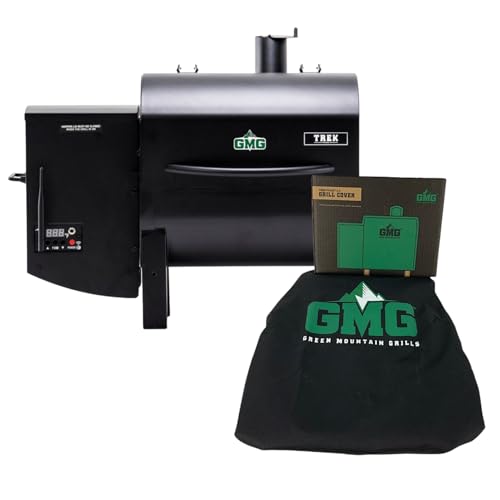
Green Mountain Grills Trek Prime 2.0 — Best Portable
The Trek Prime 2.0 takes the pellet grill camping. It is a compact Wi-Fi pellet grill with folding legs, a 12-volt power option that runs it from a vehicle or a battery pack, and a control system borrowed from its full-size siblings rather than a stripped-down camping afterthought. On a tailgate it smokes a rack of ribs properly; at a campsite it grills breakfast and dinner off the truck battery; on a small patio it serves as a legitimate everyday wood grill for two to four people. A fitted cover is included in the common bundle, which matters for a grill that lives in truck beds and garage corners.
Strengths
- True pellet-grill cooking that travels: 12-volt capable, foldable, compact.
- Wi-Fi control, unusual in the portable class.
- Big enough for real meals, small enough for a balcony or RV.
Trade-offs
- Cooking area limits you to one brisket flat or a couple of rib racks at a time.
- Small hopper means refills on long cooks.
- Portable grills live hard lives; legs and latches need periodic tightening.
What separates the Trek from novelty camping grills is that it is not a toy version of a pellet grill — it is a pellet grill, shrunk. Temperature control, smoke output, and build all behave like the full-size GMG line, and the same pizza-oven attachment ecosystem in the GMG family (covered in our pizza guide linked below) has a small Trek-sized version. For RV travelers, tailgaters, and small households, it may be the only grill on this list that fits both the space and the life.
Best for: campers, tailgaters, RVers, and small patios / Not suited for: cooking for more than four to six people at once
Check the current price on Amazon

Ninja Woodfire Outdoor Grill & Smoker OG301 — Best for Small Spaces
The Woodfire is the honest cheat code of this category: an electric outdoor grill, sized for a balcony table, that burns a small scoop of real hardwood pellets in a smoke box so the food genuinely tastes wood-fired. It grills, smokes, and air-fries, preheats in minutes, and runs off a standard outlet — which makes it the only pick here that many apartment and condo dwellers are actually allowed to use. The smoke flavor is lighter than a full pellet grill’s; it is seasoning-level smoke, clearly present on ribs and chicken, rather than the deep smoke of an all-pellet fire. For its size and ruleset, that is a fair and tasty trade.
Strengths
- Real wood-pellet smoke in an electric, balcony-legal footprint.
- Fast preheat and multi-function cooking (grill, smoke, air fry) in one unit.
- Simple cleanup and storage compared with any fire-burning pick.
Trade-offs
- Smoke depth is lighter than a true pellet or charcoal grill.
- Cooking area serves two to four people, no more.
- Requires outdoor-rated power access; no battery or off-grid option.
Judge the Woodfire against the alternative its buyers actually face — no grill at all, or a flavorless electric plate — and it wins easily. Chicken thighs with real smoke, burgers that taste like a cookout, and weeknight speed make it the most-used grill in many small homes. It will not smoke a brisket for a party, and it does not pretend to. As the small-space answer in a wood grill roundup, it is included with clear eyes and a clear conscience.
Best for: apartments, condos, and small patios with power but no room / Not suited for: brisket cooks, parties, or smoke purists
Check the current price on Amazon
Comparison Table
| Pick | Badge | Key spec | Best for |
|---|---|---|---|
| Traeger Ironwood 885 | Best Overall | 885 sq in, WiFIRE, Super Smoke | The complete family pellet grill |
| Weber Searwood 600 | Best for Searing | Pellet grill, high-heat direct cooking focus | Grill-first cooks and reverse sears |
| Char-Griller AKORN Kamado | Best Charcoal | 20-inch insulated steel kamado | Searing power and fuel efficiency |
| Pit Boss 850 Navigator | Best Value Large | Wi-Fi, flame broiler slide | Big capacity per dollar |
| GMG Trek Prime 2.0 | Best Portable | 12V capable, Wi-Fi, folding legs | Camping, tailgating, RV life |
| Ninja Woodfire OG301 | Best Small Space | Electric with real pellet smoke box | Balconies and small patios |
How to Choose a Wood Grill: Pellets, Charcoal, or Electric Woodfire
The fuel decision is the whole ballgame, so make it deliberately. Pellet grills trade a little smoke intensity and a hard ceiling on searing for total convenience: consistent temperatures, app monitoring, and weeknight usability that gets the grill used three times a week instead of three times a month. A grill you use constantly beats a theoretically superior grill you avoid, which is why pellet grills have taken over the category. Choose pellets if your cooking is varied, your schedule is real, and your smoke ambitions are satisfied by a clean hardwood background note plus a proper smoke ring on weekend cooks.
Charcoal and wood — the kamado pattern — is the choice when peak flavor and peak heat are the point. Nothing in this roundup sears like the AKORN, nothing matches lump-and-chunk smoke for depth, and nothing else works without power. The cost is skill and attention: you manage airflow by hand, you learn your cooker’s temperament over a dozen cooks, and capacity stays modest unless you spend heavily. Choose charcoal if cooking is a hobby you practice, not just a meal you produce. Electric woodfire is the third path, and it exists for constrained spaces: where open flame is banned or room is measured in feet, a pellet-smoke electric grill delivers real wood flavor at small scale. It is not a compromise to apologize for; it is the only door into wood grilling for many homes.
Within pellet grills, the specs that actually separate models are controller quality, hopper size, and grate material. Controller quality decides whether “set 225” means a steady smoke bath or a roller coaster that toughens ribs; established controllers from Traeger, Weber, and GMG hold noticeably tighter than bargain units. Hopper size decides whether an overnight cook is possible without a 3 a.m. refill — for long cooks, treat anything under roughly eighteen pounds of capacity as a daytime grill. Grates matter for the sear: heavier grates hold more heat when cold food lands, and porcelain-enameled cast iron gives the best balance of marks and maintenance. Ignore maximum-temperature bragging in isolation; what matters is how much heat the grate itself stores, which is mass, not a number on a box.
How to Get a Real Sear on a Wood Grill
The sear problem is physics: a great crust needs a very hot surface and dry meat. Start with the meat — pat steaks and chops thoroughly dry, salt them ahead when time allows, and let thick cuts lose their refrigerator chill while the grill heats. Preheat longer than the display suggests: the controller reaches air temperature quickly, but the grates need another ten minutes to load with heat, and that stored heat is what brands the meat. On a pellet grill, cook at the top of the range and resist opening the lid; every peek dumps the heat you spent fifteen minutes building. If your grill has a direct-flame feature like the Navigator’s broiler slide, finish over the open flame for the final minute per side.
On the kamado, searing is a different sport: build a two-zone fire with coals banked to one side, sear over the inferno side, and move meat to the cooler side to finish — the same zone logic competition steak cooks use. For thick steaks on any wood grill, the reverse sear is the reliable master technique: smoke low until the interior is twenty degrees shy of target, rest briefly, then sear hot and fast. The smoke phase builds flavor no direct method matches, and the final sear stays short because the meat is already warm through, so the crust forms without a gray band of overcooked meat beneath it. Whichever grill you own, a cheap instant-read thermometer turns these techniques from folklore into repeatable results — internal temperature, not time or color, is the only honest doneness signal.
Pellet and Wood Storage: The Unglamorous Skill That Decides Flavor
More wood-grill disappointment traces back to damp fuel than to any grill defect. Pellets are compressed sawdust; they absorb humidity eagerly, swell, crumble, and then jam augers or burn weakly with acrid smoke. Store pellets in a sealed container, off a concrete floor, and never leave a hopper full through a rainy month — pellets sitting in the hopper between cooks are the number one cause of the “my grill won’t hold temperature” complaint. If pellets have gone dull gray and dusty, they are done; burn them in a fire pit, not under a brisket. Lump charcoal is hardier but still degrades when damp, and it lights slowly and spits when wet. Keep it bagged, sealed, and dry.
Flavor choice matters as much as freshness. Hickory and oak are the assertive all-rounders for beef and pork; fruit woods — apple, cherry, pecan — run milder and sweeter for poultry, fish, and vegetables. Mesquite burns hot and strong and will bully delicate food if used for a whole cook; blend it or reserve it for short, hot grilling. Buy smaller bags of two or three woods and learn their voices on chicken, the most honest test food, before committing to a bulk bag of anything. And whatever the wood, let the fire establish before food goes on: white, billowing startup smoke is the dirtiest smoke of the cook, and patience at the start is flavor at the table.
Common Buying Mistakes
The classic mistake is buying a pellet grill expecting steakhouse sear straight out of the box, then blaming the grill for physics. If searing is your top priority, buy the searing specialist or the kamado, or plan on a cast-iron grate or griddle accessory for your pellet grill from day one. The second mistake is sizing by headline square inches: manufacturers count every rack, including top shelves where little cooking happens. Compare main-grate area, and picture your actual largest cook — a spatchcocked turkey, four racks of ribs — before trusting a number.
Third, buyers ignore the ownership costs and chores: pellets by the bag, a cover, a vacuum for ash in the burn pot, replacement igniters over the years. Pellet grills are appliances with a fire inside; the burn pot needs its ash cleared regularly or the fire smothers and temperatures wander, and that ten-minute chore is the difference between a grill that feels broken and one that feels new. Fourth, do not buy a portable or compact grill as your only grill if you host — the Trek and the Woodfire are brilliant inside their briefs and miserable outside them. Finally, beware chasing the largest hopper or the highest temperature as a proxy for quality; controller steadiness and grate mass decide your results far more than either headline number.
The Details That Decide Daily Satisfaction: Grates, Lids, and Cleanup
Spec sheets fight over capacity and temperature, but daily satisfaction with a wood grill is decided by smaller things. Grate weight is the first: lift the grate before you buy if you can. A heavy grate stores heat, marks food properly, and feels like equipment; a wire-thin grate flexes under a brisket and sheds heat the moment cold meat lands. Porcelain coating over cast iron is the sweet spot for most owners — cast iron’s heat with a surface that releases food and resists rust better than bare iron. Lid and body sealing is the second detail: on a pellet grill, a well-sealed lid keeps heat and smoke working on the food instead of escaping at the seams, and it shows up in pellet consumption on windy days more than in any laboratory number.
Cleanup design is the third detail, and it is the one owners curse or praise weekly. Pellet grills generate ash in the burn pot and grease at the drip tray; the good designs route both to places a human can reach — a removable ash cup, a grease bucket that actually catches, a drip pan that slides out instead of requiring a contortionist. The Ironwood’s clean-out thinking and Weber’s service access exist because their makers learned that a grill which is annoying to clean gets cleaned less, and a grill cleaned less cooks worse every month. Kamados ask the least here — scoop ash, brush grates — but demand the discipline of never letting ash sit wet. Whatever you buy, read the cleaning section of its manual before the first cook, not after the first disappointing one; half of “pellet grill problems” are cleaning problems wearing a disguise.
Finally, consider where the grill will live. A full-size pellet grill is a piece of outdoor furniture with a power cord: it needs a covered or coverable spot near an outlet, out of the worst weather, on a surface that tolerates heat and the occasional grease drip. Measure the space, the door widths it must pass through, and the slope of the patio — a big grill on a slope with small casters is a slow-motion accident. The best wood grill is the one that fits your space, your power, and your habits, not the one with the longest feature list.
Your First Ninety Days With a Wood Grill
New wood grill owners tend to follow a predictable arc, and knowing it in advance smooths the ride. The first two weeks are honeymoon and chaos in equal measure: everything tastes faintly of smoke and victory, and at least one cook will run long, short, hot, or sideways. Cook forgiving foods — chicken thighs, sausages, pork chops, burgers — and learn the machine’s startup rhythm, its real preheat time, and how its displayed temperature compares with a probe at grate level. Write the differences down; every grill has a personality offset between its display and reality, and knowing yours is worth more than any accessory.
Weeks three through eight are for range-finding. Run one deliberate low-and-slow cook — a pork butt is the classic teacher — and one deliberate high-heat session, so you learn both ends of your grill’s temperament while the stakes are low. This is also when pellet or wood preferences form: try two pellet flavors on the same cut of chicken a week apart and you will learn more about wood flavor than a month of reading. By the third month, the grill should feel like an appliance you trust: you will know how long startup takes on a cold morning, how your hopper level maps to cook time, and which of your early worries were imaginary. Owners who reach that point use their wood grills for years; owners who spend the ninety days fighting damp pellets, skipped cleanings, and unrealistic sear expectations are the ones listing grills for sale in October. The difference is almost never the grill.
Wood Flavor, Explained Honestly: What Each Fuel Actually Tastes Like
Flavor claims in grill marketing are usually poetry, so here is the plain version. All hardwood smoke is built from the same family of compounds — the differences between woods are differences of emphasis, not of kind. Oak is the reference flavor: clean, medium-strong, and neutral enough to sit under any rub or sauce, which is why it is the default fuel wood of Texas barbecue and the backbone of most pellet blends. Hickory leans bacon-like and assertive; it flatters pork and beef and bullies fish and delicate vegetables if the cook runs long. Pecan sits between them, like a gentler hickory with a hint of sweetness, and it is the connoisseur’s choice for poultry. Among fruit woods, apple is mild and slightly sweet — the safest wood for a first year of cooking — while cherry runs a touch stronger and famously deepens the mahogany color of smoked meat, which is why competition cooks blend it in even when they cannot quite taste it.
Mesquite deserves its warning label: it burns hot, smokes hard, and turns bitter if food sits in its smoke for hours. Used for what it is good at — short, hot grilling of beef, where its punch reads as character rather than contamination — it is wonderful. Used for an overnight brisket, it is the most common reason a new cook concludes they “don’t like smoked food.” Pellet blends complicate the picture helpfully: most bags labeled with a single wood are blends built on oak or alder with the named wood as the leading voice, which is why two brands of “hickory” pellets can taste different and why your own chicken test, described above, beats any chart.
Charcoal has a flavor of its own, separate from the wood chunks burned with it. Lump charcoal — the choice for the kamado in this roundup — is pure carbonized wood and tastes clean and faintly of the wood it came from. Briquettes burn longer and steadier but carry a mineral note from their binders that some palates catch and others never do; in a kamado smoking low for hours, lump is the connoisseur’s fuel, while briquettes earn their keep in open grills where their evenness matters more. The honest summary: fuel choice changes the accent of your food, not its quality. Fresh fuel, a clean fire, and correct temperatures will do more for dinner than any exotic wood — which is good news, because those are all within your control from the first cook.
Final Recommendation
Most households should start with the Traeger Ironwood 885: it is the most complete wood grill here, and its smoke mode answers the one fair criticism of pellet cooking. If your cooking leans hot and fast, the Weber Searwood 600 is the grill-first pellet grill to beat. Charcoal loyalists and sear chasers get the most joy from the AKORN Kamado, value hunters feeding a crowd from the Pit Boss Navigator 850, travelers from the GMG Trek Prime 2.0, and balcony cooks from the Ninja Woodfire.
Related guides in this cluster: Best Wood Grill And Smokers, Best Wood Pellet Grills, Best Wood Pellet Grill Smokers, Best Wood Oven Pizza Grills, Best Wifi Pellet Grills, and Best Wood Chip Grills.
Frequently Asked Questions
Do pellet grills produce real smoke flavor?
Yes — real hardwood smoke, milder than a stick-burner’s. Pellet fires burn efficiently, which means cleaner, lighter smoke. At low temperatures and with smoke modes like the Ironwood’s Super Smoke, the flavor is unmistakably wood-fired, with a proper smoke ring on brisket and ribs. At searing temperatures the smoke nearly vanishes, which is why the reverse sear — smoke low first, sear fast second — is the pellet grill’s signature technique.
Can a wood grill replace my gas grill entirely?
For most households, yes. Pellet grills cover the gas grill’s whole repertoire with better flavor, at the cost of a longer preheat. The two honest exceptions are true high-heat searing, where charcoal still wins, and absolute speed — a gas grill is hot in five minutes for a single emergency hot dog. Many households keep a small gas or charcoal unit beside the pellet grill for exactly those moments.
How long do pellets last, and how much does a cook use?
Usage varies with temperature and weather: gentle smoking sips pellets, while high-heat grilling in winter burns them several times faster. As a planning rule, a long low cook uses a modest fraction of a standard bag, and a season of regular grilling runs through several bags. Store them sealed and dry; damp pellets are the leading cause of jams and weak fires.
What is the difference between a wood grill and a wood smoker?
Emphasis. A wood grill is built around direct, higher-heat cooking with wood flavor; a wood smoker is built around indirect, low-and-slow cooking. Most modern pellet cookers do both credibly, while offset smokers and kamados lean toward one end. Our companion guides linked above take the smoker side of the family in depth.
Is a kamado hard to learn?
The basics take two or three cooks: build a modest fire, set the dampers, and approach your target temperature slowly, because an insulated cooker sheds overshoot heat very slowly. After that, a kamado is one of the steadiest cookers made — set it for a low smoke and it will hold for hours on a single load of lump. The learning curve is real but short, and the payoff in searing power is unmatched here.
How much do pellets and charcoal cost to run compared with propane?
Running costs are closer than most people assume, and they depend more on how you cook than on the fuel itself. Long, low smokes sip fuel on any platform; high-heat winter grilling drinks it. Pellets and lump charcoal both cost more per cook than propane in most regions, but the difference per meal is small — the scale of a side dish, not a main course — and nearly every wood grill owner we hear from considers it the cheapest flavor upgrade in their kitchen. Buying pellets in larger bags during seasonal sales, and keeping them dry so none are wasted, closes most of the remaining gap.
Do I need to worry about ash and grease fires in a pellet grill?
Only enough to build the two habits that prevent them: vacuum or scoop the burn pot ash on a regular rhythm, and keep the grease path clean — drip tray scraped, bucket emptied, and no heavy build-up where grease can pool near the fire. A pellet grill moves a lot of air past a small fire; that is safe by design as long as grease never accumulates where the fire can reach it. The cooks who get in trouble are almost always the ones who run a summer of fatty cooks without a single cleaning, then crank the grill to its maximum to “burn it off.”
Can I use a wood grill on a wooden deck or balcony?
Follow your local rules and your lease first — many buildings ban open-flame grills on balconies, which is exactly the situation the electric Woodfire exists for. On a deck, keep any fire-burning grill on a heat-resistant mat, away from railings and siding, with ash fully cold before disposal. Pellet grills still contain a real fire; treat them with the same respect as charcoal.


