Disclosure: airfryerkitchensupply.com is reader-supported. When you buy through links on our site, we may earn an affiliate commission at no extra cost to you.
Where to buy
All six brushes below were confirmed as current Amazon listings before this guide was written. A grill brush is a consumable, not a lifetime tool — whichever you choose, put its replacement date in your calendar as you read the safety section, because that section is the most important part of this guide.
Quick links to the verified picks in this guide: GRILLART Grill Brush, 18-inch Extra-Strong Handle with Scraper · Kona Safe/Clean Bristle-Free Grill Brush · GRILLART Grill Brush and Scraper, 3-in-1 Stainless Wire, 18-inch · Weber 18-inch Detail Brush · BBQ-Aid Grill Brush and Scraper with Replaceable Head · GRILLART Grill Brush Wire & Helix Dual-Sided, 18-inch. Every product link in this article points to a listing we confirmed before writing; anything we could not confirm is discussed in plain text only, with no link.
The best wire brush for cleaning grills comes with a conversation this category avoided for years and no honest guide can skip: wire brushes work brilliantly, and they carry a real, documented risk. A traditional wire brush scrubs a hot grate cleaner and faster than any rival — the stiff stainless bristles get between the bars, the scraper lifts the welded-on residue, and thirty seconds of work restores a cooking surface. But bristles fatigue, loosen and shed, and a shed bristle clinging to a grate can end up in food, with consequences that have sent people to emergency rooms. That is not a reason for panic; it is a reason for discipline. This guide therefore does two jobs at once. It ranks six verified brushes — the best traditional wire brushes, judged on bristle security, handle strength and scraper design, alongside the best bristle-free alternatives that eliminate the risk entirely — and it teaches the inspection and replacement routine that makes wire-brush use a managed risk rather than a gamble: check the head before every cook, wipe the grate after brushing, and retire the brush on schedule, not when it falls apart. Choose your side of the trade with your eyes open; both are represented here at their best. Whichever side you choose, choose it before the season starts and equip it properly — the middle of a cookout is no time to discover your household never actually decided.
In this guide
Quick Picks
GRILLART Grill Brush, 18-inch Extra-Strong Handle with Scraper — Best Overall Wire Brush: Triple bristle scrubbers on an extra-strong 18-inch handle with a scraper — the wire brush built most seriously for the job, and for bristle security. — Check the current price on Amazon
Kona Safe/Clean Bristle-Free Grill Brush — Best Bristle-Free (Safest Pick): A continuous stainless coil design with no bristles to shed — the brush that deletes the risk category entirely while still cleaning like it means it. — Check the current price on Amazon
GRILLART Grill Brush and Scraper, 3-in-1 Stainless Wire, 18-inch — Best for Deep Cleaning: Thicker bristles and a 360-degree head with scraper — the deep-clean specialist for grates that have seen a season of neglect. — Check the current price on Amazon
Weber 18-inch Detail Brush — Best for Detail Work: A precision long-reach brush made for burners, Flavorizer bars and the corners a big brush cannot reach — the specialist second brush. — Check the current price on Amazon
BBQ-Aid Grill Brush and Scraper with Replaceable Head — Best Sustainable Design: A large wooden handle you keep for years and a stainless head you replace on schedule — the brush designed around the replacement rule itself. — Check the current price on Amazon
GRILLART Grill Brush Wire & Helix Dual-Sided, 18-inch — Best Hybrid: One side wire for speed, one side helix coil for safety — the dual-sided brush for households that want both tools in one handle. — Check the current price on Amazon
How These Picks Were Chosen
Safety engineering was the first filter, before cleaning performance. For traditional wire brushes we looked for the construction features that keep bristles in the brush: bristles anchored in twisted-wire or securely set heads rather than lightly glued tufts, heads that resist flexing (flexing fatigues bristle roots), and handles rigid enough that you are never levering against a bending neck. Brushes with flimsy stamped heads and mystery bristles were excluded regardless of price.
Every product was verified on this site’s Amazon integration: searched by brand and model, the returned title matched to the exact brush — length, head design, bristle type — that we intended to recommend, and the ASIN recorded only on a confident match. GRILLART and Kona anchor the verified list because they are the category’s established specialists; Weber’s entry represents the grill makers’ own accessory standard.
We ranked on the full job: cleaning power on a genuinely dirty grate, scraper usefulness, reach and leverage from the handle, performance across grate types (porcelain-enameled, cast iron, stainless rod), and — for the bristle-free designs — how close their cleaning speed comes to wire, because an alternative nobody enjoys using will be abandoned for the risky tool in the drawer.
A note on our stance, stated plainly: if anyone in your household is uncomfortable with the bristle risk after reading the safety section, the bristle-free picks are not a compromise we tolerate — they are excellent brushes we recommend without reservation. The wire picks are for cooks who accept the routine: inspect, wipe, replace. Both paths are honorable; the unforgivable path is the neglected brush.
The 6 Best Wire Brushes for Cleaning Grills (and the Best Bristle-Free Alternatives)

GRILLART Grill Brush, 18-inch Extra-Strong Handle with Scraper — Best Overall Wire Brush
GRILLART is the name that comes up when grill forums discuss wire brushes without wincing, and this 18-inch model is why: three bristle scrubber sections arranged to wrap the grate bars, bristles described by the maker as triple-safe in their setting, a scraper for the carbonized residue bristles cannot shift, and a handle built to take real downward force without flexing. That rigidity is a safety feature as much as a cleaning one — a brush that does not bend does not fatigue its bristle roots with every stroke.
It suits the committed wire-brush cook: the owner of a big grill who cleans hot, often, and properly — inspecting the head, wiping the grate after, replacing the brush on schedule. The triple-head design cleans wide grates fast, which matters when the grill is hot and the food is waiting. It is less suited to small kettle grills where 18 inches is unwieldy, and — like every wire brush — it is not suited to a household that will not do the inspection routine. The brush is excellent; the routine is the owner’s half of the bargain.
Ownership notes: store it hanging or head-protected, not rattling in a drawer where heads get bent and bristles crushed. Mark its start date on the handle with a paint pen; a brush whose age you know is a brush you will replace on time. On porcelain-enameled grates use it with a lighter hand — the bristles that make it superb on cast iron can scar porcelain if you lean on it like a workout.
Strengths
- Triple scrubber head wraps grate bars for fast, thorough cleaning
- Extra-strong rigid handle — power without bristle-fatiguing flex
- Integrated scraper handles carbonized residue
Trade-offs
- 18-inch length is oversized for small portable grills
- Wire brush: demands the inspect-wipe-replace routine
- Too aggressive for delicate porcelain if used with full force
| Length | 18 in (per Amazon title) |
| Head | Triple wire bristle scrubbers with scraper |
| Handle | Extra-strong, rigid |
This is the wire brush for the cook who has decided — informed, eyes open — that wire is the tool, and wants the best-engineered version of it. Its cleaning speed on a neglected grate is the class benchmark, and its construction shows a maker who understands that bristle retention is the product. Paired with the routine in this guide, it is the strongest traditional choice we verified.
Best for: frequent grillers with mid-to-large grills who follow the safety routine / Not suited for: households unwilling to inspect and replace on schedule
Check the current price on Amazon

Kona Safe/Clean Bristle-Free Grill Brush — Best Bristle-Free (Safest Pick)
The Kona starts from the safety conclusion and engineers backwards: if shed bristles are the hazard, build a brush with no bristles. Its cleaning head is a continuous stainless steel coil — a spring-like helix that scrubs grate bars with its edges, flexes around them, and physically cannot leave a bristle in your food because there is nothing to shed. It is the brush pediatric caution and common sense both point to, and crucially, it cleans well enough that choosing it costs you minutes per season, not results per cook.
It suits households with children, cautious cooks, and anyone who reads the safety section and decides the wire routine is not for them — a decision this guide respects completely. The coil works best on a hot grate with a dip in water for steam, the classic technique its design is built around. It is less suited to the heaviest carbonized neglect — a season of baked-on residue wants a scraper’s violence first — and its cleaning stroke is a touch slower than a triple wire head on a merely dirty grate.
Ownership notes: the Kona’s lifespan embarrasses wire brushes — no bristle fatigue means it serves for seasons, needing only a wash and an occasional check of the coil’s tension. It is also the brush to hand a guest or teenager who offers to clean the grill: safe in untrained hands in a way no wire brush is. Many owners keep both: the Kona for every cook, the wire brush retired to history. That is a perfectly good ending.
Strengths
- Zero shed risk — no bristles exist to shed
- Coil design scrubs all grate types, porcelain-safe with normal pressure
- Outlasts wire brushes several times over
Trade-offs
- Slightly slower than wire on ordinary residue
- Heavy carbon still wants a scraper first
- Steam-dip technique takes one cook to learn
| Design | Bristle-free stainless steel coil (per Amazon title) |
| Use | Outdoor grill grates (per Amazon title) |
| Safety | No loose bristles by construction |
If this guide’s safety section moved you at all, buy this brush and close the question. The Kona is not the ‘safe but worse’ option — on a properly hot grate with the steam technique it cleans to a standard any cook can serve from, and it does so with a risk profile of exactly zero on the category’s only serious hazard. For most households, that combination should win, and the badge reflects it: this is the pick we would hand our own families.
Best for: families, cautious cooks and anyone who wants zero bristle risk / Not suited for: competition-speed cleaning of neglected grates
Check the current price on Amazon

GRILLART Grill Brush and Scraper, 3-in-1 Stainless Wire, 18-inch — Best for Deep Cleaning
Where the triple-head GRILLART is the sprinter, this 3-in-1 is the weightlifter: bristles the maker rates as five times thicker, arranged for 360-degree contact around grate bars, married to a scraper in one 18-inch tool. Thick bristles matter twice over — they scour harder per stroke, and a thick bristle is a more robust, more securely anchored bristle than a hair-thin one. This is the brush for the spring rescue mission and the post-party restoration.
It suits owners of hard-used grills, second-hand grill rescuers, and anyone whose cleaning sessions are monthly deep-cleans rather than after-cook rituals. The 360-degree head earns its keep on round-bar stainless grates, wrapping contact that flat heads miss. It is less suited to porcelain-enameled grates at full pressure — thick bristles plus enthusiasm can mark the coating — and its deep-clean talents are wasted, and its size wasted, on a small portable’s grate.
Ownership notes: because this brush is bought for punishment, inspect it more often, not less — a deep-clean brush lives a hard life and its bristles earn their fatigue honestly. Alternate it with a lighter daily brush if you own both; tools specialized by intensity last longer and clean better than one tool asked to do everything. Rinse and dry it after wet work; even stainless appreciates being put away dry.
Strengths
- Thick bristles scour heavy residue and anchor robustly
- 360-degree head wraps round grate bars completely
- Scraper and brush in one deep-clean tool
Trade-offs
- Can mark porcelain enamel if used at full force
- Oversized for small grills
- Deep-clean duty shortens its inspection interval
| Length | 18 in (per Amazon title) |
| Bristles | 5x thicker stainless wire, 360° head (per Amazon title) |
| Design | 3-in-1 brush and scraper |
Every grill owner eventually faces the grate that got away from them — the rental-house grill, the inherited grill, the one under the cover since September. This is the tool for that day, and for the monthly deep-clean rhythm that keeps a hard-used grill honest. Buy it as the heavy artillery, keep the daily tool lighter, and the pair will cover every state a grate can reach.
Best for: deep cleans, neglected grates and hard-used grills / Not suited for: delicate porcelain at full pressure or small portables
Check the current price on Amazon
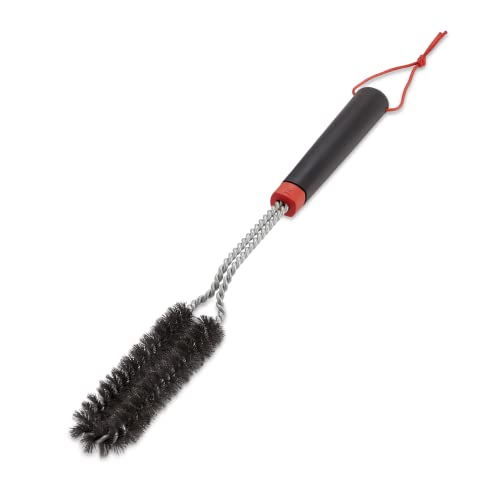
Weber 18-inch Detail Brush — Best for Detail Work
Every grill has two cleaning jobs: the grate, and everything else. The Weber Detail Brush is built for the second — a precision head on an 18-inch reach, designed to get at burners, Flavorizer bars, firebox corners and the grate’s own edges where the big triple-heads cannot maneuver. Weber makes it for its own grills’ geometry, but the problem it solves is universal to gas grills of every badge.
It suits the thorough owner as a second brush — and this guide’s honest position is that serious gas-grill owners need two: a grate brush and a detail brush, because the crud that kills burners and causes flare-ups lives below the grate, where grate brushes never reach. Used on the grate itself it is adequate for light work. It is less suited as an only brush for a dirty grate — precision is not power — and its narrower head makes full-grate cleaning a slow sermon.
Ownership notes: this is the brush that extends your grill’s life rather than your food’s safety — clearing burner ports and Flavorizer bars keeps heat even and flare-ups down, which is cooking quality and safety in one chore. Work it cold for the below-grate jobs; you are cleaning components, not cooking surfaces, and cold work is thorough work. Its long reach also makes it the safest hand position for quick hot touch-ups at the grate’s back edge.
Strengths
- Reaches burners, Flavorizer bars and corners other brushes cannot
- 18-inch reach keeps hands far from heat and awkward angles
- Weber build quality and parts ecosystem
Trade-offs
- A specialist — not the power tool for a full dirty grate
- Premium tier for a second brush
- Narrow head means slow going on wide grates
| Length | 18 in (per Amazon title) |
| Purpose | Detail cleaning: burners and Flavorizer bars (per Amazon title) |
| Design | Precision long-reach head |
Judge this brush by the job it claims: the detail work that separates a maintained grill from a merely wiped one. If your gas grill’s heat has gone uneven or its flare-ups have grown theatrical, the cure is below the grate, and this is the cure’s applicator. As a household’s only brush it is underpowered; as the second brush it is close to indispensable, and it earns its place in this guide on that honest basis.
Best for: gas grill owners as the below-grate detail tool / Not suited for: anyone wanting a single all-purpose brush
Check the current price on Amazon

BBQ-Aid Grill Brush and Scraper with Replaceable Head — Best Sustainable Design
The BBQ-Aid’s idea is the safety routine, productized: since a wire brush’s head is a consumable with a finite safe life, make the head replaceable and the handle permanent. The extended wooden handle is genuinely handsome and genuinely functional — wood insulates the hand and the length keeps you off the heat — and when the head’s bristles reach their season, you swap the head, not the tool, at a fraction of a whole brush’s cost and waste.
It suits the routine-minded owner who likes the replace-on-schedule discipline made easy, and anyone whose grip prefers a big wooden handle to molded plastic. The replaceable-head system also means a fresh, tight-bristled head is always an order away rather than a new-tool decision. It is less suited to buyers who will not actually order the heads — the system’s virtue depends on the habit — and the wooden handle wants dry storage to live its longest life.
Ownership notes: order a spare head with the brush, on day one, while your intentions are good; the replacement that is already in the drawer happens, the one that needs ordering competes with forgetting. Date the head when you fit it. The wooden handle ages gracefully with an occasional wipe of food-safe oil, turning a cleaning tool into one of those rare objects that improves with service.
Strengths
- Replaceable head makes the safety replacement rule cheap and easy
- Large wooden handle: cool, comfortable, long reach
- Less waste and lower lifetime cost than whole-brush replacement
Trade-offs
- System only works if you actually stock spare heads
- Wooden handle prefers dry storage
- Head design is capable rather than class-leading in raw power
| Handle | Extended, large wooden (per Amazon title) |
| Head | Replaceable stainless (per Amazon title) |
| Design | Brush and scraper combination |
There is an elegance to a product whose design assumes the truth about its category: heads wear out, and safety lives in replacing them. The BBQ-Aid builds that truth into the purchase, and for the organized owner it is the most rational wire brush here — the handle becomes an heirloom, the heads become a calendar item, and the risk stays managed by design rather than by memory.
Best for: organized owners who like systems and hate waste / Not suited for: owners who know they will never order spare heads
Check the current price on Amazon

GRILLART Grill Brush Wire & Helix Dual-Sided, 18-inch — Best Hybrid
The dual-sided GRILLART refuses to choose: one face is a fast wire brush for the heavy work, the other is a helix coil in the bristle-free style for the safe finishing pass. The workflow it invites is exactly the one this guide teaches — wire for power where you judge it appropriate, then the helix across the whole grate as the final sweep, which doubles as both a polish and a check that nothing loose remains. Two tools, one handle, no drawer debate.
It suits households divided on the wire question — one cook who trusts the routine, one who does not — and owners who want the steam-clean helix for porcelain and the wire for cast iron in a single kit. The 18-inch length serves full-size grills. It is less suited to minimalists (it is neither the lightest nor the simplest tool here) and the wire side, obviously, carries the full wire discipline: the helix’s presence does not exempt the brush from inspection and scheduled replacement.
Ownership notes: the dual design also extends the tool’s useful life intelligently — as the wire side ages toward retirement, the helix side remains fully serviceable for light duty while you await the replacement. Keep the two sides’ roles strict in your routine and the brush becomes a small system: power, then safety, every cook, in that order. It is the easiest brush in this guide to build a correct habit around.
Strengths
- Wire speed and helix safety in one tool
- Finishing helix pass doubles as a loose-bristle check
- Serves porcelain and cast iron regimes without a second brush
Trade-offs
- Wire side still demands full inspection and replacement discipline
- Bulkier than single-purpose brushes
- Neither side is the absolute specialist its dedicated rivals are
| Length | 18 in (per Amazon title) |
| Design | Dual-sided: wire + helix coil (per Amazon title) |
| Use | Fast clean and safe clean in one tool |
Compromise is usually a warning word in tool buying; here it is the design brief, and it works. The dual-sided GRILLART acknowledges that households contain multitudes — different cooks, different comfort levels, different grates — and equips all of them from one handle. If your home debates the wire question at the grill, this brush ends the debate by honoring both sides of it, literally.
Best for: mixed households and multi-grate owners / Not suited for: purists wanting one dedicated specialist
Check the current price on Amazon
Comparison Table
| Pick | Badge | Key spec | Best for |
|---|---|---|---|
| GRILLART Grill Brush, 18-inch Extra-Strong Handle with Scraper | Best Overall Wire Brush | 18-in, triple head, scraper | frequent grillers with mid-to-large grills who follow the safety routine |
| Kona Safe/Clean Bristle-Free Grill Brush | Best Bristle-Free (Safest Pick) | Bristle-free coil, steam-clean design | families, cautious cooks and anyone who wants zero bristle risk |
| GRILLART Grill Brush and Scraper, 3-in-1 Stainless Wire, 18-inch | Best for Deep Cleaning | Thick bristles, 360° head | deep cleans, neglected grates and hard-used grills |
| Weber 18-inch Detail Brush | Best for Detail Work | 18-in precision detail brush | gas grill owners as the below-grate detail tool |
| BBQ-Aid Grill Brush and Scraper with Replaceable Head | Best Sustainable Design | Replaceable head, wooden handle | organized owners who like systems and hate waste |
| GRILLART Grill Brush Wire & Helix Dual-Sided, 18-inch | Best Hybrid | Wire + helix dual-sided | mixed households and multi-grate owners |
The Safety Section: Wire Bristles, Honestly
The hazard is specific and mechanical. A wire brush’s bristles are thin steel wires under constant flexing stress, pressed against hot metal, season after season. They fatigue at their roots, loosen, and occasionally detach — onto the grate, where a burger or a chicken breast picks them up. Swallowed wire bristles have caused serious injuries requiring surgery; the cases are documented in medical literature and consumer-safety warnings, and while the absolute numbers are small against millions of brush users, the injuries are severe and the prevention is cheap. That is the whole calculus: small probability, high severity, trivial prevention.
Prevention has three parts, and they are the price of using wire. First, inspection: before the season and monthly within it, run a hand (carefully, or a gloved hand / a wad of foil) over the head, tug-test a sample of bristles, and retire the brush at the first sign of looseness, missing patches or a bent, tired head. Second, the wipe: after brushing, pass a damp paper towel or an oiled cloth held in tongs over the grate — it picks up any loose bristle and is a good final clean in its own right. Third, replacement: a wire brush is a seasonal consumable. Heavy users replace mid-season; everyone replaces yearly at the latest, and sooner after any visible damage. A brush is a few dollars of steel; treat it like the disposable it is.
- Inspect the head monthly; retire at any looseness or damage
- Wipe the grate with a damp towel in tongs after every wire brushing
- Replace wire brushes on a schedule — yearly at the latest
- Never use a brush with a cracked handle or bent head
- When in doubt, go bristle-free: the Kona in this guide cleans superbly
How to Choose a Grill Brush for Your Grate Type
Match the aggression to the surface. Stainless steel rod grates are the most forgiving — they take wire, helix and scraper without complaint, and they are where wire brushes earn their speed honestly. Cast iron is nearly as tough but wants the brush followed by a light oil wipe to protect the seasoning the cleaning exposed. Porcelain-enameled grates — cast iron or steel under a glass-like coating — are the delicate ones: the coating can chip under a scraper’s corner or scar under a heavy wire assault, and a chipped spot rusts and spreads. On porcelain, the helix and coil designs, or wire used with a deliberately light hand on a hot grate, are the correct tools.
Size the brush to the grill with the same honesty: 18-inch brushes are leverage and safety on a full-size grill and clumsiness on a kettle or a portable. Handle material matters at temperature — wood and quality synthetics stay grippable; thin hollow handles flex, and flex is the enemy twice over, spoiling your stroke and fatiguing the bristles. When a listing brags, let it brag about head construction and handle rigidity; those are the specifications that decide both cleaning and safety.
The Correct Cleaning Routine: Hot, Fast and Finished With a Wipe
Technique beats tools. Clean on a hot grate — after the cook, while the grill is still at temperature, or during the next preheat — because carbonized residue softens with heat and releases in seconds, while the same residue cold is a chiseling job that destroys brushes and tempers alike. Work with the bars, not across them, in long strokes, letting the head’s design wrap the bars; use the scraper first only where buildup is welded, with its flat — never its corner — on porcelain.
Finish every session the same way: the damp-towel wipe in tongs (which is also your loose-bristle insurance), a glance at the grate against the light to confirm it is clean and clear, and — for cast iron — a whisper of high-heat oil on a paper towel to re-season what you scrubbed. The whole ritual is ninety seconds. Done every cook, it means the deep-clean emergency never happens, the brush lives its full safe life, and the grate is always one preheat from service.
Bristle-Free Alternatives and Other Tools in the Kit
The wire question has widened the whole category, and a modern grill-cleaning kit is a small team rather than a single brush. The coil and helix designs in this guide are the headliners, but they share the drawer with wooden scrapers that conform to your grate’s bars as they char into shape, pumice-style grill stones for periodic resurfacing, nylon brushes for cold porcelain cleaning (never on a hot grate — nylon melts), and the humble ball of foil in tongs that has saved a thousand cookouts when the brush was forgotten.
None of these is a universal replacement for wire’s speed on a filthy grate, which is why this guide ranks rather than preaches. But the trend of the category is clear and, in our judgment, healthy: the default is shifting toward designs that cannot shed, with wire retained by informed cooks who run the routine. Whichever side your household lands on, land there deliberately, equip it properly, and never let a brush of any kind grow old in silence.
Brush Storage and the Life Between Cooks
Brushes die in drawers. A wire head crushed under a spatula collection bends bristles at their roots between cooks, so the damage you inspect for in spring was done by storage in winter. Hang the brush by its handle hole or store it head-up in a caddy by the grill, dry, where air reaches it. A brush put away wet after a steam session should dry in the open before it goes into any closed space — stainless resists rust, but the handle’s fittings and the head’s joints appreciate the courtesy.
Keep the brush with the grill, not with the kitchen tools: the routine works when the tools are where the work is, and a brush that lives indoors gets forgotten outdoors. The same caddy holds the tongs for the wipe towel and the oil for cast iron, and suddenly the whole ninety-second ritual is one grab away. Systems beat intentions, in grill cleaning as in everything else this site writes about.
What to Do With a Retired Brush
Retirement should be irreversible: a demoted wire brush kept ‘for the firebox’ or ‘for rusty jobs’ will wander back to a grate in someone’s hands eventually, because brushes look alike at dusk. Cut the head, bag it, and bin it — bristles in household trash should be contained so they cannot stick to anything on their way out. The handle of a replaceable-head system, of course, stays in service; that is its design. But a one-piece wire brush at the end of its schedule leaves the household entirely.
Make the replacement a standing habit rather than a decision: buy the new brush with the season’s first pellet or propane purchase, fit it, date it, and let the old one’s departure be a ritual as unremarkable as changing the grill cover. The safest brush is not the most expensive one — it is the fresh one, in a household that never has to wonder how old its brush is.
How to Clean a Grill Grate Properly, Step by Step
This is the routine the brushes in this guide are built for — five minutes after a cook, or folded into the next preheat.
- Heat the grate: run the grill to a solid medium-high for ten minutes so residue carbonizes and loosens. Cold scrubbing is how brushes die young and grates stay dirty.
- Scrape first, sparingly: use the brush’s scraper flat against the bars to lift welded patches. On porcelain, skip the scraper or use its flat with a light touch — the coating is the grate’s armor.
- Brush with the bars in long strokes, letting the head wrap each bar. For coil and helix brushes, dip in water between passes — the steam blast is their superpower. For wire, steady pressure, no gymnastics.
- Wipe the whole grate with a damp paper towel or cloth held in long tongs. Inspect the towel: it should show grime, never a bristle. If you ever find one, the brush is retired that day, no appeal.
- For cast iron, finish with a thin film of high-heat oil on a towel while the grate is warm. For all grates, empty the grease tray while you are there — a clean grate over a filthy tray is a job half done.
- Hang the brush where it will dry, note the date check in your head or on the handle, and close the lid. Ninety seconds of brushing inside a five-minute routine, and the grill is ready for anything.
Once a season, do the deep version: grates out, firebox scraped, burners and bars detailed with the Weber-style brush, drip system fully cleaned. The after-cook routine makes the deep clean an hour instead of an excavation — which is the entire economic argument for owning the right brushes.
Common Buying Mistakes
Mistake 1: Keeping a wire brush until it falls apart. A brush’s dangerous years are its last ones, when bristles fatigue invisibly. Replace on schedule — yearly at the latest, mid-season for heavy use — and treat the cost as part of grilling, like fuel.
Mistake 2: Skipping the post-brush wipe. The damp-towel pass is the safety net that catches the one loose bristle in ten thousand. It takes ten seconds and doubles as a final polish. There is no excuse for skipping it, ever, with a wire brush.
Mistake 3: Scrubbing a cold grate with maximum force. Cold residue does not yield; bristles bend, fatigue and shed instead. Heat is the solvent. Clean hot, or do not clean yet.
Mistake 4: Using one brush for every surface. Porcelain wants a gentle tool, cast iron wants authority, burners want a detail brush. A single brush asked to do all three does the delicate job badly and dangerously. The kit in this guide exists because the jobs differ.
Mistake 5: Using a nylon brush on a hot grate. Nylon is for cold cleaning only; on a hot grate it melts into the surface it was meant to clean. Read the brush’s temperature rating the way you would read a medicine label.
Mistake 6: Ignoring a bent head or cracked handle. Damage concentrates stress exactly where bristles anchor. A brush that has been dropped, crushed in a drawer or bent back into shape is a brush at the end of its safe life, whatever its age.
Final Recommendation
One practical ordering note: buy the brush and its first replacement together when the design allows it — the GRILLART and Kona will serve from day one regardless, but for the BBQ-Aid the spare head bought today is the safety routine kept next spring, and for any wire brush, having the successor in the drawer removes the temptation to stretch a tired brush one cook too far.
If your household runs the routine — inspect, wipe, replace — the GRILLART 18-inch triple-head is the best wire brush we verified: fast, rigid and built with bristle security in mind, with its 3-in-1 sibling for deep-clean duty and the dual-sided model as the household-peace option. If your household would rather delete the risk, the Kona bristle-free is not a compromise but a recommendation we make without a whisper of reservation. The BBQ-Aid’s replaceable head is the systematizer’s delight, and the Weber detail brush completes any gas grill’s kit.
The only wrong answer in this category is the neglected brush in the drawer whose age nobody knows. Pick your side, date your brush, and clean like you mean it.
Related guides on this site:
Best Wind Resistant Propane Tailgate Grills Best Window Grills Best Gas Grill Smokers Best Wifi Pellet Smokers
Related guides
Frequently Asked Questions
Are wire grill brushes actually dangerous?
They carry a real but manageable risk: worn brushes can shed bristles that stick to grates and then to food, and swallowed bristles have caused serious injuries in documented cases. The risk concentrates in old, damaged, uninspected brushes. The management is inspection, a post-brush wipe, and scheduled replacement — or eliminating the risk entirely with a bristle-free brush like the Kona in this guide.
How often should I replace a wire grill brush?
At least once a year for a typical home griller, mid-season as well if you grill several times a week, and immediately if you find loose or missing bristles, a bent head or a cracked handle. A brush is an inexpensive consumable; its replacement date should be as routine as changing a water filter.
Do bristle-free brushes clean as well as wire brushes?
On a hot grate with the steam-dip technique, coil and helix brushes clean to a fully serviceable standard and are gentler on porcelain. Wire remains a little faster on heavy, neglected buildup, which is a problem the after-cook routine prevents from existing. For normal maintained grates, most cooks cannot tell the difference in results — only in risk.
Can I use a wire brush on porcelain-enameled grates?
Carefully, with a light hand, on a hot grate — and many owners of porcelain grates choose the helix or coil instead to protect the coating entirely. Never use a scraper’s corner on porcelain, and stop using any brush that requires force: force is what chips enamel and sheds bristles alike.
What should I do if I find a loose bristle on my grate?
Stop, wipe the whole grate carefully with a damp towel in tongs, inspect the brush, and retire it if bristles are loosening. Check any food that was on the grate with unusual care or discard it if in doubt — no burger is worth the alternative. Then replace the brush before the next cook.
Is a wooden grill scraper a good alternative?
As part of the kit, yes: a wooden paddle scrapes hot grates safely and gradually grooves to your bars’ spacing. It does not clean between bars or handle detail work, so it partners with a coil brush rather than replacing the whole kit. It is also the zero-risk tool to hand a helper.
What is the steam-clean technique for coil brushes?
Heat the grate, dip the coil brush in a pan of water, and scrub — the water flashes to steam on contact with the hot bars and lifts residue the coil then sweeps away. Work in sections, re-dipping as you go, and keep your hand back on the handle: the steam is enthusiastic. It is the method coil and helix brushes are designed around, and one session is enough to make it a habit.


