Disclosure: airfryerkitchensupply.com is reader-supported. When you buy through links on our site, we may earn an affiliate commission at no extra cost to you.
Where to buy
This guide deliberately ranges beyond pellet grills: the verified picks below include a digital charcoal gravity grill, a smart charcoal kettle and WiFi pellet models, because ‘wifi grill’ shoppers are choosing a fuel as much as a radio. Every model was confirmed before receiving a link.
Traeger Woodridge Pro Wood Pellet Grill & Smoker (Best Overall): check price on Amazon
Masterbuilt Gravity Series 600 Digital Charcoal Grill Smoker (Best Charcoal WiFi): check price on Amazon
Weber Performer Premium Smart 22-Inch Charcoal Grill (Best Smart Kettle): check price on Amazon
Pit Boss 850 Navigator Series Pellet Grill (Best Mid-Size Pellet): check price on Amazon
recteq DualFire 1200 Wood Pellet Smoker Grill (Best Two-Zone): check price on Amazon
Green Mountain Grills Trek Prime 2.0 Portable WiFi Pellet Grill (Best Portable): check price on Amazon
Searching for the best wifi grills lands you in a market where the word ‘grill’ covers three different fuels and three different cooking personalities. Pellet grills dominate the WiFi shelves, but they are not the whole story: gravity-fed charcoal now comes with full app control, and even the classic kettle has a smart, WiFi-enabled flagship. The best wifi grills are the ones where the connection serves the cooking — so this guide compares across fuels honestly, including where charcoal beats pellets and where it does not.
The question to answer first is not ‘which app is prettiest’ but ‘what do I cook, and how do I want to feel while cooking it?’ Pellet grills are the set-and-forget option: wood flavour, oven-like control, minimal fire craft. Gravity charcoal gives you charcoal flavour with digital control — the fan and controller do the fire-tending that used to chain you to the vents. A smart kettle keeps the ritual of charcoal and adds monitoring and a prep table. All three are legitimate; they suit different cooks.
Every pick below is a true WiFi grill, verified as such. Bluetooth-only models were excluded even when their cooking credentials were strong, because a guide to WiFi grills that smuggles in Bluetooth is not doing its job.
In this guide
Quick Picks
Traeger Woodridge Pro Wood Pellet Grill & Smoker — Best Overall. The default recommendation for most households: 970 sq in of pellet cooking with WiFIRE control, Super Smoke mode and a side shelf, in the mid-to-premium tier.
Masterbuilt Gravity Series 600 Digital Charcoal Grill Smoker — Best Charcoal WiFi. Charcoal flavour with a thermostat: the GravityFed hopper feeds charcoal automatically while a fan and WiFi controller hold your temperature — and it can run hot enough to sear properly.
Weber Performer Premium Smart 22-Inch Charcoal Grill — Best Smart Kettle. The classic 22-inch kettle, grown up: Wi-Fi enabled monitoring, a proper prep table and Weber Works side storage in Weber’s porcelain-enamel build.
Pit Boss 850 Navigator Series Pellet Grill — Best Mid-Size Pellet. The value-and-versatility pellet pick: 932 sq in, WiFi plus Bluetooth, an LCD controller and the Flame Broiler for direct-flame finishing.
recteq DualFire 1200 Wood Pellet Smoker Grill — Best Two-Zone. Two chambers, two personalities: one side low-and-slow, the other hot-and-fast, under one Wi-Fi controller — the multitasker’s pellet grill.
Green Mountain Grills Trek Prime 2.0 Portable WiFi Pellet Grill — Best Portable. WiFi pellet cooking that travels: 12V or mains power, folding legs and a cover included — for tailgates, campsites and balconies.
How These Picks Were Chosen
Verification ran for each model: name, fuel type, cooking area and connectivity all had to match the live listing. That process caught several ‘smart’ grills whose connectivity turned out to be a bundled probe rather than a connected controller — those were cut.
Judging then split by fuel. Pellet picks were scored on temperature stability, hopper capacity and smoke quality. Charcoal picks were scored on how completely the digital system replaces manual vent work, and how fast they can move from smoking heat to searing heat. Across all fuels, app reliability and alert quality were scored the same way, because at hour eight of a cook the app is the product.
As everywhere in this programme: no static prices, no fixed star ratings or review counts. Each pick is placed in its tier in words, and the links exist so you can check the current price on Amazon when you are ready to buy.
The 6 Best WiFi Grills

Traeger Woodridge Pro Wood Pellet Grill & Smoker — Best Overall
If the household answer to ‘what fuel?’ is ‘the easy one that still tastes like wood’, the Woodridge Pro is where the search ends. WiFIRE is the most mature app ecosystem in this roundup — pairing is painless, the connection holds, and the temperature graph becomes the way you learn your own cooking. At 970 square inches it covers the real-world menu: a packer brisket, or two shoulders, or a family load of chicken with room for corn alongside.
Strengths
- WiFIRE app is stable, clear and genuinely useful mid-cook
- Super Smoke mode builds real bark at smoking temperatures
- Size suits family cooking without dominating the patio
Trade-offs
- 500°F ceiling means good, not great, searing
- Pellet flavour is milder than charcoal — some cooks miss the edge
- Consumables are an ongoing cost: pellets, plus covers and buckets over time
| Detail | Verified from the listing |
|---|---|
| Cooking area | 970 sq in (per Amazon title) |
| Max temperature | 500°F |
| Controller | WiFIRE app control |
| Modes | Super Smoke Mode |
Day to day, the Woodridge asks almost nothing of you: fill the hopper, set the temperature in the app, and glance at your phone occasionally. The digital sensor keeps recovery after lid openings tight, and the side shelf earns its floor space during prep. It loses points only where all pellet grills do — top-end heat and the gentlest smoke profile of the three fuels here. For the majority of buyers, that trade is exactly right: this is the grill that gets used three times a week because nothing about using it is a production.
Best for: Most households wanting easy, connected wood-fired cooking / Not suited for: Charcoal flavour devotees
Check the current price on Amazon

Masterbuilt Gravity Series 600 Digital Charcoal Grill Smoker — Best Charcoal WiFi
The Gravity Series is the answer to the oldest complaint about charcoal: the flavour is unbeatable and the fire-tending is a part-time job. Charcoal sits in a vertical hopper and feeds down by gravity into the firebox, while a digitally controlled fan holds the chamber at the temperature you set in the app. You get the deep, unmistakable taste of real charcoal with pellet-grill levels of hands-off control — and because it is charcoal, the top end is true searing heat, not a 500°F apology.
Strengths
- Real charcoal flavour with digital, app-controlled temperatures
- GravityFed hopper runs long cooks without manual refuelling rituals
- Reaches genuine searing temperatures pellets cannot match
Trade-offs
- Charcoal ash and grease need more cleaning discipline than pellets
- Hopper burn time depends on charcoal type — lump and briquettes behave differently
- Moving parts (fan, controller) mean more to maintain than a kettle
| Detail | Verified from the listing |
|---|---|
| Cooking area | 600 sq in (per Amazon title) |
| Fuel | Charcoal, GravityFed hopper |
| Controller | Digital with WiFi Technology |
| Model | MB200 series (per Amazon title) |
Cooking on the Gravity 600 feels like cheating, in the best way: ribs pick up that charcoal kiss, the app graph stays flat, and when the ribs come off you can open it up and sear burgers over the same fire. It is the pick for the cook who grew up on charcoal, tried a pellet grill, and found the smoke too polite. Respect its two chores — empty the ash, keep the grease path clean — and it will hold temperature through cooks that used to require a chair, a headlamp and strong opinions about vents.
Best for: Charcoal lovers who want set-and-forget control / Not suited for: Anyone who wants the absolute lowest-maintenance fuel
Check the current price on Amazon

Weber Performer Premium Smart 22-Inch Charcoal Grill — Best Smart Kettle
There are cooks for whom grilling is the ritual — lighting the chimney, banking the coals, reading the fire. The Performer Premium Smart respects that ritual and simply removes its anxiety: Wi-Fi-enabled monitoring watches temperatures for you while the kettle does what kettles have done brilliantly for decades. The prep table is not a garnish; a kettle with a real work surface and tool storage is a different, calmer cooking experience from a kettle with a plate balanced on its rim.
Strengths
- All the versatility of the 22-inch kettle — grill, smoke, roast — with connected monitoring
- Prep table and Weber Works storage make the cook organised, not improvised
- Porcelain-enamel build is the durability benchmark for charcoal grills
Trade-offs
- You still manage the fire — WiFi monitors, it does not feed charcoal
- 22-inch grate is right for most meals, tight for very large gatherings
- Smart features add cost over the plain Performer for cooks who may not use them
| Detail | Verified from the listing |
|---|---|
| Grate | 22-inch (per Amazon title) |
| Finish | Porcelain-enameled, black |
| Connectivity | Wi-Fi Enabled |
| Extras | Prep table, Weber Works side system |
This is the connoisseur’s pick in a guide full of automation: choose it if you enjoy cooking over charcoal and want information, not intervention. Indirect ribs with the coals banked, a whole chicken under the lid, burgers directly over the coals — the kettle does all of it, and the connected monitoring means the low-and-slow cooks no longer require hovering. If your honest preference is to press a button and walk away for eight hours, the pellet picks above serve you better. If you want to stay the cook and let the grill be the instrument panel, this is the one.
Best for: Charcoal traditionalists who want monitoring without automation / Not suited for: Set-and-forget cooks
Check the current price on Amazon

Pit Boss 850 Navigator Series Pellet Grill — Best Mid-Size Pellet
The Navigator 850 is the Pit Boss formula at its most sensible size: big enough for a brisket or a party load of wings, small enough to heat quickly and live on an ordinary patio. The Flame Broiler is the feature that keeps winning it recommendations — slide the plate open and the firepot’s direct flame finishes steaks, burgers and chicken skin the way pellet grills are supposed to be unable to. WiFi covers remote monitoring, with Bluetooth as the close-range fallback.
Strengths
- Flame Broiler gives pellet cooking a real sear option
- 932 sq in is the practical sweet spot for most families
- WiFi and Bluetooth both on board — connection options for any setup
Trade-offs
- App polish trails Traeger’s WiFIRE
- Temperature swings are a touch wider than premium PID rivals
- Grease and ash routine needs keeping on top of, as with all Pit Boss grills
| Detail | Verified from the listing |
|---|---|
| Cooking area | 932 sq in (per Amazon title) |
| Controller | LCD Digital Controller, WiFi & Bluetooth |
| Temperature range | From 180°F (per Amazon title) |
| Feature | Flame Broiler direct-flame plate |
In practice the Navigator is the grill households grow into rather than out of: weeknight chicken, weekend ribs, the occasional brisket, all handled without drama, and the sear function means it can be the only grill you own. Its tier is the honest middle — you are not paying for stainless bragging rights or the slickest app, and you are not accepting a toy. If the budget stretches, the Woodridge Pro’s app and smoke mode are nicer; if it does not, very little about the Navigator will make you feel you settled.
Best for: Families wanting one versatile mid-tier pellet grill / Not suited for: App perfectionists
Check the current price on Amazon

recteq DualFire 1200 Wood Pellet Smoker Grill — Best Two-Zone
Every pellet grill owner knows the scheduling problem: the brisket wants 225°F for six more hours and the guests want burgers now. The DualFire 1200 solves it structurally, with dual chambers — one dedicated to low-and-slow smoking, the other able to run hot and fast at the same time. It is a simple idea executed with recteq’s usual heavy steel and temperature discipline, and once you have cooked a mixed menu on it, single-chamber grills feel like a kitchen with one oven shelf.
Strengths
- Dual chambers smoke and sear simultaneously — no menu scheduling conflicts
- Recteq temperature control and build quality throughout
- Wi-Fi control manages both zones from the app
Trade-offs
- Large, heavy and priced in the premium tier
- Two chambers mean two grease paths to keep clean
- Overkill for households whose menu is one protein at a time
| Detail | Verified from the listing |
|---|---|
| Design | Dual chambers (per Amazon title) |
| Controller | Wi-Fi Smart Grill |
| Modes | Hot and fast + low and slow simultaneously |
| Fuel | Wood pellet |
The DualFire earns its keep at gatherings: shoulders resting low on one side while chicken, sausages and corn cycle through the hot side, all watched from one app screen. Solo weeknight cooks will find it more grill than they need, and the footprint demands a real patio commitment. But as a single-unit answer to ‘smoker and grill’, it is the most complete machine in this guide — buy it when your cooking regularly involves two temperatures at once, and it will quietly end a whole category of barbecue logistics.
Best for: Entertainers cooking mixed menus at two temperatures / Not suited for: Small households and small patios
Check the current price on Amazon
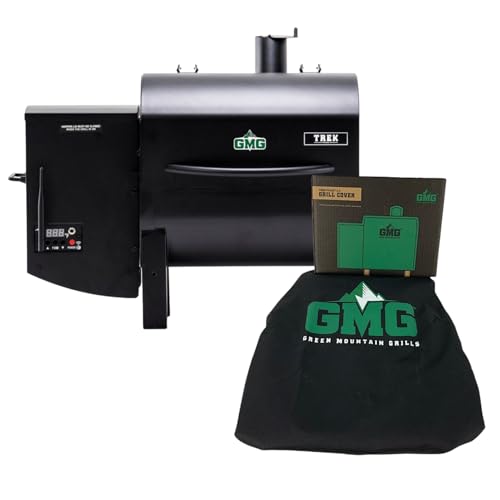
Green Mountain Grills Trek Prime 2.0 Portable WiFi Pellet Grill — Best Portable
A guide to WiFi grills that only covers patio furniture misses where remote monitoring is most valuable: away from home, doing three things at once. The Trek Prime 2.0 folds down, runs on 12V or mains, and keeps full WiFi control, so the ribs at the campsite are as monitored as the brisket at home. It is a real pellet grill in miniature — genuine smoke, digital control — sized for a couple of racks of ribs or a spatchcocked chicken rather than a banquet.
Strengths
- Genuinely portable with folding legs and dual power options
- WiFi monitoring at tailgates and campsites, not just the backyard
- Cover included — a small thing that portable grills desperately need
Trade-offs
- Compact chamber limits cook size
- Small hopper needs checks on longer cooks
- Less insulation than home grills — shelter it from wind
| Detail | Verified from the listing |
|---|---|
| Power | 12V and mains (per Amazon title) |
| Controller | WiFi-enabled |
| Extras | Cover included |
| Design | Portable, folding legs |
Judge the Trek by its mission and it is excellent: it brings connected pellet cooking to places no other pick in this guide can go. As a household’s only grill it asks for menu planning around its size; as a second grill or a travel grill it has no real rival here. Battery and 12V running make it a natural partner for RV and boat life, and the app means the cook can actually join the day instead of guarding the fire.
Best for: Campers, tailgaters, RVers and balcony cooks / Not suited for: Cooking for crowds at home
Check the current price on Amazon
Comparison Table
| Pick | Badge | Key spec | Best for |
|---|---|---|---|
| Traeger Woodridge Pro Wood Pellet Grill & Smoker | Best Overall | 970 sq in, WiFIRE, Super Smoke | Most households wanting easy, connected wood-fired cooking |
| Masterbuilt Gravity Series 600 Digital Charcoal Grill Smoker | Best Charcoal WiFi | 600 sq in, gravity charcoal, WiFi digital control | Charcoal lovers who want set-and-forget control |
| Weber Performer Premium Smart 22-Inch Charcoal Grill | Best Smart Kettle | 22-in kettle, Wi-Fi, prep table | Charcoal traditionalists who want monitoring without automation |
| Pit Boss 850 Navigator Series Pellet Grill | Best Mid-Size Pellet | 932 sq in, Flame Broiler, WiFi + Bluetooth | Families wanting one versatile mid-tier pellet grill |
| recteq DualFire 1200 Wood Pellet Smoker Grill | Best Two-Zone | Dual chamber, Wi-Fi, hot + low zones | Entertainers cooking mixed menus at two temperatures |
| Green Mountain Grills Trek Prime 2.0 Portable WiFi Pellet Grill | Best Portable | Portable, 12V capable, WiFi | Campers, tailgaters, RVers and balcony cooks |
How to Choose a WiFi Grill: Fuel First, Then Features
Fuel decides flavour, workload and running cost, so choose it before you compare apps. Pellet grills burn compressed hardwood sawdust, feed it automatically, and taste like gentle wood smoke; they are the lowest-effort path to consistent barbecue. Charcoal — whether in a gravity hopper or a kettle — tastes deeper and more primal, sears harder, and asks a little more of the cook even when a fan and controller are helping. Neither is ‘better’; they are different answers to what you want dinner to taste like and how you want to spend the afternoon.
Then be honest about automation. A pellet grill or a gravity charcoal grill will hold a temperature for hours with the app as your only involvement. A smart kettle like the Weber Performer monitors beautifully but the fire remains yours — fuel runs down, vents matter, and a six-hour cook includes some tending. Buy the level of automation you will actually enjoy, because the most common WiFi grill regret is not the app; it is discovering you bought a robot when you wanted an instrument, or the reverse.
Connectivity checks come third: confirm the verified spec says WiFi, test your signal where the grill will stand, and make sure your router offers a 2.4GHz band the grill can join. Finally, size for your regular cook. Two of the picks here are deliberately specialised — the DualFire for two-temperature entertaining, the Trek for travel — and they are the right answers only when their speciality is your actual life.
Searing, Smoking and the Temperature Map
Every grill in this guide can smoke; they part company at the top of the dial. Pellet grills generally ceiling out around 500°F — enough for chicken skin and a decent burger crust, short of a steakhouse sear — unless they cheat the limit with a direct-flame plate like Pit Boss’s Flame Broiler. Charcoal systems run far hotter: the gravity grill sears like the charcoal it is, and a kettle over a full chimney is the hottest thing in most backyards. If your menu is steak-led, weight the charcoal picks and the Flame Broiler; if it is brisket-led, weight hopper size and low-temperature stability instead.
At the smoking end, what matters is stability, not the minimum number on the dial. A grill that holds 225°F within a few degrees through wind and lid openings cooks better barbecue than one that advertises 165°F and hunts ±30°F all day. The app graph is your evidence: after your first cooks, look at the line, not the brochure. Every pick here was chosen partly because its line stays boring — boring graphs make delicious brisket.
WiFi Range, Routers and the Backyard Reality Check
Every WiFi grill in this guide is only as connected as the network it joins, and backyards are where home networks go to be humbled. Brick and stone walls, foil-backed insulation and metal siding all tax a signal that seemed strong in the kitchen. Before any grill arrives, run the honest test: stand at the grill’s future position with your phone on your home WiFi, run a speed test, then walk to the room you will monitor from and confirm the connection feels instant, not patient. That two-minute audit predicts your ownership experience better than any router specification.
If the signal is weak, the fixes are mundane and effective. A mesh node or extender placed near the back door — inside the house, high, away from the microwave — transforms most patios. Keep the grill on the 2.4GHz band, which trades raw speed (irrelevant for temperature data) for reach. And give the grill a fixed place in your network’s life: routers that aggressively band-steer devices between frequencies cause more grill dropouts than any grill firmware ever has.
Also plan for the internet itself failing, because it will, once, during a brisket. A properly designed connected grill — every pick here qualifies — keeps cooking at its set temperature with no network at all; you lose the graph and the alerts, not the fire. Judge any grill that cannot cook offline as a toy, and test yours once, deliberately, on a cheap cook: router off, sausages on, and watch it behave. Knowing it copes is worth more than hoping it does.
Matching the Grill to the Menu: A Cook’s Matrix
Brisket and pork shoulder reward stability and capacity: pellet picks with generous hoppers and calm PID manners — the Woodridge Pro, the Navigator, the DualFire’s low chamber — make these cooks nearly administrative. Ribs reward smoke quality and mid-cook access: the Ironwood-style smoke systems, the gravity charcoal’s deeper flavour, and any grill whose lid you can open without a five-minute recovery all shine. Poultry rewards heat range: spatchcocked chicken wants 325–375°F and crispy skin, which is where the gravity grill and the Flame Broiler pull away from standard pellet ceilings.
Steak night rewards raw top-end heat and grate material: charcoal first, the DualFire’s hot chamber and Flame Broiler designs second, everything else an honourable third. Pizza and flatbreads reward the highest ceiling you can find — the kettle over a full chimney and high-heat pellet designs lead. Vegetables and fish reward control at moderate temperatures and clean smoke: pellet grills at 250–350°F are superb here, and the app graph helps you hold the gentle line that fish forgives nothing beyond.
The pattern underneath the matrix is the real advice: no grill in this guide wins every row, and the right purchase is the one that wins your rows — the five things your household actually cooks in a month. Write that list before you shop, score the picks against it, and let the app’s polish be the tiebreaker rather than the decision.
Care Calendar: Keeping a Connected Grill Honest
Weekly, or after every greasy cook: empty the grease bucket or tray, wipe the chamber probe clean, and glance at the firepot or charcoal ash. Monthly in season: vacuum the firepot and ash paths properly, scrape the grease channel end to end, check the lid gasket’s seal, and run a short empty burn while you watch the app graph — a healthy grill draws a boring line, and a change in the line is your earliest warning of anything.
Seasonally: inspect igniter and fan operation, check that wheels, hinges and the hopper lid still do their jobs, update firmware on a quiet day (never the morning of a big cook), and review your pellet or charcoal store for damp or age. Annually: a deep clean, a look at wiring and connectors for weather’s work, and an honest appraisal of the cover — a perished cover is worse than none, because it holds moisture against the steel it was meant to protect.
The connected features make this calendar easier than it has ever been: the app remembers your cooks, so let it. If the graph of a standard 225°F test burn changes character across the season, the grill is telling you its firepot, probe or fuel needs attention — usually weeks before the same problem would announce itself as a ruined dinner.
Gas, and Why It Is Absent From This Guide
An honest gap deserves an explanation: mainstream gas grills with true, full-control WiFi remain rare — most ‘smart gas’ offerings amount to a connected probe or a Bluetooth thermometer bundled in the box, which this guide’s verification standard excludes. If your heart is set on gas with genuine app control of burners, the market is still catching up with your idea, and the sensible interim purchase is an excellent conventional gas grill plus a top-tier WiFi probe thermometer from this programme’s thermometer guide. Do not let a bundled Bluetooth probe talk you into calling a grill ‘WiFi’ — the distinction decides what you can monitor from bed, and bed is where overnight cooks are won.
Everything else about choosing still applies to that interim gas purchase: size for the regular cook, weight build quality over feature count, and treat the connected thermometer as the smart layer. When true WiFi gas grills mature, the thermometer moves to your second grill or your smoker and nothing was wasted. Good buying is often sequencing, and this category’s honest sequence, today, runs through pellets and charcoal.
Entertaining With a Connected Grill: The Host’s Workflow
The connected grill changes entertaining less through technology than through attention: the host’s scarcest resource. The workflow that works: start the long items early and let the app babysit them; set alerts a few degrees early so finishing happens in company, not in a scramble; and stage the fast items — burgers, sausages, corn — for the window when guests are actually hungry rather than when the grill is free. The DualFire’s two chambers formalise this, but the rhythm works on any pick here with a cooler for resting meat and a plan written down.
Two host habits separate calm evenings from smoky chaos. First, do every new thing before guests arrive: new fuel, new recipe, new firmware are all weekday experiments. Second, let the graph be the schedule — when people ask ‘how long?’, the app’s trend gives an honest answer, and an honest ‘forty minutes, here is a drink’ beats a hopeful ‘ten minutes’ three times running. A WiFi grill’s real party trick is not remote control; it is a host who is present, unhurried, and holding a glass instead of a thermometer.
The One-Season Review: What Owners Reconsider
Ask owners a season in and the reconsiderations are remarkably consistent, and they are rarely about the app. Pellet owners reconsider size — usually wishing one step larger for the three big cooks a year, which is why this guide nudges family buyers toward the 900-square-inch class. Gravity charcoal owners reconsider nothing about flavour and everything about ash discipline, which becomes a five-minute ritual or a slow resentment depending on the owner. Kettle owners reconsider automation honestly: some graduate to a pellet grill for the overnight cooks and keep the kettle for everything they love about fire. The lesson for a new buyer is to purchase for the cook you are, while leaving the door open — a second grill later is a normal evolution, not an admission that the first choice failed.
Fuel Economics: Pellets, Charcoal and Your Wallet
Running costs separate the fuels more honestly than purchase prices do. Pellets are bought by the bag and burned at a predictable rate — roughly a pound an hour at smoking temperatures — so a long brisket’s fuel cost is knowable in advance and compares well with restaurant money. Charcoal for the gravity grill costs similarly per long cook, with lump and briquettes pricing differently and burning differently; the kettle is the economist of the family, sipping charcoal on a two-zone fire and asking only for a chimney’s worth on weeknights. None of these fuels is ruinous; all of them punish waste, which is why right-sizing the grill to the regular cook is an economic decision as much as a culinary one.
Electricity is the rounding error in every case — augers, fans and controllers sip power — and the real second cost is time: the gravity grill asks for ash management, the kettle for fire craft, the pellet grill for firepot vacuuming. Price your own time into the comparison and the fuels sort themselves by personality again. The cheapest grill to own is the one whose chores you do not mind, because it is the one that stays clean, stays ready, and gets used instead of replaced.
Finally, buy fuel like a cook, not a speculator: fresh, dry, stored properly, in quantities your storage can protect. A bargain pallet of pellets ruined by a damp autumn costs more than full-price bags ever would, and charcoal that has drunk a winter’s humidity lights like it resents you. The connected grill will report the consequences faithfully in its graph — fuel is the one input the app cannot fix, only reveal.
A Final Word on Firmware and Patience
Connected grills improve after you buy them, which is new in the history of fire. Firmware updates refine temperature algorithms, apps gain features, and a grill that was merely good in spring can be measurably calmer by autumn — provided its owner lets it update on a quiet weekday and not, under any circumstances, in the hour before guests arrive for a brisket reveal. Build the update habit into the seasonal care calendar, read the maker’s notes before applying anything major, and keep one truth in view: the grill cooked beautifully before the update existed. Technology should accumulate quietly in the background of a cooking life, and on the picks in this guide, it does — the fire stays the headline, and the software stays the stagehand, which is exactly the right billing for both.
One Last Check Before You Buy
Run the final checklist out loud before money moves: the fuel is the one your menu wants; the size fits your regular cook and your patio; the connectivity in the verified spec says WiFi, in those letters; your backyard signal test passed at the grill’s future home; and the first five cooks are already imagined, in order, starting with something forgiving. If all five answers are yes, the remaining choice between the picks in this guide is taste, and taste is allowed to decide. Buy it, do the empty setup day without skipping a step, and let the first graph you ever watch be a chicken’s — the brisket, and the bed you monitor it from, will thank you for the rehearsal.
How to Set Up a WiFi Grill and Run Your First Connected Cook
Whatever the fuel, connected grills share a setup rhythm. Do it once, properly, on a day when dinner does not depend on it.
- Assemble and season first: run the burn-off or seasoning cycle in the manual — empty for pellet and gravity grills, a hot empty burn for a kettle — before pairing apps or cooking food.
- Update firmware and pair the app while the grill is empty and you are standing next to it; most pairing problems vanish at close range on the 2.4GHz band.
- Check the signal at the grill’s cooking position with the lid closed and your phone in the room you will actually monitor from. Relocate a mesh node now if the connection is flaky.
- Verify temperature honesty: run the grill at 225–250°F for 30 minutes with an independent probe at grate level and note the offset between grate reality and the controller’s claim.
- Practise the alert set on a short cook — chicken thighs or sausages — setting a probe target and a temperature-deviation alert, and change the set temperature from the app once, just to prove you can.
- Learn your fuel logistics: pellets dry and sealed, charcoal stored dry, hopper or fuel load sized for the cook plus a margin. Most ‘grill failures’ are fuel failures wearing a disguise.
- Finish with the cleaning circuit for your fuel type — firepot vacuum and grease path for pellets, ash and grease management for charcoal — so the second cook starts from a known-good grill.
Keep a short log of your first five cooks: fuel, weather, set temperature, actual graph behaviour, result. Connected grills generate the data for you in the app; your job is only to connect it to what landed on the plate. By cook six you will know your grill’s personality better than any review can tell you.
Common Buying Mistakes
Choosing by app screenshots. Every app looks slick in marketing. What matters is connection stability in your backyard and alerts that fire when they should — prioritise verified WiFi and a controller with a good reliability record over interface sparkle.
Assuming ‘smart’ means ‘self-cooking’. Monitoring is not feeding. Kettles still need fuel management, pellet hoppers still empty, and charcoal still turns to ash. Match the automation level to the involvement you actually want.
Ignoring fuel storage. Damp pellets swell and jam; damp charcoal lights badly and burns dirty. Sealed, dry, off the ground — for both fuels, this one habit prevents most bad cooks.
Buying the biggest grill for the biggest day of the year. A grill sized for the annual party heats slowly and burns extra fuel for every ordinary Tuesday. Size for the regular cook and borrow capacity strategies — tiers, timing, resting in a cooler — for the exceptions.
Skipping the grate-level temperature check. Controllers report their own probe’s neighbourhood, which can differ from where the food sits. One calibration cook with a second probe prevents a season of mysteriously fast or slow food.
Placing the grill for looks instead of signal and safety. The grill needs WiFi reach, clearance from siding and eaves, and a spot out of the worst wind. A beautiful position that drops the connection and swings the temperature is not beautiful for long.
Final Recommendation
Start with fuel and the answer usually picks itself: pellet ease points to the Traeger Woodridge Pro or the Pit Boss Navigator 850, charcoal flavour with digital control points to the Masterbuilt Gravity 600, charcoal ritual with connected monitoring points to the Weber Performer Smart, two-temperature entertaining to the recteq DualFire 1200, and life on the move to the GMG Trek Prime 2.0.
All six are verified WiFi grills — no Bluetooth substitutes — so whichever lands on your patio, do the empty-grill setup day first. An hour of pairing, calibrating and practising alerts is what turns a connected grill from a gadget into the most relaxed cooking you have ever done.
Related reading: Best Wifi Pellet Grills · Best Wifi Smokers · Best Wifi Pellet Smokers · Best Charcoal And Pellet Grills · Best Entry Level Pellet Grills · Best Traeger Pellet Grills
Frequently Asked Questions
What is the difference between a WiFi grill and a Bluetooth grill?
A WiFi grill joins your home network, so your phone can monitor and control it from anywhere with internet. A Bluetooth grill only talks to a phone nearby — fine on the patio, useless from the office or from bed during an overnight cook. Every pick in this guide is verified WiFi.
Do charcoal grills really come with WiFi now?
Yes, in two forms. Gravity-fed models like the Masterbuilt Gravity Series pair a charcoal hopper with a fan and digital controller for full app control of temperature. Smart kettles like the Weber Performer add Wi-Fi monitoring to a traditional charcoal fire that you still manage yourself.
Which fuel tastes best on a WiFi grill?
Charcoal gives the deepest, most traditional barbecue flavour and the hardest sear. Pellets give a gentler, cleaner wood smoke and the easiest temperature control. Most cooks find the difference obvious on brisket and ribs — which is why this guide recommends choosing fuel before features.
Can I leave a WiFi grill cooking while I go out?
Many owners do monitor cooks from errands, and the apps are designed for it — but the grill remains a live fire appliance. Keep it away from structures, ensure the hopper or fuel load comfortably covers the cook, keep grease management current, and treat alerts as your signal to head home if temperatures misbehave.
Why does my WiFi grill keep disconnecting?
Usually it is signal, not the grill: patios sit at the edge of home WiFi, and 2.4GHz has to pass walls and appliances to get there. Check signal strength at the grill’s position, consider a mesh node near the back door, and make sure firmware is current before blaming the hardware.
Is a WiFi grill worth it for quick weeknight cooking?
The connection matters least for 20-minute cooks — you are standing there anyway. WiFi earns its price on long, low cooks and on entertaining days when you want to be with guests. If your grilling is entirely weeknight-fast, a simpler grill plus a good wireless probe thermometer may serve you better.


