Disclosure: airfryerkitchensupply.com is reader-supported. When you buy through links on our site, we may earn an affiliate commission at no extra cost to you.
Where to buy
Every candidate for the best upright vacuum for floors and area rugs below is sold on Amazon and was confirmed against Amazon’s own product data before it earned a link: the Shark Navigator Lift-Away NV352, the Simplicity S20EZM Allergy Bagged Upright, the Hoover WindTunnel 3 Max Performance Pet, the Dyson Ball Animal 3 Extra, the Shark Navigator Lift-Away Speed ZU561 and the Bissell CleanView Swivel Pet 2252. Check the current price on Amazon for each, since vacuum pricing moves frequently.
Introduction
The best upright vacuum for floors and area rugs has to be two machines in one body. Bare floors want a brushroll that will not scatter debris or scratch finishes; area rugs want the opposite — agitation deep enough to pull grit out of pile, without so much suction that the vacuum seals itself to a lightweight rug and drags it across the room. Most uprights are tuned for wall-to-wall carpet and merely tolerate the other two surfaces. The six in this guide were chosen because their verified listings speak directly to this mixed-surface job.
Two listings here say it outright: the Shark Navigator NV352’s product data names carpet, area rug and hard floor cleaning in one breath, and the Simplicity S20EZM lists carpet, rugs and hardwood among its surfaces. The others earn their place through features that matter on rugs and floors specifically — lift-away canisters for the stairs and the rug’s edge, swivel steering for working around furniture legs on hard floors, bagged HEPA systems for allergy households, and brushrolls designed to resist hair wrap, which is the maintenance tax rugs with pets impose.
A note on honesty before the picks: no upright is equally brilliant on shag, low-pile wool and bare oak. The buying guide below explains how pile height changes the answer, and the verdicts call out which surfaces each machine should skip. Match the machine to the rug you actually own, not the showroom floor it was photographed on.
In this guide
Quick Picks
- Best Overall: Shark Navigator Lift-Away NV352 — verified for carpet, area rug and hard floor cleaning, with an XL dust cup and swivel steering.
- Best Bagged for Allergy Households: Simplicity S20EZM — bagged upright with certified HEPA, listed for carpet, rugs and hardwood.
- Best for Deep Carpet Work: Hoover WindTunnel 3 Max Performance Pet — corded upright with HEPA media filtration and a quick-pass brushroll.
- Best Premium Steering: Dyson Ball Animal 3 Extra — ball-steering upright built for pet homes and mixed floors.
- Best Self-Cleaning Brushroll: Shark ZU561 Navigator Lift-Away Speed — self-cleaning brushroll with HEPA filter, in Red Peony.
- Best Budget: Bissell CleanView Swivel Pet 2252 — swivel steering, triple-action brushroll and a large-capacity dirt tank at a budget tier.
How These Picks Were Chosen
Every vacuum here was cross-checked against Amazon listing data product data for this site: the listing had to describe a complete upright vacuum cleaner — not a filter pack, not a replacement battery, not a handheld — and the title had to support the surface claims we make for it. That filter removed several tempting listings from contention, including replacement filter kits that appear in vacuum searches and two renewed (refurbished) uprights, which we exclude from a best list because condition varies by unit.
From the verified complete uprights, we selected for mixed-surface evidence: listings that name area rugs or rugs explicitly (Shark NV352, Simplicity S20EZM), filtration suited to the dust rugs release when beaten by a brushroll (HEPA media or certified HEPA on four of the six), steering that works around furniture on hard floors, and a lift-away or bagged option for households whose needs differ. The result is deliberately varied — bagged and bagless, budget and premium — because “floors and area rugs” describes half the homes in the country, and their owners do not all need the same machine.
The 6 Best Upright Vacuums for Floors and Area Rugs

Shark Navigator Lift-Away NV352 — Best Overall
The NV352 is the rare upright whose verified listing was practically written for this search: it names carpet, area rug and hard floor cleaning, HEPA filtration, an XL dust cup, lightweight construction with swivel steering, and a crevice tool plus wide upholstery tool in the box. The Lift-Away design — the canister detaches from the floor head — is the feature that turns a good upright into a whole-home system, because rugs rarely live alone: they sit beside sofas, under dining tables and at the foot of stairs.
Strengths
- Listing explicitly covers carpet, area rugs and hard floors
- Lift-Away canister handles stairs, upholstery and above-floor edges
- XL dust cup means fewer emptying stops in rug-heavy homes
Trade-offs
- Bagless bin emptying releases a puff of dust — allergy households take note
- Swivel steering takes a session to get used to if you come from a fixed-head upright
- No self-cleaning brushroll; pet hair needs periodic manual clearing
Key specs (from the verified listing): HEPA filtration; XL dust cup; Lift-Away design; swivel steering; crevice and wide upholstery tools; Lavender finish.
On area rugs, the NV352’s balance is its virtue: enough agitation to lift grit from medium pile, in a body light enough to carry from rug to rug without the chore feeling like furniture moving. The swivel head earns its keep on the hard floor around the rug, where you are steering between chair legs rather than marching in straight lines, and the wide upholstery tool handles the sofa that usually anchors the rug’s long edge.
The honest limits are maintenance and dust handling. A brushroll without a self-cleaning mechanism collects hair wrap — five minutes with scissors every few weeks in a pet home. And while the HEPA filter traps fine dust inside the machine, emptying a bagless bin is the moment allergy sufferers should delegate or do outdoors. If either issue is decisive for you, the Simplicity below (bagged) or the ZU561 (self-cleaning brushroll) answer it directly.
Best for: mixed-surface homes wanting one proven all-rounder. Not suited for: severe allergy households that should go bagged. Check the current price on Amazon.

Simplicity S20EZM Allergy Bagged Upright — Best Bagged for Allergy Households
The Simplicity S20EZM is the traditionalist in this list: a bagged upright whose verified listing names multi-surface use across carpet, rugs and hardwood, with certified HEPA filtration, positioned for pet homes. Bagged machines have fallen out of fashion, but for the floors-and-rugs job in an allergy household they hold a real advantage — the bag is the filter and the dust container in one, and changing it never produces the bagless dust puff.
Strengths
- Certified HEPA with a bagged system: dust leaves the house sealed in the bag
- Listing explicitly covers carpet, rugs and hardwood
- Bagged suction stays consistent as the bag fills, unlike neglected bagless filters
Trade-offs
- Ongoing cost and storage of replacement bags
- No lift-away canister; above-floor work relies on hose reach
- Bagged uprights are heavier in hand than the lightest bagless rivals
Key specs (from the verified listing): Bagged upright; certified HEPA; multi-surface (carpet, rugs, hardwood); pet-positioned.
Rugs are dust reservoirs — every footstep pumps a little of what the pile holds into the air, and a deep clean releases much more. That is the moment filtration earns its price, and the S20EZM’s certified HEPA bagged system is the most complete answer in this guide. It is also the forgiving option for owners who will not wash bagless filters on schedule: a bagged machine’s performance depends on a consumable you replace, not a maintenance ritual you must remember.
The costs are equally real. Bags are a subscription you did not know you signed, and when the bag fills mid-clean in a big rug-heavy home, suction tails off until you change it. Keep a spare pack in the cupboard and this machine is the calm, sealed, allergy-first way to run mixed floors.
Best for: allergy households and anyone who hates emptying dust bins. Not suited for: buyers who refuse ongoing bag costs. Check the current price on Amazon.

Hoover WindTunnel 3 Max Performance Pet — Best for Deep Carpet Work
Hoover’s WindTunnel line is built around channelled suction, and the Max Performance Pet’s verified listing confirms the formula: a corded bagless upright with HEPA media filtration and a Quick Pass brushroll, positioned for homes with pets. Among these six, it is the pick when the area rugs in question are thick, large and genuinely dirty — the machine leans toward carpet aggression.
Strengths
- WindTunnel design with a quick-pass brushroll for efficient carpet passes
- HEPA media filtration for the dust deep-cleaning releases
- Corded power: no battery fade across a whole-house clean
Trade-offs
- Carpet-leaning tuning means a gentler touch is needed on delicate or lightweight rugs
- Cord management across multiple rooms is the usual upright chore
- Pet-focused build is more machine than a pet-free, low-pile home needs
Key specs (from the verified listing): Corded bagless upright; HEPA media filtration; Quick Pass brushroll; WindTunnel technology.
The use case writes itself: a living room with a large medium-pile rug, a dog, and hard floors radiating off it. The Hoover does the rug with authority — the brushroll and channelled suction are designed to pull embedded grit rather than skim the surface — and the cord means the last room gets the same power as the first. On the surrounding hard floors it performs the upright’s standard trick of switching pace, though as with all brushroll machines, scatter-prone debris like cat litter is best approached slowly from the edges.
Delicacy is the caveat. A lightweight rug that a high-suction machine can lift and bunch needs the suction eased or a different tool, and fine antique rugs deserve a suction-only approach no upright here provides. For the mainstream of modern rugs and wall-to-wall carpet, though, this is the deep-clean pick.
Best for: pet homes with substantial rugs and carpet needing real extraction. Not suited for: delicate antique rugs or cordless devotees. Check the current price on Amazon.

Dyson Ball Animal 3 Extra — Best Premium Steering
The Dyson Ball Animal 3 Extra’s verified listing is admirably short — just the product name — so we will be equally disciplined: what the name itself confirms is an upright in Dyson’s Ball line, in the Animal (pet-focused) family, in its “Extra” configuration. The Ball format’s reason to exist is steering: the machine pivots on a ball rather than fixed wheels, which changes how an upright behaves in the exact environment this search describes — hard floors interrupted by rugs, furniture and thresholds.
Strengths
- Ball steering pivots in place around furniture and rug edges
- Animal line is Dyson’s pet-hair-focused configuration
- Premium build tier with strong resale and parts support culture
Trade-offs
- Premium pricing, the highest tier in this guide
- The listing confirms few specifics, so check the configuration carefully before ordering
- Ball steering has a learning curve; some users prefer a conventional head
Key specs (from the verified listing): Upright vacuum; Ball format; Animal 3 Extra configuration. (The listing title states no further specifications, and we do not invent them.)
Steering sounds like a luxury until you vacuum a furnished room weekly. A conventional upright travels like a shopping trolley — forward, back, wide arcs. A ball machine turns within its own footprint, which means the hard floor around a rug gets cleaned in the same pass rhythm as the rug itself, and the transition over the rug’s edge becomes a tilt rather than a shove. In open-plan spaces where floor and rug alternate every few metres, that handling difference is the product.
Buy it with eyes open: you are paying a premium for engineering and brand, the verified listing is minimal, and the exact tool set of the “Extra” configuration should be confirmed on the product page. For pet owners in furnished, mixed-surface homes who vacuum often, it remains a defensible flagship.
Best for: furnished mixed-floor homes and pet owners who value handling. Not suited for: budget buyers or anyone who wants every spec in writing first. Check the current price on Amazon.

Shark ZU561 Navigator Lift-Away Speed — Best Self-Cleaning Brushroll
The ZU561’s verified listing states its headline plainly: a Navigator Lift-Away Speed upright with a self-cleaning brushroll and a HEPA filter, in Red Peony. The self-cleaning brushroll is the feature rug owners with long-haired humans or pets dream about — the brushroll is designed to resist the hair wrap that slowly strangles an ordinary upright’s performance.
Strengths
- Self-cleaning brushroll reduces the scissor-and-tweezers maintenance ritual
- Lift-Away format for stairs and above-floor work
- HEPA filter stated in the listing
Trade-offs
- “Self-cleaning” reduces wrap; determined long hair still needs occasional checks
- Bagless dust handling, like the NV352, is not the allergy-first choice
- Speed format prioritises lighter weight over maximum bin size
Key specs (from the verified listing): Self-cleaning brushroll; Lift-Away design; HEPA filter; Red Peony finish.
Hair wrap is not a cosmetic issue: a wrapped brushroll stops agitating the rug pile, and the vacuum quietly becomes a suction-only machine while its owner wonders why the rug never looks clean. For households where hair is the dominant debris — which is most rug-owning pet homes — a brushroll engineered against wrap protects cleaning performance between deep maintenances. Combined with Lift-Away portability, the ZU561 is the low-fuss Shark in this guide.
Choose between the two Sharks by your dominant pain: the NV352 for maximum all-round credentials and bin size, the ZU561 for minimum brushroll maintenance. Both are verified, both handle the floors-and-rugs brief, and the difference is honestly that specific.
Best for: long hair and pet households that hate brushroll maintenance. Not suited for: bagged-system loyalists. Check the current price on Amazon.
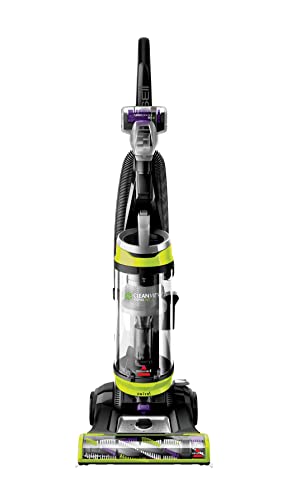
Bissell CleanView Swivel Pet 2252 — Best Budget
The Bissell CleanView 2252’s verified listing reads like a checklist written for value shoppers: swivel steering for manoeuvrability, a triple-action brushroll, a large-capacity dirt tank and pet hair pickup. It covers the floors-and-rugs brief at the lowest tier in this guide, and for smaller homes it covers it completely.
Strengths
- Swivel steering at a budget tier — the feature that matters most on furnished hard floors
- Triple-action brushroll aimed at pet hair on multiple surfaces
- Large-capacity dirt tank reduces emptying stops
Trade-offs
- No HEPA claim is stated in the listing; filtration is a step below the Sharks and Hoover
- Budget build and plastics are built to a price
- No lift-away canister for stairs
Key specs (from the verified listing): Swivel steering; triple-action brushroll; large-capacity dirt tank; pet hair focus; model 2252.
The honest framing: this is the vacuum for a flat or small house with one or two rugs, hard floors elsewhere and a pet — a very common household that does not need a flagship. The swivel head makes the hard-floor work pleasant, the brushroll handles the rugs, and the big tank suits a weekly whole-home session.
Where it yields to the pricier picks is filtration and refinement. If allergies drive your purchase, the Simplicity or the HEPA-equipped Sharks justify their premium. If the brief is “clean my mixed floors well without overspending,” the Bissell is the correct answer and the savings are real.
Best for: smaller mixed-floor homes and first upright purchases. Not suited for: allergy-first buyers or large multi-rug homes. Check the current price on Amazon.
Comparison Table
| Pick | Badge | Key spec | Best for |
|---|---|---|---|
| Shark Navigator NV352 | Best Overall | HEPA, XL cup, Lift-Away, rug+floor listing | Mixed-surface all-rounder |
| Simplicity S20EZM | Best Bagged | Bagged, certified HEPA, rugs listed | Allergy households |
| Hoover WindTunnel 3 Pet | Best Deep Carpet | HEPA media, Quick Pass brushroll, corded | Thick rugs, pet homes |
| Dyson Ball Animal 3 Extra | Best Premium Steering | Ball steering, Animal configuration | Furnished homes |
| Shark ZU561 | Best Self-Cleaning Brushroll | Self-cleaning brushroll, HEPA, Lift-Away | Hair-heavy homes |
| Bissell CleanView 2252 | Best Budget | Swivel, triple-action brushroll, large tank | Small homes, first buy |
Key Takeaways
- Rugs and hard floors pull a vacuum in opposite directions; the winners here balance brushroll agitation with steering and filtration.
- Two picks (Shark NV352, Simplicity S20EZM) name rugs in their verified listings — the strongest surface evidence in this guide.
- Bagged HEPA (Simplicity) is the allergy-first architecture; bagless HEPA (Sharks, Hoover) trades a dust puff at emptying for zero bag costs.
- Hair wrap silently kills rug cleaning performance; the ZU561’s self-cleaning brushroll exists precisely for that failure mode.
- Technique is half the product: slow extraction passes and cross-hatching will make a mid-tier upright outperform a flagship used in a hurry, on every rug in your home, every week.
How to Choose an Upright Vacuum for Floors and Area Rugs
Match the machine to your pile height
Low-pile and flatweave rugs need moderate suction and a brushroll that will not fuzz the surface; almost every upright here handles them. Medium pile — the mainstream — is where this whole guide lives. High-pile and shag are the danger zone: aggressive brushrolls can mat the fibres and powerful suction can seal the head to the rug, so test any machine on a corner first and prefer gentler settings. Antique and hand-knotted rugs deserve suction-only cleaning, which none of these uprights specialise in; vacuum them with the brushroll off if the machine allows, or with an attachment.
Brushroll behaviour on hard floors
On bare floors a spinning brushroll can scatter grit ahead of the machine. The practical technique matters as much as the model: approach scattered debris slowly, let the head pass over it rather than into it, and work room edges with the crevice tool weekly. Swivel and ball steering (Bissell, Dyson, the Sharks) make this edge-and-furniture work markedly less tiring than a fixed head, which is why handling features dominate this guide’s verdicts for hard-floor-heavy homes.
Filtration: what the labels here actually say
“HEPA media” (Hoover) means the filter material meets HEPA-grade specification; “certified HEPA” (Simplicity) is the stronger, system-level claim stated in its listing; the Sharks list HEPA filtration/filter. All three are meaningful, and all beat an unlabelled filter for the dust a rug releases. What no filter fixes is the emptying moment on a bagless machine — if that matters, the bagged Simplicity is your architecture, full stop.
Weight, storage and the stairs question
An upright you dread lifting is an upright you will not carry to the rug upstairs. The NV352’s listing calls out lightweight construction, and both Sharks offer Lift-Away canisters that separate the carrying problem from the cleaning head. Measure your storage cupboard, count your stairs, and be honest about who in the household will actually wield the machine — the best vacuum here is the one that gets used twice a week, not the one with the longest spec sheet.
How to Vacuum Area Rugs and Hard Floors Properly
- Shake or beat first (monthly): take smaller rugs outside and shake them vigorously; the grit that falls out is grit your vacuum no longer has to extract.
- Set the approach: vacuum the hard floor immediately around the rug first, so loose debris at the rug’s edge is not tracked onto it.
- Slow passes on the rug: push forward at half your hard-floor speed and pull back slower still — extraction happens on the slow pull.
- Cross-hatch weekly: vacuum in one direction, then at ninety degrees to it; pile leans, and the second direction lifts what the first laid down.
- Edges and fringe: clean rug edges with the crevice or upholstery tool, and never run a spinning brushroll over fringe — it eats it.
- Under the rug (seasonally): grit migrates through pile and grinds the backing and the floor beneath; lift, vacuum both sides and the floor, and replace any worn rug pad.
- Empty and check: empty the bin or check the bag, and glance at the brushroll for wrap while the machine is already out — thirty seconds now saves a deep maintenance session later.
Common Buying Mistakes
- Buying for carpet alone. A carpet specialist scatters hard-floor debris and can be brutal on light rugs; this search exists because the mix matters.
- Ignoring the emptying moment. Allergy buyers who choose bagless for the HEPA sticker still meet the dust at the bin. Bagged exists for you.
- Letting hair wrap accumulate. A wrapped brushroll stops agitating; check monthly, or buy the self-cleaning design.
- Running the brushroll over fringe and delicate edges. The fastest way to shorten a rug’s life with any upright.
- Skipping the rug pad. A pad protects the floor, stops rug creep that fights the vacuum, and makes pile stand up for better extraction.
- Judging suction by noise. Loud is not strong; the listings’ filtration and brushroll designs tell you more than decibels ever will.
- Buying the flagship for a flatweave life. If your rugs are low-pile and your floors are bare, the budget and mid picks here genuinely finish the job; flagship extraction earns its premium only where pile depth gives dirt somewhere to hide. Match the spend to the pile, and put the difference toward a good rug pad — the cheapest cleaning upgrade in this entire guide.
Final Recommendation
Start with the Shark Navigator NV352 unless a specific need points elsewhere: allergy households to the bagged Simplicity S20EZM, deep carpet and pet work to the Hoover WindTunnel 3, hair-heavy homes to the self-cleaning Shark ZU561, furnished rooms and premium handling to the Dyson Ball Animal 3 Extra, and tight budgets to the Bissell CleanView 2252, which covers smaller mixed-floor homes completely.
Related guides: Best Lightweight Vacuum For Hardwood Floors And Area Rugs, Best Upright Vacuum For Hardwood Floors And Area Rugs, Best Shark Vacuum For Area Rugs, Best Inexpensive Vacuum For Low Pile Rugs, and Best Robot Vacuum For Hardwood Floors And Area Rugs.
Deep Dive: Why Rugs Defeat Ordinary Uprights
A rug is a dirt trap by design: pile fibres intercept grit that would skate across a hard floor, and foot traffic works that grit downward until it sits at the backing, abrading fibres from below every time the rug is walked on. This is why rug vacuuming is an extraction task, not a surface sweep — the brushroll’s job is to vibrate the pile so suction can lift what is buried, and the “slow pull” technique in the how-to section exists because extraction needs dwell time. It is also why a vacuum that has lost its brushroll to hair wrap fails rugs first while still appearing to clean hard floors: suction alone skims both surfaces, but only agitation empties a pile.
The hard-floor half of the problem is the mirror image. Bare floors give debris nowhere to hide, so the challenge is capture without scatter — approach speed, head sealing and steering. Homes that are mostly hard floor with a few rugs should weight the handling picks (Dyson, Bissell, the swivel Sharks) highest; homes that are mostly rug and carpet should weight extraction (Hoover, NV352) and filtration, because a deep rug clean puts the day’s dust into the air in a way hard floors never do. The keyword sits between those poles, and so does this guide’s ordering.
Maintenance That Keeps an Upright Honest
Wash or replace bagless filters on the maker’s schedule — a clogged filter is the silent cause of most “my vacuum lost suction” stories, and it precedes motor strain. Empty bins at two-thirds full, not at the line, because airflow through a packed bin falls off a cliff. Change bags before they are drum-tight for the same reason. Check the brushroll monthly for wrap and the belt (on belted designs) for stretch. Wipe the head’s underside and wheels so grit does not get ground into your hard floors by the machine meant to protect them. Twice a year, vacuum the vacuum: crevice-tool the vents, the hose and the canister seals. Ten minutes of this, twice a year, is the difference between a five-year machine and a two-year disappointment.
A Rug-by-Rug Field Guide
Low-pile and flatweave rugs
The easiest case. Every pick in this guide handles flatweaves and low pile; the risks are suction-seal on lightweight pieces (anchor them with a pad or furniture legs) and brushroll fuzzing on loose weaves. The Bissell and the NV352 are proportionate tools here — flagship extraction power is wasted on a rug with nowhere for dirt to hide.
Medium-pile synthetic rugs
The mainstream, and the case this guide is built around. Buried grit is the enemy, agitation is the cure, and all six picks are in their element. Cross-hatch weekly, extract slowly, and let filtration choice be driven by your household’s allergy picture rather than by marketing.
Wool rugs
Wool sheds, pills and hates aggression. Use the gentlest effective pass, never park a spinning brushroll in one spot, and expect the bin to collect fibre along with dirt for the rug’s first months — that is the rug’s loose surface fibre, not damage, but excessive fibre in every clean means the machine is too rough for the rug. The bagged Simplicity’s sealed system is a calm choice here; whatever you use, turn the aggression down and the frequency up.
Shag and high-pile rugs
Approach with humility. Deep pile can swallow a brushroll, stall a head and hide debris at depths suction cannot reach in one pass. Work slowly in short strokes, lift the head rather than forcing it, and accept that a shag rug also needs periodic outdoor shaking that no vacuum replaces. If shag is your dominant surface, say so honestly when choosing: this guide’s gentler-handling picks will serve you better than its extraction champions.
Jute, sisal and natural-fibre rugs
Dry, brittle fibres and woven construction punish both moisture and rough agitation. Suction-led, gentle passes only, and never a wet clean. These rugs also release fibre dust, which makes the filtration discussion above more than academic.
Corded, and Why This Guide Is Comfortable With It
Every pick here is a corded upright, and for the floors-and-rugs job that is a defensible place to land. Rug extraction is the most power-hungry task in home vacuuming, sustained over large areas; corded machines deliver their full suction in the last room exactly as in the first, with no battery budget shaping your technique. The cost is cord management — a real annoyance, priced into the trade-offs above. Cordless sticks are excellent hard-floor tools and are covered in their own guides in this series, but a household whose centre of gravity is rugs will feel the difference in extraction long before it enjoys the difference in convenience. If your home is mostly hard floor with decorative rugs, weight that calculus the other way and read the stick-vacuum guides linked from this series instead.
What We Left Out, and Why
Transparency about exclusions is part of a useful guide. Two renewed (refurbished) Shark uprights appeared in the verified data and were excluded: renewed units vary in condition, accessories and remaining life from one box to the next, so a “best” recommendation cannot honestly be attached to them even when the underlying model is strong. Replacement filter packs and batteries also appeared in vacuum search data and were excluded as accessories, not vacuums. Several handheld and stick models were set aside because this search asks for uprights specifically — they are covered in their own guides. Finally, a number of uprights with strong names were passed over because their verified listings did not support the rug-and-floor claims this article would have needed to make; we would rather recommend six machines we can describe accurately than ten we have to describe hopefully.
A Whole-Home Route That Respects the Machines
Order matters more than effort. Start upstairs and work down, so debris travels one way. In each room, do the soft furnishings and edges first with hand tools (Lift-Away owners: this is your moment), then the rug with slow extraction passes, then the surrounding hard floor at normal pace, finishing at the doorway so you never walk back across a cleaned rug with outdoor shoes. Empty or check the machine between floors, not between rooms — the two-thirds rule keeps airflow honest without breaking rhythm. Put the machine away with the brushroll checked and the cord loosely looped; the next session’s quality is decided by how this one ended. Households that adopt a fixed route find the whole job shrinks: the same rooms, in the same order, with the same technique, take measurably less time by the fourth week than the first, because the route — not the vacuum — was the inefficiency all along.
Noise, Effort and Storage: The Household Realities
Uprights are not quiet, and rug extraction is their loudest work; households with sleeping babies or night-shift partners should schedule accordingly rather than shop for a silent upright that does not exist. Effort is the second reality: a heavier bagged machine cleans calmly but asks more of the person carrying it upstairs, which is why the verdicts repeatedly separate “best cleaning” from “best for you.” Storage is the third: an upright needs a home with the cord managed and the head accessible, and a machine stored behind three obstacles gets used half as often — a cleaning penalty no specification can offset. Measure the cupboard, count the stairs, name the operator. Then choose from the six above.
Setup Notes for Each Pick
Shark NV352: learn the Lift-Away release on day one and store the upholstery tool on the machine, or it will live in a drawer and never clean the sofa. Simplicity S20EZM: order a pack of bags with the machine, not after the first one fills mid-clean on a Sunday. Hoover WindTunnel 3: scout your rug edges before the first run — its carpet enthusiasm deserves a test pass on any lightweight rug before you commit to full passes. Dyson Ball Animal 3 Extra: confirm the exact tool set of the Extra configuration on the product page before ordering, since the verified listing is brief; practise the ball pivot in an open room before tackling the furnished one. Shark ZU561: still glance at the brushroll monthly — self-cleaning reduces wrap dramatically, but a thirty-second check protects the feature’s whole point. Bissell 2252: the large tank invites overfilling; empty at two-thirds to keep airflow honest, and its budget filtration rewards a monthly filter tap-out outdoors.
Suction and Agitation: The Two Halves of Cleaning
Buyers talk about suction as if it were the whole of cleaning; on rugs it is barely half. Suction is airflow and pressure — what lifts loose material and carries it away. Agitation is the brushroll’s mechanical work — vibrating pile, loosening embedded grit, combing hair free of fibres. A machine with heroic suction and a dead brushroll skims a rug; a machine with a lively brushroll and weak suction stirs dirt it cannot collect. The picks in this guide were chosen as balanced pairs of the two: the Hoover’s WindTunnel channels exist to keep suction effective across the head’s width while its Quick Pass brushroll agitates, and the Sharks pair their brushrolls — standard on the NV352, self-cleaning on the ZU561 — with sealed HEPA paths that preserve airflow as the cup fills.
On hard floors the balance inverts: agitation becomes a liability when it scatters, and capture depends on the head sealing lightly to the surface so airflow does the work. This is why technique — slow approach, flat head, edge tools — is written into this guide as prominently as product choice. The machine provides the two halves; the operator decides their ratio, floor by floor.
A Word on Pet Hair, Specifically
Four of these six listings position themselves for pet homes, and the reason is structural: pet hair is the debris that defeats domestic vacuums, because it wraps brushrolls, mats into rug pile and clings electrostatically to hard floors. The defences, in order of importance, are a brushroll that resists or sheds wrap (ZU561’s self-cleaning design first, then disciplined manual checks), filtration that handles the dander accompanying the hair (the HEPA-equipped picks), and a hand tool for the furniture where pets actually sit (the NV352’s wide upholstery tool). Technique helps too: vacuum pet zones in two directions, and do the pet’s favourite rug corner first while suction and your patience are both fresh. No upright makes pet hair vanish from a home; the good ones reduce it to a five-minute weekly discipline instead of a losing war.
Frequently Asked Questions
Can one upright really handle both shag rugs and hardwood?
Mostly, with technique. Shag needs a gentle touch and patience; hardwood needs scatter control. The picks here cover low- to medium-pile rugs and hard floors well. Very deep shag may still prefer a suction-only pass, and delicate antique rugs should never meet a spinning brushroll. When in doubt, test any new machine on the rug’s least visible corner for a full minute before committing to the whole piece.
Is bagged or bagless better for area rugs?
For cleaning performance, both extract well. The difference is dust handling and upkeep: bagged (Simplicity S20EZM) seals dust away and suits allergy households, at the cost of buying bags. Bagless (the Sharks, Hoover, Bissell) costs nothing per empty but releases a puff of dust at the bin and needs its filters washed on schedule to keep extraction where it started.
How often should I vacuum an area rug?
High-traffic rugs benefit from twice-weekly vacuuming, with one of those sessions done slowly with cross-hatch passes. Low-traffic bedroom rugs can go weekly. Pet homes should add a quick mid-week pass — hair is easiest to extract before it works deep into the pile. A useful way to think about frequency: every footstep on a rug is a tiny hammer driving grit deeper, so the right interval is set by traffic, not by the calendar. A hallway runner in a house with children and a dog may honestly need attention every other day, while a guest-room rug can wait a fortnight. Vacuum the traffic, not the timetable, and the deep cleans become shorter because less grit ever reaches the backing.
Why does my vacuum push debris around on hard floors?
Usually approach speed and brushroll scatter: the head arrives faster than suction can capture, and the brush flicks grit forward. Slow down, approach piles of debris from the edge, and keep the head flat to the floor. Swivel and ball-steering models make the slow, controlled approach easier to sustain. One more culprit worth checking: a bin filled past the two-thirds point or a clogged filter drops airflow exactly where the head meets the floor, and the machine starts leaving trails it would have captured when empty. Before blaming the model, empty it, tap the filter clean outdoors and try the same patch of floor again — in our experience that sequence “repairs” more vacuums than any replacement part.
What does Lift-Away actually help with on rugs?
The rug itself is cleaned by the floor head; Lift-Away helps with everything around it — stairs the rug leads to, the sofa on the rug, the skirting boards and the rug’s own edges and fringe with hand tools. In rug-centred rooms, that surrounding work is a large share of the total job, and it is the share most upright-only owners quietly skip until it becomes a separate, dreaded deep-clean day.
When should I replace rather than repair an upright?
Filters, belts, bags and brushroll cleanings are maintenance, not repairs. A cracked housing, a motor that smells hot or loses power under load, or a head that no longer seals to the floor are end-of-life signs. If the machine is a premium model, a single motor or head replacement can still be rational; for budget models, replacement usually wins. A practical test before you decide: give the machine one full maintenance session — new or washed filter, emptied bin or fresh bag, brushroll stripped of wrap, hose checked for a hidden clog — and then clean your busiest rug. Machines that return to form were never broken; machines that still leave grit behind after that session have told you the truth about their remaining life.


