Disclosure: airfryerkitchensupply.com is reader-supported. When you buy through links on our site, we may earn an affiliate commission at no extra cost to you.
Where to buy
For most low-pile rug owners, start with the Bissell Featherweight Stick Vacuum 2033M if your rugs sit among hard floors and you want one light machine for both, or the Eureka PowerSpeed Upright Vacuum NEU181A if rugs are the main event and you want a real upright’s dirt cup and tools. Tight budgets point to the Eureka Blaze 3-in-1 Stick Vacuum, pet owners to the Bissell CleanView Swivel Pet Upright 2252, and canister loyalists to the Eureka Whirlwind Bagless Canister NEN110A. Every vacuum below was cross-checked against Amazon’s catalog data before receiving a link; colors and bundled tools vary by listing, so check the current price on Amazon for the exact configuration you are considering.
Introduction: Low-Pile Rugs Are the Easy Case — If You Buy Right
The best inexpensive vacuum for low pile rugs is one of the few genuinely solvable problems in floor care. Low-pile rugs — the flatweaves, the short-loop berbers, the modern washable rugs and runners with pile under about a quarter inch — do not hide dirt the way plush carpet does. Debris sits on or just within a short, dense surface, which means a vacuum does not need a aggressive beater bar or deep-agitation power to clean it; it needs honest suction, a floor head that seals reasonably against a low surface, and height or brushroll control so it glides instead of plowing. That is why the inexpensive tier serves this job unusually well: the expensive features of premium vacuums mostly exist to defeat deep pile, and your rugs do not have any.
This guide compares six verified budget-friendly vacuums across the formats that suit low-pile rugs: two featherweight stick vacuums for mixed floors and small homes, two uprights for rug-heavy households (one a pet specialist), a step-up upright with sealed HEPA filtration for allergy-conscious buyers, and a lightweight canister for homes with stairs and furniture to clean around. We explain what low pile actually demands technically — and what it forgives — plus the settings and technique that make a cheap vacuum clean like a considered one, the maintenance that keeps suction honest, and the specific ways buyers waste money in this category, usually by purchasing deep-carpet firepower their floors will never use.
In this guide
Quick Picks
- Best Overall — Bissell Featherweight Stick Vacuum 2033M: a lightweight bagless stick and hand vacuum in one, with a crevice tool, made for hard floors and low carpets alike. Check the current price on Amazon
- Best Ultra-Budget — Eureka Blaze 3-in-1 Stick Vacuum: a corded 3-in-1 stick, hand, and stair vacuum sized for dorms, apartments, and quick daily passes. Check the current price on Amazon
- Best Upright — Eureka PowerSpeed Upright NEU181A: a lightweight bagless upright with a large 2.6L dust cup and pet tools for rug-heavy homes. Check the current price on Amazon
- Best for Pet Hair — Bissell CleanView Swivel Pet Upright 2252: a swivel-steering upright with a triple-action brush roll built for pet hair on carpets and rugs. Check the current price on Amazon
- Best Step-Up — Shark Navigator Lift-Away NV360: a lift-away upright with HEPA filtration and swivel steering for buyers who want one vacuum for the whole home. Check the current price on Amazon
- Best Canister — Eureka Whirlwind Bagless Canister NEN110A: a lightweight corded canister for carpets and hard floors, with the reach and wand that stairs and furniture want. Check the current price on Amazon
How These Picks Were Chosen
We chose for the actual physics of low-pile rugs. Because debris rests shallow, our criteria weighted suction delivery and floor-head behavior over raw agitation: a head that maintains contact without sealing itself immovably to a flat rug (the classic stick-vacuum-on-rug failure), brushrolls that sweep a short surface without scattering or snagging, and — for uprights — height settings or brushroll control that let the machine float at the right level. Every pick was cross-checked through Amazon data available to this site, matching each model’s name and configuration against its catalog title before it earned a link; the model numbers in the reviews are the verified ones, because budget vacuums are sold in thickets of near-identical variants and the wrong variant is a real-world disappointment.
We also weighted ownership economics, because “inexpensive” should describe the whole ownership, not the checkout: bagless designs with washable filters (most picks here) over bagged designs with consumable costs, dirt-cup capacity against emptying frequency, corded reliability against cordless convenience at this tier — budget cordless vacuums compromise runtime and suction in ways corded budget vacuums simply do not, which is why this guide’s picks are corded or cord-optional workhorses. Finally, we included format diversity deliberately: the best inexpensive vacuum for a studio apartment’s two rugs is a stick; for a rug-layered family home it is an upright; for a house with stairs it may be the canister, and pretending one format wins everywhere would fail real readers.
One scope note: these picks are for low-pile rugs and the hard floors around them. If your home also has medium- or high-pile carpet, the upright picks here will serve it respectably, but deep plush carpet is a different brief with different machines, and this guide will not pretend a featherweight stick is a whole-house answer for a shag-carpeted home.
The 6 Best Inexpensive Vacuums for Low-Pile Rugs Reviewed

Bissell Featherweight Stick Vacuum 2033M — Best Overall
The Featherweight is the budget vacuum that understands its assignment: a lightweight bagless machine that works as a stick vacuum for floors, converts to a hand vacuum for furniture and stairs, and carries a crevice tool for edges — its catalog title describes it plainly as a stick, lightweight bagless vacuum and electric broom for hard floors and carpets. On low-pile rugs that formula is exactly right. The head is light enough to glide over short pile without the plow-and-stick behavior of heavy uprights, the suction is honestly matched to shallow debris, and the whole machine hangs in a closet or stands in a corner of a small home without a negotiation. For apartments and mixed-floor homes where rugs are accents over hard floors, this is the inexpensive answer most people actually need.
Strengths
- Stick-to-handheld conversion covers rugs, hard floors, stairs, and furniture with one light machine.
- Lightweight head glides over low pile instead of sealing or plowing.
- Bagless with a simple dirt cup — minimal running costs.
Trade-offs
- Small dirt cup empties often in larger or pet-heavy homes.
- Corded design — you trade cordless freedom for consistent suction at this tier.
- Not built for deep or plush carpet; it is a low-pile and hard-floor specialist.
Choose the Featherweight if your floors are mostly hard with low-pile rugs on top, your home is small to medium, and you value a vacuum you can grab for a two-minute pass as much as a Saturday clean. It is the pick that gets used daily, and in floor care, used daily beats powerful monthly.
Best for: apartments and mixed floors with low-pile rugs / Not suited for: large homes or deep carpet
Check the current price on Amazon

Eureka Blaze 3-in-1 Stick Vacuum — Best Ultra-Budget
The Blaze is the minimum viable vacuum done right: a corded 3-in-1 that works as a stick, a hand vacuum, and a stair cleaner, described in its catalog title as a small vacuum for home and dorm use with featherweight handling. At the very bottom of the price ladder, the honest questions are whether suction is real and whether the machine survives its first year; the Blaze’s long presence in this segment and its simple, serviceable design are its credentials. On low-pile rugs and hard floors — dorm rooms, first apartments, a kitchen-and-entry rug circuit — it does the whole job without pretending to be a whole-house upright.
Strengths
- Lowest-commitment format in the guide: stick, hand, and stair modes in one featherweight body.
- Corded suction that does not fade mid-room the way budget cordless runtime does.
- Stores anywhere — the first-apartment and dorm champion.
Trade-offs
- Small cup and basic filtration; empty and rinse on schedule or suction fades.
- Lightweight construction is not a decade-scale heirloom.
- Rug coverage is for low pile and small areas, not wall-to-wall family rooms.
Pick the Blaze when the budget is the brief: a first home, a dorm, a vacation place, or a second vacuum kept near the kitchen for the daily crumb-and-grit circuit. It is also the honest recommendation for anyone whose alternative is not vacuuming at all — a cheap vacuum used beats a premium vacuum postponed.
Best for: dorms, first apartments, and tight budgets / Not suited for: large rug-covered homes
Check the current price on Amazon
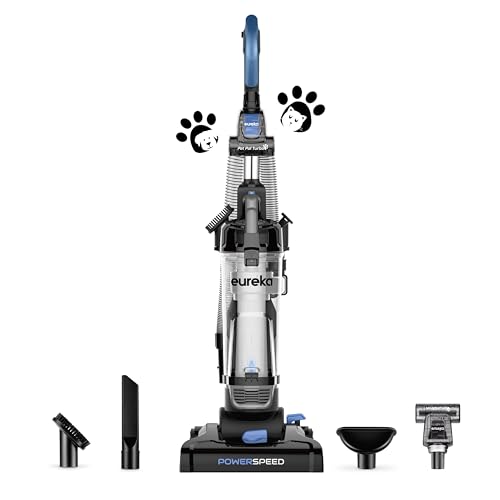
Eureka PowerSpeed Upright NEU181A — Best Upright
When low-pile rugs cover real square footage — layered through living rooms, hallways, and bedrooms — a stick stops being enough and the PowerSpeed is the inexpensive upright that steps in. Its catalog title confirms the specifications that matter for the job: a lightweight upright build, a large 2.6L dust cup that swallows a whole home’s worth of rug debris between empties, a pet turbo brush among its tools, and suitability across carpet and hard floor. The upright format brings a full-size brushroll and stronger sustained suction to rug work, and the big cup is a genuine quality-of-life feature in homes where a stick’s thimble would need emptying mid-room.
Strengths
- Large 2.6L dust cup suits whole-home rug cleaning without constant emptying.
- Full upright brushroll and suction for rug-heavy floors, in a lightweight body.
- Included pet turbo brush and tools extend it to stairs and upholstery.
Trade-offs
- An upright is more machine to store and carry than a stick.
- Brushroll energy that serves rugs needs height judgment on delicate flatweaves — use the settings.
- Bagless filtration needs its wash-and-dry routine to keep suction honest.
Choose the PowerSpeed if rugs are your home’s main flooring story, if you have pets contributing to them, or if you simply want one inexpensive machine that cleans like a primary vacuum rather than a supplement. It is the workhorse pick of this guide.
Best for: rug-heavy homes wanting a real upright on a budget / Not suited for: tiny apartments where storage is the constraint
Check the current price on Amazon
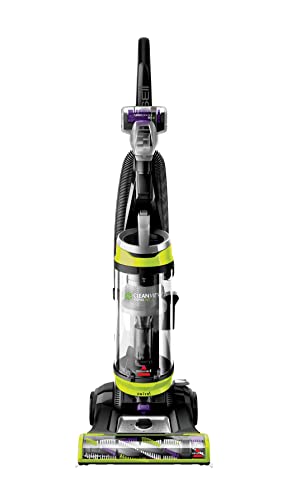
Bissell CleanView Swivel Pet Upright 2252 — Best for Pet Hair
Pet hair on low-pile rugs is a specific enemy: hair lies flat, weaves into short fibers, and resists lazy suction. The CleanView Swivel Pet answers with the two features its catalog title confirms — swivel steering for working around furniture legs and rug edges, and a triple-action brush roll designed to loosen, lift, and suction pet hair from carpet — plus a large-capacity dirt tank for the volume pet homes generate. Swivel steering sounds like a luxury until you have threaded an upright around a dining set on a rug; in pet homes, where the rug is exactly where the dog is, maneuverability is cleaning power.
Strengths
- Triple-action brush roll targets pet hair embedded in low pile.
- Swivel steering works rugs around furniture without a wrestling match.
- Large dirt tank matches pet-home debris volume.
Trade-offs
- Pet-focused brushroll needs its hair-wrap cleaned off regularly to stay effective.
- More vacuum than pet-free small spaces need.
- Like all uprights here, it asks for filter washing discipline.
Pick the CleanView if a pet owns your rugs jointly with you. It is the difference between a vacuum that moves hair around a low-pile surface and one that actually removes it — and in a pet home, that difference is the whole purchase.
Best for: pet owners with low-pile rugs and carpet / Not suited for: pet-free minimalists in small spaces
Check the current price on Amazon

Shark Navigator Lift-Away NV360 — Best Step-Up
The NV360 is where this guide steps above the strict budget tier for buyers whose “inexpensive” has a little headroom and whose homes ask more questions. Its catalog title confirms the upgrades: a lift-away pod that detaches for stairs and above-floor cleaning, HEPA filtration with a sealed system for allergy-conscious households, swivel steering, and a brushroll suited to carpet and pet hair. On low-pile rugs it cleans with authority to spare, and the lift-away format solves the stairs problem that uprights usually fumble. It is the buy-once answer in a guide of buy-cheerfully answers.
Strengths
- Lift-away pod extends one vacuum to stairs, upholstery, and car interiors.
- HEPA filtration in a sealed system — the allergy-aware choice here.
- Swivel steering and strong carpet performance cover rugs and more.
Trade-offs
- Costs more than the strict-budget picks; that is the step-up bargain, stated plainly.
- Heavier and larger than the sticks — storage and carrying are real considerations.
- HEPA filters are consumables to budget for over the years.
Choose the NV360 if your home mixes low-pile rugs with stairs, upholstery, and an allergy-sensitive sleeper or two, and you want one machine to retire the question for years. It is the premium of this guide and still, by the standards of its class, an inexpensive vacuum.
Best for: whole-home buyers wanting lift-away versatility and HEPA / Not suited for: the strictest budgets or the smallest closets
Check the current price on Amazon

Eureka Whirlwind Bagless Canister NEN110A — Best Canister
The canister format is the connoisseur’s answer to low-pile rugs in furnished, multi-level homes, and the Whirlwind is its inexpensive ambassador: a lightweight corded bagless canister whose catalog title positions it for carpets and hard floors. A canister separates the motor from the cleaning head, which buys three things rug owners value: a low-profile head that slides under furniture where rugs extend beneath sofas and beds, a wand that makes stairs and edges a standing-up job, and a machine that trails behind you instead of being pushed with your arm’s full effort. On low-pile rugs, where brute agitation is unnecessary, that finesse is worth more than power.
Strengths
- Low-profile head reaches rugs under furniture that uprights cannot touch.
- Wand and hose make stairs, edges, and upholstery genuinely easy.
- Lightweight canister body trails comfortably through multi-room cleans.
Trade-offs
- Two-piece format stores less tidily than a stick in a small closet.
- Suction-first cleaning suits low pile; deep carpet is not its brief.
- Cord management is a canister habit some users never learn to love.
Pick the Whirlwind if your rugs live under and around furniture, if stairs are part of the cleaning map, or if pushing an upright has always felt like the workout you did not order. It is the format pick of this guide, and for the right home it is not a compromise at all.
Best for: furnished and multi-level homes with rugs under furniture / Not suited for: deep carpet or minimal-storage spaces
Check the current price on Amazon
Comparison Table
| Pick | Badge | Key spec | Best for |
|---|---|---|---|
| Bissell Featherweight 2033M | Best Overall | Stick + handheld, bagless, crevice tool | Mixed floors, small homes |
| Eureka Blaze 3-in-1 | Best Ultra-Budget | Corded 3-in-1 stick/hand/stair | Dorms and first apartments |
| Eureka PowerSpeed NEU181A | Best Upright | Lightweight upright, 2.6L cup, pet tools | Rug-heavy homes |
| Bissell CleanView Swivel Pet 2252 | Best for Pet Hair | Swivel, triple-action brush roll, large tank | Pet hair on rugs |
| Shark Navigator Lift-Away NV360 | Best Step-Up | Lift-away pod, HEPA, swivel steering | Whole-home versatility |
| Eureka Whirlwind NEN110A | Best Canister | Lightweight bagless canister, wand reach | Stairs and under furniture |
How to Choose an Inexpensive Vacuum for Low-Pile Rugs
Start by understanding what low pile forgives and what it punishes. It forgives modest suction and modest agitation, because debris has nowhere to hide; a budget machine’s honest airflow lifts grit, crumbs, hair, and dust from a short surface completely. It punishes two things: a floor head that seals itself to the rug — recognizable when the vacuum suddenly becomes hard to push and starts dragging the rug — and an aggressive brushroll on delicate flatweaves and looped rugs, where stiff bristles can fuzz the surface or catch loops over time. The buyer’s translation: prefer machines with height adjustment, brushroll control, or a naturally gliding lightweight head, and if your rugs are fine flatweaves or heirloom pieces, favor suction-forward formats like the canister or the sticks on their gentlest settings.
Next, match format to floor plan, as the reviews suggest: sticks for hard-floor homes with rug accents and small storage; uprights for rug-dominant homes and pet volume; a canister for stairs, furniture density, and under-furniture rugs; and the lift-away step-up when one machine must answer every question in a larger home. Then check the unglamorous specifications that decide year two: filter type and washability, dirt-cup size against your home’s debris rate, cord length against your room sizes (budget cords can be short, and an extension-cord lifestyle is a quiet daily tax), and replacement-part availability for the brushroll and filters of the specific model number you are buying.
Finally, hold the line on “inexpensive” intelligently. The trap at this tier is not overspending on the machine — it is underspending into false economy: a vacuum so weak or fragile that it is replaced within a year costs more than the mid-pick bought once. The six machines here were chosen to sit above that line: each is a recognized model from a real floor-care maker, with a verified identity and a plausible multi-year life when maintained. That, more than any single specification, is what inexpensive should mean.
How to Vacuum Low-Pile Rugs for the Best Results
Technique multiplies a budget vacuum’s value. First, set the machine for the surface: on uprights, use the lowest height setting that still lets the head glide without dragging — contact without plowing — and on delicate flatweaves, raise a step or switch the brushroll off if your model allows. Second, vacuum in slow, overlapping passes in two directions: north-south, then east-west. Low pile releases grit most completely when the head approaches fibers from more than one angle, and slow passes give suction time to work; the frantic sawing motion of television cleaning mostly rearranges surface dust. Third, work edges deliberately with the crevice tool, because rug edges against baseboards are where low-pile homes accumulate their grit line, and no floor head seals into a corner.
Sequence the room intelligently: hard floors and rugs in one session, rugs last if your machine’s settings change between them, and shake small rugs outdoors before vacuuming when you can — a shaken runner gives up half its grit to gravity and lets the vacuum finish a much easier job. For pet homes, a pass with a rubber broom or a lint roller before vacuuming lifts the hair mat that otherwise loads the brushroll, and emptying the cup before it passes two-thirds full keeps suction at its rated honesty. None of this costs money; all of it is the difference between a cheap vacuum that disappoints and the same vacuum performing like a considered purchase.
Maintenance That Keeps a Budget Vacuum Honest
Budget vacuums die of neglect, not of price. The routine is short. Empty the dirt cup after every substantial clean — suction falls as the cup fills and the filter loads, and most “my vacuum stopped working” stories are a full cup wearing a disguise. Wash washable filters on the maker’s schedule, let them dry completely before refitting (a damp filter is a mold farm and a suction killer), and replace non-washable filters rather than shaking them forever. Clear the brushroll of hair and thread monthly with scissors along its groove; a brushroll wound in hair is a brushroll that has stopped brushing. Check the hose and head for the blockages that announce themselves as a sudden pitch change in the motor’s note, and wipe the head’s underside so the seal against low pile stays clean. Five minutes a month, and an inexpensive vacuum stays inexpensive for years instead of becoming an annual purchase.
Low Pile, Defined: What Counts and Why It Changes Everything
Pile height is the thickness of a rug’s fiber surface, and “low” generally means under about a quarter inch. That small number reorganizes the cleaning problem completely. In medium and high pile, dirt migrates downward and lodges at the fiber base, where only agitation and deep suction retrieve it — the expensive end of vacuum engineering exists for that retrieval. In low pile, gravity has almost no depth to work with: grit, crumbs, and hair rest on or barely within a dense, short surface, visible to the eye and available to ordinary airflow. This is why a modest stick vacuum can leave a low-pile rug genuinely clean while merely grooming the surface of a plush carpet, and why this category is the budget shopper’s home turf.
The common low-pile residents of modern homes each add a wrinkle. Flatweaves — kilims, dhurries, woven cotton rugs — have no pile at all and reward suction while punishing aggressive brushrolls that can fuzz or catch their weave. Loop-pile berbers are durable and forgiving but ask you not to snag a loop with a damaged brushroll or beater bar. The new generation of washable low-pile rugs, printed and thin by design so they fit in home machines, vacuum beautifully with gliding heads and benefit from their rug pads staying put — a head that drags will walk the rug across the floor, so technique and height settings matter. Runners and entry rugs, whatever their construction, live in the grit stream from outdoors and deserve the most frequent passes in the house. Read your specific rugs into the picks above and the right format usually announces itself.
The True Cost of Inexpensive: Thinking in Three Years
Run the three-year ledger before choosing, because the cheapest purchase is often not the cheapest ownership. A bagless budget vacuum’s consumables are near zero — filters wash, cups empty — provided the maker keeps parts available, which is a quiet argument for the recognized brands in this guide over anonymous listings. A bagged alternative spends steadily on bags. A step-up machine like the Navigator spends a little on HEPA filters and returns it in years of service and one-machine simplicity. The false-economy traps are a vacuum too weak for the home (replaced early), a cordless whose battery fades into uselessness (replaced entirely), and any machine whose filters and brushrolls cannot be sourced (landfilled at the first wear point). Inexpensive, properly understood, is a low three-year cost with a clean floor throughout — and every pick here was chosen to satisfy that definition rather than a headline.
Troubleshooting: When Suction Fades
Work the chain before blaming the machine. First, empty the cup — suction loss tracks fullness more faithfully than any other cause. Second, wash or replace the filter and let a washed filter dry completely; a surprising share of “dead” budget vacuums revive at this step. Third, inspect the brushroll: a roll wound with hair and carpet thread cannot sweep, and its motor strain changes the machine’s note. Fourth, hunt the blockage — detach the hose and wand, drop a coin through, and check the head’s throat, where low-pile homes pack a dense felt of hair and grit exactly at the bend. Fifth, check seals and the head’s underside for the wear and debris that break the floor seal. In order, those five checks resolve the overwhelming majority of suction complaints in this class of machine, and they cost nothing but minutes — which is, in the end, the maintenance philosophy of the entire inexpensive category.
Common Buying Mistakes
The first mistake is buying deep-carpet specifications for low-pile floors — maximum agitation and premium prices aimed at a problem your rugs do not present. The second is choosing a budget cordless for a whole home and discovering that its runtime cleans two rooms; corded budget machines are the honest value at this tier. The third is ignoring cord length and cup size, the two specifications that tax you daily. The fourth is running an aggressive brushroll over a delicate flatweave for a year and blaming the rug. And the fifth is skipping filter maintenance until suction dies, then replacing a vacuum that needed a wash — the most expensive habit in the entire inexpensive category.
Apartment, Dorm, and Small-Space Notes
Small homes change the vacuum brief in ways worth stating plainly. Storage is a specification: a stick that hangs inside a closet door or stands in a corner will be used; an upright that must be fetched from a hall closet shared with winter coats will be negotiated with, and negotiation loses to crumbs. Noise is a specification too: budget vacuums are not quiet machines, and in thin-walled buildings the courteous move is a vacuum whose job can be done in short, effective passes at civilized hours — another argument for the sticks’ quick-pass style. And in a rental, where the rugs are often yours but the floors are the landlord’s, a vacuum that excels on both surfaces protects your deposit as faithfully as it cleans your textiles. The Featherweight and Blaze picks exist in this guide precisely because so many low-pile rug owners live exactly this life.
Seasonal Deep Cleaning for Low-Pile Rugs
Twice a year, give low-pile rugs the deeper treatment their daily passes maintain between. Take smaller rugs outside for a thorough shake and, where the maker allows, a wash — washable low-pile rugs are a genuine modern convenience, and a clean rug makes every subsequent vacuum pass more effective. For fixed and large rugs, vacuum slowly in both directions, then go over high-traffic lanes a second time after an hour, because grit loosened by the first pass migrates upward as fibers relax. Check underneath the rug: pads and subfloors collect a surprising film of fine dust that only an under-rug pass twice a year will ever meet, and that film is part of why rooms can smell stale despite clean surfaces. Finish by washing the vacuum’s filters and clearing its brushroll, so the machine starts the new season at full honesty. It is half a day, twice a year, and it is the difference between rugs that age gracefully and rugs that quietly become ground-in.
Final Recommendation
Most readers should buy the Bissell Featherweight and stop deliberating: for mixed floors with low-pile rugs in a small or medium home, it is the inexpensive answer that gets used daily. If the budget is absolute, the Eureka Blaze covers the essentials with dignity. Rug-heavy homes should step to the Eureka PowerSpeed, pet homes to the Bissell CleanView Swivel Pet, and homes with stairs and furniture-choked rugs to the Eureka Whirlwind canister. If you can stretch once for years of service, the Shark Navigator NV360 retires the question entirely. Whichever you choose, set it correctly for low pile, vacuum in two directions, and keep its filters clean — the best inexpensive vacuum for low pile rugs is a modest machine, correctly used, and that combination beats expensive machinery used carelessly every single week. For related formats, see Best Lightweight Vacuums With Bags, Best Performing Lightweight Vacuums, and Best Mini Upright Vacuums.
One last encouragement for the budget-minded: in this specific category, the inexpensive choice is not the compromise choice. Low-pile rugs ask so little of a vacuum that the modest machines here, chosen by model number and maintained monthly, will leave your floors as clean as machines several times their price — and the money you did not spend can go to the rug pad, the second rug, or anything else your home actually needs.
Rugs on Hard Floors: Pads, Edges, and the Mixed-Floor Routine
Most low-pile rugs live on hard floors, and the combination has its own technique. A rug pad underneath — sized slightly smaller than the rug — stops the rug walking under the vacuum’s head, cushions the fibers against the hard subfloor, and makes every pass more effective because the rug stays where the suction expects it. If your rug currently migrates across the room during cleaning, a pad is a better purchase than a stronger vacuum. At the rug’s edge, approach from the rug side outward onto the hard floor rather than climbing the edge from the floor, which folds lightweight rugs; the sticks and the canister in this guide cross edges gracefully when led that way, and uprights behave if you keep their momentum steady.
For the mixed-floor session itself, work dry-to-dirty: bedrooms and living areas first, entry runners last, so grit from the entry is not carried through the house on the vacuum’s own head. Finish with the crevice tool along baseboards and the rug edges, where the floor head’s seal cannot reach. It is a fifteen-minute discipline in most apartments, and it is the routine that makes inexpensive equipment produce expensive-looking floors.
Vacuuming Delicate and Vintage Low-Pile Rugs
A final, specific caution for owners of antique flatweaves, hand-knotted low-pile pieces, and any rug whose value is sentimental or financial: vacuum it like the textile it is. Use suction without a spinning brushroll where your machine allows — the canister with a floor tool is the classic conservator’s setup — keep passes gentle and infrequent compared with your everyday rugs, and never attack fraying edges or loose fringe with a powered head; fringe is combed straight by hand, not vacuumed. If a rug is genuinely valuable, ask a rug specialist about cleaning intervals before establishing your own. The inexpensive vacuums in this guide are entirely capable of this gentle work — capability was never the question — provided the operator supplies the restraint that delicate fibers require.
Related guides
Frequently Asked Questions
Do I need a special vacuum for low-pile rugs?
No special machine — you need an ordinary machine with the right behavior: honest suction, a head that glides without sealing to the rug, and ideally height or brushroll control. Low pile is the easiest rug surface to clean, which is why inexpensive vacuums serve it so well when chosen by those criteria.
Should the brushroll be on or off for low-pile rugs?
For sturdy low-pile rugs, a brushroll on a low height setting helps lift embedded grit and pet hair. For delicate flatweaves, looped rugs, or fringed pieces, gentler is better: raise the height, reduce agitation, or use a suction-forward format. When in doubt, test a corner and inspect the fibers afterward.
Are stick vacuums powerful enough for rugs?
For low-pile rugs, yes — the debris sits shallow, and a decent stick’s suction lifts it completely, as the Featherweight and Blaze picks demonstrate. Sticks run out of authority on deep carpet and large rug areas, where an upright’s sustained suction and brushroll earn their size.
How often should I vacuum low-pile rugs?
High-traffic rugs benefit from two or three passes a week; pet homes, daily quick passes in the pet’s territory with a full clean weekly. Low pile shows dirt honestly but also releases it easily, so frequent light cleaning beats occasional heroic sessions.
Why does my vacuum push hard or drag the rug?
The head is sealing to the low surface — suction without airflow. Raise the height setting a step, check that the head’s vents and underside are clean, and confirm the filter is not clogged (a loaded filter changes the head’s behavior). Lightweight heads and canister wands rarely have this problem, which is one reason they suit low pile so well.
Can these vacuums handle a washable low-pile rug without bunching it?
Yes, with technique: keep the rug on its pad, approach edges from the rug outward, use a gliding height setting, and let the machine’s suction rather than your pushing do the work. The lightweight sticks and the canister are the most graceful on thin washable rugs; heavy uprights should cross them at a steady pace without stopping mid-rug, which is when bunching starts.
What about robot vacuums for low-pile rugs?
Robots handle low pile competently — it is the surface they were born for — and a robot plus one of this guide’s inexpensive machines for edges and stairs is a legitimate system. As a sole solution, a budget robot leaves edges, corners, and above-floor work undone, which is why this guide’s picks remain the foundation and a robot, if desired, the supplement.
How do I stop pet hair wrapping around the brushroll?
You reduce it rather than abolish it: a quick pass with a rubber broom before vacuuming lifts the surface mat, vacuuming more often keeps accumulation thin, and a monthly scissor pass along the brushroll’s groove clears what wrapped. Pet-specific brushrolls like the CleanView’s are designed to channel hair toward suction, but no design in this tier is maintenance-free — budget five minutes a month and the problem stays a chore instead of becoming a failure.
Is a canister or an upright better for rugs?
For low-pile rugs alone, they tie on cleaning and differ on everything else: the canister wins on stairs, under-furniture reach, and gentle suction-only work; the upright wins on single-unit storage, wide fast passes over open rug areas, and brushroll authority for pet hair. Your floor plan, not the rug, should cast the deciding vote.
What cord length should I look for?
Enough to cross your largest room without unplugging — in practice, measure your longest cleaning run and compare it honestly, because budget models vary and an extension cord is a daily tax on goodwill toward vacuuming. Apartment dwellers can forgive a shorter cord; whole-house upright buyers should treat cord length as a first-order specification alongside cup size.
Do inexpensive vacuums work on Berber rugs?
Yes — loop-pile Berber is a low-pile surface and these machines clean it well. The one discipline Berber asks is a healthy brushroll: check yours for nicks or damage that could catch a loop, and if your Berber is a delicate wool loop, favor the gentler settings or the canister’s suction-forward approach described in this guide.
Should I buy a second cheap vacuum instead of one better one?
Sometimes, yes — a featherweight stick stationed where life happens (kitchen, entry) plus an upright for the weekly whole-home clean is a system many households love, and at this tier the pair can still cost less than one premium machine. Buy the pair deliberately by format, as this guide’s picks allow, rather than duplicating the same format twice.
How loud are budget vacuums, honestly?
They are not quiet — inexpensive motors and simple housings make more noise than premium designs, and no pick in this guide should be sold to you as a whisper machine. What you can control is exposure: short, effective passes with correct settings clean faster than long struggles with clogged filters, so the maintained budget vacuum is also, incidentally, the briefest-sounding one.
When should I replace a budget vacuum rather than maintain it?
When the motor itself fades or fails, when the housing or head cracks beyond a sound repair, or when parts for your model disappear — those are honest end-of-life signals. Everything short of them — suction loss, noise changes, brushroll wear — is maintenance, and the troubleshooting chain in this guide will tell you which side of the line your machine is on before you spend anything.
Do I need HEPA filtration for rugs?
For most households, no — standard filtration on a maintained bagless machine handles rug dust adequately, and the money is better spent on the right format. For allergy-sensitive households, sealed HEPA is a genuine upgrade rather than a label, which is why the step-up pick in this guide was chosen with a sealed system; buy it for the sealing, not the acronym.
What is the best first vacuum for a new apartment with rugs?
The Featherweight pattern: one light convertible machine that covers rugs, hard floors, and furniture without storage drama. Add the upright later only if rug area grows; most first apartments never need step two.
Bagged or bagless at this price?
Bagless dominates the inexpensive tier and keeps running costs near zero, at the price of filter-washing discipline. Bagged models trap dust more neatly at emptying time but add a permanent consumable cost. For most budget shoppers, a bagless pick from this guide, maintained monthly, is the economical answer.


