Disclosure: airfryerkitchensupply.com is reader-supported. When you buy through links on our site, we may earn an affiliate commission at no extra cost to you.
Where to buy
A tube mixer is laboratory equipment — the vortex mixer that spins a test tube’s contents into a whirlpool, and the rotator that tumbles tubes gently end over end. Every pick below is a real tube mixer verified and sold through Amazon; check price on Amazon on the exact model, because vortex mixers are sold with different head attachments and regional power variants whose listings sit side by side.
Scientific Industries Vortex-Genie 2 Mixer SI-0236, 120V (Best Overall Tube Mixer): Check the current price on Amazon.
Benchmark Scientific BenchMixer Vortex Mixer BV1000, 115V (Best Variable-Speed Value for Labs): Check the current price on Amazon.
JOANLAB VM500S Multi-Tube Vortex Mixer, 0-3000 RPM (Best for Multi-Tube Batch Mixing): Check the current price on Amazon.
ONiLAB Lab Vortex Mixer with Touch Start and Continuous Modes, 3000 RPM (Best Mid-Range Single-Tube Vortexer): Check the current price on Amazon.
ONiLAB Mini Vortex Mixer with Touch Function (Best Mini Tube Mixer): Check the current price on Amazon.
VISOSCI Tube Rotator, Fixed 20 RPM Laboratory Tube Mixer (Best Gentle Tube Rotator): Check the current price on Amazon.
Best Tube Mixers: Vortex and Rotator Mixers for Lab Tubes
If you are shopping for the best tube mixers, you are shopping for the bench workhorse that laboratories use a hundred times a day: press a tube to the cup, and a vortex swirls the sample to uniformity in seconds. Around that core idea the category divides by mixing philosophy. Vortex mixers are aggressive and instant — resuspending pellets, mixing reagents, blending paints and adhesives in their hobby afterlife. Tube rotators are gentle and continuous — keeping blood tubes, cultures and suspensions moving for minutes or hours without frothing or shearing. Choosing the wrong philosophy is the category’s main buying error, and this guide separates the two cleanly.
The six verified picks span both families: a multi-tube vortex platform for batch work, the classic Vortex-Genie 2 that defined the bench standard, a variable-speed BenchMixer, two ONiLAB vortex models at the value end, and a fixed-speed tube rotator for gentle continuous mixing. The reviews judge what tube mixing actually punishes — speed control at the low end, cup and head design, stability on the bench at full speed, and duty rating for continuous work — so the mixer you buy matches the tubes you actually run.
In this guide
Quick Picks
Scientific Industries Vortex-Genie 2 Mixer SI-0236, 120V — Best Overall Tube Mixer. The bench standard: the Vortex-Genie 2 has been the reference tube mixer in laboratories for decades — variable speed, touch or continuous operation, and a universe of interchangeable heads.
Benchmark Scientific BenchMixer Vortex Mixer BV1000, 115V — Best Variable-Speed Value for Labs. A laboratory vortex mixer with a stated 200 to 3200 rpm range — wide, genuinely controllable speed in a compact bench footprint, from a maker of dedicated lab equipment.
JOANLAB VM500S Multi-Tube Vortex Mixer, 0-3000 RPM — Best for Multi-Tube Batch Mixing. Batch throughput: interchangeable modules hold multiple tubes — or a flask — at once, with a stated 0-3000 rpm range and both touch and continuous modes.
ONiLAB Lab Vortex Mixer with Touch Start and Continuous Modes, 3000 RPM — Best Mid-Range Single-Tube Vortexer. A full-size single-tube vortexer at a mid-range tier: touch start and continuous modes at a stated 3000 rpm, serving lab tubes and the hobby bench with the same machine.
ONiLAB Mini Vortex Mixer with Touch Function — Best Mini Tube Mixer. The palm-sized touch vortexer: press the tube or bottle down and it mixes — the space-saving answer for small tubes, paint bottles and adhesive work, with mixing balls included for stubborn pigments.
VISOSCI Tube Rotator, Fixed 20 RPM Laboratory Tube Mixer — Best Gentle Tube Rotator. The other philosophy: a fixed 20 rpm rotator with adjustable-angle holders for 0.5 to 50 ml tubes — gentle, continuous, end-over-end mixing for samples a vortexer would destroy.
How These Picks Were Chosen
Selection required a true tube-mixing action from every pick: orbital vortexing with a cup or platform head, or end-over-end tube rotation — not general lab stirrers wearing the keyword. Speed range and control were ranked next, because resuspending a stubborn pellet and gently mixing a fragile sample are opposite demands that a single fixed speed serves poorly. Bench behaviour — weight, feet and the tendency to walk at full speed — was weighted heavily, as any bench scientist who has chased a vortexer across the counter will understand.
Verification was by live Amazon listing data search at the time of writing, recorded in this batch’s cache file with the Amazon titles quoted in the sources. Hobby crossover is real in this category — the same mini vortexers mix model paints, nail polish and lash adhesives — and the picks were chosen to serve both the laboratory and the bench-hobbyist honestly, with the reviews stating which models are lab-grade instruments and which are light-duty mixers that happen to wear a lab coat. Prices are not printed; check price on Amazon.
The 6 Best Tube Mixers

Scientific Industries Vortex-Genie 2 Mixer SI-0236, 120V — Best Overall Tube Mixer
Some products are recommended; the Vortex-Genie 2 is simply what laboratories have. Its variable-speed orbital action handles the full tube-mixing repertoire — a gentle swirl for a fragile suspension, a full-speed vortex that resuspends a centrifuged pellet in seconds — and it switches between touch activation, where pressure on the cup starts the motor, and continuous running for platform work. The accessory head system is the deepest in the category: cups, flat heads, foam inserts for multiple tubes, microplate holders — the mixer grows with the bench’s work instead of being replaced by it.
Durability is the other half of its reputation. These units survive the daily abuse of teaching labs and production benches for years, and the design’s sheer installed base means parts, heads and knowledge are everywhere. The honest costs: it is priced as the professional instrument it is, it is a single-tube-at-a-time tool in its standard cup configuration, and at full speed it demands a stable bench like any powerful vortexer. For a laboratory buying one mixer to serve a decade, this is the default answer, and the burden of proof sits on every alternative.
Strengths
- Variable speed covers gentle to aggressive mixing
- Touch or continuous operation in one unit
- Deepest accessory head ecosystem in the category
Trade-offs
- Professional pricing tier
- Standard cup is one tube at a time
- Powerful enough to need a stable, solid bench
| Detail | What to know |
|---|---|
| Type | Vortex mixer |
| Operation | Touch or continuous |
| Power | 120V (this listing) |
Best for: Laboratories wanting the proven bench standard / Not suited for: High-throughput multi-tube batch work
Check on Amazon — check price on Amazon.

Benchmark Scientific BenchMixer Vortex Mixer BV1000, 115V — Best Variable-Speed Value for Labs
The BenchMixer’s case rests on its speed range: a stated 200 to 3200 rpm span that is unusually wide at the bottom, where delicate work lives. Many vortexers’ ‘low’ is still a violent shake; a mixer that can turn genuinely slowly lets you mix blood tubes, fragile cultures and foaming reagents on the same bench as the pellet-resuspension work that needs the top end. For a small lab that can only justify one vortex mixer, that breadth is the specification that matters most.
Benchmark Scientific builds laboratory equipment rather than hobby gear, and the BenchMixer presents accordingly — a proper bench instrument with touch and continuous modes and a head system suited to tubes and small vessels. It undercuts the Vortex-Genie on ecosystem depth and decades-long installed base, which is the honest trade at its tier, and counters with the speed range and a compact footprint that suits crowded benches. Teaching labs, QC benches and research groups buying their first serious vortexer should shortlist it beside the Genie and decide on the range-versus-ecosystem question, which is a real question with no wrong answer.
Strengths
- Stated 200-3200 rpm range reaches genuinely gentle speeds
- Dedicated lab-equipment maker
- Compact footprint for crowded benches
Trade-offs
- Accessory ecosystem smaller than Vortex-Genie’s
- Less installed-base history than the category leader
- 115V listing — check regional variant needs
| Detail | What to know |
|---|---|
| Type | Vortex mixer |
| Speed | 200 to 3200 rpm (Amazon title) |
| Operation | Touch or continuous |
Best for: Small labs needing one mixer for delicate and aggressive work / Not suited for: Benches standardised on Genie accessories
Check on Amazon — check price on Amazon.
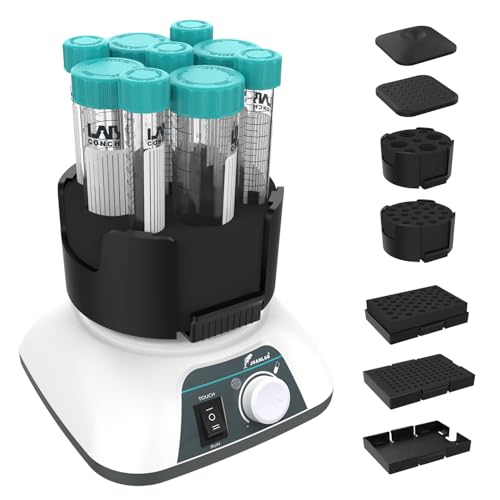
JOANLAB VM500S Multi-Tube Vortex Mixer, 0-3000 RPM — Best for Multi-Tube Batch Mixing
The VM500S answers the vortex category’s throughput problem. A cup mixer processes one tube per press; a multi-tube platform processes the rack. JOANLAB’s modular design swaps heads for different tube formats and flask work, so a sample-prep bench can vortex a batch of tubes together at a stated 0-3000 rpm, in touch or continuous mode, instead of paying a technician to stand and press tubes one at a time. In any workflow where twelve tubes need the same thirty seconds, that arithmetic dominates every other specification.
The trade-offs are the platform format’s own. A loaded platform is less violent per tube than a focused cup vortex — the energy is shared — so the most stubborn pellets may still want a finishing press on a cup mixer, and module fit for your exact tube sizes must be confirmed against the listing before ordering. JOANLAB’s lab line is a value-tier alternative to the legacy brands, which shows in price positioning rather than in any specification that matters here. For prep benches, teaching labs running class sets, and QC workflows with repetitive batches, this is the pick that buys back bench hours.
Strengths
- Multi-tube modules mix batches, not singles
- Stated 0-3000 rpm with touch and continuous modes
- Modules extend to flask mixing
Trade-offs
- Shared platform energy is gentler per tube than a cup
- Confirm module fit for your tube sizes before ordering
- Value-tier brand versus legacy lab names
| Detail | What to know |
|---|---|
| Type | Multi-tube vortex mixer |
| Speed | 0-3000 rpm (Amazon title) |
| Format | Interchangeable modules |
Best for: Sample prep and teaching batches / Not suited for: Single stubborn pellets needing maximum focused energy
Check on Amazon — check price on Amazon.

ONiLAB Lab Vortex Mixer with Touch Start and Continuous Modes, 3000 RPM — Best Mid-Range Single-Tube Vortexer
ONiLAB’s standard vortex mixer occupies the sensible middle of this guide: a proper single-tube vortexer with both operating modes — press for touch, switch for continuous — at a stated 3000 rpm top speed, priced for benches that need real mixing without the legacy brands’ premium. Its listing speaks to both of its audiences honestly: laboratory tubes on one side, nail polish, lash adhesives and hobby paints on the other, because the physics of resuspending pigment in a small bottle and reagent in a tube are the same physics.
For a small lab, a clinic bench or a serious hobby station, that dual citizenship is a feature — the machine is built around the cup-and-tube interaction all day, every day. What it does not offer is the Genie’s accessory universe or the BenchMixer’s documented low-end range; speed control here is the standard dial-and-judgement arrangement. Buyers choosing between this and the mini below should decide by duty: all-day tube work earns the full-size machine its bench space, while occasional small-bottle mixing does not. As the middle pick of the guide, it is the one most benches will actually be best served by.
Strengths
- Touch and continuous modes at a stated 3000 rpm
- Full-size cup handles real lab tube duty
- Mid-range tier between minis and legacy brands
Trade-offs
- Accessory range is the standard cup format
- Speed low-end is less documented than the BenchMixer’s
- Single tube at a time
| Detail | What to know |
|---|---|
| Type | Vortex mixer, single-tube |
| Speed | 3000 rpm class (Amazon title) |
| Operation | Touch start + continuous |
Best for: Small labs, clinics and serious hobby benches / Not suited for: Multi-tube batches or microplate work
Check on Amazon — check price on Amazon.

ONiLAB Mini Vortex Mixer with Touch Function — Best Mini Tube Mixer
The mini vortexer is a distinct species: no dial, no modes, just a touch pad that spins when a tube or bottle is pressed into it and stops when it is lifted. For its designed work — small tubes, sample vials, and the hobby world’s bottles of acrylic paint, nail polish and lash adhesive — that simplicity is perfect ergonomics. The included stainless mixing balls matter more than they look: dropped into a separated paint bottle, they turn the vortex into a true resuspension system that revives bottles a hand-shake cannot.
Its limits are size’s limits. The pad suits small vessels; a 50 ml tube is beyond its brief, continuous hands-free running is not its mode, and all-day laboratory duty belongs to the full-size picks above. But as a second mixer — the one that lives at the painting desk, the nail station, the field kit or the corner of a crowded bench where a full vortexer cannot — it is unmatched in this guide. Many benches end up owning both formats: the mini for the hundred small mixes, the standard for the serious ones. That is not duplication; it is how the category’s users actually work.
Strengths
- Instant touch operation — no dial, no modes
- Mixing balls included revive separated paints and polishes
- Tiny footprint lives anywhere
Trade-offs
- Small vessels only — not for large tubes
- No continuous hands-free mode
- Light duty compared with full-size lab vortexers
| Detail | What to know |
|---|---|
| Type | Mini vortex mixer |
| Operation | Touch-activated |
| Extras | 120 stainless mixing balls (Amazon title) |
Best for: Paints, polishes, adhesives and small tubes / Not suited for: Large tubes or continuous laboratory duty
Check on Amazon — check price on Amazon.

VISOSCI Tube Rotator, Fixed 20 RPM Laboratory Tube Mixer — Best Gentle Tube Rotator
Every other pick in this guide mixes in seconds. The rotator mixes in minutes and hours, deliberately. End-over-end rotation at a fixed, gentle 20 rpm keeps suspensions uniform without frothing proteins, shearing cells or beating a sample into foam — the correct action for blood collection tubes awaiting analysis, gentle resuspension of delicate preparations, culture work and any protocol that says ‘mix continuously, gently’ and means it. Its three interchangeable holders span the stated 0.5 to 50 ml tube range, with adjustable angles to tune how lazy or lively the tumbling is.
Buying a rotator is a protocol decision, not a preference: if your work’s instructions specify rotation, a vortexer is not a substitute at any speed, and vice versa. The fixed speed is a feature in this philosophy — one less variable between operators and days — and the continuous-duty design assumes it will run for hours on a bench or in a cold room. Benches that do both kinds of work own both machines, and this guide’s structure — five vortexers and one rotator — mirrors real purchasing: rotation is the speciality, vortexing the staple. If your protocols call for gentle continuous mixing, this is your pick and the vortexers are somebody else’s article.
Strengths
- True gentle end-over-end rotation at fixed 20 rpm
- Holders cover stated 0.5-50 ml tube range
- Adjustable holder angle tunes the mixing action
Trade-offs
- Fixed speed only — by design, but inflexible
- Minutes-to-hours mixing, not seconds
- Cannot resuspend a hard pellet — wrong physics
| Detail | What to know |
|---|---|
| Type | Tube rotator mixer |
| Speed | Fixed 20 rpm (Amazon title) |
| Tubes | 0.5-50 ml via 3 holders (Amazon title) |
Best for: Blood tubes, cultures and gentle continuous protocols / Not suited for: Fast resuspension or pellet work
Check on Amazon — check price on Amazon.
Comparison Table
| Pick | Badge | Key spec | Best for |
|---|---|---|---|
| Scientific Industries Vortex-Genie 2 Mixer SI-0236, 120V | Best Overall Tube Mixer | Variable-speed vortex, accessory heads | Laboratories wanting the proven bench standard |
| Benchmark Scientific BenchMixer Vortex Mixer BV1000, 115V | Best Variable-Speed Value for Labs | 200-3200 rpm variable vortex | Small labs needing one mixer for delicate and aggressive work |
| JOANLAB VM500S Multi-Tube Vortex Mixer, 0-3000 RPM | Best for Multi-Tube Batch Mixing | Multi-tube platform, 0-3000 rpm | Sample prep and teaching batches |
| ONiLAB Lab Vortex Mixer with Touch Start and Continuous Modes, 3000 RPM | Best Mid-Range Single-Tube Vortexer | 3000 rpm, touch + continuous | Small labs, clinics and serious hobby benches |
| ONiLAB Mini Vortex Mixer with Touch Function | Best Mini Tube Mixer | Touch mini vortex + mixing balls | Paints, polishes, adhesives and small tubes |
| VISOSCI Tube Rotator, Fixed 20 RPM Laboratory Tube Mixer | Best Gentle Tube Rotator | 20 rpm rotator, 0.5-50 ml holders | Blood tubes, cultures and gentle continuous protocols |
How to Choose a Tube Mixer
Philosophy first: vortex or rotation. If the job is speed — resuspend, dissolve, blend, in seconds per tube — you are buying a vortexer. If the job is gentleness over time — keep suspended, incubate while mixing, never foam — you are buying a rotator, and no vortexer’s lowest speed is a substitute, because the motion itself is different: a vortexer orbits a tube in place; a rotator turns tubes end over end. Protocols usually dictate this choice outright. Obey them.
Within vortexers, match the format to the count. One tube at a time, all day: a standard cup vortexer (Genie, BenchMixer, ONiLAB standard). Dozens of identical tubes: the multi-tube platform pays for itself in technician hours. Small bottles and occasional tubes: the mini’s touch simplicity wins and its footprint disappears. Then judge speed control by your most delicate sample, not your most stubborn one — a mixer that cannot go gently enough ruins fragile work, while a stubborn pellet can always be given more time, a mixing ball, or a second press.
Finally, the bench realities: weight and feet decide whether full speed is usable speed — a mixer that walks must be held, and a held mixer is a one-handed bench. Check the power variant for your region, confirm which heads are in the box versus sold separately, and for continuous-duty work, favour designs that present themselves as instruments over those that present as gadgets. Tube mixers are bought rarely and used constantly; the category rewards buying once, correctly.
Vortex Technique: Getting a Clean Mix in Seconds
A vortex forms when the tube meets the cup at the right pressure and angle. Press too lightly and the contents merely shiver; too hard and you stall the orbit and shake the bench. The working technique is a firm, centred press with the tube near-vertical, letting the liquid climb the tube wall in a whirlpool that reaches the bottom — that reaching is the whole event, because an unmixed layer at the cone of the tube is the classic failed mix. For pellets, start with a small volume, vortex the pellet loose, then add the rest of the liquid and vortex again.
Foam-sensitive samples invert the technique: short pulses at low speed, the tube angled, stopping the moment uniformity arrives. Mixing balls extend any vortexer’s reach into viscous or separated materials — paints are the famous case, but resins and adhesives follow the same physics. And temperature matters more than benches admit: cold, viscous samples mix slowly, and thirty seconds of patience at the cup beats a protocol written for room temperature.
Build the habit of inspecting against the light after mixing. A tube mixer’s job is uniformity, and uniformity is visible — streaks, a surviving pellet shadow, a separated layer all announce themselves in one glance. The seconds saved by skipping the glance are repaid, with interest, by the experiment or the paint job that fails downstream for want of a second press.
Heads, Cups and Holders: The Accessory Decision
A vortex mixer is a motor; the head decides what it can hold. The standard cup takes single tubes by hand pressure and suits varied, intermittent work. Flat and foam-insert heads hold tubes hands-free for continuous runs. Multi-tube platforms and microplate holders convert the machine for batch formats. When comparing prices across this guide, compare configurations, not headline numbers: a mixer sold with the head your work needs is cheaper than a bargain mixer plus the accessory order that follows it home.
The rotator’s equivalent decision is its holder set: the VISOSCI’s three interchangeable holders spanning 0.5 to 50 ml are the specification that decides whether one rotator serves a whole bench’s tube formats or only one rack’s worth. Adjustable angle is the subtle feature — steeper angles tumble more energetically, shallow angles rock gently — and protocols that specify ‘gentle rotation’ without an angle are usually written assuming the shallow end of that range.
Care of accessories is unglamorous and decisive: foam inserts perish and should be treated as consumables, cups crack at the rim after years of presses, and holders collect the spills of a hundred tubes. A mixer whose wear parts are replaceable — the legacy brands’ quiet advantage — stays a precision tool; one whose head cannot be replaced becomes a countdown. Ask the accessory question before purchase, not after the first cracked cup.
Beyond the Lab: Paint, Polish and the Hobby Bench
The mini and standard vortexers in this guide lead double lives, and the hobby life is not a lesser one. Model and miniature painters resuspend separated acrylics that hand-shaking cannot revive; nail technicians restore polishes and mix adhesives to a consistency that decides their work’s quality; resin and pigment users blend small batches uniformly without introducing the bubbles a stirrer whips in. The mixing ball is the hobby bench’s secret weapon — the vortex plus a steel ball is a complete resuspension system in a bottle.
Hobby buyers should choose by bottle, not by aspiration. Paint and polish bottles are the mini’s home format; larger craft containers and all-day station work suit the ONiLAB standard. Laboratory buyers crossing the other way should note that hobby-proven durability at a nail station — thousands of presses, spilled solvents, daily abuse — is real evidence about a machine’s build, even if it arrives wearing different vocabulary.
One caution crosses both worlds: know your materials’ compatibility with vigorous mixing. Some adhesives and resins begin curing or entraining air when vortexed enthusiastically; some laboratory reagents foam or aerosolise. The mixer provides the motion — the user provides the judgement about what should receive it, at what speed, for how long. That judgement, plus the right format from this guide, is the entire skill of the category.
How to Use a Vortex Tube Mixer Correctly
Ninety percent of tube mixing is one press of a tube to a cup — and the difference between a clean mix and a failed one lives in the details of that press. This sequence builds the habit properly.
- Set the speed before the tube. Choose the speed for the sample, not the habit: low for fragile or foaming samples, high for pellets and viscous materials. On touch models without a dial, pressure and time are your controls.
- Centre the tube on the cup. Press the tube’s base firmly into the centre of the cup, near-vertical. Off-centre presses orbit weakly and walk the tube; centred presses build the whirlpool.
- Watch for the vortex to reach the bottom. The mix is working when the whirlpool’s cone reaches the tube’s base and the bottom layer moves. If it does not reach, adjust pressure or angle before adding time.
- Pulse for delicate samples. Short presses with rests between them mix gently and limit foam and heat. Continuous running is for robust samples and platform work.
- Use a mixing ball for separated materials. Drop a clean stainless ball into paints, polishes and stubborn suspensions. The ball’s movement through the vortex does the resuspension work the liquid alone cannot.
- Inspect against the light. Lift the tube and look: streaks, layers and pellet shadows are all visible. A second five-second press now is cheaper than a failed result later.
- For rotators: balance the load. Distribute tubes evenly across the holder, set the angle for the protocol’s gentleness, and confirm caps are fully sealed before starting a long rotation.
- Clean the cup and heads as you go. Spills on a cup change its grip and chemistry’s next sample does not want your last one. A wiped head between samples is laboratory hygiene at its smallest scale.
Master the press and the tube mixer disappears as a topic — samples are simply mixed, every time, in seconds. That invisibility is the mark of a bench tool doing its job, and it is what every pick in this guide was chosen to deliver.
Buying for a Teaching Lab vs a Research Bench vs a Studio Desk
The same category serves three buyers whose correct answers differ, and naming yours sharpens the shortlist. The teaching laboratory buys durability, forgiveness and fleet sense: mixers that survive thirty students a week, present one simple interaction, and can be bought in matching sets so training transfers between benches. The Vortex-Genie’s installed base in teaching labs is no accident, and the JOANLAB platform’s batch modules answer the teaching lab’s other problem — thirty samples that all need the same thirty seconds before the next step.
The research bench buys control and documentation: a speed range with a genuinely gentle floor, repeatability between operators, and accessories that match the lab’s actual vessels — microplates, specific tube formats, the flask that appears twice a week. The BenchMixer’s documented range and the Genie’s head system compete here, and the deciding evidence is the lab’s own sample list, not any review — including this one. The studio desk — paints, polishes, adhesives, resins — buys format fit and instant operation: the mini for bottles, the ONiLAB standard for a station that works all day. Its evidence is throughput of small vessels, and its worst purchase is an instrument bought for prestige whose cup never fits the bottles.
Across all three, the second-mixer pattern recurs: benches converge on a primary instrument plus a mini at the point of use, because walking samples to a shared mixer is a tax paid in minutes and in dropped tubes. Budget for the pair from the start if your workflow has a clear point-of-use, and the category’s total cost still undercuts the hours it returns in a single term.
Maintenance and Calibration Habits for Tube Mixers
Tube mixers ask little and repay it. The cup and heads collect every spill the bench produces; a weekly wipe with a suitable cleaner keeps the grip true and the chemistry honest, and foam inserts should be inspected as the consumables they are — a perished insert that sheds into samples has failed at its one job. Feet are the silent system: a mixer whose feet are worn or missing walks, vibrates its neighbours and mixes unevenly, and replacement feet are the cheapest performance upgrade in the category.
Speed honesty matters in documented work. A dial’s numbers are a promise, not a measurement; labs that record speeds in protocols should verify a mixer’s actual behaviour at its working settings — even a simple timed observation of a marked tube’s mixing pattern across the dial builds the operator knowledge that makes settings repeatable between people. Rotators want their holders checked for grip as elastics and clips age, because a tube that slips its holder mid-protocol announces itself at the worst stage of the work.
None of this exceeds ten minutes a month. It is the difference between a mixer that is an instrument — trusted, recorded, boring — and one that is an appliance of uncertain behaviour. Laboratories run on the first kind; this guide’s picks were chosen to be capable of it.
Safety and Good Practice at the Cup
A vortex mixer is a benign machine with three genuine hazards, all manageable by habit. The first is aerosol: vortexing an open tube of anything biological or volatile generates it, which is why capped tubes, appropriate containment and the lab’s own biosafety rules govern what may be vortexed, where, and in what vessel — the mixer does not know what is in the tube, and the responsibility is entirely the operator’s. The second is glass: a thin-walled or damaged tube pressed hard into a cup at full speed can fail, so inspect tubes, favour the vessels the head was designed for, and let pressure be firm rather than heroic.
The third is repetition itself. Hundreds of presses a day is an ergonomic load, and benches that run high volumes should rotate the task, set the bench height honestly, and prefer continuous-mode and platform formats — the JOANLAB’s batch modules exist partly as an ergonomic answer, not only a throughput one. None of this diminishes the category; it is the ordinary professionalism of a tool used a hundred times a day. The labs with the fewest incidents are not the ones with the most rules — they are the ones whose habits were built before the workload arrived.
The One-Tube Habit: Workflow at a Busy Bench
High-throughput benches develop a choreography around the vortex cup that is worth copying deliberately. Tubes arrive racked in protocol order; the mixer sits at the dominant hand’s side, at a height that lets the press come from the shoulder rather than the wrist; each tube is pressed, inspected against the light in the same motion that returns it to the rack’s completed side, so the rack itself becomes the progress record. Caps are checked with a thumb-roll as each tube leaves the hand — the cheapest insurance in the whole workflow, because the one unsealed tube in fifty is the one the vortex will decorate the bench with.
None of this is in any manual, and all of it is why two benches with identical mixers produce different error rates. The instrument is constant; the habit is the variable. New bench staff should be taught the choreography as explicitly as the protocol it serves — and buyers equipping a bench should remember that the mixer’s placement, the rack system and the light over the inspection point are part of the purchase, even though only one of them arrives in a box with a brand on it.
The Verdict in One Bench
Stand in front of a well-run bench and the tube mixer’s place explains itself: it is the most-touched instrument in the room, used in the gaps between the famous machines, a hundred times a day, by everyone. That is why this guide weighted reliability, format fit and honest speed control above novelty, and why its top picks are proven designs rather than new arrivals. A tube mixer is not where a laboratory or a studio should gamble. Buy the motion your work specifies, in the format your vessels need, from the tier your duty cycle justifies — and the machine will repay the decision in the only currency benches keep: years of mixes that simply worked.
Common Buying Mistakes
Buying a vortexer for a rotation protocol
The category’s most expensive confusion. Rotation and vortexing are different motions serving different protocols; a vortexer at its gentlest still orbits in place and cannot reproduce end-over-end tumbling, and a rotator cannot resuspend a pellet at any patience. Read the protocol’s verb — vortex or rotate — and buy that machine. Benches that need both, own both.
Judging by top speed alone
A stated 3000 rpm tells you the ceiling and nothing about the floor, the control or the stability that decide daily usefulness. Delicate work is ruined at the low end, not the top. The BenchMixer’s documented low range is worth more to a mixed-work bench than another few hundred rpm nobody’s samples can survive.
Ignoring what is in the box
Heads and holders are the mixer’s working interface, and listings differ: one includes the platform, another sells it separately; one rotator spans three tube sizes, another one. Compare configurations line by line. The cheapest headline price with the essential head missing is the most expensive way to buy a tube mixer.
Running a mini like an instrument
Mini touch vortexers are brilliant within their format — small vessels, intermittent duty — and disappointing outside it. A bench that presses a mini into all-day, large-tube service will kill it and conclude the category is junk. Format honesty runs both ways: minis are not toys, and they are not Genies.
Neglecting bench stability
A powerful vortexer on a light, hollow bench transmits vibration into everything sharing the surface — including the samples waiting their turn. Place the mixer on the most solid surface available, keep its feet clean and intact, and do not run continuous modes on a bench that amplifies. The mixer’s manual will not say this. Every experienced bench scientist will.
Final Recommendation
For most laboratories, the Vortex-Genie 2 remains the tube mixer to buy: proven, versatile and supported by the deepest accessory system in the category. Benches that prize a documented gentle low end should take the Benchmark BenchMixer; batch workflows belong to the JOANLAB multi-tube platform; the ONiLAB standard is the mid-range single-tube answer, and its mini sibling owns the paint-and-polish corner of the bench. Protocols calling for gentle continuous motion have their own correct answer in the VISOSCI rotator.
Choose the motion first, the format second and the badge last, and a tube mixer becomes what it should be: the tool you stop thinking about, hundreds of perfect mixes a year.
Related reading: Best Tiny Mixers Best Travel Mixers.
Frequently Asked Questions
What is a tube mixer used for?
Mixing the contents of test tubes and small vessels quickly and uniformly: resuspending centrifuged pellets, blending reagents, dissolving powders, and — in their hobby roles — reviving paints, polishes and adhesives. Vortex mixers do it in seconds with an orbital whirlpool action; tube rotators do it gently over minutes to hours with end-over-end tumbling.
What is the difference between a vortex mixer and a tube rotator?
Motion and intent. A vortex mixer orbits a tube in place at high speed, creating a whirlpool that mixes aggressively in seconds. A rotator turns tubes end over end at low speed — the VISOSCI here is a fixed 20 rpm — for gentle, continuous mixing that will not foam or shear delicate samples. Protocols specify one or the other; they are not interchangeable.
Can a vortex mixer handle 50 ml tubes?
Standard cup vortexers handle common lab tube sizes, and larger tubes are typically managed with flat heads or platform inserts rather than the cup — check the head configuration of the exact model. The rotator in this guide explicitly covers 0.5 to 50 ml tubes via its holder set. Match the vessel to the head, not to hope.
Why does my vortex mixer walk across the bench?
At high speed, an unbalanced load, worn feet or a light bench lets the machine travel. Centre the tube, reduce speed for large vessels, clean or replace the feet, and move the mixer to a solid surface. A powerful vortexer held in place by its own weight and feet — as the lab-grade picks here are designed to be — stays where it is put.
Are mini vortex mixers good enough for a laboratory?
For small tubes and intermittent duty, they are genuinely useful — many labs keep one as a second, personal mixer. For continuous duty, large tubes or accessory versatility, a full-size instrument like the Vortex-Genie or BenchMixer is the correct tool. The mini’s home turf is small vessels: microtubes, and the paint and polish bottles it is famous for.
What speed should I vortex at?
The lowest speed that achieves a full vortex reaching the bottom of the tube, for the shortest time that produces uniformity. Pellets and viscous samples need the top of the range; fragile, foaming or cell-bearing samples need the bottom, in pulses. Speed is a per-sample decision — which is why controllable range, especially at the low end, is this category’s most valuable specification.


